LUBS5826: Operations and Information Management Report, Leeds Uni
VerifiedAdded on 2022/09/29
|23
|5739
|25
Report
AI Summary
This report provides a detailed analysis of operations and information management practices at the University of Leeds. It begins with an introduction highlighting the importance of effective operations and information systems in academic institutions, emphasizing the challenges of data storage and retrieval. The main body of the report is structured around four key themes: the nature of operations, the nature of information management, operations philosophy, and information management challenges. The report explores the university's operational structure, purpose, and location, including the role of Minerva as a key technological platform. It examines the application of transformation systems and discusses environmental challenges such as Brexit's impact and the increasing reliance on technology. The report also covers aspects of operations like volume, variety, variation, and visibility, as well as the university's customer interface and the relationships between operations and other functions. In the section on information management, the strategic use of information is discussed, along with the elements of the information life cycle. The report references relevant theories and provides insights that could be beneficial for prospective students and faculty members. Finally, the report reflects on the learning experience and concludes with a list of references.

Running head: OPERATIONS AND INFORMATION MANAGEMENT
Operations and Information Management at the University of Leeds
Name of the student:
Name of the university:
Author note:
Operations and Information Management at the University of Leeds
Name of the student:
Name of the university:
Author note:

Paraphrase This Document
Need a fresh take? Get an instant paraphrase of this document with our AI Paraphraser
1OPERATIONS AND INFORMATION MANAGEMENT
Executive summary
Technology is essentially becoming an integral part of academic institutions. Both teachers and
students desire for something that could make their job easier. One of the challenges faced by
them is storing and accessing relevant data when required. It is timesaving as well. This study
also serves a similar purpose. The study is divided into four distinct themes to discuss the
operations management and information systems at the University of Leeds. In doing so, the
study discusses Minerva, which is a support tool available to students.
Executive summary
Technology is essentially becoming an integral part of academic institutions. Both teachers and
students desire for something that could make their job easier. One of the challenges faced by
them is storing and accessing relevant data when required. It is timesaving as well. This study
also serves a similar purpose. The study is divided into four distinct themes to discuss the
operations management and information systems at the University of Leeds. In doing so, the
study discusses Minerva, which is a support tool available to students.
2OPERATIONS AND INFORMATION MANAGEMENT
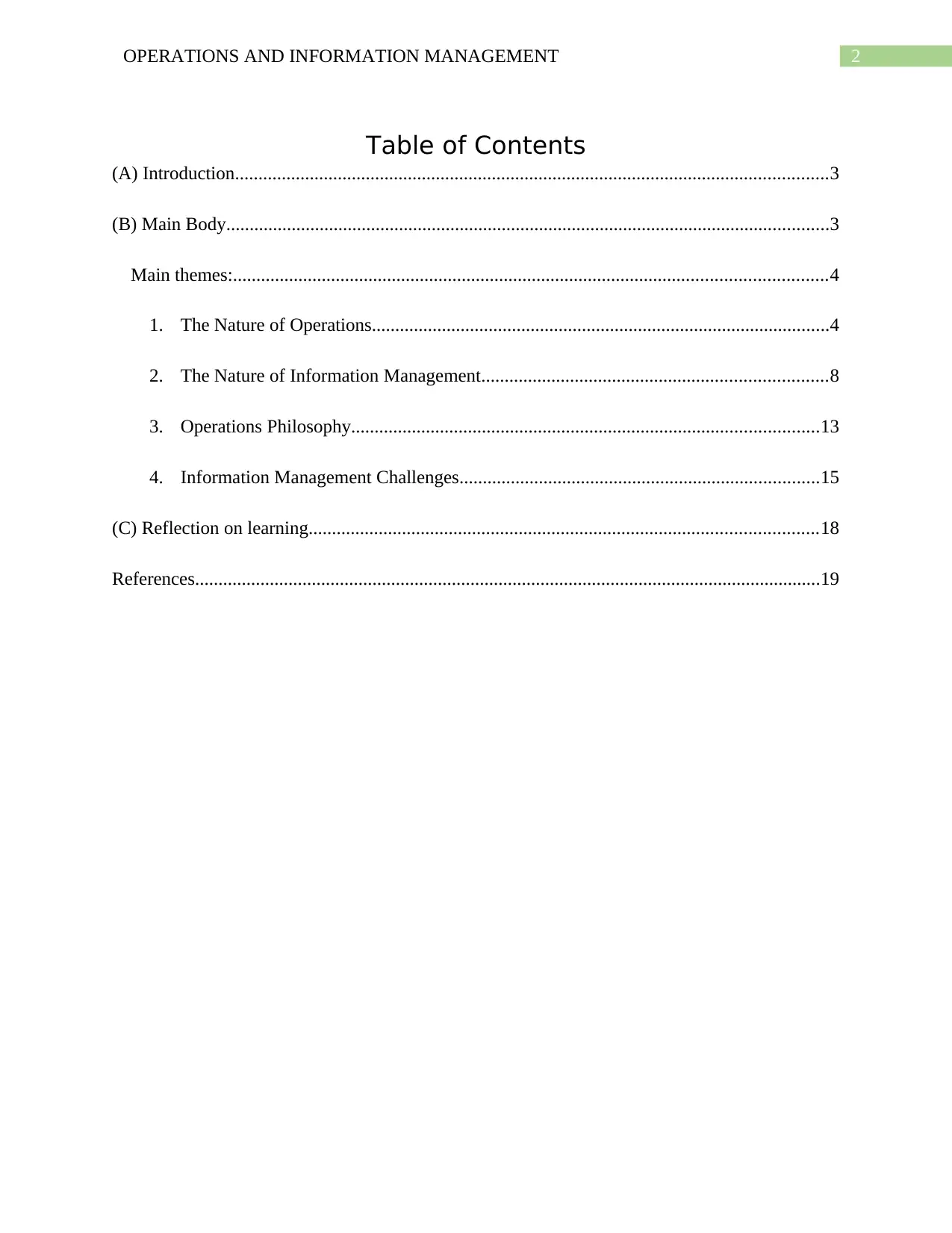
Table of Contents
(A) Introduction...............................................................................................................................3
(B) Main Body.................................................................................................................................3
Main themes:...............................................................................................................................4
1. The Nature of Operations..................................................................................................4
2. The Nature of Information Management..........................................................................8
3. Operations Philosophy....................................................................................................13
4. Information Management Challenges.............................................................................15
(C) Reflection on learning.............................................................................................................18
References......................................................................................................................................19
Table of Contents
(A) Introduction...............................................................................................................................3
(B) Main Body.................................................................................................................................3
Main themes:...............................................................................................................................4
1. The Nature of Operations..................................................................................................4
2. The Nature of Information Management..........................................................................8
3. Operations Philosophy....................................................................................................13
4. Information Management Challenges.............................................................................15
(C) Reflection on learning.............................................................................................................18
References......................................................................................................................................19
⊘ This is a preview!⊘
Do you want full access?
Subscribe today to unlock all pages.

Trusted by 1+ million students worldwide
3OPERATIONS AND INFORMATION MANAGEMENT
(A) Introduction
In today's' world, operations management and information systems are critical to the
success of every organisation. Likewise, these are important for universities as well. With
effective operations management and appropriate utilisation of information systems, the
universities give them opportunities to smoothen the institutional process both for their faculties
and for the students. This study is on a similar track. It describes the operations management and
information systems practiced at the University of Leeds.
I being one of the students at the University of Leeds can best describe the quality of
operations and information systems offered to us. Finding and searching appropriate data is a
time-consuming process for the universities those that entirely depend on a library system to
stock a huge database of books and journals articles (McPherson 2015). This is where the
problem arises. The searched items may not appear in the list of books and journals articles
stored in an online library system. Hence, there should be some alternate ways of treating the
problem (Henderson, Selwyn and Aston 2017). This study investigates whether the University of
Leeds faces a similar challenge as well.
(B) Main Body
This is the main section of this study. This contains a few different themes dedicated to
the operations management and information systems respectively. The operations management
and information systems at the University of Leeds will be assessed under these themes. Besides,
each one of the themes will be supported with appropriate theories to make it more
(A) Introduction
In today's' world, operations management and information systems are critical to the
success of every organisation. Likewise, these are important for universities as well. With
effective operations management and appropriate utilisation of information systems, the
universities give them opportunities to smoothen the institutional process both for their faculties
and for the students. This study is on a similar track. It describes the operations management and
information systems practiced at the University of Leeds.
I being one of the students at the University of Leeds can best describe the quality of
operations and information systems offered to us. Finding and searching appropriate data is a
time-consuming process for the universities those that entirely depend on a library system to
stock a huge database of books and journals articles (McPherson 2015). This is where the
problem arises. The searched items may not appear in the list of books and journals articles
stored in an online library system. Hence, there should be some alternate ways of treating the
problem (Henderson, Selwyn and Aston 2017). This study investigates whether the University of
Leeds faces a similar challenge as well.
(B) Main Body
This is the main section of this study. This contains a few different themes dedicated to
the operations management and information systems respectively. The operations management
and information systems at the University of Leeds will be assessed under these themes. Besides,
each one of the themes will be supported with appropriate theories to make it more
Paraphrase This Document
Need a fresh take? Get an instant paraphrase of this document with our AI Paraphraser
4OPERATIONS AND INFORMATION MANAGEMENT
understandable to the readers. The discussion to be held could be beneficial for those who
aspire to join the University of Leeds at both the Research and Faculty levels.
Main themes:
1. The Nature of Operations
Purpose, structure, size and location:
The purpose of this university is to offer career opportunities in teaching as well as in
researching. Moreover, the purpose is to serve the community influenced by the University
through quality education service (Leeds.ac.uk 2019).
The structure consists of a management team, group of quality teachers, human resource
team, IT personnel and the team handling financial operations (Leeds.ac.uk 2019).
In terms of size, the University is one of the largest in the United Kingdom in teaching
and research practices (Leeds.ac.uk 2019).
The University of Leeds is located in Leeds, West Yorkshire in England (Leeds.ac.uk
2019).
Elements constituting the Operations function:
The various functions in the University are operative in two distinct modes such as
verbal communication and Minerva. Verbal communication is a common communication
mode used during a lecture session and for conversation between tutors. Tutors also use verbal
communication to communicate and conduct a lecture session with the students. Additionally,
the University of Leeds is also good at utilising information systems. Minerva is a technological
platform used as the information systems in the University. Both research students and tutors are
understandable to the readers. The discussion to be held could be beneficial for those who
aspire to join the University of Leeds at both the Research and Faculty levels.
Main themes:
1. The Nature of Operations
Purpose, structure, size and location:
The purpose of this university is to offer career opportunities in teaching as well as in
researching. Moreover, the purpose is to serve the community influenced by the University
through quality education service (Leeds.ac.uk 2019).
The structure consists of a management team, group of quality teachers, human resource
team, IT personnel and the team handling financial operations (Leeds.ac.uk 2019).
In terms of size, the University is one of the largest in the United Kingdom in teaching
and research practices (Leeds.ac.uk 2019).
The University of Leeds is located in Leeds, West Yorkshire in England (Leeds.ac.uk
2019).
Elements constituting the Operations function:
The various functions in the University are operative in two distinct modes such as
verbal communication and Minerva. Verbal communication is a common communication
mode used during a lecture session and for conversation between tutors. Tutors also use verbal
communication to communicate and conduct a lecture session with the students. Additionally,
the University of Leeds is also good at utilising information systems. Minerva is a technological
platform used as the information systems in the University. Both research students and tutors are
5OPERATIONS AND INFORMATION MANAGEMENT
authorised to access Minerva. Moreover, they also can adjust the components of Minerva if
required (Leeds.ac.uk 2019).
Application of the transformation systems viewpoint:
Transformation is an essential part of any business (Slack and Brandon-Jones 2018).
Transformation depending on the business and the organisational culture can take various
shapes. Hence, transformation can be both minor and the major as well. The transformation in
the University of Leeds is minor; however, is a significant shift to a tech-oriented operation. It is
due to Minerva, which is an online portal for both tutors and researchers. Notably, verbal
communication is still a major part of the communication practices in the University.
Environmental challenges:
The current political state in the United Kingdom largely due to Brexit can influence the
fees to structure for international students (Fowler et al. 2018). Hence, there may be a drop in the
numbers of international students at the University of Leeds in the future.
In case there is a drop in foreign students’ participation in the University of Leeds, the fee
structure will be influenced as well. The economic efficiency of the University will be affected in
case there is a hike in the fee structure for international students (Li 2018).
Increased usage of smartphones and the internet will put pressure on the University in
regards to spending more on innovative technologies (Jesse 2015).
A decreased economic efficiency discussed as above will also affect the technological
developments in the University. Hence, the teaching and research quality will also be affected.
authorised to access Minerva. Moreover, they also can adjust the components of Minerva if
required (Leeds.ac.uk 2019).
Application of the transformation systems viewpoint:
Transformation is an essential part of any business (Slack and Brandon-Jones 2018).
Transformation depending on the business and the organisational culture can take various
shapes. Hence, transformation can be both minor and the major as well. The transformation in
the University of Leeds is minor; however, is a significant shift to a tech-oriented operation. It is
due to Minerva, which is an online portal for both tutors and researchers. Notably, verbal
communication is still a major part of the communication practices in the University.
Environmental challenges:
The current political state in the United Kingdom largely due to Brexit can influence the
fees to structure for international students (Fowler et al. 2018). Hence, there may be a drop in the
numbers of international students at the University of Leeds in the future.
In case there is a drop in foreign students’ participation in the University of Leeds, the fee
structure will be influenced as well. The economic efficiency of the University will be affected in
case there is a hike in the fee structure for international students (Li 2018).
Increased usage of smartphones and the internet will put pressure on the University in
regards to spending more on innovative technologies (Jesse 2015).
A decreased economic efficiency discussed as above will also affect the technological
developments in the University. Hence, the teaching and research quality will also be affected.
⊘ This is a preview!⊘
Do you want full access?
Subscribe today to unlock all pages.
Trusted by 1+ million students worldwide
6OPERATIONS AND INFORMATION MANAGEMENT
The environmental impacts of the University such as in the form of leftover food, energy
usage, etc. will be the things to look for (Rauter, Jonker and Baumgartner 2017). There will be
increased industry-based competition for adopting the sustainable business practice.
The legal policy does always have an impact on the business of the University of Leeds.
For example, a government policy to reduce the number of foreign students will affect the
business for the University (Eniola and Entebang 2015).
Aspects of Operations (volume, variety, variation and visibility):
The University of Leeds operates at a massive level. The University has more than 38,000
full-time students. This includes 9,000 international students from 170 countries. The University
has staffs from various parts of the world. The number of staffs is close to 8,700 (Leeds.ac.uk
2019). Notably, it adds a huge £1.3 billion to the UK economy every year (Leeds.ac.uk 2019).
There are varieties of courses offered to research students. Moreover, it also creates
wider job options for tutors.
The University of Leeds adds variation to its courses and teaching style by applying
relevant technology to these systems. The fact is evidenced in a fact the University is among the
highly preferred UK universities for both local and international students (Leeds.ac.uk 2019).
The University of Leeds increases its operations visibility to tutors, students and those
aspiring to be a part of the University through effective adoption of relevant technologies
(Leeds.ac.uk 2019). Minerva is one of the examples where the tutors can create online
components for the modules. Moreover, research students can access to these components
(Leeds.ac.uk 2019).
The environmental impacts of the University such as in the form of leftover food, energy
usage, etc. will be the things to look for (Rauter, Jonker and Baumgartner 2017). There will be
increased industry-based competition for adopting the sustainable business practice.
The legal policy does always have an impact on the business of the University of Leeds.
For example, a government policy to reduce the number of foreign students will affect the
business for the University (Eniola and Entebang 2015).
Aspects of Operations (volume, variety, variation and visibility):
The University of Leeds operates at a massive level. The University has more than 38,000
full-time students. This includes 9,000 international students from 170 countries. The University
has staffs from various parts of the world. The number of staffs is close to 8,700 (Leeds.ac.uk
2019). Notably, it adds a huge £1.3 billion to the UK economy every year (Leeds.ac.uk 2019).
There are varieties of courses offered to research students. Moreover, it also creates
wider job options for tutors.
The University of Leeds adds variation to its courses and teaching style by applying
relevant technology to these systems. The fact is evidenced in a fact the University is among the
highly preferred UK universities for both local and international students (Leeds.ac.uk 2019).
The University of Leeds increases its operations visibility to tutors, students and those
aspiring to be a part of the University through effective adoption of relevant technologies
(Leeds.ac.uk 2019). Minerva is one of the examples where the tutors can create online
components for the modules. Moreover, research students can access to these components
(Leeds.ac.uk 2019).
Paraphrase This Document
Need a fresh take? Get an instant paraphrase of this document with our AI Paraphraser
7OPERATIONS AND INFORMATION MANAGEMENT
The processes and layout:
The process types will be different for a manufacturing company and a service company.
The University of Leeds is a service company. Now, a service firm is divided into three distinct
process types. These are Professional Services, Service Shops and Mass Services. The process
type followed at the University of Leeds is “Mass Services”. It is because the services offered at
the University serve means for a close to 9,000 staffs and 38,000 students (Leeds.ac.uk 2019).
Work organisation:
The University of Leeds is a place where thousands of tutors are teaching students in
various subject fields. Moreover, it is house to even bigger numbers of research students
pursuing research studies in different subject areas.
Planning systems:
Planning systems decide the list of activities to take place in the operations. Moreover, it
also decides when and how to conduct these activities. The higher authority of the University of
Leeds takes care of the planning process. When they express their desire for something, it is
implemented into the system. This happens with the collaborations between the HR team, IT
professionals, the management personnel and the other University members (Dzurec and
Kennison 2017).
The customer interface:
The customers of the University of Leeds are its tutors and students. There is a
technological interface in the form of Minerva, which both tutors and students can access for a
The processes and layout:
The process types will be different for a manufacturing company and a service company.
The University of Leeds is a service company. Now, a service firm is divided into three distinct
process types. These are Professional Services, Service Shops and Mass Services. The process
type followed at the University of Leeds is “Mass Services”. It is because the services offered at
the University serve means for a close to 9,000 staffs and 38,000 students (Leeds.ac.uk 2019).
Work organisation:
The University of Leeds is a place where thousands of tutors are teaching students in
various subject fields. Moreover, it is house to even bigger numbers of research students
pursuing research studies in different subject areas.
Planning systems:
Planning systems decide the list of activities to take place in the operations. Moreover, it
also decides when and how to conduct these activities. The higher authority of the University of
Leeds takes care of the planning process. When they express their desire for something, it is
implemented into the system. This happens with the collaborations between the HR team, IT
professionals, the management personnel and the other University members (Dzurec and
Kennison 2017).
The customer interface:
The customers of the University of Leeds are its tutors and students. There is a
technological interface in the form of Minerva, which both tutors and students can access for a
8OPERATIONS AND INFORMATION MANAGEMENT
different purpose. Besides, every student has its student portal where he or she can access the
entire thing related to his or her studies and academics (Leeds.ac.uk 2019).
The relationships of Operations to other functions:
There is a clear relationship between Operations and other functions at the University of
Leeds. For example, Minerva is operative to help tutors adjust the online components for the
modules. On the other hand, the students will get to know the components to be followed under
each module (Leeds.ac.uk 2019).
On a similar note, the HR team in the University is there to ensure more and more
students thronging to the University. Moreover, they also guide on policy-related queries (Noe et
al. 2017).
The IT team is there to make the process easier for tutors as well as for the students.
The management team is there to devise new strategies related to the socio-economic
development of the University of Leeds.
The overall contribution of Operations to the company:
The Operations team is behind the success of the University of Leeds. They are
responsible for making the modules engaging for both tutors and students. They are behind the
process to reach out to the University. They are letting the global students and tutors know about
the University in an effective manner. This is the reason why the numbers of students and tutors
are increasing for the University with passing times. The Operations team has its involvement in
the development of Minerva, which is making the course modules accessible in real-time. There
will be rooms for the development to compete better with other universities. For that, the
different purpose. Besides, every student has its student portal where he or she can access the
entire thing related to his or her studies and academics (Leeds.ac.uk 2019).
The relationships of Operations to other functions:
There is a clear relationship between Operations and other functions at the University of
Leeds. For example, Minerva is operative to help tutors adjust the online components for the
modules. On the other hand, the students will get to know the components to be followed under
each module (Leeds.ac.uk 2019).
On a similar note, the HR team in the University is there to ensure more and more
students thronging to the University. Moreover, they also guide on policy-related queries (Noe et
al. 2017).
The IT team is there to make the process easier for tutors as well as for the students.
The management team is there to devise new strategies related to the socio-economic
development of the University of Leeds.
The overall contribution of Operations to the company:
The Operations team is behind the success of the University of Leeds. They are
responsible for making the modules engaging for both tutors and students. They are behind the
process to reach out to the University. They are letting the global students and tutors know about
the University in an effective manner. This is the reason why the numbers of students and tutors
are increasing for the University with passing times. The Operations team has its involvement in
the development of Minerva, which is making the course modules accessible in real-time. There
will be rooms for the development to compete better with other universities. For that, the
⊘ This is a preview!⊘
Do you want full access?
Subscribe today to unlock all pages.
Trusted by 1+ million students worldwide
9OPERATIONS AND INFORMATION MANAGEMENT
Operations team at the University of Leeds will need to introduce more innovation to the
teaching and research system (Edison et al. 2018).
2. The Nature of Information Management
The strategic use of information:
The strategic use of information can be realised over various Operations functions. For
example, the strategic use of the information will be devising a strategy to improve marketing
practices. On a similar note, the strategic use of information could be in the form of developing
new products and services to offer a better experience to service users (McGee et al. 2015). The
University of Leeds does a good utilisation of the information. It is evidenced in their practices
to create a database of knowledge. Minerva, for example, is a stock of information and
knowledge, which is accessible to tutors as well as students. Tutors access Minerva to modify the
components of the modules. On the other hand, research students access this to know about the
components to be followed to complete each module successfully (Leeds.ac.uk 2019).
The elements of the Information Life Cycle:
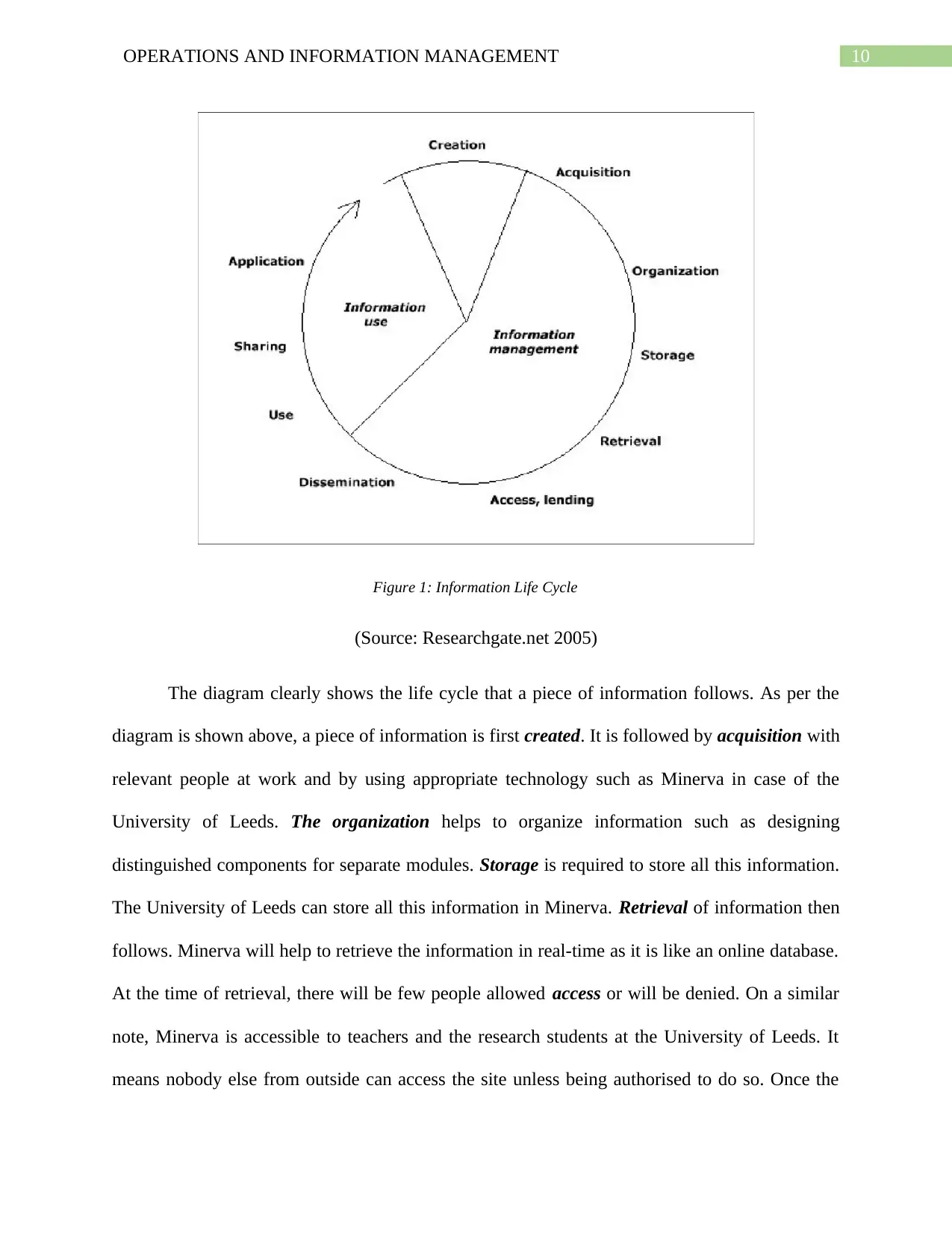
The information life cycle has various elements such as those shown in the figure
provided below:
Operations team at the University of Leeds will need to introduce more innovation to the
teaching and research system (Edison et al. 2018).
2. The Nature of Information Management
The strategic use of information:
The strategic use of information can be realised over various Operations functions. For
example, the strategic use of the information will be devising a strategy to improve marketing
practices. On a similar note, the strategic use of information could be in the form of developing
new products and services to offer a better experience to service users (McGee et al. 2015). The
University of Leeds does a good utilisation of the information. It is evidenced in their practices
to create a database of knowledge. Minerva, for example, is a stock of information and
knowledge, which is accessible to tutors as well as students. Tutors access Minerva to modify the
components of the modules. On the other hand, research students access this to know about the
components to be followed to complete each module successfully (Leeds.ac.uk 2019).
The elements of the Information Life Cycle:
The information life cycle has various elements such as those shown in the figure
provided below:
Paraphrase This Document
Need a fresh take? Get an instant paraphrase of this document with our AI Paraphraser
10OPERATIONS AND INFORMATION MANAGEMENT
Figure 1: Information Life Cycle
(Source: Researchgate.net 2005)
The diagram clearly shows the life cycle that a piece of information follows. As per the
diagram is shown above, a piece of information is first created. It is followed by acquisition with
relevant people at work and by using appropriate technology such as Minerva in case of the
University of Leeds. The organization helps to organize information such as designing
distinguished components for separate modules. Storage is required to store all this information.
The University of Leeds can store all this information in Minerva. Retrieval of information then
follows. Minerva will help to retrieve the information in real-time as it is like an online database.
At the time of retrieval, there will be few people allowed access or will be denied. On a similar
note, Minerva is accessible to teachers and the research students at the University of Leeds. It
means nobody else from outside can access the site unless being authorised to do so. Once the
Figure 1: Information Life Cycle
(Source: Researchgate.net 2005)
The diagram clearly shows the life cycle that a piece of information follows. As per the
diagram is shown above, a piece of information is first created. It is followed by acquisition with
relevant people at work and by using appropriate technology such as Minerva in case of the
University of Leeds. The organization helps to organize information such as designing
distinguished components for separate modules. Storage is required to store all this information.
The University of Leeds can store all this information in Minerva. Retrieval of information then
follows. Minerva will help to retrieve the information in real-time as it is like an online database.
At the time of retrieval, there will be few people allowed access or will be denied. On a similar
note, Minerva is accessible to teachers and the research students at the University of Leeds. It
means nobody else from outside can access the site unless being authorised to do so. Once the
11OPERATIONS AND INFORMATION MANAGEMENT
information is ready for the use, the teachers will disseminate the information for the research
students. They will use relevant data in preparing a quality research paper and in enriching their
knowledge of the course module. Once, the information is stored in Minerva it will become
accessible to the students. Moreover, there will be a sharing of information between the
students. Hence, the knowledge base will also grow leading to increased productivity of students.
Application is the last stage where the retrieved information is applied to the system. In the
University of Leeds, the students will use the retrieved information as an additional resource to
secondary data.
Key enablers for information management:
Information management (IM) generally has many enablers. On a similar note, the
information management at the University of Leeds has three key enablers. These are
information, technology and people (Kausar, Garg and Luthra 2017).
Information is essential for prospering academic studies. Without adequate information,
there will be a lack of quality secondary data for research students. This will be a less friendly
experience for them. Hence, their overall productivity will also be affected. This has what
compelled the University of Leeds to work on its information management systems. Indeed,
improved ‘information management systems’ is essential for increased efficiency in teaching and
research activities (Cassidy 2016). The management personnel at the University of Leeds seem
to have a good understanding of the fact. This is why Minerva came to existence, which is
accessible for teachers as well as research students. In the form of Minerva, the University of
Leeds facilitated the creation of a database, which is highly reliable and productive as well.
information is ready for the use, the teachers will disseminate the information for the research
students. They will use relevant data in preparing a quality research paper and in enriching their
knowledge of the course module. Once, the information is stored in Minerva it will become
accessible to the students. Moreover, there will be a sharing of information between the
students. Hence, the knowledge base will also grow leading to increased productivity of students.
Application is the last stage where the retrieved information is applied to the system. In the
University of Leeds, the students will use the retrieved information as an additional resource to
secondary data.
Key enablers for information management:
Information management (IM) generally has many enablers. On a similar note, the
information management at the University of Leeds has three key enablers. These are
information, technology and people (Kausar, Garg and Luthra 2017).
Information is essential for prospering academic studies. Without adequate information,
there will be a lack of quality secondary data for research students. This will be a less friendly
experience for them. Hence, their overall productivity will also be affected. This has what
compelled the University of Leeds to work on its information management systems. Indeed,
improved ‘information management systems’ is essential for increased efficiency in teaching and
research activities (Cassidy 2016). The management personnel at the University of Leeds seem
to have a good understanding of the fact. This is why Minerva came to existence, which is
accessible for teachers as well as research students. In the form of Minerva, the University of
Leeds facilitated the creation of a database, which is highly reliable and productive as well.
⊘ This is a preview!⊘
Do you want full access?
Subscribe today to unlock all pages.
Trusted by 1+ million students worldwide

1 out of 23


Related Documents


Your All-in-One AI-Powered Toolkit for Academic Success.
+13062052269
info@desklib.com
Available 24*7 on WhatsApp / Email
![[object Object]](/_next/static/media/star-bottom.7253800d.svg)
Unlock your academic potential
Copyright © 2020–2026 A2Z Services. All Rights Reserved. Developed and managed by ZUCOL.