Critical Review of Operations Management at Hotpoint: A Report
VerifiedAdded on 2020/11/23
|18
|5660
|263
Report
AI Summary
This report provides a comprehensive analysis of Hotpoint's operations management, focusing on the application and effectiveness of key principles. It begins with an introduction to operations management and its significance, followed by a critical review of operational principles such as Six Sigma, Lean, and Total Quality Management (TQM) within the context of Hotpoint's manufacturing processes. The report then prepares a continuous improvement plan for Hotpoint, leveraging the PDCA cycle to enhance product quality and efficiency. Furthermore, it applies the Product Life Cycle (PLC) concept to a given project, differentiating between large and small-scale projects. Finally, the report reviews the effectiveness of the PLC application, drawing conclusions and providing references to support the analysis. The report aims to evaluate Hotpoint's strategic goals with utmost precision and provide thorough visibility into the operational activities regarding the same.

OPERATIONS AND
PROJECT MANAGEMENT
PROJECT MANAGEMENT

Paraphrase This Document
Need a fresh take? Get an instant paraphrase of this document with our AI Paraphraser
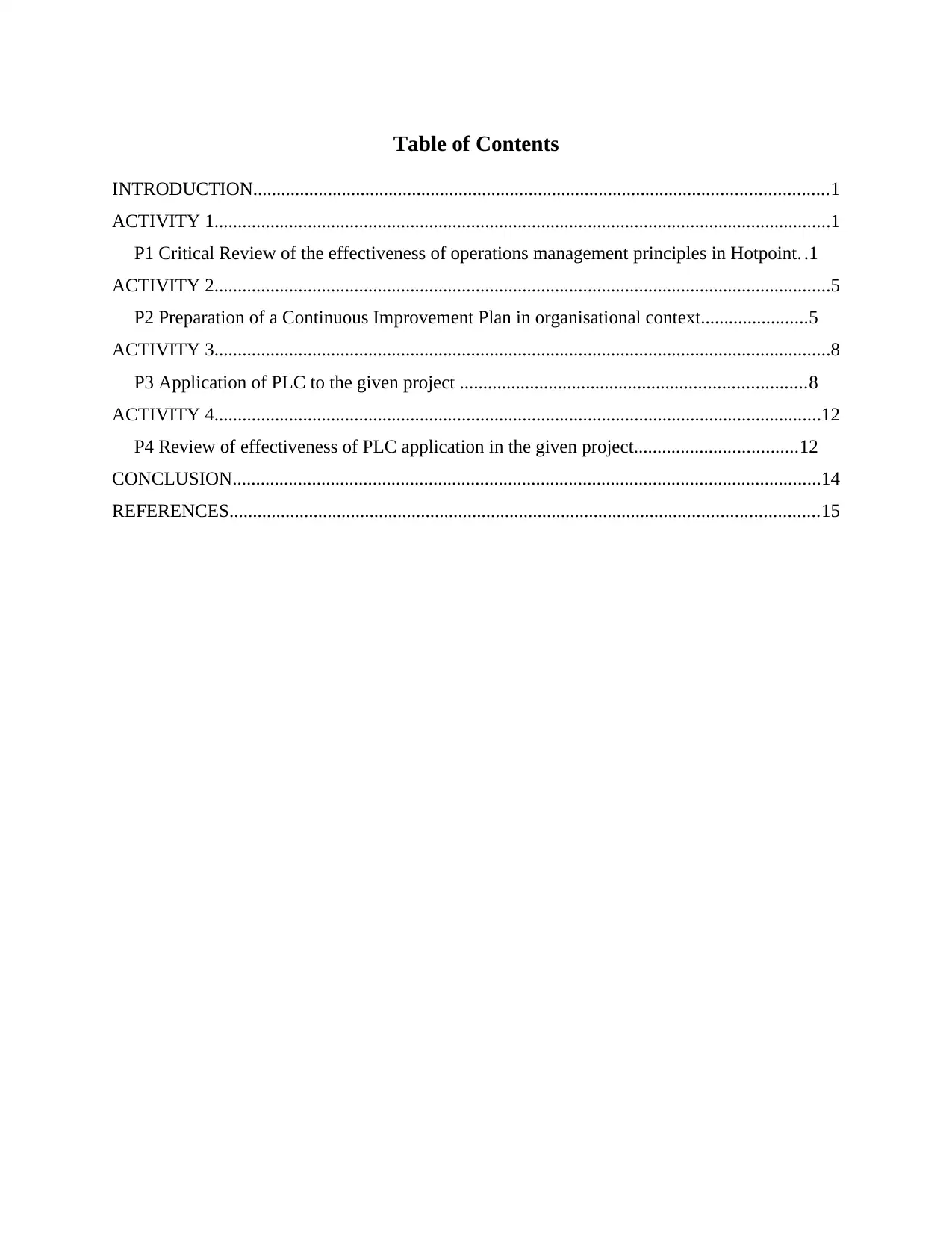
Table of Contents
INTRODUCTION...........................................................................................................................1
ACTIVITY 1....................................................................................................................................1
P1 Critical Review of the effectiveness of operations management principles in Hotpoint. .1
ACTIVITY 2....................................................................................................................................5
P2 Preparation of a Continuous Improvement Plan in organisational context.......................5
ACTIVITY 3....................................................................................................................................8
P3 Application of PLC to the given project ..........................................................................8
ACTIVITY 4..................................................................................................................................12
P4 Review of effectiveness of PLC application in the given project...................................12
CONCLUSION..............................................................................................................................14
REFERENCES..............................................................................................................................15
INTRODUCTION...........................................................................................................................1
ACTIVITY 1....................................................................................................................................1
P1 Critical Review of the effectiveness of operations management principles in Hotpoint. .1
ACTIVITY 2....................................................................................................................................5
P2 Preparation of a Continuous Improvement Plan in organisational context.......................5
ACTIVITY 3....................................................................................................................................8
P3 Application of PLC to the given project ..........................................................................8
ACTIVITY 4..................................................................................................................................12
P4 Review of effectiveness of PLC application in the given project...................................12
CONCLUSION..............................................................................................................................14
REFERENCES..............................................................................................................................15
INTRODUCTION
Operations Management relates to the field of study that is concerned with the
administration of systems and processes which are involved in production of goods and services.
For an organization that is involved in manufacturing, Operations Management would include
conversion of inputs such as raw materials into outputs such as goods in the most effective
manner (Badiru and Osisanya, 2016). Hence, it would look at technology, work systems, location
and facilities planning, quality assurance as well as improvement. This assignment report is
based on a given case scenario emphasizing on a UK-based home appliance manufacturing
company called 'Hotpoint'. Furthermore, a critical evaluation of effectiveness of operational
management principles in its context has been conducted in both theoretical as well as practical
scenario. Apart from this, the report prepares an improvement plan and analyses various stages
of Product Life Cycle based on theoretical framework to differentiate between large as well as
small scale projects.
ACTIVITY 1
P1 Critical Review of the effectiveness of operations management principles in Hotpoint
Operations refer to the business function in an organisation that is concerned with
production of goods and services which are offered to the final consumers. Here, goods include
those physical items that maybe in the form of raw materials, equipments, sub-assemblies as well
as final products such as computers, keyboards and automobiles. Whereas, Services include
those activities which create a psychological value and include a mixture of time, location and
form.
Operations Management, on the other hand, is concerned with ensuring that the process
of production of such goods and services occurs with proper planning, organisation and
supervision to assure quality in compliance with predefined standards. Where operations
produce, manage and improve quality of products and services, operational management ensures
its effectiveness. Hence, the latter concept has a much wider scope than its counterpart (Binder,
2016).
In the given case scenario, Hotpoint has an existing product line of fridges, freezers,
washing machines, electric friars as well as gas and electric cookers. The company is involved in
manufacturing, marketing and selling of home appliances with a prospect to enter the Large
1

Operations Management relates to the field of study that is concerned with the
administration of systems and processes which are involved in production of goods and services.
For an organization that is involved in manufacturing, Operations Management would include
conversion of inputs such as raw materials into outputs such as goods in the most effective
manner (Badiru and Osisanya, 2016). Hence, it would look at technology, work systems, location
and facilities planning, quality assurance as well as improvement. This assignment report is
based on a given case scenario emphasizing on a UK-based home appliance manufacturing
company called 'Hotpoint'. Furthermore, a critical evaluation of effectiveness of operational
management principles in its context has been conducted in both theoretical as well as practical
scenario. Apart from this, the report prepares an improvement plan and analyses various stages
of Product Life Cycle based on theoretical framework to differentiate between large as well as
small scale projects.
ACTIVITY 1
P1 Critical Review of the effectiveness of operations management principles in Hotpoint
Operations refer to the business function in an organisation that is concerned with
production of goods and services which are offered to the final consumers. Here, goods include
those physical items that maybe in the form of raw materials, equipments, sub-assemblies as well
as final products such as computers, keyboards and automobiles. Whereas, Services include
those activities which create a psychological value and include a mixture of time, location and
form.
Operations Management, on the other hand, is concerned with ensuring that the process
of production of such goods and services occurs with proper planning, organisation and
supervision to assure quality in compliance with predefined standards. Where operations
produce, manage and improve quality of products and services, operational management ensures
its effectiveness. Hence, the latter concept has a much wider scope than its counterpart (Binder,
2016).
In the given case scenario, Hotpoint has an existing product line of fridges, freezers,
washing machines, electric friars as well as gas and electric cookers. The company is involved in
manufacturing, marketing and selling of home appliances with a prospect to enter the Large
1

⊘ This is a preview!⊘
Do you want full access?
Subscribe today to unlock all pages.

Trusted by 1+ million students worldwide
Screen Television Market. Its Board of Directors has decided to introduce a 58 inches television
for its customers along with large screens that will be sold to stadiums and parks. In order to
achieve this, the company needs to create a project in accordance with a certain set of principles.
These principles will help in meeting company's strategic goals with utmost precision and
provide thorough visibility into the operational activities regarding the same. These have been
discussed below:
(a)Six-Sigma:
This methodology is concerned with ensuring zero or minimal errors by eliminating
defect-causing elements simultaneously improving the manufacturing processes of the business.
It involves a series of steps that are needed to be followed for maximising value of any given
project. Apart from this, it also takes help of statistical tools and techniques to measure the
efficiency as well as effectiveness of the production systems (Bowers and Khorakian, 2014). Six-
Sigma follows a DMADV approach that includes:
Defining benchmarks for a project to gauge deviations at any point of production cycle
by completely understanding customer needs as well as the process that would go into
producing the commodity;
Measuring capabilities, processes and risks along with identification of factors that are
CTQ (Critical To Quality) to initiate the production process;
Analysing the process to develop alternatives, conceptual or process designs as well as
understand the constraints that are critical to achieving value;
Designing an improved alternative which is effective in rectifying errors and creating a
prototype model including necessary modifications; and
Verifying the design among the internal as well as external stakeholders, set-up pilot
runs, hence, deploying production process as a routine operation by maintaining
sustainability and quality.
It is a core tool used in projects that are concerned with new product development. If
Hotpoint adopts this strategy to develop a 58 inches television for its customers as well as
stadiums and parks, the business would be able to develop a model with zero errors and highest
precision possible (Fleming and Koppelman, 2016). As a television requires integration of highly
accurate work modules to produce high definition resolution as well as audio-visual experience
for the buyers, it is important to create a differentiated product which would be able to attract
2

for its customers along with large screens that will be sold to stadiums and parks. In order to
achieve this, the company needs to create a project in accordance with a certain set of principles.
These principles will help in meeting company's strategic goals with utmost precision and
provide thorough visibility into the operational activities regarding the same. These have been
discussed below:
(a)Six-Sigma:
This methodology is concerned with ensuring zero or minimal errors by eliminating
defect-causing elements simultaneously improving the manufacturing processes of the business.
It involves a series of steps that are needed to be followed for maximising value of any given
project. Apart from this, it also takes help of statistical tools and techniques to measure the
efficiency as well as effectiveness of the production systems (Bowers and Khorakian, 2014). Six-
Sigma follows a DMADV approach that includes:
Defining benchmarks for a project to gauge deviations at any point of production cycle
by completely understanding customer needs as well as the process that would go into
producing the commodity;
Measuring capabilities, processes and risks along with identification of factors that are
CTQ (Critical To Quality) to initiate the production process;
Analysing the process to develop alternatives, conceptual or process designs as well as
understand the constraints that are critical to achieving value;
Designing an improved alternative which is effective in rectifying errors and creating a
prototype model including necessary modifications; and
Verifying the design among the internal as well as external stakeholders, set-up pilot
runs, hence, deploying production process as a routine operation by maintaining
sustainability and quality.
It is a core tool used in projects that are concerned with new product development. If
Hotpoint adopts this strategy to develop a 58 inches television for its customers as well as
stadiums and parks, the business would be able to develop a model with zero errors and highest
precision possible (Fleming and Koppelman, 2016). As a television requires integration of highly
accurate work modules to produce high definition resolution as well as audio-visual experience
for the buyers, it is important to create a differentiated product which would be able to attract
2

Paraphrase This Document
Need a fresh take? Get an instant paraphrase of this document with our AI Paraphraser
more customers. Implementation of this concept to develop a new product would not only ensure
production of a high quality Television model that is durable, customer driven making
requirements of the audiences a priority. However, application of this principle may have a
negative impact on the Hotpoint's TV dream as it may result in time and cost overruns due to the
fact that this principle favours a internal quality control measure which is expensive, thus,
affecting the innovation and creativity thought process of the business altogether. For instance,
Hotpoint would require to use those resources which are costlier as they tend to have lesser
chances of being defective in comparison to a cheaper one.
(b) Lean Principle:
Another waste minimizing method implemented in manufacturing units across majority
of sectors is Lean Production Principle. This concept aims to enhance value addition by reducing
wastage without affecting the productivity (Greene and Stellman, 2018). It works on the simple
thought process of smoothing out unevenness in workloads and overburdening process systems.
This principle has been successfully implemented among technology-based sectors such as
Electronics and Healthcare to reduce waiting as well as handling time, accent barriers and attain
process adherence. This framework includes five key principles mentioned below that are
important while implementation of this principle through Value Stream Mapping:
Identification of Value that a customer derives by clearly understanding the problems
and determining the price for a product that they would readily pay for it;
Mapping out the steps and material necessary to the placement of product in the hands
of the customer. Thus, creating a value stream which would help in revealing time delays,
separating value creation tasks from the ones which do not contribute to adding value;
Creation of a flow to assure smooth transition of product from one activity to another;
Pull economic value by encouraging production that is customer-driven rather based on
a forecast or scheduling;
Perfection in systems by eliminating wastage and improving each step of the value-
stream.
If Hotpoint adopts this strategy to develop a 58 inches television for its customers as well
as stadiums and parks, the business would be able to develop a model with zero wastage and in a
sustainable manner. Manufacturing a television model based on this operation principle would
ensure no deviation of budgeted costs of the project thus preventing for the company to face time
3

production of a high quality Television model that is durable, customer driven making
requirements of the audiences a priority. However, application of this principle may have a
negative impact on the Hotpoint's TV dream as it may result in time and cost overruns due to the
fact that this principle favours a internal quality control measure which is expensive, thus,
affecting the innovation and creativity thought process of the business altogether. For instance,
Hotpoint would require to use those resources which are costlier as they tend to have lesser
chances of being defective in comparison to a cheaper one.
(b) Lean Principle:
Another waste minimizing method implemented in manufacturing units across majority
of sectors is Lean Production Principle. This concept aims to enhance value addition by reducing
wastage without affecting the productivity (Greene and Stellman, 2018). It works on the simple
thought process of smoothing out unevenness in workloads and overburdening process systems.
This principle has been successfully implemented among technology-based sectors such as
Electronics and Healthcare to reduce waiting as well as handling time, accent barriers and attain
process adherence. This framework includes five key principles mentioned below that are
important while implementation of this principle through Value Stream Mapping:
Identification of Value that a customer derives by clearly understanding the problems
and determining the price for a product that they would readily pay for it;
Mapping out the steps and material necessary to the placement of product in the hands
of the customer. Thus, creating a value stream which would help in revealing time delays,
separating value creation tasks from the ones which do not contribute to adding value;
Creation of a flow to assure smooth transition of product from one activity to another;
Pull economic value by encouraging production that is customer-driven rather based on
a forecast or scheduling;
Perfection in systems by eliminating wastage and improving each step of the value-
stream.
If Hotpoint adopts this strategy to develop a 58 inches television for its customers as well
as stadiums and parks, the business would be able to develop a model with zero wastage and in a
sustainable manner. Manufacturing a television model based on this operation principle would
ensure no deviation of budgeted costs of the project thus preventing for the company to face time
3

or cost overruns altogether. Due to increasing demand for sustainability in the strategies applied
business goals, the company would not only be able to enhance value stream for its televisions
but also attract customers that are socially responsible, ultimately bolstering its image. However,
as there is little margin of error, a small deviation from this principle may lead to a serious
failure of one or more process activities. For instance, if Hotpoint is able to achieve zero wastage
by maintaining a stock level of 40,000 units of television models, any level below or above this
would lead to wastage thus leading to failure of the principle altogether (He, Yu and Ma, 2014) .
(C) Total Quality Management (TQM):
This approach aims to ensure long-term success through maximisation of Customer
Satisfaction. In order to achieve this goal, it uses strategies, data and effective communication so
as to integrate discipline of quality into the internal business environment of organisation such as
Hotpoint. TQM Principles are related to:
Ensuring Customer-driven Quality Maintenance as they are the critical determinants as
well as consumers of the final product or service produced and offered by a business
entity.
Complete involvement of Employees is necessary as it will enable the integration of
business processes and result in development of high-performance work systems that are
capable of delivering premium quality service or products with continuous improvement
efforts.
TQM must be Process Centred as this approach involves implementation of
improvements at all levels of the organisation continuously.
Creating an Integrated System of Business Processes by Horizontally linking them to
each other is one of the main focus of TQM. This would ensure that everyone
understands their role in accordance with vision, mission and guiding principles of the
business enterprise. This can be done by incorporating a Baldridge National Quality
Program and/or ISO 9000 standards.
Adoption of a Strategic and Systematic Approach which includes formulation of a
strategic plan that incorporates quality as the core component across all organisation
levels.
4

business goals, the company would not only be able to enhance value stream for its televisions
but also attract customers that are socially responsible, ultimately bolstering its image. However,
as there is little margin of error, a small deviation from this principle may lead to a serious
failure of one or more process activities. For instance, if Hotpoint is able to achieve zero wastage
by maintaining a stock level of 40,000 units of television models, any level below or above this
would lead to wastage thus leading to failure of the principle altogether (He, Yu and Ma, 2014) .
(C) Total Quality Management (TQM):
This approach aims to ensure long-term success through maximisation of Customer
Satisfaction. In order to achieve this goal, it uses strategies, data and effective communication so
as to integrate discipline of quality into the internal business environment of organisation such as
Hotpoint. TQM Principles are related to:
Ensuring Customer-driven Quality Maintenance as they are the critical determinants as
well as consumers of the final product or service produced and offered by a business
entity.
Complete involvement of Employees is necessary as it will enable the integration of
business processes and result in development of high-performance work systems that are
capable of delivering premium quality service or products with continuous improvement
efforts.
TQM must be Process Centred as this approach involves implementation of
improvements at all levels of the organisation continuously.
Creating an Integrated System of Business Processes by Horizontally linking them to
each other is one of the main focus of TQM. This would ensure that everyone
understands their role in accordance with vision, mission and guiding principles of the
business enterprise. This can be done by incorporating a Baldridge National Quality
Program and/or ISO 9000 standards.
Adoption of a Strategic and Systematic Approach which includes formulation of a
strategic plan that incorporates quality as the core component across all organisation
levels.
4

⊘ This is a preview!⊘
Do you want full access?
Subscribe today to unlock all pages.
Trusted by 1+ million students worldwide
Continual Improvement both analytically as well as creatively by discovering and
implementing ways which improve the competitive advantage and better meet the
expectations of the stakeholders.
Fact-based Decision-Making that encourages improved decision making accuracy,
achieve consensus and allows predictability is what the TQM of a company must aim at.
Ensuring Effective Communication Practices which include strategies, method and
timeliness as well as result in increasing morale and motivation among employees at all
levels of organisation.
If Hotpoint adopts this strategy to develop a 58 inches television for its customers as well
as stadiums and parks, the business would be able to develop a model that is customer-centric.
Manufacturing a television model based on this operation principle would ensure reduction in
costs and increase in customer satisfaction at the same time. Also, continual and gradual
improvements in all of its operational activities would result in defect reduction and increase in
morale. For instance, if Hotpoint is able to achieve maximum customer satisfaction at a stock
level of 40,000 units of television models with a minimum price of £430, any level below or
above this would lead to over (or under) efficiency of its business processes (Sallis, 2014).
For implementation of a successful plan in Hotpoint's case, TQM methodology has been
chosen as it reduces defects and improves precision in the product sought to be introduced.
ACTIVITY 2
P2 Preparation of a Continuous Improvement Plan in organisational context
A continuous improvement cycle is a set of activities that aim at improving products,
services or systems as an ongoing process by regularly reviewing them. In order to implement
TQM effectively in Hotpoint, firstly a PDCA is carried out. The improvement plan developed
under Total Quality Management (TQM) methodology adopts Deming's Plan-Do-Check-Act to
support continuous betterment (PDCA, 2019). It is an important tool which helps in creating a
systematic method while addressing issues related to the new product. Based on this cycle,
Hotpoint's project improvement plan has been developed below:
Plan Do Check Act
5

implementing ways which improve the competitive advantage and better meet the
expectations of the stakeholders.
Fact-based Decision-Making that encourages improved decision making accuracy,
achieve consensus and allows predictability is what the TQM of a company must aim at.
Ensuring Effective Communication Practices which include strategies, method and
timeliness as well as result in increasing morale and motivation among employees at all
levels of organisation.
If Hotpoint adopts this strategy to develop a 58 inches television for its customers as well
as stadiums and parks, the business would be able to develop a model that is customer-centric.
Manufacturing a television model based on this operation principle would ensure reduction in
costs and increase in customer satisfaction at the same time. Also, continual and gradual
improvements in all of its operational activities would result in defect reduction and increase in
morale. For instance, if Hotpoint is able to achieve maximum customer satisfaction at a stock
level of 40,000 units of television models with a minimum price of £430, any level below or
above this would lead to over (or under) efficiency of its business processes (Sallis, 2014).
For implementation of a successful plan in Hotpoint's case, TQM methodology has been
chosen as it reduces defects and improves precision in the product sought to be introduced.
ACTIVITY 2
P2 Preparation of a Continuous Improvement Plan in organisational context
A continuous improvement cycle is a set of activities that aim at improving products,
services or systems as an ongoing process by regularly reviewing them. In order to implement
TQM effectively in Hotpoint, firstly a PDCA is carried out. The improvement plan developed
under Total Quality Management (TQM) methodology adopts Deming's Plan-Do-Check-Act to
support continuous betterment (PDCA, 2019). It is an important tool which helps in creating a
systematic method while addressing issues related to the new product. Based on this cycle,
Hotpoint's project improvement plan has been developed below:
Plan Do Check Act
5

Paraphrase This Document
Need a fresh take? Get an instant paraphrase of this document with our AI Paraphraser
A manufacturing process
based on Six Sigma
Principle that would
ensure:
-Deliverance of quality
products with zero errors.
-Competitive Advantage
in Large Screen Television
Market.
-Acquisition of at least
10% or more of the total
market share in the sector
with a budget of £100
million.
- Production of 4K as well
as UHD television units
with android-friendly user
interface including Screen
Mirroring.
-Television units would
include LED and OLED
Technology, 58 inches-
wide screen with a wide
viewing angle of 147 (H)/
147 (V) as well as High
Dynamic Contrasting Ratio
of 300000:1 for better
colour representation,
vividness, sharpness of
screen and crisp image.
-Raw Material used in
A blueprint of
television model will
be created that would
guide in producing the
physical parts as well
as the overall unit of
Television Model.
Small changes to the
blueprint may be
added to check
whether the data
gathered through these
alterations is effective
to achieve an error-
free model.
Multiple pilot runs
conducted of the
prototype to target
issues arising while
operating the model as
well as distortion in
images, audio as well
as colour
representation.
Using TQM
approach, the
quality test of the
prototype proved
to be successful
ensuring that the
production
process includes
the most effective
blueprint for the
new model. Also
using Customer
Mapping
technique, it was
ascertained that
the model gives a
high viewing
experience that
would provide
strong customer
relationship for
Hotpoint. Hence,
the solution is
successful and the
project can be
implemented.
6

based on Six Sigma
Principle that would
ensure:
-Deliverance of quality
products with zero errors.
-Competitive Advantage
in Large Screen Television
Market.
-Acquisition of at least
10% or more of the total
market share in the sector
with a budget of £100
million.
- Production of 4K as well
as UHD television units
with android-friendly user
interface including Screen
Mirroring.
-Television units would
include LED and OLED
Technology, 58 inches-
wide screen with a wide
viewing angle of 147 (H)/
147 (V) as well as High
Dynamic Contrasting Ratio
of 300000:1 for better
colour representation,
vividness, sharpness of
screen and crisp image.
-Raw Material used in
A blueprint of
television model will
be created that would
guide in producing the
physical parts as well
as the overall unit of
Television Model.
Small changes to the
blueprint may be
added to check
whether the data
gathered through these
alterations is effective
to achieve an error-
free model.
Multiple pilot runs
conducted of the
prototype to target
issues arising while
operating the model as
well as distortion in
images, audio as well
as colour
representation.
Using TQM
approach, the
quality test of the
prototype proved
to be successful
ensuring that the
production
process includes
the most effective
blueprint for the
new model. Also
using Customer
Mapping
technique, it was
ascertained that
the model gives a
high viewing
experience that
would provide
strong customer
relationship for
Hotpoint. Hence,
the solution is
successful and the
project can be
implemented.
6

production will include
metals, plastics, fluorescent
chemical coatings and
silicon.
The aforementioned table shows an interrelationship between the four stages viz. Plan,
Do, Check and Act. These stages provide a step-wise critical analysis of every aspect of a project
related to an existing or a new product. In the given case scenario, Hotpoint's Management has
decided to introduce a new product using six sigma methodology in television division. Using
this approach in combination with TQM, a continuous improvement plan, it is able to check the
objectives it has set with the predefined budget. The company lists out the plans it has in regards
to the geometry, dimensions and quality of the television. This helps the business to analyse the
implementation of plans in accordance with blueprint formulated in the next stage called the 'Do'
Stage. The main objective of this technique is to ascertain whether the model is free of any
constraints that may result in errors in later stages of production (Hjelmbrekke, Lædre and
Lohne, 2014). Hence, in the second stage, the implementation of blueprint in accordance with
this objective is checked to test the potential solution on a smaller scale and measure the results.
In the 'Check' Stage of this plan, Hotpoint's product development team focuses on
analysing that whether the variables assumed in the start of this project to achieve error-free
model are actually coherent or not. For this, multiple pilot runs of the prototype model made in
the second stage are executed to measure the model's effectiveness. This stage showed that there
were issues arising in the user-interface of the prototype relating to image distortion, colour
representation and audio quality. In the last stage, conclusions are drawn based on the
improvements made with the help of Total Quality Management (TQM), improvements were
carried out to rectify these shortcomings and a customer mapping technique helped in increasing
the customer experience derived from the model.
As one can see, these stages have certain criteria and results on the basis of which the
next stage determines the effective as well as ineffectiveness of the overall model. Hence, every
stage is important to analyse the project to achieve continuous improvement and consistency
across all activities.
7

metals, plastics, fluorescent
chemical coatings and
silicon.
The aforementioned table shows an interrelationship between the four stages viz. Plan,
Do, Check and Act. These stages provide a step-wise critical analysis of every aspect of a project
related to an existing or a new product. In the given case scenario, Hotpoint's Management has
decided to introduce a new product using six sigma methodology in television division. Using
this approach in combination with TQM, a continuous improvement plan, it is able to check the
objectives it has set with the predefined budget. The company lists out the plans it has in regards
to the geometry, dimensions and quality of the television. This helps the business to analyse the
implementation of plans in accordance with blueprint formulated in the next stage called the 'Do'
Stage. The main objective of this technique is to ascertain whether the model is free of any
constraints that may result in errors in later stages of production (Hjelmbrekke, Lædre and
Lohne, 2014). Hence, in the second stage, the implementation of blueprint in accordance with
this objective is checked to test the potential solution on a smaller scale and measure the results.
In the 'Check' Stage of this plan, Hotpoint's product development team focuses on
analysing that whether the variables assumed in the start of this project to achieve error-free
model are actually coherent or not. For this, multiple pilot runs of the prototype model made in
the second stage are executed to measure the model's effectiveness. This stage showed that there
were issues arising in the user-interface of the prototype relating to image distortion, colour
representation and audio quality. In the last stage, conclusions are drawn based on the
improvements made with the help of Total Quality Management (TQM), improvements were
carried out to rectify these shortcomings and a customer mapping technique helped in increasing
the customer experience derived from the model.
As one can see, these stages have certain criteria and results on the basis of which the
next stage determines the effective as well as ineffectiveness of the overall model. Hence, every
stage is important to analyse the project to achieve continuous improvement and consistency
across all activities.
7

⊘ This is a preview!⊘
Do you want full access?
Subscribe today to unlock all pages.
Trusted by 1+ million students worldwide
ACTIVITY 3
P3 Application of PLC to the given project
Project life cycle is a complete cycle which starts from taking initiation till the
completion or closure of any project whether successful or unsuccessful. It is a workflow of
different activities in the systematic order to achieve maximum results from the project. There
are various phases in any business project such as initiation, planning, execution and closure.
Each phase plays important role in the successful completion of any project. Hot Point was
established by Earl Richardson in 1911. It is company of electric appliances which includes
washing machines, refrigerators, freezers, cookers and many more (Kerzner and Kerzner, 2017) .
The organization has a plan of producing and launching a television in the United Kingdom and
further build a project life cycle to introduce it to its customers. Phases of project life cycle of
Hot point are as follows:
Initiation Phase:
This phase is the starting point of any business idea. At this stage, the managers of Hot
point identifies the objectives and a feasibility study is done regarding any problems in
performing the tasks of the project. Feasibility study is used to determine the positive and
negative potential outcomes before investing time and money in the project. The goal at this
stage is to emphasize on the problems which may occur while performing the tasks (Xu, Ma and
Ding, 2014).
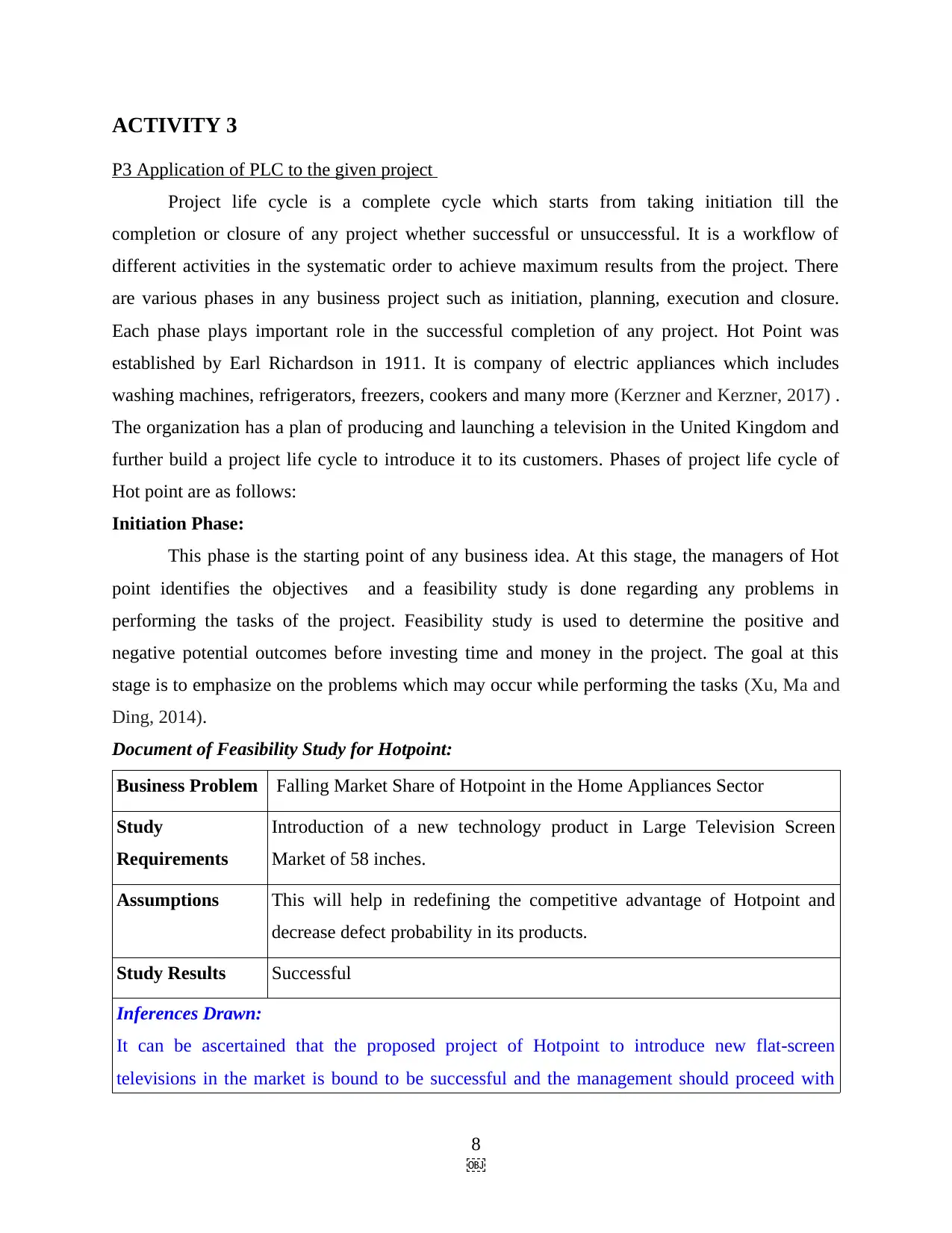
Document of Feasibility Study for Hotpoint:
Business Problem Falling Market Share of Hotpoint in the Home Appliances Sector
Study
Requirements
Introduction of a new technology product in Large Television Screen
Market of 58 inches.
Assumptions This will help in redefining the competitive advantage of Hotpoint and
decrease defect probability in its products.
Study Results Successful
Inferences Drawn:
It can be ascertained that the proposed project of Hotpoint to introduce new flat-screen
televisions in the market is bound to be successful and the management should proceed with
8

P3 Application of PLC to the given project
Project life cycle is a complete cycle which starts from taking initiation till the
completion or closure of any project whether successful or unsuccessful. It is a workflow of
different activities in the systematic order to achieve maximum results from the project. There
are various phases in any business project such as initiation, planning, execution and closure.
Each phase plays important role in the successful completion of any project. Hot Point was
established by Earl Richardson in 1911. It is company of electric appliances which includes
washing machines, refrigerators, freezers, cookers and many more (Kerzner and Kerzner, 2017) .
The organization has a plan of producing and launching a television in the United Kingdom and
further build a project life cycle to introduce it to its customers. Phases of project life cycle of
Hot point are as follows:
Initiation Phase:
This phase is the starting point of any business idea. At this stage, the managers of Hot
point identifies the objectives and a feasibility study is done regarding any problems in
performing the tasks of the project. Feasibility study is used to determine the positive and
negative potential outcomes before investing time and money in the project. The goal at this
stage is to emphasize on the problems which may occur while performing the tasks (Xu, Ma and
Ding, 2014).
Document of Feasibility Study for Hotpoint:
Business Problem Falling Market Share of Hotpoint in the Home Appliances Sector
Study
Requirements
Introduction of a new technology product in Large Television Screen
Market of 58 inches.
Assumptions This will help in redefining the competitive advantage of Hotpoint and
decrease defect probability in its products.
Study Results Successful
Inferences Drawn:
It can be ascertained that the proposed project of Hotpoint to introduce new flat-screen
televisions in the market is bound to be successful and the management should proceed with
8

Paraphrase This Document
Need a fresh take? Get an instant paraphrase of this document with our AI Paraphraser
this project.
Planning Phase:
Planning means deciding in advance what is to be done, who is going to do, how it is
going to be done and when it is going to be done. The managers of Hot point plans all the future
requirements in present for the completion of any project to deliver in the market. At this phase,
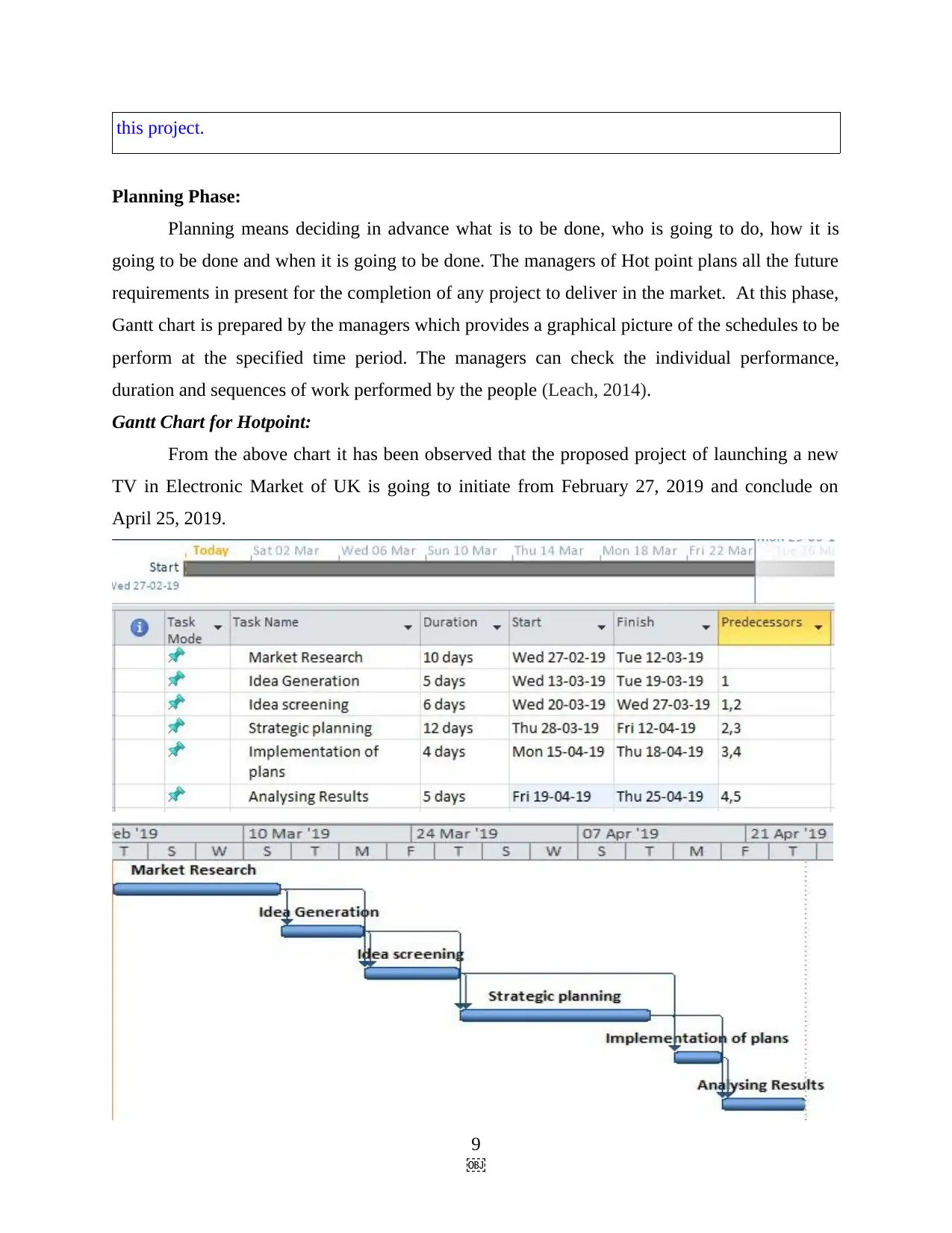
Gantt chart is prepared by the managers which provides a graphical picture of the schedules to be
perform at the specified time period. The managers can check the individual performance,
duration and sequences of work performed by the people (Leach, 2014).
Gantt Chart for Hotpoint:
From the above chart it has been observed that the proposed project of launching a new
TV in Electronic Market of UK is going to initiate from February 27, 2019 and conclude on
April 25, 2019.
9

Planning Phase:
Planning means deciding in advance what is to be done, who is going to do, how it is
going to be done and when it is going to be done. The managers of Hot point plans all the future
requirements in present for the completion of any project to deliver in the market. At this phase,
Gantt chart is prepared by the managers which provides a graphical picture of the schedules to be
perform at the specified time period. The managers can check the individual performance,
duration and sequences of work performed by the people (Leach, 2014).
Gantt Chart for Hotpoint:
From the above chart it has been observed that the proposed project of launching a new
TV in Electronic Market of UK is going to initiate from February 27, 2019 and conclude on
April 25, 2019.
9

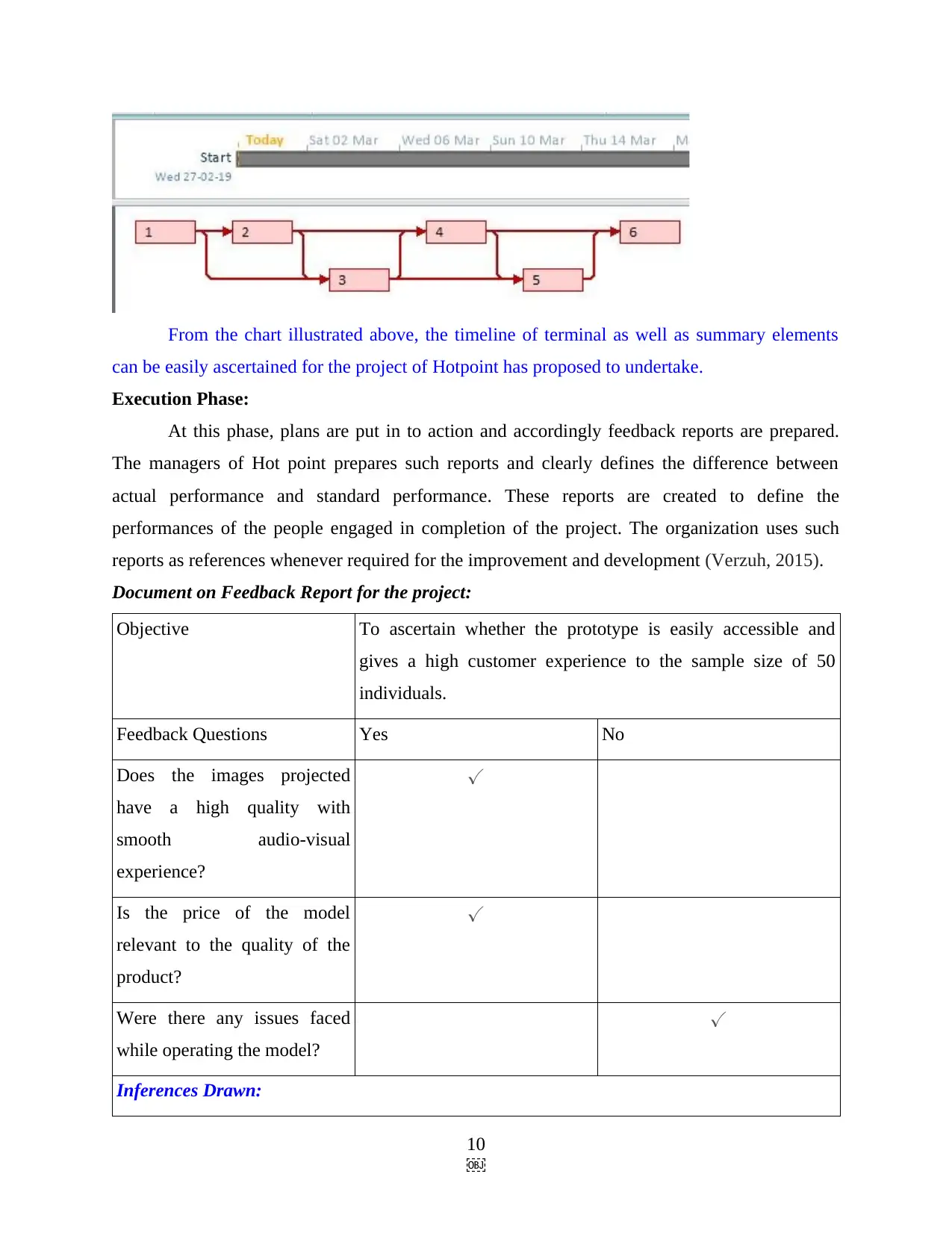
From the chart illustrated above, the timeline of terminal as well as summary elements
can be easily ascertained for the project of Hotpoint has proposed to undertake.
Execution Phase:
At this phase, plans are put in to action and accordingly feedback reports are prepared.
The managers of Hot point prepares such reports and clearly defines the difference between
actual performance and standard performance. These reports are created to define the
performances of the people engaged in completion of the project. The organization uses such
reports as references whenever required for the improvement and development (Verzuh, 2015).
Document on Feedback Report for the project:
Objective To ascertain whether the prototype is easily accessible and
gives a high customer experience to the sample size of 50
individuals.
Feedback Questions Yes No
Does the images projected
have a high quality with
smooth audio-visual
experience?
✓
Is the price of the model
relevant to the quality of the
product?
✓
Were there any issues faced
while operating the model?
✓
Inferences Drawn:
10

can be easily ascertained for the project of Hotpoint has proposed to undertake.
Execution Phase:
At this phase, plans are put in to action and accordingly feedback reports are prepared.
The managers of Hot point prepares such reports and clearly defines the difference between
actual performance and standard performance. These reports are created to define the
performances of the people engaged in completion of the project. The organization uses such
reports as references whenever required for the improvement and development (Verzuh, 2015).
Document on Feedback Report for the project:
Objective To ascertain whether the prototype is easily accessible and
gives a high customer experience to the sample size of 50
individuals.
Feedback Questions Yes No
Does the images projected
have a high quality with
smooth audio-visual
experience?
✓
Is the price of the model
relevant to the quality of the
product?
✓
Were there any issues faced
while operating the model?
✓
Inferences Drawn:
10

⊘ This is a preview!⊘
Do you want full access?
Subscribe today to unlock all pages.
Trusted by 1+ million students worldwide

1 out of 18


Related Documents


Your All-in-One AI-Powered Toolkit for Academic Success.
+13062052269
info@desklib.com
Available 24*7 on WhatsApp / Email
![[object Object]](/_next/static/media/star-bottom.7253800d.svg)
Unlock your academic potential
Copyright © 2020–2026 A2Z Services. All Rights Reserved. Developed and managed by ZUCOL.