Leadership and Management Development Programme Report UK
VerifiedAdded on 2024/06/07
|23
|7564
|105
Report
AI Summary
This report examines the adoption of a leadership and management development programme, differentiating between the roles of a manager and a leader. It discusses leadership theories and their application within organizations, focusing on examples from Tullow Oil (UK). The report compares the traits, responsibilities, and authority of leaders and managers, referencing leadership theories such as the Great Man theory, Trait theory, and transformational leadership. It also details Fayol's management principles and how they are applied in the organization, emphasizing the importance of corporate social responsibility, recruitment, and decision-making. Furthermore, the report applies situational, systems, and contingency leadership theories, using scenarios within Tullow Oil to illustrate their practical application in managing risks and enhancing efficiency. Desklib provides access to this and other solved assignments for students.
Management and Operations
1
1

Paraphrase This Document
Need a fresh take? Get an instant paraphrase of this document with our AI Paraphraser
Table of Contents
Introduction................................................................................................................................3
Task 1.........................................................................................................................................4
Task 2.......................................................................................................................................12
Conclusion................................................................................................................................20
Reference List..........................................................................................................................21
2
Introduction................................................................................................................................3
Task 1.........................................................................................................................................4
Task 2.......................................................................................................................................12
Conclusion................................................................................................................................20
Reference List..........................................................................................................................21
2
Introduction
In today’s world, an organisation or a firm needs one or more than one manager to handle the
overall functionality of the same in a competitive market. The functions of a manager and a
leader are very different yet have certain distinct similarities. A definition of leadership that is
widely adapted from the basis of theories is that it is dependent on a group of individuals
working together to achieve the same goals and share the same modicum of respect amongst
each other. In addition to that, leaders also utilise their own skill sets to contribute to the
effectiveness of a team.
This report is to present the results of the research into the adoption of a leadership and
management development programme with certain detailed differentiation of both the roles
of a manager and a leader. Each organization is privy to a different hierarchy and hence
follows a different leadership role-play. The different aspects of leadership style are
discussed with respect to the organization and a substantiate amount of attention would be
given to the examples of the styles implemented within the organization to manage the risks
and enhance the efficiency.
3
In today’s world, an organisation or a firm needs one or more than one manager to handle the
overall functionality of the same in a competitive market. The functions of a manager and a
leader are very different yet have certain distinct similarities. A definition of leadership that is
widely adapted from the basis of theories is that it is dependent on a group of individuals
working together to achieve the same goals and share the same modicum of respect amongst
each other. In addition to that, leaders also utilise their own skill sets to contribute to the
effectiveness of a team.
This report is to present the results of the research into the adoption of a leadership and
management development programme with certain detailed differentiation of both the roles
of a manager and a leader. Each organization is privy to a different hierarchy and hence
follows a different leadership role-play. The different aspects of leadership style are
discussed with respect to the organization and a substantiate amount of attention would be
given to the examples of the styles implemented within the organization to manage the risks
and enhance the efficiency.
3
⊘ This is a preview!⊘
Do you want full access?
Subscribe today to unlock all pages.

Trusted by 1+ million students worldwide
Task 1
Introduction
A leader is looked upon as the epitome of diligence and his working skills. A manager is
designated to manage or supervise a group of teams. However, a leader is required to do the
same for a team of a smaller size (Chemers, 2014). This task involves the determination of
individual roles of a leader and a manager and the discussion of the leadership theories
pertaining to their environmental dominion in the respective organisations.
a) Differences and similarities between a leader and manager considering their
roles and characteristics
Some of the common leadership content themes are as follows:
Setting a goal and a clear vision involves enabling the employees to understand the
present state of the organization and then analysing the situation to predict the future
outcome of the same.
Motivation of employees is of immense significance to the environment of the team,
culminating in bringing out the same in the concerned team.
Guiding employees in the path to completion of their respective roles in their work
process and the sub sequential administration with the necessary tools required to
help them. Furthermore, it would be implied that the leader should understand the
employees’ problems and help overcome them with his horde of strategies (Stetler et
al., 2014).
An element of resolve is necessary for all leaders; from sports to politics, a good
leader is fearless and required to be competent when it comes to his decision-making
abilities.
Building morale-The organizational value is based on the morale of the firm; the
morale, consequentially, is maintained by the leader. At times, a leader is faced with
certain difficulties and hurdles within the social and economic realm of his team
(Susca, 2018) and must overcome with his own perception.
A manager is defined as the individual who is tasked with the management of a group of
teams. Some of the common themes are:
4
Introduction
A leader is looked upon as the epitome of diligence and his working skills. A manager is
designated to manage or supervise a group of teams. However, a leader is required to do the
same for a team of a smaller size (Chemers, 2014). This task involves the determination of
individual roles of a leader and a manager and the discussion of the leadership theories
pertaining to their environmental dominion in the respective organisations.
a) Differences and similarities between a leader and manager considering their
roles and characteristics
Some of the common leadership content themes are as follows:
Setting a goal and a clear vision involves enabling the employees to understand the
present state of the organization and then analysing the situation to predict the future
outcome of the same.
Motivation of employees is of immense significance to the environment of the team,
culminating in bringing out the same in the concerned team.
Guiding employees in the path to completion of their respective roles in their work
process and the sub sequential administration with the necessary tools required to
help them. Furthermore, it would be implied that the leader should understand the
employees’ problems and help overcome them with his horde of strategies (Stetler et
al., 2014).
An element of resolve is necessary for all leaders; from sports to politics, a good
leader is fearless and required to be competent when it comes to his decision-making
abilities.
Building morale-The organizational value is based on the morale of the firm; the
morale, consequentially, is maintained by the leader. At times, a leader is faced with
certain difficulties and hurdles within the social and economic realm of his team
(Susca, 2018) and must overcome with his own perception.
A manager is defined as the individual who is tasked with the management of a group of
teams. Some of the common themes are:
4
Paraphrase This Document
Need a fresh take? Get an instant paraphrase of this document with our AI Paraphraser
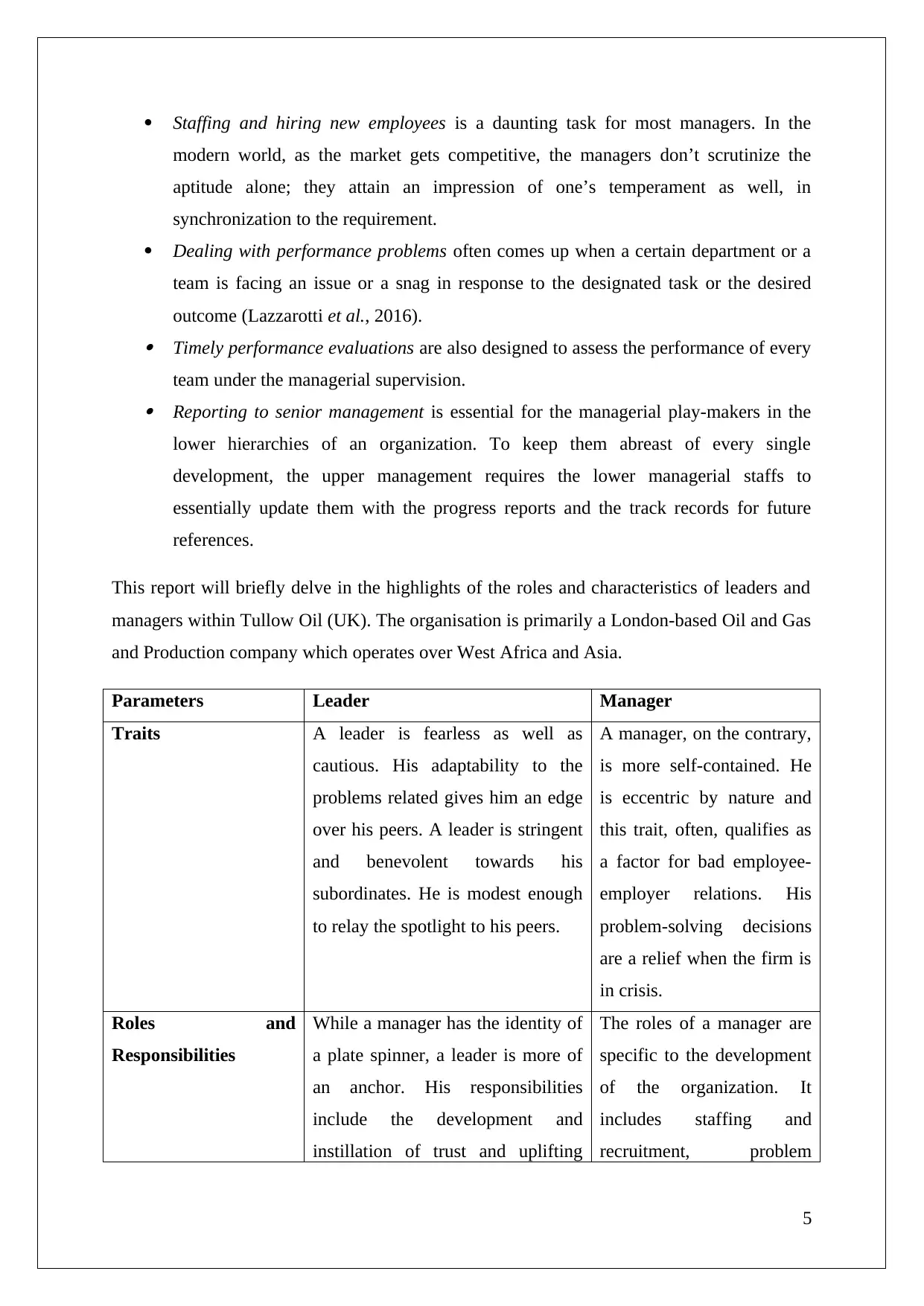
Staffing and hiring new employees is a daunting task for most managers. In the
modern world, as the market gets competitive, the managers don’t scrutinize the
aptitude alone; they attain an impression of one’s temperament as well, in
synchronization to the requirement.
Dealing with performance problems often comes up when a certain department or a
team is facing an issue or a snag in response to the designated task or the desired
outcome (Lazzarotti et al., 2016). Timely performance evaluations are also designed to assess the performance of every
team under the managerial supervision. Reporting to senior management is essential for the managerial play-makers in the
lower hierarchies of an organization. To keep them abreast of every single
development, the upper management requires the lower managerial staffs to
essentially update them with the progress reports and the track records for future
references.
This report will briefly delve in the highlights of the roles and characteristics of leaders and
managers within Tullow Oil (UK). The organisation is primarily a London-based Oil and Gas
and Production company which operates over West Africa and Asia.
Parameters Leader Manager
Traits A leader is fearless as well as
cautious. His adaptability to the
problems related gives him an edge
over his peers. A leader is stringent
and benevolent towards his
subordinates. He is modest enough
to relay the spotlight to his peers.
A manager, on the contrary,
is more self-contained. He
is eccentric by nature and
this trait, often, qualifies as
a factor for bad employee-
employer relations. His
problem-solving decisions
are a relief when the firm is
in crisis.
Roles and
Responsibilities
While a manager has the identity of
a plate spinner, a leader is more of
an anchor. His responsibilities
include the development and
instillation of trust and uplifting
The roles of a manager are
specific to the development
of the organization. It
includes staffing and
recruitment, problem
5
modern world, as the market gets competitive, the managers don’t scrutinize the
aptitude alone; they attain an impression of one’s temperament as well, in
synchronization to the requirement.
Dealing with performance problems often comes up when a certain department or a
team is facing an issue or a snag in response to the designated task or the desired
outcome (Lazzarotti et al., 2016). Timely performance evaluations are also designed to assess the performance of every
team under the managerial supervision. Reporting to senior management is essential for the managerial play-makers in the
lower hierarchies of an organization. To keep them abreast of every single
development, the upper management requires the lower managerial staffs to
essentially update them with the progress reports and the track records for future
references.
This report will briefly delve in the highlights of the roles and characteristics of leaders and
managers within Tullow Oil (UK). The organisation is primarily a London-based Oil and Gas
and Production company which operates over West Africa and Asia.
Parameters Leader Manager
Traits A leader is fearless as well as
cautious. His adaptability to the
problems related gives him an edge
over his peers. A leader is stringent
and benevolent towards his
subordinates. He is modest enough
to relay the spotlight to his peers.
A manager, on the contrary,
is more self-contained. He
is eccentric by nature and
this trait, often, qualifies as
a factor for bad employee-
employer relations. His
problem-solving decisions
are a relief when the firm is
in crisis.
Roles and
Responsibilities
While a manager has the identity of
a plate spinner, a leader is more of
an anchor. His responsibilities
include the development and
instillation of trust and uplifting
The roles of a manager are
specific to the development
of the organization. It
includes staffing and
recruitment, problem
5
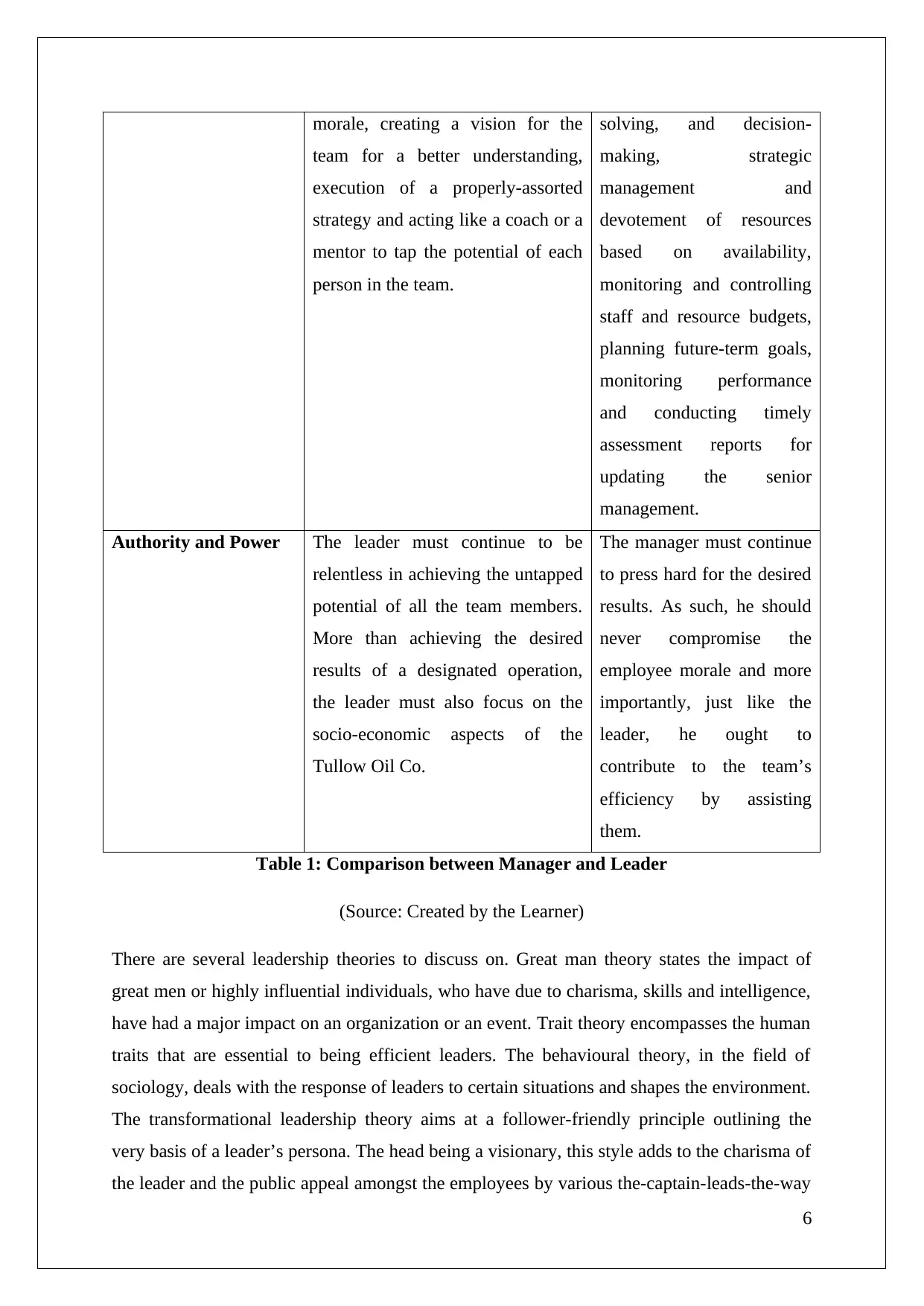
morale, creating a vision for the
team for a better understanding,
execution of a properly-assorted
strategy and acting like a coach or a
mentor to tap the potential of each
person in the team.
solving, and decision-
making, strategic
management and
devotement of resources
based on availability,
monitoring and controlling
staff and resource budgets,
planning future-term goals,
monitoring performance
and conducting timely
assessment reports for
updating the senior
management.
Authority and Power The leader must continue to be
relentless in achieving the untapped
potential of all the team members.
More than achieving the desired
results of a designated operation,
the leader must also focus on the
socio-economic aspects of the
Tullow Oil Co.
The manager must continue
to press hard for the desired
results. As such, he should
never compromise the
employee morale and more
importantly, just like the
leader, he ought to
contribute to the team’s
efficiency by assisting
them.
Table 1: Comparison between Manager and Leader
(Source: Created by the Learner)
There are several leadership theories to discuss on. Great man theory states the impact of
great men or highly influential individuals, who have due to charisma, skills and intelligence,
have had a major impact on an organization or an event. Trait theory encompasses the human
traits that are essential to being efficient leaders. The behavioural theory, in the field of
sociology, deals with the response of leaders to certain situations and shapes the environment.
The transformational leadership theory aims at a follower-friendly principle outlining the
very basis of a leader’s persona. The head being a visionary, this style adds to the charisma of
the leader and the public appeal amongst the employees by various the-captain-leads-the-way
6
team for a better understanding,
execution of a properly-assorted
strategy and acting like a coach or a
mentor to tap the potential of each
person in the team.
solving, and decision-
making, strategic
management and
devotement of resources
based on availability,
monitoring and controlling
staff and resource budgets,
planning future-term goals,
monitoring performance
and conducting timely
assessment reports for
updating the senior
management.
Authority and Power The leader must continue to be
relentless in achieving the untapped
potential of all the team members.
More than achieving the desired
results of a designated operation,
the leader must also focus on the
socio-economic aspects of the
Tullow Oil Co.
The manager must continue
to press hard for the desired
results. As such, he should
never compromise the
employee morale and more
importantly, just like the
leader, he ought to
contribute to the team’s
efficiency by assisting
them.
Table 1: Comparison between Manager and Leader
(Source: Created by the Learner)
There are several leadership theories to discuss on. Great man theory states the impact of
great men or highly influential individuals, who have due to charisma, skills and intelligence,
have had a major impact on an organization or an event. Trait theory encompasses the human
traits that are essential to being efficient leaders. The behavioural theory, in the field of
sociology, deals with the response of leaders to certain situations and shapes the environment.
The transformational leadership theory aims at a follower-friendly principle outlining the
very basis of a leader’s persona. The head being a visionary, this style adds to the charisma of
the leader and the public appeal amongst the employees by various the-captain-leads-the-way
6
⊘ This is a preview!⊘
Do you want full access?
Subscribe today to unlock all pages.
Trusted by 1+ million students worldwide
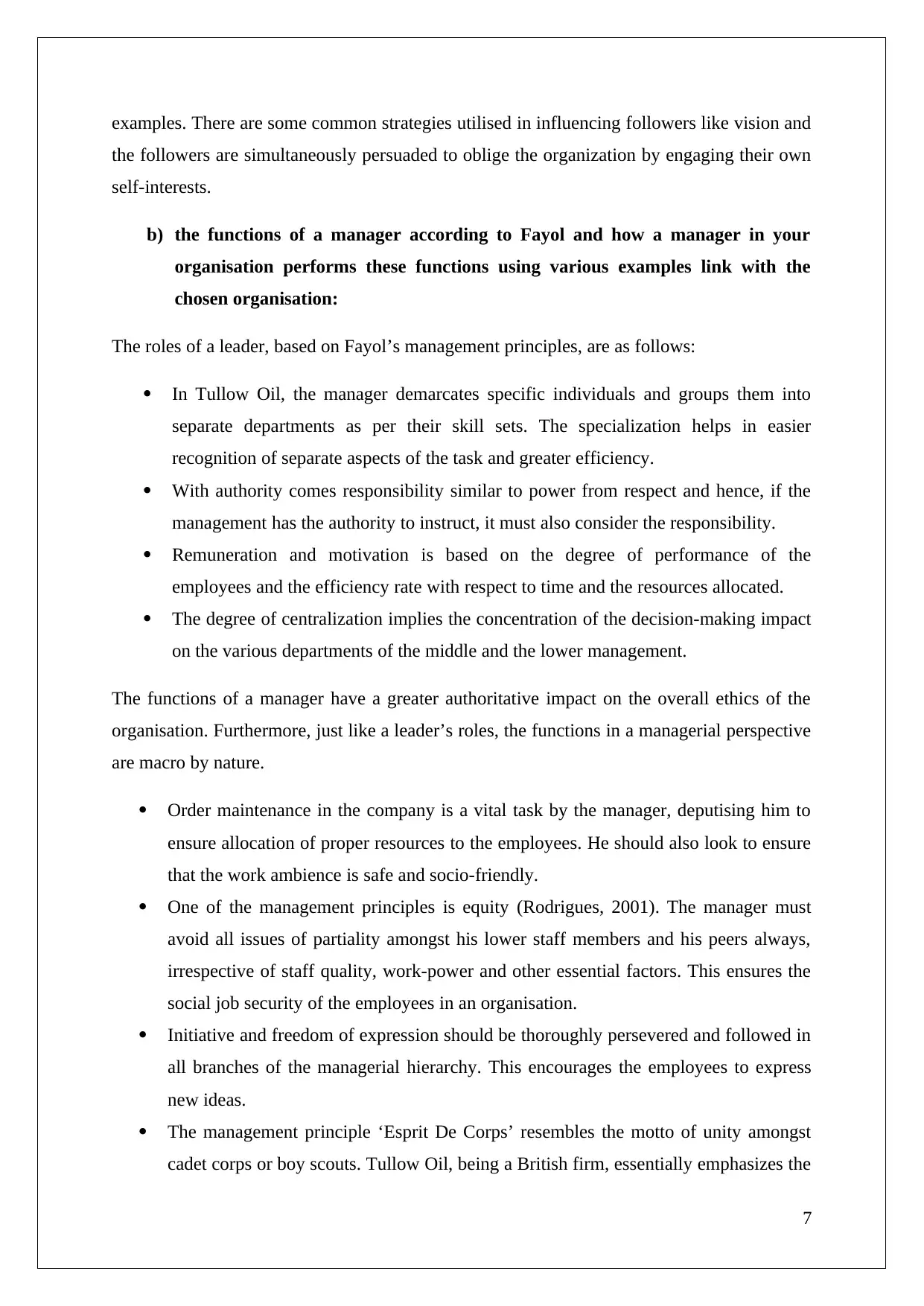
examples. There are some common strategies utilised in influencing followers like vision and
the followers are simultaneously persuaded to oblige the organization by engaging their own
self-interests.
b) the functions of a manager according to Fayol and how a manager in your
organisation performs these functions using various examples link with the
chosen organisation:
The roles of a leader, based on Fayol’s management principles, are as follows:
In Tullow Oil, the manager demarcates specific individuals and groups them into
separate departments as per their skill sets. The specialization helps in easier
recognition of separate aspects of the task and greater efficiency.
With authority comes responsibility similar to power from respect and hence, if the
management has the authority to instruct, it must also consider the responsibility.
Remuneration and motivation is based on the degree of performance of the
employees and the efficiency rate with respect to time and the resources allocated.
The degree of centralization implies the concentration of the decision-making impact
on the various departments of the middle and the lower management.
The functions of a manager have a greater authoritative impact on the overall ethics of the
organisation. Furthermore, just like a leader’s roles, the functions in a managerial perspective
are macro by nature.
Order maintenance in the company is a vital task by the manager, deputising him to
ensure allocation of proper resources to the employees. He should also look to ensure
that the work ambience is safe and socio-friendly.
One of the management principles is equity (Rodrigues, 2001). The manager must
avoid all issues of partiality amongst his lower staff members and his peers always,
irrespective of staff quality, work-power and other essential factors. This ensures the
social job security of the employees in an organisation.
Initiative and freedom of expression should be thoroughly persevered and followed in
all branches of the managerial hierarchy. This encourages the employees to express
new ideas.
The management principle ‘Esprit De Corps’ resembles the motto of unity amongst
cadet corps or boy scouts. Tullow Oil, being a British firm, essentially emphasizes the
7
the followers are simultaneously persuaded to oblige the organization by engaging their own
self-interests.
b) the functions of a manager according to Fayol and how a manager in your
organisation performs these functions using various examples link with the
chosen organisation:
The roles of a leader, based on Fayol’s management principles, are as follows:
In Tullow Oil, the manager demarcates specific individuals and groups them into
separate departments as per their skill sets. The specialization helps in easier
recognition of separate aspects of the task and greater efficiency.
With authority comes responsibility similar to power from respect and hence, if the
management has the authority to instruct, it must also consider the responsibility.
Remuneration and motivation is based on the degree of performance of the
employees and the efficiency rate with respect to time and the resources allocated.
The degree of centralization implies the concentration of the decision-making impact
on the various departments of the middle and the lower management.
The functions of a manager have a greater authoritative impact on the overall ethics of the
organisation. Furthermore, just like a leader’s roles, the functions in a managerial perspective
are macro by nature.
Order maintenance in the company is a vital task by the manager, deputising him to
ensure allocation of proper resources to the employees. He should also look to ensure
that the work ambience is safe and socio-friendly.
One of the management principles is equity (Rodrigues, 2001). The manager must
avoid all issues of partiality amongst his lower staff members and his peers always,
irrespective of staff quality, work-power and other essential factors. This ensures the
social job security of the employees in an organisation.
Initiative and freedom of expression should be thoroughly persevered and followed in
all branches of the managerial hierarchy. This encourages the employees to express
new ideas.
The management principle ‘Esprit De Corps’ resembles the motto of unity amongst
cadet corps or boy scouts. Tullow Oil, being a British firm, essentially emphasizes the
7
Paraphrase This Document
Need a fresh take? Get an instant paraphrase of this document with our AI Paraphraser
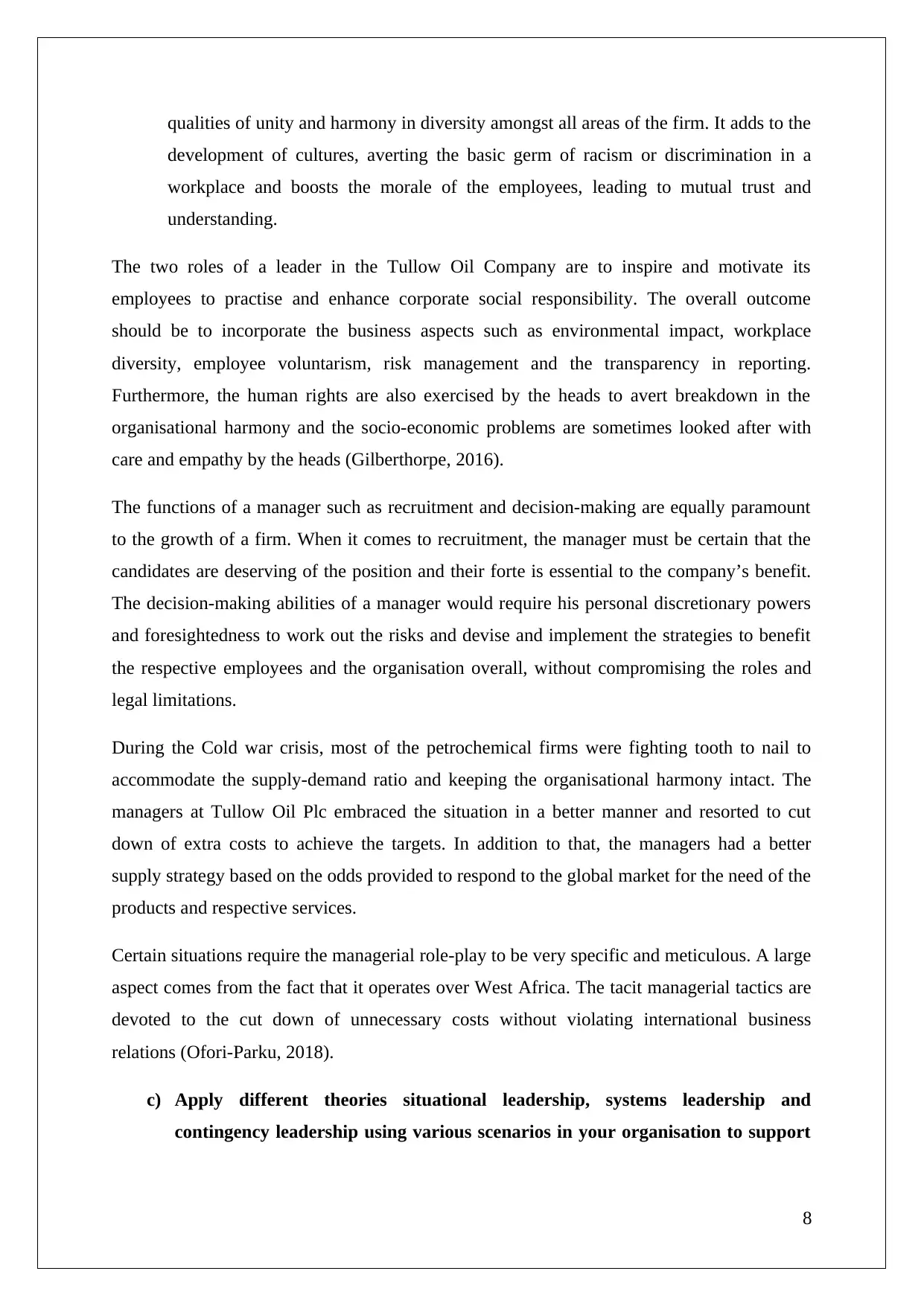
qualities of unity and harmony in diversity amongst all areas of the firm. It adds to the
development of cultures, averting the basic germ of racism or discrimination in a
workplace and boosts the morale of the employees, leading to mutual trust and
understanding.
The two roles of a leader in the Tullow Oil Company are to inspire and motivate its
employees to practise and enhance corporate social responsibility. The overall outcome
should be to incorporate the business aspects such as environmental impact, workplace
diversity, employee voluntarism, risk management and the transparency in reporting.
Furthermore, the human rights are also exercised by the heads to avert breakdown in the
organisational harmony and the socio-economic problems are sometimes looked after with
care and empathy by the heads (Gilberthorpe, 2016).
The functions of a manager such as recruitment and decision-making are equally paramount
to the growth of a firm. When it comes to recruitment, the manager must be certain that the
candidates are deserving of the position and their forte is essential to the company’s benefit.
The decision-making abilities of a manager would require his personal discretionary powers
and foresightedness to work out the risks and devise and implement the strategies to benefit
the respective employees and the organisation overall, without compromising the roles and
legal limitations.
During the Cold war crisis, most of the petrochemical firms were fighting tooth to nail to
accommodate the supply-demand ratio and keeping the organisational harmony intact. The
managers at Tullow Oil Plc embraced the situation in a better manner and resorted to cut
down of extra costs to achieve the targets. In addition to that, the managers had a better
supply strategy based on the odds provided to respond to the global market for the need of the
products and respective services.
Certain situations require the managerial role-play to be very specific and meticulous. A large
aspect comes from the fact that it operates over West Africa. The tacit managerial tactics are
devoted to the cut down of unnecessary costs without violating international business
relations (Ofori-Parku, 2018).
c) Apply different theories situational leadership, systems leadership and
contingency leadership using various scenarios in your organisation to support
8
development of cultures, averting the basic germ of racism or discrimination in a
workplace and boosts the morale of the employees, leading to mutual trust and
understanding.
The two roles of a leader in the Tullow Oil Company are to inspire and motivate its
employees to practise and enhance corporate social responsibility. The overall outcome
should be to incorporate the business aspects such as environmental impact, workplace
diversity, employee voluntarism, risk management and the transparency in reporting.
Furthermore, the human rights are also exercised by the heads to avert breakdown in the
organisational harmony and the socio-economic problems are sometimes looked after with
care and empathy by the heads (Gilberthorpe, 2016).
The functions of a manager such as recruitment and decision-making are equally paramount
to the growth of a firm. When it comes to recruitment, the manager must be certain that the
candidates are deserving of the position and their forte is essential to the company’s benefit.
The decision-making abilities of a manager would require his personal discretionary powers
and foresightedness to work out the risks and devise and implement the strategies to benefit
the respective employees and the organisation overall, without compromising the roles and
legal limitations.
During the Cold war crisis, most of the petrochemical firms were fighting tooth to nail to
accommodate the supply-demand ratio and keeping the organisational harmony intact. The
managers at Tullow Oil Plc embraced the situation in a better manner and resorted to cut
down of extra costs to achieve the targets. In addition to that, the managers had a better
supply strategy based on the odds provided to respond to the global market for the need of the
products and respective services.
Certain situations require the managerial role-play to be very specific and meticulous. A large
aspect comes from the fact that it operates over West Africa. The tacit managerial tactics are
devoted to the cut down of unnecessary costs without violating international business
relations (Ofori-Parku, 2018).
c) Apply different theories situational leadership, systems leadership and
contingency leadership using various scenarios in your organisation to support
8
your explanation, explain how they are applied in the organisation by any
manager.
The situational leadership model, developed by Paul Hersey and Ken Blanchard, was aimed
at conceptualising the fact that every leader has a different style and every manager’s modus
operandi varies as per his aptitude and his insight. It has two fundamental concepts, namely
the leadership style and the individual’s performance level. The systematic leadership style is
an efficient process of conducting business management and is essential to the
petrochemicals company as it would require them to devise newer and cost-effective ways of
transport and product exchange between areas. Fiedler’s contingency leadership theory deals
with the leader’s effectiveness and his influence on the others. It states that a leadership
doesn’t consist of performance alone; the control over a situation and the response rate is
equally important to deciding if the leader is effective enough (Sethibe, 2015).
The democratic style states that the leadership would be participative by nature; it keeps the
employees informed. Even though the leader shares his ideas and decisions with the team, his
decision attains the ultimatum. He also allows freedom of expression, which helps the
employees to express ideas. The autocratic style is the arbitrary way of leading a team. It is
coercive in nature. As the name hints, an autocratic leader primarily depends on his power to
make decisions, which could often affect the employees. The laissez-faire style is known as
‘hands-off’ style. It gives followers the maximal freedom. The followers are also allowed to
make the decisions for the company and set the goals and the future targets of the company.
The continuum leadership styles are those kinds that are manager-oriented and manifest the
amount of freedom and power that a manager chooses to bestow upon his team and the same
that he wishes to exercise at his own discretion. Kurt Lewin, often acknowledged as the
father of social psychology, was the architect of the continuum leadership model, which was
sub-divided into the democratic, autocratic and laissez-faire styles respectively based on the
administration of power between the manager and his unit. There are several pros and cons to
this leadership style; the pros being it deviates away from the old, mystic ‘great man’ theory
and makes the leader more approachable and gives both the parties enough exposure for
dispassionate and impartial responsibility sharing. This leadership style provides the vantage
of self-learning and self-building through experience and daily retrospection. Another merit
of this style is it serves as a coaching framework and thus adds to the value of executive
leadership coaching.
9
manager.
The situational leadership model, developed by Paul Hersey and Ken Blanchard, was aimed
at conceptualising the fact that every leader has a different style and every manager’s modus
operandi varies as per his aptitude and his insight. It has two fundamental concepts, namely
the leadership style and the individual’s performance level. The systematic leadership style is
an efficient process of conducting business management and is essential to the
petrochemicals company as it would require them to devise newer and cost-effective ways of
transport and product exchange between areas. Fiedler’s contingency leadership theory deals
with the leader’s effectiveness and his influence on the others. It states that a leadership
doesn’t consist of performance alone; the control over a situation and the response rate is
equally important to deciding if the leader is effective enough (Sethibe, 2015).
The democratic style states that the leadership would be participative by nature; it keeps the
employees informed. Even though the leader shares his ideas and decisions with the team, his
decision attains the ultimatum. He also allows freedom of expression, which helps the
employees to express ideas. The autocratic style is the arbitrary way of leading a team. It is
coercive in nature. As the name hints, an autocratic leader primarily depends on his power to
make decisions, which could often affect the employees. The laissez-faire style is known as
‘hands-off’ style. It gives followers the maximal freedom. The followers are also allowed to
make the decisions for the company and set the goals and the future targets of the company.
The continuum leadership styles are those kinds that are manager-oriented and manifest the
amount of freedom and power that a manager chooses to bestow upon his team and the same
that he wishes to exercise at his own discretion. Kurt Lewin, often acknowledged as the
father of social psychology, was the architect of the continuum leadership model, which was
sub-divided into the democratic, autocratic and laissez-faire styles respectively based on the
administration of power between the manager and his unit. There are several pros and cons to
this leadership style; the pros being it deviates away from the old, mystic ‘great man’ theory
and makes the leader more approachable and gives both the parties enough exposure for
dispassionate and impartial responsibility sharing. This leadership style provides the vantage
of self-learning and self-building through experience and daily retrospection. Another merit
of this style is it serves as a coaching framework and thus adds to the value of executive
leadership coaching.
9
⊘ This is a preview!⊘
Do you want full access?
Subscribe today to unlock all pages.
Trusted by 1+ million students worldwide
The demerits lie in the fact that these styles are considered outdated in comparison to popular
recent hypotheses by many psychologists, as they do not have a proper cache in the
competitive context of all businesses in UK. The Tannenbaum and Schmidt Continuum
leadership recognises that the chosen leadership style depends on a vista of factors, namely,
the leader’s personalities and the respective workers’ qualities at the former’s disposal.
Clearly, it practises the elements of decision-making and prioritises the need for leadership
(Tortorella et al., 2018).
The continuum represents the action area pertaining to two aspects, area of freedom available
to non-managers and degree of authority belonging to the leader. The managerial part of the
leadership is in telling and selling the decisions to the staff, which involves persuading the
staff to buy the idea. He then entertains all kinds of questions from his staff for which he
presents a ballpark of tentative decisions subject to further implementation. Furthermore, the
manager presents a problem, then gets the required suggestions, and then emerges with a
decision, which sums up the consulting form. Finally, the part where he asks his team
members to join hands and accomplish the task given or achieve the set targets within the
parameters and the limitations. Simultaneously, the manager also allows the freedom of
options to be exercised by his own team to set a strategic pattern for task-completion (Bond,
2015). Hence, the theory rightly pointed that the telling, the selling and the consulting parts
were cardinal to the manager and the joining part was essential to the subordinates. The pros
and cons of this leadership are as follows:
The advantage of this leadership lies, hereof, that the manager has a wide range of
aspects for easy involvement and power exercise. It allows the features of delegation
and authority. It emphasizes the focus and empowers the decision-maker to judge
time, resources, etcetera and it creates a background research of the delegation model
to adjudicate about its effectiveness.
The disadvantage is once the managerial aspect is done with, the supremoes do not
follow up with the task computation and the efficiency of the strategy set by the team
members. It assumes ‘neutral’ environment and hence doesn’t socialise much or
engage in politics. It simplifies complex decisions to a polar dimension, thus
restricting the extent of acumen usage and increase in restrictions.
In Tullow Oil (UK), the manager exercises a Lewin leadership model, which comprises the
democratic, and the autocratic styles and at times, tangentially fringes on the laissez-faire
10
recent hypotheses by many psychologists, as they do not have a proper cache in the
competitive context of all businesses in UK. The Tannenbaum and Schmidt Continuum
leadership recognises that the chosen leadership style depends on a vista of factors, namely,
the leader’s personalities and the respective workers’ qualities at the former’s disposal.
Clearly, it practises the elements of decision-making and prioritises the need for leadership
(Tortorella et al., 2018).
The continuum represents the action area pertaining to two aspects, area of freedom available
to non-managers and degree of authority belonging to the leader. The managerial part of the
leadership is in telling and selling the decisions to the staff, which involves persuading the
staff to buy the idea. He then entertains all kinds of questions from his staff for which he
presents a ballpark of tentative decisions subject to further implementation. Furthermore, the
manager presents a problem, then gets the required suggestions, and then emerges with a
decision, which sums up the consulting form. Finally, the part where he asks his team
members to join hands and accomplish the task given or achieve the set targets within the
parameters and the limitations. Simultaneously, the manager also allows the freedom of
options to be exercised by his own team to set a strategic pattern for task-completion (Bond,
2015). Hence, the theory rightly pointed that the telling, the selling and the consulting parts
were cardinal to the manager and the joining part was essential to the subordinates. The pros
and cons of this leadership are as follows:
The advantage of this leadership lies, hereof, that the manager has a wide range of
aspects for easy involvement and power exercise. It allows the features of delegation
and authority. It emphasizes the focus and empowers the decision-maker to judge
time, resources, etcetera and it creates a background research of the delegation model
to adjudicate about its effectiveness.
The disadvantage is once the managerial aspect is done with, the supremoes do not
follow up with the task computation and the efficiency of the strategy set by the team
members. It assumes ‘neutral’ environment and hence doesn’t socialise much or
engage in politics. It simplifies complex decisions to a polar dimension, thus
restricting the extent of acumen usage and increase in restrictions.
In Tullow Oil (UK), the manager exercises a Lewin leadership model, which comprises the
democratic, and the autocratic styles and at times, tangentially fringes on the laissez-faire
10
Paraphrase This Document
Need a fresh take? Get an instant paraphrase of this document with our AI Paraphraser
style. The managers have an authoritative impact on their employees and prioritise certain
aspects of the operations management field such as cost, time, resources and manpower
dependability to gain the competitive edge. In doing so, the managerial emphasis often
overlooks the employee satisfaction part, resulting in office chaos and several disgruntled
members (Franks, 2015). The managers are devout to their work and should remind
themselves to empathise with the situation of the employees. Their skill sets are however,
pivotal at times when the teams and the company, at large, face a production crisis and hence
help the organisation, overall, to overcome the odds.
Conclusion
The managerial styles and the leadership criteria are very essential to the organisational
benefits at large, without risking its values in the consumer market. A manager, above
everyone else, must remember that he is the brainchild of how the company strategizes its
objectives and forwards the company. Addition and implementation of long-term goals and
execution of the same are distinctly achievable if the leaders can adapt to the changing times
with response to the consumer audience and deploy the newer technologies like shale oil
extraction to restrict unnecessary expenditure. As petrochemicals are increasingly becoming
an expendable resource, it also helps to create background research on more innovative
methods for supply enhancement. The employees, because of such highly challenging moves
could avail the benefits for added welfare adding to the employee customer satisfaction. A
quantitative macroeconomic analysis suggests that the organisation might take a slack on the
sovereign funds and deploy more tools to assist its workforce in regions of West Africa and
Asia. The company, being a private sector company, would not deploy the laissez-faire style
as it might prove the company’s vulnerability to employee-manager conflicts of interest.
11
aspects of the operations management field such as cost, time, resources and manpower
dependability to gain the competitive edge. In doing so, the managerial emphasis often
overlooks the employee satisfaction part, resulting in office chaos and several disgruntled
members (Franks, 2015). The managers are devout to their work and should remind
themselves to empathise with the situation of the employees. Their skill sets are however,
pivotal at times when the teams and the company, at large, face a production crisis and hence
help the organisation, overall, to overcome the odds.
Conclusion
The managerial styles and the leadership criteria are very essential to the organisational
benefits at large, without risking its values in the consumer market. A manager, above
everyone else, must remember that he is the brainchild of how the company strategizes its
objectives and forwards the company. Addition and implementation of long-term goals and
execution of the same are distinctly achievable if the leaders can adapt to the changing times
with response to the consumer audience and deploy the newer technologies like shale oil
extraction to restrict unnecessary expenditure. As petrochemicals are increasingly becoming
an expendable resource, it also helps to create background research on more innovative
methods for supply enhancement. The employees, because of such highly challenging moves
could avail the benefits for added welfare adding to the employee customer satisfaction. A
quantitative macroeconomic analysis suggests that the organisation might take a slack on the
sovereign funds and deploy more tools to assist its workforce in regions of West Africa and
Asia. The company, being a private sector company, would not deploy the laissez-faire style
as it might prove the company’s vulnerability to employee-manager conflicts of interest.
11
Task 2
Introduction
The manager of a retail store is required to deliver to a seminar on operations management.
The store in context is Amazon (UK). A brand manager is often looked upon as the pilot of
most decisions in the organization. Hence, a manager must discharge his duties with utmost
care and diligence, so that his members can complete the task with a greater efficiency,
portraying the overall efficiency of the organization; this strategy should be exercised across
all the branches of the same firm to inspire confidence in managerial styles and
implementation to give a better work-field backdrop amongst employees.
a. Explain different approaches to operations management and identifying what is
used in your store.
An operations management approach is primarily based on the production arrangement and
the criteria that be-fits its maximal potency. Amazon Inc. (UK) is one of the worldwide
reputed examples of e-commerce. As such, it deploys numerous theories in several
applications of it operations management. These theories help in improving the quality and
the efficiency of services and resource management, keeping in mind, the employer-
employee satisfaction and the consumer-market adaptability range. Some of the theories and
tools that are utilised to enhance the approach are discussed as follows:
Six Sigma
Six Sigma is a measure in many organizations to strive to better market quality and process
improvement. Engineered by Bill Smith, it has recently been centralised to most companies
as a part of its business strategy. The strategies seek to control the quality of output of a
process by marking and optimization of the product defects and uses a set of empirical
statistical models. Each Six Sigma project is executed to improve the performance, increase
customer satisfaction, complement the product quality, value the consumer targets, reduce
costs and have a direct impact on ecology. Following a delineated series of steps and
techniques, it is aimed at keeping the number of defects to effectively 3.4 per million
opportunities. The key idea of this seminar would be able to manifest and enlighten others
how Six Sigma could help Amazon in ascertaining its place and consolidating its reputation
in the world market of e-commerce.
12
Introduction
The manager of a retail store is required to deliver to a seminar on operations management.
The store in context is Amazon (UK). A brand manager is often looked upon as the pilot of
most decisions in the organization. Hence, a manager must discharge his duties with utmost
care and diligence, so that his members can complete the task with a greater efficiency,
portraying the overall efficiency of the organization; this strategy should be exercised across
all the branches of the same firm to inspire confidence in managerial styles and
implementation to give a better work-field backdrop amongst employees.
a. Explain different approaches to operations management and identifying what is
used in your store.
An operations management approach is primarily based on the production arrangement and
the criteria that be-fits its maximal potency. Amazon Inc. (UK) is one of the worldwide
reputed examples of e-commerce. As such, it deploys numerous theories in several
applications of it operations management. These theories help in improving the quality and
the efficiency of services and resource management, keeping in mind, the employer-
employee satisfaction and the consumer-market adaptability range. Some of the theories and
tools that are utilised to enhance the approach are discussed as follows:
Six Sigma
Six Sigma is a measure in many organizations to strive to better market quality and process
improvement. Engineered by Bill Smith, it has recently been centralised to most companies
as a part of its business strategy. The strategies seek to control the quality of output of a
process by marking and optimization of the product defects and uses a set of empirical
statistical models. Each Six Sigma project is executed to improve the performance, increase
customer satisfaction, complement the product quality, value the consumer targets, reduce
costs and have a direct impact on ecology. Following a delineated series of steps and
techniques, it is aimed at keeping the number of defects to effectively 3.4 per million
opportunities. The key idea of this seminar would be able to manifest and enlighten others
how Six Sigma could help Amazon in ascertaining its place and consolidating its reputation
in the world market of e-commerce.
12
⊘ This is a preview!⊘
Do you want full access?
Subscribe today to unlock all pages.
Trusted by 1+ million students worldwide

1 out of 23


Related Documents


Your All-in-One AI-Powered Toolkit for Academic Success.
+13062052269
info@desklib.com
Available 24*7 on WhatsApp / Email
![[object Object]](/_next/static/media/star-bottom.7253800d.svg)
Unlock your academic potential
Copyright © 2020–2026 A2Z Services. All Rights Reserved. Developed and managed by ZUCOL.