OTMA01 Operations Management: Consol Glass Case Study Analysis
VerifiedAdded on 2023/06/15
|10
|2452
|221
Case Study
AI Summary
This assignment provides a comprehensive analysis of Consol Glass's operations management strategies, focusing on aligning with corporate strategy, environmental scanning, market analysis, and competitive priorities. It examines process strategy, structure, and principles, including the implementation of advanced technologies for glass manufacturing. The assignment also delves into quality dimensions using models like Kaizen, Lean Manufacturing, Six Sigma, and Lean Six Sigma, alongside an analysis of supply chain material flows. Furthermore, it includes a statistical process control analysis using X-Bar and R-Bar charts and a breakeven analysis for accounting services, recommending pricing strategies to maximize profitability. This document is available on Desklib, a platform offering a wealth of study resources for students.
Running head: OPERATIONS MANAGEMENT
Operations Management
Name of Student:
Name of University:
Author’s Note:
Operations Management
Name of Student:
Name of University:
Author’s Note:

Paraphrase This Document
Need a fresh take? Get an instant paraphrase of this document with our AI Paraphraser
1OPERATIONS MANAGEMENT
Table of Contents
Section A.........................................................................................................................................3
Answer to question 1.......................................................................................................................3
Alignment with the corporate strategy........................................................................................3
Environment Scanning.................................................................................................................3
Market analysis............................................................................................................................3
Competitive priorities..................................................................................................................4
Process strategy as a part of the operations strategy....................................................................4
Process structure and principles...................................................................................................4
Section B..........................................................................................................................................5
Answer to question 1.......................................................................................................................5
Answer to question 1.1................................................................................................................5
Answer to question 1.2................................................................................................................5
Answer to question 2.......................................................................................................................6
Answer to question 2.1................................................................................................................6
Answer to question 2.1.1.........................................................................................................6
Answer to question 2.1.2.........................................................................................................7
Answer to question 2.2................................................................................................................7
References........................................................................................................................................9
Table of Contents
Section A.........................................................................................................................................3
Answer to question 1.......................................................................................................................3
Alignment with the corporate strategy........................................................................................3
Environment Scanning.................................................................................................................3
Market analysis............................................................................................................................3
Competitive priorities..................................................................................................................4
Process strategy as a part of the operations strategy....................................................................4
Process structure and principles...................................................................................................4
Section B..........................................................................................................................................5
Answer to question 1.......................................................................................................................5
Answer to question 1.1................................................................................................................5
Answer to question 1.2................................................................................................................5
Answer to question 2.......................................................................................................................6
Answer to question 2.1................................................................................................................6
Answer to question 2.1.1.........................................................................................................6
Answer to question 2.1.2.........................................................................................................7
Answer to question 2.2................................................................................................................7
References........................................................................................................................................9
2OPERATIONS MANAGEMENT
Section A
Answer to question 1
Alignment with the corporate strategy
The main initiative towards the corporate strategy of the company should be aimed at the
enhancement of glass manufacturing process. The company scoured the world to locate the top
producers of plant in the enhancement of the glass manufacturing and standardised the processes
with proven American equipment. A significant factor in the decision of the corporate strategy
should comprise of the level of expertise that the suppliers included in the glass making process
and apply to the extent which the knowledge which has been encapsulated in the design of the
equipment. Some of the other strategic initiatives with the hardware suppliers should be
considered responsible for ensuring the complete integration of the various aspects of the system.
As per the corporate objective, the company should aim at becoming the world class competitor
for an innovative approach for enhancing the process technology (Dobrzykowski et al. 2014).
Environment Scanning
As discussed by Matta et al. (2014), South African political situation is discerned to be
highly unstable in nature which may cause various inconveniences for new and existing
businesses based on the political agenda. In addition to this, the South African currency is
subject to numerous market forces and with low currency and exchange rate (Opresnik and
Taisch 2015). The depleting nature of the unemployment has been seen to be another reason for
the high entrepreneurship spirit. The unemployment in South Africa has hit by more than 25% of
the buying power from the people. The technological factors and advancement in the
manufacturing supply chian has seen to be depicted to be considerably thin. The main laws of the
country are like that of U.K. This is seen to be particularly the case when exporting goods to
South Africa (Wilke, Majumdar and Ochieng 2014).
Market analysis
It has been discerned that the glass manufacturing industry has been able to contribute
0.3% for the total manufacturing and the value of glass sales amounting to R9.317bn in 2015.
Section A
Answer to question 1
Alignment with the corporate strategy
The main initiative towards the corporate strategy of the company should be aimed at the
enhancement of glass manufacturing process. The company scoured the world to locate the top
producers of plant in the enhancement of the glass manufacturing and standardised the processes
with proven American equipment. A significant factor in the decision of the corporate strategy
should comprise of the level of expertise that the suppliers included in the glass making process
and apply to the extent which the knowledge which has been encapsulated in the design of the
equipment. Some of the other strategic initiatives with the hardware suppliers should be
considered responsible for ensuring the complete integration of the various aspects of the system.
As per the corporate objective, the company should aim at becoming the world class competitor
for an innovative approach for enhancing the process technology (Dobrzykowski et al. 2014).
Environment Scanning
As discussed by Matta et al. (2014), South African political situation is discerned to be
highly unstable in nature which may cause various inconveniences for new and existing
businesses based on the political agenda. In addition to this, the South African currency is
subject to numerous market forces and with low currency and exchange rate (Opresnik and
Taisch 2015). The depleting nature of the unemployment has been seen to be another reason for
the high entrepreneurship spirit. The unemployment in South Africa has hit by more than 25% of
the buying power from the people. The technological factors and advancement in the
manufacturing supply chian has seen to be depicted to be considerably thin. The main laws of the
country are like that of U.K. This is seen to be particularly the case when exporting goods to
South Africa (Wilke, Majumdar and Ochieng 2014).
Market analysis
It has been discerned that the glass manufacturing industry has been able to contribute
0.3% for the total manufacturing and the value of glass sales amounting to R9.317bn in 2015.
⊘ This is a preview!⊘
Do you want full access?
Subscribe today to unlock all pages.

Trusted by 1+ million students worldwide
3OPERATIONS MANAGEMENT
The industry is seen to be dominated by three main players. The import of the glass products was
depicted to be cheaper that the local manufacturers and this was a threat to the local sector. The
marketing environment at Consol Glass has been depicted with factors influencing the success of
the sector. The five industry players are included with the “dominant three manufacturers as well
as Natglass Distributors (Pty) Ltd t/a National Glass, which is a manufacturer and wholesaler of
flat” (Hazen et al. 2016).
Competitive priorities
The main competitors of Consol Glass are PG Group and Nampak. PG Group is seen to
own the building of the different types of the programs which are related to building and the
automobile glass sector. Some of the other competitor is seen with “Natglass Distributors (Pty)
Ltd t/a National Glass” which is identified a flat glass wholesaler. The company needs to be also
prioritise the strategies for “Northern Hardware and Glass (Pty) Ltd”, which has been the main
manufacturer for “glass products for the building and automotive industries”. As per the present
competencies of the company it needs to be seen that the company specializes in “glass
packaging products in Africa and Nampak”. In addition to this, the company is determined to
manufacture one-third of the glass bottle products in South Africa. The main role of the players
has been seen with focusing on the competition commission and enquiring about the allegations
on the price fixing and division of market (Pedraza-Martinez and Van Wassenhove 2016).
Process strategy as a part of the operations strategy
The company should put an augmented focus on the process technology which is in use
of many plants as a competitive weapon. This factor has been conducive in proving the definite
cost, quality, lead-time and advantages pertaining to flexibility. These strategies have been
further seen to be related to the optimising the CIM to optimise the overall process using the
programmed knowledge base. The design of the final system will allow to reduce the manual
control and automate overall process. This is further seen to allow the processes to run at an
optimum condition on a continuous basis. The operational spin offs have been substantial for the
different types of benefits (Li et al. 2016).
Process structure and principles
The process structures and principles to needs to based on the main ideas relating to
hierarchy of command, or definition, evaluating outcomes and provisions for altering
The industry is seen to be dominated by three main players. The import of the glass products was
depicted to be cheaper that the local manufacturers and this was a threat to the local sector. The
marketing environment at Consol Glass has been depicted with factors influencing the success of
the sector. The five industry players are included with the “dominant three manufacturers as well
as Natglass Distributors (Pty) Ltd t/a National Glass, which is a manufacturer and wholesaler of
flat” (Hazen et al. 2016).
Competitive priorities
The main competitors of Consol Glass are PG Group and Nampak. PG Group is seen to
own the building of the different types of the programs which are related to building and the
automobile glass sector. Some of the other competitor is seen with “Natglass Distributors (Pty)
Ltd t/a National Glass” which is identified a flat glass wholesaler. The company needs to be also
prioritise the strategies for “Northern Hardware and Glass (Pty) Ltd”, which has been the main
manufacturer for “glass products for the building and automotive industries”. As per the present
competencies of the company it needs to be seen that the company specializes in “glass
packaging products in Africa and Nampak”. In addition to this, the company is determined to
manufacture one-third of the glass bottle products in South Africa. The main role of the players
has been seen with focusing on the competition commission and enquiring about the allegations
on the price fixing and division of market (Pedraza-Martinez and Van Wassenhove 2016).
Process strategy as a part of the operations strategy
The company should put an augmented focus on the process technology which is in use
of many plants as a competitive weapon. This factor has been conducive in proving the definite
cost, quality, lead-time and advantages pertaining to flexibility. These strategies have been
further seen to be related to the optimising the CIM to optimise the overall process using the
programmed knowledge base. The design of the final system will allow to reduce the manual
control and automate overall process. This is further seen to allow the processes to run at an
optimum condition on a continuous basis. The operational spin offs have been substantial for the
different types of benefits (Li et al. 2016).
Process structure and principles
The process structures and principles to needs to based on the main ideas relating to
hierarchy of command, or definition, evaluating outcomes and provisions for altering
Paraphrase This Document
Need a fresh take? Get an instant paraphrase of this document with our AI Paraphraser
4OPERATIONS MANAGEMENT
organizational structure. The hierarchical command needs to be followed by authority of
management and executive teams to create functional line of communication. The role definition
should be assigned with giving clear responsibilities for each person within the company which
is understood with how individual performance may impact on the overall efficiency of the entire
organization. The evaluating outcomes as well as the individual employees’ evaluation need to
be determined with the strengths and weaknesses in the overall organizational structure. The
weaknesses need to be dealt with staff training, relocation of company assets and eliminating
ineffective employees are those duplicating tasks. The principle for altering the organizational
structure is depicted with ability to remain dynamic and change itself as per the market
environment (Choi, Cheng and Zhao 2016).
Section B
Answer to question 1
Answer to question 1.1
The various types of the dimensions of the quality can be categorised as per “Kaizen /
Toyota Production System, Lean Manufacturing / The Toyota Way, Six Sigma and Lean Six"
Sigma”. The Kaizen system is seen as the “just-in-time production system pioneered in Japan”.
The lean manufacturing way is further depicted with “evolution of Kaizen as a global production
system”. The six-sigma process is considered as the improvement model which was introduced
in 1996 by Motorola. This model was later “promoted by General Electric’s CEO Jack Welch”.
The lean six sigma model has been depicted as another quality measurement tool, in which the
organizational models combines the best features for the “Lean Manufacturing and Six Sigma”.
These models are seen to be important for tracking the continuous improvement on daily basis.
The inclusion of the models in a chronological manner has been adopted as per the major
components inspired from other models (Guide and Ketokivi 2015).
Answer to question 1.2
As discussed by Hübner, Holzapfel and Kuhn (2015), the effect of supply chain in
creating effective material flows is depicted with five major flows supply chain. These are seen
with “product flow, financial flow, information flow, value flow & risk flow”. The product flows
organizational structure. The hierarchical command needs to be followed by authority of
management and executive teams to create functional line of communication. The role definition
should be assigned with giving clear responsibilities for each person within the company which
is understood with how individual performance may impact on the overall efficiency of the entire
organization. The evaluating outcomes as well as the individual employees’ evaluation need to
be determined with the strengths and weaknesses in the overall organizational structure. The
weaknesses need to be dealt with staff training, relocation of company assets and eliminating
ineffective employees are those duplicating tasks. The principle for altering the organizational
structure is depicted with ability to remain dynamic and change itself as per the market
environment (Choi, Cheng and Zhao 2016).
Section B
Answer to question 1
Answer to question 1.1
The various types of the dimensions of the quality can be categorised as per “Kaizen /
Toyota Production System, Lean Manufacturing / The Toyota Way, Six Sigma and Lean Six"
Sigma”. The Kaizen system is seen as the “just-in-time production system pioneered in Japan”.
The lean manufacturing way is further depicted with “evolution of Kaizen as a global production
system”. The six-sigma process is considered as the improvement model which was introduced
in 1996 by Motorola. This model was later “promoted by General Electric’s CEO Jack Welch”.
The lean six sigma model has been depicted as another quality measurement tool, in which the
organizational models combines the best features for the “Lean Manufacturing and Six Sigma”.
These models are seen to be important for tracking the continuous improvement on daily basis.
The inclusion of the models in a chronological manner has been adopted as per the major
components inspired from other models (Guide and Ketokivi 2015).
Answer to question 1.2
As discussed by Hübner, Holzapfel and Kuhn (2015), the effect of supply chain in
creating effective material flows is depicted with five major flows supply chain. These are seen
with “product flow, financial flow, information flow, value flow & risk flow”. The product flows
5OPERATIONS MANAGEMENT
include the movement of goods from the suppliers to the consumers and including the internal
and external flows. The inclusion of the financial flows can consider two perspectives of SCM.
Firstly, the cost and investment perspective and secondly the flows of funds. The investments
and the costs add to moving forward with the supply chain and optimization of “return on the
capital employed in a company”. A similar optimisation in the supply chain investment is able to
consider product backed down with flow of funds (Alderton 2008).
Answer to question 2
Answer to question 2.1
Answer to question 2.1.1
Sample Observation 1 Observation 2 Observation 3 Observation 4
1 204 212 188 200
2 197 201 207 203
3 181 170 185 192
4 220 205 195 188
5 190 214 208 204
54321
210
200
190
180
Sample
Sample Mean
__
X=198.2
UCL=214.52
LCL=181.88
54321
48
36
24
12
0
Sample
Sample Range
_
R=22.4
UCL=51.10
LCL=0
Xbar-R Chart of Obervation 1, ..., Obervation 4
include the movement of goods from the suppliers to the consumers and including the internal
and external flows. The inclusion of the financial flows can consider two perspectives of SCM.
Firstly, the cost and investment perspective and secondly the flows of funds. The investments
and the costs add to moving forward with the supply chain and optimization of “return on the
capital employed in a company”. A similar optimisation in the supply chain investment is able to
consider product backed down with flow of funds (Alderton 2008).
Answer to question 2
Answer to question 2.1
Answer to question 2.1.1
Sample Observation 1 Observation 2 Observation 3 Observation 4
1 204 212 188 200
2 197 201 207 203
3 181 170 185 192
4 220 205 195 188
5 190 214 208 204
54321
210
200
190
180
Sample
Sample Mean
__
X=198.2
UCL=214.52
LCL=181.88
54321
48
36
24
12
0
Sample
Sample Range
_
R=22.4
UCL=51.10
LCL=0
Xbar-R Chart of Obervation 1, ..., Obervation 4
⊘ This is a preview!⊘
Do you want full access?
Subscribe today to unlock all pages.
Trusted by 1+ million students worldwide
6OPERATIONS MANAGEMENT
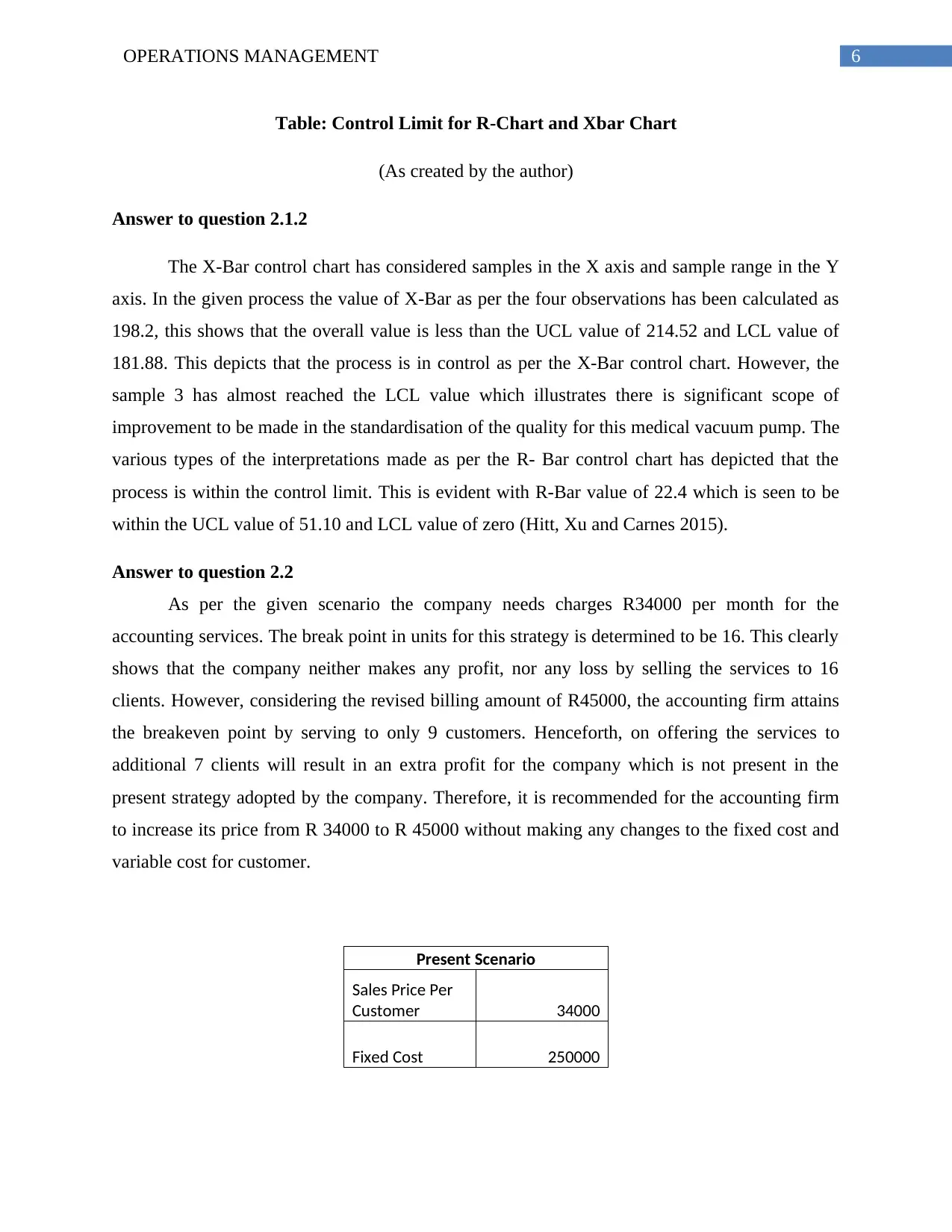
Table: Control Limit for R-Chart and Xbar Chart
(As created by the author)
Answer to question 2.1.2
The X-Bar control chart has considered samples in the X axis and sample range in the Y
axis. In the given process the value of X-Bar as per the four observations has been calculated as
198.2, this shows that the overall value is less than the UCL value of 214.52 and LCL value of
181.88. This depicts that the process is in control as per the X-Bar control chart. However, the
sample 3 has almost reached the LCL value which illustrates there is significant scope of
improvement to be made in the standardisation of the quality for this medical vacuum pump. The
various types of the interpretations made as per the R- Bar control chart has depicted that the
process is within the control limit. This is evident with R-Bar value of 22.4 which is seen to be
within the UCL value of 51.10 and LCL value of zero (Hitt, Xu and Carnes 2015).
Answer to question 2.2
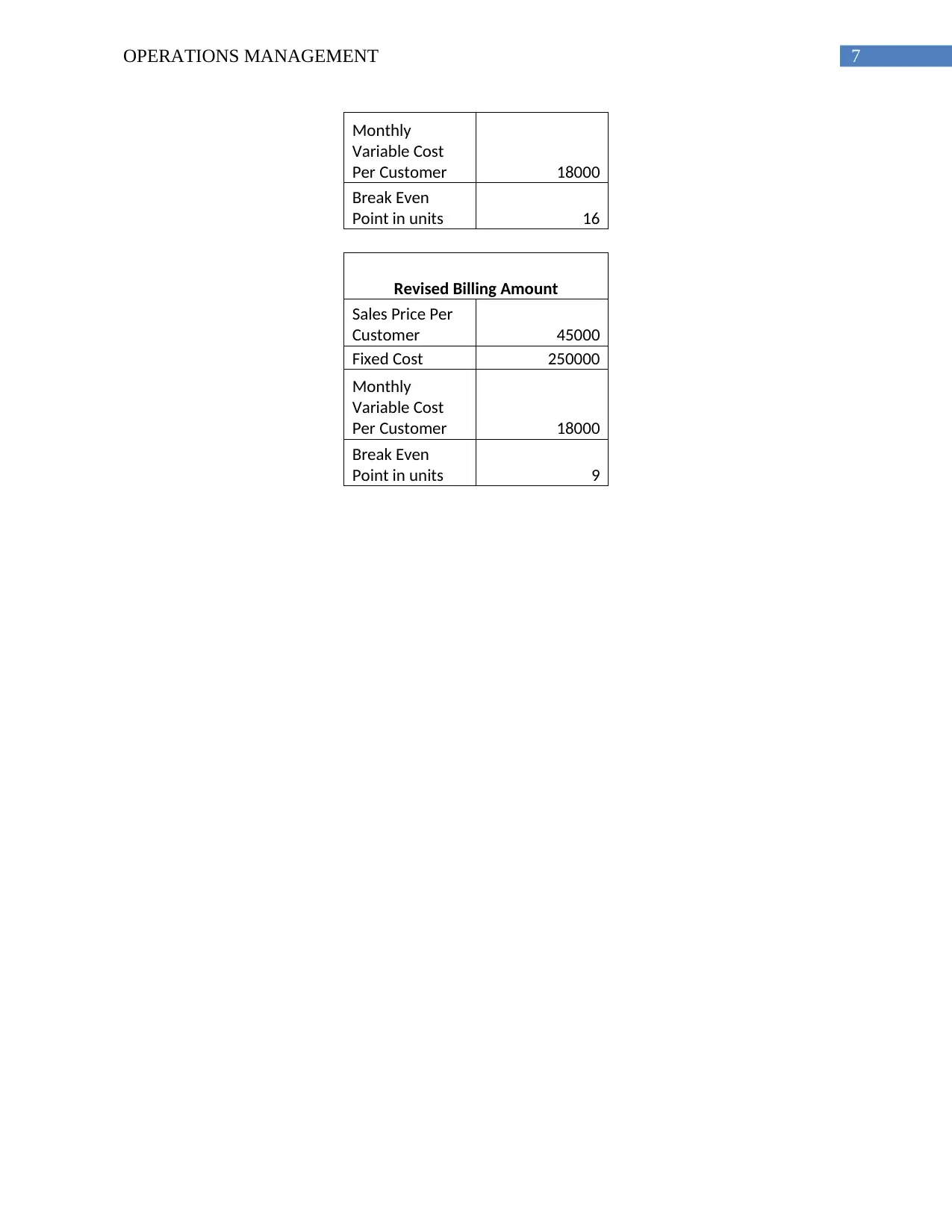
As per the given scenario the company needs charges R34000 per month for the
accounting services. The break point in units for this strategy is determined to be 16. This clearly
shows that the company neither makes any profit, nor any loss by selling the services to 16
clients. However, considering the revised billing amount of R45000, the accounting firm attains
the breakeven point by serving to only 9 customers. Henceforth, on offering the services to
additional 7 clients will result in an extra profit for the company which is not present in the
present strategy adopted by the company. Therefore, it is recommended for the accounting firm
to increase its price from R 34000 to R 45000 without making any changes to the fixed cost and
variable cost for customer.
Present Scenario
Sales Price Per
Customer 34000
Fixed Cost 250000
Table: Control Limit for R-Chart and Xbar Chart
(As created by the author)
Answer to question 2.1.2
The X-Bar control chart has considered samples in the X axis and sample range in the Y
axis. In the given process the value of X-Bar as per the four observations has been calculated as
198.2, this shows that the overall value is less than the UCL value of 214.52 and LCL value of
181.88. This depicts that the process is in control as per the X-Bar control chart. However, the
sample 3 has almost reached the LCL value which illustrates there is significant scope of
improvement to be made in the standardisation of the quality for this medical vacuum pump. The
various types of the interpretations made as per the R- Bar control chart has depicted that the
process is within the control limit. This is evident with R-Bar value of 22.4 which is seen to be
within the UCL value of 51.10 and LCL value of zero (Hitt, Xu and Carnes 2015).
Answer to question 2.2
As per the given scenario the company needs charges R34000 per month for the
accounting services. The break point in units for this strategy is determined to be 16. This clearly
shows that the company neither makes any profit, nor any loss by selling the services to 16
clients. However, considering the revised billing amount of R45000, the accounting firm attains
the breakeven point by serving to only 9 customers. Henceforth, on offering the services to
additional 7 clients will result in an extra profit for the company which is not present in the
present strategy adopted by the company. Therefore, it is recommended for the accounting firm
to increase its price from R 34000 to R 45000 without making any changes to the fixed cost and
variable cost for customer.
Present Scenario
Sales Price Per
Customer 34000
Fixed Cost 250000
Paraphrase This Document
Need a fresh take? Get an instant paraphrase of this document with our AI Paraphraser
7OPERATIONS MANAGEMENT
Monthly
Variable Cost
Per Customer 18000
Break Even
Point in units 16
Revised Billing Amount
Sales Price Per
Customer 45000
Fixed Cost 250000
Monthly
Variable Cost
Per Customer 18000
Break Even
Point in units 9
Monthly
Variable Cost
Per Customer 18000
Break Even
Point in units 16
Revised Billing Amount
Sales Price Per
Customer 45000
Fixed Cost 250000
Monthly
Variable Cost
Per Customer 18000
Break Even
Point in units 9
8OPERATIONS MANAGEMENT
References
Alderton, P. M. (Patrick M. (2008) Port Management and Operations, Igarss 2014. doi:
10.1017/CBO9781107415324.004.
Choi, T. M., Cheng, T. C. E. and Zhao, X. (2016) ‘Multi-Methodological Research in Operations
Management’, Production and Operations Management, 25(3), pp. 379–389. doi:
10.1111/poms.12534.
Dobrzykowski, D., Saboori Deilami, V., Hong, P. and Kim, S. C. (2014) ‘A structured analysis
of operations and supply chain management research in healthcare (1982-2011)’, International
Journal of Production Economics, 147(PART B), pp. 514–530. doi: 10.1016/j.ijpe.2013.04.055.
Guide, V. D. R. and Ketokivi, M. (2015) ‘Notes from the Editors: Restructuring the Journal of
Operations Management’, Journal of Operations Management, pp. v–x. doi: 10.1016/S0272-
6963(15)00073-X.
Hazen, B. T., Skipper, J. B., Boone, C. A. and Hill, R. R. (2016) ‘Back in business: operations
research in support of big data analytics for operations and supply chain management’, Annals of
Operations Research, pp. 1–11. doi: 10.1007/s10479-016-2226-0.
Hitt, M. A., Xu, K. and Carnes, C. M. (2015) ‘Resource based theory in operations management
research’, Journal of Operations Management, 41, pp. 77–94. doi: 10.1016/j.jom.2015.11.002.
Hübner, A., Holzapfel, A. and Kuhn, H. (2015) ‘Operations management in multi-channel
retailing: an exploratory study’, Operations Management Research, 8(3–4), pp. 84–100. doi:
10.1007/s12063-015-0101-9.
Li, F., Nucciarelli, A., Roden, S. and Graham, G. (2016) ‘How smart cities transform operations
models: a new research agenda for operations management in the digital economy’, Production
Planning & Control, 27(6), pp. 514–528. doi: 10.1080/09537287.2016.1147096.
Matta, A., Chahed, S., Sahin, E. and Dallery, Y. (2014) ‘Modelling home care organisations
from an operations management perspective’, Flexible Services and Manufacturing Journal,
26(3), pp. 295–319. doi: 10.1007/s10696-012-9157-0.
References
Alderton, P. M. (Patrick M. (2008) Port Management and Operations, Igarss 2014. doi:
10.1017/CBO9781107415324.004.
Choi, T. M., Cheng, T. C. E. and Zhao, X. (2016) ‘Multi-Methodological Research in Operations
Management’, Production and Operations Management, 25(3), pp. 379–389. doi:
10.1111/poms.12534.
Dobrzykowski, D., Saboori Deilami, V., Hong, P. and Kim, S. C. (2014) ‘A structured analysis
of operations and supply chain management research in healthcare (1982-2011)’, International
Journal of Production Economics, 147(PART B), pp. 514–530. doi: 10.1016/j.ijpe.2013.04.055.
Guide, V. D. R. and Ketokivi, M. (2015) ‘Notes from the Editors: Restructuring the Journal of
Operations Management’, Journal of Operations Management, pp. v–x. doi: 10.1016/S0272-
6963(15)00073-X.
Hazen, B. T., Skipper, J. B., Boone, C. A. and Hill, R. R. (2016) ‘Back in business: operations
research in support of big data analytics for operations and supply chain management’, Annals of
Operations Research, pp. 1–11. doi: 10.1007/s10479-016-2226-0.
Hitt, M. A., Xu, K. and Carnes, C. M. (2015) ‘Resource based theory in operations management
research’, Journal of Operations Management, 41, pp. 77–94. doi: 10.1016/j.jom.2015.11.002.
Hübner, A., Holzapfel, A. and Kuhn, H. (2015) ‘Operations management in multi-channel
retailing: an exploratory study’, Operations Management Research, 8(3–4), pp. 84–100. doi:
10.1007/s12063-015-0101-9.
Li, F., Nucciarelli, A., Roden, S. and Graham, G. (2016) ‘How smart cities transform operations
models: a new research agenda for operations management in the digital economy’, Production
Planning & Control, 27(6), pp. 514–528. doi: 10.1080/09537287.2016.1147096.
Matta, A., Chahed, S., Sahin, E. and Dallery, Y. (2014) ‘Modelling home care organisations
from an operations management perspective’, Flexible Services and Manufacturing Journal,
26(3), pp. 295–319. doi: 10.1007/s10696-012-9157-0.
⊘ This is a preview!⊘
Do you want full access?
Subscribe today to unlock all pages.
Trusted by 1+ million students worldwide
9OPERATIONS MANAGEMENT
Opresnik, D. and Taisch, M. (2015) ‘The conceptualization of sustainability in operations
management’, in Procedia CIRP, pp. 532–537. doi: 10.1016/j.procir.2015.01.038.
Pedraza-Martinez, A. J. and Van Wassenhove, L. N. (2016) ‘Empirically grounded research in
humanitarian operations management: The way forward’, Journal of Operations Management,
pp. 1–10. doi: 10.1016/j.jom.2016.06.003.
Wilke, S., Majumdar, A. and Ochieng, W. Y. (2014) ‘Airport surface operations: A holistic
framework for operations modeling and risk management’, Safety Science, 63, pp. 18–33. doi:
10.1016/j.ssci.2013.10.015.
Opresnik, D. and Taisch, M. (2015) ‘The conceptualization of sustainability in operations
management’, in Procedia CIRP, pp. 532–537. doi: 10.1016/j.procir.2015.01.038.
Pedraza-Martinez, A. J. and Van Wassenhove, L. N. (2016) ‘Empirically grounded research in
humanitarian operations management: The way forward’, Journal of Operations Management,
pp. 1–10. doi: 10.1016/j.jom.2016.06.003.
Wilke, S., Majumdar, A. and Ochieng, W. Y. (2014) ‘Airport surface operations: A holistic
framework for operations modeling and risk management’, Safety Science, 63, pp. 18–33. doi:
10.1016/j.ssci.2013.10.015.

1 out of 10


Related Documents


Your All-in-One AI-Powered Toolkit for Academic Success.
+13062052269
info@desklib.com
Available 24*7 on WhatsApp / Email
![[object Object]](/_next/static/media/star-bottom.7253800d.svg)
Unlock your academic potential
Copyright © 2020–2026 A2Z Services. All Rights Reserved. Developed and managed by ZUCOL.