Choice of Law in Tort Claims

Verified

Added on  2019/09/25

|4
|978
|229
Essay
AI Summary
This essay analyzes a choice-of-law problem concerning a sexual harassment tort claim. The essay applies Oregon's choice-of-law rules, specifically ORS 15.440, 15.420, 15.445, and 15.430, to determine whether the plaintiff's claim, which would be barred under Argentina's statute of limitations, should be barred in California. The essay argues that while Oregon law might initially point to Argentina due to the domicile of both parties and the location of the harassment, California law is more appropriate given its strong policy against sexual harassment and its longer statute of limitations. The conclusion favors the application of California law, allowing the plaintiff's claim to proceed.
Document Page
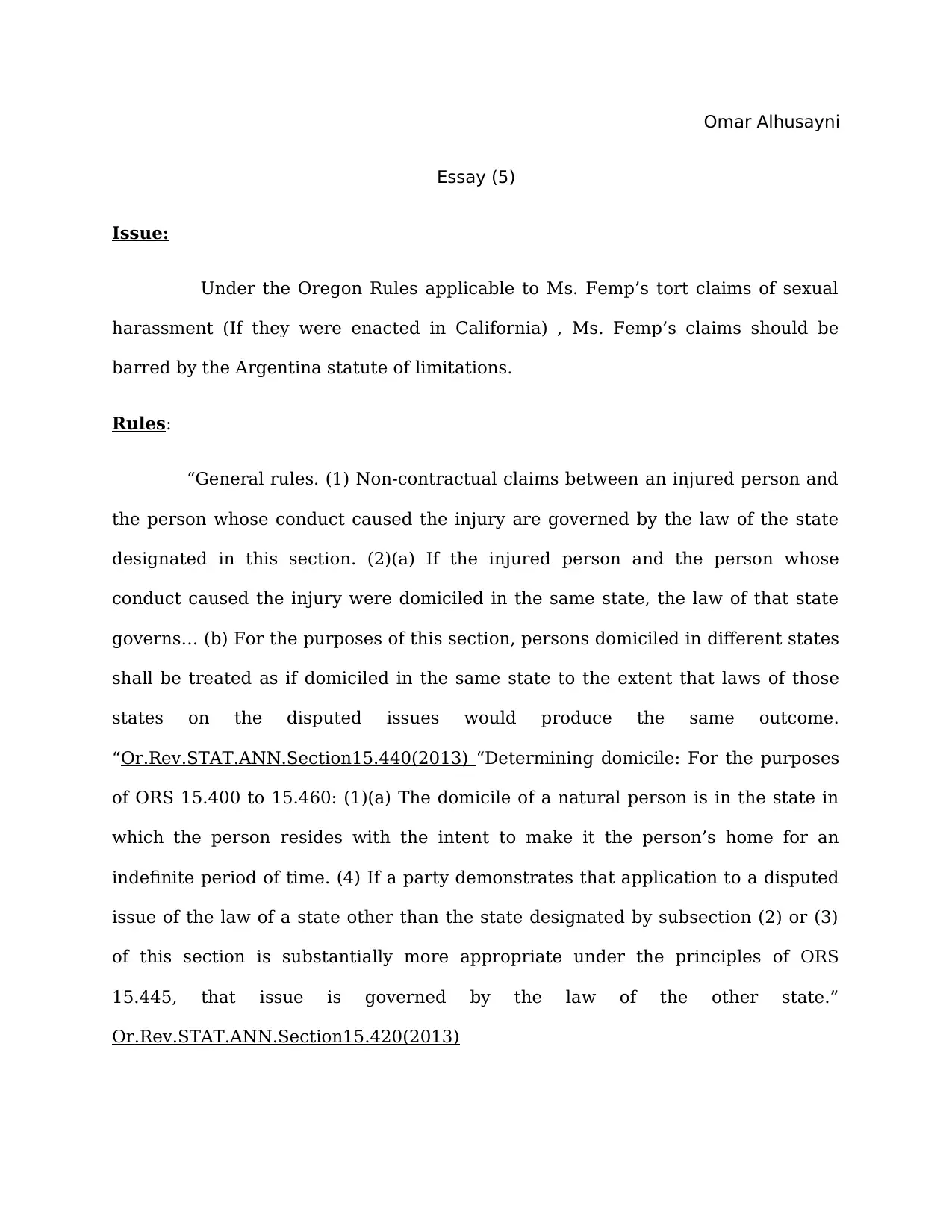
Omar Alhusayni
Essay (5)
Issue:
Under the Oregon Rules applicable to Ms. Femp’s tort claims of sexual
harassment (If they were enacted in California) , Ms. Femp’s claims should be
barred by the Argentina statute of limitations.
Rules:
“General rules. (1) Non-contractual claims between an injured person and
the person whose conduct caused the injury are governed by the law of the state
designated in this section. (2)(a) If the injured person and the person whose
conduct caused the injury were domiciled in the same state, the law of that state
governs… (b) For the purposes of this section, persons domiciled in different states
shall be treated as if domiciled in the same state to the extent that laws of those
states on the disputed issues would produce the same outcome.
Or.Rev.STAT.ANN.Section15.440(2013) “Determining domicile: For the purposes
of ORS 15.400 to 15.460: (1)(a) The domicile of a natural person is in the state in
which the person resides with the intent to make it the person’s home for an
indefinite period of time. (4) If a party demonstrates that application to a disputed
issue of the law of a state other than the state designated by subsection (2) or (3)
of this section is substantially more appropriate under the principles of ORS
15.445, that issue is governed by the law of the other state.”
Or.Rev.STAT.ANN.Section15.420(2013)
tabler-icon-diamond-filled.svg

Paraphrase This Document

Need a fresh take? Get an instant paraphrase of this document with our AI Paraphraser
Document Page
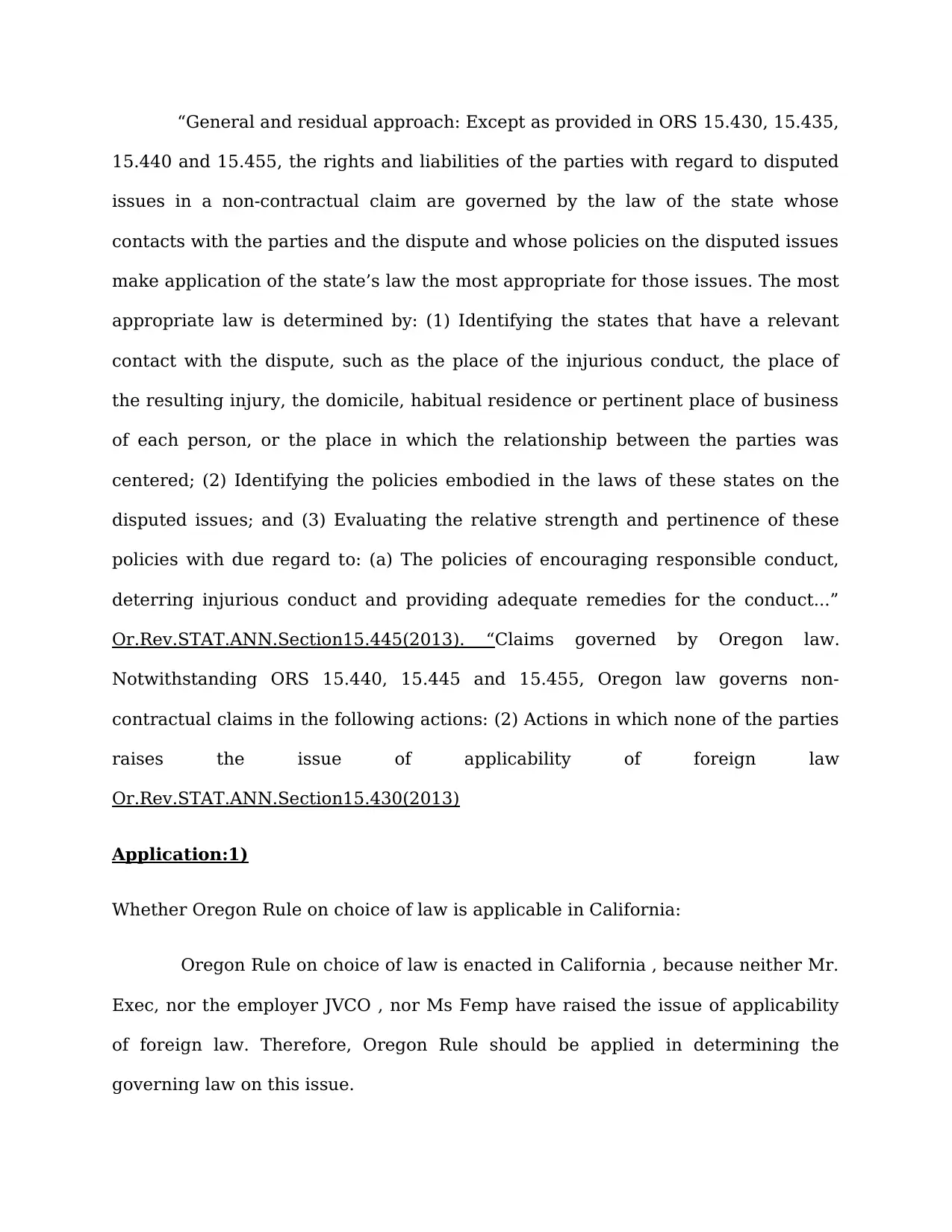
“General and residual approach: Except as provided in ORS 15.430, 15.435,
15.440 and 15.455, the rights and liabilities of the parties with regard to disputed
issues in a non-contractual claim are governed by the law of the state whose
contacts with the parties and the dispute and whose policies on the disputed issues
make application of the state’s law the most appropriate for those issues. The most
appropriate law is determined by: (1) Identifying the states that have a relevant
contact with the dispute, such as the place of the injurious conduct, the place of
the resulting injury, the domicile, habitual residence or pertinent place of business
of each person, or the place in which the relationship between the parties was
centered; (2) Identifying the policies embodied in the laws of these states on the
disputed issues; and (3) Evaluating the relative strength and pertinence of these
policies with due regard to: (a) The policies of encouraging responsible conduct,
deterring injurious conduct and providing adequate remedies for the conduct...”
Or.Rev.STAT.ANN.Section15.445(2013). Claims governed by Oregon law.
Notwithstanding ORS 15.440, 15.445 and 15.455, Oregon law governs non-
contractual claims in the following actions: (2) Actions in which none of the parties
raises the issue of applicability of foreign law
Or.Rev.STAT.ANN.Section15.430(2013)
Application:1)
Whether Oregon Rule on choice of law is applicable in California:
Oregon Rule on choice of law is enacted in California , because neither Mr.
Exec, nor the employer JVCO , nor Ms Femp have raised the issue of applicability
of foreign law. Therefore, Oregon Rule should be applied in determining the
governing law on this issue.
Document Page
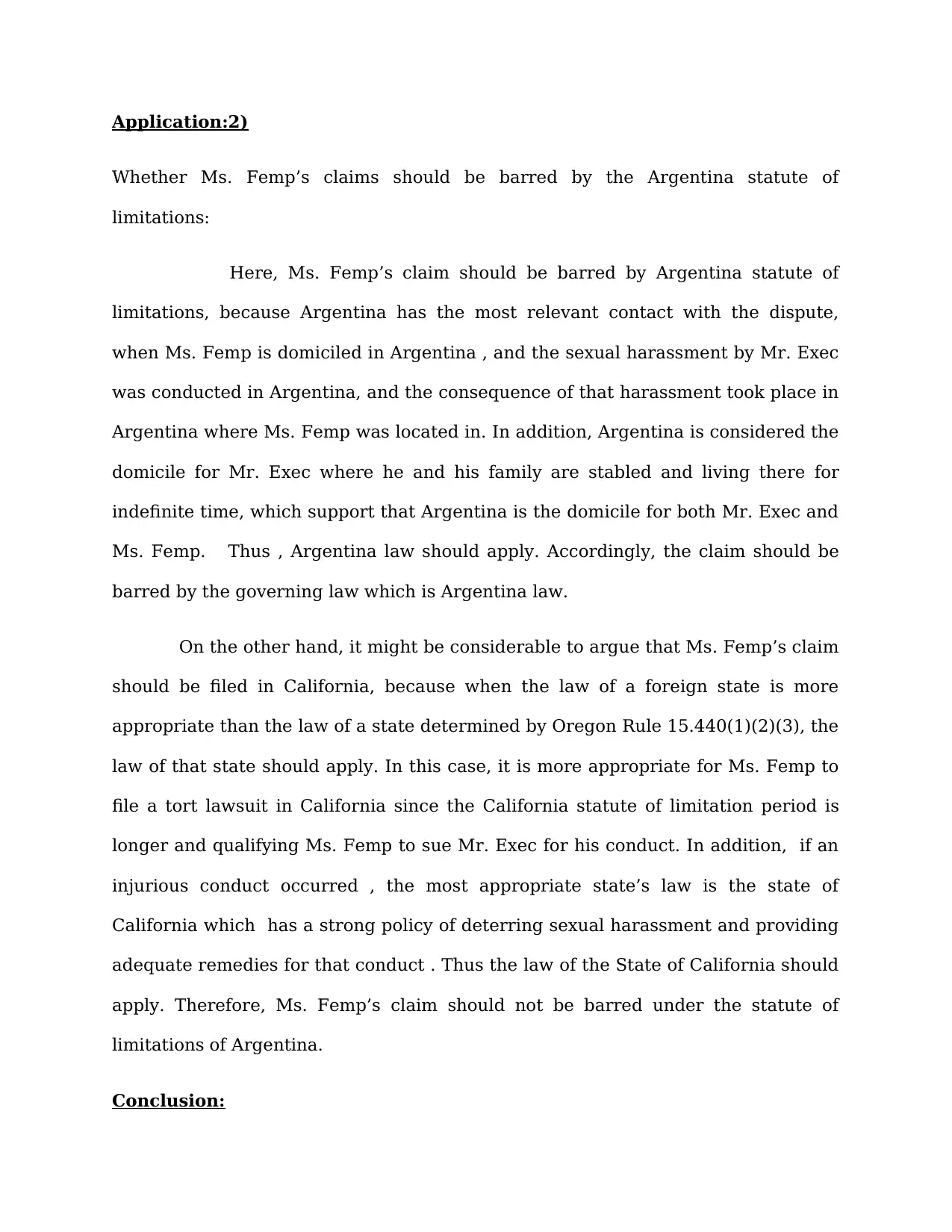
Application:2)
Whether Ms. Femp’s claims should be barred by the Argentina statute of
limitations:
Here, Ms. Femp’s claim should be barred by Argentina statute of
limitations, because Argentina has the most relevant contact with the dispute,
when Ms. Femp is domiciled in Argentina , and the sexual harassment by Mr. Exec
was conducted in Argentina, and the consequence of that harassment took place in
Argentina where Ms. Femp was located in. In addition, Argentina is considered the
domicile for Mr. Exec where he and his family are stabled and living there for
indefinite time, which support that Argentina is the domicile for both Mr. Exec and
Ms. Femp. Thus , Argentina law should apply. Accordingly, the claim should be
barred by the governing law which is Argentina law.
On the other hand, it might be considerable to argue that Ms. Femp’s claim
should be filed in California, because when the law of a foreign state is more
appropriate than the law of a state determined by Oregon Rule 15.440(1)(2)(3), the
law of that state should apply. In this case, it is more appropriate for Ms. Femp to
file a tort lawsuit in California since the California statute of limitation period is
longer and qualifying Ms. Femp to sue Mr. Exec for his conduct. In addition, if an
injurious conduct occurred , the most appropriate state’s law is the state of
California which has a strong policy of deterring sexual harassment and providing
adequate remedies for that conduct . Thus the law of the State of California should
apply. Therefore, Ms. Femp’s claim should not be barred under the statute of
limitations of Argentina.
Conclusion:
Document Page
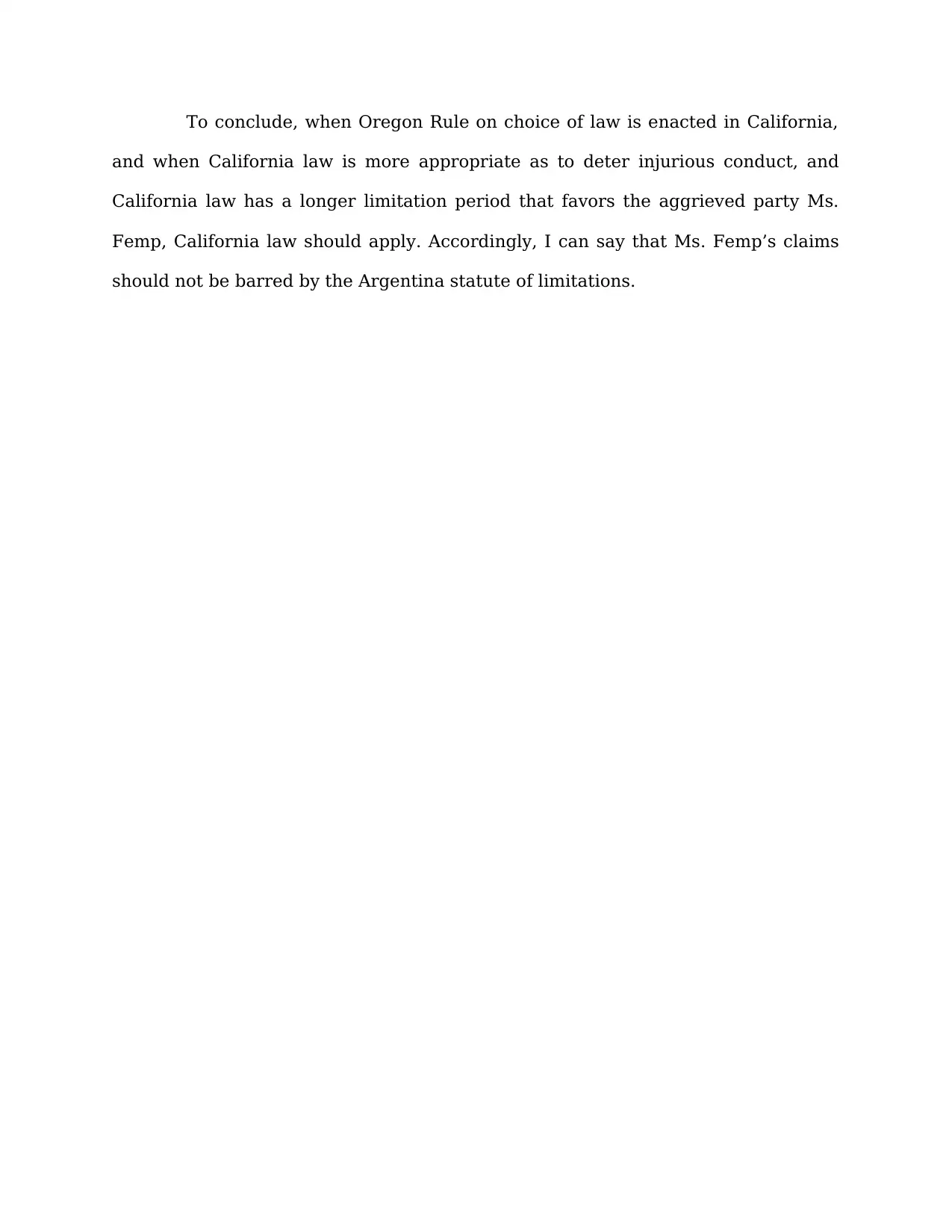
To conclude, when Oregon Rule on choice of law is enacted in California,
and when California law is more appropriate as to deter injurious conduct, and
California law has a longer limitation period that favors the aggrieved party Ms.
Femp, California law should apply. Accordingly, I can say that Ms. Femp’s claims
should not be barred by the Argentina statute of limitations.
chevron_up_icon
1 out of 4
circle_padding
hide_on_mobile
zoom_out_icon
[object Object]