Organisation Behaviour: Culture, Motivation and Team Dynamics
VerifiedAdded on 2023/06/18
|12
|4006
|91
Report
AI Summary
This report provides an analysis of organisation behaviour, focusing on team dynamics, motivation theories, and the impact of organisational culture, politics, and power on individual and team performance. It evaluates motivational theories, including Maslow's hierarchy of needs, Herzberg's two-factor theory, Skinner's reinforcement theory, and Vroom's expectancy theory, to understand their effects on achieving organisational goals. The report also discusses the characteristics of effective versus ineffective teams and applies organisational behaviour concepts within a business context, using Accenture as a case study. The aim is to understand how to foster cooperation and apply organisational behaviour principles to improve business outcomes.
Organisation Behaviour

Paraphrase This Document
Need a fresh take? Get an instant paraphrase of this document with our AI Paraphraser
Contents
INTRODUCTION...........................................................................................................................1
PART 1............................................................................................................................................1
P1 Effect of culture, politics and power of organisation on individual and team
behaviour and performance................................................................................................1
P2 Discussion of theories of motivation which implies effect on the achievement of
organisational goals..............................................................................................................3
PART 2............................................................................................................................................6
P3 Explain what makes an effective team as opposed to an ineffective team.................6
P4 Apply concepts and philosophies of organisational behaviour within an
organisational context and given business situation..........................................................7
CONCLUSION................................................................................................................................8
References:.......................................................................................................................................9
INTRODUCTION...........................................................................................................................1
PART 1............................................................................................................................................1
P1 Effect of culture, politics and power of organisation on individual and team
behaviour and performance................................................................................................1
P2 Discussion of theories of motivation which implies effect on the achievement of
organisational goals..............................................................................................................3
PART 2............................................................................................................................................6
P3 Explain what makes an effective team as opposed to an ineffective team.................6
P4 Apply concepts and philosophies of organisational behaviour within an
organisational context and given business situation..........................................................7
CONCLUSION................................................................................................................................8
References:.......................................................................................................................................9

INTRODUCTION
The organisation behaviour is a field which deals with the human behaviour in
organisation. The organisation behaviour can be referred as study and application of knowledge
regarding human behaviour which is related to other element of organisation such as structure,
technology and social system. It is related to individual and group of people working in a team.
The main task of the organisation behaviour is to offer several guidance to the company. In the
workplace the motivation is the important factor which leads to the improvement in work
performance of employees and motivates to work efficiently (Babine, R.L and et.al., 2018). In
the organisation various strategies are develop to create the interrelationship between the
employees and organisation. In the study the analyses are in context of Accenture a multinational
company providing the consulting and professional services. This company was founded in 1989
by David Rowland. In the report the discussion is made on effect of power, culture and politics
of organisation on team behaviour and performance. The motivational theories and techniques is
evaluated. The understanding is made how to cooperate effectively and applying the
philosophies of organisation behaviour on business.
PART 1
P1 Effect of culture, politics and power of organisation on individual and team behaviour
and performance.
The organisation behaviour includes team behaviour, individual and their performance
which directly impacts the organisation culture, politics and powers that is related to organisation
surroundings. The organisation culture defines the norms and values which is formed by the
beliefs and attitude of the customer. In the company growth the organisation culture has the
significant role which includes the employee’s attention (Ecclestone, K., 2017). The organisation
culture includes the expectations, philosophy, values, experiences which holds together
expressing the self-image, interactions with others and future expectations. The behaviour of the
people is governing in the company in context to Accenture. The classification of the culture can
be into four types including power, task. Role and person culture which is introduced by the
Charles handy model.
Power culture- In this culture the power remains in the hand of few people and they are
authorized to take decision. In the workplace they enjoy the special privileges and for the
1
The organisation behaviour is a field which deals with the human behaviour in
organisation. The organisation behaviour can be referred as study and application of knowledge
regarding human behaviour which is related to other element of organisation such as structure,
technology and social system. It is related to individual and group of people working in a team.
The main task of the organisation behaviour is to offer several guidance to the company. In the
workplace the motivation is the important factor which leads to the improvement in work
performance of employees and motivates to work efficiently (Babine, R.L and et.al., 2018). In
the organisation various strategies are develop to create the interrelationship between the
employees and organisation. In the study the analyses are in context of Accenture a multinational
company providing the consulting and professional services. This company was founded in 1989
by David Rowland. In the report the discussion is made on effect of power, culture and politics
of organisation on team behaviour and performance. The motivational theories and techniques is
evaluated. The understanding is made how to cooperate effectively and applying the
philosophies of organisation behaviour on business.
PART 1
P1 Effect of culture, politics and power of organisation on individual and team behaviour
and performance.
The organisation behaviour includes team behaviour, individual and their performance
which directly impacts the organisation culture, politics and powers that is related to organisation
surroundings. The organisation culture defines the norms and values which is formed by the
beliefs and attitude of the customer. In the company growth the organisation culture has the
significant role which includes the employee’s attention (Ecclestone, K., 2017). The organisation
culture includes the expectations, philosophy, values, experiences which holds together
expressing the self-image, interactions with others and future expectations. The behaviour of the
people is governing in the company in context to Accenture. The classification of the culture can
be into four types including power, task. Role and person culture which is introduced by the
Charles handy model.
Power culture- In this culture the power remains in the hand of few people and they are
authorized to take decision. In the workplace they enjoy the special privileges and for the
1
⊘ This is a preview!⊘
Do you want full access?
Subscribe today to unlock all pages.

Trusted by 1+ million students worldwide

organisation they are important person. The responsibilities are delegated by themselves to the
other employees. The subordinate is liable to follow the instructions of the superiors and liberty
is not provided to the employees to express their views or sharing ideas.
Task culture- In this culture team is formed in the organisation to achieve the targets ans solving
the critical problems. To form the team the individual with the common interest and
specialization comes together in the company. The team members in this culture contributes
equally and tasks is accomplished in the innovative way (Elsmore, P., 2017).
Role culture- in such culture the roles and responsibilities is delegated to the employees
according to the specialization, their educational qualification and interest. The employees
decide the best they can do and willing to accept the challenge. In the work culture the power
comes with the responsibility and every individual is accountable for something.
Person culture- In such culture employees feel they are important than their organisation. In the
culture the individual is more concerned regarding own self. The employees never decide in the
favour of the organisation and not loyal towards the management. The employees of the
organisation work for the sake of money and eventually company suffers.
It is founded that Accenture follows the task and role culture which helps in achieving the
objectives of the company and company stability is developed. The company culture is
influenced by the external power and affected with the cultural norms. The organisation culture
of the company can be improved by involving creativity and relationship of the employees is
improved in the organisation (Judge, M and et.al., 2019).
The organisation politics defines the process and behaviour in the human interactions
which includes the power and authority. The operational capacity is assessing with this tool
which includes the use of power and social networking in the workplace to attain the changes. It
is self-serving behaviour which increases the profitability of employees by obtaining positive
outcomes. It is related to influence tactics to improve the organisational and personal interest.
The organisation works on the principal of the utility and to attain the organisation goals. The
major reason behind the politics is disagreement as the organisation of Accenture comprises of
different members and groups with the varied motives and viewpoints. The scarcity in the
resources can lead to competition and interest is the important factor which leads to the conflict
and politics in the organisation.
2
other employees. The subordinate is liable to follow the instructions of the superiors and liberty
is not provided to the employees to express their views or sharing ideas.
Task culture- In this culture team is formed in the organisation to achieve the targets ans solving
the critical problems. To form the team the individual with the common interest and
specialization comes together in the company. The team members in this culture contributes
equally and tasks is accomplished in the innovative way (Elsmore, P., 2017).
Role culture- in such culture the roles and responsibilities is delegated to the employees
according to the specialization, their educational qualification and interest. The employees
decide the best they can do and willing to accept the challenge. In the work culture the power
comes with the responsibility and every individual is accountable for something.
Person culture- In such culture employees feel they are important than their organisation. In the
culture the individual is more concerned regarding own self. The employees never decide in the
favour of the organisation and not loyal towards the management. The employees of the
organisation work for the sake of money and eventually company suffers.
It is founded that Accenture follows the task and role culture which helps in achieving the
objectives of the company and company stability is developed. The company culture is
influenced by the external power and affected with the cultural norms. The organisation culture
of the company can be improved by involving creativity and relationship of the employees is
improved in the organisation (Judge, M and et.al., 2019).
The organisation politics defines the process and behaviour in the human interactions
which includes the power and authority. The operational capacity is assessing with this tool
which includes the use of power and social networking in the workplace to attain the changes. It
is self-serving behaviour which increases the profitability of employees by obtaining positive
outcomes. It is related to influence tactics to improve the organisational and personal interest.
The organisation works on the principal of the utility and to attain the organisation goals. The
major reason behind the politics is disagreement as the organisation of Accenture comprises of
different members and groups with the varied motives and viewpoints. The scarcity in the
resources can lead to competition and interest is the important factor which leads to the conflict
and politics in the organisation.
2
Paraphrase This Document
Need a fresh take? Get an instant paraphrase of this document with our AI Paraphraser

The power defines the individual capability which influence the behaviour of another
person. In the organisation culture the power is the key factor which provides the opportunity to
the employers in expressing their opinions and decision is taken. The power refers to acting
power of decision makers. The organisation uses the role culture as the work is assigned to the
employees and the superior has the power. The types of power can be legitimate, reward,
coercive, expert power which influences the individual behaviour and performance in the
organisation (Matsikesimbe, T., 2020).
P2 Discussion of theories of motivation which implies effect on the achievement of
organisational goals.
In the business the motivation involves all the factors that motivates continuously to
achieve the given tasks and roles efficiently. The motivation is the procedure which initiates and
guides and maintains the goal-oriented behaviour. It is the word motive which defines the needs,
desires within the individuals. The actions of the people is stimulated to achieve the goals. The
employees in the organisation are motivated to have the maximum contribution of efforts. The
motivation can be of two types-
Intrinsic motivation- For the personal satisfaction it arises within the individual which is
concerned with the self-actualization and occurs while performing the task. The non-financial
rewards is included like participation, resp0onsibilities etc. the individual skill is improved in the
given task and motivated intrinsically performs better.
Extrinsic motivation- This motivation arises outside of the individual which comprises
rewards, recognition, money, fringe benefits, profit sharing etc. it is mainly financial in nature
affected by the external factors (Moody, G.D and et.al., 2017).
The theories of motivation are classified on the basis of content and process-
Content theories- The focus of the content theory is on WHAT motivating the human
behaviour. It has great impact on the management practice and policy. The content theory is also
known as need theory where the needs are identified and relate to motivation for fulfilling those
needs. There are several content theories like Maslow's need hierarchy theory, Herberg's theory,
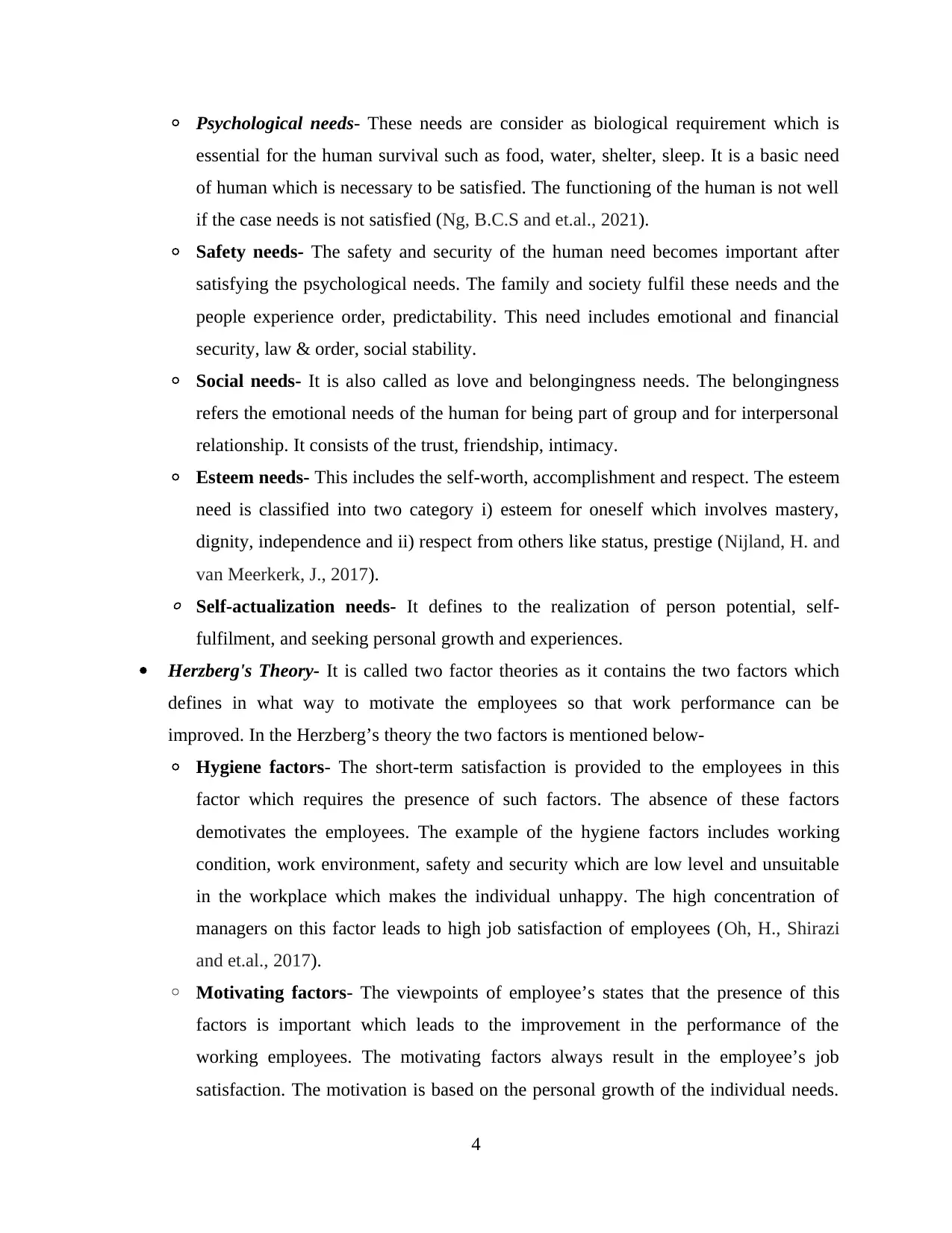
ERG theory, McClelland theory. Maslow's need hierarchy theory- In the shape of pyramid it is five tier model of human
need developed in 1943 by Abraham Maslow as a motivational model. The lower needs
are satisfied before attending to higher needs.
3
person. In the organisation culture the power is the key factor which provides the opportunity to
the employers in expressing their opinions and decision is taken. The power refers to acting
power of decision makers. The organisation uses the role culture as the work is assigned to the
employees and the superior has the power. The types of power can be legitimate, reward,
coercive, expert power which influences the individual behaviour and performance in the
organisation (Matsikesimbe, T., 2020).
P2 Discussion of theories of motivation which implies effect on the achievement of
organisational goals.
In the business the motivation involves all the factors that motivates continuously to
achieve the given tasks and roles efficiently. The motivation is the procedure which initiates and
guides and maintains the goal-oriented behaviour. It is the word motive which defines the needs,
desires within the individuals. The actions of the people is stimulated to achieve the goals. The
employees in the organisation are motivated to have the maximum contribution of efforts. The
motivation can be of two types-
Intrinsic motivation- For the personal satisfaction it arises within the individual which is
concerned with the self-actualization and occurs while performing the task. The non-financial
rewards is included like participation, resp0onsibilities etc. the individual skill is improved in the
given task and motivated intrinsically performs better.
Extrinsic motivation- This motivation arises outside of the individual which comprises
rewards, recognition, money, fringe benefits, profit sharing etc. it is mainly financial in nature
affected by the external factors (Moody, G.D and et.al., 2017).
The theories of motivation are classified on the basis of content and process-
Content theories- The focus of the content theory is on WHAT motivating the human
behaviour. It has great impact on the management practice and policy. The content theory is also
known as need theory where the needs are identified and relate to motivation for fulfilling those
needs. There are several content theories like Maslow's need hierarchy theory, Herberg's theory,
ERG theory, McClelland theory. Maslow's need hierarchy theory- In the shape of pyramid it is five tier model of human
need developed in 1943 by Abraham Maslow as a motivational model. The lower needs
are satisfied before attending to higher needs.
3
◦ Psychological needs- These needs are consider as biological requirement which is
essential for the human survival such as food, water, shelter, sleep. It is a basic need
of human which is necessary to be satisfied. The functioning of the human is not well
if the case needs is not satisfied (Ng, B.C.S and et.al., 2021).
◦ Safety needs- The safety and security of the human need becomes important after
satisfying the psychological needs. The family and society fulfil these needs and the
people experience order, predictability. This need includes emotional and financial
security, law & order, social stability.
◦ Social needs- It is also called as love and belongingness needs. The belongingness
refers the emotional needs of the human for being part of group and for interpersonal
relationship. It consists of the trust, friendship, intimacy.
◦ Esteem needs- This includes the self-worth, accomplishment and respect. The esteem
need is classified into two category i) esteem for oneself which involves mastery,
dignity, independence and ii) respect from others like status, prestige (Nijland, H. and
van Meerkerk, J., 2017).
◦ Self-actualization needs- It defines to the realization of person potential, self-
fulfilment, and seeking personal growth and experiences.
Herzberg's Theory- It is called two factor theories as it contains the two factors which
defines in what way to motivate the employees so that work performance can be
improved. In the Herzberg’s theory the two factors is mentioned below-
◦ Hygiene factors- The short-term satisfaction is provided to the employees in this
factor which requires the presence of such factors. The absence of these factors
demotivates the employees. The example of the hygiene factors includes working
condition, work environment, safety and security which are low level and unsuitable
in the workplace which makes the individual unhappy. The high concentration of
managers on this factor leads to high job satisfaction of employees (Oh, H., Shirazi
and et.al., 2017).
◦ Motivating factors- The viewpoints of employee’s states that the presence of this
factors is important which leads to the improvement in the performance of the
working employees. The motivating factors always result in the employee’s job
satisfaction. The motivation is based on the personal growth of the individual needs.
4
essential for the human survival such as food, water, shelter, sleep. It is a basic need
of human which is necessary to be satisfied. The functioning of the human is not well
if the case needs is not satisfied (Ng, B.C.S and et.al., 2021).
◦ Safety needs- The safety and security of the human need becomes important after
satisfying the psychological needs. The family and society fulfil these needs and the
people experience order, predictability. This need includes emotional and financial
security, law & order, social stability.
◦ Social needs- It is also called as love and belongingness needs. The belongingness
refers the emotional needs of the human for being part of group and for interpersonal
relationship. It consists of the trust, friendship, intimacy.
◦ Esteem needs- This includes the self-worth, accomplishment and respect. The esteem
need is classified into two category i) esteem for oneself which involves mastery,
dignity, independence and ii) respect from others like status, prestige (Nijland, H. and
van Meerkerk, J., 2017).
◦ Self-actualization needs- It defines to the realization of person potential, self-
fulfilment, and seeking personal growth and experiences.
Herzberg's Theory- It is called two factor theories as it contains the two factors which
defines in what way to motivate the employees so that work performance can be
improved. In the Herzberg’s theory the two factors is mentioned below-
◦ Hygiene factors- The short-term satisfaction is provided to the employees in this
factor which requires the presence of such factors. The absence of these factors
demotivates the employees. The example of the hygiene factors includes working
condition, work environment, safety and security which are low level and unsuitable
in the workplace which makes the individual unhappy. The high concentration of
managers on this factor leads to high job satisfaction of employees (Oh, H., Shirazi
and et.al., 2017).
◦ Motivating factors- The viewpoints of employee’s states that the presence of this
factors is important which leads to the improvement in the performance of the
working employees. The motivating factors always result in the employee’s job
satisfaction. The motivation is based on the personal growth of the individual needs.
4
⊘ This is a preview!⊘
Do you want full access?
Subscribe today to unlock all pages.
Trusted by 1+ million students worldwide
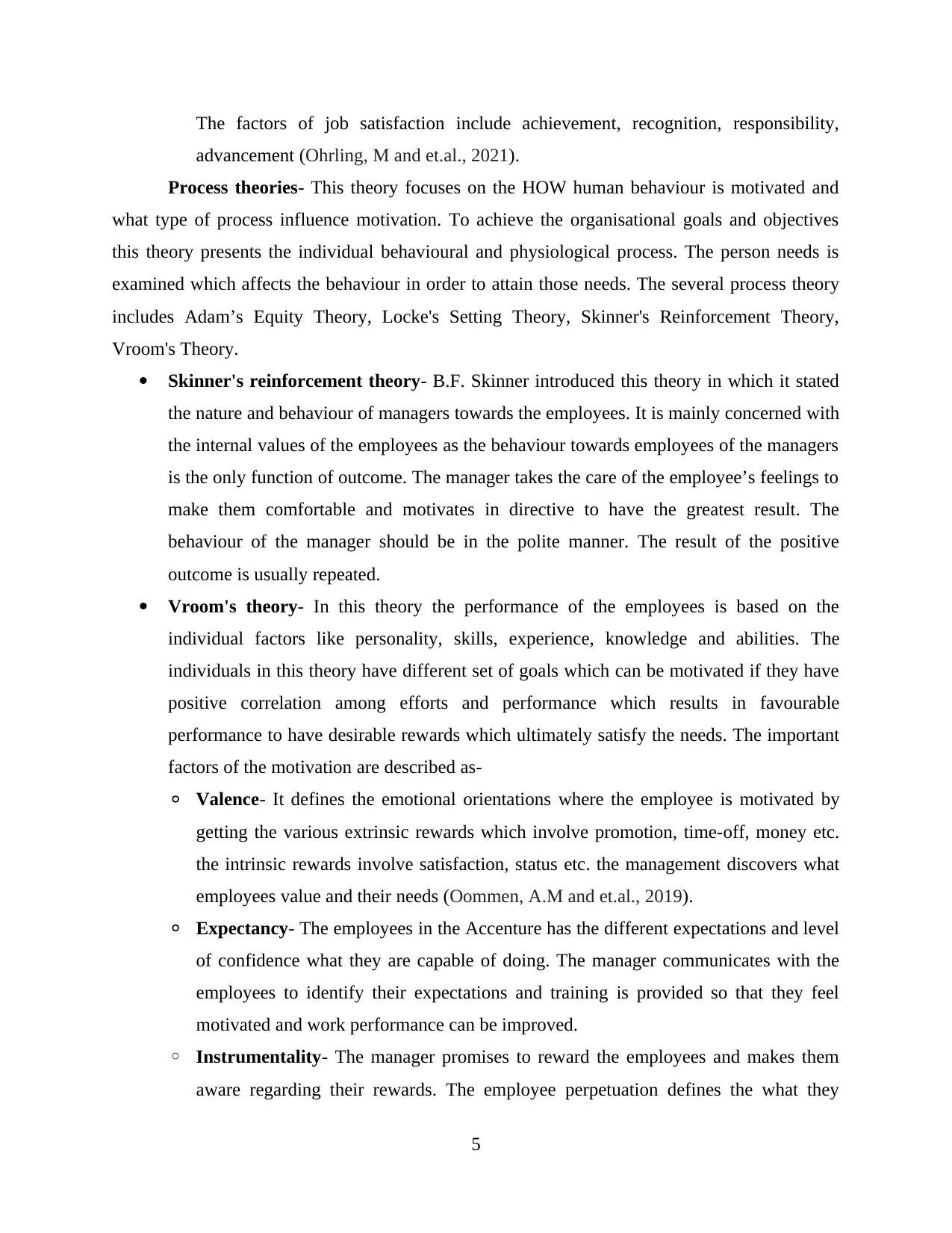
The factors of job satisfaction include achievement, recognition, responsibility,
advancement (Ohrling, M and et.al., 2021).
Process theories- This theory focuses on the HOW human behaviour is motivated and
what type of process influence motivation. To achieve the organisational goals and objectives
this theory presents the individual behavioural and physiological process. The person needs is
examined which affects the behaviour in order to attain those needs. The several process theory
includes Adam’s Equity Theory, Locke's Setting Theory, Skinner's Reinforcement Theory,
Vroom's Theory.
Skinner's reinforcement theory- B.F. Skinner introduced this theory in which it stated
the nature and behaviour of managers towards the employees. It is mainly concerned with
the internal values of the employees as the behaviour towards employees of the managers
is the only function of outcome. The manager takes the care of the employee’s feelings to
make them comfortable and motivates in directive to have the greatest result. The
behaviour of the manager should be in the polite manner. The result of the positive
outcome is usually repeated.
Vroom's theory- In this theory the performance of the employees is based on the
individual factors like personality, skills, experience, knowledge and abilities. The
individuals in this theory have different set of goals which can be motivated if they have
positive correlation among efforts and performance which results in favourable
performance to have desirable rewards which ultimately satisfy the needs. The important
factors of the motivation are described as-
◦ Valence- It defines the emotional orientations where the employee is motivated by
getting the various extrinsic rewards which involve promotion, time-off, money etc.
the intrinsic rewards involve satisfaction, status etc. the management discovers what
employees value and their needs (Oommen, A.M and et.al., 2019).
◦ Expectancy- The employees in the Accenture has the different expectations and level
of confidence what they are capable of doing. The manager communicates with the
employees to identify their expectations and training is provided so that they feel
motivated and work performance can be improved.
◦ Instrumentality- The manager promises to reward the employees and makes them
aware regarding their rewards. The employee perpetuation defines the what they
5
advancement (Ohrling, M and et.al., 2021).
Process theories- This theory focuses on the HOW human behaviour is motivated and
what type of process influence motivation. To achieve the organisational goals and objectives
this theory presents the individual behavioural and physiological process. The person needs is
examined which affects the behaviour in order to attain those needs. The several process theory
includes Adam’s Equity Theory, Locke's Setting Theory, Skinner's Reinforcement Theory,
Vroom's Theory.
Skinner's reinforcement theory- B.F. Skinner introduced this theory in which it stated
the nature and behaviour of managers towards the employees. It is mainly concerned with
the internal values of the employees as the behaviour towards employees of the managers
is the only function of outcome. The manager takes the care of the employee’s feelings to
make them comfortable and motivates in directive to have the greatest result. The
behaviour of the manager should be in the polite manner. The result of the positive
outcome is usually repeated.
Vroom's theory- In this theory the performance of the employees is based on the
individual factors like personality, skills, experience, knowledge and abilities. The
individuals in this theory have different set of goals which can be motivated if they have
positive correlation among efforts and performance which results in favourable
performance to have desirable rewards which ultimately satisfy the needs. The important
factors of the motivation are described as-
◦ Valence- It defines the emotional orientations where the employee is motivated by
getting the various extrinsic rewards which involve promotion, time-off, money etc.
the intrinsic rewards involve satisfaction, status etc. the management discovers what
employees value and their needs (Oommen, A.M and et.al., 2019).
◦ Expectancy- The employees in the Accenture has the different expectations and level
of confidence what they are capable of doing. The manager communicates with the
employees to identify their expectations and training is provided so that they feel
motivated and work performance can be improved.
◦ Instrumentality- The manager promises to reward the employees and makes them
aware regarding their rewards. The employee perpetuation defines the what they
5
Paraphrase This Document
Need a fresh take? Get an instant paraphrase of this document with our AI Paraphraser

desire actually they get. The rewarding system in the organisation must be clear to
the employees (Orojo, O and et.al., 2020).
PART 2
P3 Explain what makes an effective team as opposed to an ineffective team.
The successful completion of the assigned task can be with the efforts of the effective
team. The quality of the effective team is improved by completing all the tasks in the efficient
and effective manner. To have the successful and smooth business conduct the cooperation
between team members is mot essential element. The team gins the status of effectiveness when
an open discussion prevails which allows to express the views. In the organisation of the
Accenture to complete the work in appropriate manner various teams has been formed so that
resources can be utilized properly along with bringing talent and skills of each individual in
team. The purpose of the organisation is clearly seen by all the employees and creates the
informal working environment where employees feel comfortable. In this there is the equal
chance to participate in the activities & operations of the organisation. To each and ever team
member the important tasks, objectives and procedures are made cleared. There is agreement
between the teams for taking the decisions in the organisation.
In ineffective team the members do not listen to each other following the authority’s
leadership style and closed discussion takes place. It makes the difficulty in understanding the
group task and what the objective is. In this the ideas are ignored and proper discussion is not
taken. The leadership is with the chairperson and one way communication takes place. The
managers in this do not provides the complete information to perform the task. The decision is
taken by the majority which is not acceptable by the other team members (Prause, M. and
Günther, C., 2019).
To have the effective team the Tuckman model of team development can be considered.
From the research the manger of the Accenture completes the task in the effective manner
which can be done by considering the concept of team development. The Bruce Tuckman a great
phycologist developed the five stages of the team development which are as follows-
Forming- For the team member it is the stage of team orientation and gets acquainted.
The best behaviour is shown by each and every member in the team due to presence of high
uncertainty. On leadership and authority more concentration is given by the organisation.
6
the employees (Orojo, O and et.al., 2020).
PART 2
P3 Explain what makes an effective team as opposed to an ineffective team.
The successful completion of the assigned task can be with the efforts of the effective
team. The quality of the effective team is improved by completing all the tasks in the efficient
and effective manner. To have the successful and smooth business conduct the cooperation
between team members is mot essential element. The team gins the status of effectiveness when
an open discussion prevails which allows to express the views. In the organisation of the
Accenture to complete the work in appropriate manner various teams has been formed so that
resources can be utilized properly along with bringing talent and skills of each individual in
team. The purpose of the organisation is clearly seen by all the employees and creates the
informal working environment where employees feel comfortable. In this there is the equal
chance to participate in the activities & operations of the organisation. To each and ever team
member the important tasks, objectives and procedures are made cleared. There is agreement
between the teams for taking the decisions in the organisation.
In ineffective team the members do not listen to each other following the authority’s
leadership style and closed discussion takes place. It makes the difficulty in understanding the
group task and what the objective is. In this the ideas are ignored and proper discussion is not
taken. The leadership is with the chairperson and one way communication takes place. The
managers in this do not provides the complete information to perform the task. The decision is
taken by the majority which is not acceptable by the other team members (Prause, M. and
Günther, C., 2019).
To have the effective team the Tuckman model of team development can be considered.
From the research the manger of the Accenture completes the task in the effective manner
which can be done by considering the concept of team development. The Bruce Tuckman a great
phycologist developed the five stages of the team development which are as follows-
Forming- For the team member it is the stage of team orientation and gets acquainted.
The best behaviour is shown by each and every member in the team due to presence of high
uncertainty. On leadership and authority more concentration is given by the organisation.
6

Storming- The team members face the difficulty in the gaining the trust of each other which
organisation also faces the difficulty. Between the team members the conflicts or friction starts
arises. The hierarchy of the position in the group is identified and individuals learns the working
style of each other. The entire group task is divided into small task so that skills can be
developed and conflicts in the management can be remove (Verboven, K., 2017).
Norming- In this stage the individual resolves the differences by appreciating each other’s
strength and respect their authority as leader. By knowing each other on the team the member of
team feels comfortable and strong commitment is shared to the team goals. The productivity of
the organisation is improved by focusing on both individual as well as collective work.
Performing- In this stage the team is in flow to work with the full potential and with hard work.
With the structured process the team is likely to achieve the goals efficiently. To enhance the
team performance the differences among the team member are appreciated. In this stage the team
members are prepared to achieve the goals and objective of the company. The skills of the team
members is developed according to the assigned task.
Adjourning- It is the last stage where many teams naturally reach at this stage due to the
completion of the project and peoples are redeployed. The positive achievement of the team is
celebrated when all the task is completed. With the long period of the intensive work the
uncertainty is also generated for the individual team members.
P4 Apply concepts and philosophies of organisational behaviour within an organisational
context and given business situation.
On the basis of the two key elements the concept and philosophies of the organisation behaviour
is based which are as follows-
o Nature of people
o Nature of organisation
Nature of people
It is considered as basic quality or character of individual which can be same or different.
In the framework of Accenture there are numerous factors which analysis the nature of people
affecting organisation. Some of them are-
Individual differences- It is a management approach which approaches to each
individual as the all the employees are different from each other. From the psychology
7
organisation also faces the difficulty. Between the team members the conflicts or friction starts
arises. The hierarchy of the position in the group is identified and individuals learns the working
style of each other. The entire group task is divided into small task so that skills can be
developed and conflicts in the management can be remove (Verboven, K., 2017).
Norming- In this stage the individual resolves the differences by appreciating each other’s
strength and respect their authority as leader. By knowing each other on the team the member of
team feels comfortable and strong commitment is shared to the team goals. The productivity of
the organisation is improved by focusing on both individual as well as collective work.
Performing- In this stage the team is in flow to work with the full potential and with hard work.
With the structured process the team is likely to achieve the goals efficiently. To enhance the
team performance the differences among the team member are appreciated. In this stage the team
members are prepared to achieve the goals and objective of the company. The skills of the team
members is developed according to the assigned task.
Adjourning- It is the last stage where many teams naturally reach at this stage due to the
completion of the project and peoples are redeployed. The positive achievement of the team is
celebrated when all the task is completed. With the long period of the intensive work the
uncertainty is also generated for the individual team members.
P4 Apply concepts and philosophies of organisational behaviour within an organisational
context and given business situation.
On the basis of the two key elements the concept and philosophies of the organisation behaviour
is based which are as follows-
o Nature of people
o Nature of organisation
Nature of people
It is considered as basic quality or character of individual which can be same or different.
In the framework of Accenture there are numerous factors which analysis the nature of people
affecting organisation. Some of them are-
Individual differences- It is a management approach which approaches to each
individual as the all the employees are different from each other. From the psychology
7
⊘ This is a preview!⊘
Do you want full access?
Subscribe today to unlock all pages.
Trusted by 1+ million students worldwide
the idea has been discovered. The manager in the organisation can not do partiality with
the employees and should treat them equally and judge on the basis of work performance.
Perception- The different people have different perception. In the same situation the
employees present their thinking in different styles. The perception is the way of
interpreting things and presenting in accordance to the viewpoint. The manager of the
Accenture considers various theories to motivate the employees.
Nature of organisation
The organisation goals and objectives define the organisation nature. The features of the
organisation are reflected and presented to the society. There are several factors which defines
the organisation nature. Social System: It is well recognised that individually and each organisation is
socialising with additional firms, merely the outside world, their customers along with
their personnel. Such performance is majorly stimulus by the group and individual
energies. The social system is of wo types formal and informal. The working of the
people together in the single firm or the same group of peoples comes under the formal
group. The socializing of the people with other or with friends for the purpose of
chilling, enjoying and partying usually comes under the informal group of social system
(Yusliza, M.Y and et.al., 2020).
Ethics: It refers to the individual, group or an organisation moral principle. In directive
to attract the employees the ethical activities play an important role which also helps in
setting the organisational moral standard. Accenture have established code of ethics
training rewards for the purpose of notable ethical behaviour.
CONCLUSION
The conclusion from the above report is been made that organisational behaviour is made
because of the organisation culture. In the workplace the manager develops the motivation and
positive work culture to have the positive behaviour among all the employees. The power and
politics influence the work performance of the employees in the favourable and unfavourable
way. The Accenture uses the motivational theory s per the organisation needs and requirements
and employees are motivated to perform better. The organisation adopts the several ways to
maintain the interest of employees towards their organisation. For the same objective the reward
8
the employees and should treat them equally and judge on the basis of work performance.
Perception- The different people have different perception. In the same situation the
employees present their thinking in different styles. The perception is the way of
interpreting things and presenting in accordance to the viewpoint. The manager of the
Accenture considers various theories to motivate the employees.
Nature of organisation
The organisation goals and objectives define the organisation nature. The features of the
organisation are reflected and presented to the society. There are several factors which defines
the organisation nature. Social System: It is well recognised that individually and each organisation is
socialising with additional firms, merely the outside world, their customers along with
their personnel. Such performance is majorly stimulus by the group and individual
energies. The social system is of wo types formal and informal. The working of the
people together in the single firm or the same group of peoples comes under the formal
group. The socializing of the people with other or with friends for the purpose of
chilling, enjoying and partying usually comes under the informal group of social system
(Yusliza, M.Y and et.al., 2020).
Ethics: It refers to the individual, group or an organisation moral principle. In directive
to attract the employees the ethical activities play an important role which also helps in
setting the organisational moral standard. Accenture have established code of ethics
training rewards for the purpose of notable ethical behaviour.
CONCLUSION
The conclusion from the above report is been made that organisational behaviour is made
because of the organisation culture. In the workplace the manager develops the motivation and
positive work culture to have the positive behaviour among all the employees. The power and
politics influence the work performance of the employees in the favourable and unfavourable
way. The Accenture uses the motivational theory s per the organisation needs and requirements
and employees are motivated to perform better. The organisation adopts the several ways to
maintain the interest of employees towards their organisation. For the same objective the reward
8
Paraphrase This Document
Need a fresh take? Get an instant paraphrase of this document with our AI Paraphraser

system is followed so that performance can be improved and employees remain motivated by
creating a positive working environment at work place. In addition to this, it is also found that
the effectiveness of any team is an important factor which plays an important role in achieving
the organisational goals and objectives.
9
creating a positive working environment at work place. In addition to this, it is also found that
the effectiveness of any team is an important factor which plays an important role in achieving
the organisational goals and objectives.
9

References:
Books and Journals
Babine, R.L and et.al., 2018. Falls and delirium in an acute care setting: A retrospective chart
review before and after an organisation‐wide interprofessional education. Journal of
clinical nursing, 27(7-8), pp.e1429-e1441.
Ecclestone, K., 2017. Behaviour change policy agendas for ‘vulnerable’subjectivities: The
dangers of therapeutic governance and its new entrepreneurs. Journal of Education
Policy, 32(1), pp.48-62.
Elsmore, P., 2017. Organisational Culture: Organisational Change? Organisational Change?
Routledge.
Judge, M and et.al., 2019. Using the theory of planned behaviour to predict intentions to
purchase sustainable housing. Journal of cleaner production, 215, pp.259-267.
Matsikesimbe, T., 2020. Impact of professional ethics on organisation performance: a case study
of Chitungwiza Municipality (Doctoral dissertation, BUSE).
Moody, G.D and et.al., 2017. It’s complicated: explaining the relationship between trust, distrust,
and ambivalence in online transaction relationships using polynomial regression
analysis and response surface analysis. European Journal of Information
Systems, 26(4), pp.379-413.
Ng, B.C.S and et.al., 2021. A stress perspective on antecedents of abusive supervision: Blaming
the organisation when exhausted supervisors abuse. Journal of Management &
Organization, 27(2), pp.361-381.
Nijland, H. and van Meerkerk, J., 2017. Mobility and environmental impacts of car sharing in the
Netherlands. Environmental Innovation and Societal Transitions, 23, pp.84-91.
Oh, H., Shirazi and et.al., 2017. Bio-inspired self-organising multi-robot pattern formation: A
review. Robotics and Autonomous Systems, 91, pp.83-100.
Ohrling, M and et.al., 2021. That's how it should work: the perceptions of a senior management
on the value of decentralisation in a service delivery organisation. Journal of Health
Organization and Management.
Oommen, A.M and et.al., 2019. Intracluster correlation estimates from a World Health
Organisation STEPwise approach to surveillance (STEPS) survey for cardiovascular
risk factors in Vellore, Tamil Nadu, India. Public health, 168, pp.102-106.
Orojo, O and et.al., 2020, July. Time sensitivity and self-organisation in Multi-recurrent Neural
Networks. In 2020 International Joint Conference on Neural Networks (IJCNN) (pp. 1-
7). IEEE.
Prause, M. and Günther, C., 2019. Technology diffusion of Industry 4.0: an agent-based
approach. International Journal of Computational Economics and Econometrics, 9(1-
2), pp.29-48.
Verboven, K., 2017. 9 Guilds and the Organisation of Urban Populations During the Principate.
In Work, Labour, and Professions in the Roman World (pp. 173-202). Brill.
Yusliza, M.Y and et.al., 2020. Effects of supportive work environment on employee retention:
the mediating role of person–organisation fit. Industrial and Commercial Training.
10
Books and Journals
Babine, R.L and et.al., 2018. Falls and delirium in an acute care setting: A retrospective chart
review before and after an organisation‐wide interprofessional education. Journal of
clinical nursing, 27(7-8), pp.e1429-e1441.
Ecclestone, K., 2017. Behaviour change policy agendas for ‘vulnerable’subjectivities: The
dangers of therapeutic governance and its new entrepreneurs. Journal of Education
Policy, 32(1), pp.48-62.
Elsmore, P., 2017. Organisational Culture: Organisational Change? Organisational Change?
Routledge.
Judge, M and et.al., 2019. Using the theory of planned behaviour to predict intentions to
purchase sustainable housing. Journal of cleaner production, 215, pp.259-267.
Matsikesimbe, T., 2020. Impact of professional ethics on organisation performance: a case study
of Chitungwiza Municipality (Doctoral dissertation, BUSE).
Moody, G.D and et.al., 2017. It’s complicated: explaining the relationship between trust, distrust,
and ambivalence in online transaction relationships using polynomial regression
analysis and response surface analysis. European Journal of Information
Systems, 26(4), pp.379-413.
Ng, B.C.S and et.al., 2021. A stress perspective on antecedents of abusive supervision: Blaming
the organisation when exhausted supervisors abuse. Journal of Management &
Organization, 27(2), pp.361-381.
Nijland, H. and van Meerkerk, J., 2017. Mobility and environmental impacts of car sharing in the
Netherlands. Environmental Innovation and Societal Transitions, 23, pp.84-91.
Oh, H., Shirazi and et.al., 2017. Bio-inspired self-organising multi-robot pattern formation: A
review. Robotics and Autonomous Systems, 91, pp.83-100.
Ohrling, M and et.al., 2021. That's how it should work: the perceptions of a senior management
on the value of decentralisation in a service delivery organisation. Journal of Health
Organization and Management.
Oommen, A.M and et.al., 2019. Intracluster correlation estimates from a World Health
Organisation STEPwise approach to surveillance (STEPS) survey for cardiovascular
risk factors in Vellore, Tamil Nadu, India. Public health, 168, pp.102-106.
Orojo, O and et.al., 2020, July. Time sensitivity and self-organisation in Multi-recurrent Neural
Networks. In 2020 International Joint Conference on Neural Networks (IJCNN) (pp. 1-
7). IEEE.
Prause, M. and Günther, C., 2019. Technology diffusion of Industry 4.0: an agent-based
approach. International Journal of Computational Economics and Econometrics, 9(1-
2), pp.29-48.
Verboven, K., 2017. 9 Guilds and the Organisation of Urban Populations During the Principate.
In Work, Labour, and Professions in the Roman World (pp. 173-202). Brill.
Yusliza, M.Y and et.al., 2020. Effects of supportive work environment on employee retention:
the mediating role of person–organisation fit. Industrial and Commercial Training.
10
⊘ This is a preview!⊘
Do you want full access?
Subscribe today to unlock all pages.
Trusted by 1+ million students worldwide

1 out of 12


Related Documents


Your All-in-One AI-Powered Toolkit for Academic Success.
+13062052269
info@desklib.com
Available 24*7 on WhatsApp / Email
![[object Object]](/_next/static/media/star-bottom.7253800d.svg)
Unlock your academic potential
Copyright © 2020–2026 A2Z Services. All Rights Reserved. Developed and managed by ZUCOL.