Organisational Behaviour: Analysing Culture, Motivation and Team Work
VerifiedAdded on 2023/06/11
|14
|5279
|115
Report
AI Summary
This report analyses organisational behaviour within Morrisons UK, examining the influence of culture, politics, and power on individual and team behaviour. It evaluates motivational theories, including Maslow's hierarchy of needs and Vroom's expectancy theory, and compares effective and ineffective teams. The report also applies organisational behaviour concepts and philosophies to real-world business situations, highlighting the importance of culture, power dynamics, and motivational strategies in achieving organisational goals. It concludes by emphasising the need for continuous monitoring and adaptation of policies to ensure employee satisfaction and optimal performance, with Desklib offering further resources for students.
Unit 12 Organisational
Behaviour Part A and Part B
Behaviour Part A and Part B

Paraphrase This Document
Need a fresh take? Get an instant paraphrase of this document with our AI Paraphraser
Table of Contents
INTRODUCTION...........................................................................................................................3
MAIN BODY...................................................................................................................................3
Analysing how culture, politics and power influence individual team behaviour......................3
Evaluating how theories of motivation enable effective achievement of goals.........................5
Comparison between effective and ineffective team ..................................................................7
Applying concepts and philosophies of organisational behaviour...........................................10
CONCLUSION..............................................................................................................................12
REFERENCES................................................................................................................................1
INTRODUCTION...........................................................................................................................3
MAIN BODY...................................................................................................................................3
Analysing how culture, politics and power influence individual team behaviour......................3
Evaluating how theories of motivation enable effective achievement of goals.........................5
Comparison between effective and ineffective team ..................................................................7
Applying concepts and philosophies of organisational behaviour...........................................10
CONCLUSION..............................................................................................................................12
REFERENCES................................................................................................................................1
INTRODUCTION
Organisational behaviour is study of how people interact within the groups and how its
principles are applied to make the business more effective. Also, the present report is based on
the Morrison UK and will identify impact of the organisation culture, politics and power on the
overall organisation performance and team efficiency . Moreover, such evaluation will help
quoted firm to devise various policies and strategies in the future so that long term business
goals might be achieved. Also, the study will highlight various motivational theories and
techniques that will help in achieving the long and short term goals in the quoted firm. Further,
report will analyse the significance of such motivational techniques in achieving certain business
targets in the best manner within specified time frame. Also, the report will also identify the
difference between effective and ineffective team in detail. Lastly, the study will apply various
concepts and philosophies related to the organisational behaviour in any particular business
situation.
MAIN BODY
Analysing how culture, politics and power influence individual team behaviour
Culture in any organisation refers to the way in which any group of individual behaves in
the right manner through values and shared beliefs established by the leaders. Also, such type
of culture is shared among the group of people by the top management through various means.
Moreover, the through applying the handy model it can be stated that there are four types of
culture that are followed in any firm which are as follows:
Power culture: This could be understood as firm where only few people have the
power to do make certain decisions and set out rules for the whole organisation. Also, in such
type of culture the employees do not have the right to make certain decisions by their won but
they only need to follow what is being told to them by the top management (Al-Madadha, Al-
Adwan and Zakzouk, 2021). However, in this type of culture power is within the few individuals
and hence the chances of its being misused are higher
Task culture: Moreover, this is type of culture where tasks are been divided among the
group of people based on skills, competencies and their abilities. Furthermore, particular tasks
are being assigned to the individual employee by the management so that efficiency might be
achieved and there are no problems in the future.
Organisational behaviour is study of how people interact within the groups and how its
principles are applied to make the business more effective. Also, the present report is based on
the Morrison UK and will identify impact of the organisation culture, politics and power on the
overall organisation performance and team efficiency . Moreover, such evaluation will help
quoted firm to devise various policies and strategies in the future so that long term business
goals might be achieved. Also, the study will highlight various motivational theories and
techniques that will help in achieving the long and short term goals in the quoted firm. Further,
report will analyse the significance of such motivational techniques in achieving certain business
targets in the best manner within specified time frame. Also, the report will also identify the
difference between effective and ineffective team in detail. Lastly, the study will apply various
concepts and philosophies related to the organisational behaviour in any particular business
situation.
MAIN BODY
Analysing how culture, politics and power influence individual team behaviour
Culture in any organisation refers to the way in which any group of individual behaves in
the right manner through values and shared beliefs established by the leaders. Also, such type
of culture is shared among the group of people by the top management through various means.
Moreover, the through applying the handy model it can be stated that there are four types of
culture that are followed in any firm which are as follows:
Power culture: This could be understood as firm where only few people have the
power to do make certain decisions and set out rules for the whole organisation. Also, in such
type of culture the employees do not have the right to make certain decisions by their won but
they only need to follow what is being told to them by the top management (Al-Madadha, Al-
Adwan and Zakzouk, 2021). However, in this type of culture power is within the few individuals
and hence the chances of its being misused are higher
Task culture: Moreover, this is type of culture where tasks are been divided among the
group of people based on skills, competencies and their abilities. Furthermore, particular tasks
are being assigned to the individual employee by the management so that efficiency might be
achieved and there are no problems in the future.
⊘ This is a preview!⊘
Do you want full access?
Subscribe today to unlock all pages.

Trusted by 1+ million students worldwide
Person culture: It is type of the culture where the employee works independently and
have the power to take certain decisions by their own. Also, in such type of firms the individual
employee performance is increased because they have power to take certain decisions by their
own. Thus, there is more positivity and better working culture within the firm
Role culture: It is type of culture where employees are assigned roles based on the
skills and interest. Moreover, here each employee is able to perform best because they are
allowed to wok in the environment where chances of conflicts are very few or minimum .
Moreover, it can be said that power and politics also plays major role in Morrisons UK as all
the tasks need to be accomplished within specified time frame and in proper manner (Oyetunji-
Alemede, Omole and Oladundoye, 2019).
Power: It is ability of any person in the organisation to influence the behaviour of
others so that there is no wastage of resources and the work is carried out smoothly. Also, there
are various types of power that might be used in the firm on the basis of certain objectives that
need to be accomplished. Also, it might be linked with French and Raven model where power
is divided into different forms such as Reward , coercive , legitimate , referent and expert.
Moreover, these might be described in detail as follows:
Coercive power: It is way in which someone is forced to perform something against
their will. Moreover, exerting too much power will cause people to leave the organisation.
Reward power: In such type of power it influences people to work at the point at which
the reward is been earned so that motivation level is maintained and proper satisfaction is
derived out of the work done (Ojebola and et.al., 2020).
Legitimate power: It is power that is derived from position or set of formal
relationships. Also, here the leaders are elected officials and once the leader losses the position
they quickly losses their power.
Expert power: Here the power is derived from individual expertise as their level of skill
and competencies helps them make feel trustworthy and able to influence others.
Referent power: It is power that is on the basis of being liked and respect as individual
personality. Also , this type of power is derived from the value or attractiveness . For example:
social media influencer (Tjahjono, Fachrunnisa and Palupi, 2019).
Furthermore, all these power in Morrisons are used according to the business situation
that might create either positive or negative impact on the employee attitude or behaviour.
have the power to take certain decisions by their own. Also, in such type of firms the individual
employee performance is increased because they have power to take certain decisions by their
own. Thus, there is more positivity and better working culture within the firm
Role culture: It is type of culture where employees are assigned roles based on the
skills and interest. Moreover, here each employee is able to perform best because they are
allowed to wok in the environment where chances of conflicts are very few or minimum .
Moreover, it can be said that power and politics also plays major role in Morrisons UK as all
the tasks need to be accomplished within specified time frame and in proper manner (Oyetunji-
Alemede, Omole and Oladundoye, 2019).
Power: It is ability of any person in the organisation to influence the behaviour of
others so that there is no wastage of resources and the work is carried out smoothly. Also, there
are various types of power that might be used in the firm on the basis of certain objectives that
need to be accomplished. Also, it might be linked with French and Raven model where power
is divided into different forms such as Reward , coercive , legitimate , referent and expert.
Moreover, these might be described in detail as follows:
Coercive power: It is way in which someone is forced to perform something against
their will. Moreover, exerting too much power will cause people to leave the organisation.
Reward power: In such type of power it influences people to work at the point at which
the reward is been earned so that motivation level is maintained and proper satisfaction is
derived out of the work done (Ojebola and et.al., 2020).
Legitimate power: It is power that is derived from position or set of formal
relationships. Also, here the leaders are elected officials and once the leader losses the position
they quickly losses their power.
Expert power: Here the power is derived from individual expertise as their level of skill
and competencies helps them make feel trustworthy and able to influence others.
Referent power: It is power that is on the basis of being liked and respect as individual
personality. Also , this type of power is derived from the value or attractiveness . For example:
social media influencer (Tjahjono, Fachrunnisa and Palupi, 2019).
Furthermore, all these power in Morrisons are used according to the business situation
that might create either positive or negative impact on the employee attitude or behaviour.
Paraphrase This Document
Need a fresh take? Get an instant paraphrase of this document with our AI Paraphraser
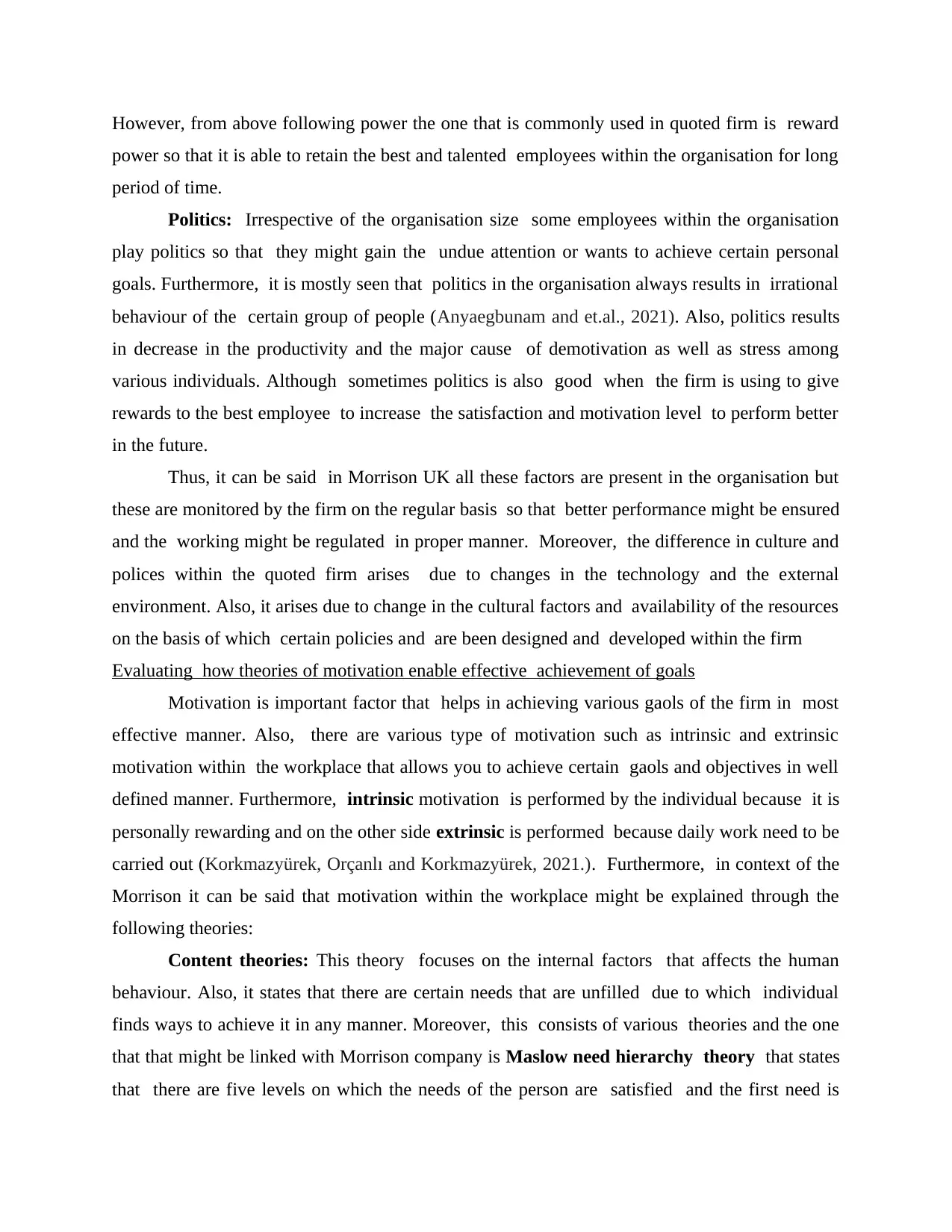
However, from above following power the one that is commonly used in quoted firm is reward
power so that it is able to retain the best and talented employees within the organisation for long
period of time.
Politics: Irrespective of the organisation size some employees within the organisation
play politics so that they might gain the undue attention or wants to achieve certain personal
goals. Furthermore, it is mostly seen that politics in the organisation always results in irrational
behaviour of the certain group of people (Anyaegbunam and et.al., 2021). Also, politics results
in decrease in the productivity and the major cause of demotivation as well as stress among
various individuals. Although sometimes politics is also good when the firm is using to give
rewards to the best employee to increase the satisfaction and motivation level to perform better
in the future.
Thus, it can be said in Morrison UK all these factors are present in the organisation but
these are monitored by the firm on the regular basis so that better performance might be ensured
and the working might be regulated in proper manner. Moreover, the difference in culture and
polices within the quoted firm arises due to changes in the technology and the external
environment. Also, it arises due to change in the cultural factors and availability of the resources
on the basis of which certain policies and are been designed and developed within the firm
Evaluating how theories of motivation enable effective achievement of goals
Motivation is important factor that helps in achieving various gaols of the firm in most
effective manner. Also, there are various type of motivation such as intrinsic and extrinsic
motivation within the workplace that allows you to achieve certain gaols and objectives in well
defined manner. Furthermore, intrinsic motivation is performed by the individual because it is
personally rewarding and on the other side extrinsic is performed because daily work need to be
carried out (Korkmazyürek, Orçanlı and Korkmazyürek, 2021.). Furthermore, in context of the
Morrison it can be said that motivation within the workplace might be explained through the
following theories:
Content theories: This theory focuses on the internal factors that affects the human
behaviour. Also, it states that there are certain needs that are unfilled due to which individual
finds ways to achieve it in any manner. Moreover, this consists of various theories and the one
that that might be linked with Morrison company is Maslow need hierarchy theory that states
that there are five levels on which the needs of the person are satisfied and the first need is
power so that it is able to retain the best and talented employees within the organisation for long
period of time.
Politics: Irrespective of the organisation size some employees within the organisation
play politics so that they might gain the undue attention or wants to achieve certain personal
goals. Furthermore, it is mostly seen that politics in the organisation always results in irrational
behaviour of the certain group of people (Anyaegbunam and et.al., 2021). Also, politics results
in decrease in the productivity and the major cause of demotivation as well as stress among
various individuals. Although sometimes politics is also good when the firm is using to give
rewards to the best employee to increase the satisfaction and motivation level to perform better
in the future.
Thus, it can be said in Morrison UK all these factors are present in the organisation but
these are monitored by the firm on the regular basis so that better performance might be ensured
and the working might be regulated in proper manner. Moreover, the difference in culture and
polices within the quoted firm arises due to changes in the technology and the external
environment. Also, it arises due to change in the cultural factors and availability of the resources
on the basis of which certain policies and are been designed and developed within the firm
Evaluating how theories of motivation enable effective achievement of goals
Motivation is important factor that helps in achieving various gaols of the firm in most
effective manner. Also, there are various type of motivation such as intrinsic and extrinsic
motivation within the workplace that allows you to achieve certain gaols and objectives in well
defined manner. Furthermore, intrinsic motivation is performed by the individual because it is
personally rewarding and on the other side extrinsic is performed because daily work need to be
carried out (Korkmazyürek, Orçanlı and Korkmazyürek, 2021.). Furthermore, in context of the
Morrison it can be said that motivation within the workplace might be explained through the
following theories:
Content theories: This theory focuses on the internal factors that affects the human
behaviour. Also, it states that there are certain needs that are unfilled due to which individual
finds ways to achieve it in any manner. Moreover, this consists of various theories and the one
that that might be linked with Morrison company is Maslow need hierarchy theory that states
that there are five levels on which the needs of the person are satisfied and the first need is
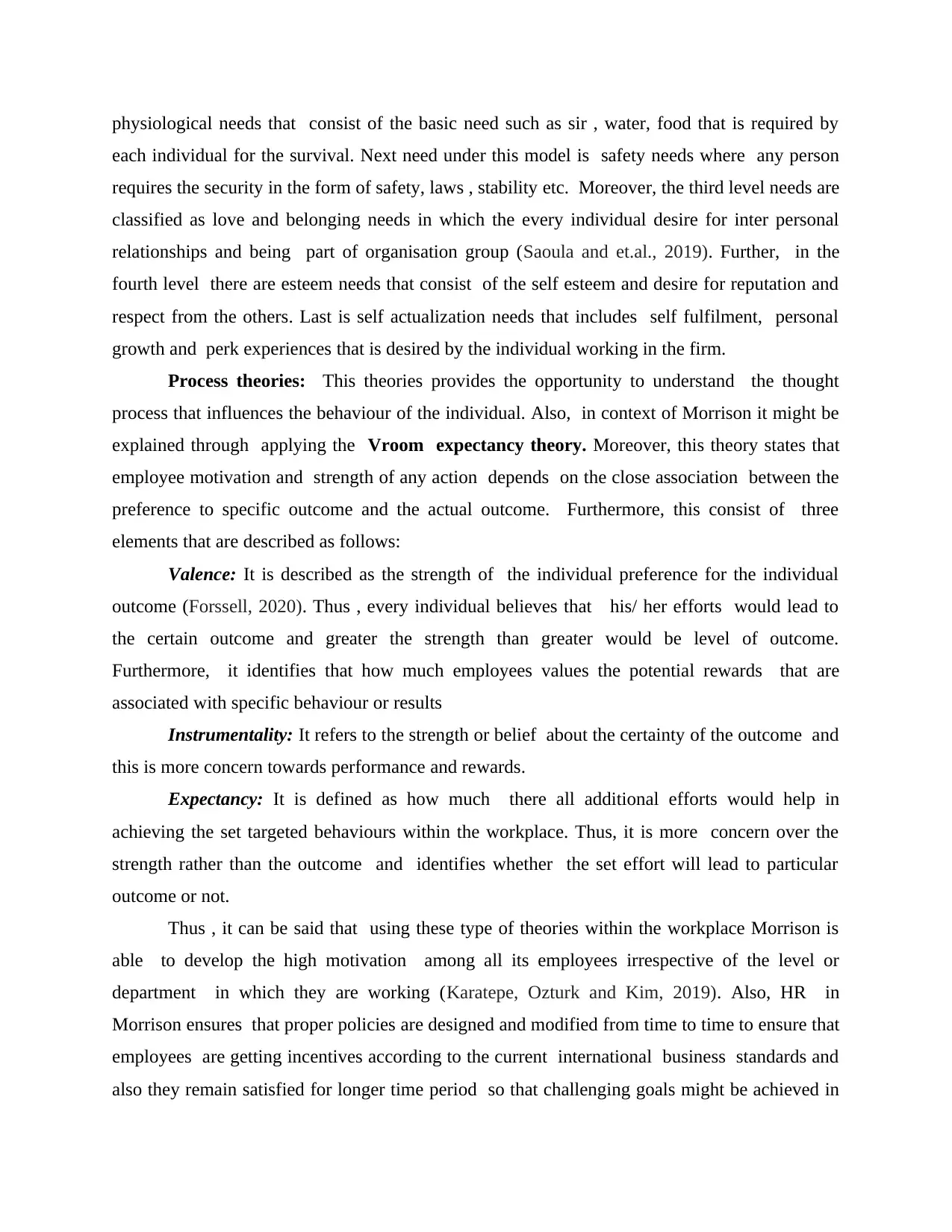
physiological needs that consist of the basic need such as sir , water, food that is required by
each individual for the survival. Next need under this model is safety needs where any person
requires the security in the form of safety, laws , stability etc. Moreover, the third level needs are
classified as love and belonging needs in which the every individual desire for inter personal
relationships and being part of organisation group (Saoula and et.al., 2019). Further, in the
fourth level there are esteem needs that consist of the self esteem and desire for reputation and
respect from the others. Last is self actualization needs that includes self fulfilment, personal
growth and perk experiences that is desired by the individual working in the firm.
Process theories: This theories provides the opportunity to understand the thought
process that influences the behaviour of the individual. Also, in context of Morrison it might be
explained through applying the Vroom expectancy theory. Moreover, this theory states that
employee motivation and strength of any action depends on the close association between the
preference to specific outcome and the actual outcome. Furthermore, this consist of three
elements that are described as follows:
Valence: It is described as the strength of the individual preference for the individual
outcome (Forssell, 2020). Thus , every individual believes that his/ her efforts would lead to
the certain outcome and greater the strength than greater would be level of outcome.
Furthermore, it identifies that how much employees values the potential rewards that are
associated with specific behaviour or results
Instrumentality: It refers to the strength or belief about the certainty of the outcome and
this is more concern towards performance and rewards.
Expectancy: It is defined as how much there all additional efforts would help in
achieving the set targeted behaviours within the workplace. Thus, it is more concern over the
strength rather than the outcome and identifies whether the set effort will lead to particular
outcome or not.
Thus , it can be said that using these type of theories within the workplace Morrison is
able to develop the high motivation among all its employees irrespective of the level or
department in which they are working (Karatepe, Ozturk and Kim, 2019). Also, HR in
Morrison ensures that proper policies are designed and modified from time to time to ensure that
employees are getting incentives according to the current international business standards and
also they remain satisfied for longer time period so that challenging goals might be achieved in
each individual for the survival. Next need under this model is safety needs where any person
requires the security in the form of safety, laws , stability etc. Moreover, the third level needs are
classified as love and belonging needs in which the every individual desire for inter personal
relationships and being part of organisation group (Saoula and et.al., 2019). Further, in the
fourth level there are esteem needs that consist of the self esteem and desire for reputation and
respect from the others. Last is self actualization needs that includes self fulfilment, personal
growth and perk experiences that is desired by the individual working in the firm.
Process theories: This theories provides the opportunity to understand the thought
process that influences the behaviour of the individual. Also, in context of Morrison it might be
explained through applying the Vroom expectancy theory. Moreover, this theory states that
employee motivation and strength of any action depends on the close association between the
preference to specific outcome and the actual outcome. Furthermore, this consist of three
elements that are described as follows:
Valence: It is described as the strength of the individual preference for the individual
outcome (Forssell, 2020). Thus , every individual believes that his/ her efforts would lead to
the certain outcome and greater the strength than greater would be level of outcome.
Furthermore, it identifies that how much employees values the potential rewards that are
associated with specific behaviour or results
Instrumentality: It refers to the strength or belief about the certainty of the outcome and
this is more concern towards performance and rewards.
Expectancy: It is defined as how much there all additional efforts would help in
achieving the set targeted behaviours within the workplace. Thus, it is more concern over the
strength rather than the outcome and identifies whether the set effort will lead to particular
outcome or not.
Thus , it can be said that using these type of theories within the workplace Morrison is
able to develop the high motivation among all its employees irrespective of the level or
department in which they are working (Karatepe, Ozturk and Kim, 2019). Also, HR in
Morrison ensures that proper policies are designed and modified from time to time to ensure that
employees are getting incentives according to the current international business standards and
also they remain satisfied for longer time period so that challenging goals might be achieved in
⊘ This is a preview!⊘
Do you want full access?
Subscribe today to unlock all pages.
Trusted by 1+ million students worldwide
the future. However some of the researchers stated that Maslow hierarchy theory is not effective
as there is lack of direct cause and effect relationship between the need and behaviour. Also,
another major problem of using this type of the model is that it cannot be verified empirically
because there is no proper way to measure how accurately on satisfied level of need must be
before or another. Furthermore, some of the researchers also analysed that vroom expectancy
theory has certain limitations and one of them being that this theory might not be able to work
in best manner if there is lack of active participation from the top managers of any firm. Also,
this theory fails when certain reads that are provided by the top management of nay company
are not being valued by its employees (Gnanarajan Kengatharan and Velnampy, 2022). Thus, if
rewards does not have perceived value associated with it than there would be no motivation left
among the employees to carry out certain task in well defined and proper manner. Moreover,
this theory does not considers other inputs such as overall capacity and education policy that
also need to be considered apart from the efforts alone.
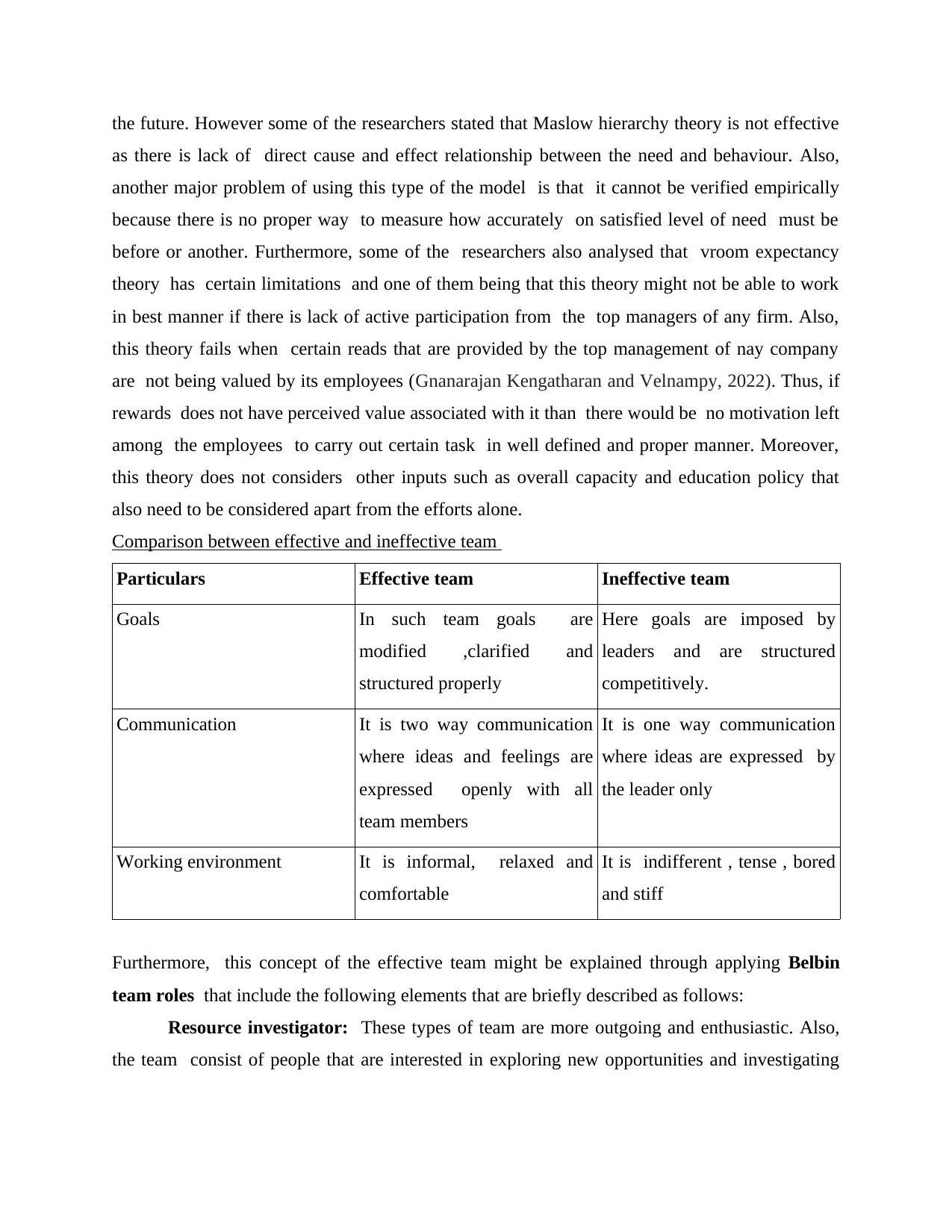
Comparison between effective and ineffective team
Particulars Effective team Ineffective team
Goals In such team goals are
modified ,clarified and
structured properly
Here goals are imposed by
leaders and are structured
competitively.
Communication It is two way communication
where ideas and feelings are
expressed openly with all
team members
It is one way communication
where ideas are expressed by
the leader only
Working environment It is informal, relaxed and
comfortable
It is indifferent , tense , bored
and stiff
Furthermore, this concept of the effective team might be explained through applying Belbin
team roles that include the following elements that are briefly described as follows:
Resource investigator: These types of team are more outgoing and enthusiastic. Also,
the team consist of people that are interested in exploring new opportunities and investigating
as there is lack of direct cause and effect relationship between the need and behaviour. Also,
another major problem of using this type of the model is that it cannot be verified empirically
because there is no proper way to measure how accurately on satisfied level of need must be
before or another. Furthermore, some of the researchers also analysed that vroom expectancy
theory has certain limitations and one of them being that this theory might not be able to work
in best manner if there is lack of active participation from the top managers of any firm. Also,
this theory fails when certain reads that are provided by the top management of nay company
are not being valued by its employees (Gnanarajan Kengatharan and Velnampy, 2022). Thus, if
rewards does not have perceived value associated with it than there would be no motivation left
among the employees to carry out certain task in well defined and proper manner. Moreover,
this theory does not considers other inputs such as overall capacity and education policy that
also need to be considered apart from the efforts alone.
Comparison between effective and ineffective team
Particulars Effective team Ineffective team
Goals In such team goals are
modified ,clarified and
structured properly
Here goals are imposed by
leaders and are structured
competitively.
Communication It is two way communication
where ideas and feelings are
expressed openly with all
team members
It is one way communication
where ideas are expressed by
the leader only
Working environment It is informal, relaxed and
comfortable
It is indifferent , tense , bored
and stiff
Furthermore, this concept of the effective team might be explained through applying Belbin
team roles that include the following elements that are briefly described as follows:
Resource investigator: These types of team are more outgoing and enthusiastic. Also,
the team consist of people that are interested in exploring new opportunities and investigating
Paraphrase This Document
Need a fresh take? Get an instant paraphrase of this document with our AI Paraphraser
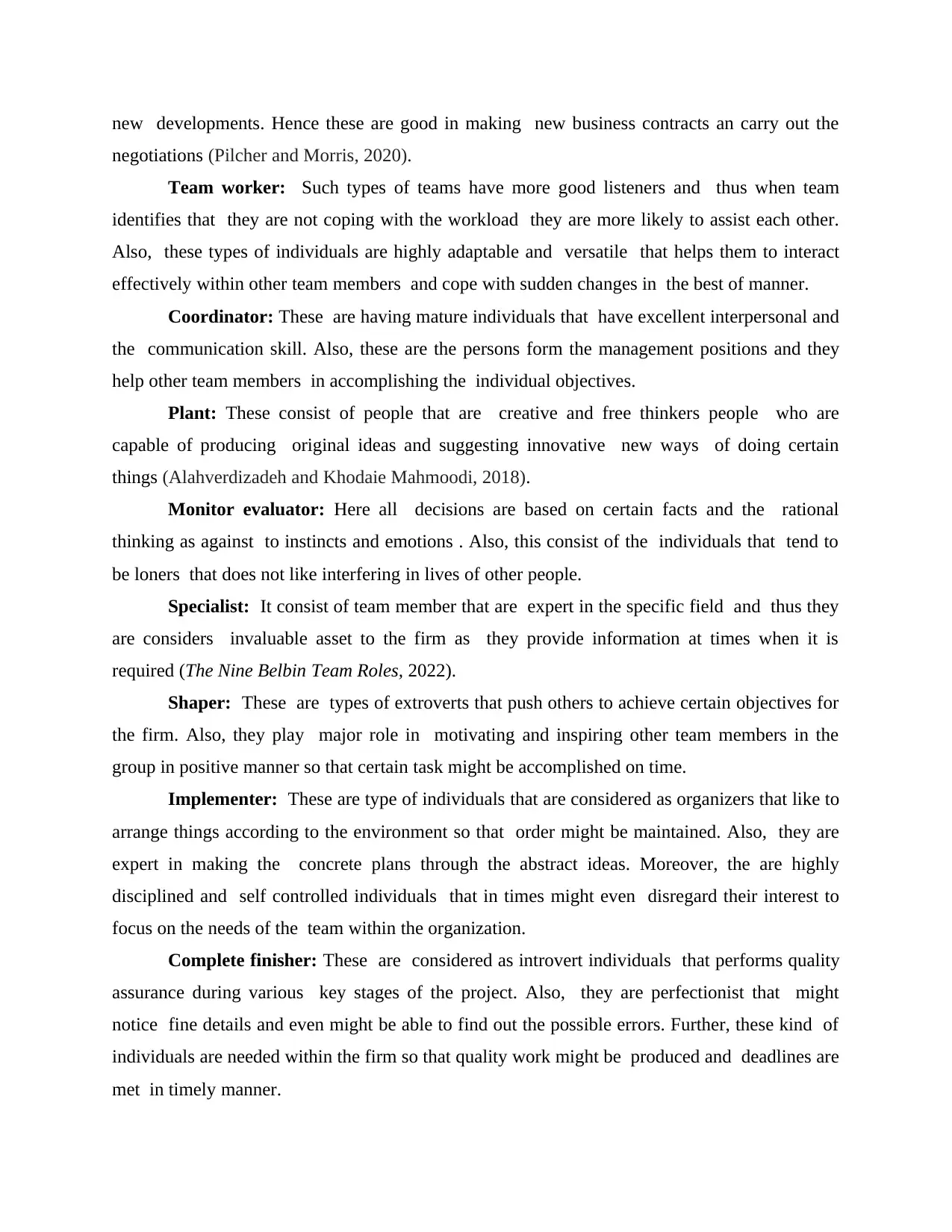
new developments. Hence these are good in making new business contracts an carry out the
negotiations (Pilcher and Morris, 2020).
Team worker: Such types of teams have more good listeners and thus when team
identifies that they are not coping with the workload they are more likely to assist each other.
Also, these types of individuals are highly adaptable and versatile that helps them to interact
effectively within other team members and cope with sudden changes in the best of manner.
Coordinator: These are having mature individuals that have excellent interpersonal and
the communication skill. Also, these are the persons form the management positions and they
help other team members in accomplishing the individual objectives.
Plant: These consist of people that are creative and free thinkers people who are
capable of producing original ideas and suggesting innovative new ways of doing certain
things (Alahverdizadeh and Khodaie Mahmoodi, 2018).
Monitor evaluator: Here all decisions are based on certain facts and the rational
thinking as against to instincts and emotions . Also, this consist of the individuals that tend to
be loners that does not like interfering in lives of other people.
Specialist: It consist of team member that are expert in the specific field and thus they
are considers invaluable asset to the firm as they provide information at times when it is
required (The Nine Belbin Team Roles, 2022).
Shaper: These are types of extroverts that push others to achieve certain objectives for
the firm. Also, they play major role in motivating and inspiring other team members in the
group in positive manner so that certain task might be accomplished on time.
Implementer: These are type of individuals that are considered as organizers that like to
arrange things according to the environment so that order might be maintained. Also, they are
expert in making the concrete plans through the abstract ideas. Moreover, the are highly
disciplined and self controlled individuals that in times might even disregard their interest to
focus on the needs of the team within the organization.
Complete finisher: These are considered as introvert individuals that performs quality
assurance during various key stages of the project. Also, they are perfectionist that might
notice fine details and even might be able to find out the possible errors. Further, these kind of
individuals are needed within the firm so that quality work might be produced and deadlines are
met in timely manner.
negotiations (Pilcher and Morris, 2020).
Team worker: Such types of teams have more good listeners and thus when team
identifies that they are not coping with the workload they are more likely to assist each other.
Also, these types of individuals are highly adaptable and versatile that helps them to interact
effectively within other team members and cope with sudden changes in the best of manner.
Coordinator: These are having mature individuals that have excellent interpersonal and
the communication skill. Also, these are the persons form the management positions and they
help other team members in accomplishing the individual objectives.
Plant: These consist of people that are creative and free thinkers people who are
capable of producing original ideas and suggesting innovative new ways of doing certain
things (Alahverdizadeh and Khodaie Mahmoodi, 2018).
Monitor evaluator: Here all decisions are based on certain facts and the rational
thinking as against to instincts and emotions . Also, this consist of the individuals that tend to
be loners that does not like interfering in lives of other people.
Specialist: It consist of team member that are expert in the specific field and thus they
are considers invaluable asset to the firm as they provide information at times when it is
required (The Nine Belbin Team Roles, 2022).
Shaper: These are types of extroverts that push others to achieve certain objectives for
the firm. Also, they play major role in motivating and inspiring other team members in the
group in positive manner so that certain task might be accomplished on time.
Implementer: These are type of individuals that are considered as organizers that like to
arrange things according to the environment so that order might be maintained. Also, they are
expert in making the concrete plans through the abstract ideas. Moreover, the are highly
disciplined and self controlled individuals that in times might even disregard their interest to
focus on the needs of the team within the organization.
Complete finisher: These are considered as introvert individuals that performs quality
assurance during various key stages of the project. Also, they are perfectionist that might
notice fine details and even might be able to find out the possible errors. Further, these kind of
individuals are needed within the firm so that quality work might be produced and deadlines are
met in timely manner.
Thus, from the above Belbin theory it can be said that Morrison company should
consider category of shaper and the implementer where all task are aimed to be performed in
well defined and timely manner through its employees and diverse team that have to work
according to the changing business requirement and available resources
Moreover, another way of teams within the Morrison might be explained through
applying the tuck-man team theory that have four stages of team development that are as
follows:
Forming: under this first stage the Morrison's company employees form teams where
there is high dependence on the leader for the guidance and direction so that specified task
might be achieved (Urgan, 2019). Also, with new team all the individuals have responsibilities
and roles that are unclear and thus employees every time ask for proper direction so that no
wrong decisions are taken in the end or the any task is carried out in inappropriate manner.
Moreover, the leader in Morrison is prepared to answer certain questions received about the
team purpose and external relationships.
Storming: While making the group decisions that are problems in arriving to the final
decisions and thus Morrison employees under this stage still have certain amount of dependency
on the managers to support and make changes in the group decisions. Furthermore, even
through team clarity over its purpose is known but in spite of it there are various uncertainties
that still persist (Bruce Tuckman's 1965 Team-Development Model, 2022) . Also, quoted firm
team makes certain compromises so that progress might be enabled and thus here the team is
focused on the gaols so that it does not get distracted by the emotional and relationship issues
that affects the productivity or performance of group members.
Norming: Here in this stage the team that is working the Morrison is reach to certain
agreements after the conclusion drawn out of the situation . Also, here the commitment and
unity among the group is strong and thus team engages in social and fun activities to establish
better relationship with each other (Boncea, 2018). Moreover, the team develop certain
processes and working style so that role and responsibilities might be shared in the best manner
Performing: Here under this last stage the working of team in Morrison is such that the
groups has increased the strategic awareness and team members are very clear about why they
are doing and what they are doing. Also, under this stage the team does not require much
instruction or assistance for the leader or the manager . Moreover, the leader of the Morrison is
consider category of shaper and the implementer where all task are aimed to be performed in
well defined and timely manner through its employees and diverse team that have to work
according to the changing business requirement and available resources
Moreover, another way of teams within the Morrison might be explained through
applying the tuck-man team theory that have four stages of team development that are as
follows:
Forming: under this first stage the Morrison's company employees form teams where
there is high dependence on the leader for the guidance and direction so that specified task
might be achieved (Urgan, 2019). Also, with new team all the individuals have responsibilities
and roles that are unclear and thus employees every time ask for proper direction so that no
wrong decisions are taken in the end or the any task is carried out in inappropriate manner.
Moreover, the leader in Morrison is prepared to answer certain questions received about the
team purpose and external relationships.
Storming: While making the group decisions that are problems in arriving to the final
decisions and thus Morrison employees under this stage still have certain amount of dependency
on the managers to support and make changes in the group decisions. Furthermore, even
through team clarity over its purpose is known but in spite of it there are various uncertainties
that still persist (Bruce Tuckman's 1965 Team-Development Model, 2022) . Also, quoted firm
team makes certain compromises so that progress might be enabled and thus here the team is
focused on the gaols so that it does not get distracted by the emotional and relationship issues
that affects the productivity or performance of group members.
Norming: Here in this stage the team that is working the Morrison is reach to certain
agreements after the conclusion drawn out of the situation . Also, here the commitment and
unity among the group is strong and thus team engages in social and fun activities to establish
better relationship with each other (Boncea, 2018). Moreover, the team develop certain
processes and working style so that role and responsibilities might be shared in the best manner
Performing: Here under this last stage the working of team in Morrison is such that the
groups has increased the strategic awareness and team members are very clear about why they
are doing and what they are doing. Also, under this stage the team does not require much
instruction or assistance for the leader or the manager . Moreover, the leader of the Morrison is
⊘ This is a preview!⊘
Do you want full access?
Subscribe today to unlock all pages.
Trusted by 1+ million students worldwide
only responsible for delegating certain roles as there is higher degree of the autonomy to the
team members to carry out the task by their own manner in effective ways.
Adjourning: It is stage where group that is formed by top manager of the Morrison for
accomplishing certain tasks is now been break up as the goals are been achieved. Also, there are
less chances that members with similar teams are formed in the future as business environment
demands changed requirements.
Applying concepts and philosophies of organisational behaviour
Concepts of organisation behaviour:
There are various concepts on which organisational behaviour works and hence some
of the fundamental concepts are briefly described as follows:
Individual differences: It states that every individual in this world have different
opinions and views regarding any statement that is been provided (Wilder, 2020). Hence, many
people would provide various solutions to any problems that is been occurring at any particular
point of time. Furthermore, these differences might be accepted in the organisations so that
conflicts might be avoided for the same.
Perception: When visualizing the same thing it can be said that people perceptions vary
different form each other due to either age gaps, gender and cultural differences etc. Thus, the
person always organise and interprets things that it visualize in his lifetime. Moreover,
employees see each other work differently based on the personalities and past experiences so
that better decisions might be made.
Motivated behaviour: This concepts states that employee has various needs inside
himself that needs to be fulfilled over period of time. Also, some time of motivation are
essential so that quality of the work might be done that includes least amount of mistakes and
errors (Larionova, Stepanova and Shalina, 2020). Thus, these needs needs to be closely identified
so that better results might be delivered.
Desire of involvement: In organisations every employee is actively looking for
opportunities to work in the decision making problems. Also, each firm needs to provide equal
chance and opportunities so that employees are able to openly express certain views and
opinions. Moreover, hunger to share from the experience and the learn is always there is each
individual employee
team members to carry out the task by their own manner in effective ways.
Adjourning: It is stage where group that is formed by top manager of the Morrison for
accomplishing certain tasks is now been break up as the goals are been achieved. Also, there are
less chances that members with similar teams are formed in the future as business environment
demands changed requirements.
Applying concepts and philosophies of organisational behaviour
Concepts of organisation behaviour:
There are various concepts on which organisational behaviour works and hence some
of the fundamental concepts are briefly described as follows:
Individual differences: It states that every individual in this world have different
opinions and views regarding any statement that is been provided (Wilder, 2020). Hence, many
people would provide various solutions to any problems that is been occurring at any particular
point of time. Furthermore, these differences might be accepted in the organisations so that
conflicts might be avoided for the same.
Perception: When visualizing the same thing it can be said that people perceptions vary
different form each other due to either age gaps, gender and cultural differences etc. Thus, the
person always organise and interprets things that it visualize in his lifetime. Moreover,
employees see each other work differently based on the personalities and past experiences so
that better decisions might be made.
Motivated behaviour: This concepts states that employee has various needs inside
himself that needs to be fulfilled over period of time. Also, some time of motivation are
essential so that quality of the work might be done that includes least amount of mistakes and
errors (Larionova, Stepanova and Shalina, 2020). Thus, these needs needs to be closely identified
so that better results might be delivered.
Desire of involvement: In organisations every employee is actively looking for
opportunities to work in the decision making problems. Also, each firm needs to provide equal
chance and opportunities so that employees are able to openly express certain views and
opinions. Moreover, hunger to share from the experience and the learn is always there is each
individual employee
Paraphrase This Document
Need a fresh take? Get an instant paraphrase of this document with our AI Paraphraser
Organisations are social systems: This concept believes that all the organisation are the
social systems where all the activities are carried out in according to certain social laws and the
systems. Moreover, the behaviour that is prevailing in any firm tends to have the influence on
others that are present within the system. Moreover, there are two types of systems that exist
within the organisation that is formal and informal system (Sawitri and et.al., 2021) .
Furthermore, in formal system all the rules are clearly laid down and specified that need to be
followed in right manner. However, the informal system exist due to mutual bonds that are
shared by each individual employee that are working together to achieve certain goals and
objectives.
Philosophies of organisational behaviour:
The philosophies that are followed within any firm might be understood in best manner
through applying the path goals theory that states that leadership style within any organisation
changes from time to time depending upon the situation. Furthermore, it consist of various
leadership styles that are briefly described as follows:
Directive leadership: it is type of style where the leaders know exactly what need to be
done , how many tasks need to be carried out and what re the best ways to meet any deadlines of
the project. Also, here leaders create the framework that helps in providing guidance to
employees and allow to clearly communicate certain expectations and the methods of
performing the any task in most effective manner (Dekawati, Suhendar and Aji, 2019).
Furthermore, this type of style is best suited when the team in inexperienced or have very little
know;edge of the work that need to be performed within the firm.
Supportive leadership: It is type of style where the leaders create the friendly
environment where well being of each others is been taken care of. Also, leaders of such teams
are quite supportive and enthusiastic in helping the individual employee to accomplish certain
skills of competencies (Yasini, Shiri and Moradi Kia, 2018) . Moreover , such type of
engagement is essential for increasing the job satisfactions and engagement within the leader
and the employee. Furthermore, this type of the leadership is essential when the company need
to overcome certain personal challenges such as low morale.
Achievement oriented leadership: Here the leaders are responsible for setting the
ambitious goals for the overall team so that consistent improvement might be ensured through
setting certain challenging goals for the team. Also, here the managers delegate certain
social systems where all the activities are carried out in according to certain social laws and the
systems. Moreover, the behaviour that is prevailing in any firm tends to have the influence on
others that are present within the system. Moreover, there are two types of systems that exist
within the organisation that is formal and informal system (Sawitri and et.al., 2021) .
Furthermore, in formal system all the rules are clearly laid down and specified that need to be
followed in right manner. However, the informal system exist due to mutual bonds that are
shared by each individual employee that are working together to achieve certain goals and
objectives.
Philosophies of organisational behaviour:
The philosophies that are followed within any firm might be understood in best manner
through applying the path goals theory that states that leadership style within any organisation
changes from time to time depending upon the situation. Furthermore, it consist of various
leadership styles that are briefly described as follows:
Directive leadership: it is type of style where the leaders know exactly what need to be
done , how many tasks need to be carried out and what re the best ways to meet any deadlines of
the project. Also, here leaders create the framework that helps in providing guidance to
employees and allow to clearly communicate certain expectations and the methods of
performing the any task in most effective manner (Dekawati, Suhendar and Aji, 2019).
Furthermore, this type of style is best suited when the team in inexperienced or have very little
know;edge of the work that need to be performed within the firm.
Supportive leadership: It is type of style where the leaders create the friendly
environment where well being of each others is been taken care of. Also, leaders of such teams
are quite supportive and enthusiastic in helping the individual employee to accomplish certain
skills of competencies (Yasini, Shiri and Moradi Kia, 2018) . Moreover , such type of
engagement is essential for increasing the job satisfactions and engagement within the leader
and the employee. Furthermore, this type of the leadership is essential when the company need
to overcome certain personal challenges such as low morale.
Achievement oriented leadership: Here the leaders are responsible for setting the
ambitious goals for the overall team so that consistent improvement might be ensured through
setting certain challenging goals for the team. Also, here the managers delegate certain
responsibilities to the team members so that certain objectives might be met and trust might be
build up.
Participative leadership: In this type of leadership style leaders are interested in
engaging the employees through allowing them to participate in the decision making process.
Also, here the team members are allowed to present certain ideas openly without the fear of
someone in the team . Moreover, this is mostly done through conducting the brainstorming
sessions where the employees are asked about ideas relating to the new projects that is going to
be undertaken by the firm in the future.
Thus from the above path goal theory it can be said that one that should be chosen by
the Morrison's to achieve the future efficiency in its work is participative approach that would
allow to the firm to have free flow of ideas and open up new opportunities for the business .
Also, through this approach greater retention of employees within the firm is ensured for
longer time frame and the employees morale is also increased in systematic manner that will
allow the firm to achieve certain long term and challenging goals (DeSocio, Garzon and
Hicks,2019). However following this practice for longer time period might diminish the quality
of expertise of the employees and increase the conflict within the workplace that might harm the
success and brand image of the quoted firm in the garget market . Hence, the leadership style
need to evaluated regularly on the basis of business performance.
CONCLUSION
From the above report it can be concluded that organizational behaviour is important in
managing the large number of employees in best and effective manner. Also, the report had
analysed impact of the politics in Morrison organisation. Moreover, study had also identified
role of adopting the right team behaviour in increasing the organisational performance over the
years. Furthermore, the study had also identified that motivation plays very important role in
retaining best talent within the firm and also to face certain challenges in the positive manner .
Thus, this concept is explained through using various motivational theories such as …...... also,
the study had analysed the comparison of the effective and the ineffective team so that better
gaols might be developed for the firm. Lastly, certain concepts and philosophies had also been
discussed in detail under this report so that complex business situations in the future might be
handled effectively.
build up.
Participative leadership: In this type of leadership style leaders are interested in
engaging the employees through allowing them to participate in the decision making process.
Also, here the team members are allowed to present certain ideas openly without the fear of
someone in the team . Moreover, this is mostly done through conducting the brainstorming
sessions where the employees are asked about ideas relating to the new projects that is going to
be undertaken by the firm in the future.
Thus from the above path goal theory it can be said that one that should be chosen by
the Morrison's to achieve the future efficiency in its work is participative approach that would
allow to the firm to have free flow of ideas and open up new opportunities for the business .
Also, through this approach greater retention of employees within the firm is ensured for
longer time frame and the employees morale is also increased in systematic manner that will
allow the firm to achieve certain long term and challenging goals (DeSocio, Garzon and
Hicks,2019). However following this practice for longer time period might diminish the quality
of expertise of the employees and increase the conflict within the workplace that might harm the
success and brand image of the quoted firm in the garget market . Hence, the leadership style
need to evaluated regularly on the basis of business performance.
CONCLUSION
From the above report it can be concluded that organizational behaviour is important in
managing the large number of employees in best and effective manner. Also, the report had
analysed impact of the politics in Morrison organisation. Moreover, study had also identified
role of adopting the right team behaviour in increasing the organisational performance over the
years. Furthermore, the study had also identified that motivation plays very important role in
retaining best talent within the firm and also to face certain challenges in the positive manner .
Thus, this concept is explained through using various motivational theories such as …...... also,
the study had analysed the comparison of the effective and the ineffective team so that better
gaols might be developed for the firm. Lastly, certain concepts and philosophies had also been
discussed in detail under this report so that complex business situations in the future might be
handled effectively.
⊘ This is a preview!⊘
Do you want full access?
Subscribe today to unlock all pages.
Trusted by 1+ million students worldwide

1 out of 14


Related Documents


Your All-in-One AI-Powered Toolkit for Academic Success.
+13062052269
info@desklib.com
Available 24*7 on WhatsApp / Email
![[object Object]](/_next/static/media/star-bottom.7253800d.svg)
Unlock your academic potential
Copyright © 2020–2026 A2Z Services. All Rights Reserved. Developed and managed by ZUCOL.