Organisational Behaviour Case Study: Challenges in Susan's New Job
VerifiedAdded on 2022/09/09
|9
|687
|27
Case Study
AI Summary
This case study examines the organisational behaviour challenges faced by Susan Taylor in her new role as the head of a product development unit. Previously a production controller, Susan encounters issues such as lack of employee engagement, questioning of her authority, and delays in production. The case explores relevant organisational behaviour theories like group behaviour, motivational theory, individual behaviour, systems theory, and human relations theory to understand the underlying issues. Recommendations include staff training, performance monitoring, implementing rewards, and establishing clear organisational policies to improve employee engagement, communication, and overall performance. The assignment references various academic sources to support the analysis and recommendations.
Organisational
behaviour
behaviour
Paraphrase This Document
Need a fresh take? Get an instant paraphrase of this document with our AI Paraphraser

Introduction
Susan used to work as a production controller in a
pharmaceutical company previously
She was assigned with the work of managing 40 production staffs
and three supervisors, every one of them were women
To use her potential skills, she joined another company to handle
challenges at work (McShane et al. 2018)
In the new company, she was handed with the responsibility of
taking charge of the product development
Susan used to work as a production controller in a
pharmaceutical company previously
She was assigned with the work of managing 40 production staffs
and three supervisors, every one of them were women
To use her potential skills, she joined another company to handle
challenges at work (McShane et al. 2018)
In the new company, she was handed with the responsibility of
taking charge of the product development

Three key organisational
behaviour issues
The organisational behaviour issues include the lack of potential
ad efforts put by the staffs at the new workplace
The staffs continuously questioned Susan regarding what is the
need to do work
The interference of Susan was also not considered by them as
effective, which created issues as well (Wood et al. 2013)
The research specialist lacked proper understanding of the needs
and preferences of the production at the company
behaviour issues
The organisational behaviour issues include the lack of potential
ad efforts put by the staffs at the new workplace
The staffs continuously questioned Susan regarding what is the
need to do work
The interference of Susan was also not considered by them as
effective, which created issues as well (Wood et al. 2013)
The research specialist lacked proper understanding of the needs
and preferences of the production at the company
⊘ This is a preview!⊘
Do you want full access?
Subscribe today to unlock all pages.

Trusted by 1+ million students worldwide

Three key organisational
behaviour issues (continued)
There was another issue related to the delay in getting the
production, which made the research director talk with Susan
The behavioural issues at the organisation also represented he
fact that there was lack of coordination between Susan and the
staffs
The support of Susan was not needed by them, but she did it for
their own good, which was objected by them and considered it as
interference in their work (Coccia 2015)
behaviour issues (continued)
There was another issue related to the delay in getting the
production, which made the research director talk with Susan
The behavioural issues at the organisation also represented he
fact that there was lack of coordination between Susan and the
staffs
The support of Susan was not needed by them, but she did it for
their own good, which was objected by them and considered it as
interference in their work (Coccia 2015)
Paraphrase This Document
Need a fresh take? Get an instant paraphrase of this document with our AI Paraphraser

Relevant Organizational
behaviour theories
The group behaviour theory related to the management of
issues, which could help in promoting diversity as well as
facilitate communication between the leader and the employees
The motivational theory such as Maslow’s hierarchy theory could
be related to the support of Susan to keep the employees
motivated
The individual behaviour theory could also be considered here to
ensure that all the staffs are taken care of individually (Unsworth,
Dmitrieva and Adriasola 2013)
behaviour theories
The group behaviour theory related to the management of
issues, which could help in promoting diversity as well as
facilitate communication between the leader and the employees
The motivational theory such as Maslow’s hierarchy theory could
be related to the support of Susan to keep the employees
motivated
The individual behaviour theory could also be considered here to
ensure that all the staffs are taken care of individually (Unsworth,
Dmitrieva and Adriasola 2013)

Relevant Organizational
behaviour theories (continued)
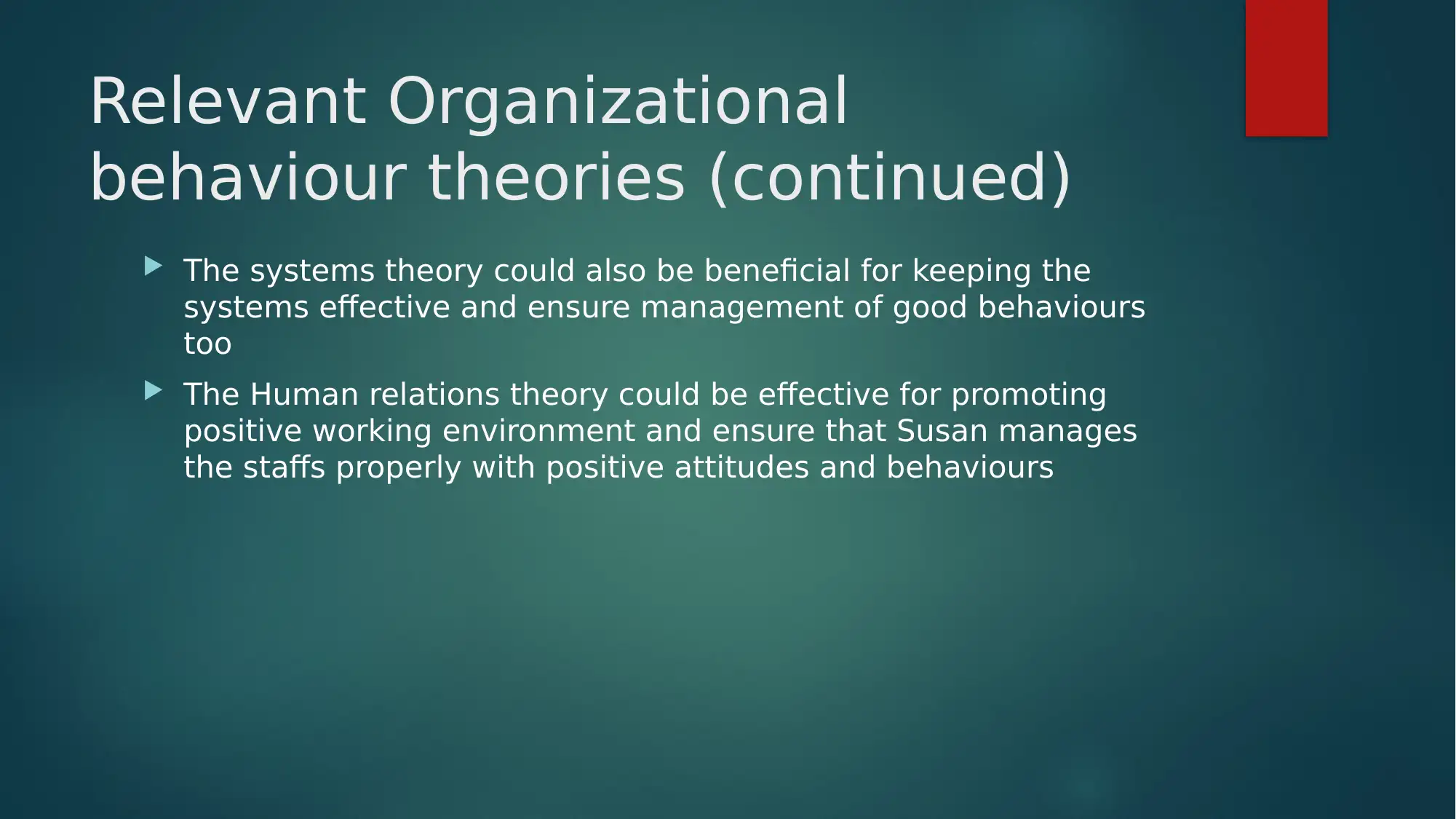
The systems theory could also be beneficial for keeping the
systems effective and ensure management of good behaviours
too
The Human relations theory could be effective for promoting
positive working environment and ensure that Susan manages
the staffs properly with positive attitudes and behaviours
behaviour theories (continued)
The systems theory could also be beneficial for keeping the
systems effective and ensure management of good behaviours
too
The Human relations theory could be effective for promoting
positive working environment and ensure that Susan manages
the staffs properly with positive attitudes and behaviours
⊘ This is a preview!⊘
Do you want full access?
Subscribe today to unlock all pages.

Trusted by 1+ million students worldwide

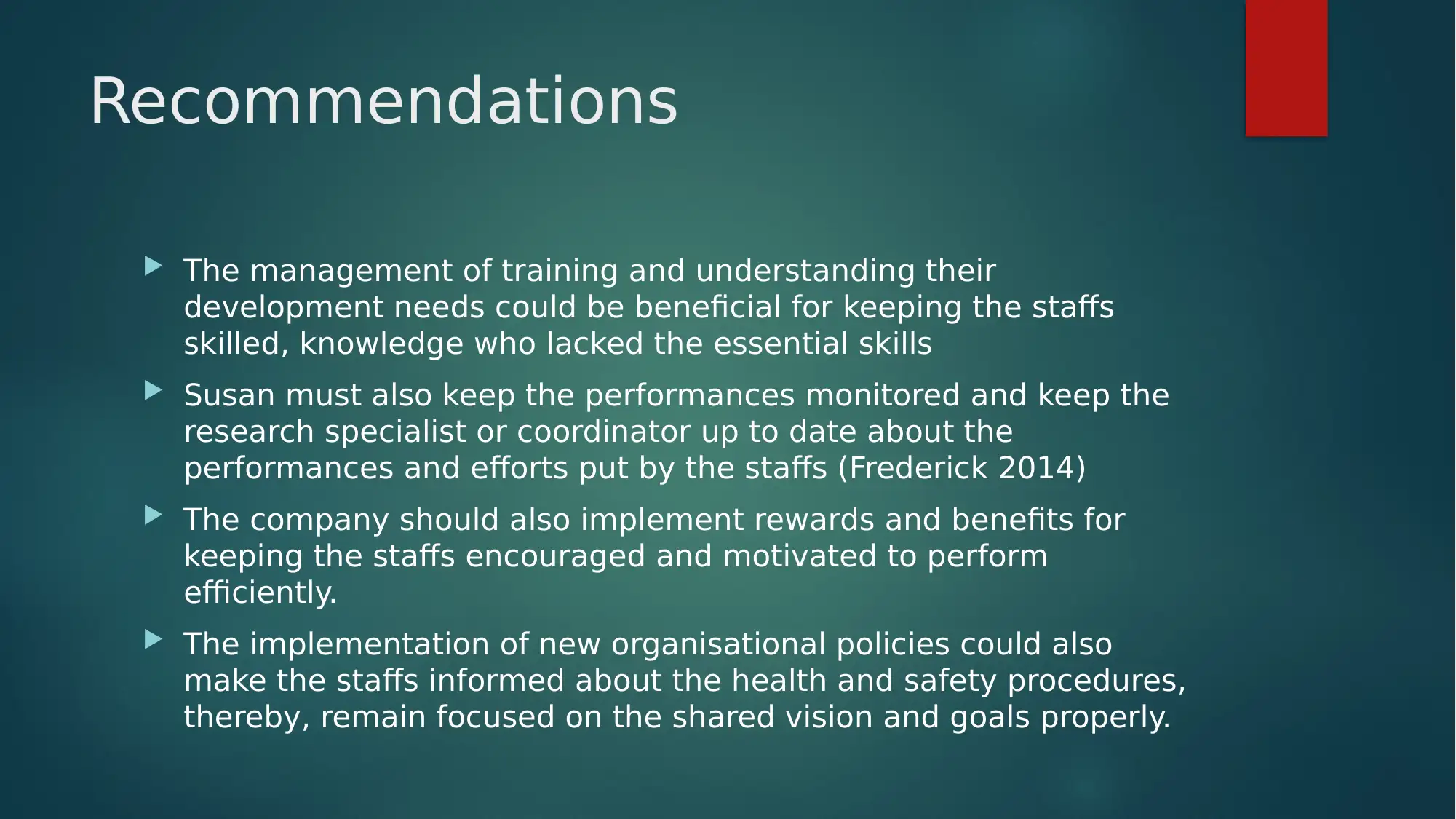
Recommendations
The management of training and understanding their
development needs could be beneficial for keeping the staffs
skilled, knowledge who lacked the essential skills
Susan must also keep the performances monitored and keep the
research specialist or coordinator up to date about the
performances and efforts put by the staffs (Frederick 2014)
The company should also implement rewards and benefits for
keeping the staffs encouraged and motivated to perform
efficiently.
The implementation of new organisational policies could also
make the staffs informed about the health and safety procedures,
thereby, remain focused on the shared vision and goals properly.
The management of training and understanding their
development needs could be beneficial for keeping the staffs
skilled, knowledge who lacked the essential skills
Susan must also keep the performances monitored and keep the
research specialist or coordinator up to date about the
performances and efforts put by the staffs (Frederick 2014)
The company should also implement rewards and benefits for
keeping the staffs encouraged and motivated to perform
efficiently.
The implementation of new organisational policies could also
make the staffs informed about the health and safety procedures,
thereby, remain focused on the shared vision and goals properly.
Paraphrase This Document
Need a fresh take? Get an instant paraphrase of this document with our AI Paraphraser

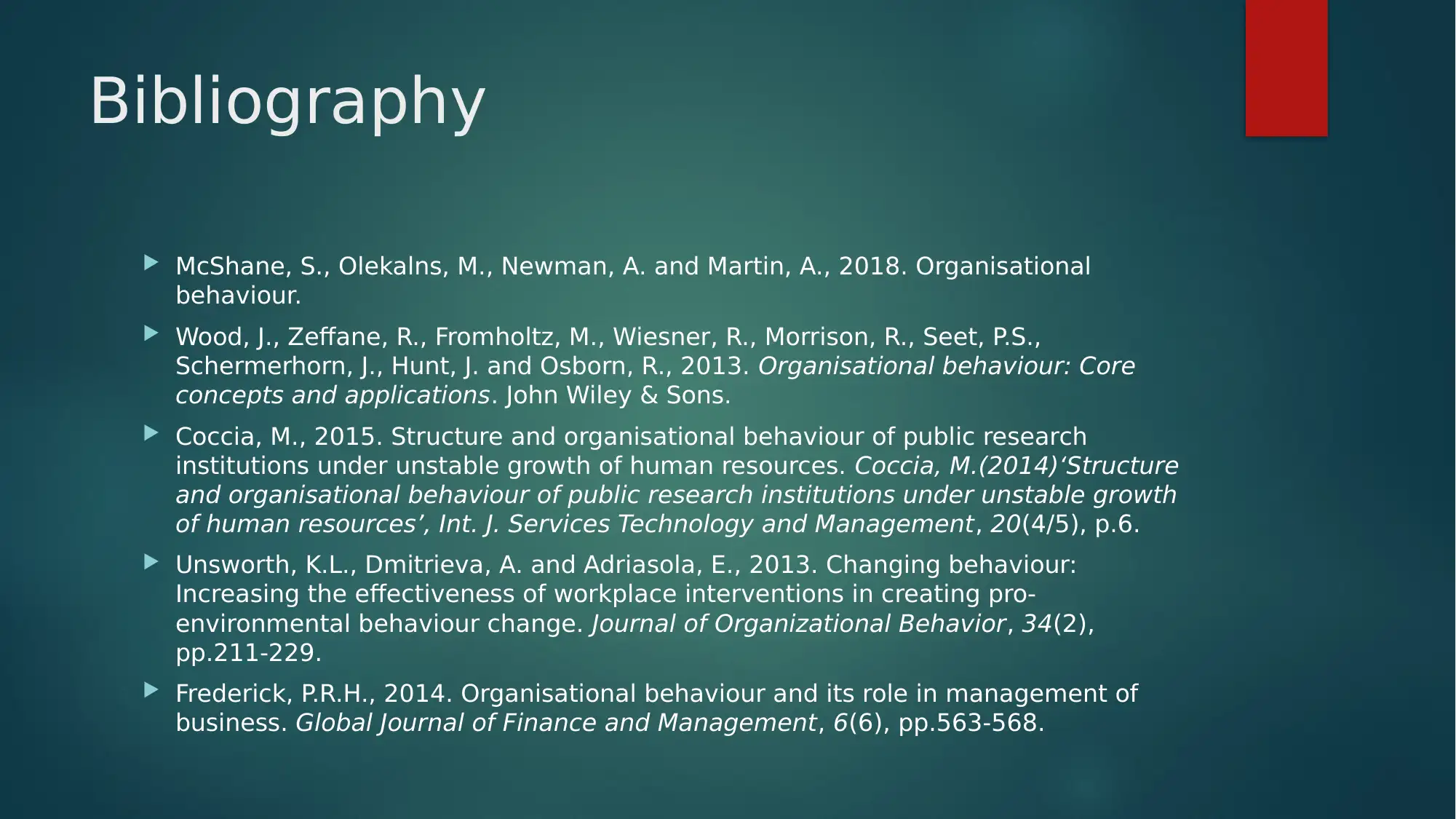
Bibliography
McShane, S., Olekalns, M., Newman, A. and Martin, A., 2018. Organisational
behaviour.
Wood, J., Zeffane, R., Fromholtz, M., Wiesner, R., Morrison, R., Seet, P.S.,
Schermerhorn, J., Hunt, J. and Osborn, R., 2013. Organisational behaviour: Core
concepts and applications. John Wiley & Sons.
Coccia, M., 2015. Structure and organisational behaviour of public research
institutions under unstable growth of human resources. Coccia, M.(2014)‘Structure
and organisational behaviour of public research institutions under unstable growth
of human resources’, Int. J. Services Technology and Management, 20(4/5), p.6.
Unsworth, K.L., Dmitrieva, A. and Adriasola, E., 2013. Changing behaviour:
Increasing the effectiveness of workplace interventions in creating pro‐
environmental behaviour change. Journal of Organizational Behavior, 34(2),
pp.211-229.
Frederick, P.R.H., 2014. Organisational behaviour and its role in management of
business. Global Journal of Finance and Management, 6(6), pp.563-568.
McShane, S., Olekalns, M., Newman, A. and Martin, A., 2018. Organisational
behaviour.
Wood, J., Zeffane, R., Fromholtz, M., Wiesner, R., Morrison, R., Seet, P.S.,
Schermerhorn, J., Hunt, J. and Osborn, R., 2013. Organisational behaviour: Core
concepts and applications. John Wiley & Sons.
Coccia, M., 2015. Structure and organisational behaviour of public research
institutions under unstable growth of human resources. Coccia, M.(2014)‘Structure
and organisational behaviour of public research institutions under unstable growth
of human resources’, Int. J. Services Technology and Management, 20(4/5), p.6.
Unsworth, K.L., Dmitrieva, A. and Adriasola, E., 2013. Changing behaviour:
Increasing the effectiveness of workplace interventions in creating pro‐
environmental behaviour change. Journal of Organizational Behavior, 34(2),
pp.211-229.
Frederick, P.R.H., 2014. Organisational behaviour and its role in management of
business. Global Journal of Finance and Management, 6(6), pp.563-568.

Thank You
⊘ This is a preview!⊘
Do you want full access?
Subscribe today to unlock all pages.

Trusted by 1+ million students worldwide
1 out of 9
Related Documents
Your All-in-One AI-Powered Toolkit for Academic Success.
+13062052269
info@desklib.com
Available 24*7 on WhatsApp / Email
Unlock your academic potential
Copyright © 2020–2026 A2Z Services. All Rights Reserved. Developed and managed by ZUCOL.