Toyota's Sustainable Projects: Organisational Best Practice Report
VerifiedAdded on 2023/06/07
|12
|3270
|234
Report
AI Summary
This report delves into Toyota's strategic initiatives for sustainable projects in Australia, addressing evolving political regulations and environmental concerns. It highlights Toyota's focus on hybrid vehicles utilizing bioplastics, cars powered by alternative fuels, and the integration of smart technology. The report explores the challenges Toyota faces, such as establishing alternative power stations and adapting to consumer preferences. Furthermore, it discusses the company's commitment to recyclability laws and the use of bio-based materials in manufacturing. The analysis includes Toyota's plans to launch new Lexus models with a significant percentage of bioplastic components. Ultimately, the report underscores Toyota's efforts to reduce carbon emissions and promote sustainable transportation solutions in the Australian market, aiming for a 50% reduction in CHG emissions by 2035.
Running head: ORGANISATIONAL BEST PRACTICE
ORGANISATIONAL BEST PRACTICE
Student’s Name
University Name
Author’s Note
ORGANISATIONAL BEST PRACTICE
Student’s Name
University Name
Author’s Note

Paraphrase This Document
Need a fresh take? Get an instant paraphrase of this document with our AI Paraphraser
2ORGANISATIONAL BEST PRACTICE
Executive Summary
This report shed light on the sustainable and future faceted projects that Toyota would launch
in the future commercially is being discussed in the course of this report. The recent political
regulations in Australia have necessitated the introduction of alternative fuels and new car
models that can substantially reduce the rate of carbon and Greenhouse emission. This report
furthermore encompasses a detailed discussion of the feasibilities that Toyota would have to
face if they want to make a commercial launch of the projects in Australia. The first project is
a subversion of an ongoing project, the making of hybrid models. The cars make use of bio-
plastics. This is what makes the cars commercially cheaper also. Nevertheless, the second
project is dealing with the making of cars that run on alternative powers. The major hindrance
that Toyota would face in this context is that the establishment of alternative power stations
for refilling is difficult in Australia. The last state discusses the implementation of smart
technology in the making of cars. This model is yet in its conception phase and requires any
amendments before launch.
Executive Summary
This report shed light on the sustainable and future faceted projects that Toyota would launch
in the future commercially is being discussed in the course of this report. The recent political
regulations in Australia have necessitated the introduction of alternative fuels and new car
models that can substantially reduce the rate of carbon and Greenhouse emission. This report
furthermore encompasses a detailed discussion of the feasibilities that Toyota would have to
face if they want to make a commercial launch of the projects in Australia. The first project is
a subversion of an ongoing project, the making of hybrid models. The cars make use of bio-
plastics. This is what makes the cars commercially cheaper also. Nevertheless, the second
project is dealing with the making of cars that run on alternative powers. The major hindrance
that Toyota would face in this context is that the establishment of alternative power stations
for refilling is difficult in Australia. The last state discusses the implementation of smart
technology in the making of cars. This model is yet in its conception phase and requires any
amendments before launch.
3ORGANISATIONAL BEST PRACTICE
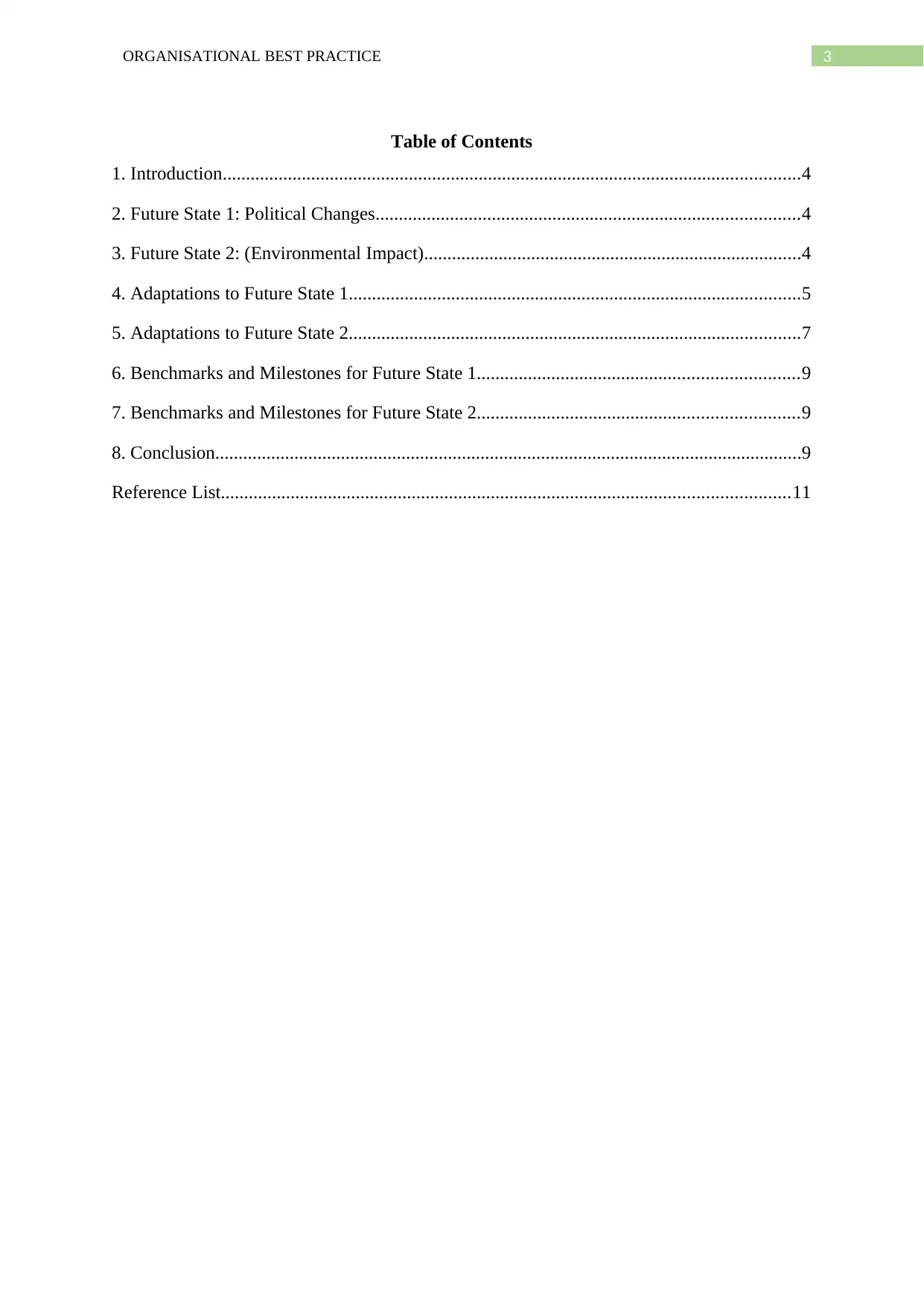
Table of Contents
1. Introduction............................................................................................................................4
2. Future State 1: Political Changes...........................................................................................4
3. Future State 2: (Environmental Impact).................................................................................4
4. Adaptations to Future State 1.................................................................................................5
5. Adaptations to Future State 2.................................................................................................7
6. Benchmarks and Milestones for Future State 1.....................................................................9
7. Benchmarks and Milestones for Future State 2.....................................................................9
8. Conclusion..............................................................................................................................9
Reference List..........................................................................................................................11
Table of Contents
1. Introduction............................................................................................................................4
2. Future State 1: Political Changes...........................................................................................4
3. Future State 2: (Environmental Impact).................................................................................4
4. Adaptations to Future State 1.................................................................................................5
5. Adaptations to Future State 2.................................................................................................7
6. Benchmarks and Milestones for Future State 1.....................................................................9
7. Benchmarks and Milestones for Future State 2.....................................................................9
8. Conclusion..............................................................................................................................9
Reference List..........................................................................................................................11
⊘ This is a preview!⊘
Do you want full access?
Subscribe today to unlock all pages.

Trusted by 1+ million students worldwide
4ORGANISATIONAL BEST PRACTICE
1. Introduction
This report sheds light on the future changes in the Political and the Environmental
factors regarding transport and its impacts in Australia. The government of Australia have
followed a policy of providing heavy subsidy on the fuel prices for several years. At present
moment it is impossible to seek alternative and revert the policy. It is evident that transport in
Australia is largely dependent on personal vehicles and this is why the government is
currently in doldrums. However this scenario can be seen as a prospective opportunity for
Toyota who have been developing concept projects already by using green parts which can
reduce carbon output heavily. Other than that the company is also designing a new project for
manufacturing cars which would run on alternative fuels. These future changes have
presented a major business opportunity for Toyota and the ways in which the company can
prospectively exploit these business opportunities have been reflected in this report.
2. Future State 1: Political Changes
Owning private cars are almost like birth right in Australia. The Fuel economy of the
country is on the rise and parallely the CO2 emission is also on the rise. The agency for
Environment Protection in Australia and the Highway and Traffic safety agencies in Australia
have finalised the bar on the maximum fuel economy, beyond which the new car fleets
cannot expand their emission limit. As per the information provided by Anitha (2017), the
average Corporate Standard for Fuel Economy in Australia have demarcated that cars that
give 100 kilometres of mileage should restrict CO2 emission to 250 cc per mile (Bowbrick,
2014). The government of Australia have confirmed that a re-licensing campaign would be
carried out in the Australian territory for the new light and heavy vehicles. The Euro VI
standards of emission control would be in practice since 2020 and the Ministerial Forum have
released that cars or trucks that cannot adopt to the new regulation changes would have to
undergo re-licensing.
3. Future State 2: (Environmental Impact)
Environmental Impact of transport in Australia is huge. The huge level of
subsidisation in Australia is leading to effective reduction of fuel prices in Australia. As
discussed earlier, the proportion of owning private cars in Australia is very high and as an
impact the greenhouse gar emission has increased. The Energy regulatory authority of
Australia and The Pricing Tribunal of Australian Territory has played a key role by regulating
the electricity prices, because of which the consumer usage of electricity have been
1. Introduction
This report sheds light on the future changes in the Political and the Environmental
factors regarding transport and its impacts in Australia. The government of Australia have
followed a policy of providing heavy subsidy on the fuel prices for several years. At present
moment it is impossible to seek alternative and revert the policy. It is evident that transport in
Australia is largely dependent on personal vehicles and this is why the government is
currently in doldrums. However this scenario can be seen as a prospective opportunity for
Toyota who have been developing concept projects already by using green parts which can
reduce carbon output heavily. Other than that the company is also designing a new project for
manufacturing cars which would run on alternative fuels. These future changes have
presented a major business opportunity for Toyota and the ways in which the company can
prospectively exploit these business opportunities have been reflected in this report.
2. Future State 1: Political Changes
Owning private cars are almost like birth right in Australia. The Fuel economy of the
country is on the rise and parallely the CO2 emission is also on the rise. The agency for
Environment Protection in Australia and the Highway and Traffic safety agencies in Australia
have finalised the bar on the maximum fuel economy, beyond which the new car fleets
cannot expand their emission limit. As per the information provided by Anitha (2017), the
average Corporate Standard for Fuel Economy in Australia have demarcated that cars that
give 100 kilometres of mileage should restrict CO2 emission to 250 cc per mile (Bowbrick,
2014). The government of Australia have confirmed that a re-licensing campaign would be
carried out in the Australian territory for the new light and heavy vehicles. The Euro VI
standards of emission control would be in practice since 2020 and the Ministerial Forum have
released that cars or trucks that cannot adopt to the new regulation changes would have to
undergo re-licensing.
3. Future State 2: (Environmental Impact)
Environmental Impact of transport in Australia is huge. The huge level of
subsidisation in Australia is leading to effective reduction of fuel prices in Australia. As
discussed earlier, the proportion of owning private cars in Australia is very high and as an
impact the greenhouse gar emission has increased. The Energy regulatory authority of
Australia and The Pricing Tribunal of Australian Territory has played a key role by regulating
the electricity prices, because of which the consumer usage of electricity have been
Paraphrase This Document
Need a fresh take? Get an instant paraphrase of this document with our AI Paraphraser
5ORGANISATIONAL BEST PRACTICE
disciplined and the government have been able to save the major capital investments that
went behind the electricity subsidy. This capital have been utilised by the government to keep
the petro and diesel prices low comprehensively. Reports suggest that 70% of the country’s
greenhouse emissions are being caused by the transport of vehicles (Bowbrick, 2014). The
companies which are current manufacturing light weight personal cars are increasing the
mileage of the cars and as an outcome, it is increasing the emission output. Australia being
located in the proximity of the Arctic Circle, the high rate of emission is affecting the ozone
layer and the UN have also expressed concern about the growing vehicular pollution in the
country. AT present only 4% of the vehicles use alternative fuels in Australia (Hines, 2016).
In this context, the Australian government is unable to remove the subsidy in fuel prices
because transport and transit in Australia is largely dependent on the personal vehicles. The
rugged terrains and natural interruptions prevent the establishment of wide networks of public
transport in Australia. The government is however sponsoring the setting up of industries and
factories to manufacturer’s cars that would run on alternative fuel in the future. A tax rebate
of 12% would be offered to those companies who would produce such cars in the future on
their corporate expenses and operational infrastructural costing.
4. Adaptations to Future State 1
Keeping in mind the above discussed apprehensions of the Australian market, Toyota
have focused on designing the hybrid vehicles with new specifications in the future. The
hybrid models that are in the concepts lab of Toyota would emphasize on the fuel efficiency
and global emission challenges without sacrificing power, affordability, and size of the car or
durability. In fact the hybrid form the basis of the Compliance strategy of Toyota
(toyota.com.au, 2018).
The Lexus Range of hybrid car range that came out in 2013 would be re-launched
with new hybrid engine model bearing cars. The hybrid technology would replace the
features like the accessory belts with new and improved electronic accessories (Pudaruth,
2014). The major aim is to enhance the fuel economy, durability as well as emissions. The
company is aiming at introducing a new zero evaporative fuel-system which would ensure a
stable reduction in the level of emission of the organic compounds that are volatile. However
no commercial progress for launching the car in the market is achieved as of yet. As per
Hatani (2017), the reason is that the company is not in a position to depict consumer
preferences of 2025.
disciplined and the government have been able to save the major capital investments that
went behind the electricity subsidy. This capital have been utilised by the government to keep
the petro and diesel prices low comprehensively. Reports suggest that 70% of the country’s
greenhouse emissions are being caused by the transport of vehicles (Bowbrick, 2014). The
companies which are current manufacturing light weight personal cars are increasing the
mileage of the cars and as an outcome, it is increasing the emission output. Australia being
located in the proximity of the Arctic Circle, the high rate of emission is affecting the ozone
layer and the UN have also expressed concern about the growing vehicular pollution in the
country. AT present only 4% of the vehicles use alternative fuels in Australia (Hines, 2016).
In this context, the Australian government is unable to remove the subsidy in fuel prices
because transport and transit in Australia is largely dependent on the personal vehicles. The
rugged terrains and natural interruptions prevent the establishment of wide networks of public
transport in Australia. The government is however sponsoring the setting up of industries and
factories to manufacturer’s cars that would run on alternative fuel in the future. A tax rebate
of 12% would be offered to those companies who would produce such cars in the future on
their corporate expenses and operational infrastructural costing.
4. Adaptations to Future State 1
Keeping in mind the above discussed apprehensions of the Australian market, Toyota
have focused on designing the hybrid vehicles with new specifications in the future. The
hybrid models that are in the concepts lab of Toyota would emphasize on the fuel efficiency
and global emission challenges without sacrificing power, affordability, and size of the car or
durability. In fact the hybrid form the basis of the Compliance strategy of Toyota
(toyota.com.au, 2018).
The Lexus Range of hybrid car range that came out in 2013 would be re-launched
with new hybrid engine model bearing cars. The hybrid technology would replace the
features like the accessory belts with new and improved electronic accessories (Pudaruth,
2014). The major aim is to enhance the fuel economy, durability as well as emissions. The
company is aiming at introducing a new zero evaporative fuel-system which would ensure a
stable reduction in the level of emission of the organic compounds that are volatile. However
no commercial progress for launching the car in the market is achieved as of yet. As per
Hatani (2017), the reason is that the company is not in a position to depict consumer
preferences of 2025.
6ORGANISATIONAL BEST PRACTICE
Some specific factors like Fuel price, technological progress and economic condition
of the market in Australia would determine the sales forecast of the company in 2025 – 2030
fiscal years. These factors are outside the management scope of Toyota. This is why the
organisation wants to reengineer the mode of the hybrid cars in such a way that it meets the
requirements of the Global list of Declarable and Sustainable automotive. Besides, the
Australian government wants the global automotive companies like Toyota, Suzuki or
Hyundai to maintain the recyclability laws of the Australian territory (Lieberman,
Balasubramanian & Garcia‐Castro, 2018). Hence the manufacturing and engineering unit of
Toyota have decided that instead of plastics that are extracted from petroleum, the company
would be promoting the sales of cars whose internal and external components would be
manufactured out of bio-based materials. In this context, the Green labs of Toyota have
manufactured a bio-based plastic that is derived out of plant materials.
In case if the company can manufacture the eco-friendly car parts in large volume
then there is a high possibility that they can get contracts from the Australian manufacturers
for these green parts also. As per Shams Alpert & Brown (2015), this would compensate for
the manufacturing cost and the company can launch the new model of the cars at competitive
price in the Asian and Australian market. So long the company have introduced various car
models in the market with bio-plastic parts. The most popular models among them are
Corolla, RAV4, and Lexus and so on (toyota.com.au, 2018). The parts that bears bio-plastic
are as follows:
Table 1: The parts with Bio-plastic in various models in Toyota
(Source: toyota.com.au, 2018)
Some specific factors like Fuel price, technological progress and economic condition
of the market in Australia would determine the sales forecast of the company in 2025 – 2030
fiscal years. These factors are outside the management scope of Toyota. This is why the
organisation wants to reengineer the mode of the hybrid cars in such a way that it meets the
requirements of the Global list of Declarable and Sustainable automotive. Besides, the
Australian government wants the global automotive companies like Toyota, Suzuki or
Hyundai to maintain the recyclability laws of the Australian territory (Lieberman,
Balasubramanian & Garcia‐Castro, 2018). Hence the manufacturing and engineering unit of
Toyota have decided that instead of plastics that are extracted from petroleum, the company
would be promoting the sales of cars whose internal and external components would be
manufactured out of bio-based materials. In this context, the Green labs of Toyota have
manufactured a bio-based plastic that is derived out of plant materials.
In case if the company can manufacture the eco-friendly car parts in large volume
then there is a high possibility that they can get contracts from the Australian manufacturers
for these green parts also. As per Shams Alpert & Brown (2015), this would compensate for
the manufacturing cost and the company can launch the new model of the cars at competitive
price in the Asian and Australian market. So long the company have introduced various car
models in the market with bio-plastic parts. The most popular models among them are
Corolla, RAV4, and Lexus and so on (toyota.com.au, 2018). The parts that bears bio-plastic
are as follows:
Table 1: The parts with Bio-plastic in various models in Toyota
(Source: toyota.com.au, 2018)
⊘ This is a preview!⊘
Do you want full access?
Subscribe today to unlock all pages.
Trusted by 1+ million students worldwide
7ORGANISATIONAL BEST PRACTICE
In 2020, the company is planning to launch a new Lexus model that would have 56%
of its parts manufactured with bio-plastic. The engineering of bio-plastic parts is going to be
approximately like this (green parts are bio-plastic parts):
Figure 1: The engineering of the new Lexis model, to capture the market in 2020
(Source: toyota.com.au, 2018)
5. Adaptations to Future State 2
The Toyota Company is looking forward to design alternative fuels for the sustainability of
the future. In the Australian market, with regulations of maximum permissible carbon
emission limit for 100 mph cars at 250 cc per mile, the companies have to think big to make
innovative changes in the engineering of their personal cars and large commercial vehicles.
Large commercial vehicle agencies like Benz and Mercedes limited Australian stocks,
however it is going to affect the sales of the personal car brands like Toyota, who generate a
major percentage of their revenue from the Australian market. The agency of alternative
In 2020, the company is planning to launch a new Lexus model that would have 56%
of its parts manufactured with bio-plastic. The engineering of bio-plastic parts is going to be
approximately like this (green parts are bio-plastic parts):
Figure 1: The engineering of the new Lexis model, to capture the market in 2020
(Source: toyota.com.au, 2018)
5. Adaptations to Future State 2
The Toyota Company is looking forward to design alternative fuels for the sustainability of
the future. In the Australian market, with regulations of maximum permissible carbon
emission limit for 100 mph cars at 250 cc per mile, the companies have to think big to make
innovative changes in the engineering of their personal cars and large commercial vehicles.
Large commercial vehicle agencies like Benz and Mercedes limited Australian stocks,
however it is going to affect the sales of the personal car brands like Toyota, who generate a
major percentage of their revenue from the Australian market. The agency of alternative
Paraphrase This Document
Need a fresh take? Get an instant paraphrase of this document with our AI Paraphraser
8ORGANISATIONAL BEST PRACTICE
energy Information attempted to keep the prices of petrol and diesel comparatively high
because of the high demand of the personal cars (Austen-Smith et al. 2017). It is projected
that within 2020. The ration of adult heads to cars ration in the country would be around
1:1.012. This is projected to create a large caste of carbon deposit in the atmosphere of the
country. That is why Toyota have decided that in the Australian market they would project
the cars that can generate better mileage than the petroleum based cars within 2022.
The Australian government feels that if potential company like Toyota launch the
project, then other major competitors like Hyundai, Volkswagen, Audi and others who have
the maximum market share in the Australian market would also be enticed to capture the
market with cars driven by eco-friendly fuels. The company projects that Toyota cars can be
run by ethanol, natural gas, electricity, biodiesel, within 2020. However, Miyakawa (2017),
opines that these are not patent technologies as cars of these kinds are already available in the
potential markets like Korea, Japan, and America and so on. Toyota is planning that
particularly for the Australian market, they would design cars based on cellulosic ethanol, bio
hydrocarbons and few other synthetic fuels. In order understand the market value of the cars
driven by alternative fuel sin the Australian market the company is planning to conduct a
demographic survey in Australia to understand the increment of purchasing power that would
occur in the market (Suhanyiova, Flin & Irwin, 2016). Besides, the company is trying to
understand if the customers of vehicles, other than personal cars have perception or wish to
switch to vehicles run by alternate vehicles.
The company is planning to launch cars as well as trucks and water-vehicles run by
alternative vehicles in Australia as the market rate of sale of all these vehicle types is high in
Australia. The company have declared in their annual reports that by the use of bio-fuels run
cars in Australia, the country can reduce the CHG emission rate by 50% within 2035 (Borah
& Tellis, 2016). Hence Australia would be the first country to achieve this target in the world.
However, there are some hindrances to the development to sustainable technologies that
would favour the launch of these vehicles on the road. The first limitation is that the company
have not yet been able to design fuel cell with alternative vehicles.
The development of fuel cells is very important in Australia. This is because of the
topographic dissimilarities that would pervade the implantation of electric charging stations.
In the absence of places for refilling or recharging their vehicles, the customers would not be
enticed to buy such vehicles with ultra-modern technologies. Especially the owners of
energy Information attempted to keep the prices of petrol and diesel comparatively high
because of the high demand of the personal cars (Austen-Smith et al. 2017). It is projected
that within 2020. The ration of adult heads to cars ration in the country would be around
1:1.012. This is projected to create a large caste of carbon deposit in the atmosphere of the
country. That is why Toyota have decided that in the Australian market they would project
the cars that can generate better mileage than the petroleum based cars within 2022.
The Australian government feels that if potential company like Toyota launch the
project, then other major competitors like Hyundai, Volkswagen, Audi and others who have
the maximum market share in the Australian market would also be enticed to capture the
market with cars driven by eco-friendly fuels. The company projects that Toyota cars can be
run by ethanol, natural gas, electricity, biodiesel, within 2020. However, Miyakawa (2017),
opines that these are not patent technologies as cars of these kinds are already available in the
potential markets like Korea, Japan, and America and so on. Toyota is planning that
particularly for the Australian market, they would design cars based on cellulosic ethanol, bio
hydrocarbons and few other synthetic fuels. In order understand the market value of the cars
driven by alternative fuel sin the Australian market the company is planning to conduct a
demographic survey in Australia to understand the increment of purchasing power that would
occur in the market (Suhanyiova, Flin & Irwin, 2016). Besides, the company is trying to
understand if the customers of vehicles, other than personal cars have perception or wish to
switch to vehicles run by alternate vehicles.
The company is planning to launch cars as well as trucks and water-vehicles run by
alternative vehicles in Australia as the market rate of sale of all these vehicle types is high in
Australia. The company have declared in their annual reports that by the use of bio-fuels run
cars in Australia, the country can reduce the CHG emission rate by 50% within 2035 (Borah
& Tellis, 2016). Hence Australia would be the first country to achieve this target in the world.
However, there are some hindrances to the development to sustainable technologies that
would favour the launch of these vehicles on the road. The first limitation is that the company
have not yet been able to design fuel cell with alternative vehicles.
The development of fuel cells is very important in Australia. This is because of the
topographic dissimilarities that would pervade the implantation of electric charging stations.
In the absence of places for refilling or recharging their vehicles, the customers would not be
enticed to buy such vehicles with ultra-modern technologies. Especially the owners of
9ORGANISATIONAL BEST PRACTICE
commercial vehicles would be in grave issues if this issue persists after buying such vehicles
(Hines, 2016). Initially the prices of vehicles that run by alternative fuels is generally high.
People buy them for long term cost effectiveness, as the cost of refilling with alternative fuels
is lesser than traditional fuels.
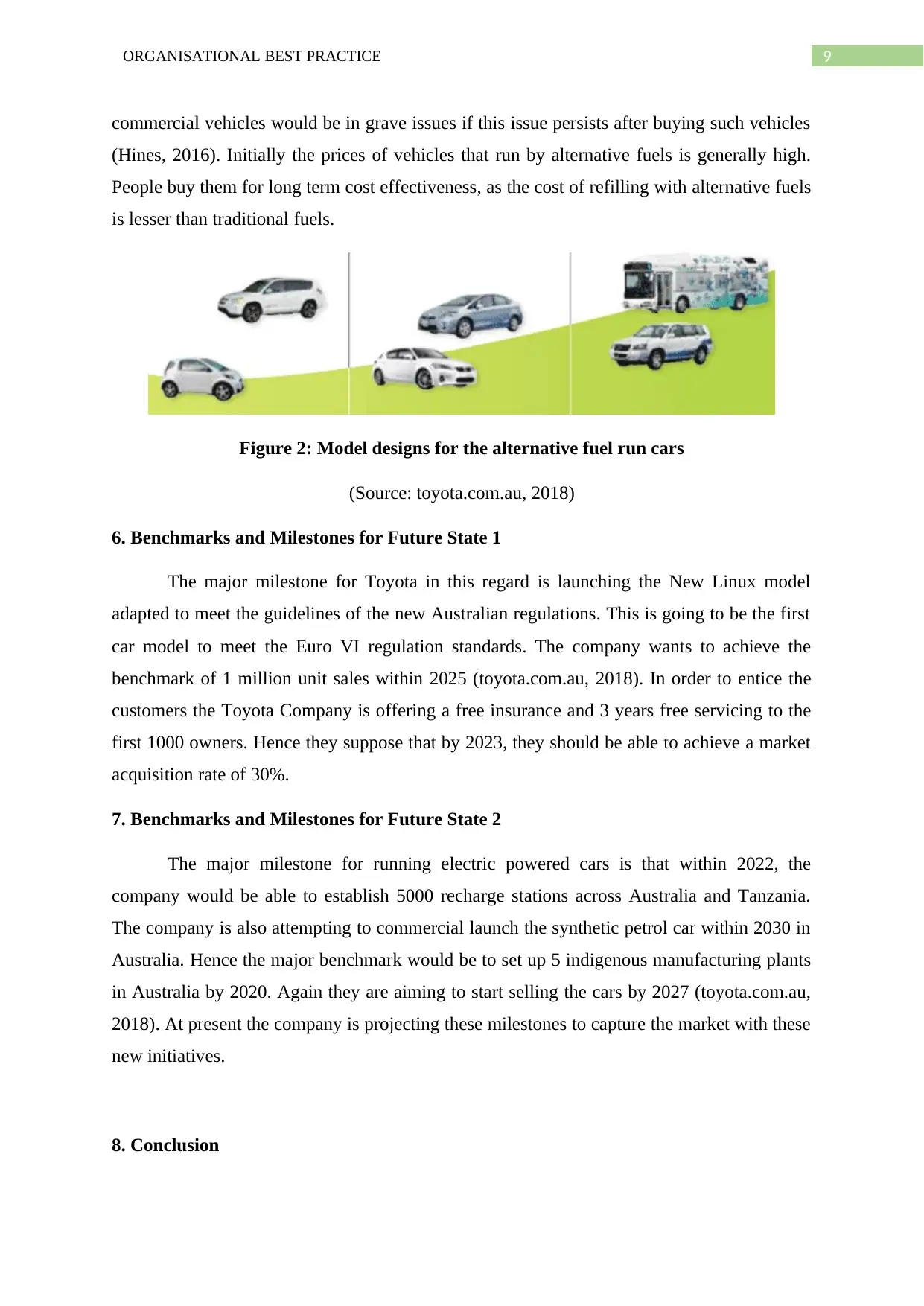
Figure 2: Model designs for the alternative fuel run cars
(Source: toyota.com.au, 2018)
6. Benchmarks and Milestones for Future State 1
The major milestone for Toyota in this regard is launching the New Linux model
adapted to meet the guidelines of the new Australian regulations. This is going to be the first
car model to meet the Euro VI regulation standards. The company wants to achieve the
benchmark of 1 million unit sales within 2025 (toyota.com.au, 2018). In order to entice the
customers the Toyota Company is offering a free insurance and 3 years free servicing to the
first 1000 owners. Hence they suppose that by 2023, they should be able to achieve a market
acquisition rate of 30%.
7. Benchmarks and Milestones for Future State 2
The major milestone for running electric powered cars is that within 2022, the
company would be able to establish 5000 recharge stations across Australia and Tanzania.
The company is also attempting to commercial launch the synthetic petrol car within 2030 in
Australia. Hence the major benchmark would be to set up 5 indigenous manufacturing plants
in Australia by 2020. Again they are aiming to start selling the cars by 2027 (toyota.com.au,
2018). At present the company is projecting these milestones to capture the market with these
new initiatives.
8. Conclusion
commercial vehicles would be in grave issues if this issue persists after buying such vehicles
(Hines, 2016). Initially the prices of vehicles that run by alternative fuels is generally high.
People buy them for long term cost effectiveness, as the cost of refilling with alternative fuels
is lesser than traditional fuels.
Figure 2: Model designs for the alternative fuel run cars
(Source: toyota.com.au, 2018)
6. Benchmarks and Milestones for Future State 1
The major milestone for Toyota in this regard is launching the New Linux model
adapted to meet the guidelines of the new Australian regulations. This is going to be the first
car model to meet the Euro VI regulation standards. The company wants to achieve the
benchmark of 1 million unit sales within 2025 (toyota.com.au, 2018). In order to entice the
customers the Toyota Company is offering a free insurance and 3 years free servicing to the
first 1000 owners. Hence they suppose that by 2023, they should be able to achieve a market
acquisition rate of 30%.
7. Benchmarks and Milestones for Future State 2
The major milestone for running electric powered cars is that within 2022, the
company would be able to establish 5000 recharge stations across Australia and Tanzania.
The company is also attempting to commercial launch the synthetic petrol car within 2030 in
Australia. Hence the major benchmark would be to set up 5 indigenous manufacturing plants
in Australia by 2020. Again they are aiming to start selling the cars by 2027 (toyota.com.au,
2018). At present the company is projecting these milestones to capture the market with these
new initiatives.
8. Conclusion
⊘ This is a preview!⊘
Do you want full access?
Subscribe today to unlock all pages.
Trusted by 1+ million students worldwide
10ORGANISATIONAL BEST PRACTICE
This report analyse the futuristic states where Toyota Company have maximum
chances of expansion in the Australian territory. The current future states in the political and
environmental context have opened up a number of opportunities before the company.
Analysing the first state of hybrid cars, it can be concluded that the major hindrance of
launching this model of car is the lack of infrastructure in Australia and higher than
competitive pricing. The company would have to utilise governmental rebate model to
overcome these challenges. Secondly, the company is planning to launch the alternative fuel
run cars. This would make the company and its products more sustainable. As an impact, the
Australian government is also supporting this venture of Toyota Thirdly, the company is
running a global project of i-cars. These are auto-intelligent vehicles that are yet in
conception phase.
This report analyse the futuristic states where Toyota Company have maximum
chances of expansion in the Australian territory. The current future states in the political and
environmental context have opened up a number of opportunities before the company.
Analysing the first state of hybrid cars, it can be concluded that the major hindrance of
launching this model of car is the lack of infrastructure in Australia and higher than
competitive pricing. The company would have to utilise governmental rebate model to
overcome these challenges. Secondly, the company is planning to launch the alternative fuel
run cars. This would make the company and its products more sustainable. As an impact, the
Australian government is also supporting this venture of Toyota Thirdly, the company is
running a global project of i-cars. These are auto-intelligent vehicles that are yet in
conception phase.
Paraphrase This Document
Need a fresh take? Get an instant paraphrase of this document with our AI Paraphraser
11ORGANISATIONAL BEST PRACTICE
Reference List
Anitha, B. M. (2017). A Study on Customer Opinion and Expectations of Toyota Cars with
Special Reference to Anaamalai’s Dealer, Coimbatore, TAMIL NADU, 12(3), 1-14
Austen-Smith, D., Diermeier, D., Zemel, E., Diermeier, D., & Merkley, G. (2017).
Unintended acceleration: Toyota’s recall crisis. Kellogg School of Management
Cases, 1-16.
Borah, A., & Tellis, G. J. (2016). Halo (spillover) effects in social media: do product recalls
of one brand hurt or help rival brands?. Journal of Marketing Research, 53(2), 143-
160.
Bowbrick, P. (2014). The Economics of Quality, Grades and Brands (Routledge Revivals).
Routledge.
Debnath, S. C. (2015). Environmental regulations become restriction or a cause for
innovation–a case study of Toyota Prius and Nissan Leaf. Procedia-Social and
Behavioral Sciences, 195, 324-333.
Hatani, L. (2017). Integrated Supply Chain Management Practices in the Flow Information
Toyota Car Dealer in Kendari. The International Journal of Engineering and
Science, 6(1), 36-43.
Hines, P. (2016). Toyota supplier system in Japan and the UK. In Developments in Logistics
and Supply Chain Management(pp. 113-124). Palgrave Macmillan, London.
Kumar, R. R. (2014). Modelling the supply of private used cars: a study of two prominent
brands in Fiji. International Journal of Economics and Business Research, 7(4), 419-
430.
Lieberman, M. B., Balasubramanian, N., & Garcia‐Castro, R. (2018). Toward a dynamic
notion of value creation and appropriation in firms: T he concept and measurement of
economic gain. Strategic Management Journal, 39(6), 1546-1572.
Mays, K. (2016, June). The 2016 Cars. com American-Made Index. In Cars. Com.
Miyakawa, Y. (2017). The transformation of the Japanese motor vehicle industry and its role
in the world: industrial restructuring and technical evolution. In Restructuring the
Global Automobile Industry (pp. 88-113). Routledge.
Reference List
Anitha, B. M. (2017). A Study on Customer Opinion and Expectations of Toyota Cars with
Special Reference to Anaamalai’s Dealer, Coimbatore, TAMIL NADU, 12(3), 1-14
Austen-Smith, D., Diermeier, D., Zemel, E., Diermeier, D., & Merkley, G. (2017).
Unintended acceleration: Toyota’s recall crisis. Kellogg School of Management
Cases, 1-16.
Borah, A., & Tellis, G. J. (2016). Halo (spillover) effects in social media: do product recalls
of one brand hurt or help rival brands?. Journal of Marketing Research, 53(2), 143-
160.
Bowbrick, P. (2014). The Economics of Quality, Grades and Brands (Routledge Revivals).
Routledge.
Debnath, S. C. (2015). Environmental regulations become restriction or a cause for
innovation–a case study of Toyota Prius and Nissan Leaf. Procedia-Social and
Behavioral Sciences, 195, 324-333.
Hatani, L. (2017). Integrated Supply Chain Management Practices in the Flow Information
Toyota Car Dealer in Kendari. The International Journal of Engineering and
Science, 6(1), 36-43.
Hines, P. (2016). Toyota supplier system in Japan and the UK. In Developments in Logistics
and Supply Chain Management(pp. 113-124). Palgrave Macmillan, London.
Kumar, R. R. (2014). Modelling the supply of private used cars: a study of two prominent
brands in Fiji. International Journal of Economics and Business Research, 7(4), 419-
430.
Lieberman, M. B., Balasubramanian, N., & Garcia‐Castro, R. (2018). Toward a dynamic
notion of value creation and appropriation in firms: T he concept and measurement of
economic gain. Strategic Management Journal, 39(6), 1546-1572.
Mays, K. (2016, June). The 2016 Cars. com American-Made Index. In Cars. Com.
Miyakawa, Y. (2017). The transformation of the Japanese motor vehicle industry and its role
in the world: industrial restructuring and technical evolution. In Restructuring the
Global Automobile Industry (pp. 88-113). Routledge.
12ORGANISATIONAL BEST PRACTICE
Pudaruth, S. (2014). Predicting the price of used cars using machine learning techniques. Int.
J. Inf. Comput. Technol, 4(7), 753-764.
Shams, R., Alpert, F., & Brown, M. (2015). Consumer perceived brand innovativeness:
Conceptualization and operationalization. European Journal of Marketing, 49(9/10),
1589-1615.
Suhanyiova, L., Flin, R., & Irwin, A. (2016). Safety Systems in Product Safety Culture. Risk,
Reliability and Safety: Innovating Theory and Practice: Proceedings of ESREL 2016,
1803-8.
toyota.com.au, (2018). About us. Retrieved on 26 August 2018. Retrieved from
https://www.toyota.com.au/
Pudaruth, S. (2014). Predicting the price of used cars using machine learning techniques. Int.
J. Inf. Comput. Technol, 4(7), 753-764.
Shams, R., Alpert, F., & Brown, M. (2015). Consumer perceived brand innovativeness:
Conceptualization and operationalization. European Journal of Marketing, 49(9/10),
1589-1615.
Suhanyiova, L., Flin, R., & Irwin, A. (2016). Safety Systems in Product Safety Culture. Risk,
Reliability and Safety: Innovating Theory and Practice: Proceedings of ESREL 2016,
1803-8.
toyota.com.au, (2018). About us. Retrieved on 26 August 2018. Retrieved from
https://www.toyota.com.au/
⊘ This is a preview!⊘
Do you want full access?
Subscribe today to unlock all pages.
Trusted by 1+ million students worldwide

1 out of 12


Related Documents


Your All-in-One AI-Powered Toolkit for Academic Success.
+13062052269
info@desklib.com
Available 24*7 on WhatsApp / Email
![[object Object]](/_next/static/media/star-bottom.7253800d.svg)
Unlock your academic potential
Copyright © 2020–2026 A2Z Services. All Rights Reserved. Developed and managed by ZUCOL.