Analyzing Google's Risk Communication Plan in Information Security

Verified

Added on  2023/06/04

|6
|1212
|199
Report
AI Summary
This report provides an analysis of a risk communication plan within the context of information security, using Google as a case study. It begins with an introduction to risk communication and its importance in organizations, followed by a description of Google and its information systems, including operational, transaction processing, and process control systems. The report then outlines the components of a crisis communication plan, including the crisis communication team (CEO, director of communication, assistant CEO, and company lawyer), their roles, and responsibilities. It details the team's functions in detecting risks, minimizing damage, developing recovery strategies, and preventing future incidents. The report further discusses statements addressing media communications, disaster recovery communications, and the types of fact sheets required. The conclusion emphasizes the significance of risk management and the development of effective crisis communication teams and information systems to monitor and manage business resources effectively. The report references various sources to support its findings.
Document Page
Running Head: Information Security 1
Managing organization risk communication plan
Name:
Institution:
Date:
tabler-icon-diamond-filled.svg

Paraphrase This Document

Need a fresh take? Get an instant paraphrase of this document with our AI Paraphraser
Document Page
Information Security 2
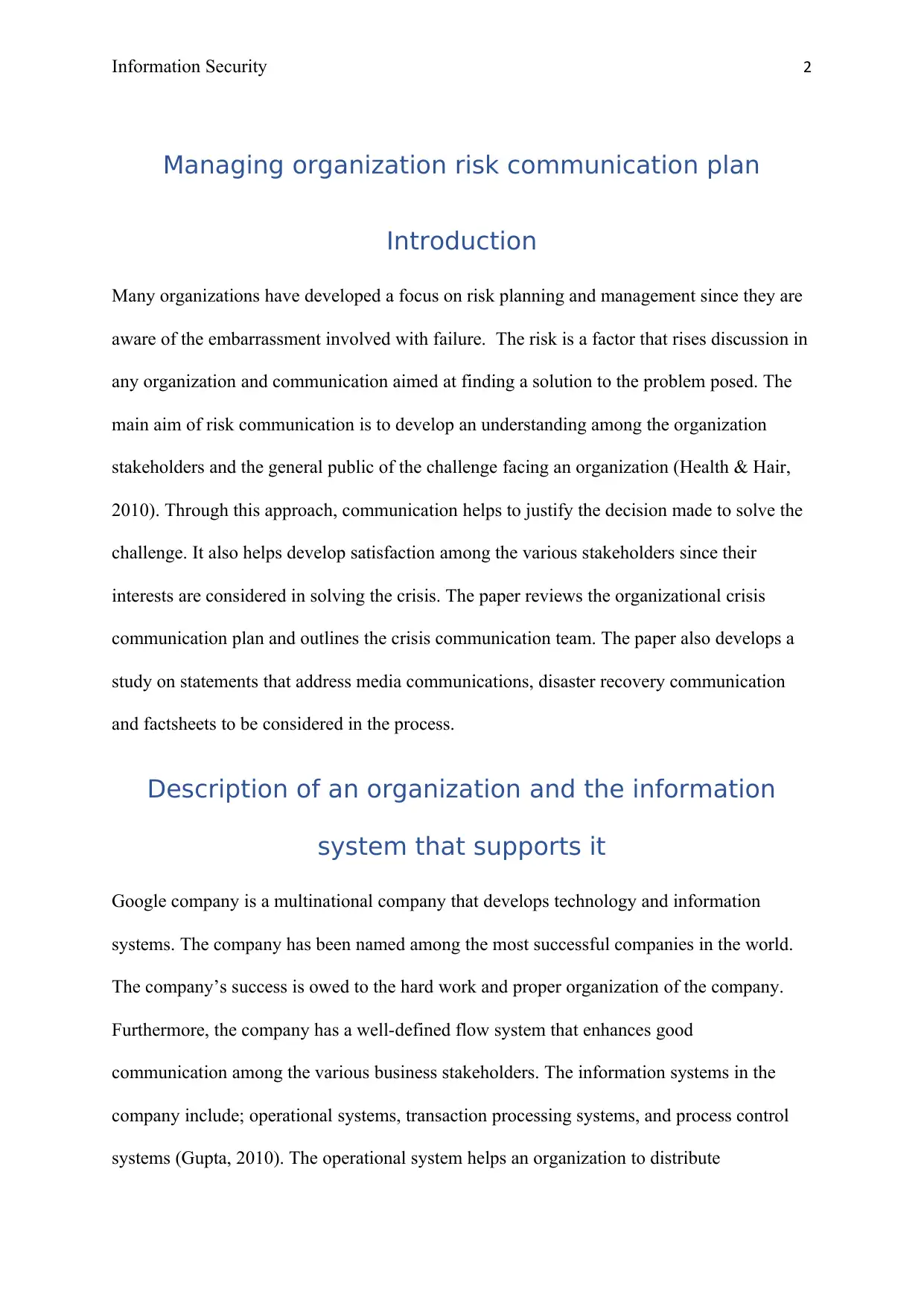
Managing organization risk communication plan
Introduction
Many organizations have developed a focus on risk planning and management since they are
aware of the embarrassment involved with failure. The risk is a factor that rises discussion in
any organization and communication aimed at finding a solution to the problem posed. The
main aim of risk communication is to develop an understanding among the organization
stakeholders and the general public of the challenge facing an organization (Health & Hair,
2010). Through this approach, communication helps to justify the decision made to solve the
challenge. It also helps develop satisfaction among the various stakeholders since their
interests are considered in solving the crisis. The paper reviews the organizational crisis
communication plan and outlines the crisis communication team. The paper also develops a
study on statements that address media communications, disaster recovery communication
and factsheets to be considered in the process.
Description of an organization and the information
system that supports it
Google company is a multinational company that develops technology and information
systems. The company has been named among the most successful companies in the world.
The company’s success is owed to the hard work and proper organization of the company.
Furthermore, the company has a well-defined flow system that enhances good
communication among the various business stakeholders. The information systems in the
company include; operational systems, transaction processing systems, and process control
systems (Gupta, 2010). The operational system helps an organization to distribute
Document Page
Information Security 3
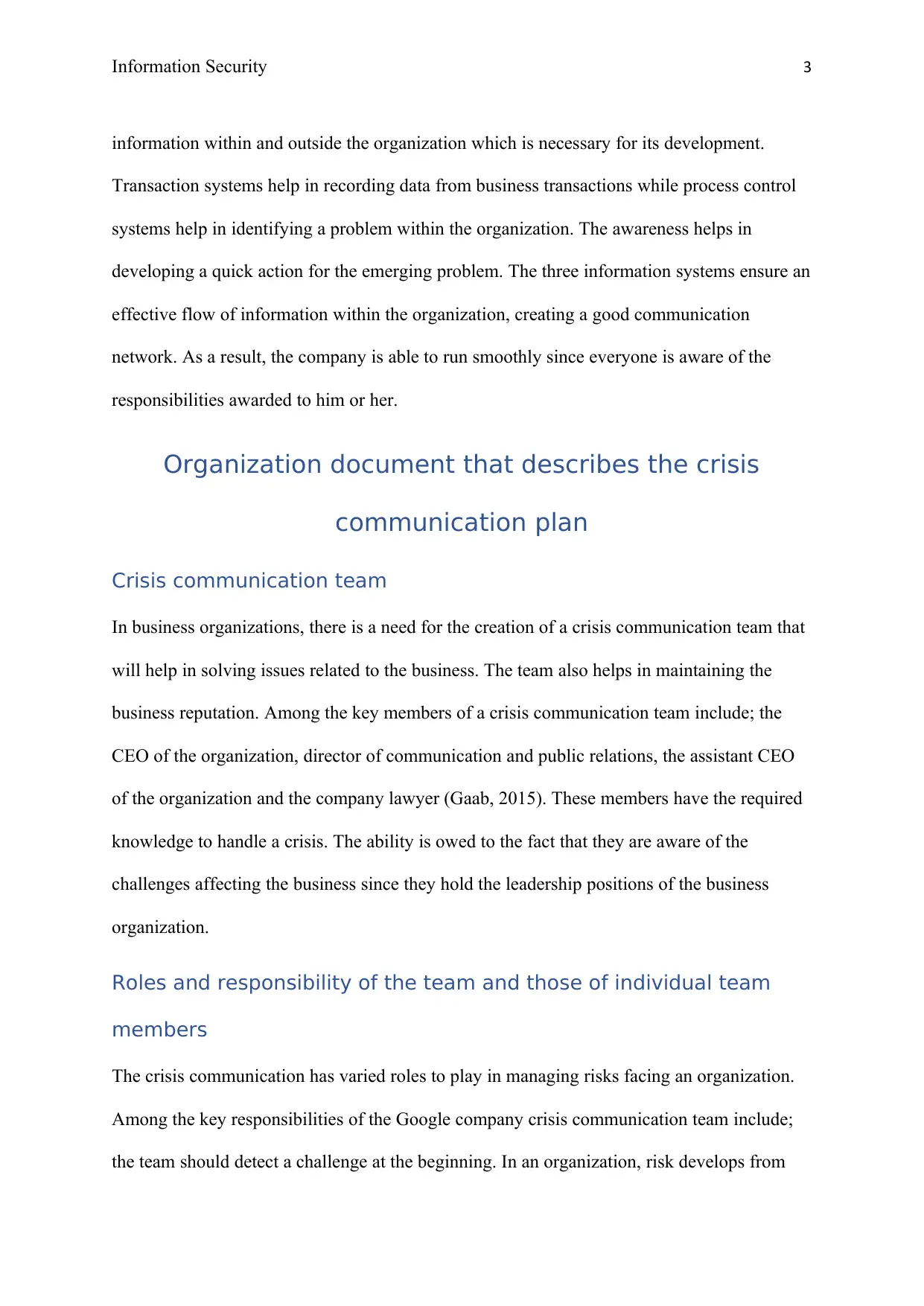
information within and outside the organization which is necessary for its development.
Transaction systems help in recording data from business transactions while process control
systems help in identifying a problem within the organization. The awareness helps in
developing a quick action for the emerging problem. The three information systems ensure an
effective flow of information within the organization, creating a good communication
network. As a result, the company is able to run smoothly since everyone is aware of the
responsibilities awarded to him or her.
Organization document that describes the crisis
communication plan
Crisis communication team
In business organizations, there is a need for the creation of a crisis communication team that
will help in solving issues related to the business. The team also helps in maintaining the
business reputation. Among the key members of a crisis communication team include; the
CEO of the organization, director of communication and public relations, the assistant CEO
of the organization and the company lawyer (Gaab, 2015). These members have the required
knowledge to handle a crisis. The ability is owed to the fact that they are aware of the
challenges affecting the business since they hold the leadership positions of the business
organization.
Roles and responsibility of the team and those of individual team
members
The crisis communication has varied roles to play in managing risks facing an organization.
Among the key responsibilities of the Google company crisis communication team include;
the team should detect a challenge at the beginning. In an organization, risk develops from
Document Page
Information Security 4
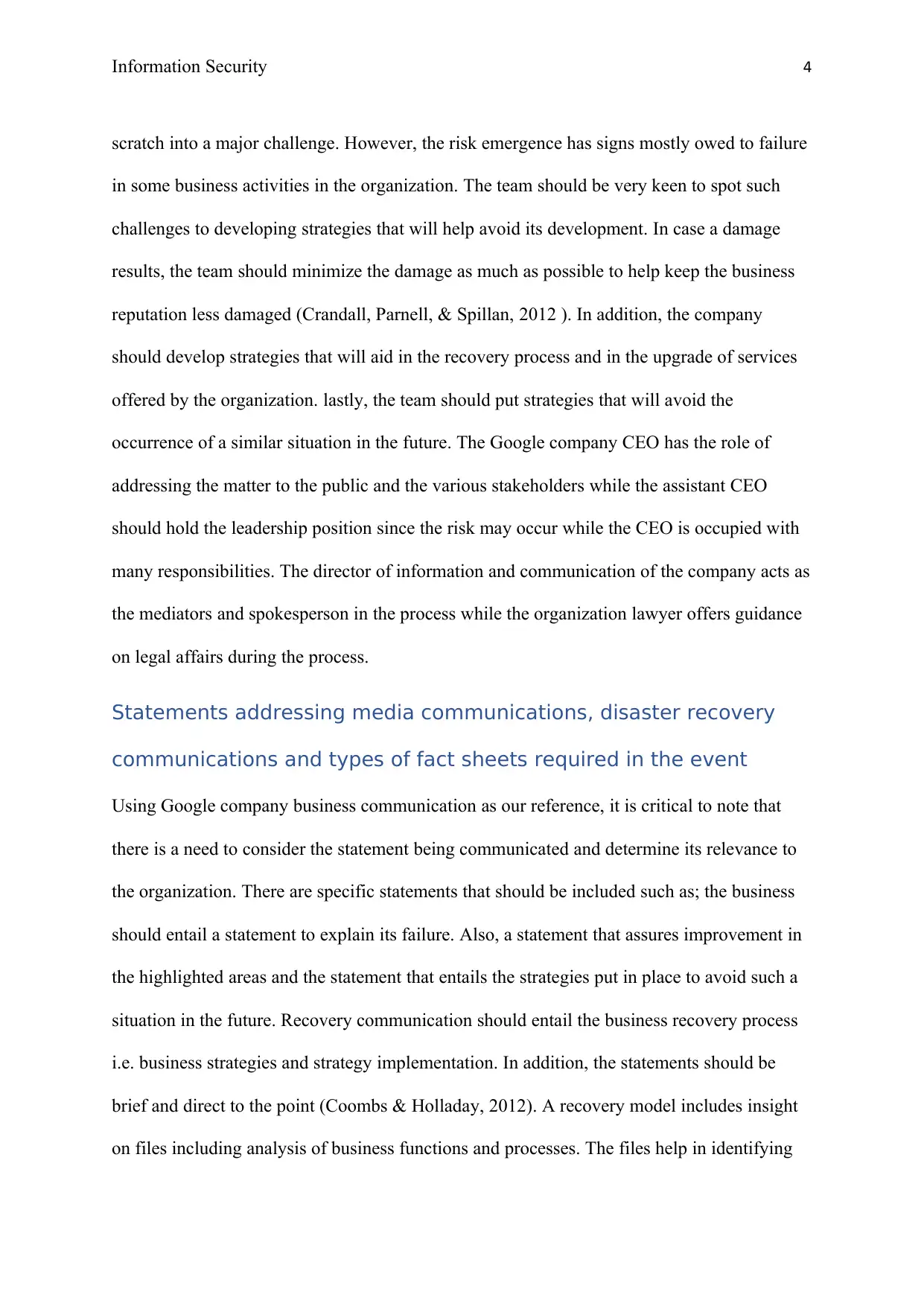
scratch into a major challenge. However, the risk emergence has signs mostly owed to failure
in some business activities in the organization. The team should be very keen to spot such
challenges to developing strategies that will help avoid its development. In case a damage
results, the team should minimize the damage as much as possible to help keep the business
reputation less damaged (Crandall, Parnell, & Spillan, 2012 ). In addition, the company
should develop strategies that will aid in the recovery process and in the upgrade of services
offered by the organization. lastly, the team should put strategies that will avoid the
occurrence of a similar situation in the future. The Google company CEO has the role of
addressing the matter to the public and the various stakeholders while the assistant CEO
should hold the leadership position since the risk may occur while the CEO is occupied with
many responsibilities. The director of information and communication of the company acts as
the mediators and spokesperson in the process while the organization lawyer offers guidance
on legal affairs during the process.
Statements addressing media communications, disaster recovery
communications and types of fact sheets required in the event
Using Google company business communication as our reference, it is critical to note that
there is a need to consider the statement being communicated and determine its relevance to
the organization. There are specific statements that should be included such as; the business
should entail a statement to explain its failure. Also, a statement that assures improvement in
the highlighted areas and the statement that entails the strategies put in place to avoid such a
situation in the future. Recovery communication should entail the business recovery process
i.e. business strategies and strategy implementation. In addition, the statements should be
brief and direct to the point (Coombs & Holladay, 2012). A recovery model includes insight
on files including analysis of business functions and processes. The files help in identifying
tabler-icon-diamond-filled.svg

Paraphrase This Document

Need a fresh take? Get an instant paraphrase of this document with our AI Paraphraser
Document Page
Information Security 5
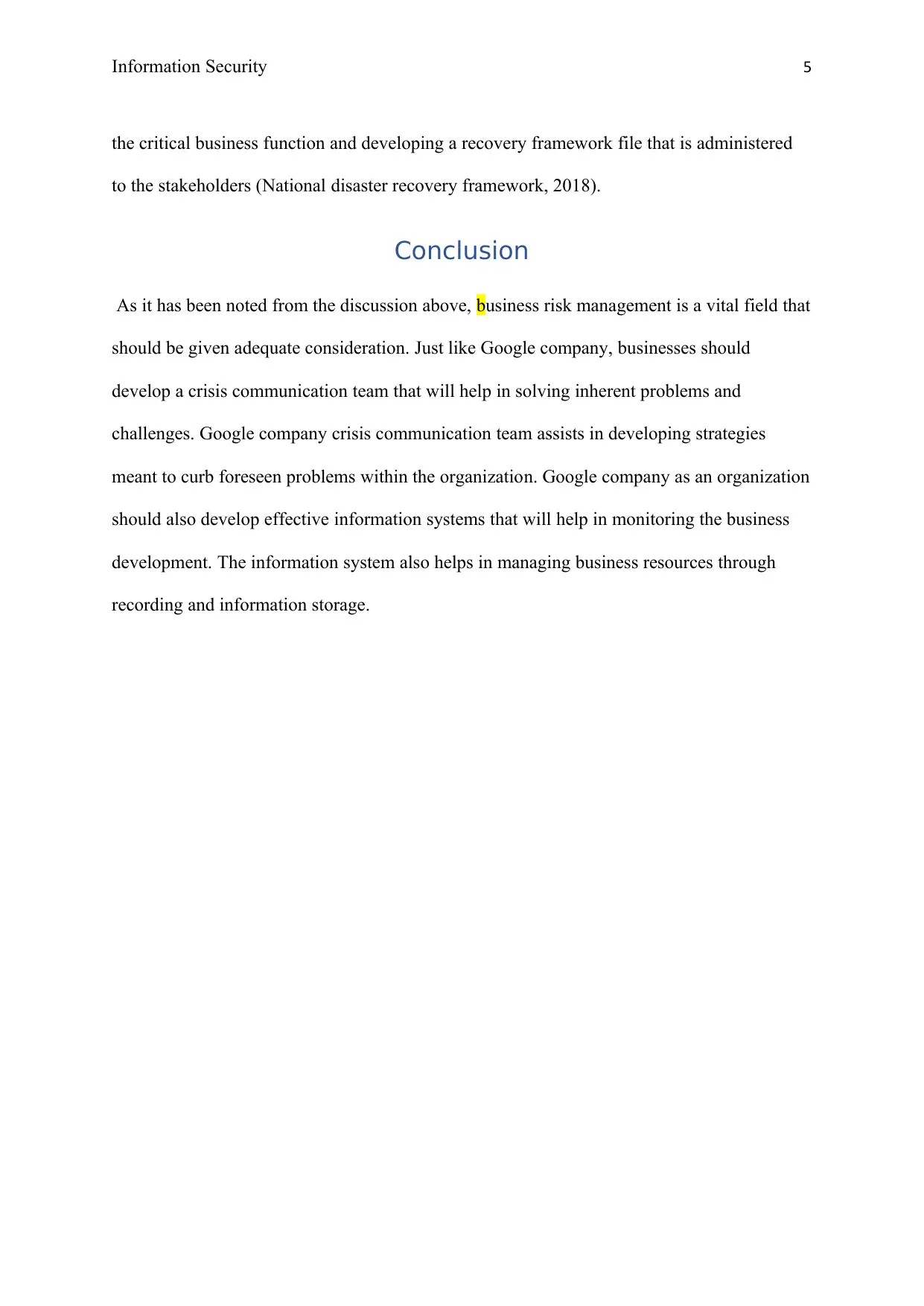
the critical business function and developing a recovery framework file that is administered
to the stakeholders (National disaster recovery framework, 2018).
Conclusion
As it has been noted from the discussion above, business risk management is a vital field that
should be given adequate consideration. Just like Google company, businesses should
develop a crisis communication team that will help in solving inherent problems and
challenges. Google company crisis communication team assists in developing strategies
meant to curb foreseen problems within the organization. Google company as an organization
should also develop effective information systems that will help in monitoring the business
development. The information system also helps in managing business resources through
recording and information storage.
Document Page
Information Security 6
References
Coombs, W. T., & Holladay, S. J. (2012). The handbook of crisis communication. Chichester,
U.K: Wiley-Blackwell.
Crandall, W., Parnell, J. A. & Spillan, J. E. (2012). Crisis management: Leading in the new
strategy landscape. Thousand Oaks, Calif: SAGE.
Gaabs, K. (2015). Who should you include on your crisis communication team? Retrieved on
24th October, 2018 from https://www.cision.com/us/2015/06/
Gupta, H. (2011). Management information system: (an insight). New Delhi: International
Book House
Health, l. & Hair, O. (2010). Handbook of risk and crisis communication. New York:
Routledge
National disaster recovery framework. (2018). Retrieved on 24th October, 2018 from
https://www.fema.gov/
chevron_up_icon
1 out of 6
circle_padding
hide_on_mobile
zoom_out_icon
[object Object]