World Bank Group Project Management: Structure and Contracts Analysis
VerifiedAdded on 2022/09/18
|11
|2781
|29
Report
AI Summary
This report provides an in-depth analysis of the World Bank's organizational structure, focusing on its matrix structure and its implications for project management, including challenges in global practices and knowledge flow. The report explores the organizational structure of the Municipal Development Fund (MDF) of Georgia, highlighting its role as an intermediary for accessing finances and its adherence to project development agreements. It also examines different types of contracts used in World Bank projects, such as National Competitive Bidding (NCB) and International Bidding, and the role of Partnership Service Agreements. Furthermore, the report delves into the bidding process, comparing open tenders, selective tenders, and negotiation tenders, along with the roles of procurement advisors and task team leaders. The analysis covers the context of international projects and globally distributed projects. The report also includes the structure of MDF and the role of World Bank in it.

World Bank group

Paraphrase This Document
Need a fresh take? Get an instant paraphrase of this document with our AI Paraphraser
Summary of this project (1 page)
The Management Framework
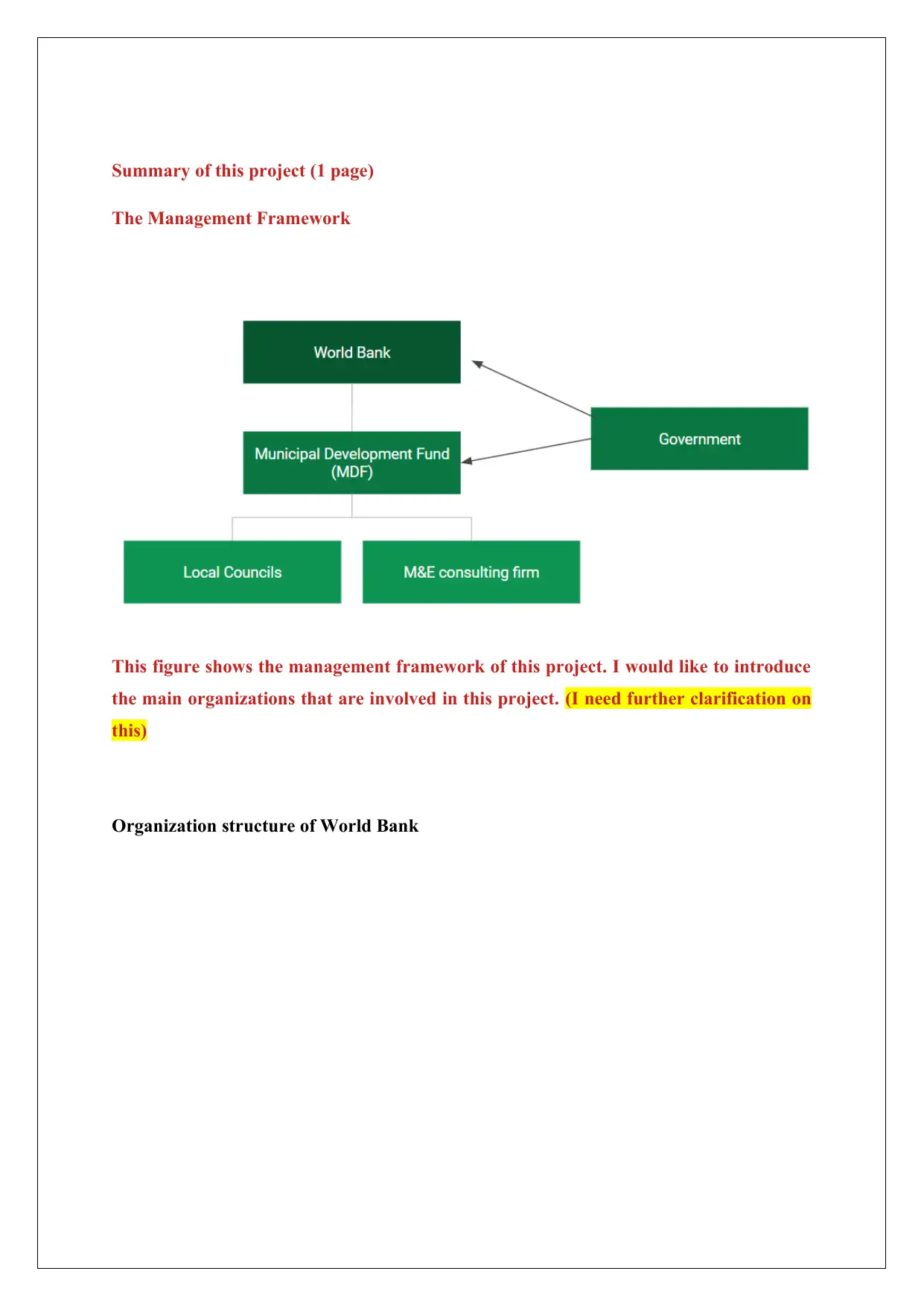
This figure shows the management framework of this project. I would like to introduce
the main organizations that are involved in this project. (I need further clarification on
this)
Organization structure of World Bank
The Management Framework
This figure shows the management framework of this project. I would like to introduce
the main organizations that are involved in this project. (I need further clarification on
this)
Organization structure of World Bank
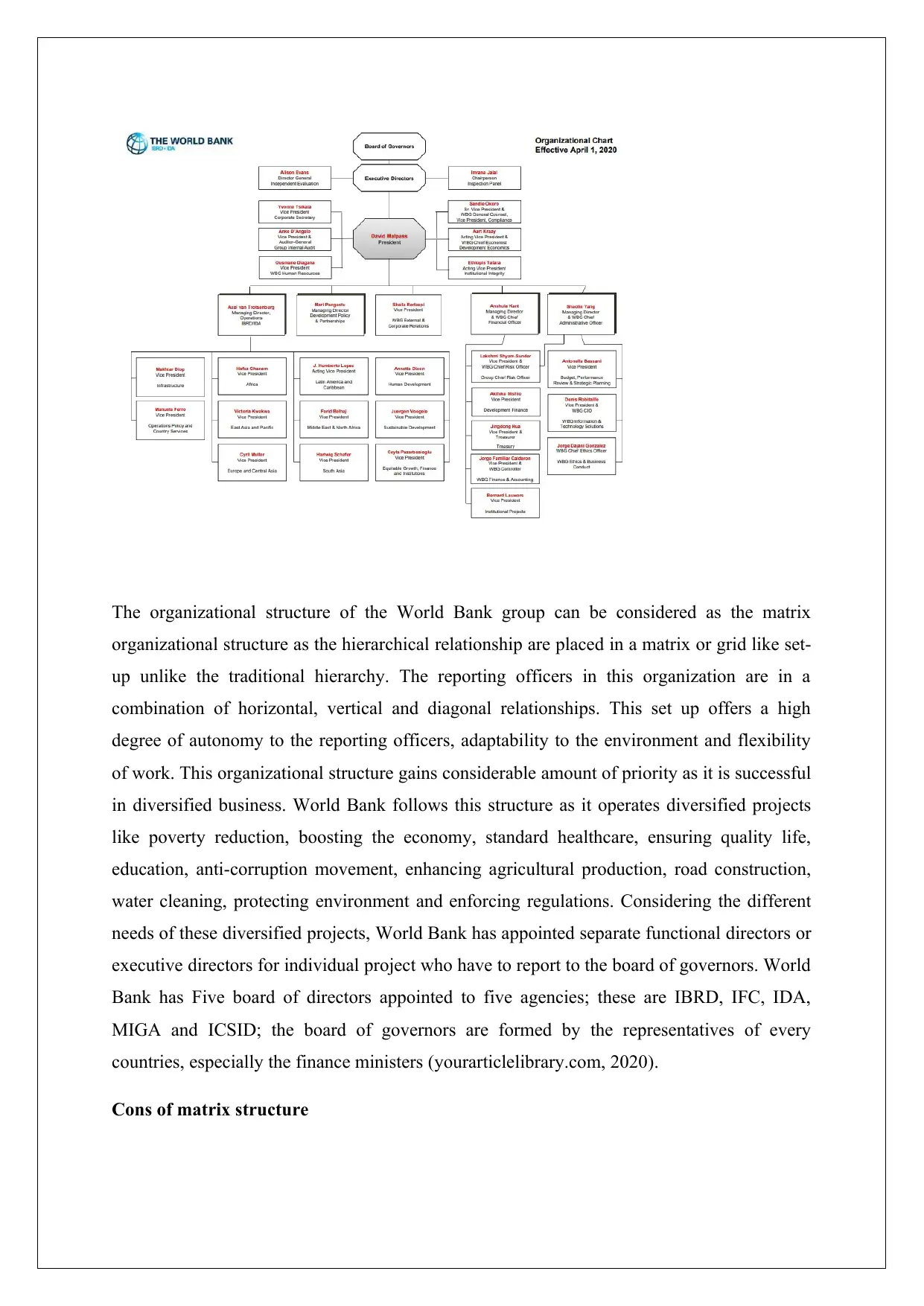
The organizational structure of the World Bank group can be considered as the matrix
organizational structure as the hierarchical relationship are placed in a matrix or grid like set-
up unlike the traditional hierarchy. The reporting officers in this organization are in a
combination of horizontal, vertical and diagonal relationships. This set up offers a high
degree of autonomy to the reporting officers, adaptability to the environment and flexibility
of work. This organizational structure gains considerable amount of priority as it is successful
in diversified business. World Bank follows this structure as it operates diversified projects
like poverty reduction, boosting the economy, standard healthcare, ensuring quality life,
education, anti-corruption movement, enhancing agricultural production, road construction,
water cleaning, protecting environment and enforcing regulations. Considering the different
needs of these diversified projects, World Bank has appointed separate functional directors or
executive directors for individual project who have to report to the board of governors. World
Bank has Five board of directors appointed to five agencies; these are IBRD, IFC, IDA,
MIGA and ICSID; the board of governors are formed by the representatives of every
countries, especially the finance ministers (yourarticlelibrary.com, 2020).
Cons of matrix structure
organizational structure as the hierarchical relationship are placed in a matrix or grid like set-
up unlike the traditional hierarchy. The reporting officers in this organization are in a
combination of horizontal, vertical and diagonal relationships. This set up offers a high
degree of autonomy to the reporting officers, adaptability to the environment and flexibility
of work. This organizational structure gains considerable amount of priority as it is successful
in diversified business. World Bank follows this structure as it operates diversified projects
like poverty reduction, boosting the economy, standard healthcare, ensuring quality life,
education, anti-corruption movement, enhancing agricultural production, road construction,
water cleaning, protecting environment and enforcing regulations. Considering the different
needs of these diversified projects, World Bank has appointed separate functional directors or
executive directors for individual project who have to report to the board of governors. World
Bank has Five board of directors appointed to five agencies; these are IBRD, IFC, IDA,
MIGA and ICSID; the board of governors are formed by the representatives of every
countries, especially the finance ministers (yourarticlelibrary.com, 2020).
Cons of matrix structure
⊘ This is a preview!⊘
Do you want full access?
Subscribe today to unlock all pages.

Trusted by 1+ million students worldwide
The World Bank faces the challenges of this organizational effectiveness in Global practices
(GP) and Cross-cutting solution Areas. The matrix organizational structure creates barriers in
cross-sectoral and multi-service program where the integration of diverse knowledge and
tools are effective (worldbankgroup.org, 2020). The organization raises the concern to carry
out the knowledge flow where advanced countries share the knowledge with laggard ones
which can improve the production, time and management. The structural divisions of World
Bank will share their knowledge to meet the clients’ needs. The objective of this solution is to
carry out the knowledge flow derived from an energy project in Africa towards the similar
Project in Asia (economicsdiscussion.net, 2020). The matrix structure has a vertical pillar of
knowledge where the members of different geographical location can access the knowledge.
The result of this structural reform seems futile as it consequences the inconsistency of
expenditure against its revenue. For this reason, the organization has planned to reduce
budget of $400 million in the next three years. This decision leads to the reduction of a
number of employments which indirectly affects World Bank’s project of poverty reduction,
quality life and other wellbeing visions. The GPs create barrier of knowledge flow and resist
collaboration as they feel competitive rivalry to each other instead of following a collective’s
vision. The board of directors and the leads of GPs have lack of clarifications about their
roles and also they loss the directions (The World Bank Reorganization 1 – Structure, 2020).
In order to facilitate the flow of global knowledge for better management skills, the
organization needs to adopt a single sector projects overseen by a common reporting
manager. This change solution is equivalent as going back to the traditional hierarchical
structure.
Organization Structure of MDF
(GP) and Cross-cutting solution Areas. The matrix organizational structure creates barriers in
cross-sectoral and multi-service program where the integration of diverse knowledge and
tools are effective (worldbankgroup.org, 2020). The organization raises the concern to carry
out the knowledge flow where advanced countries share the knowledge with laggard ones
which can improve the production, time and management. The structural divisions of World
Bank will share their knowledge to meet the clients’ needs. The objective of this solution is to
carry out the knowledge flow derived from an energy project in Africa towards the similar
Project in Asia (economicsdiscussion.net, 2020). The matrix structure has a vertical pillar of
knowledge where the members of different geographical location can access the knowledge.
The result of this structural reform seems futile as it consequences the inconsistency of
expenditure against its revenue. For this reason, the organization has planned to reduce
budget of $400 million in the next three years. This decision leads to the reduction of a
number of employments which indirectly affects World Bank’s project of poverty reduction,
quality life and other wellbeing visions. The GPs create barrier of knowledge flow and resist
collaboration as they feel competitive rivalry to each other instead of following a collective’s
vision. The board of directors and the leads of GPs have lack of clarifications about their
roles and also they loss the directions (The World Bank Reorganization 1 – Structure, 2020).
In order to facilitate the flow of global knowledge for better management skills, the
organization needs to adopt a single sector projects overseen by a common reporting
manager. This change solution is equivalent as going back to the traditional hierarchical
structure.
Organization Structure of MDF
Paraphrase This Document
Need a fresh take? Get an instant paraphrase of this document with our AI Paraphraser
Structure:
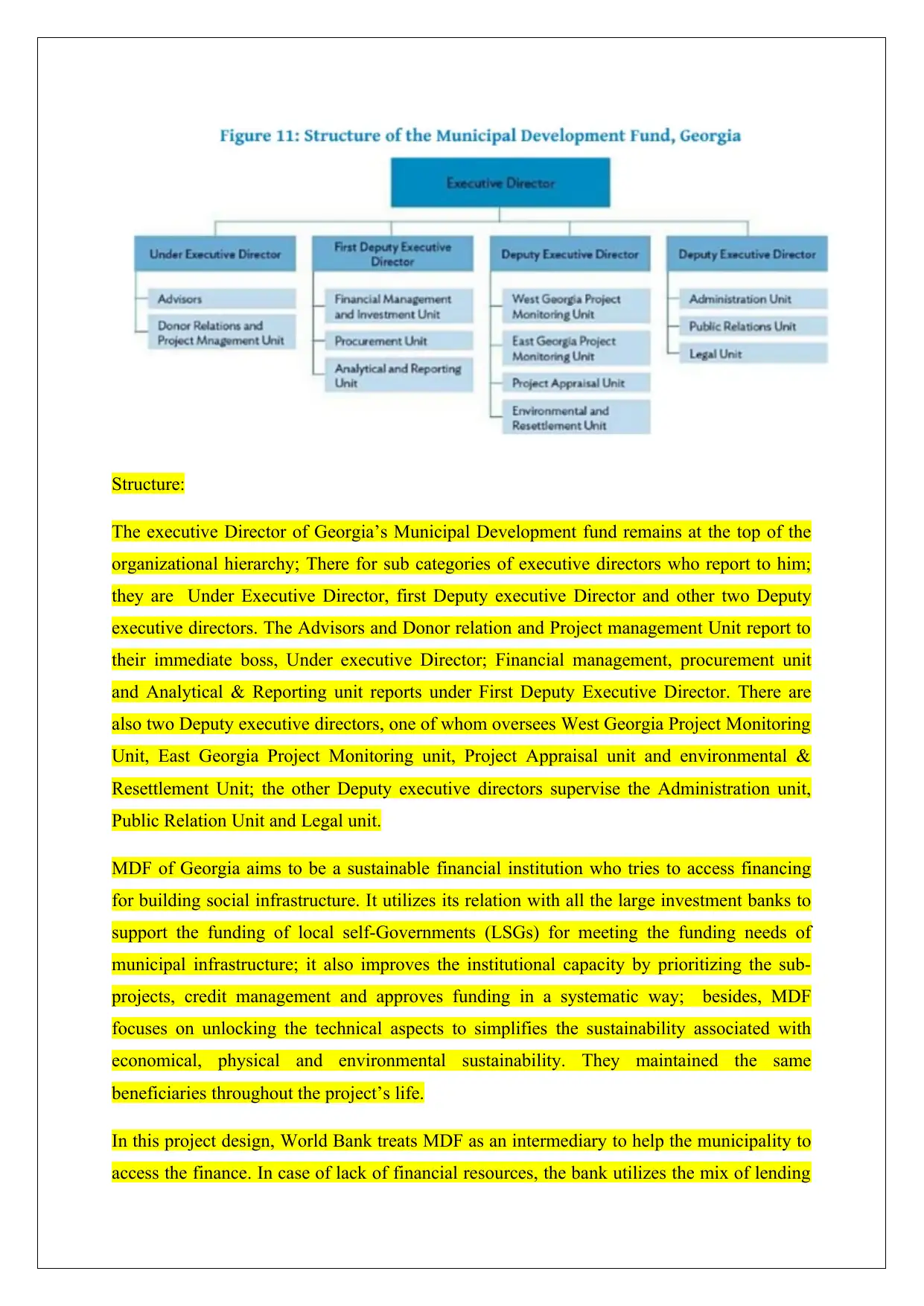
The executive Director of Georgia’s Municipal Development fund remains at the top of the
organizational hierarchy; There for sub categories of executive directors who report to him;
they are Under Executive Director, first Deputy executive Director and other two Deputy
executive directors. The Advisors and Donor relation and Project management Unit report to
their immediate boss, Under executive Director; Financial management, procurement unit
and Analytical & Reporting unit reports under First Deputy Executive Director. There are
also two Deputy executive directors, one of whom oversees West Georgia Project Monitoring
Unit, East Georgia Project Monitoring unit, Project Appraisal unit and environmental &
Resettlement Unit; the other Deputy executive directors supervise the Administration unit,
Public Relation Unit and Legal unit.
MDF of Georgia aims to be a sustainable financial institution who tries to access financing
for building social infrastructure. It utilizes its relation with all the large investment banks to
support the funding of local self-Governments (LSGs) for meeting the funding needs of
municipal infrastructure; it also improves the institutional capacity by prioritizing the sub-
projects, credit management and approves funding in a systematic way; besides, MDF
focuses on unlocking the technical aspects to simplifies the sustainability associated with
economical, physical and environmental sustainability. They maintained the same
beneficiaries throughout the project’s life.
In this project design, World Bank treats MDF as an intermediary to help the municipality to
access the finance. In case of lack of financial resources, the bank utilizes the mix of lending
The executive Director of Georgia’s Municipal Development fund remains at the top of the
organizational hierarchy; There for sub categories of executive directors who report to him;
they are Under Executive Director, first Deputy executive Director and other two Deputy
executive directors. The Advisors and Donor relation and Project management Unit report to
their immediate boss, Under executive Director; Financial management, procurement unit
and Analytical & Reporting unit reports under First Deputy Executive Director. There are
also two Deputy executive directors, one of whom oversees West Georgia Project Monitoring
Unit, East Georgia Project Monitoring unit, Project Appraisal unit and environmental &
Resettlement Unit; the other Deputy executive directors supervise the Administration unit,
Public Relation Unit and Legal unit.
MDF of Georgia aims to be a sustainable financial institution who tries to access financing
for building social infrastructure. It utilizes its relation with all the large investment banks to
support the funding of local self-Governments (LSGs) for meeting the funding needs of
municipal infrastructure; it also improves the institutional capacity by prioritizing the sub-
projects, credit management and approves funding in a systematic way; besides, MDF
focuses on unlocking the technical aspects to simplifies the sustainability associated with
economical, physical and environmental sustainability. They maintained the same
beneficiaries throughout the project’s life.
In this project design, World Bank treats MDF as an intermediary to help the municipality to
access the finance. In case of lack of financial resources, the bank utilizes the mix of lending
between the financially dominant and the subdued municipalities. The bank targets both to
create the balance between both who has low resources and who has low finances; the World
Bank involves the municipalities of MDF into an agreement of project development to omit
the financial obligations. They provide guidelines like breach of agreement, loan repayment
and help the municipalities with flexibilities and project design. The World Bank keeps
monitoring and reviewing on the internal control access of MDF to check the reliability of
financial reporting on the project. MDF also reverts them the data backup of clients. The
bank also regulates the timely submission of reporting to improve the quality and accuracy of
the financial reporting.
RMIDP is an governing body of public law which aims to empower the financial and
institutional capacity of local government. MDF cooperates the local self-government in
transferring of money and helps in mobile banking transactions from the global
organizations, donor agencies and foreign countries, central and local government. MDF
follows the legislation of Georgia while signing agreement with global financial agencies and
other donors. The decree of the Government of Georgia oversees the activities of MDF
because DF is accountable to the fund and ministry of finance. therefore, the report found that
the local government and the implementing agency MDF maintain the commitment to
RMIDP to respond immediately in emergency. They also take instant step if the world Bank
finds any quality failure regarding the development project.
Different Contracts
1. National Competitive Bidding (NCB)
National competitive Bidding is known as the public procurement. When
International competitive bidding is proved to be as the most appropriate method of
buying an ABC-financed good, the borrower may request for national competitive
bidding. The national competitive bidding also permits the principle of procuring
ABC-financed product. The purpose of NCB is to promote domestic contractors to the
developing foreign countries. NCB allows the foreign bidders to procure ABC
following the guidelines of procurement in NCB. The procurement may vary
depending on the regulatory system of the foreign countries. NCB is attractive to the
foreign bidders because of availability of the production and services which are
cheaper than the international market. On the other hand, NCB may be challenging
when the foreign bidders find the contract is less interesting due to small-value works,
create the balance between both who has low resources and who has low finances; the World
Bank involves the municipalities of MDF into an agreement of project development to omit
the financial obligations. They provide guidelines like breach of agreement, loan repayment
and help the municipalities with flexibilities and project design. The World Bank keeps
monitoring and reviewing on the internal control access of MDF to check the reliability of
financial reporting on the project. MDF also reverts them the data backup of clients. The
bank also regulates the timely submission of reporting to improve the quality and accuracy of
the financial reporting.
RMIDP is an governing body of public law which aims to empower the financial and
institutional capacity of local government. MDF cooperates the local self-government in
transferring of money and helps in mobile banking transactions from the global
organizations, donor agencies and foreign countries, central and local government. MDF
follows the legislation of Georgia while signing agreement with global financial agencies and
other donors. The decree of the Government of Georgia oversees the activities of MDF
because DF is accountable to the fund and ministry of finance. therefore, the report found that
the local government and the implementing agency MDF maintain the commitment to
RMIDP to respond immediately in emergency. They also take instant step if the world Bank
finds any quality failure regarding the development project.
Different Contracts
1. National Competitive Bidding (NCB)
National competitive Bidding is known as the public procurement. When
International competitive bidding is proved to be as the most appropriate method of
buying an ABC-financed good, the borrower may request for national competitive
bidding. The national competitive bidding also permits the principle of procuring
ABC-financed product. The purpose of NCB is to promote domestic contractors to the
developing foreign countries. NCB allows the foreign bidders to procure ABC
following the guidelines of procurement in NCB. The procurement may vary
depending on the regulatory system of the foreign countries. NCB is attractive to the
foreign bidders because of availability of the production and services which are
cheaper than the international market. On the other hand, NCB may be challenging
when the foreign bidders find the contract is less interesting due to small-value works,
⊘ This is a preview!⊘
Do you want full access?
Subscribe today to unlock all pages.
Trusted by 1+ million students worldwide
dispersed geographical location and time zone. In this literature, the foreign bidders
are generally called as Developing member countries or DMCs. The DMC will be
satisfied in ABC-bidding with the assurance of getting required quality and quantity
goods from the domestic contractors or manufacturers, at a reasonable price, within a
required time-limit.
2. International Bidding
The International Bidding is an agreement which is signed under the intermediation of
World Bank. The world Bank guide the borrowers to procure the products funded by
World Bank, under particular bidding guidelines or procurement guidelines. The
purpose of international bidding is to promote the project or products that are funded
by receiving loans from World Bank. Thus, world Bank increases the economic
opportunities of the Bank itself and also evokes a healthy competition between their
funded projects and their business partners. Though the borrowing partner is open to
choose the winning bid but there is certain arrangement done by the World Bank, to
win the lowest price and most the competitive bid.
3. Partnership Service Agreement (Please help me introduce Service agreement)
The service agreement denotes a contract between the service provider and the partner
from the receiving end. The agreement mentions the quality. Quantity, responsibility,
commitment- these are certain components of a service agreement. Service level
agreement has specific terms and language based on their business nature. For
example, an Agreement between electricity service provider and telecom client will
be signed upon the specific service level defined by the terms like ‘Mean time
between failures’ (MTBF) or ‘ Mean time to recovery’; the partnership service
agreement differs based on the business scope and involvement of multiple partners.
The partnership service agreement is mandatory for avoiding complexities and
conflicts between the partners. The agreement of service partnership is a legal
documentation that declares the relations among partners and other terms and
conditions of the business. In reality, the legal documentation also leads to conflict
due to many causes; such as the death of a partner, withdraw of shares, change in
power of attorney, ownership percentage and distinction of profits.
are generally called as Developing member countries or DMCs. The DMC will be
satisfied in ABC-bidding with the assurance of getting required quality and quantity
goods from the domestic contractors or manufacturers, at a reasonable price, within a
required time-limit.
2. International Bidding
The International Bidding is an agreement which is signed under the intermediation of
World Bank. The world Bank guide the borrowers to procure the products funded by
World Bank, under particular bidding guidelines or procurement guidelines. The
purpose of international bidding is to promote the project or products that are funded
by receiving loans from World Bank. Thus, world Bank increases the economic
opportunities of the Bank itself and also evokes a healthy competition between their
funded projects and their business partners. Though the borrowing partner is open to
choose the winning bid but there is certain arrangement done by the World Bank, to
win the lowest price and most the competitive bid.
3. Partnership Service Agreement (Please help me introduce Service agreement)
The service agreement denotes a contract between the service provider and the partner
from the receiving end. The agreement mentions the quality. Quantity, responsibility,
commitment- these are certain components of a service agreement. Service level
agreement has specific terms and language based on their business nature. For
example, an Agreement between electricity service provider and telecom client will
be signed upon the specific service level defined by the terms like ‘Mean time
between failures’ (MTBF) or ‘ Mean time to recovery’; the partnership service
agreement differs based on the business scope and involvement of multiple partners.
The partnership service agreement is mandatory for avoiding complexities and
conflicts between the partners. The agreement of service partnership is a legal
documentation that declares the relations among partners and other terms and
conditions of the business. In reality, the legal documentation also leads to conflict
due to many causes; such as the death of a partner, withdraw of shares, change in
power of attorney, ownership percentage and distinction of profits.
Paraphrase This Document
Need a fresh take? Get an instant paraphrase of this document with our AI Paraphraser
The following project accelerates the wider strategic engagement which boosted the
investment and interest of other partners. Dated back to 2006, a service agreement was
contracted between the bank and the US Millennium Challenge Corporation (MCC), where
MCC was contracted to give US$60 million for the development of municipal infrastructure
through MDF. The World Bank was involved in their partnership while it assisted MDF to
assure high design and implementation. In this way, World Bank helped in partnership
agreement with their knowledge and skills as well as their cohesive knowledge impacts on
the funding of MCC. It leads to EBRD and ADB to invest through MDF with the
coordination of IDA and MCC programs.
Bidding
Bidding is determining a value of an asset. In the practice of project management bidding
denotes to create contract of a project with a vendor or group of vendors. The project
manager declares their requirement and the vendor sends the determined cost at which they
can accomplish the project. World Bank provides loans to global countries for developing
their project by following the process of competitive bidding. World Bank appoints a task
team leader to oversee the responsibility of a project from the beginning to the end. The
purchase requirement of a project is presided over by a procurement adviser who evaluates
the purchasing activities and documents; even he guides the task team leader in the
procurement or bidding process. The practice of bidding between national and international
bidding is called competitive bidding. It gains popularity as it helps the procurers to get the
best price up to the global standard.
Differences among biddings
Open tender
Open tendering gives bidding offers to the clients by publishing their proposal on
newspapers or news portals. This is a type of competitive bidding.
Selective tender
In order to prevent competitive bidding, selecting tender proposes an alternative. In
this process the tender can shortlist the procurers and invites only them to submit their
bidding (Mishra, 2019).
Two stage selective tender
This tendering style mixes the competitive bidding and negotiation to improve the
project. In the first stage, the procurer maximizes the project’s quality and innovation
investment and interest of other partners. Dated back to 2006, a service agreement was
contracted between the bank and the US Millennium Challenge Corporation (MCC), where
MCC was contracted to give US$60 million for the development of municipal infrastructure
through MDF. The World Bank was involved in their partnership while it assisted MDF to
assure high design and implementation. In this way, World Bank helped in partnership
agreement with their knowledge and skills as well as their cohesive knowledge impacts on
the funding of MCC. It leads to EBRD and ADB to invest through MDF with the
coordination of IDA and MCC programs.
Bidding
Bidding is determining a value of an asset. In the practice of project management bidding
denotes to create contract of a project with a vendor or group of vendors. The project
manager declares their requirement and the vendor sends the determined cost at which they
can accomplish the project. World Bank provides loans to global countries for developing
their project by following the process of competitive bidding. World Bank appoints a task
team leader to oversee the responsibility of a project from the beginning to the end. The
purchase requirement of a project is presided over by a procurement adviser who evaluates
the purchasing activities and documents; even he guides the task team leader in the
procurement or bidding process. The practice of bidding between national and international
bidding is called competitive bidding. It gains popularity as it helps the procurers to get the
best price up to the global standard.
Differences among biddings
Open tender
Open tendering gives bidding offers to the clients by publishing their proposal on
newspapers or news portals. This is a type of competitive bidding.
Selective tender
In order to prevent competitive bidding, selecting tender proposes an alternative. In
this process the tender can shortlist the procurers and invites only them to submit their
bidding (Mishra, 2019).
Two stage selective tender
This tendering style mixes the competitive bidding and negotiation to improve the
project. In the first stage, the procurer maximizes the project’s quality and innovation
by deploying the strength of the contractor. The contractor is selected in the design
phase of the project as the part of competitive bidding before the cost optimization. In
the second stage, the project planning and cost data is preceded based on the supplies
in the first stage.
Negotiation tender
This style allows more than two contractors who can negotiate the deal.
Under this process, the contractors are selected by the professionals or shortlist of
procurer’s choice. This style is seen in construction industry. The focus of this
bidding is to locate a suitable contractor.
Term tender
This style of tendering is popular in maintenance projects. The contractor may be
employed for constructing multiple building in different locations. He is given a fixed
time schedule but the schedule can be extended based on the client’s needs. In this
bidding, the procurer offers rates for their work and the contractors can choose
options based on the project requirement.
Cons of competitive bidding
Communicational barrier
The tenders and bidders are expected to participate in an open communication. As the bidder
and the procurer are allowed to open the communication to other bidders, the bidders
restrains their specific query from the purchasers. The answer might give opportunity to the
other bidders by allowing them to guess the needs. So the former bidder restrains himself
from asking to prevent the information from their competitors.
Slow Process
Competitive bidding can be very time consuming where the clients have to wait for the goods
and services for a long time.
Cross cultural Collaboration
1. Heritage tourism
phase of the project as the part of competitive bidding before the cost optimization. In
the second stage, the project planning and cost data is preceded based on the supplies
in the first stage.
Negotiation tender
This style allows more than two contractors who can negotiate the deal.
Under this process, the contractors are selected by the professionals or shortlist of
procurer’s choice. This style is seen in construction industry. The focus of this
bidding is to locate a suitable contractor.
Term tender
This style of tendering is popular in maintenance projects. The contractor may be
employed for constructing multiple building in different locations. He is given a fixed
time schedule but the schedule can be extended based on the client’s needs. In this
bidding, the procurer offers rates for their work and the contractors can choose
options based on the project requirement.
Cons of competitive bidding
Communicational barrier
The tenders and bidders are expected to participate in an open communication. As the bidder
and the procurer are allowed to open the communication to other bidders, the bidders
restrains their specific query from the purchasers. The answer might give opportunity to the
other bidders by allowing them to guess the needs. So the former bidder restrains himself
from asking to prevent the information from their competitors.
Slow Process
Competitive bidding can be very time consuming where the clients have to wait for the goods
and services for a long time.
Cross cultural Collaboration
1. Heritage tourism
⊘ This is a preview!⊘
Do you want full access?
Subscribe today to unlock all pages.
Trusted by 1+ million students worldwide
The Project Development objective (PDO) of world Bank was to bring out the best of
regions by enhancing their socio-economic development which leads to a quality
living standards, increased competency and broader socio-economic equality among
regions. The PDO identifies the cultural heritage will be a great instrument to harness
the economy of the regions, especially economically backward regions. The PDO
recognizes Kakheti of Gerogia as an abode of ancient culture and historical attraction
(Aoyama & Horner, 2010). It contains architecture and historical monuments hailing
from 4th century and also have three areas which are under the law of protection to
nature. Apart from this, Kakheti has proximity of transportation for the presence of
Tbilisi international Airport. Also, it is an economically backward region as it earns
GDP per capita equivalent to the 60% of the average of the country, Georgia.
Recognition of Georgian culture has piqued international interest placing Georgia at
the forefront of heritage tourism and research to become one of the great cultural
legacies of the modern world
Swedish International Development Agency (SIDA) TF in the amount of
US$1.48million was intended to co-finance a sub-project in MTSKheta, however
the contract was never signed. This is because the project’s location is under
UNESCO’s World Heritage Site. Therefore the Government subsequently asked
that the sub-project to be cancelled.
regions by enhancing their socio-economic development which leads to a quality
living standards, increased competency and broader socio-economic equality among
regions. The PDO identifies the cultural heritage will be a great instrument to harness
the economy of the regions, especially economically backward regions. The PDO
recognizes Kakheti of Gerogia as an abode of ancient culture and historical attraction
(Aoyama & Horner, 2010). It contains architecture and historical monuments hailing
from 4th century and also have three areas which are under the law of protection to
nature. Apart from this, Kakheti has proximity of transportation for the presence of
Tbilisi international Airport. Also, it is an economically backward region as it earns
GDP per capita equivalent to the 60% of the average of the country, Georgia.
Recognition of Georgian culture has piqued international interest placing Georgia at
the forefront of heritage tourism and research to become one of the great cultural
legacies of the modern world
Swedish International Development Agency (SIDA) TF in the amount of
US$1.48million was intended to co-finance a sub-project in MTSKheta, however
the contract was never signed. This is because the project’s location is under
UNESCO’s World Heritage Site. Therefore the Government subsequently asked
that the sub-project to be cancelled.
Paraphrase This Document
Need a fresh take? Get an instant paraphrase of this document with our AI Paraphraser
References:
Aoyama, Y., & Horner, R. (2010). World Development Report 2009: Reshaping Economic
Geography, by the World Bank. Journal Of Regional Science, 50(5), 1001-1004. doi:
10.1111/j.1467-9787.2010.00709_1.x
economicsdiscussion.net (2020). Matrix Organisational Structure: Meaning, Features,
Evaluation, Merits & Demerits.. Retrieved 15 April 2020, from
http://www.economicsdiscussion.net/management/matrix-organisational-structure/
31591
Mishra, A. (2019). Bidding Trends of Contracts based on Types and Sizes of Projects under
Road Divisions Butwal and Shivapur. Journal Of Advanced Research In Construction
And Urban Architecture, 04(3&4), 7-16. doi: 10.24321/2456.9925.201905
The World Bank Reorganization 1 – Structure. (2020). Retrieved 15 April 2020, from
https://nl4worldbank.org/2014/10/01/the-world-bank-reorganization-1-structure/
worldbankgroup.org (2020). Five years ago the World Bank changed its operating model.
Where do we go from here?Retrieved 15 April 2020, from
https://ieg.worldbankgroup.org/blog/five-years-ago-world-bank-changed-its-
operating-model-where-do-we-go-here
yourarticlelibrary.com (2020). 5 Agencies of World Bank Group: & their Organizational
Structures. Retrieved 15 April 2020, from
http://www.yourarticlelibrary.com/economics/5-agencies-of-world-bank-group-their-
organizational-structures/23531
Aoyama, Y., & Horner, R. (2010). World Development Report 2009: Reshaping Economic
Geography, by the World Bank. Journal Of Regional Science, 50(5), 1001-1004. doi:
10.1111/j.1467-9787.2010.00709_1.x
economicsdiscussion.net (2020). Matrix Organisational Structure: Meaning, Features,
Evaluation, Merits & Demerits.. Retrieved 15 April 2020, from
http://www.economicsdiscussion.net/management/matrix-organisational-structure/
31591
Mishra, A. (2019). Bidding Trends of Contracts based on Types and Sizes of Projects under
Road Divisions Butwal and Shivapur. Journal Of Advanced Research In Construction
And Urban Architecture, 04(3&4), 7-16. doi: 10.24321/2456.9925.201905
The World Bank Reorganization 1 – Structure. (2020). Retrieved 15 April 2020, from
https://nl4worldbank.org/2014/10/01/the-world-bank-reorganization-1-structure/
worldbankgroup.org (2020). Five years ago the World Bank changed its operating model.
Where do we go from here?Retrieved 15 April 2020, from
https://ieg.worldbankgroup.org/blog/five-years-ago-world-bank-changed-its-
operating-model-where-do-we-go-here
yourarticlelibrary.com (2020). 5 Agencies of World Bank Group: & their Organizational
Structures. Retrieved 15 April 2020, from
http://www.yourarticlelibrary.com/economics/5-agencies-of-world-bank-group-their-
organizational-structures/23531

1 out of 11


Your All-in-One AI-Powered Toolkit for Academic Success.
+13062052269
info@desklib.com
Available 24*7 on WhatsApp / Email
![[object Object]](/_next/static/media/star-bottom.7253800d.svg)
Unlock your academic potential
Copyright © 2020–2025 A2Z Services. All Rights Reserved. Developed and managed by ZUCOL.