Organisational Change Management: Psychological Contracts and Change
VerifiedAdded on 2022/09/18
|9
|1533
|23
Essay
AI Summary
This essay provides a comprehensive overview of organisational change management, contrasting emergent and planned change strategies. It examines the importance of effective communication, the role of change agents, and the impact of psychological contracts on employee behaviour and organisational success. The analysis covers various communication strategies and their effectiveness, highlighting the 'underscore and explore' approach as optimal. The essay further discusses the significance of psychological contracts in managing employee expectations and fostering a positive work environment, ultimately linking change management to human resource practices and employee participation. Desklib offers a platform to explore more solved assignments and past papers on this topic.
Running head: ORGANISATIONAL CHANGE MANAGEMENT
Organisational Change Management
Name of the Student
Name of the University
Author note
Organisational Change Management
Name of the Student
Name of the University
Author note

Paraphrase This Document
Need a fresh take? Get an instant paraphrase of this document with our AI Paraphraser
1
Organisational change management
Table of Contents
Question1...................................................................................................................................2
Question 2..................................................................................................................................3
Question 3..................................................................................................................................4
Reference....................................................................................................................................6
Organisational change management
Table of Contents
Question1...................................................................................................................................2
Question 2..................................................................................................................................3
Question 3..................................................................................................................................4
Reference....................................................................................................................................6
2
Organisational change management
Introduction
Question 1
Emergent change can be defined as the change which is made on the supposition that
every change is constant open ended and impulsive process of bring into line and readjusting
an organisation to its varying environment.
Emergent change is a change that looks for no big sincere plan, for instance, internet
mainly occurred lacking much of a fundamental plan for consequent network linking to
networks in an exposed mode obligatory a least set of common values. Emergent changes
occur both logically and as a policy of unceasing distribution intended to be receptive to
business requirements and policy of unremitting distribution intended to be approachable to
business requirements and tactical circumstances.
Planned change is the exercise of making and applying long term policies with an
intentional planning and design.
Collins (1998: 35)
Offers a framework for dividing the organisational change literature in to four
categories
Hero manager reflection and biographies
Guru works
Student oriented texts
Critical monographs and research
The framework helps to differentiate the competing explanation of change management.
Organisational change management
Introduction
Question 1
Emergent change can be defined as the change which is made on the supposition that
every change is constant open ended and impulsive process of bring into line and readjusting
an organisation to its varying environment.
Emergent change is a change that looks for no big sincere plan, for instance, internet
mainly occurred lacking much of a fundamental plan for consequent network linking to
networks in an exposed mode obligatory a least set of common values. Emergent changes
occur both logically and as a policy of unceasing distribution intended to be receptive to
business requirements and policy of unremitting distribution intended to be approachable to
business requirements and tactical circumstances.
Planned change is the exercise of making and applying long term policies with an
intentional planning and design.
Collins (1998: 35)
Offers a framework for dividing the organisational change literature in to four
categories
Hero manager reflection and biographies
Guru works
Student oriented texts
Critical monographs and research
The framework helps to differentiate the competing explanation of change management.
⊘ This is a preview!⊘
Do you want full access?
Subscribe today to unlock all pages.

Trusted by 1+ million students worldwide
3
Organisational change management
The key features of emergent change are, it is receptive to varying tactical drivers,
inclines to be more advanced related with inferior eminence, consequences in an ad hoc
forecasting.
Recommendation based on the Coram and brunes, Pettigrew and Whipp
The key features of planned change as stated by Coram and Burnes 2001; 1996,
Pettigrew and whipp 1993 are, these are appropriate for big scale plans, permits a reliable
planning and strategy, big announcements may fail poorly, allows an assiduous policy
planning and strategy, fewer receptive to modification related with additional hard strategies,
risk organization procedures and excellence guarantee testing.
Quinn’s incremental model
Quinn’s approach assumes the incremental process is, and should be, the prime mode
used for strategy setting. Such philosophy is also presented by Mintzberg.
James Brien Quinn defines how 10 large corporations really arrived at their maximum
significant planned variations. He states that the official coherent planning frequently
converts a auxiliary for regulator instead of a procedure for inspiring invention and
entrepreneurship
importance of emergent change and planned change.
The emergent change helps to motivate the employees to provide innovative changes
in the organisation. whereas the planned change helps the organisation to implement a
planned change to help the employees to work more effectively.
In conclusion it can be said that both the emergent change and planned change is very
essential for the organisation as both the strategies help to motivate the employees of the
organisation.
Organisational change management
The key features of emergent change are, it is receptive to varying tactical drivers,
inclines to be more advanced related with inferior eminence, consequences in an ad hoc
forecasting.
Recommendation based on the Coram and brunes, Pettigrew and Whipp
The key features of planned change as stated by Coram and Burnes 2001; 1996,
Pettigrew and whipp 1993 are, these are appropriate for big scale plans, permits a reliable
planning and strategy, big announcements may fail poorly, allows an assiduous policy
planning and strategy, fewer receptive to modification related with additional hard strategies,
risk organization procedures and excellence guarantee testing.
Quinn’s incremental model
Quinn’s approach assumes the incremental process is, and should be, the prime mode
used for strategy setting. Such philosophy is also presented by Mintzberg.
James Brien Quinn defines how 10 large corporations really arrived at their maximum
significant planned variations. He states that the official coherent planning frequently
converts a auxiliary for regulator instead of a procedure for inspiring invention and
entrepreneurship
importance of emergent change and planned change.
The emergent change helps to motivate the employees to provide innovative changes
in the organisation. whereas the planned change helps the organisation to implement a
planned change to help the employees to work more effectively.
In conclusion it can be said that both the emergent change and planned change is very
essential for the organisation as both the strategies help to motivate the employees of the
organisation.
Paraphrase This Document
Need a fresh take? Get an instant paraphrase of this document with our AI Paraphraser
4
Organisational change management
Question 2
Recommendation given by Hayes.
According to hayes,2007 an effective communication is very essential to run a
business effectively. It is very essential that the process of communication flow from the top
level of the management to the lowest position of the organisation so that all the employees
and the stakeholders become aware about all the activities of the company. an organisation
will be able to carry on its operation only if an effective communication system can be
implemented in the organisation. due to a poor communication system the entire flow of
operation of any organisation will collapse.
An effective communication system can solve many issues within an organisation if it
is used properly and implemented in all the departments of an organisation.
The role of a change agent is very effective in implementing an efficient
communication system in an organisation. The change agent will observe the changes that are
required in the communication system and will detect the loopholes in the system. The
change agent after discussion with the management will implement necessary changes in the
communication system as stated by Clampett at al.’s(2000). The five main strategy provide
by clampett that is essential for the improvement of the organisation are spray and pray, tell
and sell, underscore and explore, identify and reply, and withhold and uphold.
The following strategies are explained below
Withhold and uphold:
In this strategy the company used to share very few information and thus it creates
confusion among the employees.
Identify and reply:
Organisational change management
Question 2
Recommendation given by Hayes.
According to hayes,2007 an effective communication is very essential to run a
business effectively. It is very essential that the process of communication flow from the top
level of the management to the lowest position of the organisation so that all the employees
and the stakeholders become aware about all the activities of the company. an organisation
will be able to carry on its operation only if an effective communication system can be
implemented in the organisation. due to a poor communication system the entire flow of
operation of any organisation will collapse.
An effective communication system can solve many issues within an organisation if it
is used properly and implemented in all the departments of an organisation.
The role of a change agent is very effective in implementing an efficient
communication system in an organisation. The change agent will observe the changes that are
required in the communication system and will detect the loopholes in the system. The
change agent after discussion with the management will implement necessary changes in the
communication system as stated by Clampett at al.’s(2000). The five main strategy provide
by clampett that is essential for the improvement of the organisation are spray and pray, tell
and sell, underscore and explore, identify and reply, and withhold and uphold.
The following strategies are explained below
Withhold and uphold:
In this strategy the company used to share very few information and thus it creates
confusion among the employees.
Identify and reply:
5
Organisational change management
In this strategy the organisation provides information to the employees at personal
level. this creates obstacle in free flow of communication and different employees will have
different information about an issue.
Underscore and explore:
It is the most effective mode of communication here the management allow the
communication in two dimensions and the flow of communication moves in every direction
in a uniform manner.
Tell and sell:
In this strategy too much information are provided to the employees and that creates
heavy traffic in the free flow of communication and that will disturb the focus of employees.
Spray and pray:
In this strategy the organisation openly provides all the information to the employees
and that create hindrance of confidentiality too much openness is not desired in the corporate
sectors.
So, it can be realised that among all the strategies of communication as provided by clampett
the best one is the underscore and explore strategy.
Question 3
A phycological contract can be merely seen as a countersigned established contract
among an employee and employer. there are two overall kinds of psychological contracts.
These are the transactional psychological contracts, which are, by and briefer period financial
founded exchanges. so, there might be a financial reward doled out by an employer for
Organisational change management
In this strategy the organisation provides information to the employees at personal
level. this creates obstacle in free flow of communication and different employees will have
different information about an issue.
Underscore and explore:
It is the most effective mode of communication here the management allow the
communication in two dimensions and the flow of communication moves in every direction
in a uniform manner.
Tell and sell:
In this strategy too much information are provided to the employees and that creates
heavy traffic in the free flow of communication and that will disturb the focus of employees.
Spray and pray:
In this strategy the organisation openly provides all the information to the employees
and that create hindrance of confidentiality too much openness is not desired in the corporate
sectors.
So, it can be realised that among all the strategies of communication as provided by clampett
the best one is the underscore and explore strategy.
Question 3
A phycological contract can be merely seen as a countersigned established contract
among an employee and employer. there are two overall kinds of psychological contracts.
These are the transactional psychological contracts, which are, by and briefer period financial
founded exchanges. so, there might be a financial reward doled out by an employer for
⊘ This is a preview!⊘
Do you want full access?
Subscribe today to unlock all pages.
Trusted by 1+ million students worldwide
6
Organisational change management
exactly distinct employee behaviour as stated by the Guest and Conway 2002 and Schein
1978.
There are also interpersonal psychological contracts, which are further long term and
comprise robust emotional parts. this could be somewhat like obscurely distinct chances or
potentials for development inside the organisation in argument for a profound and longer-
term promise from the employee as quoted by Pate et al., 2003; Morrison and robinson,1997.
The key characteristics of the psychological contract are
The psychological contract is subjective and based on the belief of the individuals
These contracts are not in writing and implicit set of expectation is made between the
organisation and the employees
The contract is negotiable and evolves through out the employment relationship.
The following are the main three theories of the psychological contact
Equity theory
This theory suggests that the disposition of the individual on their psychological
contact will remain effective if they feel that the treatment, they get is fair in comparison to
other
Exchange theory
This theory is related with the concept of how a individual invest or make
contributions if he get a particular reward.
Expectancy theory
Explains the extent upto which the an individual’s expectation influence his
motivation or performance.
Organisational change management
exactly distinct employee behaviour as stated by the Guest and Conway 2002 and Schein
1978.
There are also interpersonal psychological contracts, which are further long term and
comprise robust emotional parts. this could be somewhat like obscurely distinct chances or
potentials for development inside the organisation in argument for a profound and longer-
term promise from the employee as quoted by Pate et al., 2003; Morrison and robinson,1997.
The key characteristics of the psychological contract are
The psychological contract is subjective and based on the belief of the individuals
These contracts are not in writing and implicit set of expectation is made between the
organisation and the employees
The contract is negotiable and evolves through out the employment relationship.
The following are the main three theories of the psychological contact
Equity theory
This theory suggests that the disposition of the individual on their psychological
contact will remain effective if they feel that the treatment, they get is fair in comparison to
other
Exchange theory
This theory is related with the concept of how a individual invest or make
contributions if he get a particular reward.
Expectancy theory
Explains the extent upto which the an individual’s expectation influence his
motivation or performance.
Paraphrase This Document
Need a fresh take? Get an instant paraphrase of this document with our AI Paraphraser
7
Organisational change management
The importance of psychological contract is immense as the psychological contract is
used to fill the hole between what is agreed between an employee with an organisation and
what is going in the mind of the employee. Basically, the psychological agreement is entered
to fascinate and retain extremely skilled employee with the potentials that would else be very
problematic to awkward to spell out in a traditional contract, in exchange for rather that might
be indirectly understood or insistently pronounced.
From the above discussion it can be said that the change management is dependent on
the human resource of the organisation and for that reason it is necessary to implement the
people participant management policies and practices into the change management. Without
the participation of the people it will not be possible to implement the change management
policies in the organisation.
In conclusion it can be said that psychological contract helps to protect the interest of
the employees and it influences the employee’s beliefs and behaviour in the work place.
From the start to the end of the work life of the employee it has a philosophical consequence
on the attitudes and well being of the employee as concluded by Robison kraatz and
Rousseau(1994).
Organisational change management
The importance of psychological contract is immense as the psychological contract is
used to fill the hole between what is agreed between an employee with an organisation and
what is going in the mind of the employee. Basically, the psychological agreement is entered
to fascinate and retain extremely skilled employee with the potentials that would else be very
problematic to awkward to spell out in a traditional contract, in exchange for rather that might
be indirectly understood or insistently pronounced.
From the above discussion it can be said that the change management is dependent on
the human resource of the organisation and for that reason it is necessary to implement the
people participant management policies and practices into the change management. Without
the participation of the people it will not be possible to implement the change management
policies in the organisation.
In conclusion it can be said that psychological contract helps to protect the interest of
the employees and it influences the employee’s beliefs and behaviour in the work place.
From the start to the end of the work life of the employee it has a philosophical consequence
on the attitudes and well being of the employee as concluded by Robison kraatz and
Rousseau(1994).
8
Organisational change management
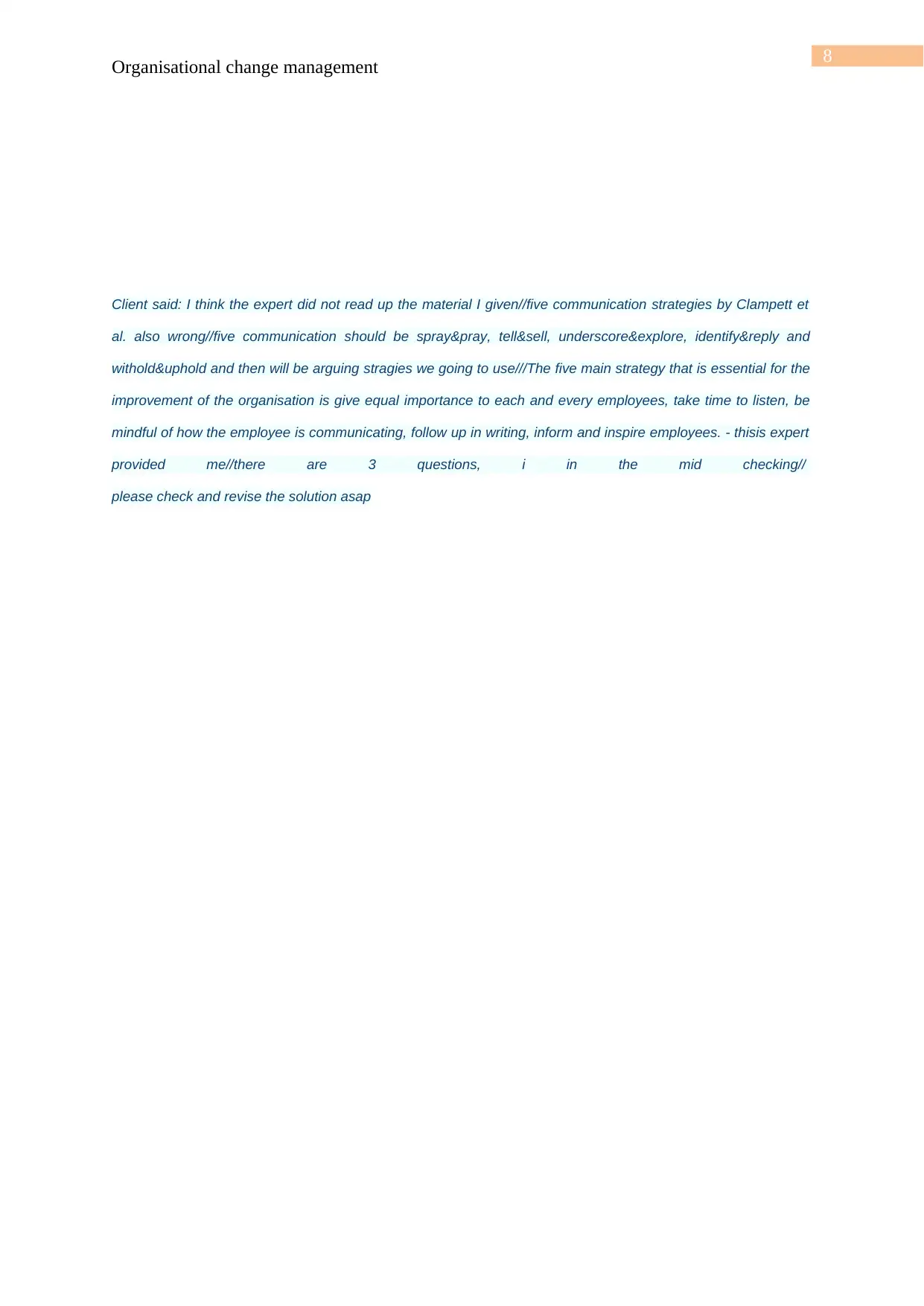
Client said: I think the expert did not read up the material I given//five communication strategies by Clampett et
al. also wrong//five communication should be spray&pray, tell&sell, underscore&explore, identify&reply and
withold&uphold and then will be arguing stragies we going to use///The five main strategy that is essential for the
improvement of the organisation is give equal importance to each and every employees, take time to listen, be
mindful of how the employee is communicating, follow up in writing, inform and inspire employees. - thisis expert
provided me//there are 3 questions, i in the mid checking//
please check and revise the solution asap
Organisational change management
Client said: I think the expert did not read up the material I given//five communication strategies by Clampett et
al. also wrong//five communication should be spray&pray, tell&sell, underscore&explore, identify&reply and
withold&uphold and then will be arguing stragies we going to use///The five main strategy that is essential for the
improvement of the organisation is give equal importance to each and every employees, take time to listen, be
mindful of how the employee is communicating, follow up in writing, inform and inspire employees. - thisis expert
provided me//there are 3 questions, i in the mid checking//
please check and revise the solution asap
⊘ This is a preview!⊘
Do you want full access?
Subscribe today to unlock all pages.
Trusted by 1+ million students worldwide

1 out of 9


Your All-in-One AI-Powered Toolkit for Academic Success.
+13062052269
info@desklib.com
Available 24*7 on WhatsApp / Email
![[object Object]](/_next/static/media/star-bottom.7253800d.svg)
Unlock your academic potential
Copyright © 2020–2026 A2Z Services. All Rights Reserved. Developed and managed by ZUCOL.