Analysis of Organizational Communication Theories and Barriers

Verified

Added on  2023/06/18

|8
|2042
|442
Report
AI Summary
This report delves into organizational communication, examining various theories such as Fredrick Taylor’s scientific management and Max Weber’s authority, highlighting their impact on organizational effectiveness. It identifies significant communication barriers hindering vaccination efforts, including dissatisfaction with trial results, lack of transparency, ineffective communication, negative experiences shared by others, and cultural differences. To address these barriers, the report discusses government strategies like effective communication, education campaigns, providing relevant information, follow-up reminders, and spreading awareness. Furthermore, it recommends initiating multi-cultural campaigns and leveraging digital platforms to enhance awareness and promote vaccination. The report concludes that understanding and addressing these communication dynamics are crucial for improving vaccination rates and overall public health, suggesting that Desklib offers valuable resources for students studying these topics.
Document Page
BUSINESS
COMMUNICATION
tabler-icon-diamond-filled.svg

Paraphrase This Document

Need a fresh take? Get an instant paraphrase of this document with our AI Paraphraser
Document Page
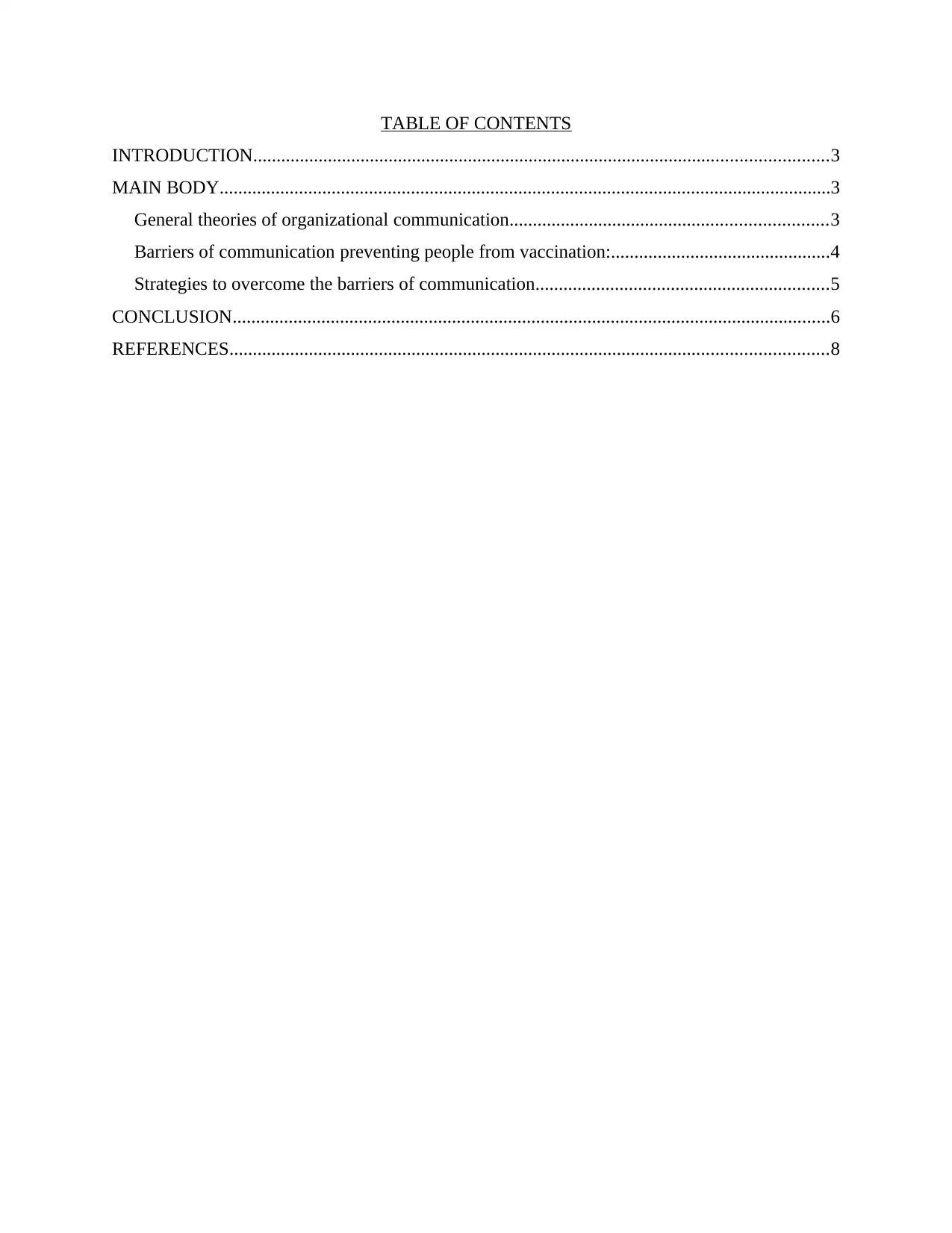
TABLE OF CONTENTS
INTRODUCTION...........................................................................................................................3
MAIN BODY...................................................................................................................................3
General theories of organizational communication....................................................................3
Barriers of communication preventing people from vaccination:...............................................4
Strategies to overcome the barriers of communication...............................................................5
CONCLUSION................................................................................................................................6
REFERENCES................................................................................................................................8
Document Page
INTRODUCTION
Organizational communication consists of all modes and forms of communication within
it and allows the organizations to get connected with stake holders as well as play roles in
contribution towards the society. This report consists of some general theories about the
organizational communication. Furthermore, evaluations of communication barriers also have
been added to focus within this report. Moreover, some government strategies are added to
understand the way to overcome the communication barriers come across the effective
organizational communication.
MAIN BODY
General theories of organizational communication
Organizational communication is very important for any business as due to this communication,
the sustainability of the organization increases within the market. There are various theories exist
within the market to understand the organizational communication. Few among these are defined
as :
Fredrick Taylor’s scientific management: this theory is based upon the principles behind
scientific management. According to this theory, optimization as well as simplification of the
jobs leads towards the increment in the productivity of the respective organization. This idea was
also expanded in the form of organization internal cooperation requirement among employees as
well as their worker within the organization. This theory defines four principles for the efficient
organizational communication as: using various scientific ways to determine as well as
standardization is one of the best way of doing a job (Mumby and Kuhn, 2018). Second principle
explains the clear division of the task as well as responsibility. As per these the rules and
responsibility towards the task makes an efficient increment in terms of improved
communication within the organization. As per third principle, high pay should be offered to the
employees who are performing high. This kind of appreciation also leads the organization
towards growth. Last principle explains the authority hierarchy and strict surveillance among the
employees so that it can be tracked that the management within the organization is going well or
not. This way effective communication can be established within an organization.
Max Weber’s authority: As per this theory, the chances of a men or man to realize their willing
within a communal actions, even if the resistance of people who are participating among the
Document Page
communal action are against in it. Authority can be termed as legitimate power form that also
can be called as legitimate under the society as well. Weber defines three types of authority
within the organization (Benham and et. al., 2021). These three authorities are traditional
authority, legal rational authority and the third one is charismatic authority. As per the first one,
traditional authority is defined on the basis of the rest for long established pattern of culture by
power legitimized. Over time the rules that are maintained but not written comes under the
category of the traditional authority. Examples of the authority are such as hereditary monarchy
etc. It have dominant power towards the employee within the organization. Second authority is
charismatic and as according to this the legitimized power is defined on the basis of the unusual,
extraordinary abilities of a person that inspire the devotion as well as obedience towards the
employer as well as the organization. These attributes showing extra ordinance within the nature
are called as charisma (Van Ruler, 2018). Third one authority is legal authority and according to
this the legal power have enacted rules as per the government regulations and the power of
respective legitimization are defined on the basis ot these rules only. These sort of authority
always do manifests the power of respective bureaucy not the individual in nature.
Barriers of communication preventing people from vaccination:
In the matter of vaccination there are various barrier exist that stops people from getting
vaccinated. Some of the barriers are defined as :
Dissatisfaction towards vaccination: The results of vaccination trial are one of the major
berries in the way of vaccination. People are not satisfied with the data of vaccination trial,
as there are many rumours in the environment related to the vaccines. Lack of knowledge
such as which vaccine have best effects, which vaccine is more effective and approved
overseas as well (Lang and et. al., 2021).
Lack of transparency: In the account of transparency, the actual numbers of the covid-19
cases also are not clear in the mind of population. Moreover, the process transparency is also
not clear in the mind of individual (Harris and Moss, 2021). The way to book slots for the
vaccination process, when to take the vaccines, how to deal with the post symptoms are also
comes under this category.
Ineffective Communication: The way to communicate respective information also behaves
as a barrier towards the vaccination process. Ineffective Communication style increases the
confusion among population. With incomplete knowledge about vaccination as well as
tabler-icon-diamond-filled.svg

Paraphrase This Document

Need a fresh take? Get an instant paraphrase of this document with our AI Paraphraser
Document Page
information related to it put life off people in danger, and this way it became as a barrier
towards the successful vaccination.
Conflicts as per experience of others: People usually believes on the oral advertising.
People do believes upon the others telling them the side effects of getting vaccinated. These
post vaccination symptoms are fever, weakness, body ache and sometimes it can be severe
as well. With all these experiences also people gets influenced and do oppose the
vaccination (Jung., 2021).
Cultural differences: Difference in between the cultures also have a huge role in terms of
the barriers. As an example all the people living in UK do not have complete knowledge of
English but on the same side all the staff providing the information knew English only. So
the people who are unaware of this specific knowledge do hesitate to ask again about the
information regarding vaccination. This way culture difference leads people towards
avoidance of vaccination (Mohd Hanafiah, Ng and Wan, 2021).
Strategies to overcome the barriers of communication
Effective communication: effective communication with the updated
information is one of the main strategies that government had adopted for the
motivation among people so that the people take initiative towards the
vaccination.
Educate and addressing barriers upfront: government have various schemes
under which govt. is providing free of cost vaccination among people . To make
people aware towards these schemes, all the survey as well as campaigns are
being conducted. To overcome the myths about side effects of vaccine
government has provided information sources such as data of recovered people
from Covid to people so that they will get actual data to judge by themselves
(Baraniuk, 2021).
Providing the information members are looking for: Government had adopted
few practices as well as initiatives in the direction of vaccination motivation such
as customer service team to deal with the queries of population. Government is
trying hard to provide the relevant information to the people of UK, in the favour
Document Page
of this, all the details about which population is searching for are being provided
to them by survey or door to door visit as well (Griffin and et. Al., 2020).
Follow up: Government is using multi-touch strategy towards the person to
remind them about the second dose of the vaccination. After first dose, follow
ups are taking place in every 15 days to remind people that their second dose is
due. All these sort of follows up leads them to reach up the medical centre as well
as reinforce the vital importance of all due dose.
Spreading awareness: For the awareness towards the vaccination, government is
telling all these information to people that the vaccination is important. To save
oneself as well as their near ones it is required to get vaccinated as soon as
possible. Vaccinated people are less prone to get infected in compare to those who
did not had vaccinated yet (Warren and Lofstedt, 2021). These kind of
information promotes the people to get vaccinated as they knew if they want their
near and dear one’s to be safe it is important to get vaccinated first.
Recommendations:
For the effective awareness towards the Covid-19 and its vaccination government should
initiate some campaigns to spread the awareness towards vaccination.
Government should adopt multi-cultural practices so that cultural difference no longer
became barrier towards the vaccination.
It is also recommended that the awareness campaign should include digital platforms as
well. With the publicity on social platform it is possible to spread the information on a
big scale as nowadays all people spend their most of time on the social platforms itself.
CONCLUSION
From the above study, it can be concluded as there are various theories within the organization
exist that have impact over organizational communication. There are lots of barriers exist within
the environment that influence people to not get vaccinated such as ineffective communication,
lack of information, hesitation, conflicts over prior experience etc. Moreover, to overcome these
barriers government had adopted few strategies so that people get motivation towards
vaccination. As a result people are being more aware towards the benefits of vaccination in
Document Page
favour of their as well as their families. In the end, few more recommendations have been
studied in this report so that the government campaign can be more effective and improved at the
same time.
tabler-icon-diamond-filled.svg

Paraphrase This Document

Need a fresh take? Get an instant paraphrase of this document with our AI Paraphraser
Document Page
REFERENCES
Books and Journals
Mumby, D. K. and Kuhn, T. R., 2018., Organizational communication: A critical introduction.
Sage Publications.
Van Ruler, B., 2018., Communication theory: An underrated pillar on which strategic
communication rests. International Journal of Strategic Communication. 12(4).
pp.367-381.
Warren, G. W. and Lofstedt, R., 2021., COVID-19 vaccine rollout risk communication strategies
in Europe: a rapid response. Journal of Risk Research. 24(3-4). pp.369-379.
Harris, P. and Moss, D., 2021., Public affairs and communicating coronavirus vaccine risk: The
role of government in maintaining public trust. Journal of Public Affairs. 21(2).
Griffin, M. and et. Al., 2020., Preparing for COVID-19 exit strategies. Annals of Medicine and
Surgery.
Jung, J., 2021., Preparing for the coronavirus disease (COVID-19) vaccination: evidence, plans,
and implications. Journal of Korean Medical Science. 36(7).
Baraniuk, C., 2021., Covid-19: How the UK vaccine rollout delivered success, so far. Bmj. 372.
Mohd Hanafiah, K., Ng, C. and Wan, A.M., 2021., Effective Communication at Different Phases
of COVID-19 Prevention: Roles, Enablers and Barriers. Viruses. 13(6), p.1058.
Benham, J.L.,and et. al., 2021., Attitudes, current behaviours and barriers to public health
measures that reduce COVID-19 transmission: A qualitative study to inform public
health messaging. PloS one.16(2). p.e0246941.
Lang, R. and et. al., 2021., Attitudes, behaviours and barriers to public health measures for
COVID-19: a survey to inform public health messaging. BMC public health,21(1),
pp.1-15.
chevron_up_icon
1 out of 8
circle_padding
hide_on_mobile
zoom_out_icon
[object Object]