Exploring Leadership Politics: Impact on Organizational Behavior
VerifiedAdded on 2023/06/10
|10
|2909
|418
Essay
AI Summary
This essay explores the significance of leadership politics in understanding organizational behavior, focusing on how political skill, power dynamics, and cultural influences shape leadership effectiveness. It discusses how leaders' political decisions impact organizational culture, employee motivation, and overall productivity. The essay further examines the relationship between power and politics, highlighting both positive and negative impacts of political leadership on the workforce. It emphasizes the importance of leaders balancing their personal ambitions with the needs of the organization and employees, and how employee responses to organizational politics can influence outcomes. The paper concludes that understanding political leadership is crucial for developing effective strategies and fostering a positive organizational structure.
Running head: ORGANIZATIONAL LEADERSHIP AND BEHAVIOUR
ORGANIZATIONAL LEADERSHIP AND BEHAVIOUR
Name of Student
Name of University
Author note
ORGANIZATIONAL LEADERSHIP AND BEHAVIOUR
Name of Student
Name of University
Author note

Paraphrase This Document
Need a fresh take? Get an instant paraphrase of this document with our AI Paraphraser
1ORGANIZATIONAL LEADERSHIP AND BEHAVIOUR
Introduction:
Politics is very important in understanding business organizations. This aspect
influences the governing of an organization and also play a significant role in determining
employee interaction. The political metaphors play a huge role in determining the work place
culture and determine the position of power in an organization effectively (Huczynski,
Buchanan & Huczynski, 2013). The leadership of an organization is highly influenced by the
political metaphors. It gives the leader the power to control and manipulate others in the work
force and become a recommendable force in the organization to deal with. The leader who is
politically strong and understands the underlying meanings of the organizational politics, is
quite effective in maintaining his position in the organization without being effectively aware
of the other factors that affect the work culture in an organisation. The decisions of the leader
of an organization determine the political scenario of an organization (Pettigrew, 2014). The
main focus of leadership politics is to gain the career achievement in the organization without
thinking of the organization’s interest. However, there are other different aspects which
determine the leadership politics. The purpose of this essay is to focus on the different aspects
of leadership politics and how it is important for understanding the political metaphors of an
organization.
Discussion:
The effectiveness of a political leadership is often determined by understanding the
political skill of a leader. In order to understand the application of political skill of a leader,
the organizations should be looked upon as political arenas and the effectiveness of political
skills for the survival and success in the political backdrop is the essential area of judgement.
The political skill of a leader depends on the ability to adjust the behavioural pattern
according to situations (Treadway, et al. 2013). It has been seen that there are other factors,
Introduction:
Politics is very important in understanding business organizations. This aspect
influences the governing of an organization and also play a significant role in determining
employee interaction. The political metaphors play a huge role in determining the work place
culture and determine the position of power in an organization effectively (Huczynski,
Buchanan & Huczynski, 2013). The leadership of an organization is highly influenced by the
political metaphors. It gives the leader the power to control and manipulate others in the work
force and become a recommendable force in the organization to deal with. The leader who is
politically strong and understands the underlying meanings of the organizational politics, is
quite effective in maintaining his position in the organization without being effectively aware
of the other factors that affect the work culture in an organisation. The decisions of the leader
of an organization determine the political scenario of an organization (Pettigrew, 2014). The
main focus of leadership politics is to gain the career achievement in the organization without
thinking of the organization’s interest. However, there are other different aspects which
determine the leadership politics. The purpose of this essay is to focus on the different aspects
of leadership politics and how it is important for understanding the political metaphors of an
organization.
Discussion:
The effectiveness of a political leadership is often determined by understanding the
political skill of a leader. In order to understand the application of political skill of a leader,
the organizations should be looked upon as political arenas and the effectiveness of political
skills for the survival and success in the political backdrop is the essential area of judgement.
The political skill of a leader depends on the ability to adjust the behavioural pattern
according to situations (Treadway, et al. 2013). It has been seen that there are other factors,
2ORGANIZATIONAL LEADERSHIP AND BEHAVIOUR
such as social intelligence, practical intelligence, self-assessment, which can determine the
effectiveness of a political leader in an organisation but it can also be seen that it is the
political skill of a leader that is solely responsible for the effective organizational
environment. The other factors in this case can be considered secondary or trivial for
consideration for the judgement of the effective political leadership.
All leaders are not politically efficient from the beginning, but essential development
depending on the situation is primarily responsible for the development of political maturity
in a leader. This development of the general features is based on the daily social interactions
and is highly influenced by the general personality of the leader (Pye & Verba, 2015). This
type of political development is created due to the pyramid shaped structure of the
organization. The creation of a mini social system in the organization compels the leader to
adopt a political stance in order to develop administrative strategies. There is also a cultural
significance in the creation of political leaders in an organization (Kuntz, Kuntz, Elenkov &
Nabirukhina, 2013). The regional cultures help in the development of the political leadership.
The importance of a political leadership is important as it is essential to maintain a
sustainable workforce in the organization. Without political decisions, the organization
behaves in an unusual manner, more like an unsolved maze, which leads to confusing
outcomes (Tregidga, Kearins & Milne, 2013). A political leadership sets the motion of the
workforce in a particular political direction. A political standpoint in the organization helps to
define the purpose of the vision of the organization and the political leader can guide the
workforce accordingly. However, these decisions might be influenced by personal motives
and career development, but still it lets the organization work peacefully. In this case,
understanding of other work culture political metaphors become highly insignificant as the
purpose of the organization is being achieved in the process.
such as social intelligence, practical intelligence, self-assessment, which can determine the
effectiveness of a political leader in an organisation but it can also be seen that it is the
political skill of a leader that is solely responsible for the effective organizational
environment. The other factors in this case can be considered secondary or trivial for
consideration for the judgement of the effective political leadership.
All leaders are not politically efficient from the beginning, but essential development
depending on the situation is primarily responsible for the development of political maturity
in a leader. This development of the general features is based on the daily social interactions
and is highly influenced by the general personality of the leader (Pye & Verba, 2015). This
type of political development is created due to the pyramid shaped structure of the
organization. The creation of a mini social system in the organization compels the leader to
adopt a political stance in order to develop administrative strategies. There is also a cultural
significance in the creation of political leaders in an organization (Kuntz, Kuntz, Elenkov &
Nabirukhina, 2013). The regional cultures help in the development of the political leadership.
The importance of a political leadership is important as it is essential to maintain a
sustainable workforce in the organization. Without political decisions, the organization
behaves in an unusual manner, more like an unsolved maze, which leads to confusing
outcomes (Tregidga, Kearins & Milne, 2013). A political leadership sets the motion of the
workforce in a particular political direction. A political standpoint in the organization helps to
define the purpose of the vision of the organization and the political leader can guide the
workforce accordingly. However, these decisions might be influenced by personal motives
and career development, but still it lets the organization work peacefully. In this case,
understanding of other work culture political metaphors become highly insignificant as the
purpose of the organization is being achieved in the process.
⊘ This is a preview!⊘
Do you want full access?
Subscribe today to unlock all pages.

Trusted by 1+ million students worldwide
3ORGANIZATIONAL LEADERSHIP AND BEHAVIOUR
The discussion about leadership politics in an organization should focus on larger
organizations for the better understanding of the aspect. The relation between power and
politics is an undeniable fact, where one compliments the other’s existence. Leaders such as
the Pope or the President to an executive in an organization or a chief of police in a
metropolitan area, all are leaders of their respective organizations, which only vary in
magnitude. The management of these organizations be it large or small requires efficient
power. The different resources available to the leaders and complete mastery over these
resources places them in the position of power.
It is essential for the leaders to acquire power and this power puts the leader on a
political platform which is managed by the amalgamation of the political power and the
positional power. The effective leadership is the balanced management of both power and
politics for the development of the organization (Higgins, Mirza, & Drozynska, 2013).
However, in most of the organizations politics is used by the leadership for personal growth
rather than the growth of the organization. This causes attrition damage in the organization,
but the management of power lets the leadership keep the upper hand in the management
affairs where the voice of the workforce is subdued in the process.
The general tendency of the employees of an organization is to overlook the politics
of the organization and keep themselves away from the controversial management system.
However, such attempts become futile in the due course of time as every action they are
required to take are influenced by the power politics of the leadership regardless of their
personal opinion (Clegg, Kornberger, & Pitsis, 2015). These type of political leadership has
two types of effect in the organizational work environment. An expert political leadership and
referent power affects the organization environment positively which enhances the
performance of the team whereas a political leadership which applies a coercive power
The discussion about leadership politics in an organization should focus on larger
organizations for the better understanding of the aspect. The relation between power and
politics is an undeniable fact, where one compliments the other’s existence. Leaders such as
the Pope or the President to an executive in an organization or a chief of police in a
metropolitan area, all are leaders of their respective organizations, which only vary in
magnitude. The management of these organizations be it large or small requires efficient
power. The different resources available to the leaders and complete mastery over these
resources places them in the position of power.
It is essential for the leaders to acquire power and this power puts the leader on a
political platform which is managed by the amalgamation of the political power and the
positional power. The effective leadership is the balanced management of both power and
politics for the development of the organization (Higgins, Mirza, & Drozynska, 2013).
However, in most of the organizations politics is used by the leadership for personal growth
rather than the growth of the organization. This causes attrition damage in the organization,
but the management of power lets the leadership keep the upper hand in the management
affairs where the voice of the workforce is subdued in the process.
The general tendency of the employees of an organization is to overlook the politics
of the organization and keep themselves away from the controversial management system.
However, such attempts become futile in the due course of time as every action they are
required to take are influenced by the power politics of the leadership regardless of their
personal opinion (Clegg, Kornberger, & Pitsis, 2015). These type of political leadership has
two types of effect in the organizational work environment. An expert political leadership and
referent power affects the organization environment positively which enhances the
performance of the team whereas a political leadership which applies a coercive power
Paraphrase This Document
Need a fresh take? Get an instant paraphrase of this document with our AI Paraphraser
4ORGANIZATIONAL LEADERSHIP AND BEHAVIOUR
affects the organization in negative manner degrading the employee satisfaction also their
commitment towards the organization.
The relation between power and politics in an organization is an inevitable one.
However, the two aspects can be viewed from two different viewpoints. Power is the capacity
to influence others which refers to incidents which can be influenced in accordance to the
system of the organisation (Fleming & Spicer, 2014). However, organizational politics can be
best understood by the advantage that it takes of the positional power for the benefits which
has to be attained in the informal manner. The unofficial manner of the organizational politics
explains its influence for the increasing in power or achievement of targets in the wake of
self-interest and to protect one’s future aspects for further stronghold in the organization. This
refers to future promotions and individual self-interests.
Positive politics and power influence encourages the organizations productivity,
which is the resultant of employee motivation. Proper use of power helps the leader to
channelize the workforce in the proper direction. The politics in this case is used for
motivating the team and using the beneficial achievements for the proper enhancement of
team productivity. The relation between the leader and the employees develop on a good note
and the trustworthiness of the leader makes them concerned towards the benefit of the
organisation (Kacmar, Andrews, Harris & Tepper, 2013). This increases quality of the work
produced and develops a higher retention rate in the organization. On the other hand, there
are leaders who have only self-interests in mind and use power and politics for their personal
benefits. These leaders hold an upper hand in the organization due to the advantage of their
powers but ultimately lose the respect from their team members and increase the negative
energy in the organization (Hoyt, Price & Poatsy, 2013). This leads to the demotivation
among the employees who decreases the quality of production. However, negative power
politics increases the quantity of production.
affects the organization in negative manner degrading the employee satisfaction also their
commitment towards the organization.
The relation between power and politics in an organization is an inevitable one.
However, the two aspects can be viewed from two different viewpoints. Power is the capacity
to influence others which refers to incidents which can be influenced in accordance to the
system of the organisation (Fleming & Spicer, 2014). However, organizational politics can be
best understood by the advantage that it takes of the positional power for the benefits which
has to be attained in the informal manner. The unofficial manner of the organizational politics
explains its influence for the increasing in power or achievement of targets in the wake of
self-interest and to protect one’s future aspects for further stronghold in the organization. This
refers to future promotions and individual self-interests.
Positive politics and power influence encourages the organizations productivity,
which is the resultant of employee motivation. Proper use of power helps the leader to
channelize the workforce in the proper direction. The politics in this case is used for
motivating the team and using the beneficial achievements for the proper enhancement of
team productivity. The relation between the leader and the employees develop on a good note
and the trustworthiness of the leader makes them concerned towards the benefit of the
organisation (Kacmar, Andrews, Harris & Tepper, 2013). This increases quality of the work
produced and develops a higher retention rate in the organization. On the other hand, there
are leaders who have only self-interests in mind and use power and politics for their personal
benefits. These leaders hold an upper hand in the organization due to the advantage of their
powers but ultimately lose the respect from their team members and increase the negative
energy in the organization (Hoyt, Price & Poatsy, 2013). This leads to the demotivation
among the employees who decreases the quality of production. However, negative power
politics increases the quantity of production.
5ORGANIZATIONAL LEADERSHIP AND BEHAVIOUR
Herein, comes the role of the employees in response to the power politics that are
practised by the organizational leadership. Employees act differently in response to these
politics and hence result in different outcomes. Employees who know the ways to act
tactfully and respond according to the political changes achieve a positive outcome in the
organization (Meisler & Vigoda-Gadot, 2014). They develop themselves considerably
according to the demand of the leadership and achieve more productiveness for future. This
indirectly highlights the politics that is passed on from the leadership to the lower hierarchies
in the organization. The employees seek refuge in the shade of politics when they see that
they can achieve personal benefits from the organization. Employees who cannot understand
these politics gets lost in the maze of political overtones and ultimately becomes confused
about their actual purpose in the organization. It is essential for a political leader to develop a
clear idea of the vision of the organization where the targets and policies would be clearly
highlighted (Colquitt & Zipay, 2015). This helps the employees to understand the political
achievement of the organization and helps them plan accordingly to meet the requirements
expected from them by the leadership. These type of focused political outlook by the
leadership helps them to achieve their own benefits and at the same time help the employees
to achieve their personal benefits.
The political leadership can be viewed from different viewpoints or as an independent
variable of personal emotions such as job satisfaction, organizational commitment, and
employee reaction (Meisler, 2014). These different emotions influence the political
leadership on different levels. However, these play very ambiguous roles in the determination
of the characteristic of the political leadership. The understanding of the leadership can then
be determined by the personality of the leadership which play a key role in the effort to
conceptualize the idea of organizational politics. The different aspects of an organization
Herein, comes the role of the employees in response to the power politics that are
practised by the organizational leadership. Employees act differently in response to these
politics and hence result in different outcomes. Employees who know the ways to act
tactfully and respond according to the political changes achieve a positive outcome in the
organization (Meisler & Vigoda-Gadot, 2014). They develop themselves considerably
according to the demand of the leadership and achieve more productiveness for future. This
indirectly highlights the politics that is passed on from the leadership to the lower hierarchies
in the organization. The employees seek refuge in the shade of politics when they see that
they can achieve personal benefits from the organization. Employees who cannot understand
these politics gets lost in the maze of political overtones and ultimately becomes confused
about their actual purpose in the organization. It is essential for a political leader to develop a
clear idea of the vision of the organization where the targets and policies would be clearly
highlighted (Colquitt & Zipay, 2015). This helps the employees to understand the political
achievement of the organization and helps them plan accordingly to meet the requirements
expected from them by the leadership. These type of focused political outlook by the
leadership helps them to achieve their own benefits and at the same time help the employees
to achieve their personal benefits.
The political leadership can be viewed from different viewpoints or as an independent
variable of personal emotions such as job satisfaction, organizational commitment, and
employee reaction (Meisler, 2014). These different emotions influence the political
leadership on different levels. However, these play very ambiguous roles in the determination
of the characteristic of the political leadership. The understanding of the leadership can then
be determined by the personality of the leadership which play a key role in the effort to
conceptualize the idea of organizational politics. The different aspects of an organization
⊘ This is a preview!⊘
Do you want full access?
Subscribe today to unlock all pages.
Trusted by 1+ million students worldwide
6ORGANIZATIONAL LEADERSHIP AND BEHAVIOUR
such as discrimination, recognition, and rewards play an independent role not influenced by
the political standpoint of the organizational leader.
It is often misunderstood that leaders can be independent of personal struggles,
inequity and unfairness and often imply effective management devoid of the ambitions and
aspirations of the personal power that they hold in the organization. The better understanding
of the organizational changes, understanding of the politics and the ability to understand the
employee mentality help the leader to break the stereotypical organizational culture and
formulate their independent political alignment (Saleem, 2015). These can however generate
unique problems such as conflicts in the organizational structure. The real calibre of the
political leader lies in the ability to balance between the organizational politics of maintaining
his own power and at the same time maintain a valuable relation with the employees to
prevent any damage of the organizational structure.
The role of the leaders has changed with time. The changes in the global environment
and the mind-set of the people to massive globalization have also affected effective
leadership in organizations. Leadership now is not only about absolute control or display of
power. There are different factors which the leader has to keep in mind while dealing with the
organization. The leadership qualities of the modern world requires to be visionary, able to
plan and setup goals for the employees, and the organizing and leading with example (Zehir,
et al. 2014). Herein, comes the role of politics that the leader is required to play to achieve
and manage the team of the organization to achieve goals.
Conclusion:
This type of political leadership helps the understanding of the other aspects of the
organization. Factors such as the development of proper planning and strategies for the
effective running of the organization all can be understood by the study of the political
such as discrimination, recognition, and rewards play an independent role not influenced by
the political standpoint of the organizational leader.
It is often misunderstood that leaders can be independent of personal struggles,
inequity and unfairness and often imply effective management devoid of the ambitions and
aspirations of the personal power that they hold in the organization. The better understanding
of the organizational changes, understanding of the politics and the ability to understand the
employee mentality help the leader to break the stereotypical organizational culture and
formulate their independent political alignment (Saleem, 2015). These can however generate
unique problems such as conflicts in the organizational structure. The real calibre of the
political leader lies in the ability to balance between the organizational politics of maintaining
his own power and at the same time maintain a valuable relation with the employees to
prevent any damage of the organizational structure.
The role of the leaders has changed with time. The changes in the global environment
and the mind-set of the people to massive globalization have also affected effective
leadership in organizations. Leadership now is not only about absolute control or display of
power. There are different factors which the leader has to keep in mind while dealing with the
organization. The leadership qualities of the modern world requires to be visionary, able to
plan and setup goals for the employees, and the organizing and leading with example (Zehir,
et al. 2014). Herein, comes the role of politics that the leader is required to play to achieve
and manage the team of the organization to achieve goals.
Conclusion:
This type of political leadership helps the understanding of the other aspects of the
organization. Factors such as the development of proper planning and strategies for the
effective running of the organization all can be understood by the study of the political
Paraphrase This Document
Need a fresh take? Get an instant paraphrase of this document with our AI Paraphraser
7ORGANIZATIONAL LEADERSHIP AND BEHAVIOUR
leadership as it clearly explains how the leadership of a n individual and his political
decisions can effectively change the decisions of an organization and how it can affect the
organizations productivity. A positive power politics can build a better organizational
structure. It motivates the employees to work and it leads to the development of the
production quality. However, a negative power politics can demotivate the organizational
structure but it increases the turnover rate of the organization. Hence, it can be concluded
from the above discussion that in an organization leadership politics that determines how the
internal structure of the organization runs. The other political metaphors which individually
determine the other aspects of the organization seem negligible if the political leadership is
understood completely.
leadership as it clearly explains how the leadership of a n individual and his political
decisions can effectively change the decisions of an organization and how it can affect the
organizations productivity. A positive power politics can build a better organizational
structure. It motivates the employees to work and it leads to the development of the
production quality. However, a negative power politics can demotivate the organizational
structure but it increases the turnover rate of the organization. Hence, it can be concluded
from the above discussion that in an organization leadership politics that determines how the
internal structure of the organization runs. The other political metaphors which individually
determine the other aspects of the organization seem negligible if the political leadership is
understood completely.
8ORGANIZATIONAL LEADERSHIP AND BEHAVIOUR
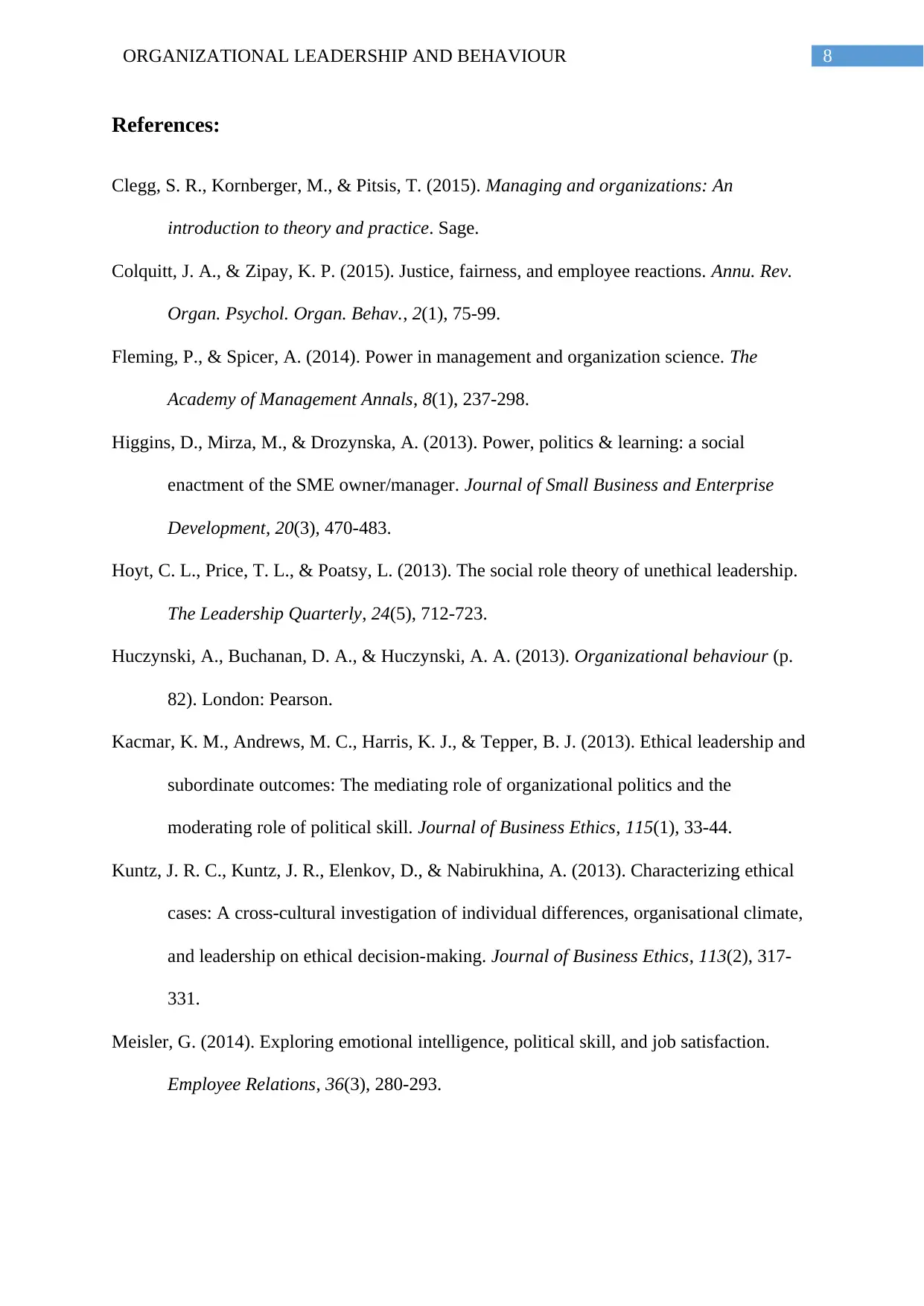
References:
Clegg, S. R., Kornberger, M., & Pitsis, T. (2015). Managing and organizations: An
introduction to theory and practice. Sage.
Colquitt, J. A., & Zipay, K. P. (2015). Justice, fairness, and employee reactions. Annu. Rev.
Organ. Psychol. Organ. Behav., 2(1), 75-99.
Fleming, P., & Spicer, A. (2014). Power in management and organization science. The
Academy of Management Annals, 8(1), 237-298.
Higgins, D., Mirza, M., & Drozynska, A. (2013). Power, politics & learning: a social
enactment of the SME owner/manager. Journal of Small Business and Enterprise
Development, 20(3), 470-483.
Hoyt, C. L., Price, T. L., & Poatsy, L. (2013). The social role theory of unethical leadership.
The Leadership Quarterly, 24(5), 712-723.
Huczynski, A., Buchanan, D. A., & Huczynski, A. A. (2013). Organizational behaviour (p.
82). London: Pearson.
Kacmar, K. M., Andrews, M. C., Harris, K. J., & Tepper, B. J. (2013). Ethical leadership and
subordinate outcomes: The mediating role of organizational politics and the
moderating role of political skill. Journal of Business Ethics, 115(1), 33-44.
Kuntz, J. R. C., Kuntz, J. R., Elenkov, D., & Nabirukhina, A. (2013). Characterizing ethical
cases: A cross-cultural investigation of individual differences, organisational climate,
and leadership on ethical decision-making. Journal of Business Ethics, 113(2), 317-
331.
Meisler, G. (2014). Exploring emotional intelligence, political skill, and job satisfaction.
Employee Relations, 36(3), 280-293.
References:
Clegg, S. R., Kornberger, M., & Pitsis, T. (2015). Managing and organizations: An
introduction to theory and practice. Sage.
Colquitt, J. A., & Zipay, K. P. (2015). Justice, fairness, and employee reactions. Annu. Rev.
Organ. Psychol. Organ. Behav., 2(1), 75-99.
Fleming, P., & Spicer, A. (2014). Power in management and organization science. The
Academy of Management Annals, 8(1), 237-298.
Higgins, D., Mirza, M., & Drozynska, A. (2013). Power, politics & learning: a social
enactment of the SME owner/manager. Journal of Small Business and Enterprise
Development, 20(3), 470-483.
Hoyt, C. L., Price, T. L., & Poatsy, L. (2013). The social role theory of unethical leadership.
The Leadership Quarterly, 24(5), 712-723.
Huczynski, A., Buchanan, D. A., & Huczynski, A. A. (2013). Organizational behaviour (p.
82). London: Pearson.
Kacmar, K. M., Andrews, M. C., Harris, K. J., & Tepper, B. J. (2013). Ethical leadership and
subordinate outcomes: The mediating role of organizational politics and the
moderating role of political skill. Journal of Business Ethics, 115(1), 33-44.
Kuntz, J. R. C., Kuntz, J. R., Elenkov, D., & Nabirukhina, A. (2013). Characterizing ethical
cases: A cross-cultural investigation of individual differences, organisational climate,
and leadership on ethical decision-making. Journal of Business Ethics, 113(2), 317-
331.
Meisler, G. (2014). Exploring emotional intelligence, political skill, and job satisfaction.
Employee Relations, 36(3), 280-293.
⊘ This is a preview!⊘
Do you want full access?
Subscribe today to unlock all pages.
Trusted by 1+ million students worldwide
9ORGANIZATIONAL LEADERSHIP AND BEHAVIOUR
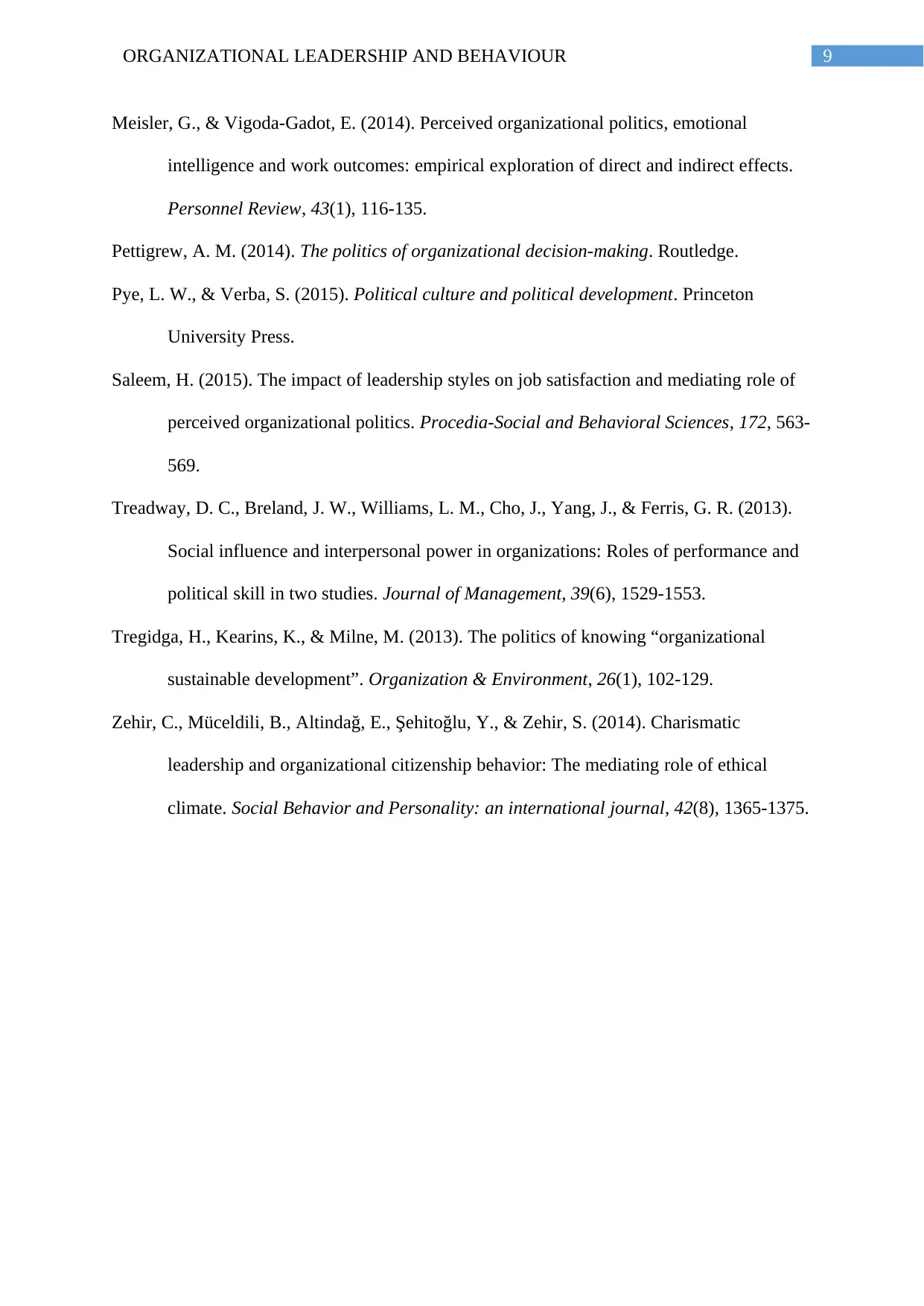
Meisler, G., & Vigoda-Gadot, E. (2014). Perceived organizational politics, emotional
intelligence and work outcomes: empirical exploration of direct and indirect effects.
Personnel Review, 43(1), 116-135.
Pettigrew, A. M. (2014). The politics of organizational decision-making. Routledge.
Pye, L. W., & Verba, S. (2015). Political culture and political development. Princeton
University Press.
Saleem, H. (2015). The impact of leadership styles on job satisfaction and mediating role of
perceived organizational politics. Procedia-Social and Behavioral Sciences, 172, 563-
569.
Treadway, D. C., Breland, J. W., Williams, L. M., Cho, J., Yang, J., & Ferris, G. R. (2013).
Social influence and interpersonal power in organizations: Roles of performance and
political skill in two studies. Journal of Management, 39(6), 1529-1553.
Tregidga, H., Kearins, K., & Milne, M. (2013). The politics of knowing “organizational
sustainable development”. Organization & Environment, 26(1), 102-129.
Zehir, C., Müceldili, B., Altindağ, E., Şehitoğlu, Y., & Zehir, S. (2014). Charismatic
leadership and organizational citizenship behavior: The mediating role of ethical
climate. Social Behavior and Personality: an international journal, 42(8), 1365-1375.
Meisler, G., & Vigoda-Gadot, E. (2014). Perceived organizational politics, emotional
intelligence and work outcomes: empirical exploration of direct and indirect effects.
Personnel Review, 43(1), 116-135.
Pettigrew, A. M. (2014). The politics of organizational decision-making. Routledge.
Pye, L. W., & Verba, S. (2015). Political culture and political development. Princeton
University Press.
Saleem, H. (2015). The impact of leadership styles on job satisfaction and mediating role of
perceived organizational politics. Procedia-Social and Behavioral Sciences, 172, 563-
569.
Treadway, D. C., Breland, J. W., Williams, L. M., Cho, J., Yang, J., & Ferris, G. R. (2013).
Social influence and interpersonal power in organizations: Roles of performance and
political skill in two studies. Journal of Management, 39(6), 1529-1553.
Tregidga, H., Kearins, K., & Milne, M. (2013). The politics of knowing “organizational
sustainable development”. Organization & Environment, 26(1), 102-129.
Zehir, C., Müceldili, B., Altindağ, E., Şehitoğlu, Y., & Zehir, S. (2014). Charismatic
leadership and organizational citizenship behavior: The mediating role of ethical
climate. Social Behavior and Personality: an international journal, 42(8), 1365-1375.

1 out of 10


Related Documents


Your All-in-One AI-Powered Toolkit for Academic Success.
+13062052269
info@desklib.com
Available 24*7 on WhatsApp / Email
![[object Object]](/_next/static/media/star-bottom.7253800d.svg)
Unlock your academic potential
Copyright © 2020–2026 A2Z Services. All Rights Reserved. Developed and managed by ZUCOL.