Organizational Skills Report: Interpersonal Skills and HR Management

Verified

Added on  2023/06/04

|7
|1686
|466
Report
AI Summary
This report delves into the critical aspects of organizational skills, emphasizing the significance of interpersonal skills and their impact on workplace dynamics. It explores how these skills contribute to effective leadership, conflict resolution, and overall organizational success. The report examines various facets, including the need for specific competencies, the role of HR management models, and the importance of adapting to corporate culture. It highlights the evolution of HR roles, from employee trustees to strategic architects, and underscores the necessity of continuous learning and professional development. The analysis also covers the importance of understanding and resolving conflict situations, and the use of non-directive methods for staff reduction, providing a comprehensive overview of how these skills and strategies are applied in real-world scenarios to achieve organizational goals.
Document Page
1
Organizational Skills
Name:
Course
Professor’s name
University name
City, State
Date of submission
tabler-icon-diamond-filled.svg

Paraphrase This Document

Need a fresh take? Get an instant paraphrase of this document with our AI Paraphraser
Document Page
2
Introduction
The companies that care about knowing what one has learned to do and the achievements you
achieved in your previous professional experiences. What I have learned helps me to evaluate if i
have the skills or competencies necessary for the working at a place. The description of
achievements and skills is a task that although important is not simple and requires time, since it
is necessary to reflect on a persons past professional and personal experience, detecting the most
significant actions and results achieved in your work and / or personal career .
Each profession has a certain number of competences that are more significant than others and it
is essential that you emphasize in your curriculum vitae all those that you have and are relevant
in your professional world.Competencies are important that are argued, based on your
professional or personal experience and that link them with the achievements.
Interpersonal skills
Interpersonal skills are human skills. In my experience at work place I have learnt that how
people interact with each other, how they communicate - these issues seem to be important for
any organization. In the organizations that have people with good interpersonal skills I have
realized that work is easily carried out. People with good interpersonal skills like to
communicate with others. They understand that the conflict is a natural phenomenon, and
sometimes it turns out to be even a bright part of life, and they are always ready to look for ways
to resolve it and pacify the parties. Skills of interpersonal relations help in any business.
Document Page
3
However, in some areas of activity, such skills can be absolutely necessary to achieve success.
For example, the work of the treasurer, as a rule, is not in sight, employees rarely see him, so the
communication skills of a person in this position do not particularly affect the results of work.
But those who are engaged in sales, marketing, who is responsible for the positive image of the
company, the ability to establish relationships with people is necessary first.
Personal skills
Study the environment in which this work should be done. Are special skills needed here? For
example, public relations work or bidding is usually related to an environment that requires
special skills in the field of interpersonal relationships and the ability to interact with people of
different interests.
Consideration of the application and the resume of the candidate will help to determine whether
he has the necessary professional qualities. It is necessary to develop special questions
concerning interpersonal relations (if they are not listed in the section of business skills), as well
as the willingness of the candidate to learn the traditions of corporate culture.
People skills
Since the functional organization promotes specialization, here employees are more ready to
develop. To have high levels of knowledge and skills in specific functional or technical areas,
but have a narrower perspective with respect to common business objectives. A narrow
description of the work may lead to a lack of involvement and competencies and to prevent staff
from understanding the essence of what is happening (Block, 2016) . This does not happen with
Document Page
4
the participation of staff in the performance of the whole task. In such organizations, the rate is
placed on technical skills and, to a lesser extent, on interpersonal relationships. This is especially
evident at low levels of organization. The result is often poor customer service. Such a syndrome
of problems causes a need to reconsider the nature of the work. Activating factors relate to the
process of human management structural same factors relate to the field of technical skills.
Roughly speaking, the relative share of factors related to the management process proper will
grow by reducing technical skills as the organizational level grows. It should be noted that the
ability to build interpersonal relationships is of great importance in all management tasks.
A group is any set of people who perceive themselves as a group with a common
purpose. The collective of workers is filled with a system of interpersonal relations, manifested
in the form of group activity. There are formal and informal formal groups (collectives) created
by the will of management for the organization of the production process, their task - the
performance of specific works in accordance with the division of labor at the informal enterprise
- are created on the initiative of the workers themselves on the basis of mutual sympathies,
friendly relations, then a certain goal. At the head of a formal group is an official leader, and an
informal leader is an informal leader, this expert, due to his personal qualities, professional skills
or other qualities, enjoys authority in the team and can exert significant influence on him.
Organizational skills
Required knowledge 1. Special training, knowledge and use of special methods, techniques and
technologies are required for the implementation of this type of work. 2. Should an employee
have the ability to combine and coordinate the diverse actions of employees with different
responsibilities. 3. Are skills of broad interpersonal relationships necessary . At present one of
tabler-icon-diamond-filled.svg

Paraphrase This Document

Need a fresh take? Get an instant paraphrase of this document with our AI Paraphraser
Document Page
5
the characteristic features of the labor market are significant changes in the process of searching,
selecting and evaluating candidates for filling vacancies, as well as changes in interpersonal
relations and behavior of both employers and and hired workers. In market relations, many
employers quickly realized the importance of qualified employees for the development of
companies, firms and organizations. This led to the fact that already today there is quite a sharp
competition between employers for the right to hire the most qualified specialists. But, of course,
questions arise as to how competent the hired specialist is to have the necessary qualifications,
knowledge and practical skills. Therefore, in order to achieve the optimal result, it is necessary to
use the appropriate modern assessment techniques, tests, interviews and other methods, except
for the study of personal data
The skills of understanding and analyzing the conflict situation and its effective
resolution presuppose a certain level of the socio-psychological culture of the leader. If the
leader focuses exclusively on production aspects, if he neglects the sphere of interpersonal
interaction, this leads to dissatisfaction, to tension in his relations with his subordinates. Such a
trip will not only complicate the process of leadership of the team, but can also cause serious
psychological problems for the leader himself. Comparison of the competences of a person with
the requirements for competences from the fourth work, indicates that this person should be sent
for interpersonal skills training, appointed to a position that requires interpersonal competencies
and influence skills (for example, developing work in the field of human resources or labor
relations) or practice as a mentor, who is known throughout the company as a master of
corporate policy).
Document Page
6
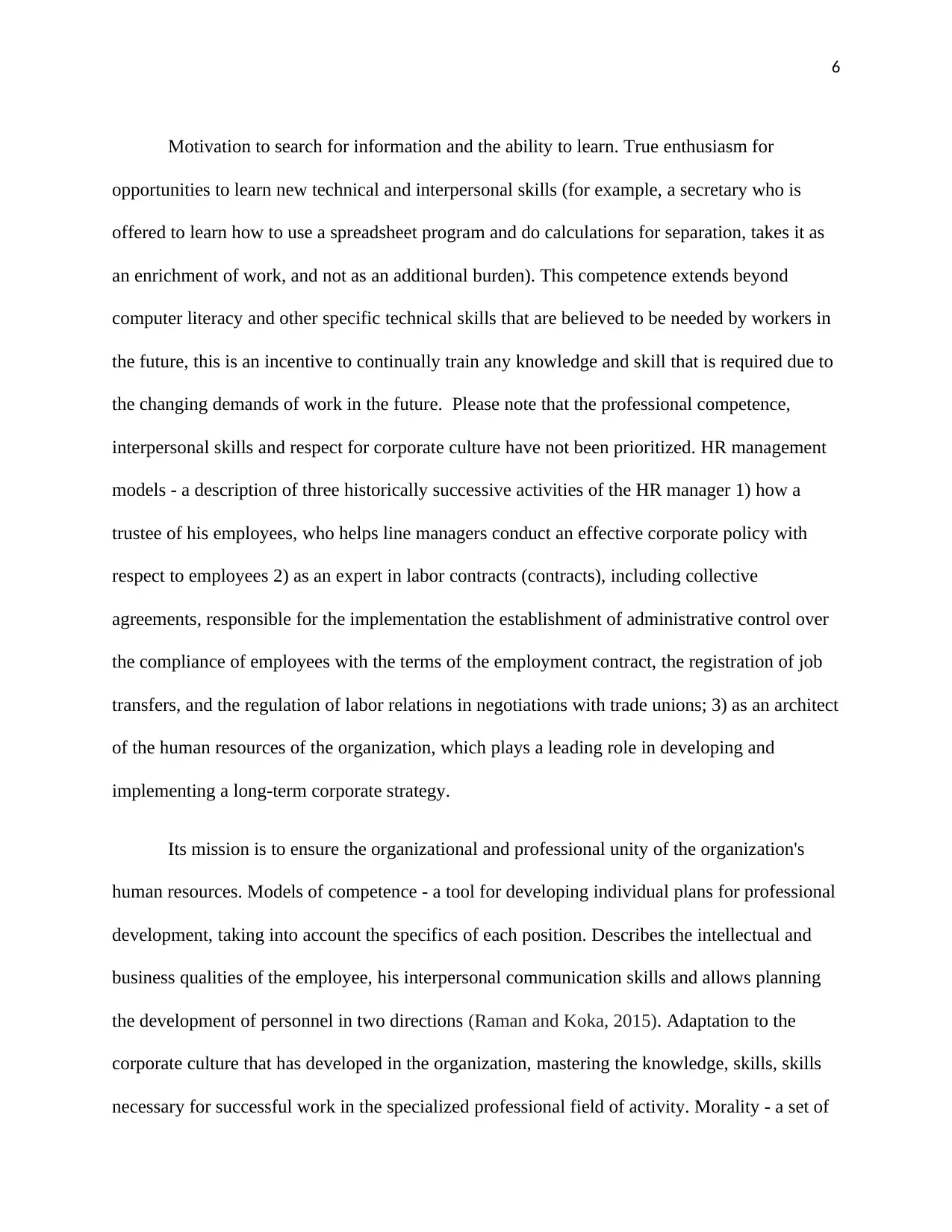
Motivation to search for information and the ability to learn. True enthusiasm for
opportunities to learn new technical and interpersonal skills (for example, a secretary who is
offered to learn how to use a spreadsheet program and do calculations for separation, takes it as
an enrichment of work, and not as an additional burden). This competence extends beyond
computer literacy and other specific technical skills that are believed to be needed by workers in
the future, this is an incentive to continually train any knowledge and skill that is required due to
the changing demands of work in the future. Please note that the professional competence,
interpersonal skills and respect for corporate culture have not been prioritized. HR management
models - a description of three historically successive activities of the HR manager 1) how a
trustee of his employees, who helps line managers conduct an effective corporate policy with
respect to employees 2) as an expert in labor contracts (contracts), including collective
agreements, responsible for the implementation the establishment of administrative control over
the compliance of employees with the terms of the employment contract, the registration of job
transfers, and the regulation of labor relations in negotiations with trade unions; 3) as an architect
of the human resources of the organization, which plays a leading role in developing and
implementing a long-term corporate strategy.
Its mission is to ensure the organizational and professional unity of the organization's
human resources. Models of competence - a tool for developing individual plans for professional
development, taking into account the specifics of each position. Describes the intellectual and
business qualities of the employee, his interpersonal communication skills and allows planning
the development of personnel in two directions (Raman and Koka, 2015). Adaptation to the
corporate culture that has developed in the organization, mastering the knowledge, skills, skills
necessary for successful work in the specialized professional field of activity. Morality - a set of
Document Page
7
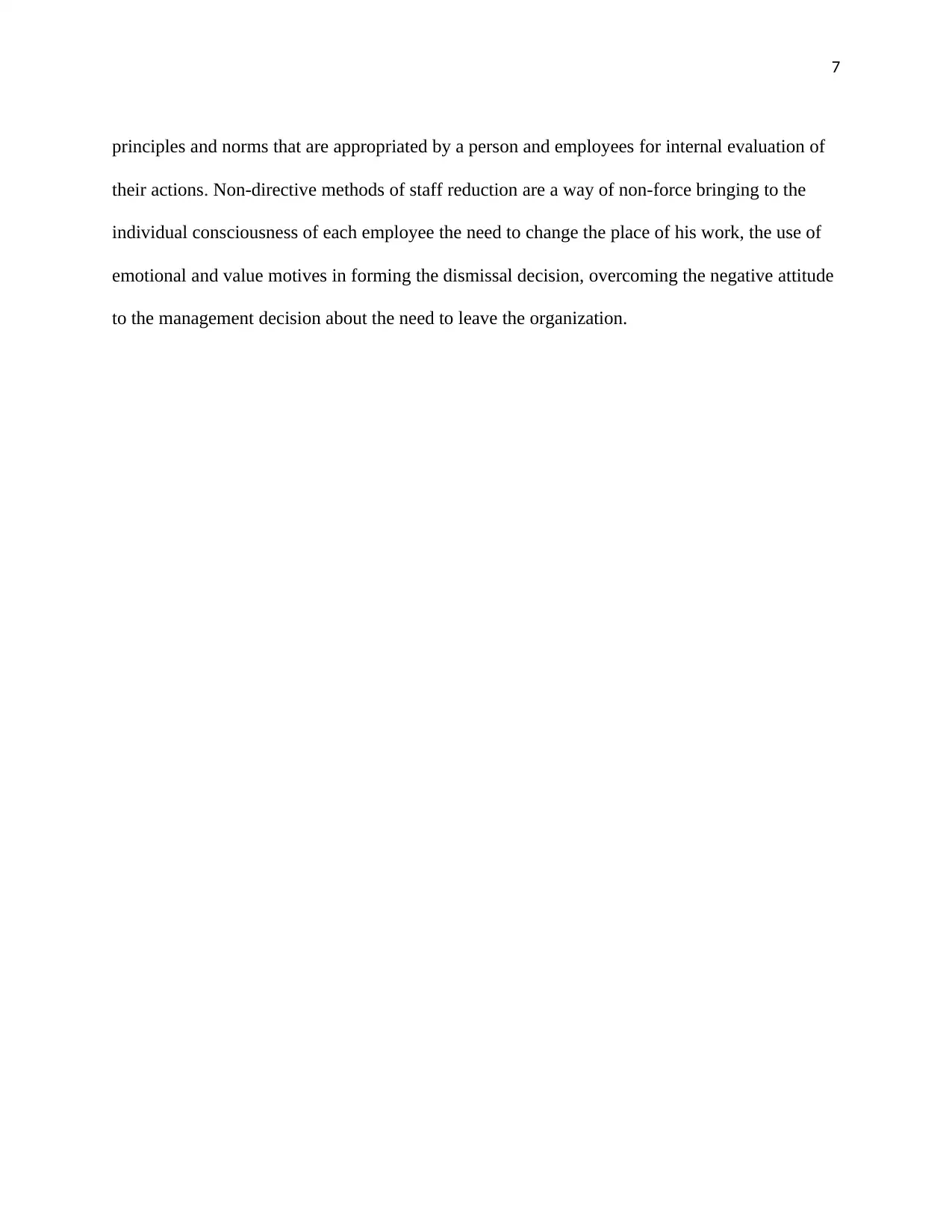
principles and norms that are appropriated by a person and employees for internal evaluation of
their actions. Non-directive methods of staff reduction are a way of non-force bringing to the
individual consciousness of each employee the need to change the place of his work, the use of
emotional and value motives in forming the dismissal decision, overcoming the negative attitude
to the management decision about the need to leave the organization.
chevron_up_icon
1 out of 7
circle_padding
hide_on_mobile
zoom_out_icon
[object Object]