Conflict in the Workplace: Scenarios, Solutions, and Strategies

Verified

Added on  2020/04/21

|9
|2132
|59
Report
AI Summary
This report provides a detailed analysis of workplace conflict, outlining steps for resolution, potential scenarios, and recommended solutions. The report begins by emphasizing the importance of identifying the origin of disagreements through discussions with all stakeholders. It then explores the need to communicate the implications of conflict and establish a common goal. The report also addresses the identification of barriers, evaluation of alternative ideas, and communication of selected solutions, including training and awareness programs. Probable scenarios such as managerial reluctance, non-acceptance of solutions, conflicts of interest, and lack of training are discussed. The solutions proposed include initiating training for employees, supervisors, and managers to enhance their skills and motivation, and implementing awareness drives for managers to encourage consultation with employees. The report emphasizes the importance of these strategies in improving workplace dynamics, enhancing relationships, and reducing conflict. This assignment is a valuable resource for students on Desklib.

Document Page
Running head: CONFLICT IN THE WORKPLACE
Conflict in the workplace
Name of the student
Name of the university
Author note
tabler-icon-diamond-filled.svg

Paraphrase This Document

Need a fresh take? Get an instant paraphrase of this document with our AI Paraphraser
Document Page
1CONFLICT IN THE WORKPLACE
Conflict in the workplace
Steps to be taken to resolve the conflict
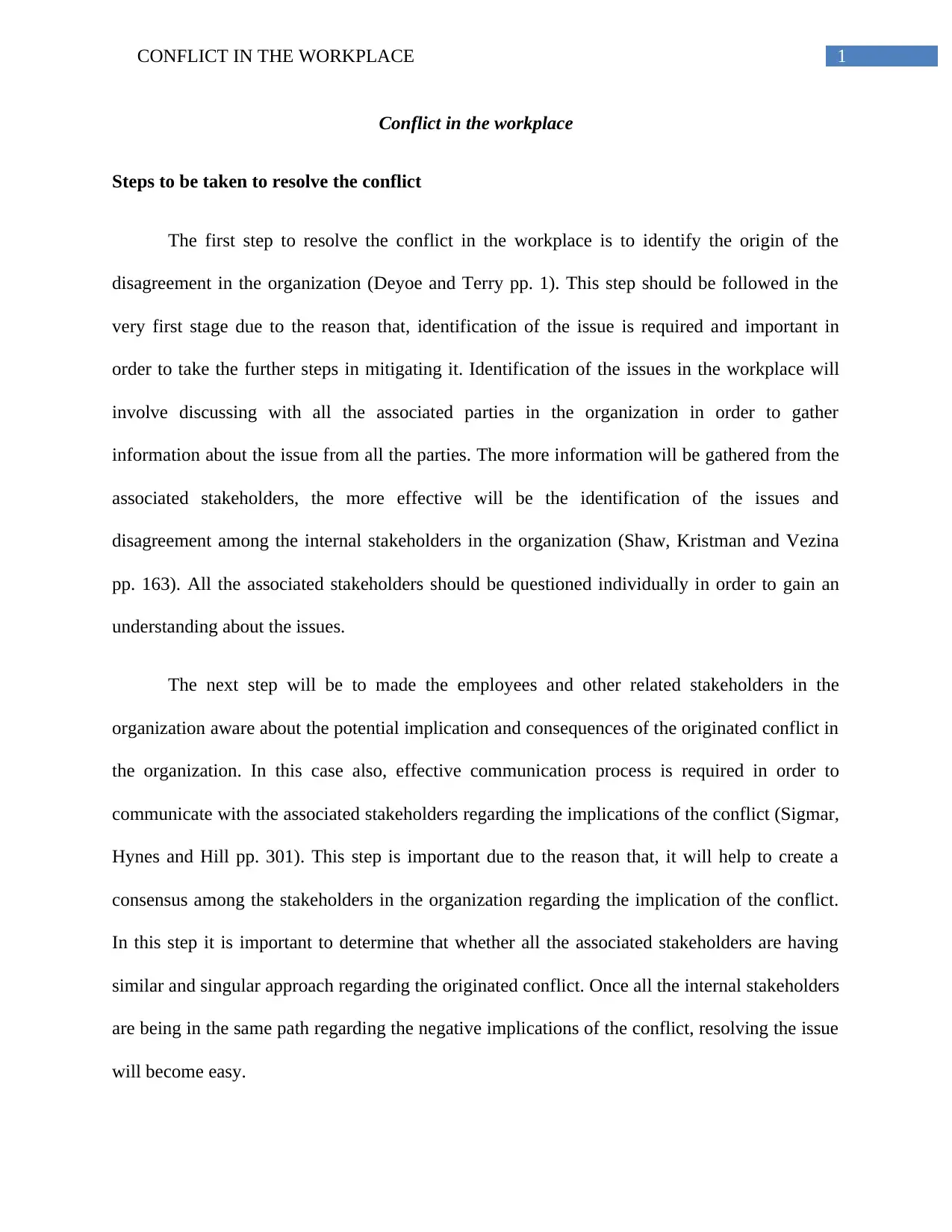
The first step to resolve the conflict in the workplace is to identify the origin of the
disagreement in the organization (Deyoe and Terry pp. 1). This step should be followed in the
very first stage due to the reason that, identification of the issue is required and important in
order to take the further steps in mitigating it. Identification of the issues in the workplace will
involve discussing with all the associated parties in the organization in order to gather
information about the issue from all the parties. The more information will be gathered from the
associated stakeholders, the more effective will be the identification of the issues and
disagreement among the internal stakeholders in the organization (Shaw, Kristman and Vezina
pp. 163). All the associated stakeholders should be questioned individually in order to gain an
understanding about the issues.
The next step will be to made the employees and other related stakeholders in the
organization aware about the potential implication and consequences of the originated conflict in
the organization. In this case also, effective communication process is required in order to
communicate with the associated stakeholders regarding the implications of the conflict (Sigmar,
Hynes and Hill pp. 301). This step is important due to the reason that, it will help to create a
consensus among the stakeholders in the organization regarding the implication of the conflict.
In this step it is important to determine that whether all the associated stakeholders are having
similar and singular approach regarding the originated conflict. Once all the internal stakeholders
are being in the same path regarding the negative implications of the conflict, resolving the issue
will become easy.
Document Page
2CONFLICT IN THE WORKPLACE
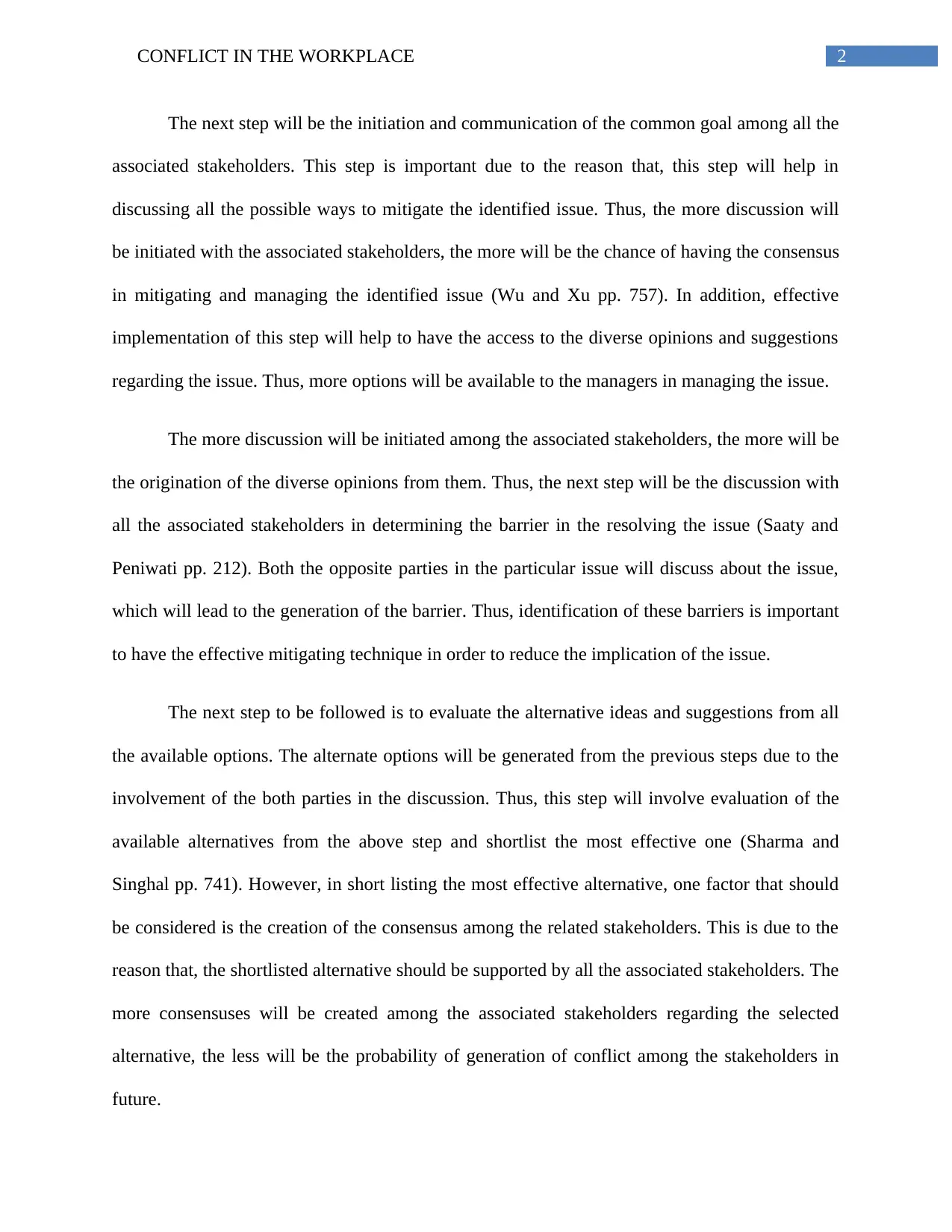
The next step will be the initiation and communication of the common goal among all the
associated stakeholders. This step is important due to the reason that, this step will help in
discussing all the possible ways to mitigate the identified issue. Thus, the more discussion will
be initiated with the associated stakeholders, the more will be the chance of having the consensus
in mitigating and managing the identified issue (Wu and Xu pp. 757). In addition, effective
implementation of this step will help to have the access to the diverse opinions and suggestions
regarding the issue. Thus, more options will be available to the managers in managing the issue.
The more discussion will be initiated among the associated stakeholders, the more will be
the origination of the diverse opinions from them. Thus, the next step will be the discussion with
all the associated stakeholders in determining the barrier in the resolving the issue (Saaty and
Peniwati pp. 212). Both the opposite parties in the particular issue will discuss about the issue,
which will lead to the generation of the barrier. Thus, identification of these barriers is important
to have the effective mitigating technique in order to reduce the implication of the issue.
The next step to be followed is to evaluate the alternative ideas and suggestions from all
the available options. The alternate options will be generated from the previous steps due to the
involvement of the both parties in the discussion. Thus, this step will involve evaluation of the
available alternatives from the above step and shortlist the most effective one (Sharma and
Singhal pp. 741). However, in short listing the most effective alternative, one factor that should
be considered is the creation of the consensus among the related stakeholders. This is due to the
reason that, the shortlisted alternative should be supported by all the associated stakeholders. The
more consensuses will be created among the associated stakeholders regarding the selected
alternative, the less will be the probability of generation of conflict among the stakeholders in
future.
Document Page
3CONFLICT IN THE WORKPLACE
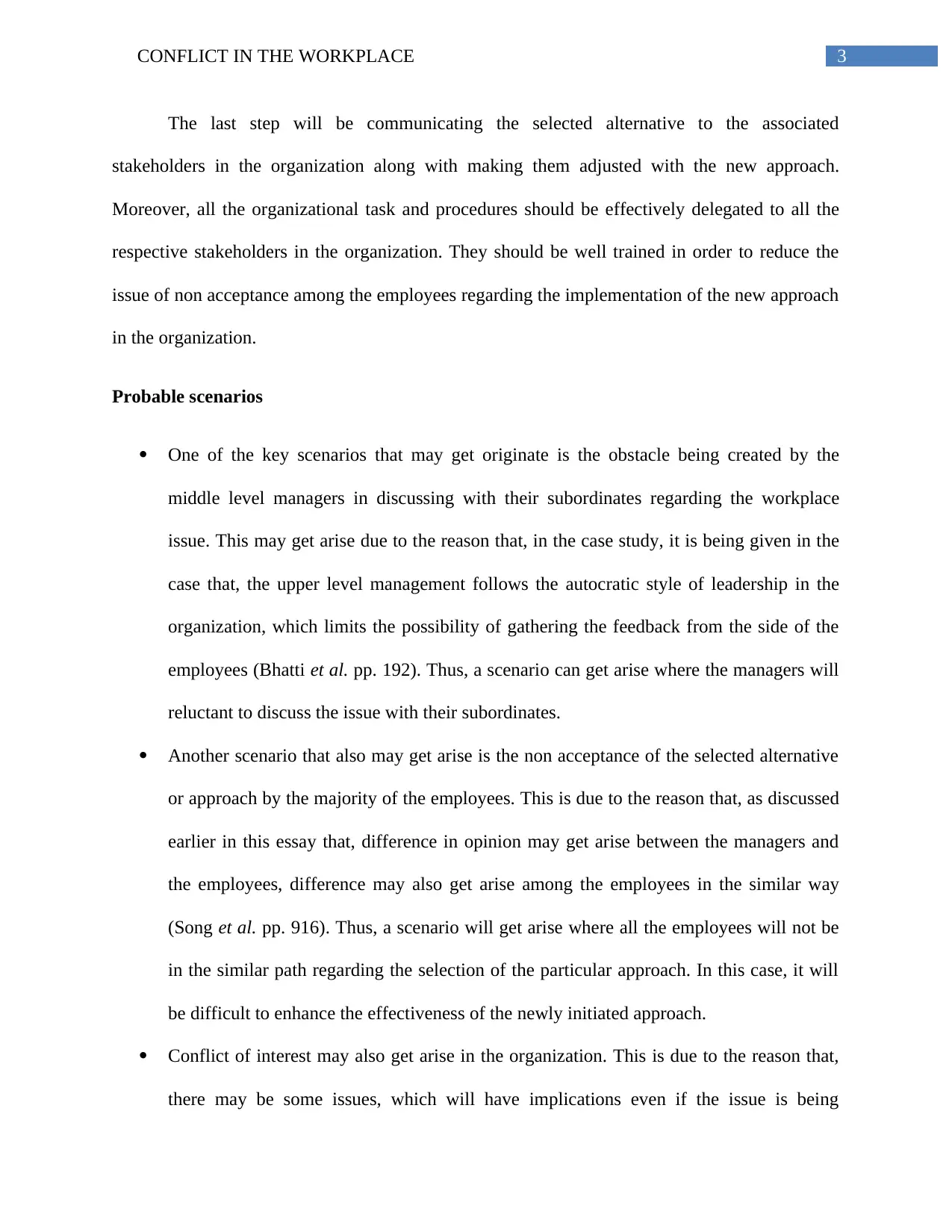
The last step will be communicating the selected alternative to the associated
stakeholders in the organization along with making them adjusted with the new approach.
Moreover, all the organizational task and procedures should be effectively delegated to all the
respective stakeholders in the organization. They should be well trained in order to reduce the
issue of non acceptance among the employees regarding the implementation of the new approach
in the organization.
Probable scenarios
One of the key scenarios that may get originate is the obstacle being created by the
middle level managers in discussing with their subordinates regarding the workplace
issue. This may get arise due to the reason that, in the case study, it is being given in the
case that, the upper level management follows the autocratic style of leadership in the
organization, which limits the possibility of gathering the feedback from the side of the
employees (Bhatti et al. pp. 192). Thus, a scenario can get arise where the managers will
reluctant to discuss the issue with their subordinates.
Another scenario that also may get arise is the non acceptance of the selected alternative
or approach by the majority of the employees. This is due to the reason that, as discussed
earlier in this essay that, difference in opinion may get arise between the managers and
the employees, difference may also get arise among the employees in the similar way
(Song et al. pp. 916). Thus, a scenario will get arise where all the employees will not be
in the similar path regarding the selection of the particular approach. In this case, it will
be difficult to enhance the effectiveness of the newly initiated approach.
Conflict of interest may also get arise in the organization. This is due to the reason that,
there may be some issues, which will have implications even if the issue is being
tabler-icon-diamond-filled.svg

Paraphrase This Document

Need a fresh take? Get an instant paraphrase of this document with our AI Paraphraser
Document Page
4CONFLICT IN THE WORKPLACE
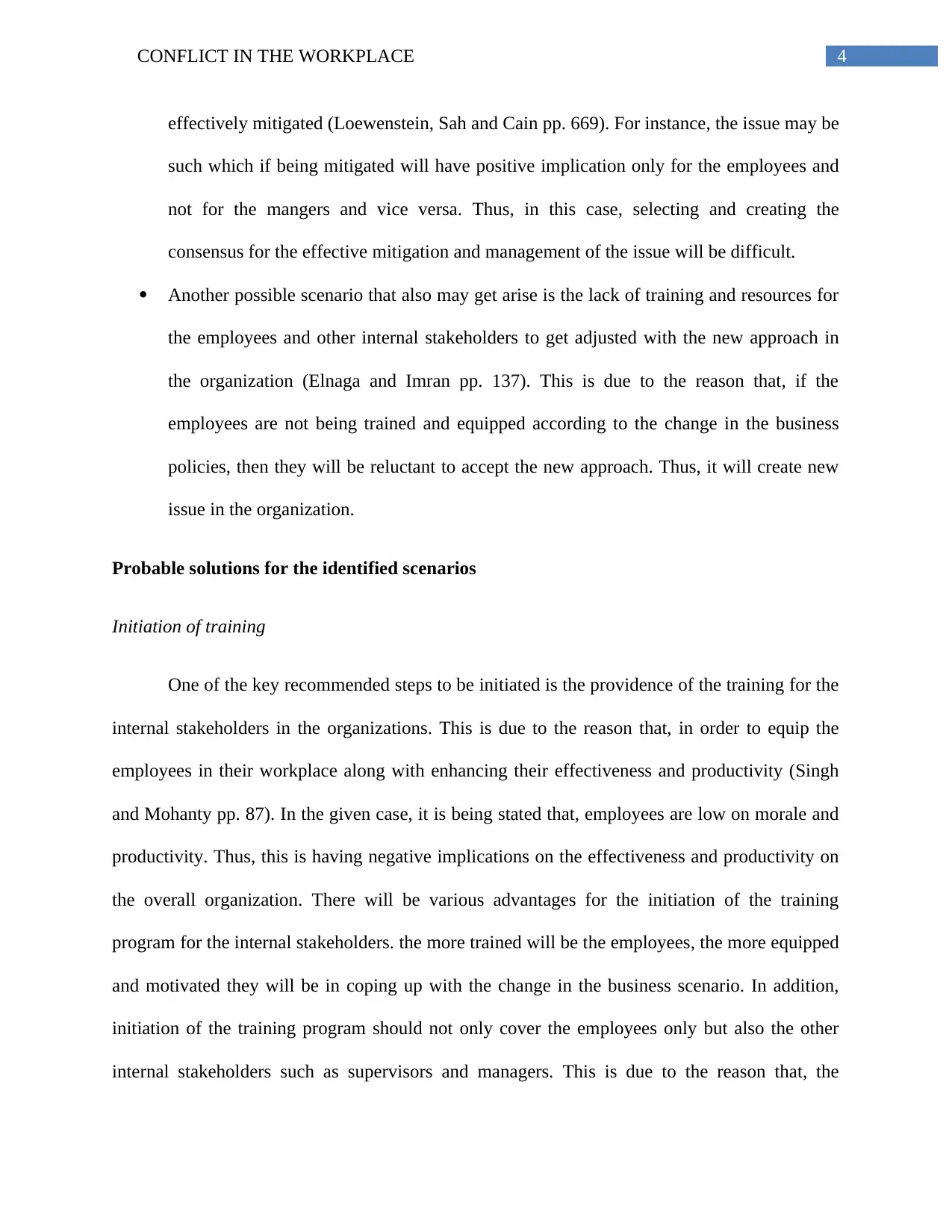
effectively mitigated (Loewenstein, Sah and Cain pp. 669). For instance, the issue may be
such which if being mitigated will have positive implication only for the employees and
not for the mangers and vice versa. Thus, in this case, selecting and creating the
consensus for the effective mitigation and management of the issue will be difficult.
Another possible scenario that also may get arise is the lack of training and resources for
the employees and other internal stakeholders to get adjusted with the new approach in
the organization (Elnaga and Imran pp. 137). This is due to the reason that, if the
employees are not being trained and equipped according to the change in the business
policies, then they will be reluctant to accept the new approach. Thus, it will create new
issue in the organization.
Probable solutions for the identified scenarios
Initiation of training
One of the key recommended steps to be initiated is the providence of the training for the
internal stakeholders in the organizations. This is due to the reason that, in order to equip the
employees in their workplace along with enhancing their effectiveness and productivity (Singh
and Mohanty pp. 87). In the given case, it is being stated that, employees are low on morale and
productivity. Thus, this is having negative implications on the effectiveness and productivity on
the overall organization. There will be various advantages for the initiation of the training
program for the internal stakeholders. the more trained will be the employees, the more equipped
and motivated they will be in coping up with the change in the business scenario. In addition,
initiation of the training program should not only cover the employees only but also the other
internal stakeholders such as supervisors and managers. This is due to the reason that, the
Document Page
5CONFLICT IN THE WORKPLACE
supervisors and managers should also be given training in order to enhance their effectiveness in
leading and organizing the organizational policies and strategies along with managing the
subordinates effectively.
Thus, with the help of the initiation of the training programs in the organization, the
middle level managers including the supervisors and managers will be equipped and motivated
to lead the employees along with effectively guiding the employees in their workplace. On the
other hand, initiation of the training program for the employees will equipped them to
accomplish their job effectively along with following the leadership of the middle and upper
level management. It will enhance the compatibility and relationship among the managers and
the employees, which will help to reduce the conflict in the organization. Thus, the first
recommended step in order to resolve the conflict in the given case will be the initiation of the
training program for the internal stakeholders.
Awareness drive for the managers
As discussed in the previous section, managers may be reluctant in discussing the
organizational issues with the employees and initiating the mitigating approaches in consultation
with them. Thus, it is important the awareness program should also be initiated for the managers
also in order to make them aware about the potential benefits of consulting with the employees
prior to the initiation of the resolve technique in the organization. It should be noted that, that the
managers should be aware and communicated that if they consult with the employees before
initiating the resolve technique, and then they will also have the positive implications (Shonin
and Van Gordon pp. 899). Thus, if they are aware that they will also gain from the consultation
with the employees, then they will be more motivated to engage with their employees. Thus, the
Document Page
6CONFLICT IN THE WORKPLACE
more engagement of the employees in the decision making process, the more will be the
relationship and understanding among the internal stakeholders, which will reduce the chance of
having conflict in the organization.
tabler-icon-diamond-filled.svg

Paraphrase This Document

Need a fresh take? Get an instant paraphrase of this document with our AI Paraphraser
Document Page
7CONFLICT IN THE WORKPLACE
Reference
Bhatti, Nadeem, et al. "The impact of autocratic and democratic leadership style on job
satisfaction." International Business Research 5.2 (2012): 192.
Deyoe, Rodney H., and Terry L. Fox. "Identifying strategies to minimize workplace conflict due
to generational differences." Journal of Behavioral Studies in Business 5 (2012): 1.
Elnaga, Amir, and Amen Imran. "The effect of training on employee performance." European
Journal of Business and Management 5.4 (2013): 137-147.
Loewenstein, George, Sunita Sah, and Daylian M. Cain. "The unintended consequences of
conflict of interest disclosure." Jama307.7 (2012): 669-670.
Saaty, Thomas L., and Kirti Peniwati. Group decision making: drawing out and reconciling
differences. RWS publications, 2013. 212-235
Sharma, Parveen, and Sandeep Singhal. "Design and evaluation of layout alternatives to enhance
the performance of industry." OPSEARCH 53.4 (2016): 741-760.
Shaw, William S., Vicki L. Kristman, and Nicole Vézina. "Workplace issues." Handbook of
work disability. Springer New York, 2013. 163-182.
Shonin, Edo, and William Van Gordon. "Managers’ experiences of meditation awareness
training." Mindfulness 6.4 (2015): 899-909.
Sigmar, Lucia Stretcher, Geraldine E. Hynes, and Kathy L. Hill. "Strategies for teaching social
and emotional intelligence in business communication." Business Communication Quarterly75.3
(2012): 301-317.
Document Page
8CONFLICT IN THE WORKPLACE
Singh, Rohan, and Madhumita Mohanty. "Impact of training practices on employee productivity:
A comparative study." Interscience Management Review 2.2 (2012): 87-92.
Song, Xiao, et al. "Impact of informal networks on opinion dynamics in hierarchically formal
organization." Physica A: Statistical Mechanics and its Applications 436 (2015): 916-924.
Wu, Zhibin, and Jiuping Xu. "A consistency and consensus based decision support model for
group decision making with multiplicative preference relations." Decision Support Systems52.3
(2012): 757-767.
chevron_up_icon
1 out of 9
circle_padding
hide_on_mobile
zoom_out_icon
[object Object]