Essay: Nursing Assessment, Interventions, and Evidence-Based Practice
VerifiedAdded on 2023/01/10
|13
|3136
|42
Essay
AI Summary
This essay provides a comprehensive analysis of nursing assessment and immediate interventions for acutely ill patients, focusing on Diabetic Ketoacidosis (DKA). It applies knowledge of pathophysiology, pharmacology, and the role of the nurse within a multidisciplinary team. The essay covers the underlying pathophysiology of DKA, including the assessment process, interventions, and the significance of evidence-based practice in improving patient outcomes. It examines the role of the nurse in acute care settings, emphasizing the importance of collaboration and communication within the healthcare team. The essay also considers health promotion in acute health care settings and the application of pharmacology, legal, ethical, and professional frameworks in medicines management. The content highlights key aspects of DKA management, including fluid replacement, insulin therapy, and potassium replacement, and discusses the importance of monitoring and ongoing assessment to ensure optimal patient care. The essay also explores the impact of evidence-based practice and quality improvement initiatives on nursing care and the significance of the nursing role within a multidisciplinary team. The essay demonstrates an understanding of the module's learning outcomes by analyzing the nursing assessment and interventions of an acutely ill patient.

OTHER

Paraphrase This Document
Need a fresh take? Get an instant paraphrase of this document with our AI Paraphraser
History
A large effective study in 2011 investigated the introduction of T1DM in children and young
adults with late-onset diabetic ketoacidosis (DKA) (7). The most important discoveries during
registration are:
The average time before admission of the adolescent to DKA is 16.5 days.
Up to 38.8% of young people taking DKA had been seen by any level 1 specialist before
being diagnosed
Both of these figures are important because the child's side effects can be attributed to other
diseases on a regular basis by the parent or family doctor, so follow-up side effects need to be
examined more accurately and low margins for blood glucose tests at bed in all sick children.
The side effects of DKA regularly include a tendency for most sick and restless, nausea and
vomiting and stomach pain. Early cerebral edema can cause migraines and fractures, leading to
dehydration, languor or rupture. There may also be symptoms of simultaneous illness, e.g. fever,
incision, looseness of the intestine or dysuria.
In the event that DM has not been studied recently, the previous side effects established by
history are:
Weight reduction: try to evaluate it in every occasion
Polyuria - probably present as a new wetting afternoon bed in young adults
polydipsia
It is also useful to study the genealogy of DM or other conditions of the immune system.
In known diabetic patients, obtain some information about their insulin systems and dosages and
their continuous monitoring. You should also gain reasonable experience in their general
diabetes, their managers, including the designated consultant, center development and withdrawn
certifications.
A large effective study in 2011 investigated the introduction of T1DM in children and young
adults with late-onset diabetic ketoacidosis (DKA) (7). The most important discoveries during
registration are:
The average time before admission of the adolescent to DKA is 16.5 days.
Up to 38.8% of young people taking DKA had been seen by any level 1 specialist before
being diagnosed
Both of these figures are important because the child's side effects can be attributed to other
diseases on a regular basis by the parent or family doctor, so follow-up side effects need to be
examined more accurately and low margins for blood glucose tests at bed in all sick children.
The side effects of DKA regularly include a tendency for most sick and restless, nausea and
vomiting and stomach pain. Early cerebral edema can cause migraines and fractures, leading to
dehydration, languor or rupture. There may also be symptoms of simultaneous illness, e.g. fever,
incision, looseness of the intestine or dysuria.
In the event that DM has not been studied recently, the previous side effects established by
history are:
Weight reduction: try to evaluate it in every occasion
Polyuria - probably present as a new wetting afternoon bed in young adults
polydipsia
It is also useful to study the genealogy of DM or other conditions of the immune system.
In known diabetic patients, obtain some information about their insulin systems and dosages and
their continuous monitoring. You should also gain reasonable experience in their general
diabetes, their managers, including the designated consultant, center development and withdrawn
certifications.
Examination
Patients present in DKA often appear ill. When performing the ABCDE assessment procedure
for peak periods:
Symptoms of respiratory weakening
Deep, brutal breathing (resting Kussmaul)
tachypnea
Subcostal and intercostal fall apart
Circuit breaker signals
Excellent - tachycardia, hypotension, reduced waiting time and new suburbs
Parchedness - dry mucous layers, irritated eyes / fontanel and reduced skin firmness
Gastrointestinal signs
Acute stomach pain and can report sensitive area
Symptoms of neurological compromise
Evaluate the patient's cognitive level (using AVPU or GCS) including “neuroscience” -
pulse, circulatory tension and pupil response to light. The symptoms of cerebral edema
are sleepiness, heart beat spread, increased circulation tension and decreased cognitive
functioning.
Papilloedema is a late symptom.
Other
Diminished digestion, general rest and ketotic breathing that has a "pear fall" smell
Note that fever is not part of DKA. In the case at this time, suspected basic corruption.
Measure the baby anywhere that can be thought because it is valuable while thinking
about melting stones afterwards.
Patients present in DKA often appear ill. When performing the ABCDE assessment procedure
for peak periods:
Symptoms of respiratory weakening
Deep, brutal breathing (resting Kussmaul)
tachypnea
Subcostal and intercostal fall apart
Circuit breaker signals
Excellent - tachycardia, hypotension, reduced waiting time and new suburbs
Parchedness - dry mucous layers, irritated eyes / fontanel and reduced skin firmness
Gastrointestinal signs
Acute stomach pain and can report sensitive area
Symptoms of neurological compromise
Evaluate the patient's cognitive level (using AVPU or GCS) including “neuroscience” -
pulse, circulatory tension and pupil response to light. The symptoms of cerebral edema
are sleepiness, heart beat spread, increased circulation tension and decreased cognitive
functioning.
Papilloedema is a late symptom.
Other
Diminished digestion, general rest and ketotic breathing that has a "pear fall" smell
Note that fever is not part of DKA. In the case at this time, suspected basic corruption.
Measure the baby anywhere that can be thought because it is valuable while thinking
about melting stones afterwards.
⊘ This is a preview!⊘
Do you want full access?
Subscribe today to unlock all pages.

Trusted by 1+ million students worldwide
Evaluation of care:
The Evaluation of DKA in pediatric patients differs from in adults. The main explanation behind
this is that children have a much higher risk of producing brain edema during the rehydration
treatment period.
The BSPED DKA guidelines (1) are available on the web and provide a complete picture of the
administration proposed for this condition. This includes an online version number cruncher
which is particularly valuable as liquid computers can be mind-boggling because the clinician
needs to consider scarcity and collapse support.
It is recommended to insert a printed duplication of the results of the additional device in the
patient's medical records. Below is a summary of the main purposes of the DKA board of
directors using the rule given below:
Primary assessment:
Airways - Check Alex on airway and consider intubation in case informational level goes down
- this involves reaching the sedative and pediatric body of injury to consider.
Breathing - Administer high flow oxygen through non-respiratory fluid.
Circulation - Most young people in DKA will have symptoms of severe irrigation and will need
resettlement and bespoke support and support of IV fluid. Only the youngest blown away get
signs of clinical exposure. Only those patients with remarkable symptoms receive a melting
bolus of 10 ml / kg of 0.9% sodium chloride. Additional bolts can be considered as the following
key recommendations.
Disability - If lower cognitive level or vomiting add a GN cylinder and leave the trash free to
prevent aspiration of contents in the stomach. They have a high record of doubts about brain
edema.
Exposure - If there are signs of sepsis (fever / hypothermia, hypotension, uncontrolled acidosis
or lactic acidosis), treat with IV anti-toxins according to neighbor rules.
The Evaluation of DKA in pediatric patients differs from in adults. The main explanation behind
this is that children have a much higher risk of producing brain edema during the rehydration
treatment period.
The BSPED DKA guidelines (1) are available on the web and provide a complete picture of the
administration proposed for this condition. This includes an online version number cruncher
which is particularly valuable as liquid computers can be mind-boggling because the clinician
needs to consider scarcity and collapse support.
It is recommended to insert a printed duplication of the results of the additional device in the
patient's medical records. Below is a summary of the main purposes of the DKA board of
directors using the rule given below:
Primary assessment:
Airways - Check Alex on airway and consider intubation in case informational level goes down
- this involves reaching the sedative and pediatric body of injury to consider.
Breathing - Administer high flow oxygen through non-respiratory fluid.
Circulation - Most young people in DKA will have symptoms of severe irrigation and will need
resettlement and bespoke support and support of IV fluid. Only the youngest blown away get
signs of clinical exposure. Only those patients with remarkable symptoms receive a melting
bolus of 10 ml / kg of 0.9% sodium chloride. Additional bolts can be considered as the following
key recommendations.
Disability - If lower cognitive level or vomiting add a GN cylinder and leave the trash free to
prevent aspiration of contents in the stomach. They have a high record of doubts about brain
edema.
Exposure - If there are signs of sepsis (fever / hypothermia, hypotension, uncontrolled acidosis
or lactic acidosis), treat with IV anti-toxins according to neighbor rules.
Paraphrase This Document
Need a fresh take? Get an instant paraphrase of this document with our AI Paraphraser
Secondary assessment and emergency treatment
If the young person is alert, not clinically disturbed and not vomiting, he may be able to treat
DKA with oral fluids and subcutaneous insulin, regardless of whether the ketones in the high
blood.
Most adolescents are that it must, as far as possible, begin IV fluid replacement and then insulin
plant expansion. The liquid used is 0.9% sodium chloride with 20 mmoles of potassium chloride
in each 500 ml package.
The full layout of the liquid must be repaired for more than 48 hours at a flat rate per hour.
The reset of the version must be determined as follows:
Required = Shortage of liquids + Maintenance
Shortage of liquids:
Assuming a 5% fluid deficit in adolescents and adolescents with mild or moderate DKA
(determined with a blood pH of 7.1 or higher), e.g. 50 ml x body weight in kg = 5%
deficiency
Observe a 10% fluid deficit in children and adolescents with severe DKA (shown with
blood pH below 7.1), e.g. 100 ml x body weight in kg = 10% deficiency
Liquid Retention: Smaller support sizes are used in teenage with DKA
If the baby weighs less than 10 kg, administer 2 ml / kg / hr
If the child weighs between 10 and 40 kg, administer 1 ml / kg / hr
In case they weigh more than 40 kg, give a fixed dose of 40 ml / kg / hr
Try not to remember the bolus liquid indicated for determining the continuous melt, but only if a
bolus greater than 20 ml / kg is given, in which case withdraw the amount greater than 20 ml / kg
given for example in the case in which 30 ml / kg of bolus is given, subtract 10 ml / kg from the
repeat estimates layers will lay.
If the young person is alert, not clinically disturbed and not vomiting, he may be able to treat
DKA with oral fluids and subcutaneous insulin, regardless of whether the ketones in the high
blood.
Most adolescents are that it must, as far as possible, begin IV fluid replacement and then insulin
plant expansion. The liquid used is 0.9% sodium chloride with 20 mmoles of potassium chloride
in each 500 ml package.
The full layout of the liquid must be repaired for more than 48 hours at a flat rate per hour.
The reset of the version must be determined as follows:
Required = Shortage of liquids + Maintenance
Shortage of liquids:
Assuming a 5% fluid deficit in adolescents and adolescents with mild or moderate DKA
(determined with a blood pH of 7.1 or higher), e.g. 50 ml x body weight in kg = 5%
deficiency
Observe a 10% fluid deficit in children and adolescents with severe DKA (shown with
blood pH below 7.1), e.g. 100 ml x body weight in kg = 10% deficiency
Liquid Retention: Smaller support sizes are used in teenage with DKA
If the baby weighs less than 10 kg, administer 2 ml / kg / hr
If the child weighs between 10 and 40 kg, administer 1 ml / kg / hr
In case they weigh more than 40 kg, give a fixed dose of 40 ml / kg / hr
Try not to remember the bolus liquid indicated for determining the continuous melt, but only if a
bolus greater than 20 ml / kg is given, in which case withdraw the amount greater than 20 ml / kg
given for example in the case in which 30 ml / kg of bolus is given, subtract 10 ml / kg from the
repeat estimates layers will lay.
Try not to give oral filters to a patient who is taking IV filters for DKA. The mouthwashes are
satisfactory for maximum comfort.
Insulin IV:
Insulin should be turned off for 1-2 hours after starting treatment with intravenous fluids as this
appears to reduce the possibility of brain edema. A concentration of 0.05 - 0.1 units / kg / hour of
soluble insulin, e.g. Actrapid, is generally appropriate. Blood glucose and ketone levels should
be monitored every hour and ketones every 1-2 hours.
Replacement of potassium:
In patients with DKA, the whole body of potassium is consumed outdoors, regardless of normal
or high levels of potassium in the blood before treatment.
Gluconeogenic hormones cause the transfer of potassium from cells and into the blood. A large
amount of potassium in this way is lost in the pee as a characteristic of osmotic diuresis.
When treatment starts with insulin, extracellular K + in the blood is absorbed by the cells
through the sodium-potassium siphon and hypokalaemia is invisible in subsequent blood tests. In
this way it is necessary to replace the potassium as a characteristic of the DKA treatment and
strictly the screening of the levels.
If the patient is hyperkalemic at the time of consolidation, pee production should be considered
before further potassium is administered. U & Es must be suspended 2 hours after starting
treatment and at least at regular intervals thereafter.
ECG observation should proceed during treatment to detect cardiovascular symptoms of hyper
and hypokalaemia.
Special care by nurse
Essential nursing observations include fluid balance control and hourly observations by BP and
GCS.
satisfactory for maximum comfort.
Insulin IV:
Insulin should be turned off for 1-2 hours after starting treatment with intravenous fluids as this
appears to reduce the possibility of brain edema. A concentration of 0.05 - 0.1 units / kg / hour of
soluble insulin, e.g. Actrapid, is generally appropriate. Blood glucose and ketone levels should
be monitored every hour and ketones every 1-2 hours.
Replacement of potassium:
In patients with DKA, the whole body of potassium is consumed outdoors, regardless of normal
or high levels of potassium in the blood before treatment.
Gluconeogenic hormones cause the transfer of potassium from cells and into the blood. A large
amount of potassium in this way is lost in the pee as a characteristic of osmotic diuresis.
When treatment starts with insulin, extracellular K + in the blood is absorbed by the cells
through the sodium-potassium siphon and hypokalaemia is invisible in subsequent blood tests. In
this way it is necessary to replace the potassium as a characteristic of the DKA treatment and
strictly the screening of the levels.
If the patient is hyperkalemic at the time of consolidation, pee production should be considered
before further potassium is administered. U & Es must be suspended 2 hours after starting
treatment and at least at regular intervals thereafter.
ECG observation should proceed during treatment to detect cardiovascular symptoms of hyper
and hypokalaemia.
Special care by nurse
Essential nursing observations include fluid balance control and hourly observations by BP and
GCS.
⊘ This is a preview!⊘
Do you want full access?
Subscribe today to unlock all pages.
Trusted by 1+ million students worldwide
The routine investigations carried out by the clinical team should include blood sugar, ketones,
blood gases and U & Es. Side effects of these lead to the liquid and insulin in the table: unless
not too many problems, see the complete rule for all subtleties.
Oral injections can be started once ketosis has settled and there is no nausea.
DKA is considered to be stable when the young person is clinically depressed, drinking and
surviving food and the ketones in the blood are less than 1 mmol / liter or the pH is normal.
Subcutaneous insulin would then be able to start and insulin IV would stop an hour later.
Further considerations at that stage include liaising with the diabetic group in relation to patient
(and parent) management and organizing the news.
Impact on the quality of care for the acutely ill patient based on Evidence
based practice
Evidence-based practice is characterized as a critical way of thinking to address the behavior of
pharmaceutical services that combines validation of optimal access, clinician competence,
characteristics and patient partiality.
Medical participants examined the writing to make sure it answered the PICOT question and
evaluated it for quality and quality. They monitored the application of drug prophylaxis and the
level of VTE. Aggregation was performed: pharmacological prophylaxis was initially 20% and
extended to over 90%. As a result of this expansion, the VTE rate in this patient population has
fallen below the criterion.
IQ is the consistent way to use guided intelligence tests to create improvements in nursing care
behaviors. For example, an IQ campaign can collect and analyze information to determine the
rhythm of the sheath emptying implant after cardiovascular catheterization. The detailed
assessment of a known problem occurs through many related exercises designed to measure the
improvement of the procedures and results of patient observation. The measures of the IQ
blood gases and U & Es. Side effects of these lead to the liquid and insulin in the table: unless
not too many problems, see the complete rule for all subtleties.
Oral injections can be started once ketosis has settled and there is no nausea.
DKA is considered to be stable when the young person is clinically depressed, drinking and
surviving food and the ketones in the blood are less than 1 mmol / liter or the pH is normal.
Subcutaneous insulin would then be able to start and insulin IV would stop an hour later.
Further considerations at that stage include liaising with the diabetic group in relation to patient
(and parent) management and organizing the news.
Impact on the quality of care for the acutely ill patient based on Evidence
based practice
Evidence-based practice is characterized as a critical way of thinking to address the behavior of
pharmaceutical services that combines validation of optimal access, clinician competence,
characteristics and patient partiality.
Medical participants examined the writing to make sure it answered the PICOT question and
evaluated it for quality and quality. They monitored the application of drug prophylaxis and the
level of VTE. Aggregation was performed: pharmacological prophylaxis was initially 20% and
extended to over 90%. As a result of this expansion, the VTE rate in this patient population has
fallen below the criterion.
IQ is the consistent way to use guided intelligence tests to create improvements in nursing care
behaviors. For example, an IQ campaign can collect and analyze information to determine the
rhythm of the sheath emptying implant after cardiovascular catheterization. The detailed
assessment of a known problem occurs through many related exercises designed to measure the
improvement of the procedures and results of patient observation. The measures of the IQ
Paraphrase This Document
Need a fresh take? Get an instant paraphrase of this document with our AI Paraphraser
exercises involve the introduction of sensitive tips on refrigeration, the monitoring of consistency
with fixed gases and the analysis of the effects of the change in the organization of prescriptions
to correct pharmacological errors reduces.
Understanding the differences between monitoring, EBP and IQ provides clarity to these three
ideas. Understanding of key coordinated ideas and use of IQ, EBP and monitoring. Collaborative
lucidity can modernize inter-professional cooperation to promote a tolerant mind and achieve
better results.
Role of the nurse in acute care setting within the multidisciplinary team
Nursing care does an important job that complements the multidisciplinary group approach to
address ongoing consideration. The medical operator responsible for examining diabetic patients
requires an unconditional agreement to treat the patient's problems during the basic stages of the
diabetes treatment process. Within the emergency clinic, a transportation framework necessary
for nursing care improves the role of the medical assistant in supporting the patient's recovery
goal. Essential nursing places responsibility and responsibility on the consideration, supervision
and evaluation of the diabetic patient's consideration by the essential medical caregiver. The
regulatory medical executive acts as the primary liaison in the communication prepared within
the multidisciplinary organization, and assured communication is fundamental under close
monitoring of ongoing diabetic treatment. For achievement of a life-style of independence after
treatment, the patient is supported by the facilitator, who provides guidance in areas such as diet,
medications, examining the basic signs and maintaining records. Despite the fact that the
medical caregiver is only one component that contributes to the consideration of a patient's
diabetes treatment, the operator's role in carrying out the treatment is critical.
However, nurses must access adequate training for these extended roles, know their skills and
recognize their limitations and understand when it is appropriate to refer to different teachings or
to seek expert guidance.
with fixed gases and the analysis of the effects of the change in the organization of prescriptions
to correct pharmacological errors reduces.
Understanding the differences between monitoring, EBP and IQ provides clarity to these three
ideas. Understanding of key coordinated ideas and use of IQ, EBP and monitoring. Collaborative
lucidity can modernize inter-professional cooperation to promote a tolerant mind and achieve
better results.
Role of the nurse in acute care setting within the multidisciplinary team
Nursing care does an important job that complements the multidisciplinary group approach to
address ongoing consideration. The medical operator responsible for examining diabetic patients
requires an unconditional agreement to treat the patient's problems during the basic stages of the
diabetes treatment process. Within the emergency clinic, a transportation framework necessary
for nursing care improves the role of the medical assistant in supporting the patient's recovery
goal. Essential nursing places responsibility and responsibility on the consideration, supervision
and evaluation of the diabetic patient's consideration by the essential medical caregiver. The
regulatory medical executive acts as the primary liaison in the communication prepared within
the multidisciplinary organization, and assured communication is fundamental under close
monitoring of ongoing diabetic treatment. For achievement of a life-style of independence after
treatment, the patient is supported by the facilitator, who provides guidance in areas such as diet,
medications, examining the basic signs and maintaining records. Despite the fact that the
medical caregiver is only one component that contributes to the consideration of a patient's
diabetes treatment, the operator's role in carrying out the treatment is critical.
However, nurses must access adequate training for these extended roles, know their skills and
recognize their limitations and understand when it is appropriate to refer to different teachings or
to seek expert guidance.
Patients and their families rely on highly qualified multidisciplinary staff, including clinical,
nursing, and respiratory and speech and language therapy staff, dieticians and therapists, from a
wide range of disciplines strong bases. There is growing evidence that planned multidisciplinary
tracheostomy organizations can influence the safety and nature of care for patients and their
families. This article examines how these colleagues work and demonstrates the potential for
innovation in care.
Significance regarding health promotion in acute health care settings
Health promotion in the definition of a medical clinic is a reasonable goal for cultivating careful
evaluation. Nursing techniques, such as lifestyle assessment, wellness teaching and strong letters
can be used to negotiate choices regarding wellness exercises. Doctors need to be aware of the
lifestyle of the diseases and the risk factors that precede these diseases. Emergency clinics play a
vital role in providing people with wellness data. Participants can play key roles in helping
hospitalized patients achieve better well-being by combining well-being approaches in routine
clinical practice.
Welfare progress estimates are based on both and relevant elements that shape the activity of
people, who intend to reduce the forest, reduce disease and improve prosperity. Well-being in
this context refers not only to the standard, balanced and biochemical view of the absence of
disease or disease, but to an overall view that includes mental resources and social prosperity to
physical well-being. The promotion of well-being goes beyond the training of well-being and
avoids diseases, to the extent that it is based on the notion of salutogenesis and emphasizes the
study and development of the potential for human well-being.
The degree of disease anticipation is identified in the health promotion glossary as "measures not
only to eliminate the onset of the disease, such as a reduction in probability factors, but also to
capture exciting results and reduce it when it is resolved". A similar source characterizes the
level of well-being management by including "open doors specially built for construction,
including a type of skill-oriented letters. Promoting well-being, including the development of
knowledge and the creation of key skills that promote the well-being of people and networks
nursing, and respiratory and speech and language therapy staff, dieticians and therapists, from a
wide range of disciplines strong bases. There is growing evidence that planned multidisciplinary
tracheostomy organizations can influence the safety and nature of care for patients and their
families. This article examines how these colleagues work and demonstrates the potential for
innovation in care.
Significance regarding health promotion in acute health care settings
Health promotion in the definition of a medical clinic is a reasonable goal for cultivating careful
evaluation. Nursing techniques, such as lifestyle assessment, wellness teaching and strong letters
can be used to negotiate choices regarding wellness exercises. Doctors need to be aware of the
lifestyle of the diseases and the risk factors that precede these diseases. Emergency clinics play a
vital role in providing people with wellness data. Participants can play key roles in helping
hospitalized patients achieve better well-being by combining well-being approaches in routine
clinical practice.
Welfare progress estimates are based on both and relevant elements that shape the activity of
people, who intend to reduce the forest, reduce disease and improve prosperity. Well-being in
this context refers not only to the standard, balanced and biochemical view of the absence of
disease or disease, but to an overall view that includes mental resources and social prosperity to
physical well-being. The promotion of well-being goes beyond the training of well-being and
avoids diseases, to the extent that it is based on the notion of salutogenesis and emphasizes the
study and development of the potential for human well-being.
The degree of disease anticipation is identified in the health promotion glossary as "measures not
only to eliminate the onset of the disease, such as a reduction in probability factors, but also to
capture exciting results and reduce it when it is resolved". A similar source characterizes the
level of well-being management by including "open doors specially built for construction,
including a type of skill-oriented letters. Promoting well-being, including the development of
knowledge and the creation of key skills that promote the well-being of people and networks
⊘ This is a preview!⊘
Do you want full access?
Subscribe today to unlock all pages.
Trusted by 1+ million students worldwide
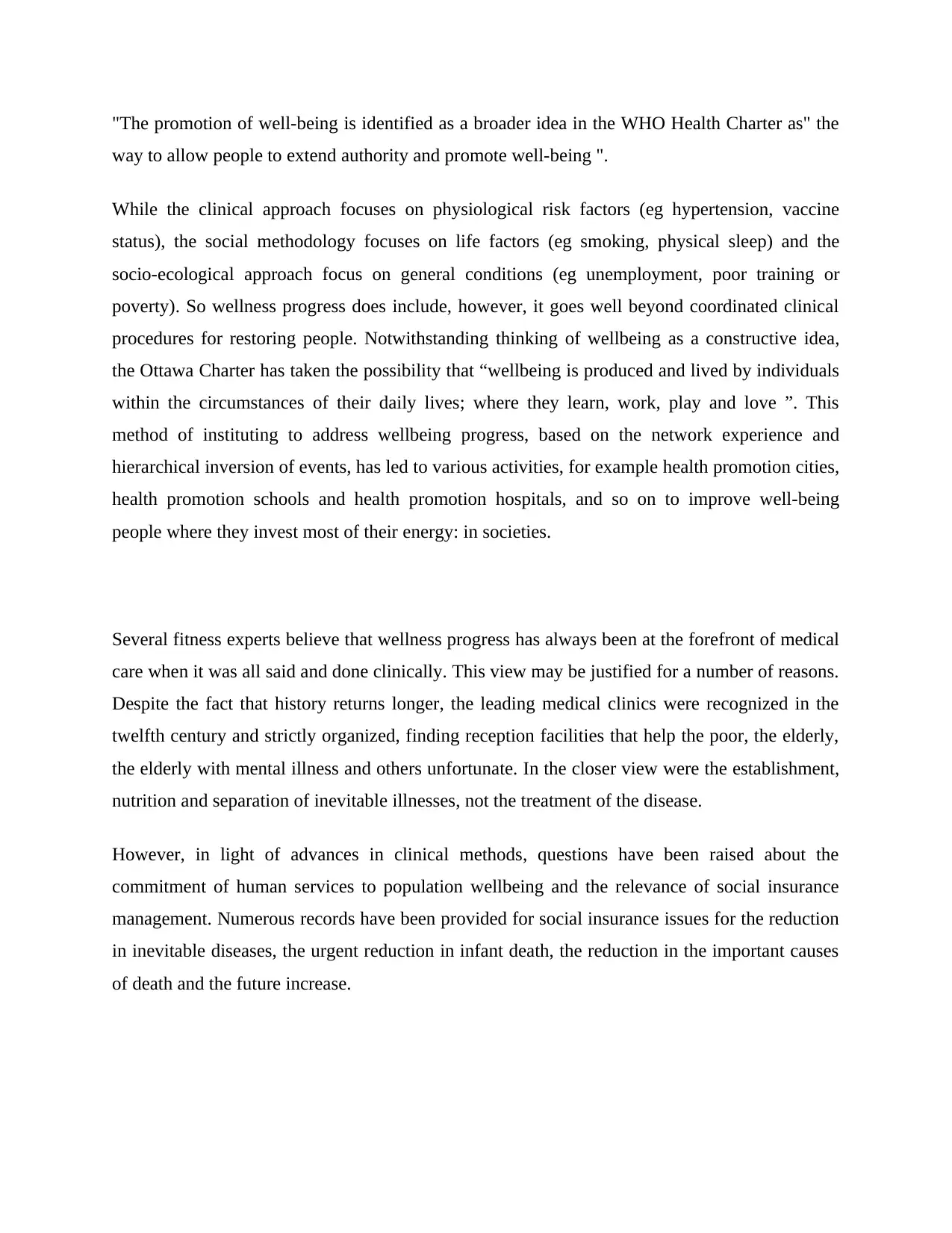
"The promotion of well-being is identified as a broader idea in the WHO Health Charter as" the
way to allow people to extend authority and promote well-being ".
While the clinical approach focuses on physiological risk factors (eg hypertension, vaccine
status), the social methodology focuses on life factors (eg smoking, physical sleep) and the
socio-ecological approach focus on general conditions (eg unemployment, poor training or
poverty). So wellness progress does include, however, it goes well beyond coordinated clinical
procedures for restoring people. Notwithstanding thinking of wellbeing as a constructive idea,
the Ottawa Charter has taken the possibility that “wellbeing is produced and lived by individuals
within the circumstances of their daily lives; where they learn, work, play and love ”. This
method of instituting to address wellbeing progress, based on the network experience and
hierarchical inversion of events, has led to various activities, for example health promotion cities,
health promotion schools and health promotion hospitals, and so on to improve well-being
people where they invest most of their energy: in societies.
Several fitness experts believe that wellness progress has always been at the forefront of medical
care when it was all said and done clinically. This view may be justified for a number of reasons.
Despite the fact that history returns longer, the leading medical clinics were recognized in the
twelfth century and strictly organized, finding reception facilities that help the poor, the elderly,
the elderly with mental illness and others unfortunate. In the closer view were the establishment,
nutrition and separation of inevitable illnesses, not the treatment of the disease.
However, in light of advances in clinical methods, questions have been raised about the
commitment of human services to population wellbeing and the relevance of social insurance
management. Numerous records have been provided for social insurance issues for the reduction
in inevitable diseases, the urgent reduction in infant death, the reduction in the important causes
of death and the future increase.
way to allow people to extend authority and promote well-being ".
While the clinical approach focuses on physiological risk factors (eg hypertension, vaccine
status), the social methodology focuses on life factors (eg smoking, physical sleep) and the
socio-ecological approach focus on general conditions (eg unemployment, poor training or
poverty). So wellness progress does include, however, it goes well beyond coordinated clinical
procedures for restoring people. Notwithstanding thinking of wellbeing as a constructive idea,
the Ottawa Charter has taken the possibility that “wellbeing is produced and lived by individuals
within the circumstances of their daily lives; where they learn, work, play and love ”. This
method of instituting to address wellbeing progress, based on the network experience and
hierarchical inversion of events, has led to various activities, for example health promotion cities,
health promotion schools and health promotion hospitals, and so on to improve well-being
people where they invest most of their energy: in societies.
Several fitness experts believe that wellness progress has always been at the forefront of medical
care when it was all said and done clinically. This view may be justified for a number of reasons.
Despite the fact that history returns longer, the leading medical clinics were recognized in the
twelfth century and strictly organized, finding reception facilities that help the poor, the elderly,
the elderly with mental illness and others unfortunate. In the closer view were the establishment,
nutrition and separation of inevitable illnesses, not the treatment of the disease.
However, in light of advances in clinical methods, questions have been raised about the
commitment of human services to population wellbeing and the relevance of social insurance
management. Numerous records have been provided for social insurance issues for the reduction
in inevitable diseases, the urgent reduction in infant death, the reduction in the important causes
of death and the future increase.
Paraphrase This Document
Need a fresh take? Get an instant paraphrase of this document with our AI Paraphraser
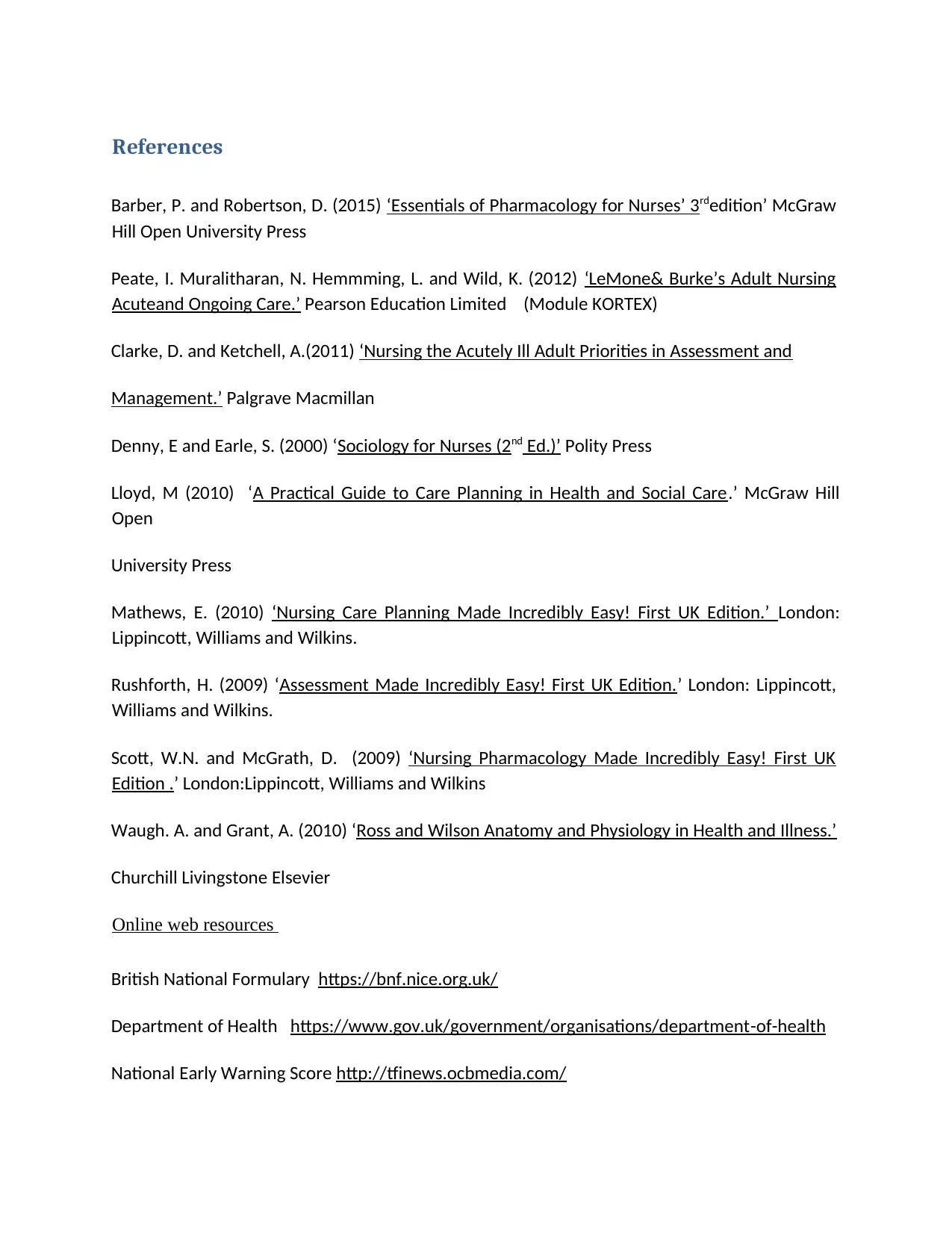
References
Barber, P. and Robertson, D. (2015) ‘Essentials of Pharmacology for Nurses’ 3rdedition’ McGraw
Hill Open University Press
Peate, I. Muralitharan, N. Hemmming, L. and Wild, K. (2012) ‘LeMone& Burke’s Adult Nursing
Acuteand Ongoing Care.’ Pearson Education Limited (Module KORTEX)
Clarke, D. and Ketchell, A.(2011) ‘Nursing the Acutely Ill Adult Priorities in Assessment and
Management.’ Palgrave Macmillan
Denny, E and Earle, S. (2000) ‘Sociology for Nurses (2nd Ed.)’ Polity Press
Lloyd, M (2010) ‘A Practical Guide to Care Planning in Health and Social Care.’ McGraw Hill
Open
University Press
Mathews, E. (2010) ‘Nursing Care Planning Made Incredibly Easy! First UK Edition.’ London:
Lippincott, Williams and Wilkins.
Rushforth, H. (2009) ‘Assessment Made Incredibly Easy! First UK Edition.’ London: Lippincott,
Williams and Wilkins.
Scott, W.N. and McGrath, D. (2009) ‘Nursing Pharmacology Made Incredibly Easy! First UK
Edition .’ London:Lippincott, Williams and Wilkins
Waugh. A. and Grant, A. (2010) ‘Ross and Wilson Anatomy and Physiology in Health and Illness.’
Churchill Livingstone Elsevier
Online web resources
British National Formulary https://bnf.nice.org.uk/
Department of Health https://www.gov.uk/government/organisations/department-of-health
National Early Warning Score http://tfinews.ocbmedia.com/
Barber, P. and Robertson, D. (2015) ‘Essentials of Pharmacology for Nurses’ 3rdedition’ McGraw
Hill Open University Press
Peate, I. Muralitharan, N. Hemmming, L. and Wild, K. (2012) ‘LeMone& Burke’s Adult Nursing
Acuteand Ongoing Care.’ Pearson Education Limited (Module KORTEX)
Clarke, D. and Ketchell, A.(2011) ‘Nursing the Acutely Ill Adult Priorities in Assessment and
Management.’ Palgrave Macmillan
Denny, E and Earle, S. (2000) ‘Sociology for Nurses (2nd Ed.)’ Polity Press
Lloyd, M (2010) ‘A Practical Guide to Care Planning in Health and Social Care.’ McGraw Hill
Open
University Press
Mathews, E. (2010) ‘Nursing Care Planning Made Incredibly Easy! First UK Edition.’ London:
Lippincott, Williams and Wilkins.
Rushforth, H. (2009) ‘Assessment Made Incredibly Easy! First UK Edition.’ London: Lippincott,
Williams and Wilkins.
Scott, W.N. and McGrath, D. (2009) ‘Nursing Pharmacology Made Incredibly Easy! First UK
Edition .’ London:Lippincott, Williams and Wilkins
Waugh. A. and Grant, A. (2010) ‘Ross and Wilson Anatomy and Physiology in Health and Illness.’
Churchill Livingstone Elsevier
Online web resources
British National Formulary https://bnf.nice.org.uk/
Department of Health https://www.gov.uk/government/organisations/department-of-health
National Early Warning Score http://tfinews.ocbmedia.com/

National Institute for Clinical Excellence http://www.nice.org.uk/
Royal College of Nursing http://www.rcn.org.uk/development/practice
Royal College of Nursing http://www.rcn.org.uk/development/practice
⊘ This is a preview!⊘
Do you want full access?
Subscribe today to unlock all pages.
Trusted by 1+ million students worldwide

1 out of 13


Your All-in-One AI-Powered Toolkit for Academic Success.
+13062052269
info@desklib.com
Available 24*7 on WhatsApp / Email
![[object Object]](/_next/static/media/star-bottom.7253800d.svg)
Unlock your academic potential
Copyright © 2020–2025 A2Z Services. All Rights Reserved. Developed and managed by ZUCOL.