Business Contracts and Negligence: An In-depth Legal Analysis
VerifiedAdded on 2023/04/07
|17
|4699
|464
Report
AI Summary
This report provides a comprehensive overview of contract law and negligence in the context of business. It begins by outlining the essential elements required to form a valid contract, including offer, acceptance, consideration, intention, capacity, and consent. It discusses different types of contracts, such as face-to-face, written, and distance selling contracts, and analyzes the impact of contract terms like conditions, warranties, and innominate terms. The report then transitions to the principles of negligence, comparing tortious and contractual liability and explaining how liability for negligence arises. It also addresses the concept of vicarious liability and its implications for business organizations. Finally, the report applies these principles to various business scenarios, illustrating the elements of negligence and vicarious liability in practical contexts. This document, contributed by a student, is available on Desklib, a platform offering study tools and resources for students.
Aspects of Contract and Negligence for Business
1
1

Paraphrase This Document
Need a fresh take? Get an instant paraphrase of this document with our AI Paraphraser
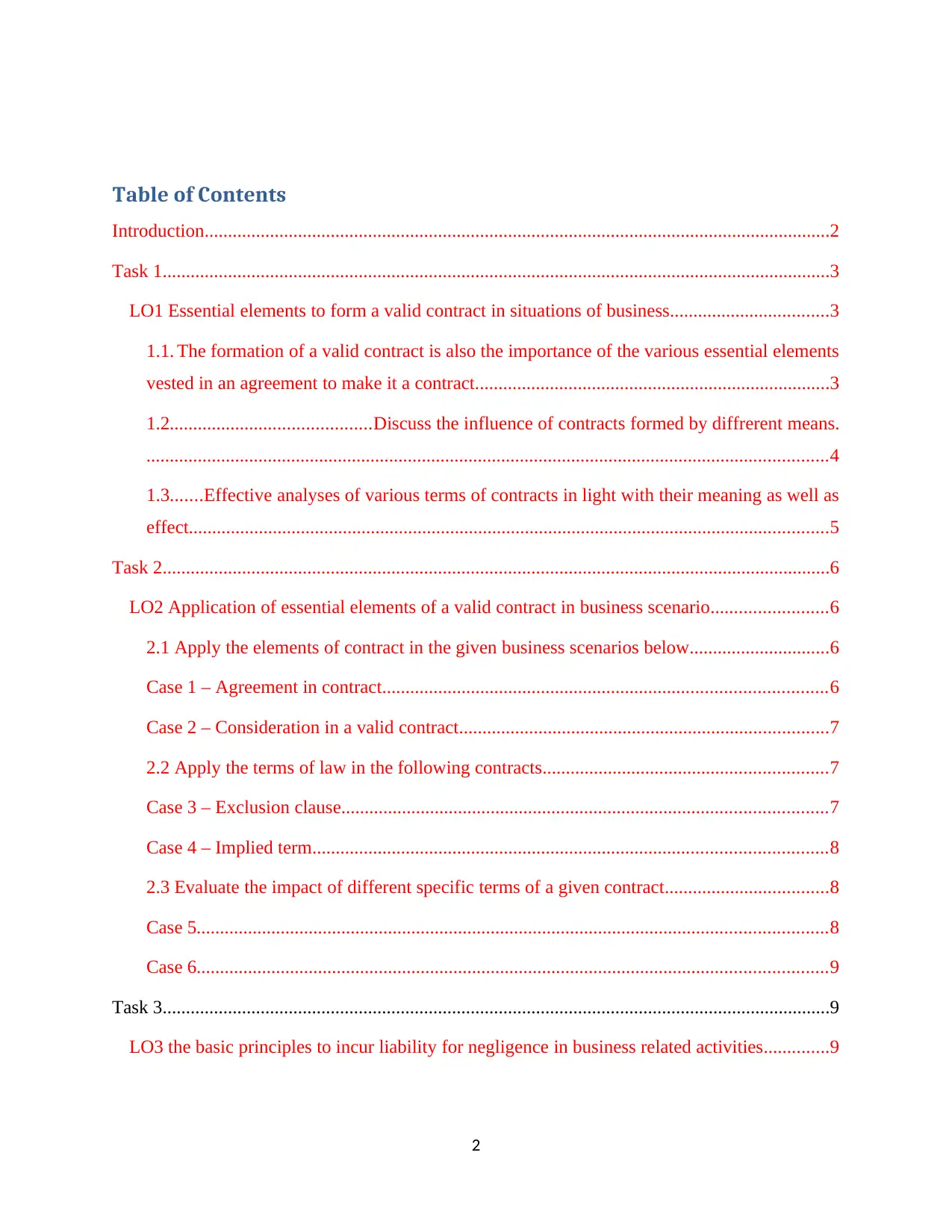
Table of Contents
Introduction......................................................................................................................................2
Task 1...............................................................................................................................................3
LO1 Essential elements to form a valid contract in situations of business..................................3
1.1. The formation of a valid contract is also the importance of the various essential elements
vested in an agreement to make it a contract............................................................................3
1.2...........................................Discuss the influence of contracts formed by diffrerent means.
..................................................................................................................................................4
1.3.......Effective analyses of various terms of contracts in light with their meaning as well as
effect.........................................................................................................................................5
Task 2...............................................................................................................................................6
LO2 Application of essential elements of a valid contract in business scenario.........................6
2.1 Apply the elements of contract in the given business scenarios below..............................6
Case 1 – Agreement in contract...............................................................................................6
Case 2 – Consideration in a valid contract...............................................................................7
2.2 Apply the terms of law in the following contracts.............................................................7
Case 3 – Exclusion clause........................................................................................................7
Case 4 – Implied term..............................................................................................................8
2.3 Evaluate the impact of different specific terms of a given contract...................................8
Case 5.......................................................................................................................................8
Case 6.......................................................................................................................................9
Task 3...............................................................................................................................................9
LO3 the basic principles to incur liability for negligence in business related activities..............9
2
Introduction......................................................................................................................................2
Task 1...............................................................................................................................................3
LO1 Essential elements to form a valid contract in situations of business..................................3
1.1. The formation of a valid contract is also the importance of the various essential elements
vested in an agreement to make it a contract............................................................................3
1.2...........................................Discuss the influence of contracts formed by diffrerent means.
..................................................................................................................................................4
1.3.......Effective analyses of various terms of contracts in light with their meaning as well as
effect.........................................................................................................................................5
Task 2...............................................................................................................................................6
LO2 Application of essential elements of a valid contract in business scenario.........................6
2.1 Apply the elements of contract in the given business scenarios below..............................6
Case 1 – Agreement in contract...............................................................................................6
Case 2 – Consideration in a valid contract...............................................................................7
2.2 Apply the terms of law in the following contracts.............................................................7
Case 3 – Exclusion clause........................................................................................................7
Case 4 – Implied term..............................................................................................................8
2.3 Evaluate the impact of different specific terms of a given contract...................................8
Case 5.......................................................................................................................................8
Case 6.......................................................................................................................................9
Task 3...............................................................................................................................................9
LO3 the basic principles to incur liability for negligence in business related activities..............9
2
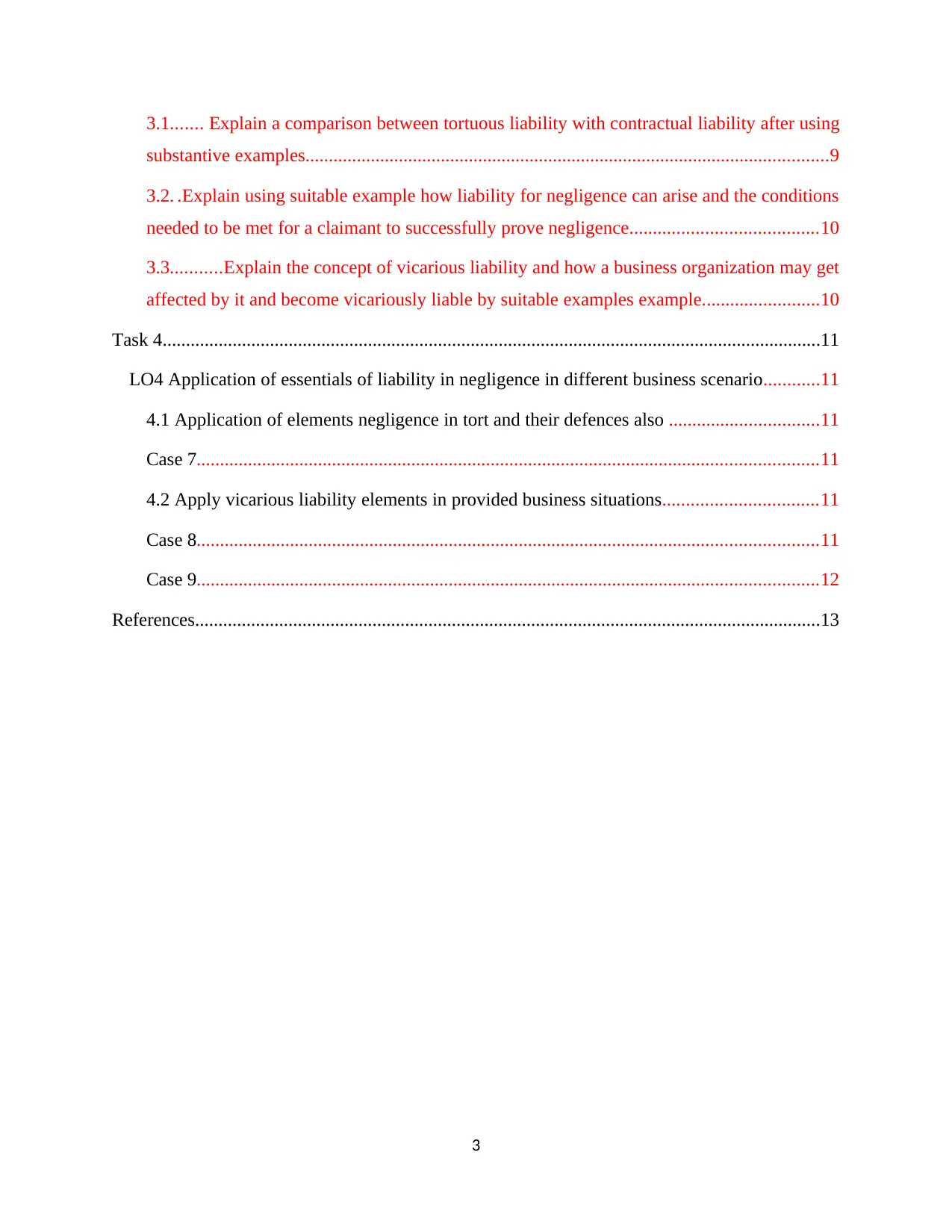
3.1....... Explain a comparison between tortuous liability with contractual liability after using
substantive examples................................................................................................................9
3.2. .Explain using suitable example how liability for negligence can arise and the conditions
needed to be met for a claimant to successfully prove negligence........................................10
3.3...........Explain the concept of vicarious liability and how a business organization may get
affected by it and become vicariously liable by suitable examples example.........................10
Task 4.............................................................................................................................................11
LO4 Application of essentials of liability in negligence in different business scenario............11
4.1 Application of elements negligence in tort and their defences also ................................11
Case 7.....................................................................................................................................11
4.2 Apply vicarious liability elements in provided business situations.................................11
Case 8.....................................................................................................................................11
Case 9.....................................................................................................................................12
References......................................................................................................................................13
3
substantive examples................................................................................................................9
3.2. .Explain using suitable example how liability for negligence can arise and the conditions
needed to be met for a claimant to successfully prove negligence........................................10
3.3...........Explain the concept of vicarious liability and how a business organization may get
affected by it and become vicariously liable by suitable examples example.........................10
Task 4.............................................................................................................................................11
LO4 Application of essentials of liability in negligence in different business scenario............11
4.1 Application of elements negligence in tort and their defences also ................................11
Case 7.....................................................................................................................................11
4.2 Apply vicarious liability elements in provided business situations.................................11
Case 8.....................................................................................................................................11
Case 9.....................................................................................................................................12
References......................................................................................................................................13
3
⊘ This is a preview!⊘
Do you want full access?
Subscribe today to unlock all pages.

Trusted by 1+ million students worldwide
Introduction
To Form an agreement, it is essential that it is communicable under law to become a valid
contract. All contracts can be termed as agreements but all agreements cannot be termed as
contracts as some of the agreements are not enforceable under law and thus becomes void. There
are certain elements which are supposed to be compulsory to construct an agreement and convert
it into a contract. Law can be measured in business contracts as the guidelines and principles
made and also regulated and authorized by the central as well as state governments. These
corporation bodies many times should be held responsible to develop and enforce a law in a
definite jurisdiction of business. A contract in business is nothing but a promise of fulfilling
conditions through an official document under the business law which must be lawful and
enforceable. Within the jurisdiction of business context, there are many laws available but the
most common and widely used law is contract law. A contract can also be termed as the
commitment of an individual or a partnership firm or any business bodies that is commenced for
the transactions of their resources. An oral contract can be implemented in business firms but a
written document about the contract solidifies its nature and its operations. A written document
about the legal procedures is essential as it states the expectations and promises done by both the
parties in a legal and lawful document.
This report is developed to have the information about the negligence of contract in
business. It will examine the principles and elements of the business law that are required to
develop a lawful contract under different business scenarios. The study will provide the
information about the liability in the law of tort and its characteristics. It will also outline the aim
and objectives of tort along with two different aspects, namely, vicarious liability and
negligence. This discourse is prepared to determine the essential fundamentals that are required
to develop a lawful contract and the liability of the parties during the negligence of business.
4
To Form an agreement, it is essential that it is communicable under law to become a valid
contract. All contracts can be termed as agreements but all agreements cannot be termed as
contracts as some of the agreements are not enforceable under law and thus becomes void. There
are certain elements which are supposed to be compulsory to construct an agreement and convert
it into a contract. Law can be measured in business contracts as the guidelines and principles
made and also regulated and authorized by the central as well as state governments. These
corporation bodies many times should be held responsible to develop and enforce a law in a
definite jurisdiction of business. A contract in business is nothing but a promise of fulfilling
conditions through an official document under the business law which must be lawful and
enforceable. Within the jurisdiction of business context, there are many laws available but the
most common and widely used law is contract law. A contract can also be termed as the
commitment of an individual or a partnership firm or any business bodies that is commenced for
the transactions of their resources. An oral contract can be implemented in business firms but a
written document about the contract solidifies its nature and its operations. A written document
about the legal procedures is essential as it states the expectations and promises done by both the
parties in a legal and lawful document.
This report is developed to have the information about the negligence of contract in
business. It will examine the principles and elements of the business law that are required to
develop a lawful contract under different business scenarios. The study will provide the
information about the liability in the law of tort and its characteristics. It will also outline the aim
and objectives of tort along with two different aspects, namely, vicarious liability and
negligence. This discourse is prepared to determine the essential fundamentals that are required
to develop a lawful contract and the liability of the parties during the negligence of business.
4
Paraphrase This Document
Need a fresh take? Get an instant paraphrase of this document with our AI Paraphraser
Task 1
LO1
1.1
For an agreement, it is essential that it is communicable under law to become a valid contract.
All contracts can be termed as agreements but all agreements cannot be termed as contracts as
some of the agreements are not enforceable under law and thus becomes void. To form a valid
contract or to convert an agreement into a contract than the parties need to follow some
essentials. If any of the elements are missing from the agreement then it is not enforceable by
law and thus cannot become a valid contract. For starting and initiating a contract, the foremost
thing that is required is offer and acceptance of a promise (Cornford, 2008). Under this, one
party makes a valid offer for giving something or having something that is legal and the other
party whom the offer has been produced has to accept the offer with a valid consideration. This
is the first step for the commencement of a legal contract. The consideration must be lawful
before the eyes of the governments; otherwise, it will become void.
In the business world, people need to get engaged in different types of contracts for the
commencement of the business and sometimes many problems arises in its formation. The
performance of activities from the side of one party and subsequently the violation of activities
was performed by that party with or without intention than other party shall bring a suit for
damage caused to him in his business. If any kind of breach happens to any individual during the
business activities, then the losing party can go to court for getting compensation from the other
party. It is necessary for the people to make sure that all the essential elements are available in
the agreement to make it a valid contract. The elements which are supposed to be essential to
construct a valid contract are mentioned below:
Agreement: When one person give some kind of offer to other for performance or abstinence of
that offer and the offer is successfully accepted by other party after paying a certain amount of
consideration than a valid agreement shall came into force at that time.
5
LO1
1.1
For an agreement, it is essential that it is communicable under law to become a valid contract.
All contracts can be termed as agreements but all agreements cannot be termed as contracts as
some of the agreements are not enforceable under law and thus becomes void. To form a valid
contract or to convert an agreement into a contract than the parties need to follow some
essentials. If any of the elements are missing from the agreement then it is not enforceable by
law and thus cannot become a valid contract. For starting and initiating a contract, the foremost
thing that is required is offer and acceptance of a promise (Cornford, 2008). Under this, one
party makes a valid offer for giving something or having something that is legal and the other
party whom the offer has been produced has to accept the offer with a valid consideration. This
is the first step for the commencement of a legal contract. The consideration must be lawful
before the eyes of the governments; otherwise, it will become void.
In the business world, people need to get engaged in different types of contracts for the
commencement of the business and sometimes many problems arises in its formation. The
performance of activities from the side of one party and subsequently the violation of activities
was performed by that party with or without intention than other party shall bring a suit for
damage caused to him in his business. If any kind of breach happens to any individual during the
business activities, then the losing party can go to court for getting compensation from the other
party. It is necessary for the people to make sure that all the essential elements are available in
the agreement to make it a valid contract. The elements which are supposed to be essential to
construct a valid contract are mentioned below:
Agreement: When one person give some kind of offer to other for performance or abstinence of
that offer and the offer is successfully accepted by other party after paying a certain amount of
consideration than a valid agreement shall came into force at that time.
5
Consideration: To make an agreement valid the presence of valid consideration is must. It is one
of the basic element by which an agreement is formed. The consideration may be in monitory
value or in any other form which have some value in eyes of law (McLean, Mason and McLean,
2004). The object of and amount of consideration varies according to different terms mentioned
in different contracts.
Intention: the subject or the object of an agreement should be lawful in the eyes of the law of
business. Both parties should aware about the terms and conditions mentioned by them in
contract and they should bear a mentality to enter into a contract. This is called as the intention
of parties.
Capacity: Parties to a contract must have the capability to form a contract i.e., both parties
should be of sound mind and able to understand possible consequences whether negative or
positive arises from a contract. If a person is usually of sound mind and at the time of making
contract he will be of unsound that he is not appropriate one to form a contract and vice-versa.
Consent of the parties: The parties forming a contract must enter into it after free consent i.e.,
their consent must not be obtained by counterfeited means like coercion, undue influence, fraud,
misrepresentation and mistake.
Written document: Contract can be made between two parties orally or in written form also but
the effective way in business situations should be a written contract.
Certainty: The terms and conditions imposed on parties by the way of contract must be specific
and certain.
Remedies for breach of contract: Generally in contracts the remedies awarded by courts are
un-liquidated damages i.e., the damages which are not pre-defined.
1.2
The legally binding contracts made in different business scenarios have different terms and
conditions which need to be followed by both the parties. These specified terms help an
agreement to become a valid contract in an efficient way. Before initiating a contract, one party
introduces his or her terms and conditions and the other party have to accept or reject the offer
6
of the basic element by which an agreement is formed. The consideration may be in monitory
value or in any other form which have some value in eyes of law (McLean, Mason and McLean,
2004). The object of and amount of consideration varies according to different terms mentioned
in different contracts.
Intention: the subject or the object of an agreement should be lawful in the eyes of the law of
business. Both parties should aware about the terms and conditions mentioned by them in
contract and they should bear a mentality to enter into a contract. This is called as the intention
of parties.
Capacity: Parties to a contract must have the capability to form a contract i.e., both parties
should be of sound mind and able to understand possible consequences whether negative or
positive arises from a contract. If a person is usually of sound mind and at the time of making
contract he will be of unsound that he is not appropriate one to form a contract and vice-versa.
Consent of the parties: The parties forming a contract must enter into it after free consent i.e.,
their consent must not be obtained by counterfeited means like coercion, undue influence, fraud,
misrepresentation and mistake.
Written document: Contract can be made between two parties orally or in written form also but
the effective way in business situations should be a written contract.
Certainty: The terms and conditions imposed on parties by the way of contract must be specific
and certain.
Remedies for breach of contract: Generally in contracts the remedies awarded by courts are
un-liquidated damages i.e., the damages which are not pre-defined.
1.2
The legally binding contracts made in different business scenarios have different terms and
conditions which need to be followed by both the parties. These specified terms help an
agreement to become a valid contract in an efficient way. Before initiating a contract, one party
introduces his or her terms and conditions and the other party have to accept or reject the offer
6
⊘ This is a preview!⊘
Do you want full access?
Subscribe today to unlock all pages.
Trusted by 1+ million students worldwide
with his or her own willingness. Both these parties are bound by the terms defined in the
contract.
1. Face to Face: A contract which was formed between two parties after direct interaction
between them is sometimes being void or may be a valid contract. To form a valid
contract, it is mandatory to produce a legally binding document containing the details of
contract (Lindemann, Kadue and Lindemann, 2012). This kind of contract, developed
between two parties after an effective face to face conversation is sometimes valid as the
formation of the contract can be imposed to fulfill the legal terms mentioned in that
contract.
2. Written Document: It is a kind of contract in which parties engaged themselves after
formation of agreement in writing. It is usually termed as a valid contract. A contract
written in a legal format should be signed by both the parties and must be submitted to a
licensed lawyer. It is also considered legal as it contains the seal and marks of the legal
terms (Schmerler, 2008). So it can be more effective in business scenario that parties
should develop and produce a legal document for verification before entering into a
contract as it will be a safer side for them from bad result that comes from the violation of
the contract.
3. Distance selling: It is a method of making a contract in which is formed between the
parties involved through different modes of communication such as telephone, internet,
etc. This type of contract can be formed with the help of communication medium like
cell-phones or with the help of verbal interaction over the internet (Legislation.gov.uk,
2016). This medium of developing a contract is considered to be valid as this medium
contains legal documentations as well as oral representations also which can be produced
on the security that is relating to the breach of contract. The agreements that are initiated
by distance selling should have less written the support of legal documents so it will
sometimes be painful for parties.
1.3
The content of the agreement: when an individual is trying to get involved in a valid contract,
he or she must have the clear notion about content that they going to impose in the agreement.
The content or the subject matter of a contract differs from contract to contract that is mainly
7
contract.
1. Face to Face: A contract which was formed between two parties after direct interaction
between them is sometimes being void or may be a valid contract. To form a valid
contract, it is mandatory to produce a legally binding document containing the details of
contract (Lindemann, Kadue and Lindemann, 2012). This kind of contract, developed
between two parties after an effective face to face conversation is sometimes valid as the
formation of the contract can be imposed to fulfill the legal terms mentioned in that
contract.
2. Written Document: It is a kind of contract in which parties engaged themselves after
formation of agreement in writing. It is usually termed as a valid contract. A contract
written in a legal format should be signed by both the parties and must be submitted to a
licensed lawyer. It is also considered legal as it contains the seal and marks of the legal
terms (Schmerler, 2008). So it can be more effective in business scenario that parties
should develop and produce a legal document for verification before entering into a
contract as it will be a safer side for them from bad result that comes from the violation of
the contract.
3. Distance selling: It is a method of making a contract in which is formed between the
parties involved through different modes of communication such as telephone, internet,
etc. This type of contract can be formed with the help of communication medium like
cell-phones or with the help of verbal interaction over the internet (Legislation.gov.uk,
2016). This medium of developing a contract is considered to be valid as this medium
contains legal documentations as well as oral representations also which can be produced
on the security that is relating to the breach of contract. The agreements that are initiated
by distance selling should have less written the support of legal documents so it will
sometimes be painful for parties.
1.3
The content of the agreement: when an individual is trying to get involved in a valid contract,
he or she must have the clear notion about content that they going to impose in the agreement.
The content or the subject matter of a contract differs from contract to contract that is mainly
7
Paraphrase This Document
Need a fresh take? Get an instant paraphrase of this document with our AI Paraphraser
developed on the terms of the involving parties (E-lawresources.co.uk, 2016). Though there are
complimentary issues that need to be simulated in agreement like the terms and conditions,
charges and fees, provision of the content, warranties, guaranties, termination and payment
procedures and the relationship among the involving parties.
Condition: It is considered as the essential elements that help in the formulation of the contract.
It is the most important among the permissible associations of the contracts. To notice the effects
of breach of the contract, it was really very important to portray the expulsion and its different
aspects (Netk.net.au, 2016). If terms are involved in a contract, then it is easy for aggrieved party
to gain strength against terminating the contract and also help them to gain remedies legally for
the loss they have incurred due to the breach of the contract.
Warranty: it is mainly termed as an aided responsibility in the fundamentals of contract law.
Though it is not necessary in the formation of the contract but it acts as a formation of the
contract (Austen-Baker, 2011). The result of breaching a warranty is same as breaching a
condition mentioned in the contract. It allows the innocent party to claim compensation in a
permissible way, but the party does not gain any strength to terminate the contract.
Innominate terms: for considering a legalized implication of the contract, innominate terms are
represented which are not presented in condition terms or warranty terms (Smith, 2011). In the
breaching of innominate terms, claiming the compensation is applicable but that depends on the
effects formed by the breaching of the contract.
Exemption clause: In contracts made under business law, the involvement of the exemption
clauses is to limits the liability of a party i.e., by adding that clause a party withdraw his whole
liability and place an ambit of limited liability over them (Cooke, 2009). It was further
subdivided into two categories i.e., exclusion law and limited clause.
8
complimentary issues that need to be simulated in agreement like the terms and conditions,
charges and fees, provision of the content, warranties, guaranties, termination and payment
procedures and the relationship among the involving parties.
Condition: It is considered as the essential elements that help in the formulation of the contract.
It is the most important among the permissible associations of the contracts. To notice the effects
of breach of the contract, it was really very important to portray the expulsion and its different
aspects (Netk.net.au, 2016). If terms are involved in a contract, then it is easy for aggrieved party
to gain strength against terminating the contract and also help them to gain remedies legally for
the loss they have incurred due to the breach of the contract.
Warranty: it is mainly termed as an aided responsibility in the fundamentals of contract law.
Though it is not necessary in the formation of the contract but it acts as a formation of the
contract (Austen-Baker, 2011). The result of breaching a warranty is same as breaching a
condition mentioned in the contract. It allows the innocent party to claim compensation in a
permissible way, but the party does not gain any strength to terminate the contract.
Innominate terms: for considering a legalized implication of the contract, innominate terms are
represented which are not presented in condition terms or warranty terms (Smith, 2011). In the
breaching of innominate terms, claiming the compensation is applicable but that depends on the
effects formed by the breaching of the contract.
Exemption clause: In contracts made under business law, the involvement of the exemption
clauses is to limits the liability of a party i.e., by adding that clause a party withdraw his whole
liability and place an ambit of limited liability over them (Cooke, 2009). It was further
subdivided into two categories i.e., exclusion law and limited clause.
8
Task 2
LO2
2.1
Case 1 –
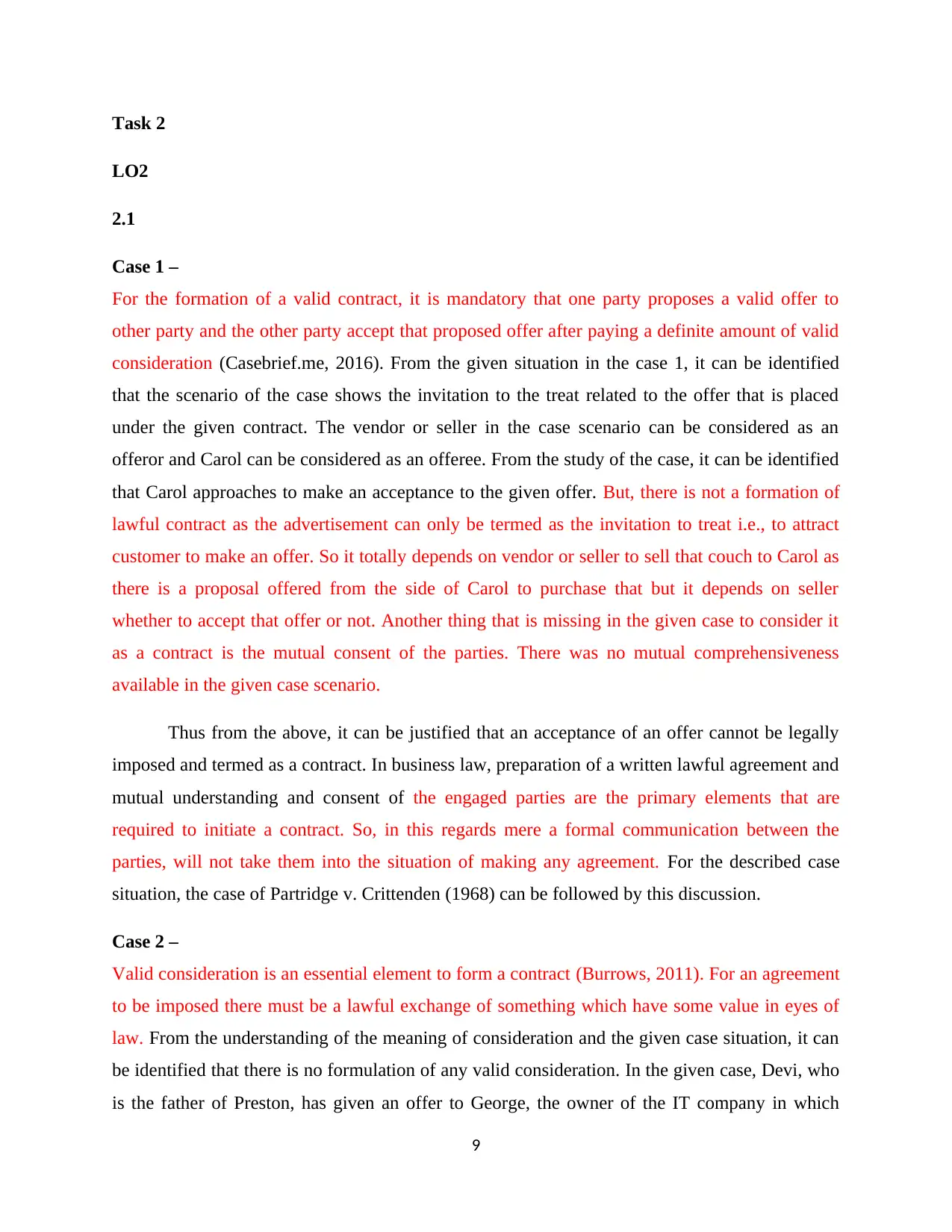
For the formation of a valid contract, it is mandatory that one party proposes a valid offer to
other party and the other party accept that proposed offer after paying a definite amount of valid
consideration (Casebrief.me, 2016). From the given situation in the case 1, it can be identified
that the scenario of the case shows the invitation to the treat related to the offer that is placed
under the given contract. The vendor or seller in the case scenario can be considered as an
offeror and Carol can be considered as an offeree. From the study of the case, it can be identified
that Carol approaches to make an acceptance to the given offer. But, there is not a formation of
lawful contract as the advertisement can only be termed as the invitation to treat i.e., to attract
customer to make an offer. So it totally depends on vendor or seller to sell that couch to Carol as
there is a proposal offered from the side of Carol to purchase that but it depends on seller
whether to accept that offer or not. Another thing that is missing in the given case to consider it
as a contract is the mutual consent of the parties. There was no mutual comprehensiveness
available in the given case scenario.
Thus from the above, it can be justified that an acceptance of an offer cannot be legally
imposed and termed as a contract. In business law, preparation of a written lawful agreement and
mutual understanding and consent of the engaged parties are the primary elements that are
required to initiate a contract. So, in this regards mere a formal communication between the
parties, will not take them into the situation of making any agreement. For the described case
situation, the case of Partridge v. Crittenden (1968) can be followed by this discussion.
Case 2 –
Valid consideration is an essential element to form a contract (Burrows, 2011). For an agreement
to be imposed there must be a lawful exchange of something which have some value in eyes of
law. From the understanding of the meaning of consideration and the given case situation, it can
be identified that there is no formulation of any valid consideration. In the given case, Devi, who
is the father of Preston, has given an offer to George, the owner of the IT company in which
9
LO2
2.1
Case 1 –
For the formation of a valid contract, it is mandatory that one party proposes a valid offer to
other party and the other party accept that proposed offer after paying a definite amount of valid
consideration (Casebrief.me, 2016). From the given situation in the case 1, it can be identified
that the scenario of the case shows the invitation to the treat related to the offer that is placed
under the given contract. The vendor or seller in the case scenario can be considered as an
offeror and Carol can be considered as an offeree. From the study of the case, it can be identified
that Carol approaches to make an acceptance to the given offer. But, there is not a formation of
lawful contract as the advertisement can only be termed as the invitation to treat i.e., to attract
customer to make an offer. So it totally depends on vendor or seller to sell that couch to Carol as
there is a proposal offered from the side of Carol to purchase that but it depends on seller
whether to accept that offer or not. Another thing that is missing in the given case to consider it
as a contract is the mutual consent of the parties. There was no mutual comprehensiveness
available in the given case scenario.
Thus from the above, it can be justified that an acceptance of an offer cannot be legally
imposed and termed as a contract. In business law, preparation of a written lawful agreement and
mutual understanding and consent of the engaged parties are the primary elements that are
required to initiate a contract. So, in this regards mere a formal communication between the
parties, will not take them into the situation of making any agreement. For the described case
situation, the case of Partridge v. Crittenden (1968) can be followed by this discussion.
Case 2 –
Valid consideration is an essential element to form a contract (Burrows, 2011). For an agreement
to be imposed there must be a lawful exchange of something which have some value in eyes of
law. From the understanding of the meaning of consideration and the given case situation, it can
be identified that there is no formulation of any valid consideration. In the given case, Devi, who
is the father of Preston, has given an offer to George, the owner of the IT company in which
9
⊘ This is a preview!⊘
Do you want full access?
Subscribe today to unlock all pages.
Trusted by 1+ million students worldwide
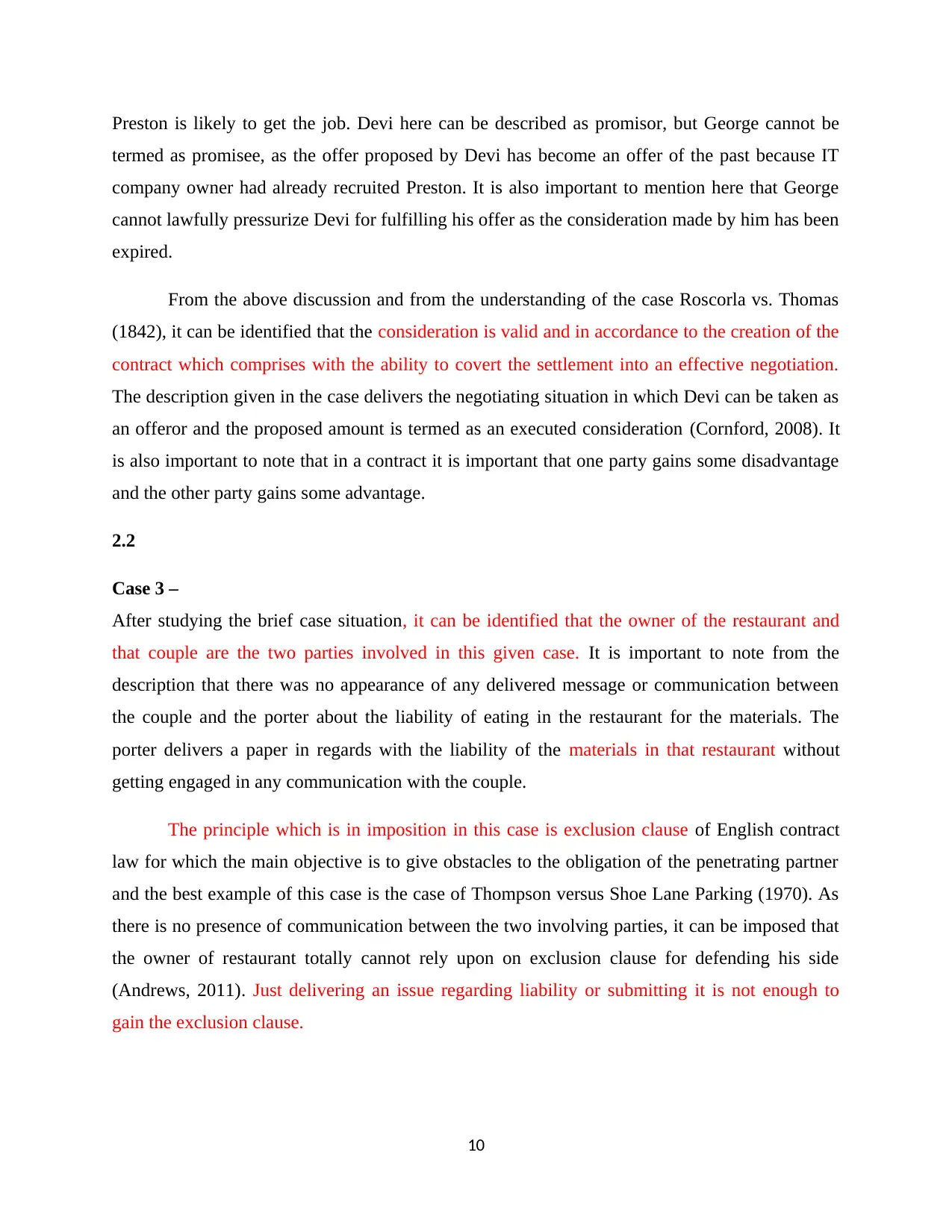
Preston is likely to get the job. Devi here can be described as promisor, but George cannot be
termed as promisee, as the offer proposed by Devi has become an offer of the past because IT
company owner had already recruited Preston. It is also important to mention here that George
cannot lawfully pressurize Devi for fulfilling his offer as the consideration made by him has been
expired.
From the above discussion and from the understanding of the case Roscorla vs. Thomas
(1842), it can be identified that the consideration is valid and in accordance to the creation of the
contract which comprises with the ability to covert the settlement into an effective negotiation.
The description given in the case delivers the negotiating situation in which Devi can be taken as
an offeror and the proposed amount is termed as an executed consideration (Cornford, 2008). It
is also important to note that in a contract it is important that one party gains some disadvantage
and the other party gains some advantage.
2.2
Case 3 –
After studying the brief case situation, it can be identified that the owner of the restaurant and
that couple are the two parties involved in this given case. It is important to note from the
description that there was no appearance of any delivered message or communication between
the couple and the porter about the liability of eating in the restaurant for the materials. The
porter delivers a paper in regards with the liability of the materials in that restaurant without
getting engaged in any communication with the couple.
The principle which is in imposition in this case is exclusion clause of English contract
law for which the main objective is to give obstacles to the obligation of the penetrating partner
and the best example of this case is the case of Thompson versus Shoe Lane Parking (1970). As
there is no presence of communication between the two involving parties, it can be imposed that
the owner of restaurant totally cannot rely upon on exclusion clause for defending his side
(Andrews, 2011). Just delivering an issue regarding liability or submitting it is not enough to
gain the exclusion clause.
10
termed as promisee, as the offer proposed by Devi has become an offer of the past because IT
company owner had already recruited Preston. It is also important to mention here that George
cannot lawfully pressurize Devi for fulfilling his offer as the consideration made by him has been
expired.
From the above discussion and from the understanding of the case Roscorla vs. Thomas
(1842), it can be identified that the consideration is valid and in accordance to the creation of the
contract which comprises with the ability to covert the settlement into an effective negotiation.
The description given in the case delivers the negotiating situation in which Devi can be taken as
an offeror and the proposed amount is termed as an executed consideration (Cornford, 2008). It
is also important to note that in a contract it is important that one party gains some disadvantage
and the other party gains some advantage.
2.2
Case 3 –
After studying the brief case situation, it can be identified that the owner of the restaurant and
that couple are the two parties involved in this given case. It is important to note from the
description that there was no appearance of any delivered message or communication between
the couple and the porter about the liability of eating in the restaurant for the materials. The
porter delivers a paper in regards with the liability of the materials in that restaurant without
getting engaged in any communication with the couple.
The principle which is in imposition in this case is exclusion clause of English contract
law for which the main objective is to give obstacles to the obligation of the penetrating partner
and the best example of this case is the case of Thompson versus Shoe Lane Parking (1970). As
there is no presence of communication between the two involving parties, it can be imposed that
the owner of restaurant totally cannot rely upon on exclusion clause for defending his side
(Andrews, 2011). Just delivering an issue regarding liability or submitting it is not enough to
gain the exclusion clause.
10
Paraphrase This Document
Need a fresh take? Get an instant paraphrase of this document with our AI Paraphraser
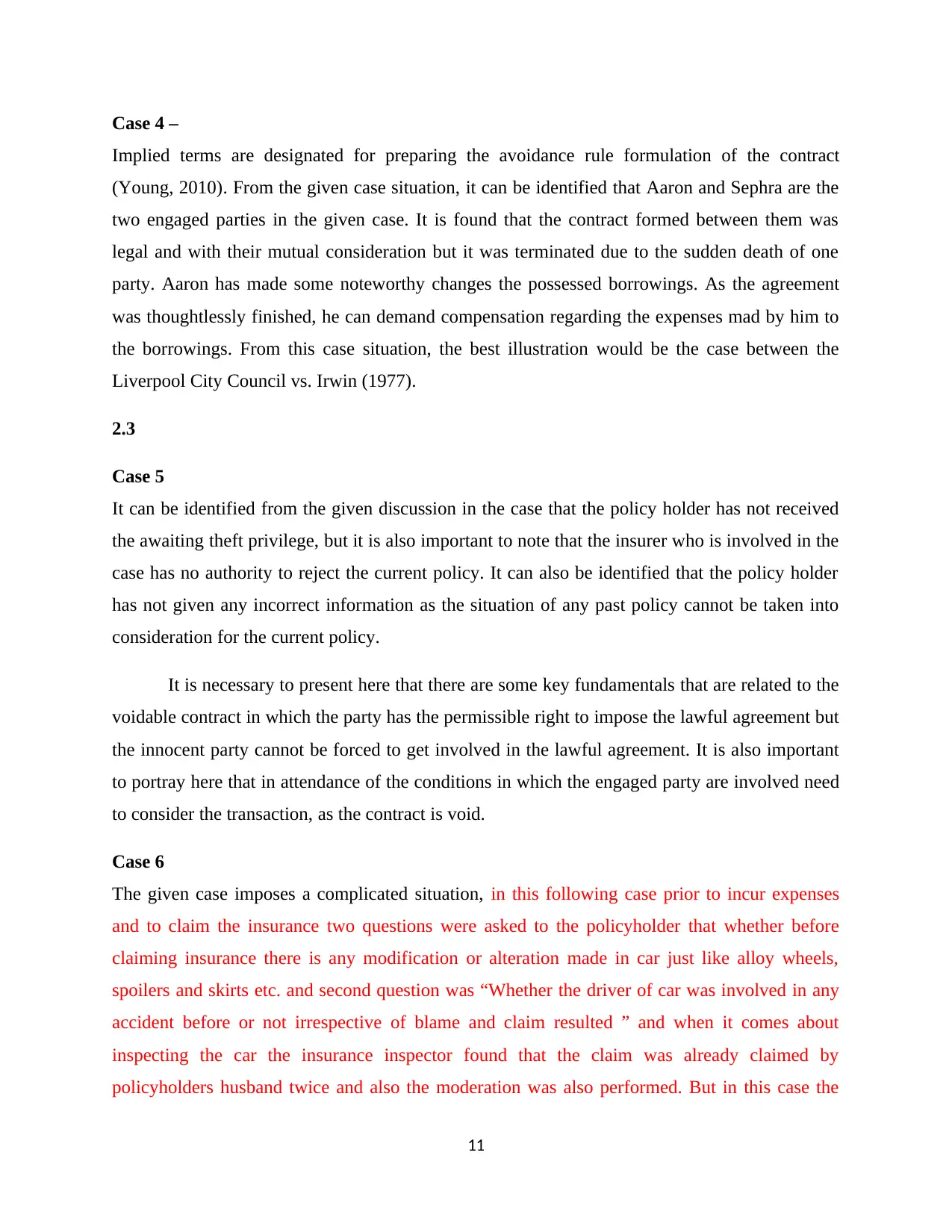
Case 4 –
Implied terms are designated for preparing the avoidance rule formulation of the contract
(Young, 2010). From the given case situation, it can be identified that Aaron and Sephra are the
two engaged parties in the given case. It is found that the contract formed between them was
legal and with their mutual consideration but it was terminated due to the sudden death of one
party. Aaron has made some noteworthy changes the possessed borrowings. As the agreement
was thoughtlessly finished, he can demand compensation regarding the expenses mad by him to
the borrowings. From this case situation, the best illustration would be the case between the
Liverpool City Council vs. Irwin (1977).
2.3
Case 5
It can be identified from the given discussion in the case that the policy holder has not received
the awaiting theft privilege, but it is also important to note that the insurer who is involved in the
case has no authority to reject the current policy. It can also be identified that the policy holder
has not given any incorrect information as the situation of any past policy cannot be taken into
consideration for the current policy.
It is necessary to present here that there are some key fundamentals that are related to the
voidable contract in which the party has the permissible right to impose the lawful agreement but
the innocent party cannot be forced to get involved in the lawful agreement. It is also important
to portray here that in attendance of the conditions in which the engaged party are involved need
to consider the transaction, as the contract is void.
Case 6
The given case imposes a complicated situation, in this following case prior to incur expenses
and to claim the insurance two questions were asked to the policyholder that whether before
claiming insurance there is any modification or alteration made in car just like alloy wheels,
spoilers and skirts etc. and second question was “Whether the driver of car was involved in any
accident before or not irrespective of blame and claim resulted ” and when it comes about
inspecting the car the insurance inspector found that the claim was already claimed by
policyholders husband twice and also the moderation was also performed. But in this case the
11
Implied terms are designated for preparing the avoidance rule formulation of the contract
(Young, 2010). From the given case situation, it can be identified that Aaron and Sephra are the
two engaged parties in the given case. It is found that the contract formed between them was
legal and with their mutual consideration but it was terminated due to the sudden death of one
party. Aaron has made some noteworthy changes the possessed borrowings. As the agreement
was thoughtlessly finished, he can demand compensation regarding the expenses mad by him to
the borrowings. From this case situation, the best illustration would be the case between the
Liverpool City Council vs. Irwin (1977).
2.3
Case 5
It can be identified from the given discussion in the case that the policy holder has not received
the awaiting theft privilege, but it is also important to note that the insurer who is involved in the
case has no authority to reject the current policy. It can also be identified that the policy holder
has not given any incorrect information as the situation of any past policy cannot be taken into
consideration for the current policy.
It is necessary to present here that there are some key fundamentals that are related to the
voidable contract in which the party has the permissible right to impose the lawful agreement but
the innocent party cannot be forced to get involved in the lawful agreement. It is also important
to portray here that in attendance of the conditions in which the engaged party are involved need
to consider the transaction, as the contract is void.
Case 6
The given case imposes a complicated situation, in this following case prior to incur expenses
and to claim the insurance two questions were asked to the policyholder that whether before
claiming insurance there is any modification or alteration made in car just like alloy wheels,
spoilers and skirts etc. and second question was “Whether the driver of car was involved in any
accident before or not irrespective of blame and claim resulted ” and when it comes about
inspecting the car the insurance inspector found that the claim was already claimed by
policyholders husband twice and also the moderation was also performed. But in this case the
11
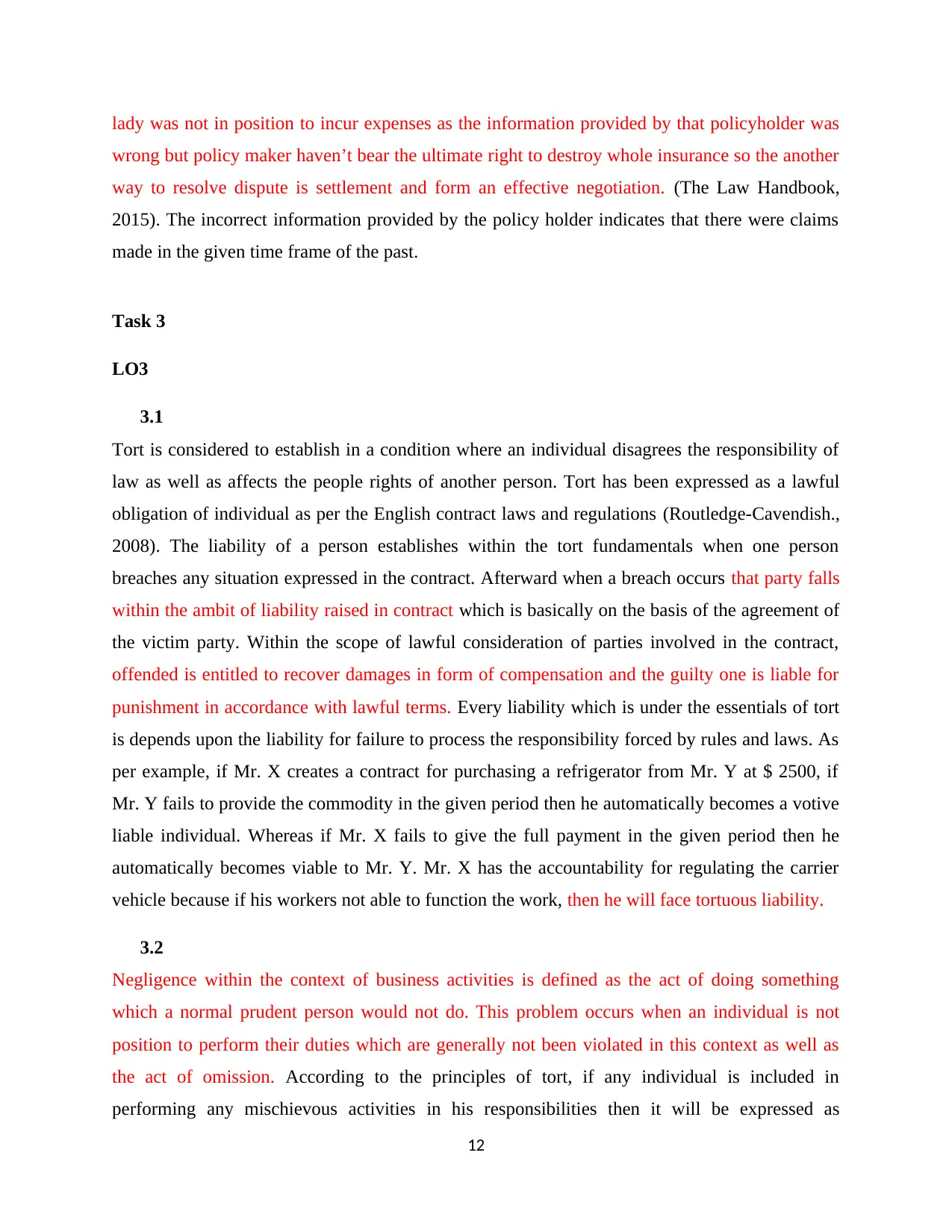
lady was not in position to incur expenses as the information provided by that policyholder was
wrong but policy maker haven’t bear the ultimate right to destroy whole insurance so the another
way to resolve dispute is settlement and form an effective negotiation. (The Law Handbook,
2015). The incorrect information provided by the policy holder indicates that there were claims
made in the given time frame of the past.
Task 3
LO3
3.1
Tort is considered to establish in a condition where an individual disagrees the responsibility of
law as well as affects the people rights of another person. Tort has been expressed as a lawful
obligation of individual as per the English contract laws and regulations (Routledge-Cavendish.,
2008). The liability of a person establishes within the tort fundamentals when one person
breaches any situation expressed in the contract. Afterward when a breach occurs that party falls
within the ambit of liability raised in contract which is basically on the basis of the agreement of
the victim party. Within the scope of lawful consideration of parties involved in the contract,
offended is entitled to recover damages in form of compensation and the guilty one is liable for
punishment in accordance with lawful terms. Every liability which is under the essentials of tort
is depends upon the liability for failure to process the responsibility forced by rules and laws. As
per example, if Mr. X creates a contract for purchasing a refrigerator from Mr. Y at $ 2500, if
Mr. Y fails to provide the commodity in the given period then he automatically becomes a votive
liable individual. Whereas if Mr. X fails to give the full payment in the given period then he
automatically becomes viable to Mr. Y. Mr. X has the accountability for regulating the carrier
vehicle because if his workers not able to function the work, then he will face tortuous liability.
3.2
Negligence within the context of business activities is defined as the act of doing something
which a normal prudent person would not do. This problem occurs when an individual is not
position to perform their duties which are generally not been violated in this context as well as
the act of omission. According to the principles of tort, if any individual is included in
performing any mischievous activities in his responsibilities then it will be expressed as
12
wrong but policy maker haven’t bear the ultimate right to destroy whole insurance so the another
way to resolve dispute is settlement and form an effective negotiation. (The Law Handbook,
2015). The incorrect information provided by the policy holder indicates that there were claims
made in the given time frame of the past.
Task 3
LO3
3.1
Tort is considered to establish in a condition where an individual disagrees the responsibility of
law as well as affects the people rights of another person. Tort has been expressed as a lawful
obligation of individual as per the English contract laws and regulations (Routledge-Cavendish.,
2008). The liability of a person establishes within the tort fundamentals when one person
breaches any situation expressed in the contract. Afterward when a breach occurs that party falls
within the ambit of liability raised in contract which is basically on the basis of the agreement of
the victim party. Within the scope of lawful consideration of parties involved in the contract,
offended is entitled to recover damages in form of compensation and the guilty one is liable for
punishment in accordance with lawful terms. Every liability which is under the essentials of tort
is depends upon the liability for failure to process the responsibility forced by rules and laws. As
per example, if Mr. X creates a contract for purchasing a refrigerator from Mr. Y at $ 2500, if
Mr. Y fails to provide the commodity in the given period then he automatically becomes a votive
liable individual. Whereas if Mr. X fails to give the full payment in the given period then he
automatically becomes viable to Mr. Y. Mr. X has the accountability for regulating the carrier
vehicle because if his workers not able to function the work, then he will face tortuous liability.
3.2
Negligence within the context of business activities is defined as the act of doing something
which a normal prudent person would not do. This problem occurs when an individual is not
position to perform their duties which are generally not been violated in this context as well as
the act of omission. According to the principles of tort, if any individual is included in
performing any mischievous activities in his responsibilities then it will be expressed as
12
⊘ This is a preview!⊘
Do you want full access?
Subscribe today to unlock all pages.
Trusted by 1+ million students worldwide

1 out of 17


Related Documents


Your All-in-One AI-Powered Toolkit for Academic Success.
+13062052269
info@desklib.com
Available 24*7 on WhatsApp / Email
![[object Object]](/_next/static/media/star-bottom.7253800d.svg)
Unlock your academic potential
Copyright © 2020–2026 A2Z Services. All Rights Reserved. Developed and managed by ZUCOL.