Learning Experience Planning Template and Reflection Assignment

Verified

Added on  2022/09/12

|4
|995
|21
Homework Assignment
AI Summary
This assignment presents a comprehensive learning experience plan, including a planning template and a reflection component. The planning template covers key learning areas, rationales for selecting specific learning experiences (focusing on graphic organizers and mind maps), and the selection of the Jigsaw cooperative learning strategy. The rationale emphasizes the benefits of graphic organizers in directing student thinking and enhancing comprehension, along with the effectiveness of the Jigsaw method in promoting collaboration and individual accountability. The plan details the selection of student groups, the overall task sequence, and assessment strategies. The reflection component addresses the implementation of effective teaching and learning, assessment strategies, and a reflection on the concept of 'good' assessment, aligning with educational standards related to planning, assessment, and reflection on teaching practices. This assignment provides a practical approach to designing and evaluating a learning experience, offering insights into various aspects of teaching and learning. This document is contributed by a student to be published on the website Desklib, a platform providing AI-based study tools.
Document Page
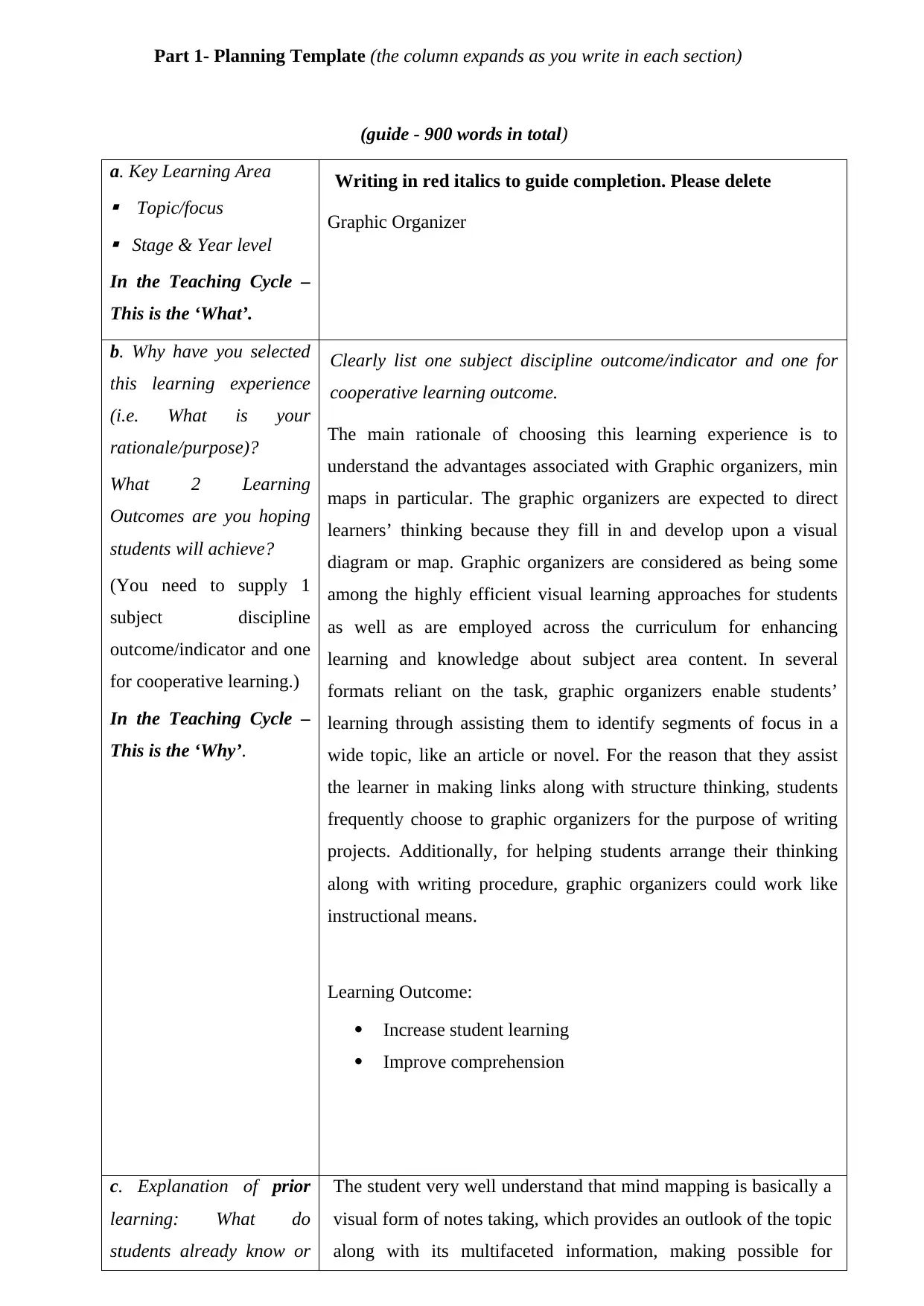
Part 1- Planning Template (the column expands as you write in each section)
(guide - 900 words in total)
a. Key Learning Area Topic/focus Stage & Year level
In the Teaching Cycle –
This is the ‘What’.
Writing in red italics to guide completion. Please delete
Graphic Organizer
b. Why have you selected
this learning experience
(i.e. What is your
rationale/purpose)?
What 2 Learning
Outcomes are you hoping
students will achieve?
(You need to supply 1
subject discipline
outcome/indicator and one
for cooperative learning.)
In the Teaching Cycle –
This is the ‘Why’.
Clearly list one subject discipline outcome/indicator and one for
cooperative learning outcome.
The main rationale of choosing this learning experience is to
understand the advantages associated with Graphic organizers, min
maps in particular. The graphic organizers are expected to direct
learners’ thinking because they fill in and develop upon a visual
diagram or map. Graphic organizers are considered as being some
among the highly efficient visual learning approaches for students
as well as are employed across the curriculum for enhancing
learning and knowledge about subject area content. In several
formats reliant on the task, graphic organizers enable students’
learning through assisting them to identify segments of focus in a
wide topic, like an article or novel. For the reason that they assist
the learner in making links along with structure thinking, students
frequently choose to graphic organizers for the purpose of writing
projects. Additionally, for helping students arrange their thinking
along with writing procedure, graphic organizers could work like
instructional means.
Learning Outcome:
Increase student learning
Improve comprehension
c. Explanation of prior
learning: What do
students already know or
The student very well understand that mind mapping is basically a
visual form of notes taking, which provides an outlook of the topic
along with its multifaceted information, making possible for
tabler-icon-diamond-filled.svg

Paraphrase This Document

Need a fresh take? Get an instant paraphrase of this document with our AI Paraphraser
Document Page
what skills have they
already acquired relevant
to this learning
experience?
students to understand, develop new ideas and develop
connections. They very understand how mind mapping can help
them in brainstorming and exploring any ideas, concepts or
problems. It could also enable superior understanding of relations
and links amid ideas and conceptions.
d. Graphic organiser
selected; how is its use by
the students suitable for
addressing the learning
outcomes or indicators?
(i.e. justification for using
it)
You may include an
example in appendix
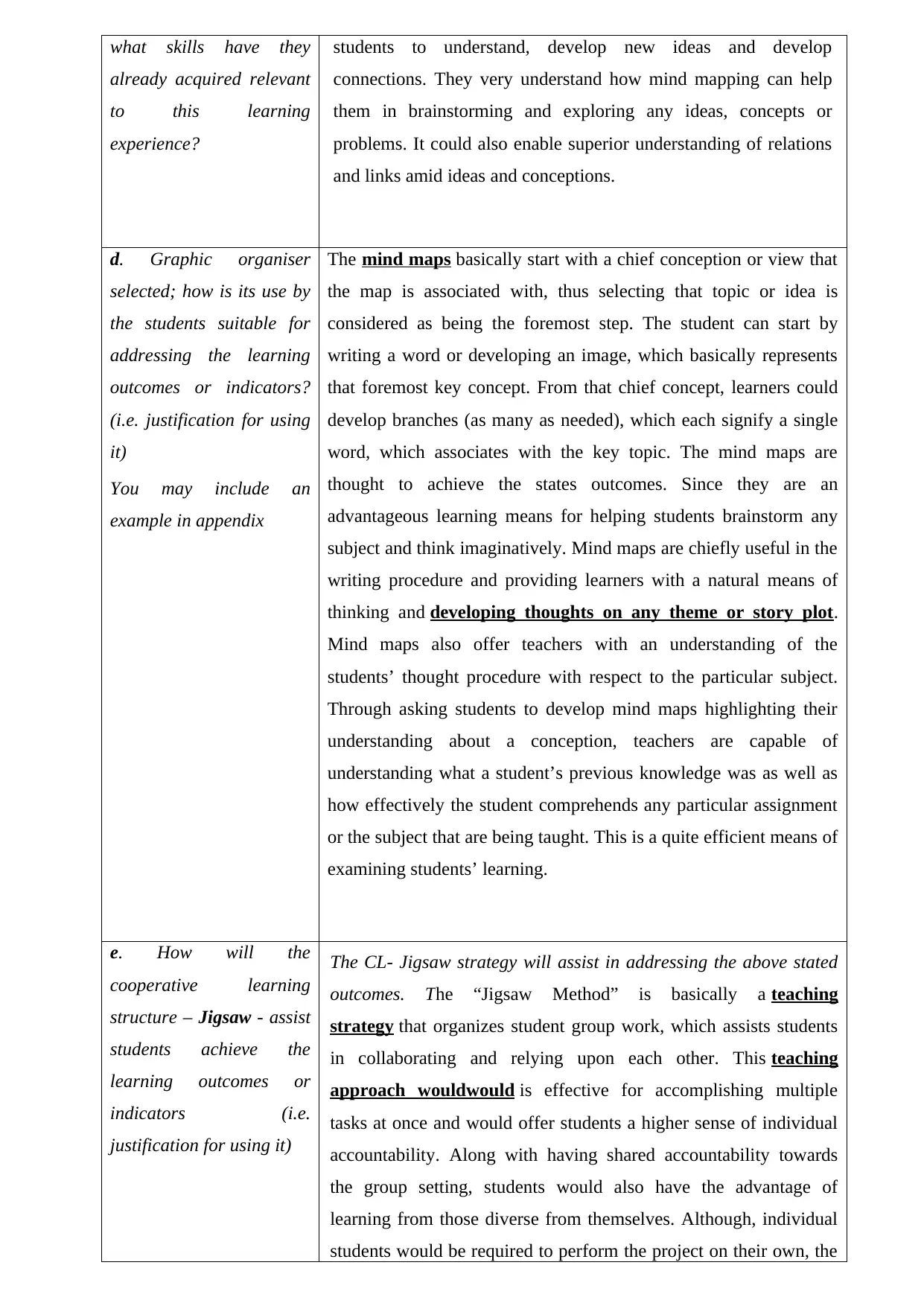
The mind maps basically start with a chief conception or view that
the map is associated with, thus selecting that topic or idea is
considered as being the foremost step. The student can start by
writing a word or developing an image, which basically represents
that foremost key concept. From that chief concept, learners could
develop branches (as many as needed), which each signify a single
word, which associates with the key topic. The mind maps are
thought to achieve the states outcomes. Since they are an
advantageous learning means for helping students brainstorm any
subject and think imaginatively. Mind maps are chiefly useful in the
writing procedure and providing learners with a natural means of
thinking and developing thoughts on any theme or story plot.
Mind maps also offer teachers with an understanding of the
students’ thought procedure with respect to the particular subject.
Through asking students to develop mind maps highlighting their
understanding about a conception, teachers are capable of
understanding what a student’s previous knowledge was as well as
how effectively the student comprehends any particular assignment
or the subject that are being taught. This is a quite efficient means of
examining students’ learning.
e. How will the
cooperative learning
structure – Jigsaw - assist
students achieve the
learning outcomes or
indicators (i.e.
justification for using it)
The CL- Jigsaw strategy will assist in addressing the above stated
outcomes. The “Jigsaw Method” is basically a teaching
strategy that organizes student group work, which assists students
in collaborating and relying upon each other. This teaching
approach wouldwould is effective for accomplishing multiple
tasks at once and would offer students a higher sense of individual
accountability. Along with having shared accountability towards
the group setting, students would also have the advantage of
learning from those diverse from themselves. Although, individual
students would be required to perform the project on their own, the
Document Page
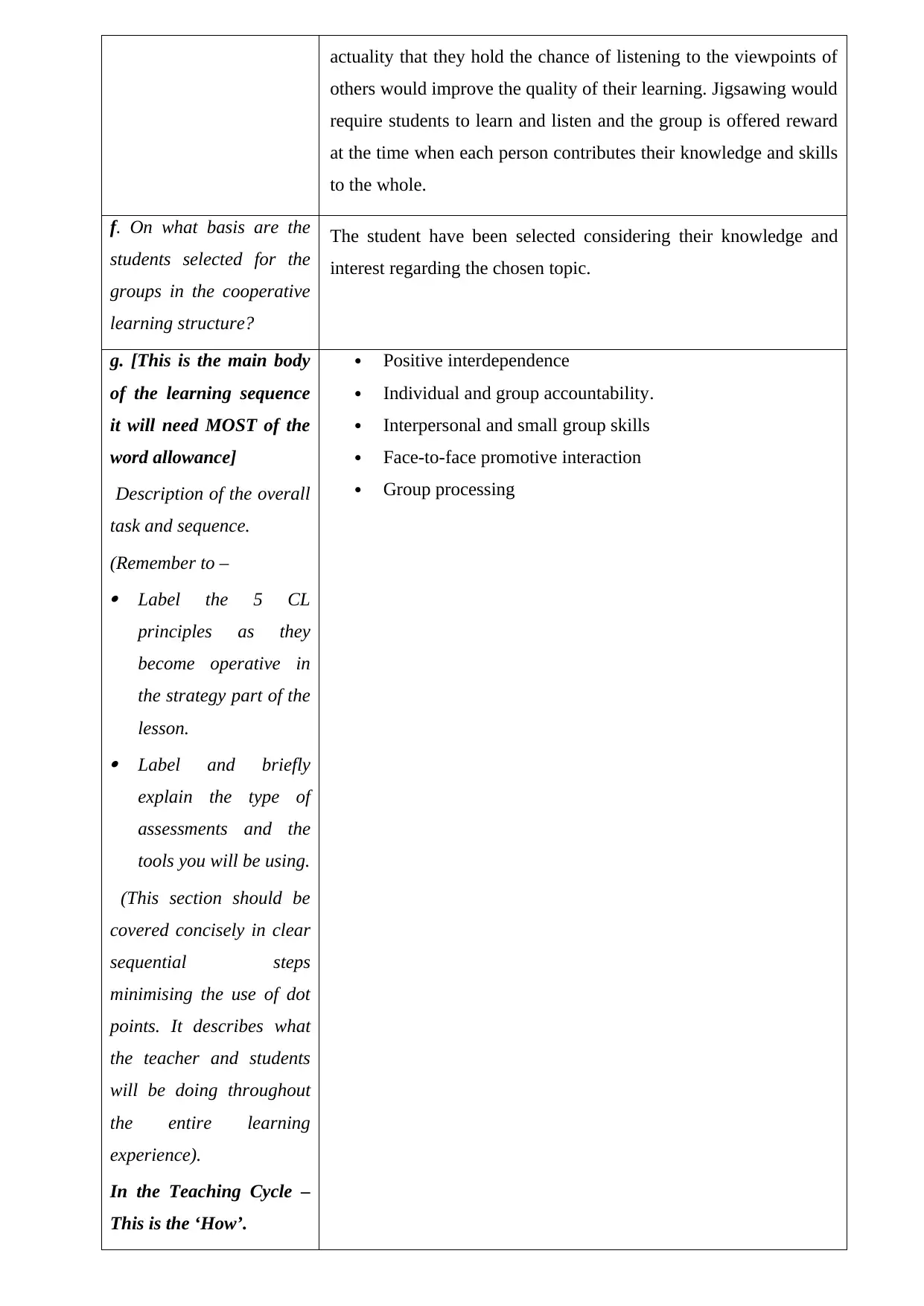
actuality that they hold the chance of listening to the viewpoints of
others would improve the quality of their learning. Jigsawing would
require students to learn and listen and the group is offered reward
at the time when each person contributes their knowledge and skills
to the whole.
f. On what basis are the
students selected for the
groups in the cooperative
learning structure?
The student have been selected considering their knowledge and
interest regarding the chosen topic.
g. [This is the main body
of the learning sequence
it will need MOST of the
word allowance]
Description of the overall
task and sequence.
(Remember to – Label the 5 CL
principles as they
become operative in
the strategy part of the
lesson. Label and briefly
explain the type of
assessments and the
tools you will be using.
(This section should be
covered concisely in clear
sequential steps
minimising the use of dot
points. It describes what
the teacher and students
will be doing throughout
the entire learning
experience).
In the Teaching Cycle –
This is the ‘How’.
Positive interdependence
Individual and group accountability.
Interpersonal and small group skills
Face-to-face promotive interaction
Group processing
Document Page
chevron_up_icon
1 out of 4
circle_padding
hide_on_mobile
zoom_out_icon
[object Object]