Marketing Analysis: Product Launch and Consumer Behavior
VerifiedAdded on 2019/09/22
|25
|5455
|177
Homework Assignment
AI Summary
This marketing assignment delves into various aspects of product launch strategies and consumer behavior. The student analyzes the effectiveness of coupons in test markets, exploring different coupon sequences and their impact on trial and repeat rates. The assignment further examines the implications of rebate offers on sales and profitability, considering factors such as cost price, selling price, and administrative costs. A switching matrix is used to evaluate the performance of different firms, and the student provides insights into competitive analysis and strategic recommendations. Furthermore, the assignment involves analyzing consumer attitudes towards different brands using a multi-attribute model and exploring strategies to improve brand perception. The student also interprets factor analysis output related to shampoo attributes and creates a perceptual map to identify competitors and propose distinct brand positioning strategies. Finally, the student outlines the design of a new shampoo brand based on market analysis and consumer needs.

PART 1: Please answer any 2 of the 4 questions. Each question is worth 100 points.
1. Assume you are contemplating the launch of a new product your firm has designed. There is
pressure internally for the product to become profitable as soon as possible and you are
contemplating the use of coupons to encourage trial. You conduct a test market – you select
two cities and launch the product without coupons in one and with coupons in the other. You
are examining the data from these test markets.
a. What would you conclude about the advisability of using coupons?
Control group Coupon group
Trial rate (%) 7.5 10
Repeat rate (%) 20 10
My advice is that we should not encourage product coupons as we have less repeat rate
when compared to the coupon without group so we can conclude that we have more profit
from without coupon group when compared to the with product coupon group.
b. You have reason to believe that the coupon effectiveness could be improved because a
single coupon may generate trial but is insufficient for long term consumer behavior.
You decide to explore the role of multiple coupons. Which of the following sequence of
coupons do you think would be most effective? Why?
Plan A 40% off 40% off 40% off 40% off
Plan B 10% off 20% off 30% off 40% off
Plan C 40% off 30% off 20% off 10% off
My suggestion would be Plan C because in plan A if we give 40% consequently will be a
loss as well as further also people might expect same rebate which might be a problem
too, in plan B raising the discount rates will not be so impressive for customers and even
if company is not stable it will be difficult to follow the coffer given so I suggest plan C as
best as we provide 40% discount people will be easily attracted and it even helps in
increase in profit over the period as we are reducing the rebate offer.
1. Assume you are contemplating the launch of a new product your firm has designed. There is
pressure internally for the product to become profitable as soon as possible and you are
contemplating the use of coupons to encourage trial. You conduct a test market – you select
two cities and launch the product without coupons in one and with coupons in the other. You
are examining the data from these test markets.
a. What would you conclude about the advisability of using coupons?
Control group Coupon group
Trial rate (%) 7.5 10
Repeat rate (%) 20 10
My advice is that we should not encourage product coupons as we have less repeat rate
when compared to the coupon without group so we can conclude that we have more profit
from without coupon group when compared to the with product coupon group.
b. You have reason to believe that the coupon effectiveness could be improved because a
single coupon may generate trial but is insufficient for long term consumer behavior.
You decide to explore the role of multiple coupons. Which of the following sequence of
coupons do you think would be most effective? Why?
Plan A 40% off 40% off 40% off 40% off
Plan B 10% off 20% off 30% off 40% off
Plan C 40% off 30% off 20% off 10% off
My suggestion would be Plan C because in plan A if we give 40% consequently will be a
loss as well as further also people might expect same rebate which might be a problem
too, in plan B raising the discount rates will not be so impressive for customers and even
if company is not stable it will be difficult to follow the coffer given so I suggest plan C as
best as we provide 40% discount people will be easily attracted and it even helps in
increase in profit over the period as we are reducing the rebate offer.
Paraphrase This Document
Need a fresh take? Get an instant paraphrase of this document with our AI Paraphraser

c. Based upon your answer to b, you select a plan for the use of multiple coupons. You do
not have time for conducting another test market. So, you conduct a quick experiment
and find that of 100 participants presented with your new coupon plan, 15% try the
product at some time during the sequence of coupons. What should the repeat rate be
to make the use of coupons worthwhile?
Based upon my answer as plan C the repeat rate should be around 6% as it
reaches around 90% and we even know it is very tough to achieve 100% so the
required return rate will be 6%
d. It’s a couple of years later. The launch of your product was successful and it is a
profitable product in the line. One of your colleagues suggests a 20% off rebate
(consumers can mail in their bill and get 20% of the value of their purchase refunded)
during the holiday season to increase sales. He estimates that the rebate will increase
sales by 10%. You point out that your objective is to maximize profits rather than sales.
He suggests that the increase in sales would translate into an increase in profits. Is there
any other information you would want before making a decision on the advisability of
the proposed rebate offer?
Yes, I agree with his point that always increase in sales doesn’t mean increase in
profit for example if a product cost price (C.P) is $8 and the selling price (S.P) is
$10 but you give a rebate of 20% which means now the C.P=S.P, so there is no
increase of profit even in case of increase of sales by 10%. But we can try one
more logic that we increase the product S.P by $ 2.5 and give 20% rebate as
proposed then we will be getting a profit of $2 as usual and even our sales will
increase by 10% and obviously our profits also increase.
not have time for conducting another test market. So, you conduct a quick experiment
and find that of 100 participants presented with your new coupon plan, 15% try the
product at some time during the sequence of coupons. What should the repeat rate be
to make the use of coupons worthwhile?
Based upon my answer as plan C the repeat rate should be around 6% as it
reaches around 90% and we even know it is very tough to achieve 100% so the
required return rate will be 6%
d. It’s a couple of years later. The launch of your product was successful and it is a
profitable product in the line. One of your colleagues suggests a 20% off rebate
(consumers can mail in their bill and get 20% of the value of their purchase refunded)
during the holiday season to increase sales. He estimates that the rebate will increase
sales by 10%. You point out that your objective is to maximize profits rather than sales.
He suggests that the increase in sales would translate into an increase in profits. Is there
any other information you would want before making a decision on the advisability of
the proposed rebate offer?
Yes, I agree with his point that always increase in sales doesn’t mean increase in
profit for example if a product cost price (C.P) is $8 and the selling price (S.P) is
$10 but you give a rebate of 20% which means now the C.P=S.P, so there is no
increase of profit even in case of increase of sales by 10%. But we can try one
more logic that we increase the product S.P by $ 2.5 and give 20% rebate as
proposed then we will be getting a profit of $2 as usual and even our sales will
increase by 10% and obviously our profits also increase.

e. Following up on d, you commission your own study and find that your colleagues
estimate was right – the rebate does result in an increase in sales of 10%. Specifically,
you selected two markets of approximately 10,000 consumers each and ran advertising
suggesting the purchase of the product for the holidays in both markets and added the
rebate offer in one of them. In the market without the rebate offer, 5000 consumers
purchased the product. In the market with the rebate offer, 5500 consumers purchased
the product and 2000 rebates were claimed. Assuming your product costs $100 and an
equal amount is spent on advertising with or without the rebate offer and the
administrative costs of the rebate program are $ 25,000, what are the implications of
the rebate offer for profitability?
As per me there is no option for profitability only as we calculate the costs as per given
question, the product sold without rebate are 5000 if it is multiplied with 100 we get it
as 5lac and as per question it is also given that only 2000 people took rebate so there
cost price will 80* 2000 which will be 1.6lac and remaining people 3500 took for 100
which will give 3.5 lac when it is totaled it will be 10.1lac , where the revenue without
any rebate for 10000 people were going to be 10lac. But again it is said that 25000 was
spent on advertising so we have not got any profit in return we have only lost $15000.
estimate was right – the rebate does result in an increase in sales of 10%. Specifically,
you selected two markets of approximately 10,000 consumers each and ran advertising
suggesting the purchase of the product for the holidays in both markets and added the
rebate offer in one of them. In the market without the rebate offer, 5000 consumers
purchased the product. In the market with the rebate offer, 5500 consumers purchased
the product and 2000 rebates were claimed. Assuming your product costs $100 and an
equal amount is spent on advertising with or without the rebate offer and the
administrative costs of the rebate program are $ 25,000, what are the implications of
the rebate offer for profitability?
As per me there is no option for profitability only as we calculate the costs as per given
question, the product sold without rebate are 5000 if it is multiplied with 100 we get it
as 5lac and as per question it is also given that only 2000 people took rebate so there
cost price will 80* 2000 which will be 1.6lac and remaining people 3500 took for 100
which will give 3.5 lac when it is totaled it will be 10.1lac , where the revenue without
any rebate for 10000 people were going to be 10lac. But again it is said that 25000 was
spent on advertising so we have not got any profit in return we have only lost $15000.
⊘ This is a preview!⊘
Do you want full access?
Subscribe today to unlock all pages.

Trusted by 1+ million students worldwide

2. Based upon scanner panel data, you have constructed the following switching matrix.
a. Evaluate the performance of the three firms A, B and C.
b. Assume you are a manager at Firm A. What is your analysis of the situation? Who is the
bigger threat, B or C? What ideas would you pursue?
Time 1
Time 2
A B C None (no
purchase)
A 4 3 3 5 15
B 5 8 0 2 15
C 5 0 12 3 20
None (no
purchase)
1 9 0 40 50
15 20 15 50 100
a. Evaluate the performance of the three firms A, B and C.
b. Assume you are a manager at Firm A. What is your analysis of the situation? Who is the
bigger threat, B or C? What ideas would you pursue?
Time 1
Time 2
A B C None (no
purchase)
A 4 3 3 5 15
B 5 8 0 2 15
C 5 0 12 3 20
None (no
purchase)
1 9 0 40 50
15 20 15 50 100
Paraphrase This Document
Need a fresh take? Get an instant paraphrase of this document with our AI Paraphraser

c. Assume that after time 2, you instituted two programs. The first was a loyalty program
and the second was a program to convert non-users into users of your product. You
track the scanner panel data and at time 3, you construct a new switching matrix.
Evaluate the two programs and make your recommendations for them.
d. Take stock of the situation now after your answer to c above. What ideas would you
pursue?
Time 2
Time 3
A B C None
A 12 1 1 1 15
B 4 10 3 3 20
C 4 0 10 1 15
None 0 9 6 35 50
20 20 20 40 100
and the second was a program to convert non-users into users of your product. You
track the scanner panel data and at time 3, you construct a new switching matrix.
Evaluate the two programs and make your recommendations for them.
d. Take stock of the situation now after your answer to c above. What ideas would you
pursue?
Time 2
Time 3
A B C None
A 12 1 1 1 15
B 4 10 3 3 20
C 4 0 10 1 15
None 0 9 6 35 50
20 20 20 40 100

3. Answer the following questions based on the following survey results for soft drinks. These
results identify the salient product attributes and how consumers rate various brands on these
attributes. Assume that e, I and b were measured on 7-point scales ranging from 1 to 7. To receive
full credit, please show all of your work.
_______________________________________
Value (ei) Ideal level (I) Brand Beliefs (bi)
Attribute A B C D
______ ____________________________________________________
High Carbonation 6 7 2 6 4 7
Quenches Thirst 7 5 6 6 7 5
Low Price 5 4 7 7 7 7
Strong Taste 2 4 5 5 7 1
a. Using the ideal point multi-attribute formulation, compute below the total attitude score for each
brand and state which brand is most liked.
Brand Score
A
B
C
D
b. What is the best score a brand could receive?
results identify the salient product attributes and how consumers rate various brands on these
attributes. Assume that e, I and b were measured on 7-point scales ranging from 1 to 7. To receive
full credit, please show all of your work.
_______________________________________
Value (ei) Ideal level (I) Brand Beliefs (bi)
Attribute A B C D
______ ____________________________________________________
High Carbonation 6 7 2 6 4 7
Quenches Thirst 7 5 6 6 7 5
Low Price 5 4 7 7 7 7
Strong Taste 2 4 5 5 7 1
a. Using the ideal point multi-attribute formulation, compute below the total attitude score for each
brand and state which brand is most liked.
Brand Score
A
B
C
D
b. What is the best score a brand could receive?
⊘ This is a preview!⊘
Do you want full access?
Subscribe today to unlock all pages.

Trusted by 1+ million students worldwide

_______________________________________
Value (ei) Ideal level (I) Brand Beliefs (bi)
Attribute A B C D
______ ____________________________________________________
High Carbonation 6 7 2 6 4 7
Quenches Thirst 7 5 6 6 7 5
Low Price 5 4 7 7 7 7
Strong Taste 2 4 5 5 7 1
c. One way brand A might consider trying to improve consumers' attitudes towards its brands is to
change the value consumers attach to the attributes. For each attribute, indicate those changes in the value
scores that would maximize attitudes toward brand A (ignoring how this might affect attitudes towards
competitive brands). If you believe that a change is unnecessary, then write "No Change" in the appropriate
space.
Attribute Desired Value Score
High Carbonation
Quenches Thirst
Low Price
Strong Taste
d. An alternative strategy for Brand A is to consider changing consumers' beliefs about its
brand. Now, identify those changes in the belief scores that would maximize attitude toward brand
A. Again, write "No Change" if you believe a change for a given attribute is unnecessary.
Attribute Desired Belief Score
High Carbonation
Quenches Thirst
Low Price
Strong Taste
Value (ei) Ideal level (I) Brand Beliefs (bi)
Attribute A B C D
______ ____________________________________________________
High Carbonation 6 7 2 6 4 7
Quenches Thirst 7 5 6 6 7 5
Low Price 5 4 7 7 7 7
Strong Taste 2 4 5 5 7 1
c. One way brand A might consider trying to improve consumers' attitudes towards its brands is to
change the value consumers attach to the attributes. For each attribute, indicate those changes in the value
scores that would maximize attitudes toward brand A (ignoring how this might affect attitudes towards
competitive brands). If you believe that a change is unnecessary, then write "No Change" in the appropriate
space.
Attribute Desired Value Score
High Carbonation
Quenches Thirst
Low Price
Strong Taste
d. An alternative strategy for Brand A is to consider changing consumers' beliefs about its
brand. Now, identify those changes in the belief scores that would maximize attitude toward brand
A. Again, write "No Change" if you believe a change for a given attribute is unnecessary.
Attribute Desired Belief Score
High Carbonation
Quenches Thirst
Low Price
Strong Taste
Paraphrase This Document
Need a fresh take? Get an instant paraphrase of this document with our AI Paraphraser

e. In your answers to parts c and d, you identified multiple attitude change strategies. Next,
identify which single change would result in the greatest improvement in attitudes toward brand A relative
to its competitors. Be sure to clearly indicate whether you are proposing a change in attribute value or a
change in brand belief. Justify your answer.
4. You have collected consumer ratings of all relevant brands of shampoo in the market on various
attributes of interest for one consumer segment. The various attributes are as follows.
a. Smells nice
b. Hair feels silky
c. Hair feels luxurious
d. Removes oils from hair
identify which single change would result in the greatest improvement in attitudes toward brand A relative
to its competitors. Be sure to clearly indicate whether you are proposing a change in attribute value or a
change in brand belief. Justify your answer.
4. You have collected consumer ratings of all relevant brands of shampoo in the market on various
attributes of interest for one consumer segment. The various attributes are as follows.
a. Smells nice
b. Hair feels silky
c. Hair feels luxurious
d. Removes oils from hair

e. Removes odors from hair
f. Leaves hair feeling clean
g. Prevents split ends
h. Moisturizes hair
i. High tech
j. Organic
k. No harsh chemicals
l. Natural ingredients
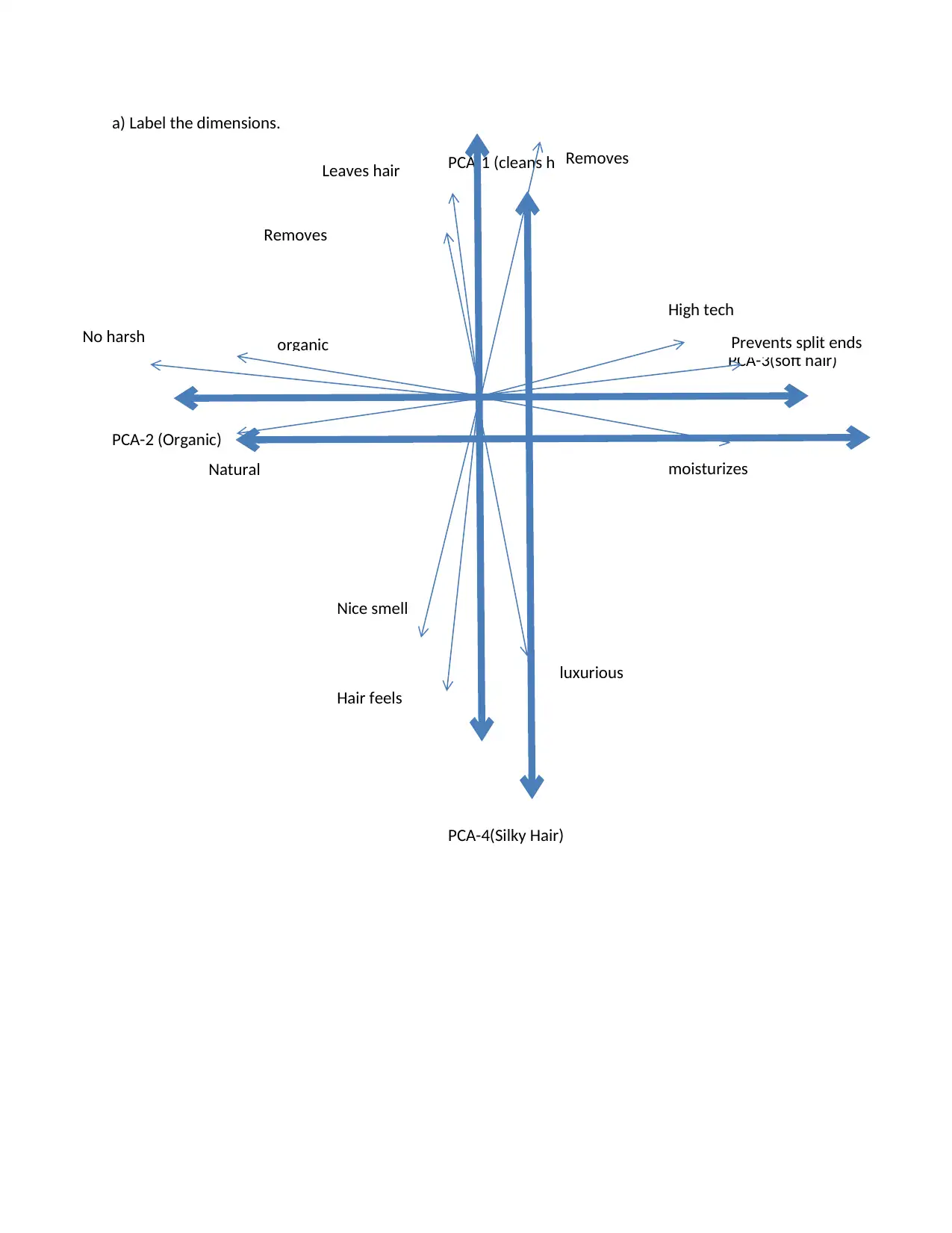
This has allowed you to generate a matrix of (m brands) X (n attributes). You submit this matrix
to a statistical software program for factor analysis and the following output is presented to you.
Please interpret the underlying dimensions.
f. Leaves hair feeling clean
g. Prevents split ends
h. Moisturizes hair
i. High tech
j. Organic
k. No harsh chemicals
l. Natural ingredients
This has allowed you to generate a matrix of (m brands) X (n attributes). You submit this matrix
to a statistical software program for factor analysis and the following output is presented to you.
Please interpret the underlying dimensions.
⊘ This is a preview!⊘
Do you want full access?
Subscribe today to unlock all pages.

Trusted by 1+ million students worldwide

a) Label the dimensions.
PCA-1 (cleans hair)
PCA-3(soft hair)
PCA-2 (Organic)
PCA-4(Silky Hair)
luxurious
Nice smell
Hair feels
silky
High tech
Prevents split ends
moisturizesNatural
No harsh
chemicals organic
Removes
Leaves hair
Removes
PCA-1 (cleans hair)
PCA-3(soft hair)
PCA-2 (Organic)
PCA-4(Silky Hair)
luxurious
Nice smell
Hair feels
silky
High tech
Prevents split ends
moisturizesNatural
No harsh
chemicals organic
Removes
Leaves hair
Removes
Paraphrase This Document
Need a fresh take? Get an instant paraphrase of this document with our AI Paraphraser

b) You then proceed to plot the positions of various brands in this perceptual space. Please answer the
following questions using the space on the following page. Please provide your reasoning for the
answers.
a) If you were brand A, who would you consider your biggest competitors?
b) If you wanted a more distinct positioning for brand A (i.e., distinguish brand A from its competitors),
what actions would you take based on this perceptual map?
c) If you were to launch a new brand of shampoo, what sort of shampoo would you design? Why?
I
A
H
G
F
E
D
C
B
following questions using the space on the following page. Please provide your reasoning for the
answers.
a) If you were brand A, who would you consider your biggest competitors?
b) If you wanted a more distinct positioning for brand A (i.e., distinguish brand A from its competitors),
what actions would you take based on this perceptual map?
c) If you were to launch a new brand of shampoo, what sort of shampoo would you design? Why?
I
A
H
G
F
E
D
C
B

a) If I’m brand A I would consider my competitors as brand H as it is plotted more
towards positive x axis and y axis too, then the next competitor is B as it is plotted
more towards positive x axis and y axis too, next will be the competitor C as it.
b) If we want more distinct position for brand A then we should increase the sales which
in turn increases the profit with proper business logic and here I have taken the x axis
as sales versus y axis as profit.
c) If we are going to launch a new brand of product we would design a shampoo which
reduces hair fall as nowadays lots of people are suffering from hair fall due to many
factors like pollution and many more so through that we can improve the product
quality and the sales which in turn leads to profit.
towards positive x axis and y axis too, then the next competitor is B as it is plotted
more towards positive x axis and y axis too, next will be the competitor C as it.
b) If we want more distinct position for brand A then we should increase the sales which
in turn increases the profit with proper business logic and here I have taken the x axis
as sales versus y axis as profit.
c) If we are going to launch a new brand of product we would design a shampoo which
reduces hair fall as nowadays lots of people are suffering from hair fall due to many
factors like pollution and many more so through that we can improve the product
quality and the sales which in turn leads to profit.
⊘ This is a preview!⊘
Do you want full access?
Subscribe today to unlock all pages.

Trusted by 1+ million students worldwide
1 out of 25
Your All-in-One AI-Powered Toolkit for Academic Success.
+13062052269
info@desklib.com
Available 24*7 on WhatsApp / Email
Unlock your academic potential
Copyright © 2020–2025 A2Z Services. All Rights Reserved. Developed and managed by ZUCOL.