Comprehensive Case Study: Urosepsis Diagnosis and Treatment Plan
VerifiedAdded on 2019/12/28
|13
|4024
|457
Case Study
AI Summary
This case study presents a comprehensive analysis of a patient diagnosed with Urosepsis, a severe form of sepsis affecting the urinary system. The patient, an 82-year-old woman with multiple comorbidities including COPD, hypertension, and AF, presented with symptoms indicative of the infection. The study details the patient's background, initial symptoms, diagnostic procedures including BIPAP, blood tests, urine analysis, and imaging. The discussion section delves into the pathophysiology of Urosepsis, its common signs and symptoms, and the specific manifestations observed in the patient. The case study also outlines the identified problems, goals for treatment, and the strategies implemented, including medication and supportive therapies. The case study highlights the complexities of managing Urosepsis in elderly patients with pre-existing conditions and underscores the importance of timely diagnosis and appropriate treatment to prevent severe complications.
Patient case study-
Urosepsis
Urosepsis

Paraphrase This Document
Need a fresh take? Get an instant paraphrase of this document with our AI Paraphraser
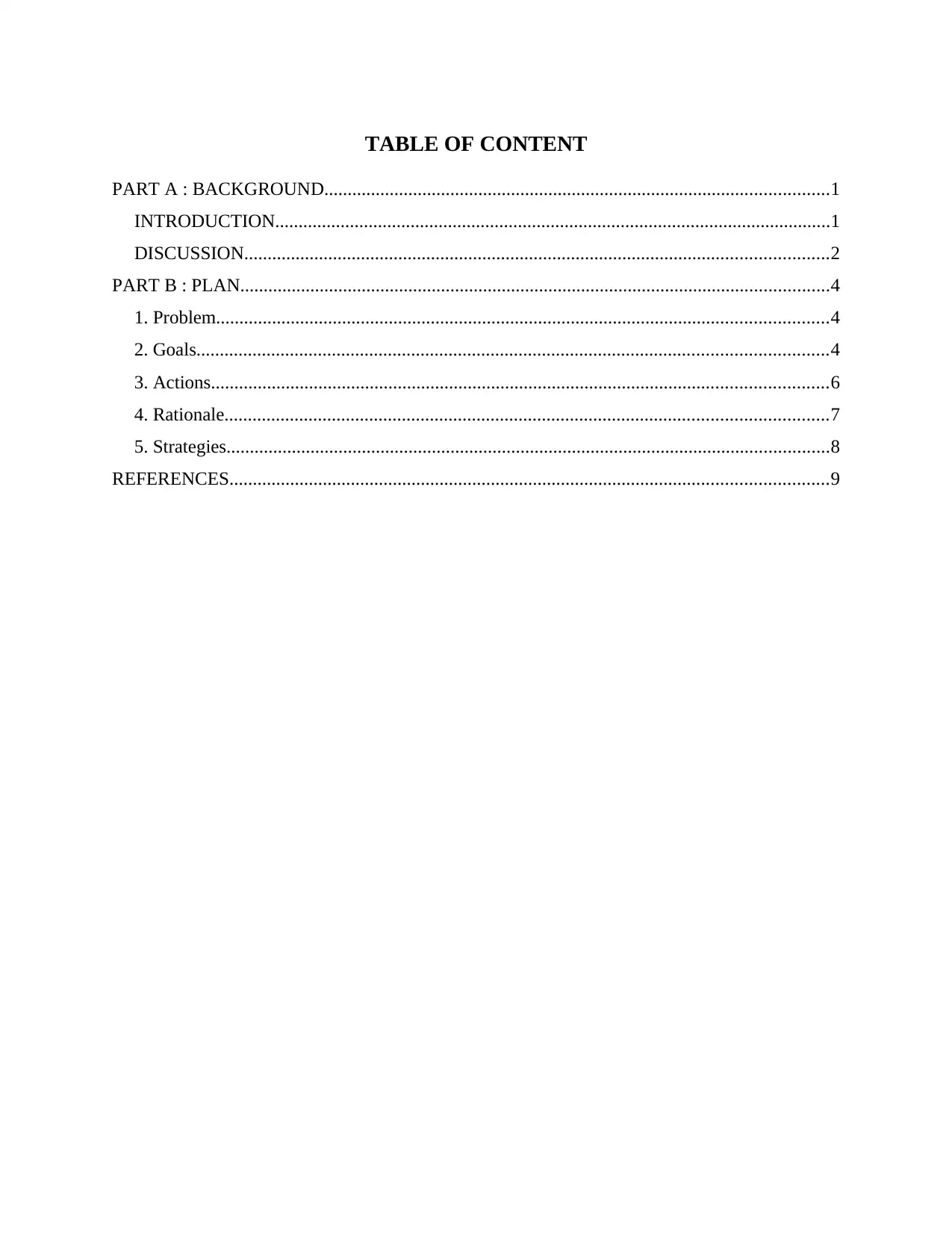
TABLE OF CONTENT
PART A : BACKGROUND............................................................................................................1
INTRODUCTION.......................................................................................................................1
DISCUSSION.............................................................................................................................2
PART B : PLAN..............................................................................................................................4
1. Problem...................................................................................................................................4
2. Goals.......................................................................................................................................4
3. Actions....................................................................................................................................6
4. Rationale.................................................................................................................................7
5. Strategies.................................................................................................................................8
REFERENCES................................................................................................................................9
PART A : BACKGROUND............................................................................................................1
INTRODUCTION.......................................................................................................................1
DISCUSSION.............................................................................................................................2
PART B : PLAN..............................................................................................................................4
1. Problem...................................................................................................................................4
2. Goals.......................................................................................................................................4
3. Actions....................................................................................................................................6
4. Rationale.................................................................................................................................7
5. Strategies.................................................................................................................................8
REFERENCES................................................................................................................................9

⊘ This is a preview!⊘
Do you want full access?
Subscribe today to unlock all pages.

Trusted by 1+ million students worldwide
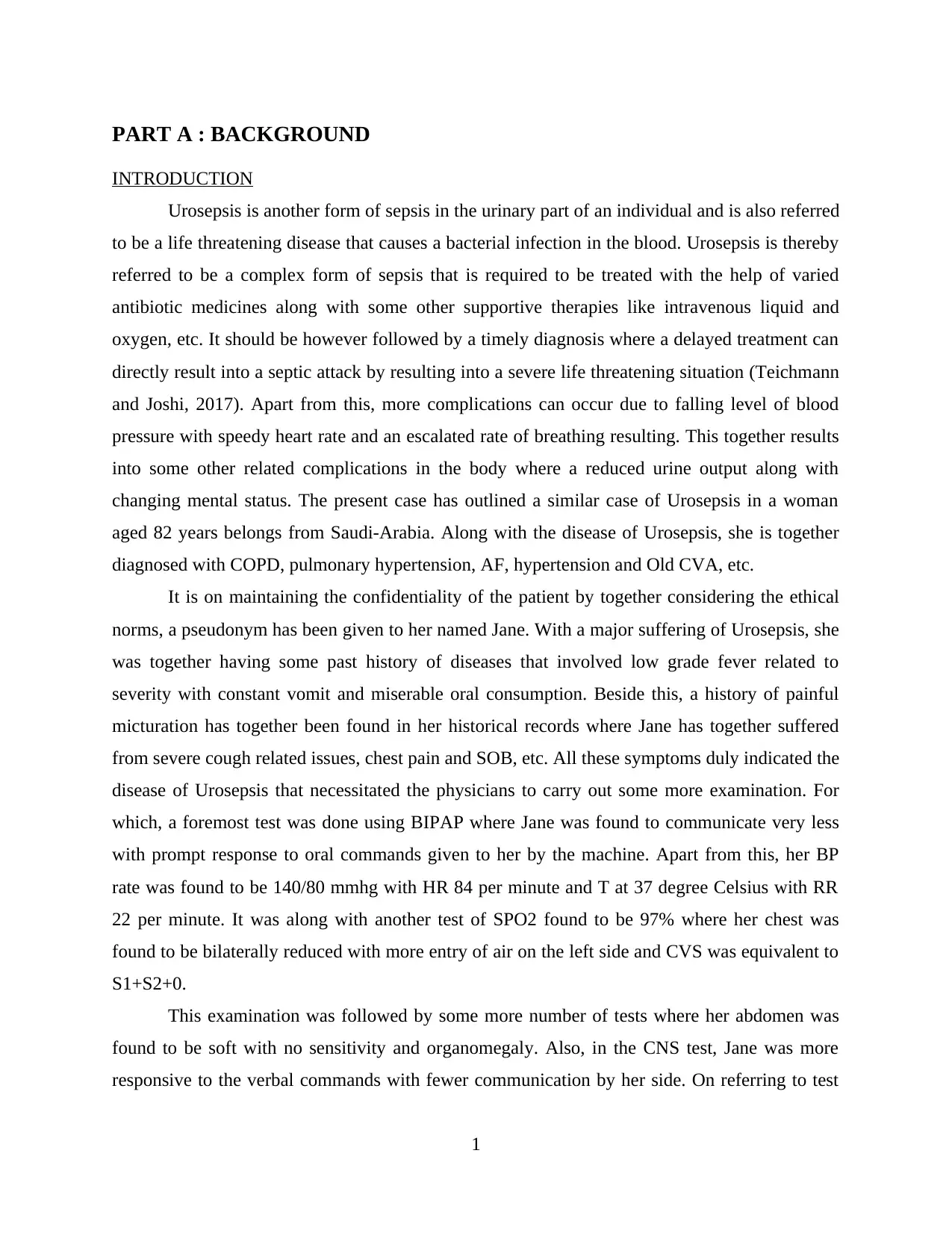
PART A : BACKGROUND
INTRODUCTION
Urosepsis is another form of sepsis in the urinary part of an individual and is also referred
to be a life threatening disease that causes a bacterial infection in the blood. Urosepsis is thereby
referred to be a complex form of sepsis that is required to be treated with the help of varied
antibiotic medicines along with some other supportive therapies like intravenous liquid and
oxygen, etc. It should be however followed by a timely diagnosis where a delayed treatment can
directly result into a septic attack by resulting into a severe life threatening situation (Teichmann
and Joshi, 2017). Apart from this, more complications can occur due to falling level of blood
pressure with speedy heart rate and an escalated rate of breathing resulting. This together results
into some other related complications in the body where a reduced urine output along with
changing mental status. The present case has outlined a similar case of Urosepsis in a woman
aged 82 years belongs from Saudi-Arabia. Along with the disease of Urosepsis, she is together
diagnosed with COPD, pulmonary hypertension, AF, hypertension and Old CVA, etc.
It is on maintaining the confidentiality of the patient by together considering the ethical
norms, a pseudonym has been given to her named Jane. With a major suffering of Urosepsis, she
was together having some past history of diseases that involved low grade fever related to
severity with constant vomit and miserable oral consumption. Beside this, a history of painful
micturation has together been found in her historical records where Jane has together suffered
from severe cough related issues, chest pain and SOB, etc. All these symptoms duly indicated the
disease of Urosepsis that necessitated the physicians to carry out some more examination. For
which, a foremost test was done using BIPAP where Jane was found to communicate very less
with prompt response to oral commands given to her by the machine. Apart from this, her BP
rate was found to be 140/80 mmhg with HR 84 per minute and T at 37 degree Celsius with RR
22 per minute. It was along with another test of SPO2 found to be 97% where her chest was
found to be bilaterally reduced with more entry of air on the left side and CVS was equivalent to
S1+S2+0.
This examination was followed by some more number of tests where her abdomen was
found to be soft with no sensitivity and organomegaly. Also, in the CNS test, Jane was more
responsive to the verbal commands with fewer communication by her side. On referring to test
1
INTRODUCTION
Urosepsis is another form of sepsis in the urinary part of an individual and is also referred
to be a life threatening disease that causes a bacterial infection in the blood. Urosepsis is thereby
referred to be a complex form of sepsis that is required to be treated with the help of varied
antibiotic medicines along with some other supportive therapies like intravenous liquid and
oxygen, etc. It should be however followed by a timely diagnosis where a delayed treatment can
directly result into a septic attack by resulting into a severe life threatening situation (Teichmann
and Joshi, 2017). Apart from this, more complications can occur due to falling level of blood
pressure with speedy heart rate and an escalated rate of breathing resulting. This together results
into some other related complications in the body where a reduced urine output along with
changing mental status. The present case has outlined a similar case of Urosepsis in a woman
aged 82 years belongs from Saudi-Arabia. Along with the disease of Urosepsis, she is together
diagnosed with COPD, pulmonary hypertension, AF, hypertension and Old CVA, etc.
It is on maintaining the confidentiality of the patient by together considering the ethical
norms, a pseudonym has been given to her named Jane. With a major suffering of Urosepsis, she
was together having some past history of diseases that involved low grade fever related to
severity with constant vomit and miserable oral consumption. Beside this, a history of painful
micturation has together been found in her historical records where Jane has together suffered
from severe cough related issues, chest pain and SOB, etc. All these symptoms duly indicated the
disease of Urosepsis that necessitated the physicians to carry out some more examination. For
which, a foremost test was done using BIPAP where Jane was found to communicate very less
with prompt response to oral commands given to her by the machine. Apart from this, her BP
rate was found to be 140/80 mmhg with HR 84 per minute and T at 37 degree Celsius with RR
22 per minute. It was along with another test of SPO2 found to be 97% where her chest was
found to be bilaterally reduced with more entry of air on the left side and CVS was equivalent to
S1+S2+0.
This examination was followed by some more number of tests where her abdomen was
found to be soft with no sensitivity and organomegaly. Also, in the CNS test, Jane was more
responsive to the verbal commands with fewer communication by her side. On referring to test
1
Paraphrase This Document
Need a fresh take? Get an instant paraphrase of this document with our AI Paraphraser
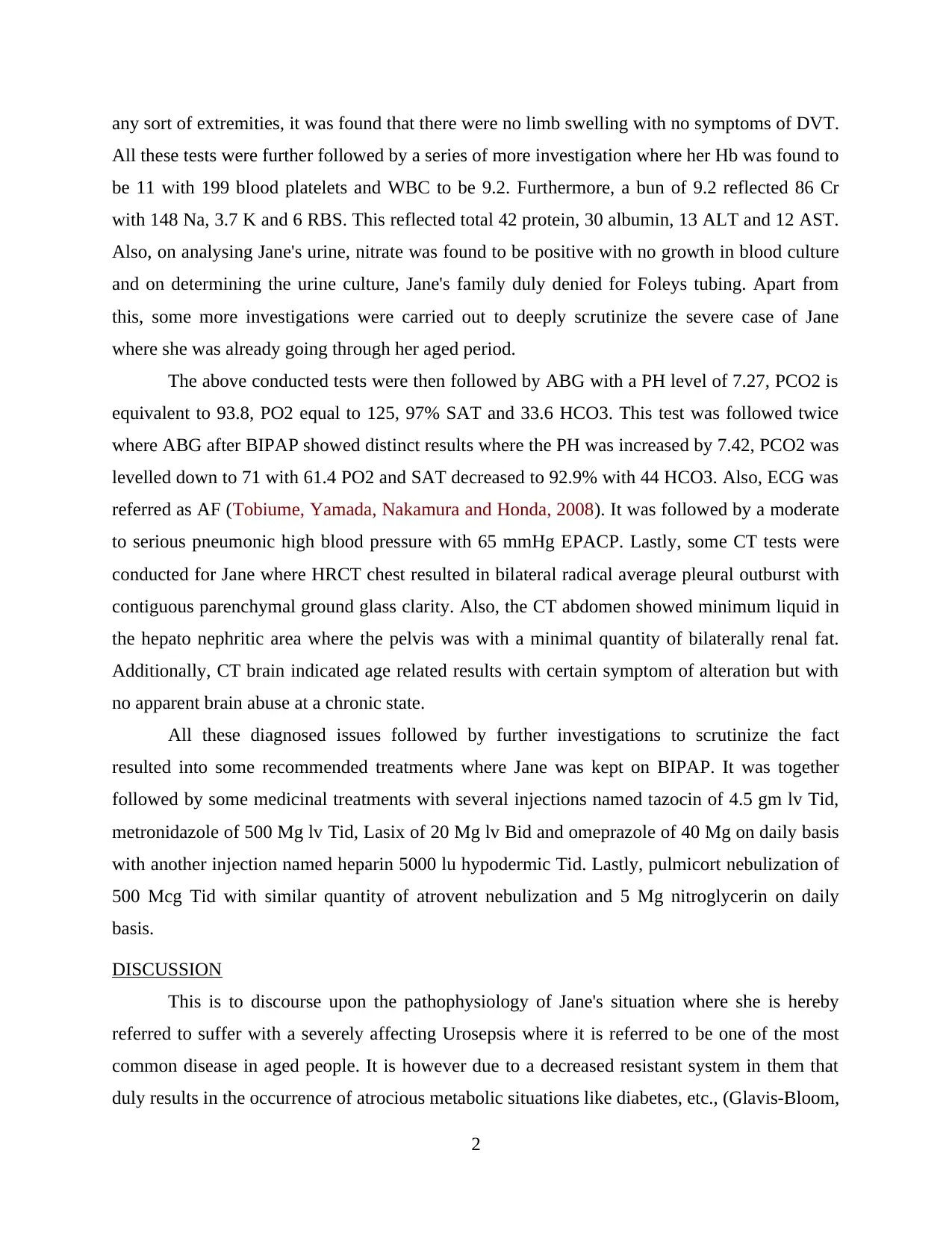
any sort of extremities, it was found that there were no limb swelling with no symptoms of DVT.
All these tests were further followed by a series of more investigation where her Hb was found to
be 11 with 199 blood platelets and WBC to be 9.2. Furthermore, a bun of 9.2 reflected 86 Cr
with 148 Na, 3.7 K and 6 RBS. This reflected total 42 protein, 30 albumin, 13 ALT and 12 AST.
Also, on analysing Jane's urine, nitrate was found to be positive with no growth in blood culture
and on determining the urine culture, Jane's family duly denied for Foleys tubing. Apart from
this, some more investigations were carried out to deeply scrutinize the severe case of Jane
where she was already going through her aged period.
The above conducted tests were then followed by ABG with a PH level of 7.27, PCO2 is
equivalent to 93.8, PO2 equal to 125, 97% SAT and 33.6 HCO3. This test was followed twice
where ABG after BIPAP showed distinct results where the PH was increased by 7.42, PCO2 was
levelled down to 71 with 61.4 PO2 and SAT decreased to 92.9% with 44 HCO3. Also, ECG was
referred as AF (Tobiume, Yamada, Nakamura and Honda, 2008). It was followed by a moderate
to serious pneumonic high blood pressure with 65 mmHg EPACP. Lastly, some CT tests were
conducted for Jane where HRCT chest resulted in bilateral radical average pleural outburst with
contiguous parenchymal ground glass clarity. Also, the CT abdomen showed minimum liquid in
the hepato nephritic area where the pelvis was with a minimal quantity of bilaterally renal fat.
Additionally, CT brain indicated age related results with certain symptom of alteration but with
no apparent brain abuse at a chronic state.
All these diagnosed issues followed by further investigations to scrutinize the fact
resulted into some recommended treatments where Jane was kept on BIPAP. It was together
followed by some medicinal treatments with several injections named tazocin of 4.5 gm lv Tid,
metronidazole of 500 Mg lv Tid, Lasix of 20 Mg lv Bid and omeprazole of 40 Mg on daily basis
with another injection named heparin 5000 lu hypodermic Tid. Lastly, pulmicort nebulization of
500 Mcg Tid with similar quantity of atrovent nebulization and 5 Mg nitroglycerin on daily
basis.
DISCUSSION
This is to discourse upon the pathophysiology of Jane's situation where she is hereby
referred to suffer with a severely affecting Urosepsis where it is referred to be one of the most
common disease in aged people. It is however due to a decreased resistant system in them that
duly results in the occurrence of atrocious metabolic situations like diabetes, etc., (Glavis‐Bloom,
2
All these tests were further followed by a series of more investigation where her Hb was found to
be 11 with 199 blood platelets and WBC to be 9.2. Furthermore, a bun of 9.2 reflected 86 Cr
with 148 Na, 3.7 K and 6 RBS. This reflected total 42 protein, 30 albumin, 13 ALT and 12 AST.
Also, on analysing Jane's urine, nitrate was found to be positive with no growth in blood culture
and on determining the urine culture, Jane's family duly denied for Foleys tubing. Apart from
this, some more investigations were carried out to deeply scrutinize the severe case of Jane
where she was already going through her aged period.
The above conducted tests were then followed by ABG with a PH level of 7.27, PCO2 is
equivalent to 93.8, PO2 equal to 125, 97% SAT and 33.6 HCO3. This test was followed twice
where ABG after BIPAP showed distinct results where the PH was increased by 7.42, PCO2 was
levelled down to 71 with 61.4 PO2 and SAT decreased to 92.9% with 44 HCO3. Also, ECG was
referred as AF (Tobiume, Yamada, Nakamura and Honda, 2008). It was followed by a moderate
to serious pneumonic high blood pressure with 65 mmHg EPACP. Lastly, some CT tests were
conducted for Jane where HRCT chest resulted in bilateral radical average pleural outburst with
contiguous parenchymal ground glass clarity. Also, the CT abdomen showed minimum liquid in
the hepato nephritic area where the pelvis was with a minimal quantity of bilaterally renal fat.
Additionally, CT brain indicated age related results with certain symptom of alteration but with
no apparent brain abuse at a chronic state.
All these diagnosed issues followed by further investigations to scrutinize the fact
resulted into some recommended treatments where Jane was kept on BIPAP. It was together
followed by some medicinal treatments with several injections named tazocin of 4.5 gm lv Tid,
metronidazole of 500 Mg lv Tid, Lasix of 20 Mg lv Bid and omeprazole of 40 Mg on daily basis
with another injection named heparin 5000 lu hypodermic Tid. Lastly, pulmicort nebulization of
500 Mcg Tid with similar quantity of atrovent nebulization and 5 Mg nitroglycerin on daily
basis.
DISCUSSION
This is to discourse upon the pathophysiology of Jane's situation where she is hereby
referred to suffer with a severely affecting Urosepsis where it is referred to be one of the most
common disease in aged people. It is however due to a decreased resistant system in them that
duly results in the occurrence of atrocious metabolic situations like diabetes, etc., (Glavis‐Bloom,
2
and et. al., 2015). It is where the women are at more risk of suffering from this disease and are at
a high risk of UTI which is in turn depicted to be a short and broad urethra. Although, the
patients who are dealing with an obstructed urinary tract are referred to suffer with terrible
infections in their urinary tract that in turn leads to Urosepsis. It is hereby on relating to the case
of Jane where she is an 82 years old women and found to suffer from serious illness of Urosepsis
that is being detected from some common signs and symptoms of this ill health.
Before that, it is better to discourse upon some common signs and symptoms of this
disease to make a clear interpretation of Jane's case by determining the actual measures that has
resulted her to suffer from Urosepsis. Frequent urination is referred to be a foremost syndrome of
this disease that is discovered at the chronic stage of infection in the urinary tract of patient
(Warren, McCarthy and Roberts, 2016). It is where this type of frequency in urination is a
resultant factor of irritation in the urethra that leads to frequent impulse of urination. It is
together followed by yet another major syndrome of dysuria which is basically termed for
painful urination. Into which, patient's urethra tends to swell up with a resultant pain while
passing the urine with a fiery sensation. Hematuria termed for the existence of blood in urine
also indicates Urosepris where the above identified inflammation followed by redness and
swelling also results in bleeding from excretion of urine.
Such existence of blood in urine directly refers to an intensified infection in the upper
area of urinary tract. Flank pain is usually felt in the lower area of back which is itself termed as
flank area with an underling redness and swelling in the kidneys that swell up the area which
emit towards back. Also, fever is referred to be a standard indication of Urosepsis which is
usually experienced right after the start of UTI (Lanternier and et. al., 2015). It is where a
continual fever with high temperature happens after the spread of infection all over the blood
streams. Oliguria which is also termed as a reduced output in terms of urination is when the
kidneys are simply not able to form urine in an efficient manner. Wherein, it is mainly due to an
increased redness and infection. It is where more serious the kidney affectedness will be, it will
significantly lead to anuria which is basically referred to a departed excretion of urine.
It is hereby on relating to the case of Jane in terms of her diagnosed disease of Urosepsis,
it has been found that continual fever was a foremost indication of this disease in her where she
was also undergoing constant pain in her abdominal area. There together exists some other
leading syndrome of Urosepris to relate with the case of Jane. It is where chills is referred to
3
a high risk of UTI which is in turn depicted to be a short and broad urethra. Although, the
patients who are dealing with an obstructed urinary tract are referred to suffer with terrible
infections in their urinary tract that in turn leads to Urosepsis. It is hereby on relating to the case
of Jane where she is an 82 years old women and found to suffer from serious illness of Urosepsis
that is being detected from some common signs and symptoms of this ill health.
Before that, it is better to discourse upon some common signs and symptoms of this
disease to make a clear interpretation of Jane's case by determining the actual measures that has
resulted her to suffer from Urosepsis. Frequent urination is referred to be a foremost syndrome of
this disease that is discovered at the chronic stage of infection in the urinary tract of patient
(Warren, McCarthy and Roberts, 2016). It is where this type of frequency in urination is a
resultant factor of irritation in the urethra that leads to frequent impulse of urination. It is
together followed by yet another major syndrome of dysuria which is basically termed for
painful urination. Into which, patient's urethra tends to swell up with a resultant pain while
passing the urine with a fiery sensation. Hematuria termed for the existence of blood in urine
also indicates Urosepris where the above identified inflammation followed by redness and
swelling also results in bleeding from excretion of urine.
Such existence of blood in urine directly refers to an intensified infection in the upper
area of urinary tract. Flank pain is usually felt in the lower area of back which is itself termed as
flank area with an underling redness and swelling in the kidneys that swell up the area which
emit towards back. Also, fever is referred to be a standard indication of Urosepsis which is
usually experienced right after the start of UTI (Lanternier and et. al., 2015). It is where a
continual fever with high temperature happens after the spread of infection all over the blood
streams. Oliguria which is also termed as a reduced output in terms of urination is when the
kidneys are simply not able to form urine in an efficient manner. Wherein, it is mainly due to an
increased redness and infection. It is where more serious the kidney affectedness will be, it will
significantly lead to anuria which is basically referred to a departed excretion of urine.
It is hereby on relating to the case of Jane in terms of her diagnosed disease of Urosepsis,
it has been found that continual fever was a foremost indication of this disease in her where she
was also undergoing constant pain in her abdominal area. There together exists some other
leading syndrome of Urosepris to relate with the case of Jane. It is where chills is referred to
3
⊘ This is a preview!⊘
Do you want full access?
Subscribe today to unlock all pages.
Trusted by 1+ million students worldwide
another form of high fever which is also a prompt indication of general infection and was duly
dealt by Jane as well (Parikh and et. al., 2014). Beside this, tachycardia termed for an escalated
heart rate also indicates the presence of Urosepsis as experienced by Jane which is mainly due to
the affectedness of the urinary system. In addition to which, it is also a fact where any sort of
infection tends to raise the metabolism rate of the patient by together raising their heart rate
where sepsis is together known to weaken the pulse rate of the patient. These symptoms were
together found in Jane where she together dealt with an increased respiratory rate where her
breathing was duly affected with a terrible state of infection that in turn resulted in septic shock.
Beside this, a hypotension is together referred to be a prime indication of Urosepsis
where it results in atrociously affecting patient's blood pressure with a signified septic shock that
in turn leads to the collapse of cardiovascular organ's. Jane also dealt with a correspondent
situation where hypothermia has also affected her with an aggravated septic shock followed a
high level of fever (Darstein and et. al., 2014). It is however due to an atrocious dilatation of
blood vessels that in turn permit the heat to go away from the body. Lastly, an altered mental
state is together a fundamental indication of this disease where it results into a decreased
insertion to the brain with dispersed infection into the blood stream that in turn results into a
changed mental state. As a result to which, the patients like Jane duly gets unenergetic by
developing a state of lethargy in them and often goes in coma in case the identified disease like
Urosepsis is not treated on immediate basis.
PART B : PLAN
1. Problem
This is to identify the two leading problems referred as actual and potential where the
actual problem that is presently being faced by Jane is Urosepsis. It is mainly on the basis of
above carried diagnosis to scrutinize the range of this ill affect to Jane (Cai and et. al., 2017).
This resulted in the identification of yet another potential problem of Jane where she is already
suffering from hypertension that may in turn affect her kidney in a dreadful manner. It is where
the potential problem has existed from the actual problem and are closely related to one other.
2. Goals
This is with reference to the above identified problems of Jane that can in turn result in
causing more complications to her health (Tait, D. and et. al., 2015). This section has thus
4
dealt by Jane as well (Parikh and et. al., 2014). Beside this, tachycardia termed for an escalated
heart rate also indicates the presence of Urosepsis as experienced by Jane which is mainly due to
the affectedness of the urinary system. In addition to which, it is also a fact where any sort of
infection tends to raise the metabolism rate of the patient by together raising their heart rate
where sepsis is together known to weaken the pulse rate of the patient. These symptoms were
together found in Jane where she together dealt with an increased respiratory rate where her
breathing was duly affected with a terrible state of infection that in turn resulted in septic shock.
Beside this, a hypotension is together referred to be a prime indication of Urosepsis
where it results in atrociously affecting patient's blood pressure with a signified septic shock that
in turn leads to the collapse of cardiovascular organ's. Jane also dealt with a correspondent
situation where hypothermia has also affected her with an aggravated septic shock followed a
high level of fever (Darstein and et. al., 2014). It is however due to an atrocious dilatation of
blood vessels that in turn permit the heat to go away from the body. Lastly, an altered mental
state is together a fundamental indication of this disease where it results into a decreased
insertion to the brain with dispersed infection into the blood stream that in turn results into a
changed mental state. As a result to which, the patients like Jane duly gets unenergetic by
developing a state of lethargy in them and often goes in coma in case the identified disease like
Urosepsis is not treated on immediate basis.
PART B : PLAN
1. Problem
This is to identify the two leading problems referred as actual and potential where the
actual problem that is presently being faced by Jane is Urosepsis. It is mainly on the basis of
above carried diagnosis to scrutinize the range of this ill affect to Jane (Cai and et. al., 2017).
This resulted in the identification of yet another potential problem of Jane where she is already
suffering from hypertension that may in turn affect her kidney in a dreadful manner. It is where
the potential problem has existed from the actual problem and are closely related to one other.
2. Goals
This is with reference to the above identified problems of Jane that can in turn result in
causing more complications to her health (Tait, D. and et. al., 2015). This section has thus
4
Paraphrase This Document
Need a fresh take? Get an instant paraphrase of this document with our AI Paraphraser
referred to set certain effective goals that will in turn result in the betterment of Jane on due
period of time by focussing to resolve the two ascertained problems that are currently being dealt
by Jane. A goal should however reflect a smart formulation where it should be specific,
measurable, achievable, realistic and time bound.
Hence, to resolve the actual issue of Uroseptic, below are the outlined smart goals-
Specific- It is with a precise context of reducing the abdominal pain of Jane caused due
to the actuality of Uroseptic for which she is duly suffering from intense discomfort
and other resultant issues such as improper consumption of food.
Measurable- It is yet another potent scale to frame an assessable goal on the basis of
above specified goal where reduction of abdominal pain is referred to be a principal
objective at present. With reference to which, a 10 level scale has been determined
where Jane’s pain level is intended to reduce by at least 5 which means that the goal
will be evaluated on the basis of 5/10 scale.
Achievable- This is on the basis of above two stages where the foremost goal of pain
reduction in Jane’s abdomen is needed to be reduced by half with a measurable scale
of 5 out of 10 (Jones and et. al., 2015). This needs to specify such nursing interventions
that will in turn result in the prevention of the above identified issue such as the
abdominal pain in Jane due to Urosepsis. Herein, antibiotic medicines are referred to
be a prompt solution to this problem that can duly reduce the abdominal pain of Jane.
Realistic- This stage is to foresee an accurate undertaking of the stipulated
interventions to treat the abdominal pain of Jane. It can be done by referring to the
accessible time period to treat the disease with plentiful resources for the same. In
context to which, Jane will be served with abundant medicinal resources with enough
time.
Time bound- This is the last agenda where a pertinent period will be assigned for the
treatment of abdominal pain in Jane due to Urosepsis. With reference to which, a
minimal time period of 2 weeks have been undertaken for the same.
Another goal is in regard to yet another potential issue of hypertension in Jane with below
identified goals- Specific- This is in context to reduce the state of hypertension in Jane whose abandon can
in turn result in failure of her kidney.
5
period of time by focussing to resolve the two ascertained problems that are currently being dealt
by Jane. A goal should however reflect a smart formulation where it should be specific,
measurable, achievable, realistic and time bound.
Hence, to resolve the actual issue of Uroseptic, below are the outlined smart goals-
Specific- It is with a precise context of reducing the abdominal pain of Jane caused due
to the actuality of Uroseptic for which she is duly suffering from intense discomfort
and other resultant issues such as improper consumption of food.
Measurable- It is yet another potent scale to frame an assessable goal on the basis of
above specified goal where reduction of abdominal pain is referred to be a principal
objective at present. With reference to which, a 10 level scale has been determined
where Jane’s pain level is intended to reduce by at least 5 which means that the goal
will be evaluated on the basis of 5/10 scale.
Achievable- This is on the basis of above two stages where the foremost goal of pain
reduction in Jane’s abdomen is needed to be reduced by half with a measurable scale
of 5 out of 10 (Jones and et. al., 2015). This needs to specify such nursing interventions
that will in turn result in the prevention of the above identified issue such as the
abdominal pain in Jane due to Urosepsis. Herein, antibiotic medicines are referred to
be a prompt solution to this problem that can duly reduce the abdominal pain of Jane.
Realistic- This stage is to foresee an accurate undertaking of the stipulated
interventions to treat the abdominal pain of Jane. It can be done by referring to the
accessible time period to treat the disease with plentiful resources for the same. In
context to which, Jane will be served with abundant medicinal resources with enough
time.
Time bound- This is the last agenda where a pertinent period will be assigned for the
treatment of abdominal pain in Jane due to Urosepsis. With reference to which, a
minimal time period of 2 weeks have been undertaken for the same.
Another goal is in regard to yet another potential issue of hypertension in Jane with below
identified goals- Specific- This is in context to reduce the state of hypertension in Jane whose abandon can
in turn result in failure of her kidney.
5
Measurable- Herein, here BP level is targeted to be reduced to a normal range of 120/80
which is currently found to be 140/80 as a way of reducing the state of hypertension in
Jane. Achievable- Herein, attempting to reduce the blood pressure level of Jane is referred to be
an achievable task where this will be done by referring to lessen down the content of
sodium in her diet followed by proper medication and relaxation therapies, etc., (Urden,
Stacy and Lough, 2014). Realistic- This is in context to determine a convincing existence of the above intervened
measures for Jane to normalise her blood pressure level. With reference to which,
plenteous resources will be undertaken by appointing a professional dietician to closely
monitor her food intake supported by a strict dietary chart. Also, she will be directly
handled by the physiatrists to provide her pertinent therapies of relaxation.
Time bound- All above specified intervention are together in support of a stipulated
duration of 2 weeks followed by further observatory measures on regular basis.
3. Actions
It is on the basis of above intended goals on the basis of two selected problems where this
section will define three nursing interventions for each of the discovered issues of Jane due to
Urosepsis (Busch and et. al., 2016). It is therefore on the basis of the foremost goal framed for
the reduction of pain in the abdominal area of Jane with a painful sensation nearby the urinary
system, below are the three intervened measures-
1. The nurses must be instructed to properly wash their hands with a due usage of
antibacterial soaps. It is with a fundamental sense of maintaining hygiene of both the
patient and of their own where they must wash their hands prior to and after performing
each of the care activity.
2. The nurses dealing with Jane's case for the prevention of Urosepsis are advised to
maintain proper technique of sterilizing at the rime of changing patient's dress, suctioning
them and giving site care to them (Pednekar, Shinde and Pednekar, 2016). This in case of
Jane involves invasive line and a urinary tubes, etc.
3. Lastly, wearing gowns and gloves while taking care of any open wound and also at the
time of making direct contact with Jane's urinary excretion, etc.
6
which is currently found to be 140/80 as a way of reducing the state of hypertension in
Jane. Achievable- Herein, attempting to reduce the blood pressure level of Jane is referred to be
an achievable task where this will be done by referring to lessen down the content of
sodium in her diet followed by proper medication and relaxation therapies, etc., (Urden,
Stacy and Lough, 2014). Realistic- This is in context to determine a convincing existence of the above intervened
measures for Jane to normalise her blood pressure level. With reference to which,
plenteous resources will be undertaken by appointing a professional dietician to closely
monitor her food intake supported by a strict dietary chart. Also, she will be directly
handled by the physiatrists to provide her pertinent therapies of relaxation.
Time bound- All above specified intervention are together in support of a stipulated
duration of 2 weeks followed by further observatory measures on regular basis.
3. Actions
It is on the basis of above intended goals on the basis of two selected problems where this
section will define three nursing interventions for each of the discovered issues of Jane due to
Urosepsis (Busch and et. al., 2016). It is therefore on the basis of the foremost goal framed for
the reduction of pain in the abdominal area of Jane with a painful sensation nearby the urinary
system, below are the three intervened measures-
1. The nurses must be instructed to properly wash their hands with a due usage of
antibacterial soaps. It is with a fundamental sense of maintaining hygiene of both the
patient and of their own where they must wash their hands prior to and after performing
each of the care activity.
2. The nurses dealing with Jane's case for the prevention of Urosepsis are advised to
maintain proper technique of sterilizing at the rime of changing patient's dress, suctioning
them and giving site care to them (Pednekar, Shinde and Pednekar, 2016). This in case of
Jane involves invasive line and a urinary tubes, etc.
3. Lastly, wearing gowns and gloves while taking care of any open wound and also at the
time of making direct contact with Jane's urinary excretion, etc.
6
⊘ This is a preview!⊘
Do you want full access?
Subscribe today to unlock all pages.
Trusted by 1+ million students worldwide
However, to lower down the stated of hypertension in Jane with by lessening down her
blood pressure level, below are the three nursing interventions-
1. Monitoring and recording BP by measuring it on both the arms and thighs of the patient
like Jane which must be done at least 3 times with a gap of 3–5 min. Also, it must be
done when the patient is taking rest, after which he or she is sitting followed by standing
for initial assessment by using accurate cuff size and correct method.
2. Observing the skin colour of the patient by together monitoring the moisture level,
temperature and refill time of capillary is also advisable to the nurses treating Jane as a
way of treating her hypertension syndrome (Zwaans, Chancellor and Lamb, 2016).
3. Noting independent and general oedema should also be done whose importance is
explicated in the below section.
4. Rationale
It is on the basis of above intervened goals for the nurses who are specially appointed to
deal with the Urosepsis case of Jane (Mohammed and et. al., 2016). Wherein, each of the
undertaken interventions are composed of some principle explanations, as stated below for the
interventions taken up for the foremost goal-
1. It is where the hand washing to maintain the hygiene will duly result in lessening down
the peril of cross contamination.
2. A well maintained sterile technique is referred to result into a lowered risk of nosocomial
contagion (Teichmann and Joshi, 2017).
3. Lastly, a proper use of wearable cloths such as gowns and gloves while treating the
patient will directly result in the prevention of dispersed infection and cross contaminant.
Another rationale is in context to the interventions taken up for the reduction of
hypertension in Jane, as mentioned below-
1. It is where the comparison of pressure level on continuous basis and with efficient
techniques will tend to provide a complete representation of vascular involvement by
together defining the actual range of problem.
2. Another intercession of reviewal is apparent to reflect any cardiac decompensation with
reduced output (Minhas and et. al., 2016).
7
blood pressure level, below are the three nursing interventions-
1. Monitoring and recording BP by measuring it on both the arms and thighs of the patient
like Jane which must be done at least 3 times with a gap of 3–5 min. Also, it must be
done when the patient is taking rest, after which he or she is sitting followed by standing
for initial assessment by using accurate cuff size and correct method.
2. Observing the skin colour of the patient by together monitoring the moisture level,
temperature and refill time of capillary is also advisable to the nurses treating Jane as a
way of treating her hypertension syndrome (Zwaans, Chancellor and Lamb, 2016).
3. Noting independent and general oedema should also be done whose importance is
explicated in the below section.
4. Rationale
It is on the basis of above intervened goals for the nurses who are specially appointed to
deal with the Urosepsis case of Jane (Mohammed and et. al., 2016). Wherein, each of the
undertaken interventions are composed of some principle explanations, as stated below for the
interventions taken up for the foremost goal-
1. It is where the hand washing to maintain the hygiene will duly result in lessening down
the peril of cross contamination.
2. A well maintained sterile technique is referred to result into a lowered risk of nosocomial
contagion (Teichmann and Joshi, 2017).
3. Lastly, a proper use of wearable cloths such as gowns and gloves while treating the
patient will directly result in the prevention of dispersed infection and cross contaminant.
Another rationale is in context to the interventions taken up for the reduction of
hypertension in Jane, as mentioned below-
1. It is where the comparison of pressure level on continuous basis and with efficient
techniques will tend to provide a complete representation of vascular involvement by
together defining the actual range of problem.
2. Another intercession of reviewal is apparent to reflect any cardiac decompensation with
reduced output (Minhas and et. al., 2016).
7
Paraphrase This Document
Need a fresh take? Get an instant paraphrase of this document with our AI Paraphraser
3. Lastly, the process of noting down may show any signs of heart failure by together
indicating about some sort of impairment in nephritic or vascular organs of the patient's
like Jane.
5. Strategies
This is to outline such strategic measures that will in turn reflect some positive results
from the intervened measures of treatment (Urden, Stacy and Lough, 2015). Herein, using varied
assessment tools such to measure the pain level of Jane can be used by the physicians as a way of
determining the level of improvement in her. Apart from this, regular monitoring with the help of
reliable diagnostic tests can together be used as a way of acknowledging the success of the
applied nursing interventions.
8
indicating about some sort of impairment in nephritic or vascular organs of the patient's
like Jane.
5. Strategies
This is to outline such strategic measures that will in turn reflect some positive results
from the intervened measures of treatment (Urden, Stacy and Lough, 2015). Herein, using varied
assessment tools such to measure the pain level of Jane can be used by the physicians as a way of
determining the level of improvement in her. Apart from this, regular monitoring with the help of
reliable diagnostic tests can together be used as a way of acknowledging the success of the
applied nursing interventions.
8
REFERENCES
Books and Journal
Busch, M.P. and et. al., 2016. Duration of dengue viremia in blood donors and relationships
between donor viremia, infection incidence and clinical case reports during a large
epidemic. Journal of Infectious Diseases. 214(1). pp.49-54.
Cai, T. and et. al., 2017. Is Preoperative Assessment and Treatment of Asymptomatic Bacteriuria
Necessary for Reducing the Risk of Postoperative Symptomatic Urinary Tract Infections
After Urologic Surgical Procedures?. Urology. 99. pp.100-105.
Darstein, F. and et. al.,2014. Successful treatment of Erdheim–Chester disease with combination
of interleukin‐1‐targeting drugs and high‐dose glucocorticoids. Internal medicine
journal. 44(1). pp.90-92.
Glavis‐Bloom, J. and et. al., 2015. Candida and cardiovascular implantable electronic devices: a
case of lead and native aortic valve endocarditis and literature review. Mycoses. 58(11).
pp.637-641.
Jones, S.L. and et. al., 2015. Reductions in sepsis mortality and costs after design and
implementation of a nurse-based early recognition and response program. The Joint
Commission Journal on Quality and Patient Safety. 41(11). pp.483-AP3.
Lanternier, F. and et. al.,2015. Inherited CARD9 deficiency in 2 unrelated patients with invasive
Exophiala infection. Journal of Infectious Diseases. 211(8). pp.1241-1250.
Minhas, J.S. and et. al., 2016. Immune-mediated reactions to vancomycin: A systematic case
review and analysis. Annals of Allergy, Asthma & Immunology. 116(6). pp.544-553.
Mohammed, W. and et. al.,2016. Six-core versus twelve-core prostate biopsy: a retrospective
study comparing accuracy, oncological outcomes and safety. Irish Journal of Medical
Science (1971-). 185(1). pp.219-223.
Parikh, N.D. and et. al., 2014. Clinical factors that predict noncirrhotic portal hypertension in
HIV-infected patients: a proposed diagnostic algorithm. Journal of Infectious Diseases.
209(5). pp.734-738.
Pednekar, J.L., Shinde, S. and Pednekar, S., 2016. Study of prognostic factors affecting outcome
of urosepsis in a tertiary care hospital in Mumbai. International Surgery Journal. 3(1).
pp.119-122.
Tait, D. and et. al.,2015. Acute and critical care in adult nursing. Learning Matters.
Books and Journal
Busch, M.P. and et. al., 2016. Duration of dengue viremia in blood donors and relationships
between donor viremia, infection incidence and clinical case reports during a large
epidemic. Journal of Infectious Diseases. 214(1). pp.49-54.
Cai, T. and et. al., 2017. Is Preoperative Assessment and Treatment of Asymptomatic Bacteriuria
Necessary for Reducing the Risk of Postoperative Symptomatic Urinary Tract Infections
After Urologic Surgical Procedures?. Urology. 99. pp.100-105.
Darstein, F. and et. al.,2014. Successful treatment of Erdheim–Chester disease with combination
of interleukin‐1‐targeting drugs and high‐dose glucocorticoids. Internal medicine
journal. 44(1). pp.90-92.
Glavis‐Bloom, J. and et. al., 2015. Candida and cardiovascular implantable electronic devices: a
case of lead and native aortic valve endocarditis and literature review. Mycoses. 58(11).
pp.637-641.
Jones, S.L. and et. al., 2015. Reductions in sepsis mortality and costs after design and
implementation of a nurse-based early recognition and response program. The Joint
Commission Journal on Quality and Patient Safety. 41(11). pp.483-AP3.
Lanternier, F. and et. al.,2015. Inherited CARD9 deficiency in 2 unrelated patients with invasive
Exophiala infection. Journal of Infectious Diseases. 211(8). pp.1241-1250.
Minhas, J.S. and et. al., 2016. Immune-mediated reactions to vancomycin: A systematic case
review and analysis. Annals of Allergy, Asthma & Immunology. 116(6). pp.544-553.
Mohammed, W. and et. al.,2016. Six-core versus twelve-core prostate biopsy: a retrospective
study comparing accuracy, oncological outcomes and safety. Irish Journal of Medical
Science (1971-). 185(1). pp.219-223.
Parikh, N.D. and et. al., 2014. Clinical factors that predict noncirrhotic portal hypertension in
HIV-infected patients: a proposed diagnostic algorithm. Journal of Infectious Diseases.
209(5). pp.734-738.
Pednekar, J.L., Shinde, S. and Pednekar, S., 2016. Study of prognostic factors affecting outcome
of urosepsis in a tertiary care hospital in Mumbai. International Surgery Journal. 3(1).
pp.119-122.
Tait, D. and et. al.,2015. Acute and critical care in adult nursing. Learning Matters.
⊘ This is a preview!⊘
Do you want full access?
Subscribe today to unlock all pages.
Trusted by 1+ million students worldwide

1 out of 13


Related Documents


Your All-in-One AI-Powered Toolkit for Academic Success.
+13062052269
info@desklib.com
Available 24*7 on WhatsApp / Email
![[object Object]](/_next/static/media/star-bottom.7253800d.svg)
Unlock your academic potential
Copyright © 2020–2025 A2Z Services. All Rights Reserved. Developed and managed by ZUCOL.