MGT502 Business Communication Assessment 2: Peer Post Critique Report

Verified

Added on  2023/02/01

|4
|432
|20
Discussion Board Post
AI Summary
This document presents a critique of a peer's discussion post on marketing reports within the context of a MGT502 Business Communication assignment. The critique begins by summarizing the original post's focus on defining marketing reports and outlining their types. It acknowledges the post's comprehensiveness in describing marketing report attributes and its alignment with existing literature. However, the critique identifies omissions, such as the report creation process and the specific information included. Despite these gaps, the critique highlights the post's strengths, including its identification of key characteristics and the use of social media data collection methods, referencing relevant sources like Ashley and Tuten (2015) and Jyoti (2010). The student's use of examples, like workplace practices and a sample marketing report link, further enhances the post's informational value. The critique concludes by emphasizing the post's informative nature, supported by its research and relevant examples.
Document Page
Running head: PEER POST CRITIQUE
Critiquing Peer Post
Student Name
Institutional Affiliation
tabler-icon-diamond-filled.svg

Paraphrase This Document

Need a fresh take? Get an instant paraphrase of this document with our AI Paraphraser
Document Page
PEER POST CRITIQUE 2
Critiquing Peer Post
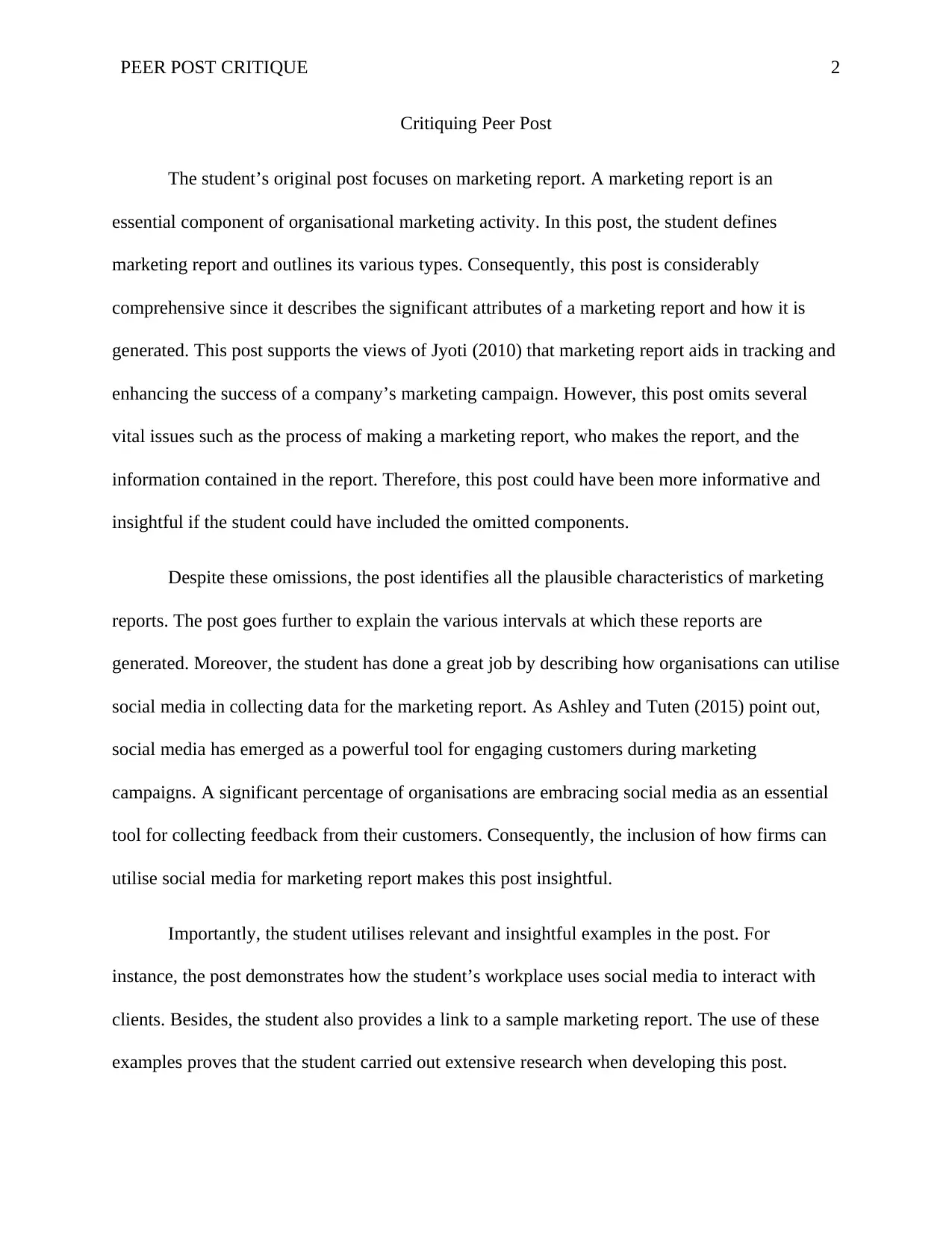
The student’s original post focuses on marketing report. A marketing report is an
essential component of organisational marketing activity. In this post, the student defines
marketing report and outlines its various types. Consequently, this post is considerably
comprehensive since it describes the significant attributes of a marketing report and how it is
generated. This post supports the views of Jyoti (2010) that marketing report aids in tracking and
enhancing the success of a company’s marketing campaign. However, this post omits several
vital issues such as the process of making a marketing report, who makes the report, and the
information contained in the report. Therefore, this post could have been more informative and
insightful if the student could have included the omitted components.
Despite these omissions, the post identifies all the plausible characteristics of marketing
reports. The post goes further to explain the various intervals at which these reports are
generated. Moreover, the student has done a great job by describing how organisations can utilise
social media in collecting data for the marketing report. As Ashley and Tuten (2015) point out,
social media has emerged as a powerful tool for engaging customers during marketing
campaigns. A significant percentage of organisations are embracing social media as an essential
tool for collecting feedback from their customers. Consequently, the inclusion of how firms can
utilise social media for marketing report makes this post insightful.
Importantly, the student utilises relevant and insightful examples in the post. For
instance, the post demonstrates how the student’s workplace uses social media to interact with
clients. Besides, the student also provides a link to a sample marketing report. The use of these
examples proves that the student carried out extensive research when developing this post.
Document Page
PEER POST CRITIQUE 3
Consequently, the inclusion of these two relevant examples in the post makes it detailed and
informative.
Document Page
PEER POST CRITIQUE 4
References
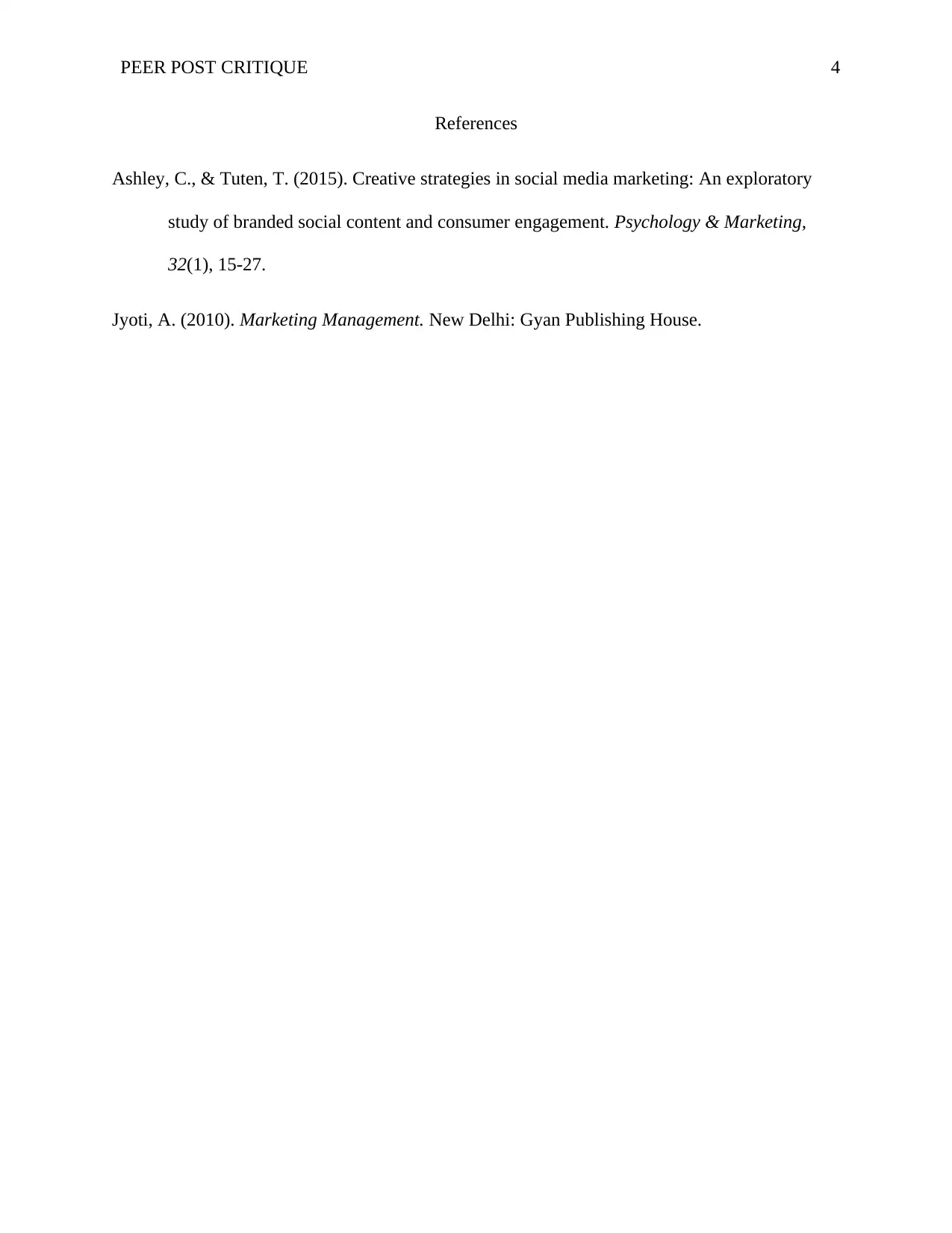
Ashley, C., & Tuten, T. (2015). Creative strategies in social media marketing: An exploratory
study of branded social content and consumer engagement. Psychology & Marketing,
32(1), 15-27.
Jyoti, A. (2010). Marketing Management. New Delhi: Gyan Publishing House.
chevron_up_icon
1 out of 4
circle_padding
hide_on_mobile
zoom_out_icon
[object Object]