Reflection Report on Organisational Behaviour: Individual, Group, Org
VerifiedAdded on  2023/06/11
|6
|1555
|64
Report
AI Summary
This report presents a reflection on organisational behaviour, examining three key areas: the individual, the group, and the organisation. The first part focuses on the individual, using a football video as a case study to explore emotional states, evaluation processes, and analysis of decision-making factors such as intuition and cultural differences. The second part shifts to the group, employing an interactive Snapchat scenario to analyze communication dynamics, emotional expression, and the impact of personality on group interactions. The final section investigates the organisation, specifically examining the merger process through a question-and-answer format to assess emotional states, evaluation criteria, and financial analysis related to potential mergers. Each section includes conclusions and recommendations based on the analysis, supported by relevant references.
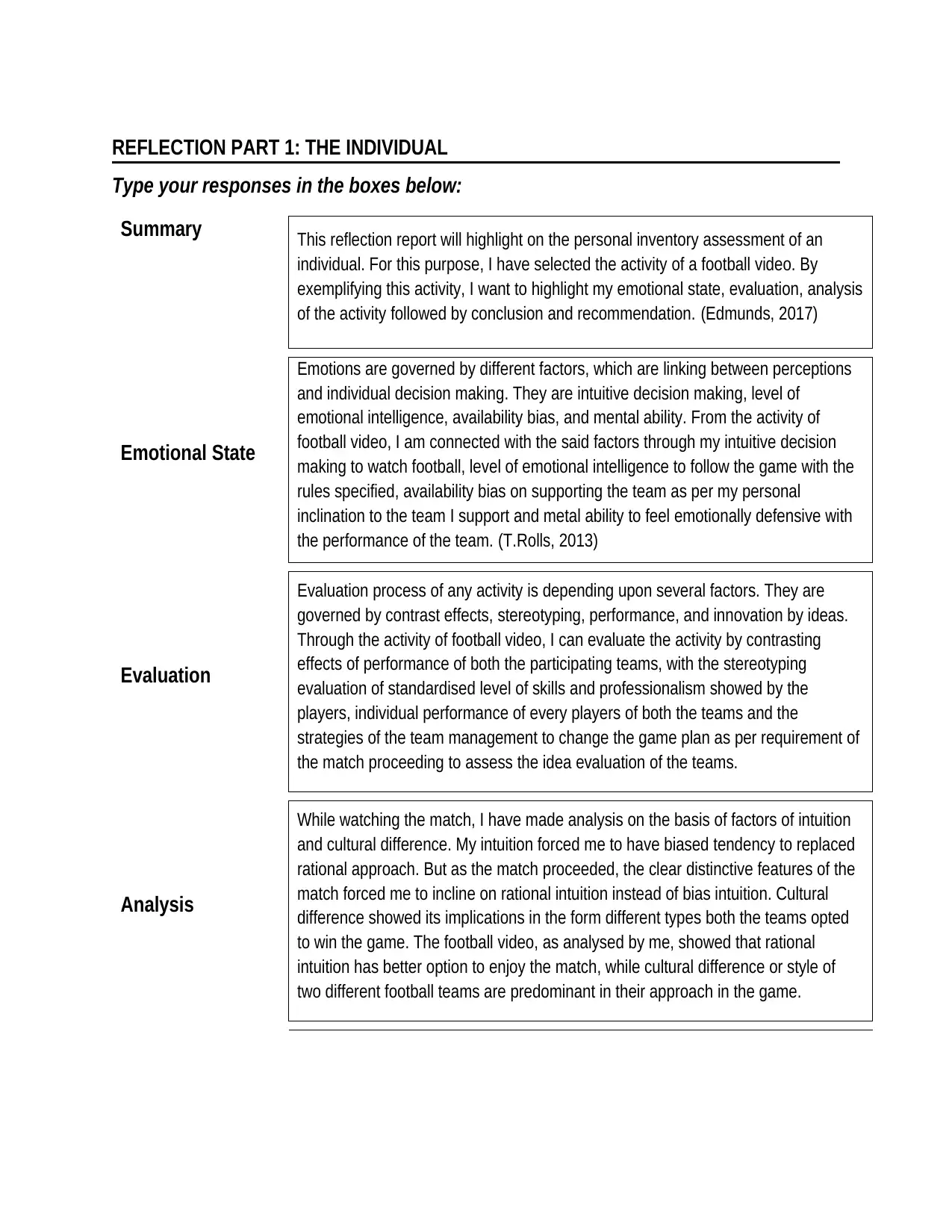
REFLECTION PART 1: THE INDIVIDUAL
Type your responses in the boxes below:
Summary This reflection report will highlight on the personal inventory assessment of an
individual. For this purpose, I have selected the activity of a football video. By
exemplifying this activity, I want to highlight my emotional state, evaluation, analysis
of the activity followed by conclusion and recommendation. (Edmunds, 2017)
Emotional State
Emotions are governed by different factors, which are linking between perceptions
and individual decision making. They are intuitive decision making, level of
emotional intelligence, availability bias, and mental ability. From the activity of
football video, I am connected with the said factors through my intuitive decision
making to watch football, level of emotional intelligence to follow the game with the
rules specified, availability bias on supporting the team as per my personal
inclination to the team I support and metal ability to feel emotionally defensive with
the performance of the team. (T.Rolls, 2013)
Evaluation
Evaluation process of any activity is depending upon several factors. They are
governed by contrast effects, stereotyping, performance, and innovation by ideas.
Through the activity of football video, I can evaluate the activity by contrasting
effects of performance of both the participating teams, with the stereotyping
evaluation of standardised level of skills and professionalism showed by the
players, individual performance of every players of both the teams and the
strategies of the team management to change the game plan as per requirement of
the match proceeding to assess the idea evaluation of the teams.
Analysis
While watching the match, I have made analysis on the basis of factors of intuition
and cultural difference. My intuition forced me to have biased tendency to replaced
rational approach. But as the match proceeded, the clear distinctive features of the
match forced me to incline on rational intuition instead of bias intuition. Cultural
difference showed its implications in the form different types both the teams opted
to win the game. The football video, as analysed by me, showed that rational
intuition has better option to enjoy the match, while cultural difference or style of
two different football teams are predominant in their approach in the game.
Type your responses in the boxes below:
Summary This reflection report will highlight on the personal inventory assessment of an
individual. For this purpose, I have selected the activity of a football video. By
exemplifying this activity, I want to highlight my emotional state, evaluation, analysis
of the activity followed by conclusion and recommendation. (Edmunds, 2017)
Emotional State
Emotions are governed by different factors, which are linking between perceptions
and individual decision making. They are intuitive decision making, level of
emotional intelligence, availability bias, and mental ability. From the activity of
football video, I am connected with the said factors through my intuitive decision
making to watch football, level of emotional intelligence to follow the game with the
rules specified, availability bias on supporting the team as per my personal
inclination to the team I support and metal ability to feel emotionally defensive with
the performance of the team. (T.Rolls, 2013)
Evaluation
Evaluation process of any activity is depending upon several factors. They are
governed by contrast effects, stereotyping, performance, and innovation by ideas.
Through the activity of football video, I can evaluate the activity by contrasting
effects of performance of both the participating teams, with the stereotyping
evaluation of standardised level of skills and professionalism showed by the
players, individual performance of every players of both the teams and the
strategies of the team management to change the game plan as per requirement of
the match proceeding to assess the idea evaluation of the teams.
Analysis
While watching the match, I have made analysis on the basis of factors of intuition
and cultural difference. My intuition forced me to have biased tendency to replaced
rational approach. But as the match proceeded, the clear distinctive features of the
match forced me to incline on rational intuition instead of bias intuition. Cultural
difference showed its implications in the form different types both the teams opted
to win the game. The football video, as analysed by me, showed that rational
intuition has better option to enjoy the match, while cultural difference or style of
two different football teams are predominant in their approach in the game.
Paraphrase This Document
Need a fresh take? Get an instant paraphrase of this document with our AI Paraphraser

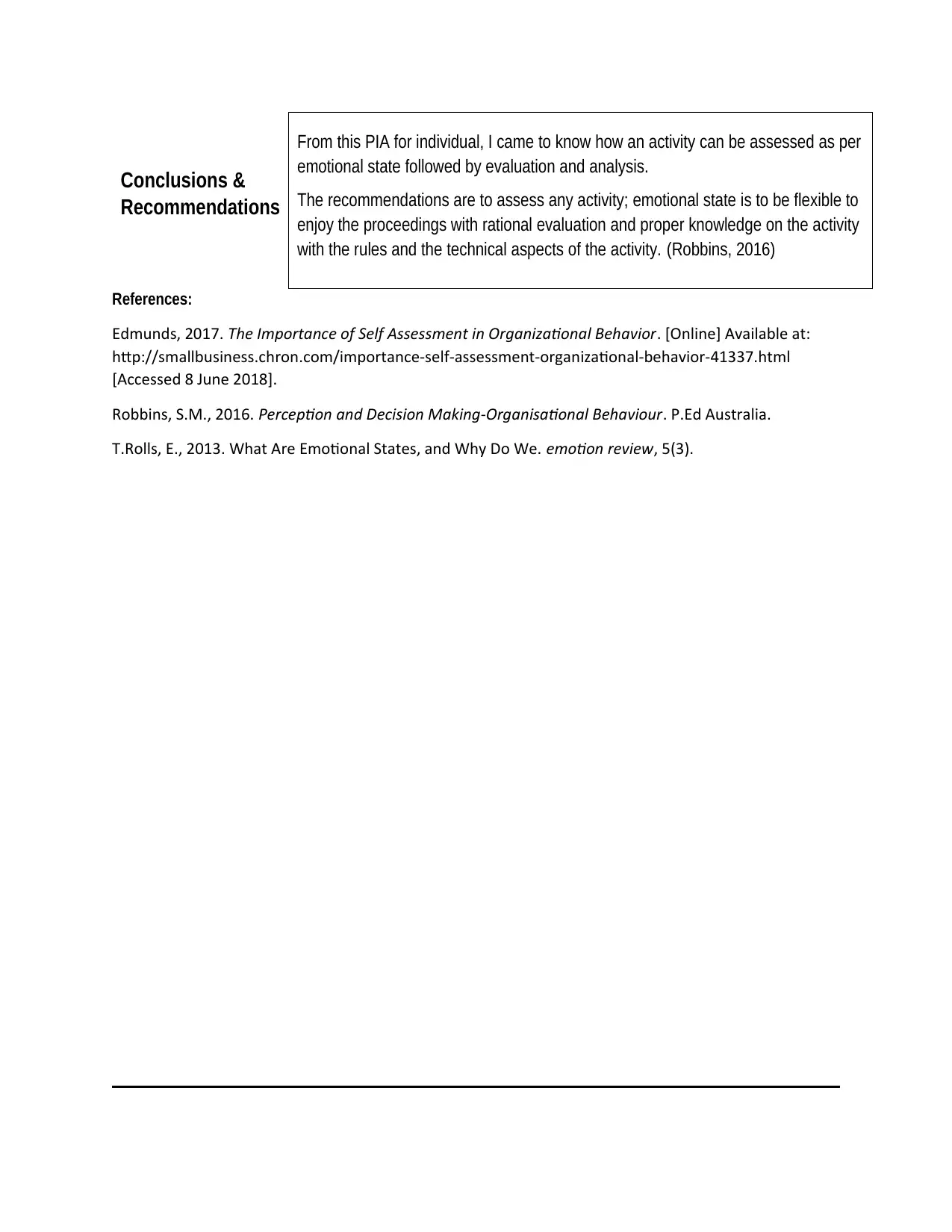
Conclusions &
Recommendations
From this PIA for individual, I came to know how an activity can be assessed as per
emotional state followed by evaluation and analysis.
The recommendations are to assess any activity; emotional state is to be flexible to
enjoy the proceedings with rational evaluation and proper knowledge on the activity
with the rules and the technical aspects of the activity. (Robbins, 2016)
References:
Edmunds, 2017. The Importance of Self Assessment in Organizational Behavior. [Online] Available at:
http://smallbusiness.chron.com/importance-self-assessment-organizational-behavior-41337.html
[Accessed 8 June 2018].
Robbins, S.M., 2016. Perception and Decision Making-Organisational Behaviour. P.Ed Australia.
T.Rolls, E., 2013. What Are Emotional States, and Why Do We. emotion review, 5(3).
Recommendations
From this PIA for individual, I came to know how an activity can be assessed as per
emotional state followed by evaluation and analysis.
The recommendations are to assess any activity; emotional state is to be flexible to
enjoy the proceedings with rational evaluation and proper knowledge on the activity
with the rules and the technical aspects of the activity. (Robbins, 2016)
References:
Edmunds, 2017. The Importance of Self Assessment in Organizational Behavior. [Online] Available at:
http://smallbusiness.chron.com/importance-self-assessment-organizational-behavior-41337.html
[Accessed 8 June 2018].
Robbins, S.M., 2016. Perception and Decision Making-Organisational Behaviour. P.Ed Australia.
T.Rolls, E., 2013. What Are Emotional States, and Why Do We. emotion review, 5(3).

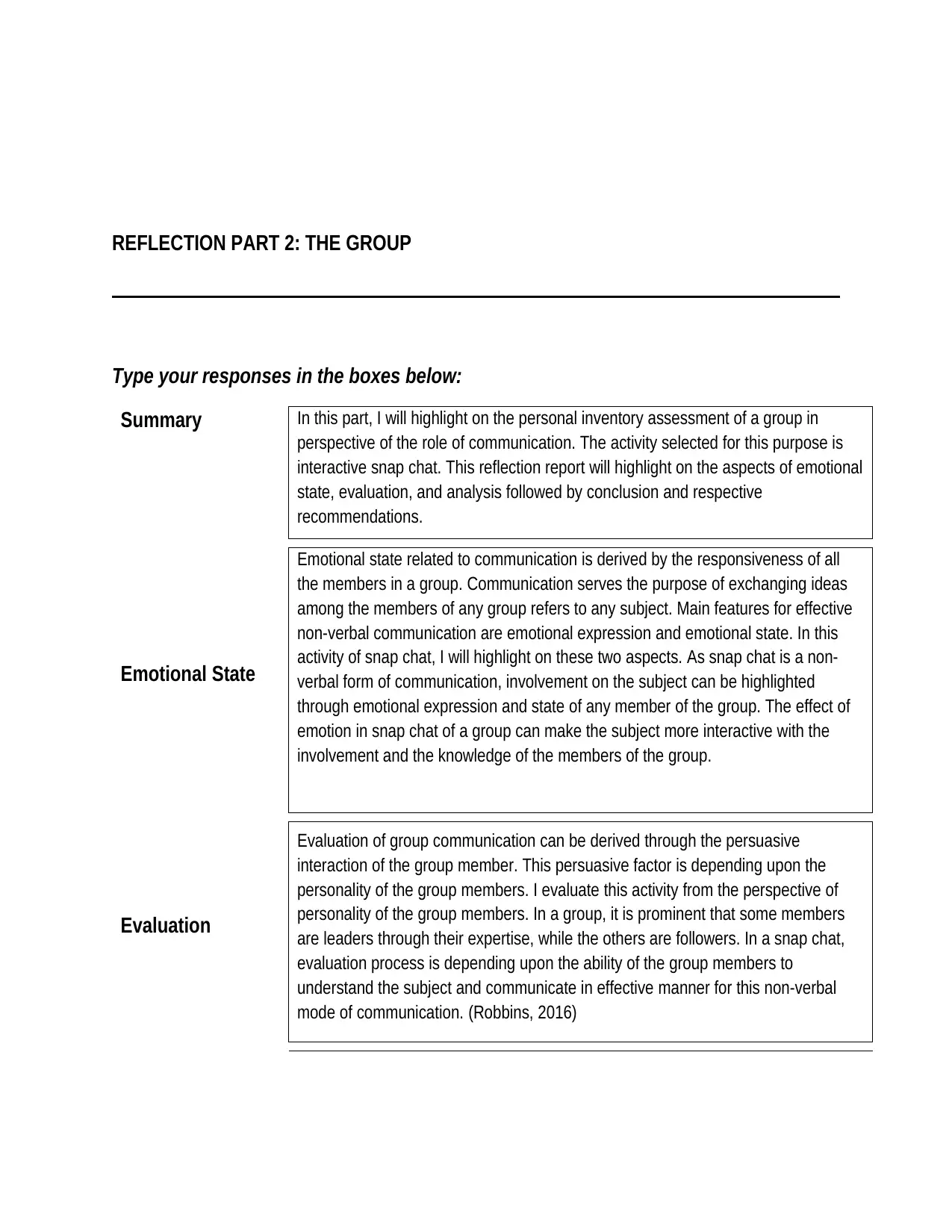
REFLECTION PART 2: THE GROUP
Type your responses in the boxes below:
Summary In this part, I will highlight on the personal inventory assessment of a group in
perspective of the role of communication. The activity selected for this purpose is
interactive snap chat. This reflection report will highlight on the aspects of emotional
state, evaluation, and analysis followed by conclusion and respective
recommendations.
Emotional State
Emotional state related to communication is derived by the responsiveness of all
the members in a group. Communication serves the purpose of exchanging ideas
among the members of any group refers to any subject. Main features for effective
non-verbal communication are emotional expression and emotional state. In this
activity of snap chat, I will highlight on these two aspects. As snap chat is a non-
verbal form of communication, involvement on the subject can be highlighted
through emotional expression and state of any member of the group. The effect of
emotion in snap chat of a group can make the subject more interactive with the
involvement and the knowledge of the members of the group.
Evaluation
Evaluation of group communication can be derived through the persuasive
interaction of the group member. This persuasive factor is depending upon the
personality of the group members. I evaluate this activity from the perspective of
personality of the group members. In a group, it is prominent that some members
are leaders through their expertise, while the others are followers. In a snap chat,
evaluation process is depending upon the ability of the group members to
understand the subject and communicate in effective manner for this non-verbal
mode of communication. (Robbins, 2016)
Type your responses in the boxes below:
Summary In this part, I will highlight on the personal inventory assessment of a group in
perspective of the role of communication. The activity selected for this purpose is
interactive snap chat. This reflection report will highlight on the aspects of emotional
state, evaluation, and analysis followed by conclusion and respective
recommendations.
Emotional State
Emotional state related to communication is derived by the responsiveness of all
the members in a group. Communication serves the purpose of exchanging ideas
among the members of any group refers to any subject. Main features for effective
non-verbal communication are emotional expression and emotional state. In this
activity of snap chat, I will highlight on these two aspects. As snap chat is a non-
verbal form of communication, involvement on the subject can be highlighted
through emotional expression and state of any member of the group. The effect of
emotion in snap chat of a group can make the subject more interactive with the
involvement and the knowledge of the members of the group.
Evaluation
Evaluation of group communication can be derived through the persuasive
interaction of the group member. This persuasive factor is depending upon the
personality of the group members. I evaluate this activity from the perspective of
personality of the group members. In a group, it is prominent that some members
are leaders through their expertise, while the others are followers. In a snap chat,
evaluation process is depending upon the ability of the group members to
understand the subject and communicate in effective manner for this non-verbal
mode of communication. (Robbins, 2016)
⊘ This is a preview!⊘
Do you want full access?
Subscribe today to unlock all pages.

Trusted by 1+ million students worldwide

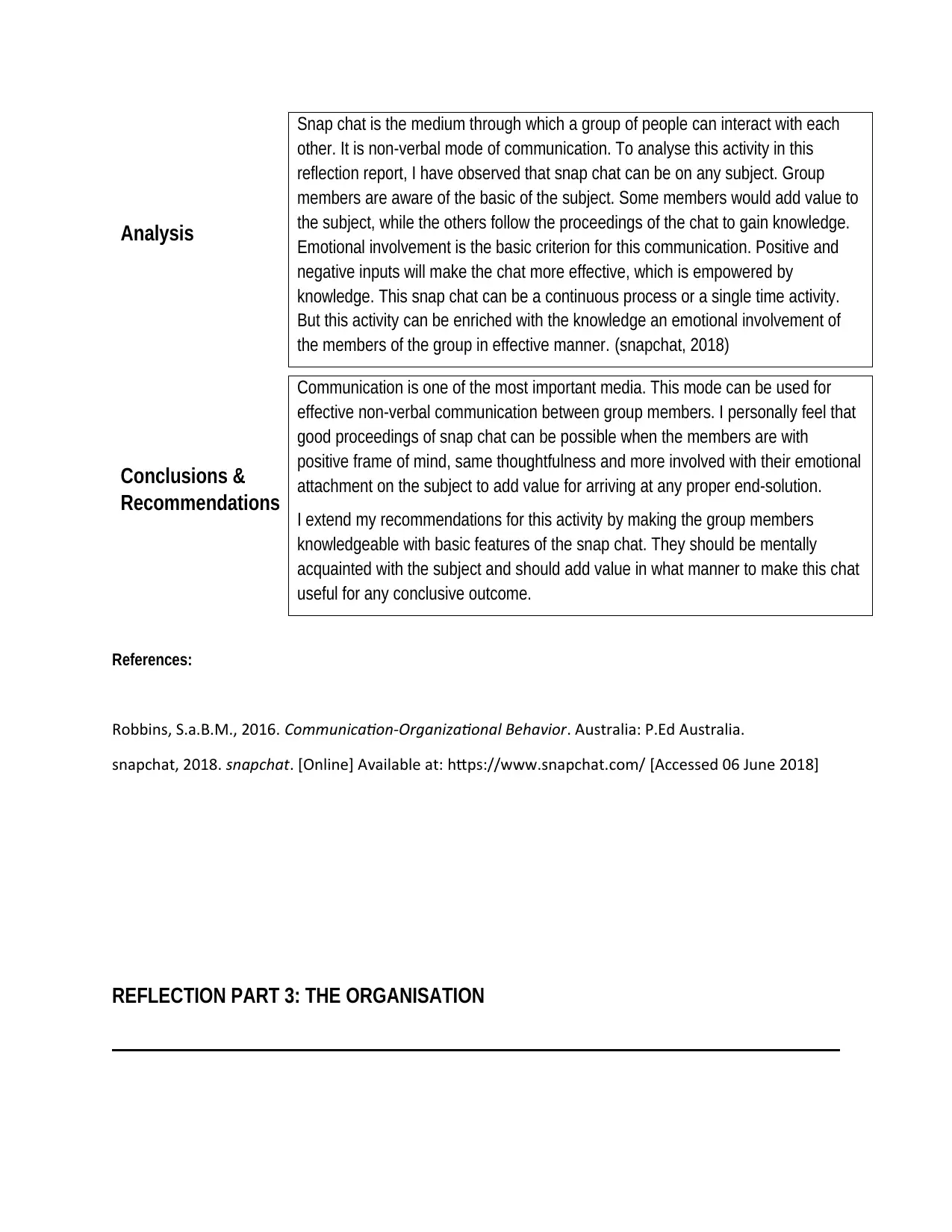
Analysis
Snap chat is the medium through which a group of people can interact with each
other. It is non-verbal mode of communication. To analyse this activity in this
reflection report, I have observed that snap chat can be on any subject. Group
members are aware of the basic of the subject. Some members would add value to
the subject, while the others follow the proceedings of the chat to gain knowledge.
Emotional involvement is the basic criterion for this communication. Positive and
negative inputs will make the chat more effective, which is empowered by
knowledge. This snap chat can be a continuous process or a single time activity.
But this activity can be enriched with the knowledge an emotional involvement of
the members of the group in effective manner. (snapchat, 2018)
Conclusions &
Recommendations
Communication is one of the most important media. This mode can be used for
effective non-verbal communication between group members. I personally feel that
good proceedings of snap chat can be possible when the members are with
positive frame of mind, same thoughtfulness and more involved with their emotional
attachment on the subject to add value for arriving at any proper end-solution.
I extend my recommendations for this activity by making the group members
knowledgeable with basic features of the snap chat. They should be mentally
acquainted with the subject and should add value in what manner to make this chat
useful for any conclusive outcome.
References:
Robbins, S.a.B.M., 2016. Communication-Organizational Behavior. Australia: P.Ed Australia.
snapchat, 2018. snapchat. [Online] Available at: https://www.snapchat.com/ [Accessed 06 June 2018]
REFLECTION PART 3: THE ORGANISATION
Snap chat is the medium through which a group of people can interact with each
other. It is non-verbal mode of communication. To analyse this activity in this
reflection report, I have observed that snap chat can be on any subject. Group
members are aware of the basic of the subject. Some members would add value to
the subject, while the others follow the proceedings of the chat to gain knowledge.
Emotional involvement is the basic criterion for this communication. Positive and
negative inputs will make the chat more effective, which is empowered by
knowledge. This snap chat can be a continuous process or a single time activity.
But this activity can be enriched with the knowledge an emotional involvement of
the members of the group in effective manner. (snapchat, 2018)
Conclusions &
Recommendations
Communication is one of the most important media. This mode can be used for
effective non-verbal communication between group members. I personally feel that
good proceedings of snap chat can be possible when the members are with
positive frame of mind, same thoughtfulness and more involved with their emotional
attachment on the subject to add value for arriving at any proper end-solution.
I extend my recommendations for this activity by making the group members
knowledgeable with basic features of the snap chat. They should be mentally
acquainted with the subject and should add value in what manner to make this chat
useful for any conclusive outcome.
References:
Robbins, S.a.B.M., 2016. Communication-Organizational Behavior. Australia: P.Ed Australia.
snapchat, 2018. snapchat. [Online] Available at: https://www.snapchat.com/ [Accessed 06 June 2018]
REFLECTION PART 3: THE ORGANISATION
Paraphrase This Document
Need a fresh take? Get an instant paraphrase of this document with our AI Paraphraser

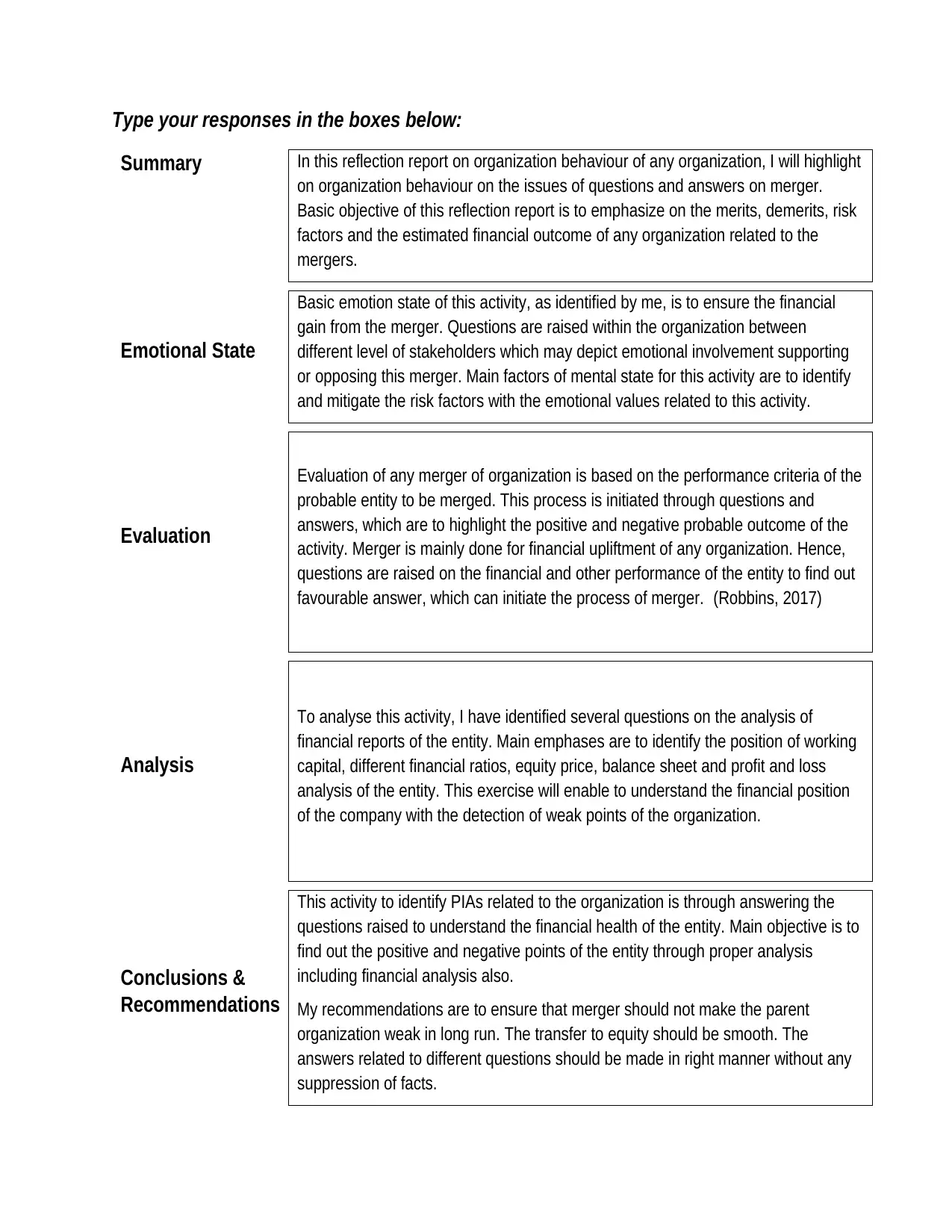
Type your responses in the boxes below:
Summary In this reflection report on organization behaviour of any organization, I will highlight
on organization behaviour on the issues of questions and answers on merger.
Basic objective of this reflection report is to emphasize on the merits, demerits, risk
factors and the estimated financial outcome of any organization related to the
mergers.
Emotional State
Basic emotion state of this activity, as identified by me, is to ensure the financial
gain from the merger. Questions are raised within the organization between
different level of stakeholders which may depict emotional involvement supporting
or opposing this merger. Main factors of mental state for this activity are to identify
and mitigate the risk factors with the emotional values related to this activity.
Evaluation
Evaluation of any merger of organization is based on the performance criteria of the
probable entity to be merged. This process is initiated through questions and
answers, which are to highlight the positive and negative probable outcome of the
activity. Merger is mainly done for financial upliftment of any organization. Hence,
questions are raised on the financial and other performance of the entity to find out
favourable answer, which can initiate the process of merger. (Robbins, 2017)
Analysis
To analyse this activity, I have identified several questions on the analysis of
financial reports of the entity. Main emphases are to identify the position of working
capital, different financial ratios, equity price, balance sheet and profit and loss
analysis of the entity. This exercise will enable to understand the financial position
of the company with the detection of weak points of the organization.
Conclusions &
Recommendations
This activity to identify PIAs related to the organization is through answering the
questions raised to understand the financial health of the entity. Main objective is to
find out the positive and negative points of the entity through proper analysis
including financial analysis also.
My recommendations are to ensure that merger should not make the parent
organization weak in long run. The transfer to equity should be smooth. The
answers related to different questions should be made in right manner without any
suppression of facts.
Summary In this reflection report on organization behaviour of any organization, I will highlight
on organization behaviour on the issues of questions and answers on merger.
Basic objective of this reflection report is to emphasize on the merits, demerits, risk
factors and the estimated financial outcome of any organization related to the
mergers.
Emotional State
Basic emotion state of this activity, as identified by me, is to ensure the financial
gain from the merger. Questions are raised within the organization between
different level of stakeholders which may depict emotional involvement supporting
or opposing this merger. Main factors of mental state for this activity are to identify
and mitigate the risk factors with the emotional values related to this activity.
Evaluation
Evaluation of any merger of organization is based on the performance criteria of the
probable entity to be merged. This process is initiated through questions and
answers, which are to highlight the positive and negative probable outcome of the
activity. Merger is mainly done for financial upliftment of any organization. Hence,
questions are raised on the financial and other performance of the entity to find out
favourable answer, which can initiate the process of merger. (Robbins, 2017)
Analysis
To analyse this activity, I have identified several questions on the analysis of
financial reports of the entity. Main emphases are to identify the position of working
capital, different financial ratios, equity price, balance sheet and profit and loss
analysis of the entity. This exercise will enable to understand the financial position
of the company with the detection of weak points of the organization.
Conclusions &
Recommendations
This activity to identify PIAs related to the organization is through answering the
questions raised to understand the financial health of the entity. Main objective is to
find out the positive and negative points of the entity through proper analysis
including financial analysis also.
My recommendations are to ensure that merger should not make the parent
organization weak in long run. The transfer to equity should be smooth. The
answers related to different questions should be made in right manner without any
suppression of facts.

References
Robbins, S.B.M., 2017. Organisational Behaviour- Organizational Culture. Australia: P.Ed Australia.
⊘ This is a preview!⊘
Do you want full access?
Subscribe today to unlock all pages.

Trusted by 1+ million students worldwide
1 out of 6
Your All-in-One AI-Powered Toolkit for Academic Success.
 +13062052269
info@desklib.com
Available 24*7 on WhatsApp / Email
Unlock your academic potential
Copyright © 2020–2026 A2Z Services. All Rights Reserved. Developed and managed by ZUCOL.