Pharmacology Reflection Report: Legal, Ethical, Safety

Verified

Added on  2020/07/22

|6
|1189
|34
Report
AI Summary
This pharmacology reflection report delves into the critical aspects of medication management and its impact on healthcare practices. The report begins by emphasizing the importance of quality medicine use, highlighting the selection of appropriate patient management options, suitable medicines, and safe and effective usage. It then explores the legal, ethical, and safety issues surrounding medication, including patient rights, privacy, and the consequences of medical errors. The report also covers the pharmacokinetic and pharmacodynamic actions of medications, individual learning needs, and the development of effective learning strategies for healthcare professionals. Furthermore, it addresses information resources, adverse effects of medication, and treatment plans. Finally, the report discusses pharmacological principles, providing a comprehensive overview of the subject matter. This resource is designed to aid healthcare professionals in understanding and applying pharmacological principles effectively in their practice.
Document Page
Pharmacology
Reflection
tabler-icon-diamond-filled.svg

Paraphrase This Document

Need a fresh take? Get an instant paraphrase of this document with our AI Paraphraser
Document Page
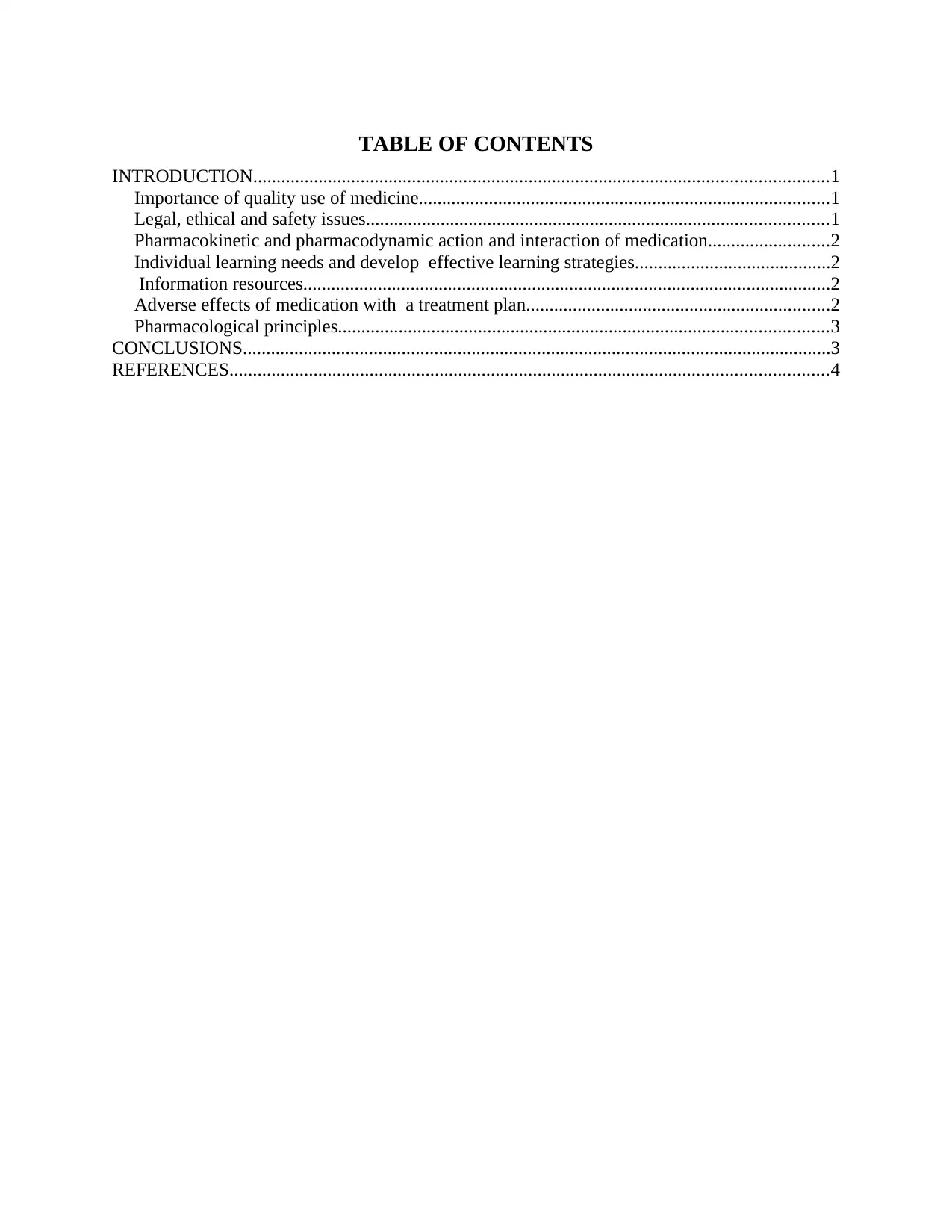
TABLE OF CONTENTS
INTRODUCTION...........................................................................................................................1
Importance of quality use of medicine........................................................................................1
Legal, ethical and safety issues...................................................................................................1
Pharmacokinetic and pharmacodynamic action and interaction of medication..........................2
Individual learning needs and develop effective learning strategies..........................................2
Information resources.................................................................................................................2
Adverse effects of medication with a treatment plan.................................................................2
Pharmacological principles.........................................................................................................3
CONCLUSIONS..............................................................................................................................3
REFERENCES................................................................................................................................4
Document Page
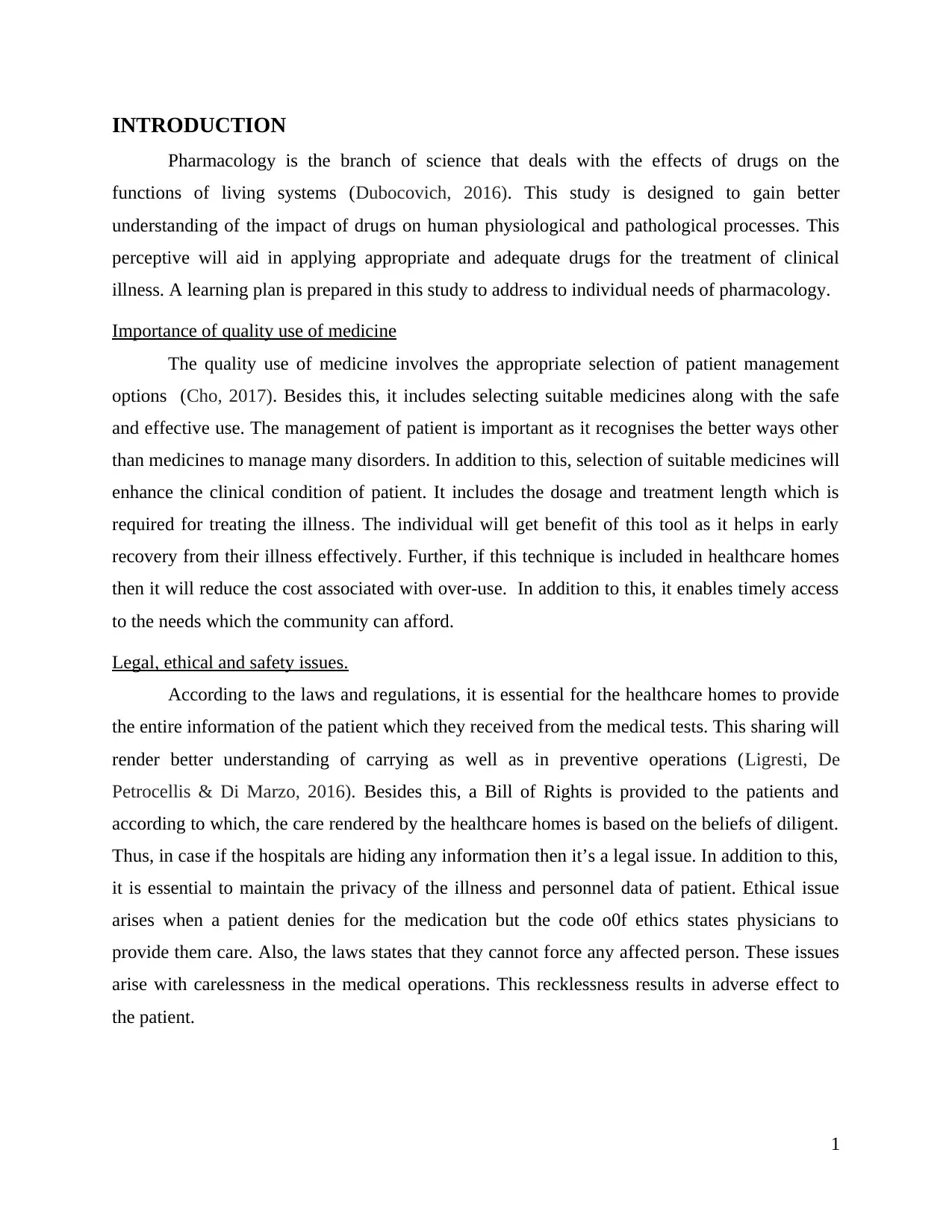
INTRODUCTION
Pharmacology is the branch of science that deals with the effects of drugs on the
functions of living systems (Dubocovich, 2016). This study is designed to gain better
understanding of the impact of drugs on human physiological and pathological processes. This
perceptive will aid in applying appropriate and adequate drugs for the treatment of clinical
illness. A learning plan is prepared in this study to address to individual needs of pharmacology.
Importance of quality use of medicine
The quality use of medicine involves the appropriate selection of patient management
options (Cho, 2017). Besides this, it includes selecting suitable medicines along with the safe
and effective use. The management of patient is important as it recognises the better ways other
than medicines to manage many disorders. In addition to this, selection of suitable medicines will
enhance the clinical condition of patient. It includes the dosage and treatment length which is
required for treating the illness. The individual will get benefit of this tool as it helps in early
recovery from their illness effectively. Further, if this technique is included in healthcare homes
then it will reduce the cost associated with over-use. In addition to this, it enables timely access
to the needs which the community can afford.
Legal, ethical and safety issues.
According to the laws and regulations, it is essential for the healthcare homes to provide
the entire information of the patient which they received from the medical tests. This sharing will
render better understanding of carrying as well as in preventive operations (Ligresti, De
Petrocellis & Di Marzo, 2016). Besides this, a Bill of Rights is provided to the patients and
according to which, the care rendered by the healthcare homes is based on the beliefs of diligent.
Thus, in case if the hospitals are hiding any information then it’s a legal issue. In addition to this,
it is essential to maintain the privacy of the illness and personnel data of patient. Ethical issue
arises when a patient denies for the medication but the code o0f ethics states physicians to
provide them care. Also, the laws states that they cannot force any affected person. These issues
arise with carelessness in the medical operations. This recklessness results in adverse effect to
the patient.
1
Document Page
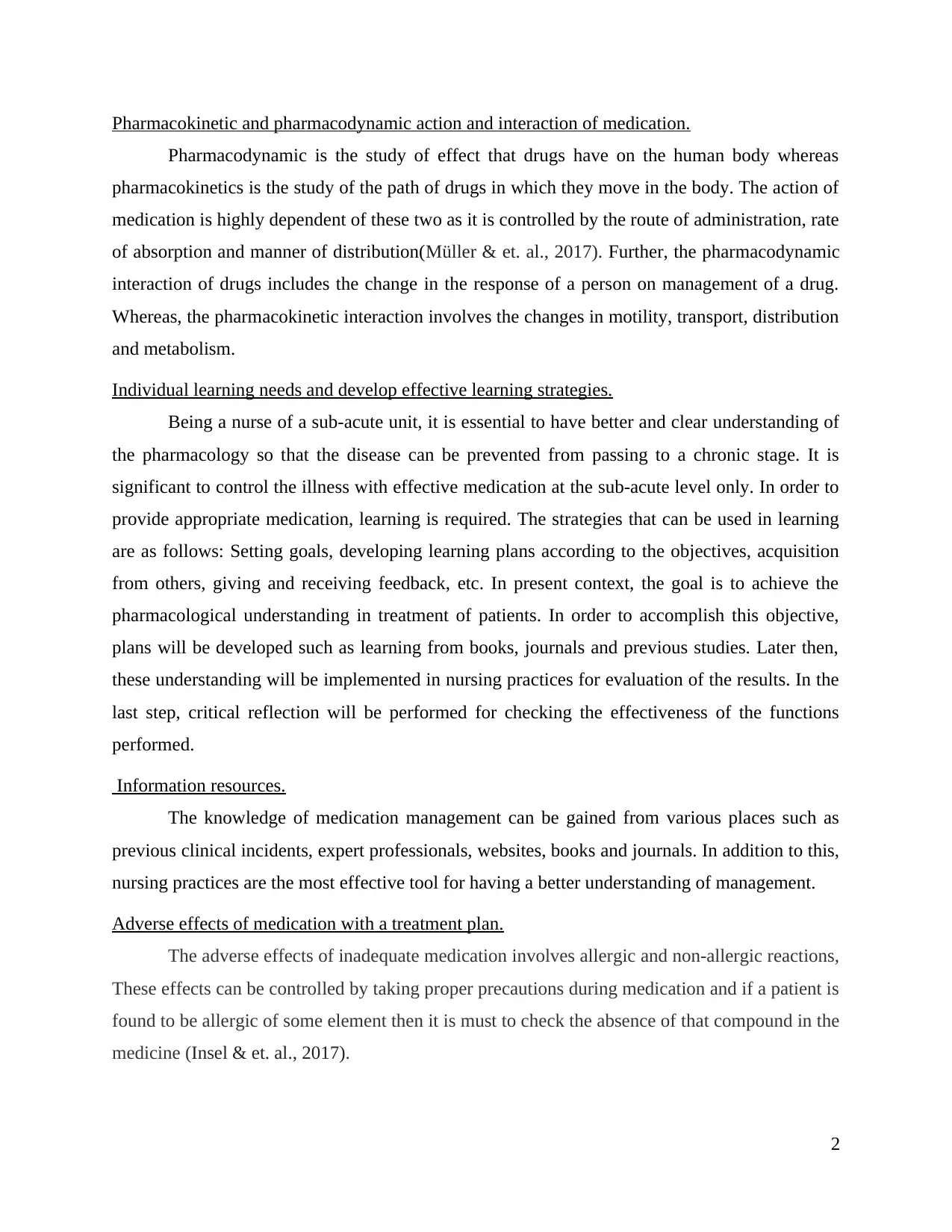
Pharmacokinetic and pharmacodynamic action and interaction of medication.
Pharmacodynamic is the study of effect that drugs have on the human body whereas
pharmacokinetics is the study of the path of drugs in which they move in the body. The action of
medication is highly dependent of these two as it is controlled by the route of administration, rate
of absorption and manner of distribution(Müller & et. al., 2017). Further, the pharmacodynamic
interaction of drugs includes the change in the response of a person on management of a drug.
Whereas, the pharmacokinetic interaction involves the changes in motility, transport, distribution
and metabolism.
Individual learning needs and develop effective learning strategies.
Being a nurse of a sub-acute unit, it is essential to have better and clear understanding of
the pharmacology so that the disease can be prevented from passing to a chronic stage. It is
significant to control the illness with effective medication at the sub-acute level only. In order to
provide appropriate medication, learning is required. The strategies that can be used in learning
are as follows: Setting goals, developing learning plans according to the objectives, acquisition
from others, giving and receiving feedback, etc. In present context, the goal is to achieve the
pharmacological understanding in treatment of patients. In order to accomplish this objective,
plans will be developed such as learning from books, journals and previous studies. Later then,
these understanding will be implemented in nursing practices for evaluation of the results. In the
last step, critical reflection will be performed for checking the effectiveness of the functions
performed.
Information resources.
The knowledge of medication management can be gained from various places such as
previous clinical incidents, expert professionals, websites, books and journals. In addition to this,
nursing practices are the most effective tool for having a better understanding of management.
Adverse effects of medication with a treatment plan.
The adverse effects of inadequate medication involves allergic and non-allergic reactions,
These effects can be controlled by taking proper precautions during medication and if a patient is
found to be allergic of some element then it is must to check the absence of that compound in the
medicine (Insel & et. al., 2017).
2
tabler-icon-diamond-filled.svg

Paraphrase This Document

Need a fresh take? Get an instant paraphrase of this document with our AI Paraphraser
Document Page
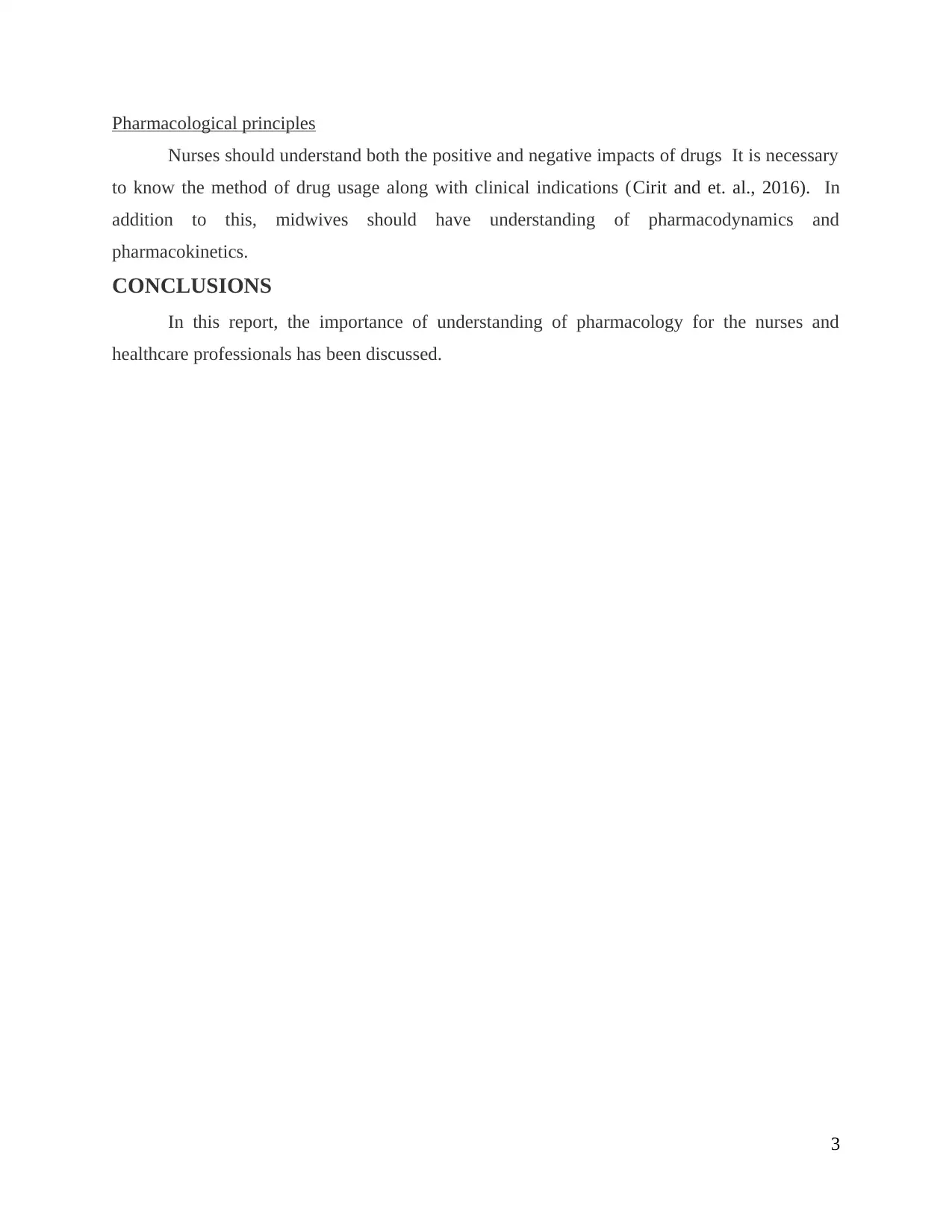
Pharmacological principles
Nurses should understand both the positive and negative impacts of drugs It is necessary
to know the method of drug usage along with clinical indications (Cirit and et. al., 2016). In
addition to this, midwives should have understanding of pharmacodynamics and
pharmacokinetics.
CONCLUSIONS
In this report, the importance of understanding of pharmacology for the nurses and
healthcare professionals has been discussed.
3
Document Page
REFERENCES
Books and Journals
Cho, A. K. (2017). A Chemical Perspective of Pharmacology and Toxicology. Annual Review of
Pharmacology and Toxicology.58(1).
Cirit, M. and et.al., (2016). Human physiome on a chip: merging tissue engineering and systems
pharmacology. The FASEB Journal.30(1 Supplement). 938-1.
Dubocovich, M. (2016). Pharmacology and function of melatonin receptors in the mammalian
central nervous. Serotonin; Mylecharane, E., Angus, JA, de la Lande, IS, Humphrey,
PAP, Eds. 265.
Insel, P. A. & et.al., (2017). Introduction to the Theme “New Methods and Novel Therapeutic
Approaches in Pharmacology and Toxicology”. Annual review of pharmacology and
toxicology.57. 13-17.
Ligresti, A., De Petrocellis, L., & Di Marzo, V. (2016). From phytocannabinoids to cannabinoid
receptors and end ocannabinoids: pleiotropic physiological and pathological roles
through complex pharmacology. Physiological reviews.96(4). 1593-1659.
Müller, T. D. & et.al., (2017). The New Biology and Pharmacology of Glucagon. Physiological
Reviews.97(2). 721-766.
4
chevron_up_icon
1 out of 6
circle_padding
hide_on_mobile
zoom_out_icon
[object Object]