Physics Assignment: Motion, Work, and Energy Problems and Solutions
VerifiedAdded on 2022/09/15
|20
|4645
|35
Homework Assignment
AI Summary
This physics assignment solution covers a range of problems related to motion, work, and energy. The motion section includes calculations of velocity, acceleration, and distance traveled, with examples involving cars, motorcycles, and polar bears. The work section explores the concept of work done in various scenarios, such as lifting objects and pushing carts, and includes calculations of force, distance, and work done by gravity. The energy section delves into kinetic and potential energy transformations, including examples of pendulums, falling objects, and rolling cars. The solutions provide step-by-step calculations and explanations, making it a valuable resource for understanding these fundamental physics concepts. This assignment is a great resource for students on Desklib.
PHYSICAL SCIENCE
By Name
Course
Instructor
Institution
Location
Date
By Name
Course
Instructor
Institution
Location
Date

Paraphrase This Document
Need a fresh take? Get an instant paraphrase of this document with our AI Paraphraser
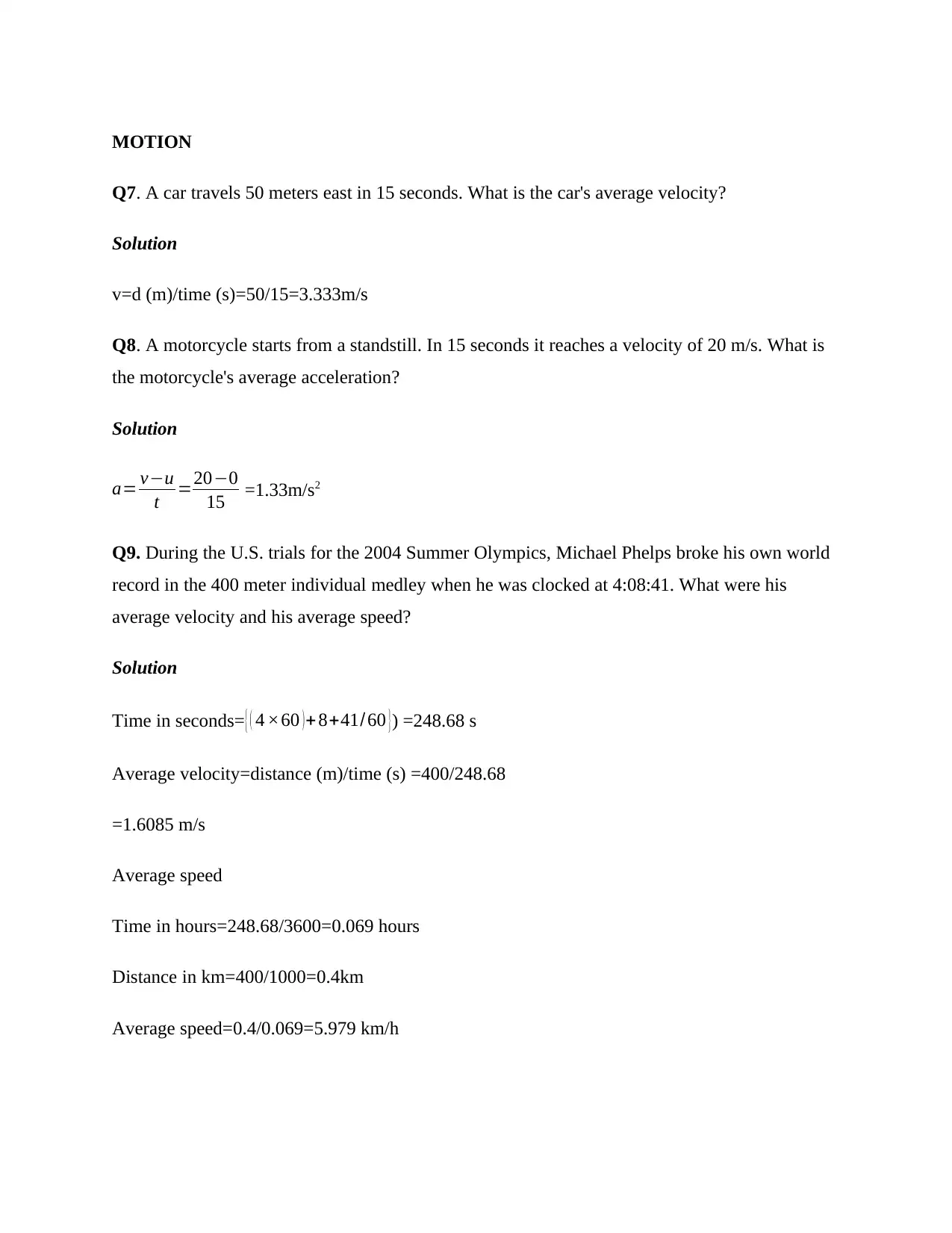
MOTION
Q7. A car travels 50 meters east in 15 seconds. What is the car's average velocity?
Solution
v=d (m)/time (s)=50/15=3.333m/s
Q8. A motorcycle starts from a standstill. In 15 seconds it reaches a velocity of 20 m/s. What is
the motorcycle's average acceleration?
Solution
a= v−u
t =20−0
15 =1.33m/s2
Q9. During the U.S. trials for the 2004 Summer Olympics, Michael Phelps broke his own world
record in the 400 meter individual medley when he was clocked at 4:08:41. What were his
average velocity and his average speed?
Solution
Time in seconds={ ( 4 ×60 ) + 8+41/ 60 }) =248.68 s
Average velocity=distance (m)/time (s) =400/248.68
=1.6085 m/s
Average speed
Time in hours=248.68/3600=0.069 hours
Distance in km=400/1000=0.4km
Average speed=0.4/0.069=5.979 km/h
Q7. A car travels 50 meters east in 15 seconds. What is the car's average velocity?
Solution
v=d (m)/time (s)=50/15=3.333m/s
Q8. A motorcycle starts from a standstill. In 15 seconds it reaches a velocity of 20 m/s. What is
the motorcycle's average acceleration?
Solution
a= v−u
t =20−0
15 =1.33m/s2
Q9. During the U.S. trials for the 2004 Summer Olympics, Michael Phelps broke his own world
record in the 400 meter individual medley when he was clocked at 4:08:41. What were his
average velocity and his average speed?
Solution
Time in seconds={ ( 4 ×60 ) + 8+41/ 60 }) =248.68 s
Average velocity=distance (m)/time (s) =400/248.68
=1.6085 m/s
Average speed
Time in hours=248.68/3600=0.069 hours
Distance in km=400/1000=0.4km
Average speed=0.4/0.069=5.979 km/h
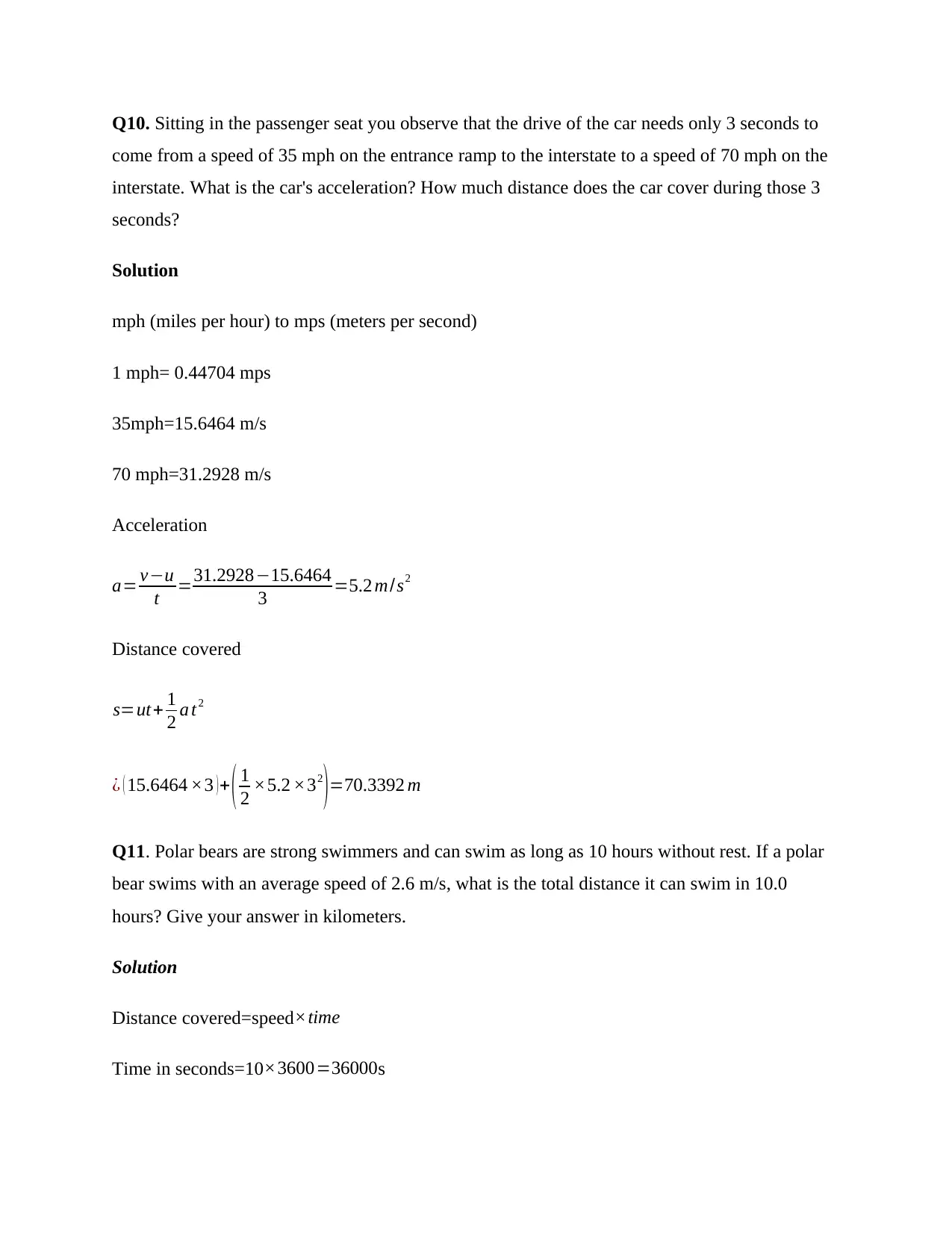
Q10. Sitting in the passenger seat you observe that the drive of the car needs only 3 seconds to
come from a speed of 35 mph on the entrance ramp to the interstate to a speed of 70 mph on the
interstate. What is the car's acceleration? How much distance does the car cover during those 3
seconds?
Solution
mph (miles per hour) to mps (meters per second)
1 mph= 0.44704 mps
35mph=15.6464 m/s
70 mph=31.2928 m/s
Acceleration
a= v−u
t =31.2928−15.6464
3 =5.2 m/s2
Distance covered
s=ut+ 1
2 a t2
¿ ( 15.6464 ×3 ) + ( 1
2 ×5.2 ×32
)=70.3392 m
Q11. Polar bears are strong swimmers and can swim as long as 10 hours without rest. If a polar
bear swims with an average speed of 2.6 m/s, what is the total distance it can swim in 10.0
hours? Give your answer in kilometers.
Solution
Distance covered=speed ×time
Time in seconds=10×3600=36000s
come from a speed of 35 mph on the entrance ramp to the interstate to a speed of 70 mph on the
interstate. What is the car's acceleration? How much distance does the car cover during those 3
seconds?
Solution
mph (miles per hour) to mps (meters per second)
1 mph= 0.44704 mps
35mph=15.6464 m/s
70 mph=31.2928 m/s
Acceleration
a= v−u
t =31.2928−15.6464
3 =5.2 m/s2
Distance covered
s=ut+ 1
2 a t2
¿ ( 15.6464 ×3 ) + ( 1
2 ×5.2 ×32
)=70.3392 m
Q11. Polar bears are strong swimmers and can swim as long as 10 hours without rest. If a polar
bear swims with an average speed of 2.6 m/s, what is the total distance it can swim in 10.0
hours? Give your answer in kilometers.
Solution
Distance covered=speed ×time
Time in seconds=10×3600=36000s
⊘ This is a preview!⊘
Do you want full access?
Subscribe today to unlock all pages.

Trusted by 1+ million students worldwide
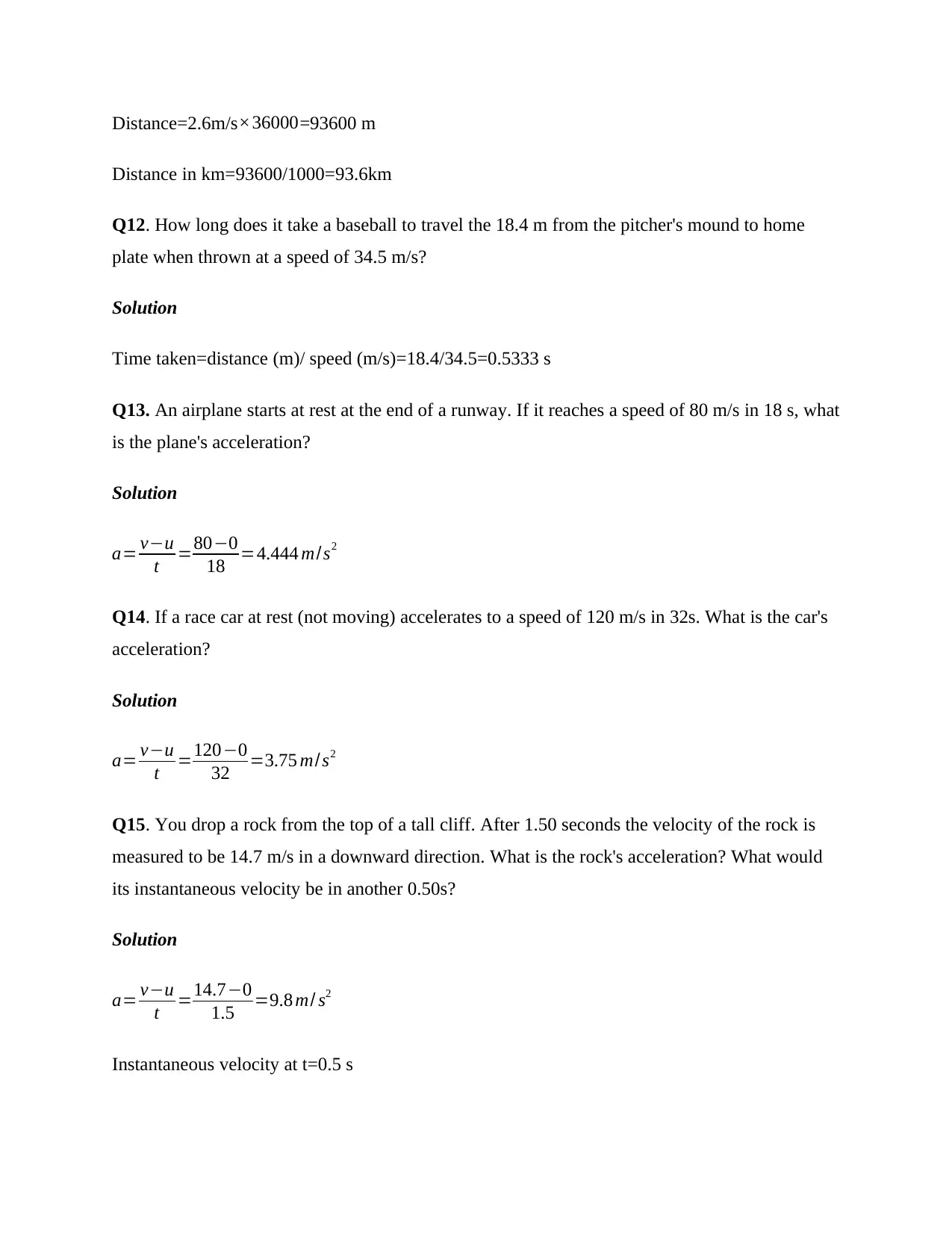
Distance=2.6m/s×36000=93600 m
Distance in km=93600/1000=93.6km
Q12. How long does it take a baseball to travel the 18.4 m from the pitcher's mound to home
plate when thrown at a speed of 34.5 m/s?
Solution
Time taken=distance (m)/ speed (m/s)=18.4/34.5=0.5333 s
Q13. An airplane starts at rest at the end of a runway. If it reaches a speed of 80 m/s in 18 s, what
is the plane's acceleration?
Solution
a= v−u
t =80−0
18 =4.444 m/s2
Q14. If a race car at rest (not moving) accelerates to a speed of 120 m/s in 32s. What is the car's
acceleration?
Solution
a= v−u
t =120−0
32 =3.75 m/s2
Q15. You drop a rock from the top of a tall cliff. After 1.50 seconds the velocity of the rock is
measured to be 14.7 m/s in a downward direction. What is the rock's acceleration? What would
its instantaneous velocity be in another 0.50s?
Solution
a= v−u
t =14.7−0
1.5 =9.8 m/ s2
Instantaneous velocity at t=0.5 s
Distance in km=93600/1000=93.6km
Q12. How long does it take a baseball to travel the 18.4 m from the pitcher's mound to home
plate when thrown at a speed of 34.5 m/s?
Solution
Time taken=distance (m)/ speed (m/s)=18.4/34.5=0.5333 s
Q13. An airplane starts at rest at the end of a runway. If it reaches a speed of 80 m/s in 18 s, what
is the plane's acceleration?
Solution
a= v−u
t =80−0
18 =4.444 m/s2
Q14. If a race car at rest (not moving) accelerates to a speed of 120 m/s in 32s. What is the car's
acceleration?
Solution
a= v−u
t =120−0
32 =3.75 m/s2
Q15. You drop a rock from the top of a tall cliff. After 1.50 seconds the velocity of the rock is
measured to be 14.7 m/s in a downward direction. What is the rock's acceleration? What would
its instantaneous velocity be in another 0.50s?
Solution
a= v−u
t =14.7−0
1.5 =9.8 m/ s2
Instantaneous velocity at t=0.5 s
Paraphrase This Document
Need a fresh take? Get an instant paraphrase of this document with our AI Paraphraser
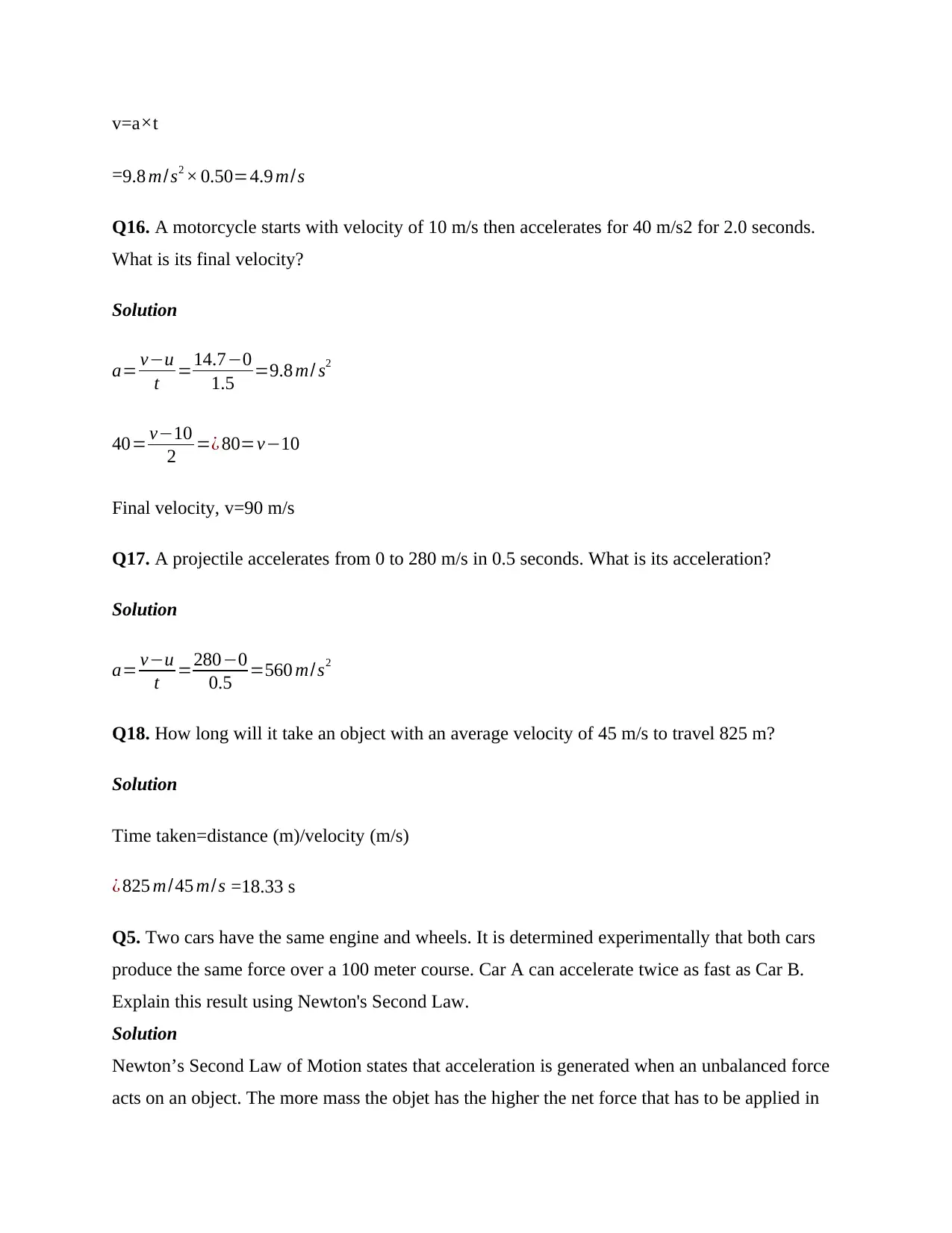
v=a×t
=9.8 m/s2 × 0.50=4.9 m/s
Q16. A motorcycle starts with velocity of 10 m/s then accelerates for 40 m/s2 for 2.0 seconds.
What is its final velocity?
Solution
a= v−u
t =14.7−0
1.5 =9.8 m/ s2
40= v−10
2 =¿ 80=v−10
Final velocity, v=90 m/s
Q17. A projectile accelerates from 0 to 280 m/s in 0.5 seconds. What is its acceleration?
Solution
a= v−u
t =280−0
0.5 =560 m/s2
Q18. How long will it take an object with an average velocity of 45 m/s to travel 825 m?
Solution
Time taken=distance (m)/velocity (m/s)
¿ 825 m/45 m/s =18.33 s
Q5. Two cars have the same engine and wheels. It is determined experimentally that both cars
produce the same force over a 100 meter course. Car A can accelerate twice as fast as Car B.
Explain this result using Newton's Second Law.
Solution
Newton’s Second Law of Motion states that acceleration is generated when an unbalanced force
acts on an object. The more mass the objet has the higher the net force that has to be applied in
=9.8 m/s2 × 0.50=4.9 m/s
Q16. A motorcycle starts with velocity of 10 m/s then accelerates for 40 m/s2 for 2.0 seconds.
What is its final velocity?
Solution
a= v−u
t =14.7−0
1.5 =9.8 m/ s2
40= v−10
2 =¿ 80=v−10
Final velocity, v=90 m/s
Q17. A projectile accelerates from 0 to 280 m/s in 0.5 seconds. What is its acceleration?
Solution
a= v−u
t =280−0
0.5 =560 m/s2
Q18. How long will it take an object with an average velocity of 45 m/s to travel 825 m?
Solution
Time taken=distance (m)/velocity (m/s)
¿ 825 m/45 m/s =18.33 s
Q5. Two cars have the same engine and wheels. It is determined experimentally that both cars
produce the same force over a 100 meter course. Car A can accelerate twice as fast as Car B.
Explain this result using Newton's Second Law.
Solution
Newton’s Second Law of Motion states that acceleration is generated when an unbalanced force
acts on an object. The more mass the objet has the higher the net force that has to be applied in
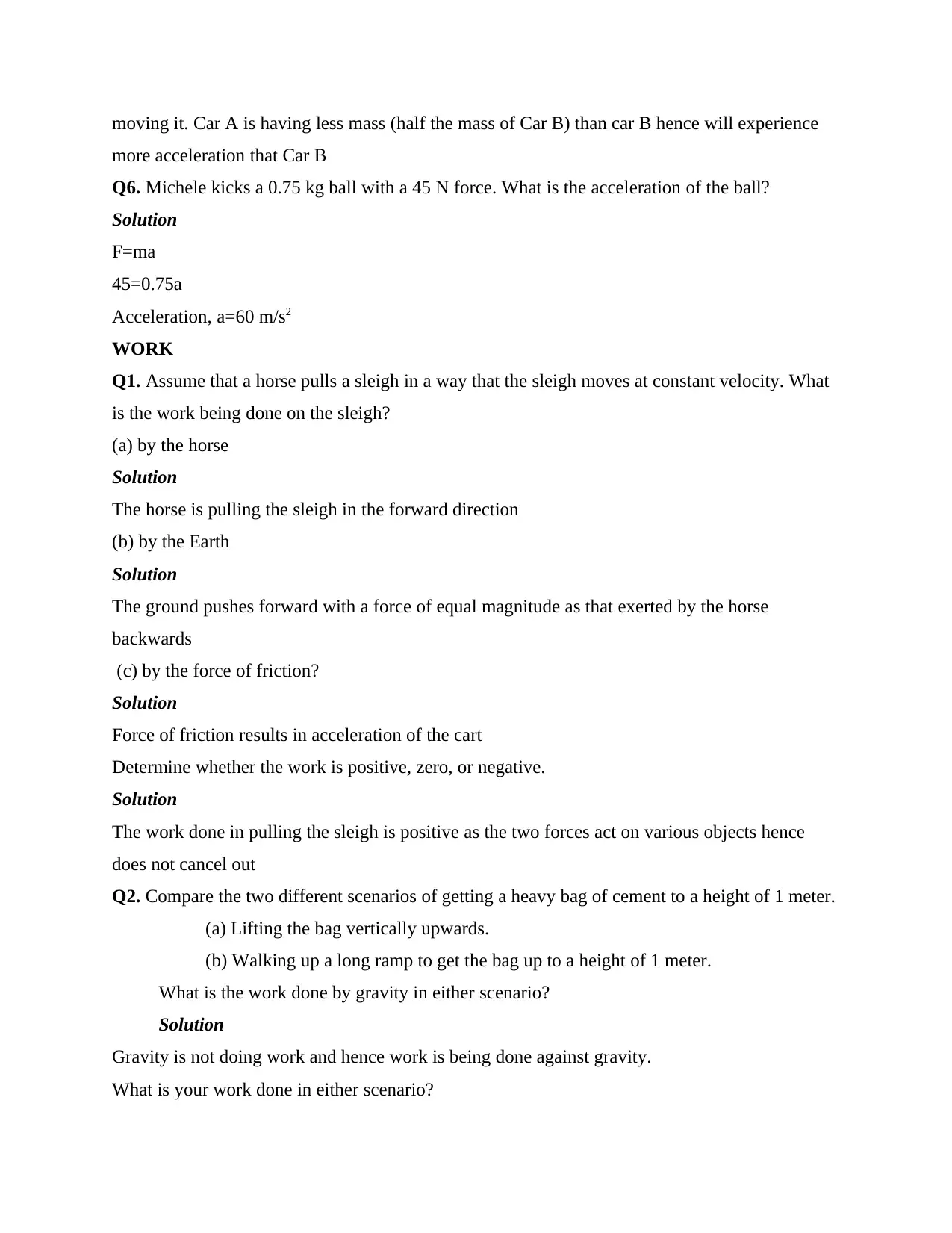
moving it. Car A is having less mass (half the mass of Car B) than car B hence will experience
more acceleration that Car B
Q6. Michele kicks a 0.75 kg ball with a 45 N force. What is the acceleration of the ball?
Solution
F=ma
45=0.75a
Acceleration, a=60 m/s2
WORK
Q1. Assume that a horse pulls a sleigh in a way that the sleigh moves at constant velocity. What
is the work being done on the sleigh?
(a) by the horse
Solution
The horse is pulling the sleigh in the forward direction
(b) by the Earth
Solution
The ground pushes forward with a force of equal magnitude as that exerted by the horse
backwards
(c) by the force of friction?
Solution
Force of friction results in acceleration of the cart
Determine whether the work is positive, zero, or negative.
Solution
The work done in pulling the sleigh is positive as the two forces act on various objects hence
does not cancel out
Q2. Compare the two different scenarios of getting a heavy bag of cement to a height of 1 meter.
(a) Lifting the bag vertically upwards.
(b) Walking up a long ramp to get the bag up to a height of 1 meter.
What is the work done by gravity in either scenario?
Solution
Gravity is not doing work and hence work is being done against gravity.
What is your work done in either scenario?
more acceleration that Car B
Q6. Michele kicks a 0.75 kg ball with a 45 N force. What is the acceleration of the ball?
Solution
F=ma
45=0.75a
Acceleration, a=60 m/s2
WORK
Q1. Assume that a horse pulls a sleigh in a way that the sleigh moves at constant velocity. What
is the work being done on the sleigh?
(a) by the horse
Solution
The horse is pulling the sleigh in the forward direction
(b) by the Earth
Solution
The ground pushes forward with a force of equal magnitude as that exerted by the horse
backwards
(c) by the force of friction?
Solution
Force of friction results in acceleration of the cart
Determine whether the work is positive, zero, or negative.
Solution
The work done in pulling the sleigh is positive as the two forces act on various objects hence
does not cancel out
Q2. Compare the two different scenarios of getting a heavy bag of cement to a height of 1 meter.
(a) Lifting the bag vertically upwards.
(b) Walking up a long ramp to get the bag up to a height of 1 meter.
What is the work done by gravity in either scenario?
Solution
Gravity is not doing work and hence work is being done against gravity.
What is your work done in either scenario?
⊘ This is a preview!⊘
Do you want full access?
Subscribe today to unlock all pages.
Trusted by 1+ million students worldwide
Solution
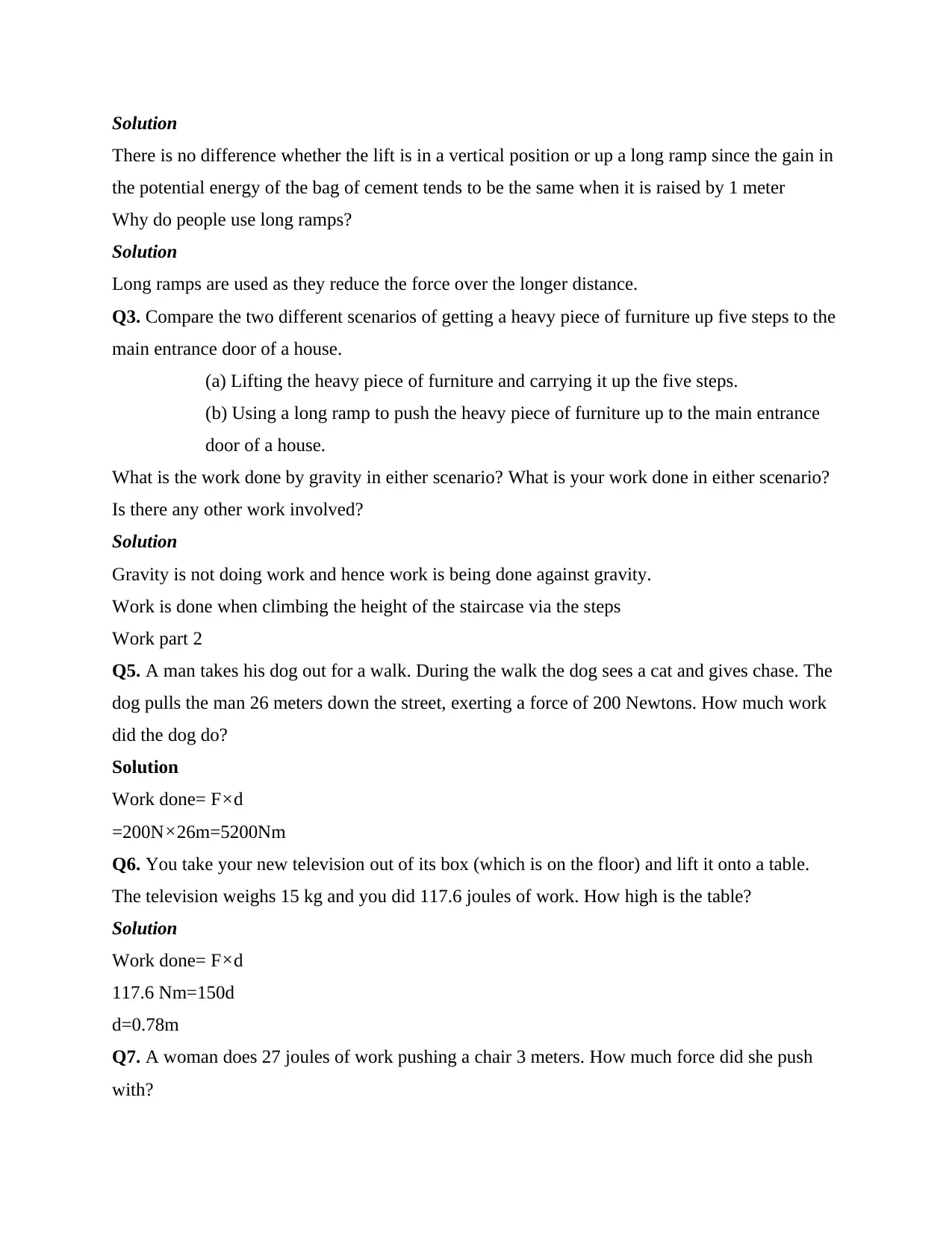
There is no difference whether the lift is in a vertical position or up a long ramp since the gain in
the potential energy of the bag of cement tends to be the same when it is raised by 1 meter
Why do people use long ramps?
Solution
Long ramps are used as they reduce the force over the longer distance.
Q3. Compare the two different scenarios of getting a heavy piece of furniture up five steps to the
main entrance door of a house.
(a) Lifting the heavy piece of furniture and carrying it up the five steps.
(b) Using a long ramp to push the heavy piece of furniture up to the main entrance
door of a house.
What is the work done by gravity in either scenario? What is your work done in either scenario?
Is there any other work involved?
Solution
Gravity is not doing work and hence work is being done against gravity.
Work is done when climbing the height of the staircase via the steps
Work part 2
Q5. A man takes his dog out for a walk. During the walk the dog sees a cat and gives chase. The
dog pulls the man 26 meters down the street, exerting a force of 200 Newtons. How much work
did the dog do?
Solution
Work done= F×d
=200N×26m=5200Nm
Q6. You take your new television out of its box (which is on the floor) and lift it onto a table.
The television weighs 15 kg and you did 117.6 joules of work. How high is the table?
Solution
Work done= F×d
117.6 Nm=150d
d=0.78m
Q7. A woman does 27 joules of work pushing a chair 3 meters. How much force did she push
with?
There is no difference whether the lift is in a vertical position or up a long ramp since the gain in
the potential energy of the bag of cement tends to be the same when it is raised by 1 meter
Why do people use long ramps?
Solution
Long ramps are used as they reduce the force over the longer distance.
Q3. Compare the two different scenarios of getting a heavy piece of furniture up five steps to the
main entrance door of a house.
(a) Lifting the heavy piece of furniture and carrying it up the five steps.
(b) Using a long ramp to push the heavy piece of furniture up to the main entrance
door of a house.
What is the work done by gravity in either scenario? What is your work done in either scenario?
Is there any other work involved?
Solution
Gravity is not doing work and hence work is being done against gravity.
Work is done when climbing the height of the staircase via the steps
Work part 2
Q5. A man takes his dog out for a walk. During the walk the dog sees a cat and gives chase. The
dog pulls the man 26 meters down the street, exerting a force of 200 Newtons. How much work
did the dog do?
Solution
Work done= F×d
=200N×26m=5200Nm
Q6. You take your new television out of its box (which is on the floor) and lift it onto a table.
The television weighs 15 kg and you did 117.6 joules of work. How high is the table?
Solution
Work done= F×d
117.6 Nm=150d
d=0.78m
Q7. A woman does 27 joules of work pushing a chair 3 meters. How much force did she push
with?
Paraphrase This Document
Need a fresh take? Get an instant paraphrase of this document with our AI Paraphraser
Solution
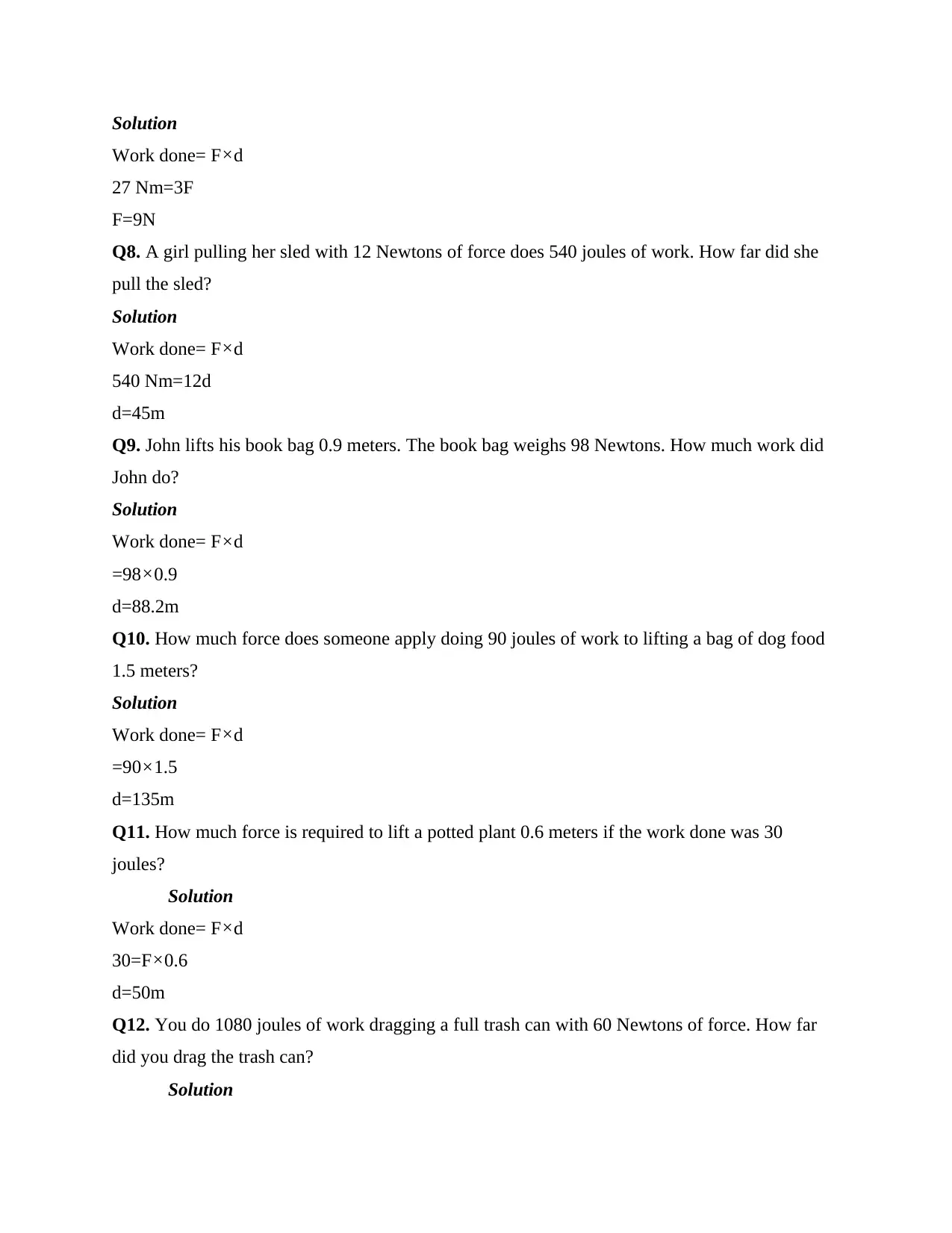
Work done= F×d
27 Nm=3F
F=9N
Q8. A girl pulling her sled with 12 Newtons of force does 540 joules of work. How far did she
pull the sled?
Solution
Work done= F×d
540 Nm=12d
d=45m
Q9. John lifts his book bag 0.9 meters. The book bag weighs 98 Newtons. How much work did
John do?
Solution
Work done= F×d
=98×0.9
d=88.2m
Q10. How much force does someone apply doing 90 joules of work to lifting a bag of dog food
1.5 meters?
Solution
Work done= F×d
=90×1.5
d=135m
Q11. How much force is required to lift a potted plant 0.6 meters if the work done was 30
joules?
Solution
Work done= F×d
30=F×0.6
d=50m
Q12. You do 1080 joules of work dragging a full trash can with 60 Newtons of force. How far
did you drag the trash can?
Solution
Work done= F×d
27 Nm=3F
F=9N
Q8. A girl pulling her sled with 12 Newtons of force does 540 joules of work. How far did she
pull the sled?
Solution
Work done= F×d
540 Nm=12d
d=45m
Q9. John lifts his book bag 0.9 meters. The book bag weighs 98 Newtons. How much work did
John do?
Solution
Work done= F×d
=98×0.9
d=88.2m
Q10. How much force does someone apply doing 90 joules of work to lifting a bag of dog food
1.5 meters?
Solution
Work done= F×d
=90×1.5
d=135m
Q11. How much force is required to lift a potted plant 0.6 meters if the work done was 30
joules?
Solution
Work done= F×d
30=F×0.6
d=50m
Q12. You do 1080 joules of work dragging a full trash can with 60 Newtons of force. How far
did you drag the trash can?
Solution
Work done= F×d
1080=60d
d=18m
Q13. A shopper pushes a cart with 20 Newtons of force for 30 meters. How much work did the
shopper do?
Solution
Work done= F×d
=20×30=600Nm
Q14. A 1000 kg rock is sitting on a ledge that is 18 meters high. How much potential energy
does the rock have?
Solution
Potential energy=mgh
=1000×9.8×18=176400J
=176.4kJ
Q15. How much gravitational potential energy does an 860 kg car at the top of a 32 meter hill
have?
Solution
Potential energy=mgh
=860×9.8×32=269696J
=269.696kJ
ENERGY
Q3. Unless you push a pendulum at the start of its swing (doing work to give it extra energy),
will it ever swing higher than its starting point? Explain your answer in terms of kinetic and
potential energy.
Solution
Pendulum will never swing higher than its starting point without being acted upon by external
force. This is in relation to the principle of conservation of energy. The amount of energy within
an object remains the same unless something is done to it. Changing the energy of something
requires it is move. The pendulum begins within some amount of potential energy and the energy
is got only if it is lifted
Q4. Does a pendulum swing forever? Why or why not?
1080=60d
d=18m
Q13. A shopper pushes a cart with 20 Newtons of force for 30 meters. How much work did the
shopper do?
Solution
Work done= F×d
=20×30=600Nm
Q14. A 1000 kg rock is sitting on a ledge that is 18 meters high. How much potential energy
does the rock have?
Solution
Potential energy=mgh
=1000×9.8×18=176400J
=176.4kJ
Q15. How much gravitational potential energy does an 860 kg car at the top of a 32 meter hill
have?
Solution
Potential energy=mgh
=860×9.8×32=269696J
=269.696kJ
ENERGY
Q3. Unless you push a pendulum at the start of its swing (doing work to give it extra energy),
will it ever swing higher than its starting point? Explain your answer in terms of kinetic and
potential energy.
Solution
Pendulum will never swing higher than its starting point without being acted upon by external
force. This is in relation to the principle of conservation of energy. The amount of energy within
an object remains the same unless something is done to it. Changing the energy of something
requires it is move. The pendulum begins within some amount of potential energy and the energy
is got only if it is lifted
Q4. Does a pendulum swing forever? Why or why not?
⊘ This is a preview!⊘
Do you want full access?
Subscribe today to unlock all pages.
Trusted by 1+ million students worldwide
Solution
A pendulum does not swing forever due to friction or drag that takes away some of the energy
from it and thereby making in gradually come to a standstill.
Q5. Describe the transformations between potential and kinetic energy when you drop a 15000
gram television from a height of 0.8 meters.
Solution
Work is done by moving the television set to the height h=0.8m above the level of ground. The
work QE=mgh=PE is changed to stored energy when the television is at height h. If the
television is dropped inadvertently as the height above the level of ground, h=0, reduces, the
work done against gravitational force on the item increases the kinetic energy. Just before the
impact the television drops on the floor, all the potential energy PE=KE=1/2 mv2 has been
changed to kinetic energy. All these chards and breaks into pieces that come to rest meaning all
the kinetic energy are consumed.
Q6. A car with a mass of 860 kg sits at the top of a 32 meter high hill. Describe the
transformations between potential and kinetic energy that occur when the car rolls to the bottom
of the hill and continues rolling.
Solution
Ignoring the effects of friction and air resistance the kinetic energy the car would be having at
the bottom of the hill would be equal to the gravitational potential energy at the top of the hill, by
conservation of energy. At the hilltop, the car only contains potential energy since it is perfectly
still, hence the total mechanical energy at the hilltop would be in the form of potential energy
only. At the hill bottom, such potential energy would be all changed to kinetic energy since there
are in such highly ideal situation no losses of energy as a result of friction. As the car gets to the
bottom of the hill where the gravitational potential energy is changed into kinetic energy the sum
of kinetic energy it would be having would be equal to the potential energy at the start
Q7. How is the previous problem different from ones where the object comes to a stop at the end
of moving/falling? Discuss what happens to the energy in each case and how they are different.
Solution
In the case the object comes to a stop at the end of moving/falling, the kinetic energy with which
the object moved to the bottom of the hill would be converted to potential energy as the object
comes to rest
A pendulum does not swing forever due to friction or drag that takes away some of the energy
from it and thereby making in gradually come to a standstill.
Q5. Describe the transformations between potential and kinetic energy when you drop a 15000
gram television from a height of 0.8 meters.
Solution
Work is done by moving the television set to the height h=0.8m above the level of ground. The
work QE=mgh=PE is changed to stored energy when the television is at height h. If the
television is dropped inadvertently as the height above the level of ground, h=0, reduces, the
work done against gravitational force on the item increases the kinetic energy. Just before the
impact the television drops on the floor, all the potential energy PE=KE=1/2 mv2 has been
changed to kinetic energy. All these chards and breaks into pieces that come to rest meaning all
the kinetic energy are consumed.
Q6. A car with a mass of 860 kg sits at the top of a 32 meter high hill. Describe the
transformations between potential and kinetic energy that occur when the car rolls to the bottom
of the hill and continues rolling.
Solution
Ignoring the effects of friction and air resistance the kinetic energy the car would be having at
the bottom of the hill would be equal to the gravitational potential energy at the top of the hill, by
conservation of energy. At the hilltop, the car only contains potential energy since it is perfectly
still, hence the total mechanical energy at the hilltop would be in the form of potential energy
only. At the hill bottom, such potential energy would be all changed to kinetic energy since there
are in such highly ideal situation no losses of energy as a result of friction. As the car gets to the
bottom of the hill where the gravitational potential energy is changed into kinetic energy the sum
of kinetic energy it would be having would be equal to the potential energy at the start
Q7. How is the previous problem different from ones where the object comes to a stop at the end
of moving/falling? Discuss what happens to the energy in each case and how they are different.
Solution
In the case the object comes to a stop at the end of moving/falling, the kinetic energy with which
the object moved to the bottom of the hill would be converted to potential energy as the object
comes to rest
Paraphrase This Document
Need a fresh take? Get an instant paraphrase of this document with our AI Paraphraser
Q8. Describe the transformations between potential and kinetic energy that occur when a 1000
kg rock falls from the top of an 18 meter cliff.
Solution
PE=mgh=1000*9.8*18=176400Nm. Such energy will be converted to kinetic energy,
KE=0.5mv2, v2=u2+2as
v2=2*9.8*18=352.8 m2/s2
KE=0.5*1000*352.8=176400Nm
Hence all the potential energy would be converted to kinetic energy
Q9. How much kinetic energy does a 2000 gram ball have the instant before it hits the ground
after falling from a height of 6 meters?
Solution
KE=0.5mv2; v2=u2+2as
v2=02+ (2*9.8*6)=117.6m2/s2
KE=0.5*2*117.6=117.6Nm
Q10. Assume the collision in problem #9 is perfectly elastic (no energy is lost) and there is no air
resistance (friction). How high should the ball bounce? Describe the transformations between
potential and kinetic energy that will occur from when the ball is dropped until it reaches the top
of its first bounce.
Solution
h=1/2gt2
0.5*9.8*(0.55)2=1.5m
The kinetic energy with which the ball moves to the ground would be converted to potential
energy as the object hits the ground and then again converted to kinetic energy when the ball
bounces
SOUND WAVES
Q1. Explain in your own words what transverse waves are. Include examples.
Motions where all points on the wave oscillate at right angles to the direction of the waves for
example seismic waves, electromagnetic waves
Q2. Explain in your own words what longitudinal waves are. Include examples.
Solution
kg rock falls from the top of an 18 meter cliff.
Solution
PE=mgh=1000*9.8*18=176400Nm. Such energy will be converted to kinetic energy,
KE=0.5mv2, v2=u2+2as
v2=2*9.8*18=352.8 m2/s2
KE=0.5*1000*352.8=176400Nm
Hence all the potential energy would be converted to kinetic energy
Q9. How much kinetic energy does a 2000 gram ball have the instant before it hits the ground
after falling from a height of 6 meters?
Solution
KE=0.5mv2; v2=u2+2as
v2=02+ (2*9.8*6)=117.6m2/s2
KE=0.5*2*117.6=117.6Nm
Q10. Assume the collision in problem #9 is perfectly elastic (no energy is lost) and there is no air
resistance (friction). How high should the ball bounce? Describe the transformations between
potential and kinetic energy that will occur from when the ball is dropped until it reaches the top
of its first bounce.
Solution
h=1/2gt2
0.5*9.8*(0.55)2=1.5m
The kinetic energy with which the ball moves to the ground would be converted to potential
energy as the object hits the ground and then again converted to kinetic energy when the ball
bounces
SOUND WAVES
Q1. Explain in your own words what transverse waves are. Include examples.
Motions where all points on the wave oscillate at right angles to the direction of the waves for
example seismic waves, electromagnetic waves
Q2. Explain in your own words what longitudinal waves are. Include examples.
Solution
A wave where the disturbance is transmitted in the same direction as the wave propagation for
instance vibrations in a string of guitar, ripples on water surface
Q3. In outer space you could see a distant explosion (separated by space); however you would
not hear the explosion. Explain why this happens based upon your knowledge of wave
propagation.
Solution
Sound waves need a medium for transmission hence cannot travel through a vacuum while light
waves are able to travel through a vacuum
Q4. Describe the meaning of the following quantities and include in which unit the respective
quantity is measured: wavelength, frequency, period, displacement, and wave speed.
Solution
Wavelength-distance between two successive crests or troughs of a given wave
Frequency-the number of waves that pass via a fixed place within a given period of time
Period-time taken for a single complete oscillation to occur
Displacement-distance of a wave particle from equilibrium position at a given time
Amplitude-maximum displacement of a wave particle from the equilibrium position
Q5. What is the relationship between wavelength and frequency of a wave?
Solution
Wavelength and frequency are related by the equation
velocity=wavelength*frequency
Q6. Find at least two other musical instruments, other than a flute and thumb piano, that are
based upon standing waves on strings with both ends fixed and describe them in your own
words.
Solution
Piano-has invisible strings
guitar-adopts strings having high tension
Q7. Find at least two other musical instruments that are based upon standing waves with both
ends open and describe them in your own words.
Solution
Drums
xylophone
instance vibrations in a string of guitar, ripples on water surface
Q3. In outer space you could see a distant explosion (separated by space); however you would
not hear the explosion. Explain why this happens based upon your knowledge of wave
propagation.
Solution
Sound waves need a medium for transmission hence cannot travel through a vacuum while light
waves are able to travel through a vacuum
Q4. Describe the meaning of the following quantities and include in which unit the respective
quantity is measured: wavelength, frequency, period, displacement, and wave speed.
Solution
Wavelength-distance between two successive crests or troughs of a given wave
Frequency-the number of waves that pass via a fixed place within a given period of time
Period-time taken for a single complete oscillation to occur
Displacement-distance of a wave particle from equilibrium position at a given time
Amplitude-maximum displacement of a wave particle from the equilibrium position
Q5. What is the relationship between wavelength and frequency of a wave?
Solution
Wavelength and frequency are related by the equation
velocity=wavelength*frequency
Q6. Find at least two other musical instruments, other than a flute and thumb piano, that are
based upon standing waves on strings with both ends fixed and describe them in your own
words.
Solution
Piano-has invisible strings
guitar-adopts strings having high tension
Q7. Find at least two other musical instruments that are based upon standing waves with both
ends open and describe them in your own words.
Solution
Drums
xylophone
⊘ This is a preview!⊘
Do you want full access?
Subscribe today to unlock all pages.
Trusted by 1+ million students worldwide

1 out of 20


Your All-in-One AI-Powered Toolkit for Academic Success.
+13062052269
info@desklib.com
Available 24*7 on WhatsApp / Email
![[object Object]](/_next/static/media/star-bottom.7253800d.svg)
Unlock your academic potential
Copyright © 2020–2026 A2Z Services. All Rights Reserved. Developed and managed by ZUCOL.