Factors Impacting Child Development: Stages and Influences

Verified

Added on  2023/01/10

|9
|1922
|33
Report
AI Summary
This report comprehensively examines the multifaceted factors influencing child development, from prenatal stages through early childhood. It begins by outlining key factors categorized into influences before and at birth, health status, disabilities, sensory impairments, learning difficulties, poverty, family environment, personal choices, care status, and education. Each factor is explored with examples and their impact on a child's development. The report also details the developmental milestones at different stages, including brain development, literacy, and numeracy skills from 0-1 years to 5-6 years, providing insights into what children learn and achieve at each age. This report is supported by multiple references to academic journals and books, making it a valuable resource for understanding the complex interplay of factors that shape a child's growth and well-being.

Document Page
PLANNING
tabler-icon-diamond-filled.svg

Paraphrase This Document

Need a fresh take? Get an instant paraphrase of this document with our AI Paraphraser
Document Page
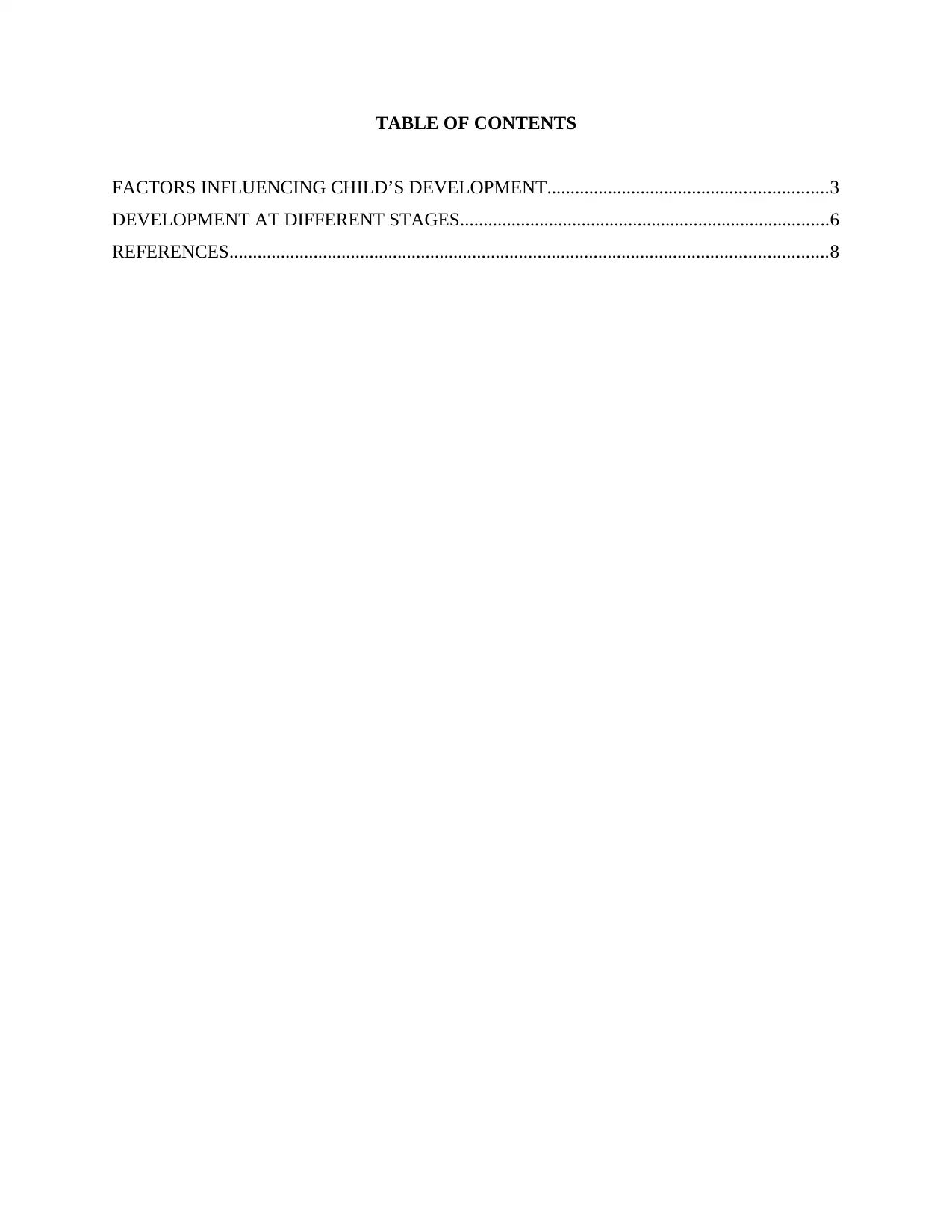
TABLE OF CONTENTS
FACTORS INFLUENCING CHILD’S DEVELOPMENT............................................................3
DEVELOPMENT AT DIFFERENT STAGES...............................................................................6
REFERENCES................................................................................................................................8
Document Page
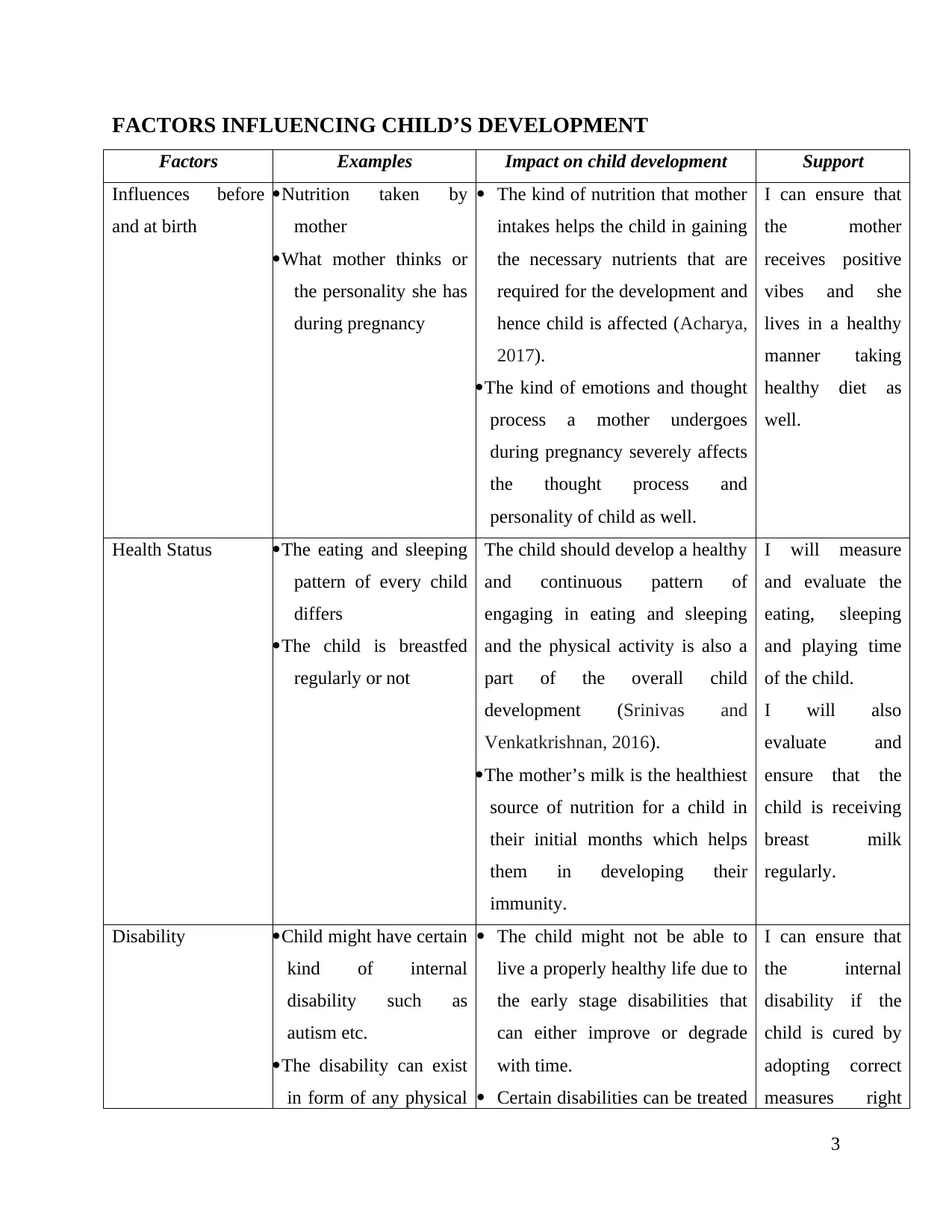
FACTORS INFLUENCING CHILD’S DEVELOPMENT
Factors Examples Impact on child development Support
Influences before
and at birth
ï‚·Nutrition taken by
mother
ï‚·What mother thinks or
the personality she has
during pregnancy
ï‚· The kind of nutrition that mother
intakes helps the child in gaining
the necessary nutrients that are
required for the development and
hence child is affected (Acharya,
2017).
ï‚·The kind of emotions and thought
process a mother undergoes
during pregnancy severely affects
the thought process and
personality of child as well.
I can ensure that
the mother
receives positive
vibes and she
lives in a healthy
manner taking
healthy diet as
well.
Health Status ï‚·The eating and sleeping
pattern of every child
differs
ï‚·The child is breastfed
regularly or not
The child should develop a healthy
and continuous pattern of
engaging in eating and sleeping
and the physical activity is also a
part of the overall child
development (Srinivas and
Venkatkrishnan, 2016).
The mother’s milk is the healthiest
source of nutrition for a child in
their initial months which helps
them in developing their
immunity.
I will measure
and evaluate the
eating, sleeping
and playing time
of the child.
I will also
evaluate and
ensure that the
child is receiving
breast milk
regularly.
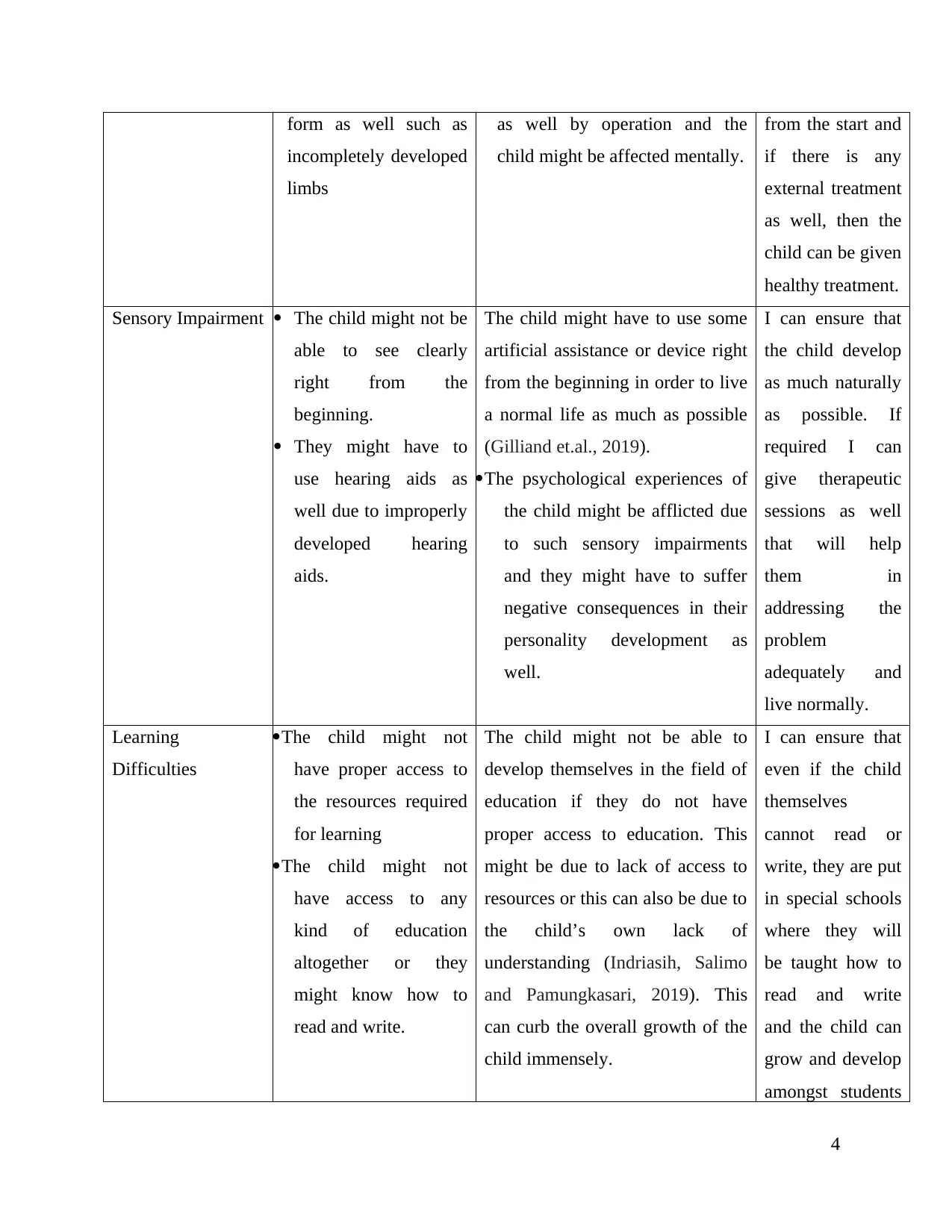
Disability ï‚·Child might have certain
kind of internal
disability such as
autism etc.
ï‚·The disability can exist
in form of any physical
ï‚· The child might not be able to
live a properly healthy life due to
the early stage disabilities that
can either improve or degrade
with time.
ï‚· Certain disabilities can be treated
I can ensure that
the internal
disability if the
child is cured by
adopting correct
measures right
3
Document Page
form as well such as
incompletely developed
limbs
as well by operation and the
child might be affected mentally.
from the start and
if there is any
external treatment
as well, then the
child can be given
healthy treatment.
Sensory Impairment ï‚· The child might not be
able to see clearly
right from the
beginning.
ï‚· They might have to
use hearing aids as
well due to improperly
developed hearing
aids.
The child might have to use some
artificial assistance or device right
from the beginning in order to live
a normal life as much as possible
(Gilliand et.al., 2019).
ï‚·The psychological experiences of
the child might be afflicted due
to such sensory impairments
and they might have to suffer
negative consequences in their
personality development as
well.
I can ensure that
the child develop
as much naturally
as possible. If
required I can
give therapeutic
sessions as well
that will help
them in
addressing the
problem
adequately and
live normally.
Learning
Difficulties
ï‚·The child might not
have proper access to
the resources required
for learning
ï‚·The child might not
have access to any
kind of education
altogether or they
might know how to
read and write.
The child might not be able to
develop themselves in the field of
education if they do not have
proper access to education. This
might be due to lack of access to
resources or this can also be due to
the child’s own lack of
understanding (Indriasih, Salimo
and Pamungkasari, 2019). This
can curb the overall growth of the
child immensely.
I can ensure that
even if the child
themselves
cannot read or
write, they are put
in special schools
where they will
be taught how to
read and write
and the child can
grow and develop
amongst students
4
tabler-icon-diamond-filled.svg

Paraphrase This Document

Need a fresh take? Get an instant paraphrase of this document with our AI Paraphraser
Document Page
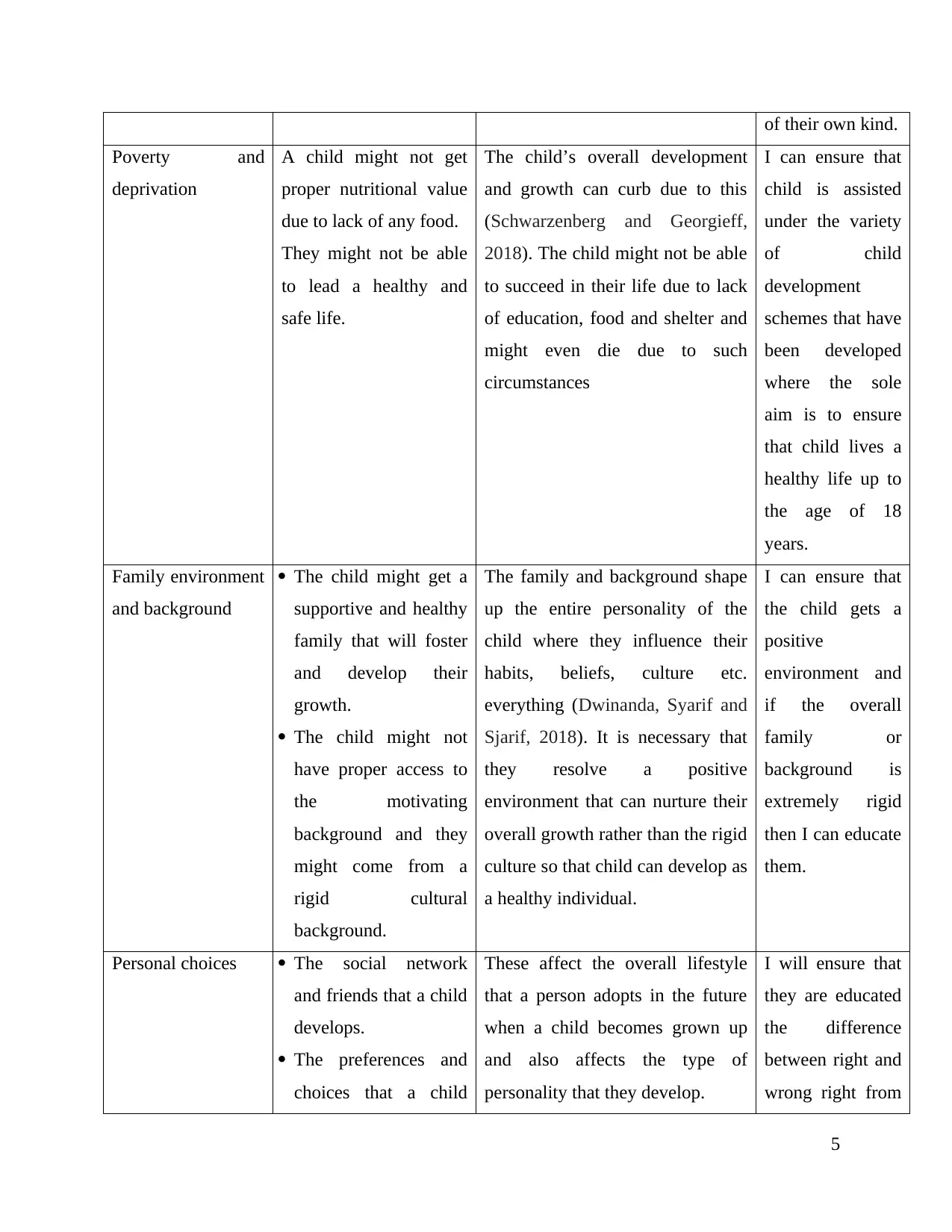
of their own kind.
Poverty and
deprivation
A child might not get
proper nutritional value
due to lack of any food.
They might not be able
to lead a healthy and
safe life.
The child’s overall development
and growth can curb due to this
(Schwarzenberg and Georgieff,
2018). The child might not be able
to succeed in their life due to lack
of education, food and shelter and
might even die due to such
circumstances
I can ensure that
child is assisted
under the variety
of child
development
schemes that have
been developed
where the sole
aim is to ensure
that child lives a
healthy life up to
the age of 18
years.
Family environment
and background
ï‚· The child might get a
supportive and healthy
family that will foster
and develop their
growth.
ï‚· The child might not
have proper access to
the motivating
background and they
might come from a
rigid cultural
background.
The family and background shape
up the entire personality of the
child where they influence their
habits, beliefs, culture etc.
everything (Dwinanda, Syarif and
Sjarif, 2018). It is necessary that
they resolve a positive
environment that can nurture their
overall growth rather than the rigid
culture so that child can develop as
a healthy individual.
I can ensure that
the child gets a
positive
environment and
if the overall
family or
background is
extremely rigid
then I can educate
them.
Personal choices ï‚· The social network
and friends that a child
develops.
ï‚· The preferences and
choices that a child
These affect the overall lifestyle
that a person adopts in the future
when a child becomes grown up
and also affects the type of
personality that they develop.
I will ensure that
they are educated
the difference
between right and
wrong right from
5
Document Page
develops the beginning.
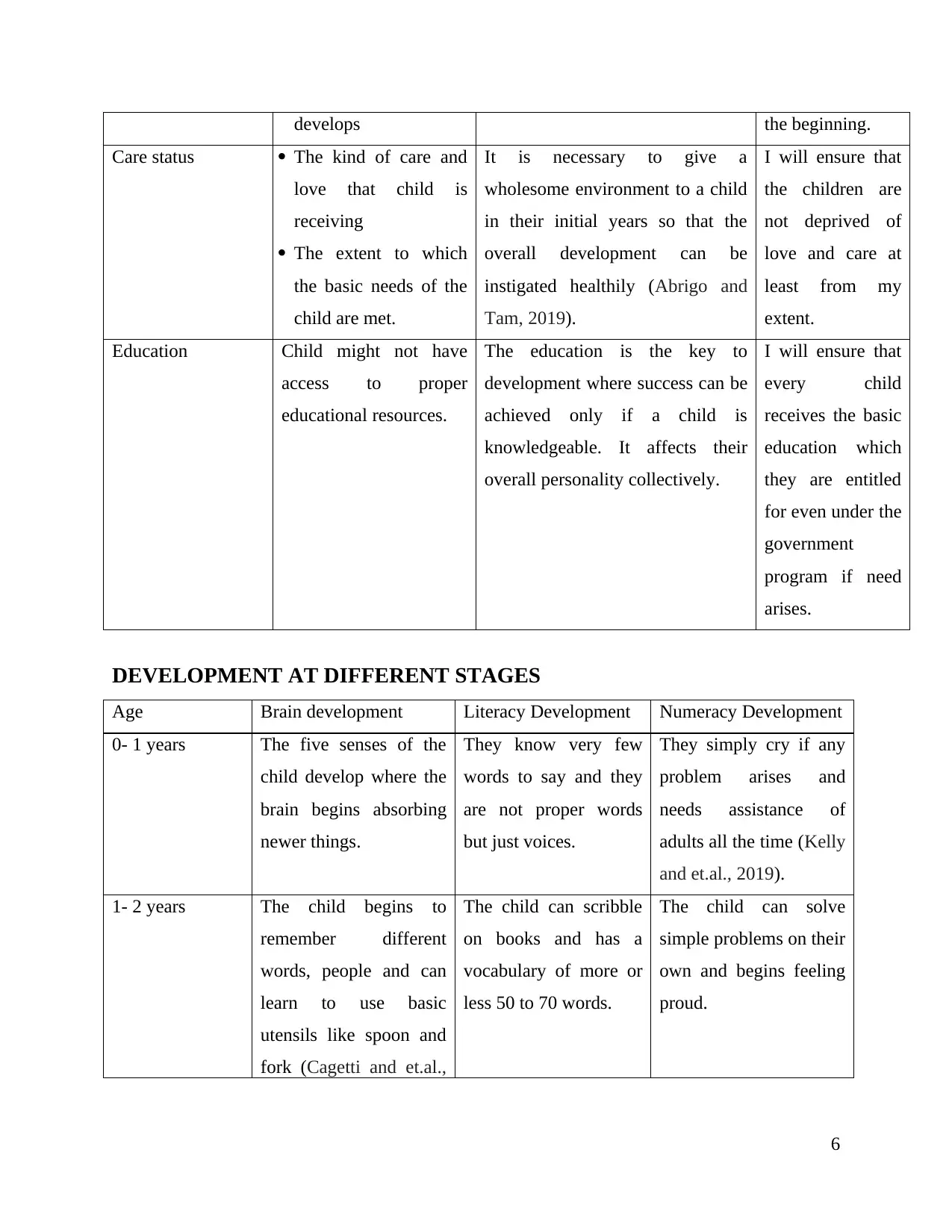
Care status ï‚· The kind of care and
love that child is
receiving
ï‚· The extent to which
the basic needs of the
child are met.
It is necessary to give a
wholesome environment to a child
in their initial years so that the
overall development can be
instigated healthily (Abrigo and
Tam, 2019).
I will ensure that
the children are
not deprived of
love and care at
least from my
extent.
Education Child might not have
access to proper
educational resources.
The education is the key to
development where success can be
achieved only if a child is
knowledgeable. It affects their
overall personality collectively.
I will ensure that
every child
receives the basic
education which
they are entitled
for even under the
government
program if need
arises.
DEVELOPMENT AT DIFFERENT STAGES
Age Brain development Literacy Development Numeracy Development
0- 1 years The five senses of the
child develop where the
brain begins absorbing
newer things.
They know very few
words to say and they
are not proper words
but just voices.
They simply cry if any
problem arises and
needs assistance of
adults all the time (Kelly
and et.al., 2019).
1- 2 years The child begins to
remember different
words, people and can
learn to use basic
utensils like spoon and
fork (Cagetti and et.al.,
The child can scribble
on books and has a
vocabulary of more or
less 50 to 70 words.
The child can solve
simple problems on their
own and begins feeling
proud.
6
Document Page
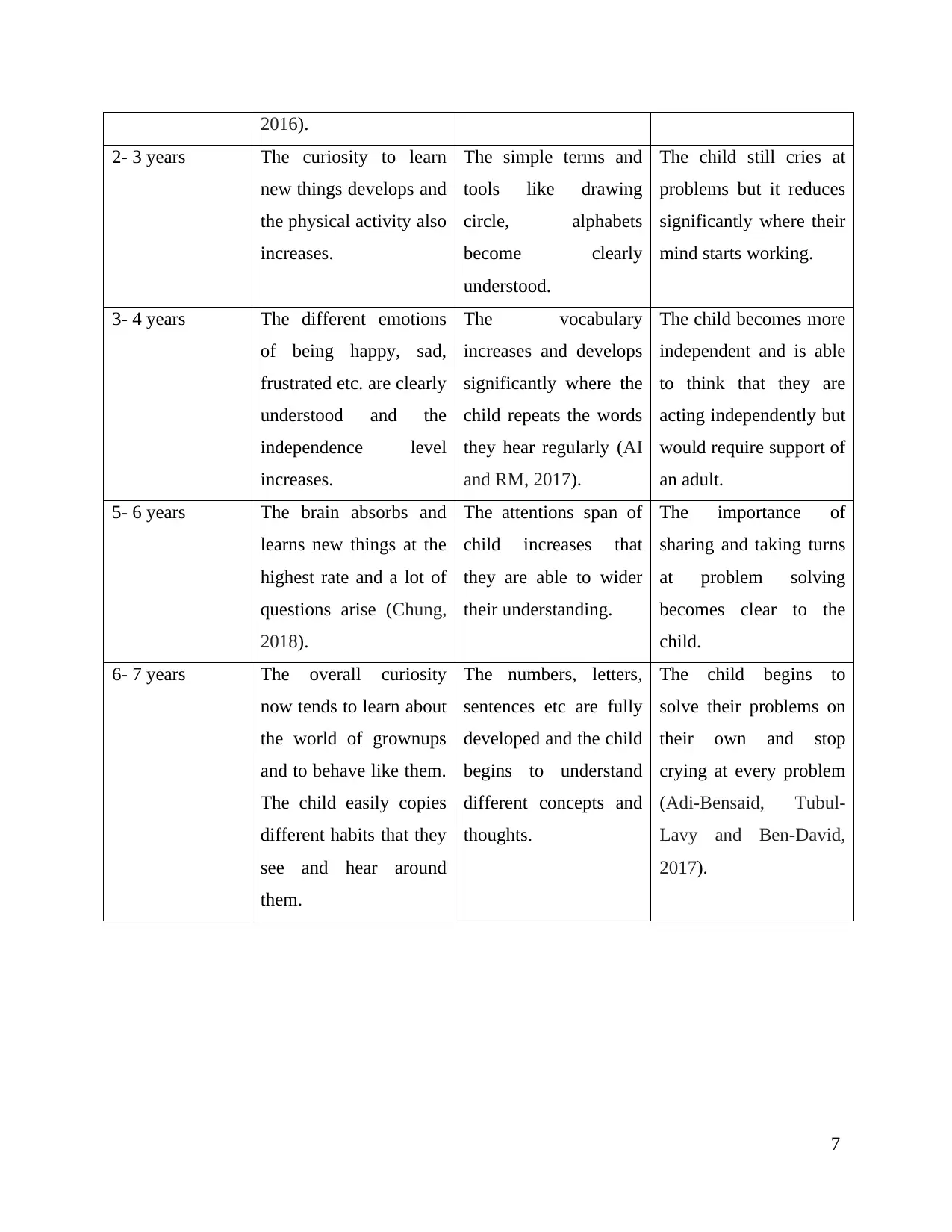
2016).
2- 3 years The curiosity to learn
new things develops and
the physical activity also
increases.
The simple terms and
tools like drawing
circle, alphabets
become clearly
understood.
The child still cries at
problems but it reduces
significantly where their
mind starts working.
3- 4 years The different emotions
of being happy, sad,
frustrated etc. are clearly
understood and the
independence level
increases.
The vocabulary
increases and develops
significantly where the
child repeats the words
they hear regularly (AI
and RM, 2017).
The child becomes more
independent and is able
to think that they are
acting independently but
would require support of
an adult.
5- 6 years The brain absorbs and
learns new things at the
highest rate and a lot of
questions arise (Chung,
2018).
The attentions span of
child increases that
they are able to wider
their understanding.
The importance of
sharing and taking turns
at problem solving
becomes clear to the
child.
6- 7 years The overall curiosity
now tends to learn about
the world of grownups
and to behave like them.
The child easily copies
different habits that they
see and hear around
them.
The numbers, letters,
sentences etc are fully
developed and the child
begins to understand
different concepts and
thoughts.
The child begins to
solve their problems on
their own and stop
crying at every problem
(Adi-Bensaid, Tubul-
Lavy and Ben-David,
2017).
7
tabler-icon-diamond-filled.svg

Paraphrase This Document

Need a fresh take? Get an instant paraphrase of this document with our AI Paraphraser
Document Page
REFERENCES
Books and Journals
Abrigo, M.R. and Tam, Z.C., 2019. Situational Analysis of Distal Factors Affecting Early
Childhood Care and Development in the First 1000 Days of Life in Zamboanga del
Norte.
Acharya, B.R., 2017. Factors affecting difficulties in learning mathematics by mathematics
learners. International Journal of Elementary Education. 6(2). pp.8-15.
Adi-Bensaid, L., Tubul-Lavy, G. and Ben-David, A., 2017. Parent use of content words to
Hebrew-speaking children at different stages of language development. Language &
Communication, 53. pp.35-44.
AI, J.O. and RM, M.G., 2017. From infant to child. Feeding in different stages. Nutricion
hospitalaria, 34(Suppl 4), pp.3-7.
Cagetti, M.G., and et.al., 2016. Are distinctive risk indicators associated with different stages of
caries in children? A cross-sectional study. BMC Public Health, 16(1). p.1213.
Chung, D., 2018. The eight stages of psychosocial protective development: Developmental
psychology. Journal of Behavioral and Brain Science, 8(06), p.369.
Dwinanda, N., Syarif, B.H. and Sjarif, D.R., 2018. Factors affecting exclusive breastfeeding in
term infants. Paediatr Indones, 58(1). pp.25-35.
Gilli, I.O., and et.al., 2019. Factors affecting diagnosis of primary pediatric central nervous
system neoplasias in a developing country. Child's Nervous System, 35(1). pp.91-96.
Indriasih, M., Salimo, H. and Pamungkasari, E.P., 2019. Path Analysis on The Biological and
Social Life Course Factors Affecting Childs Speech and Language Development
Delay. Journal of Maternal and Child Health, 4(6). pp.403-414.
Kelly, R.S., and et.al., 2019. Metabolomics and Communication Skills Development in Children;
Evidence from the Ages and Stages Questionnaire. Metabolites, 9(3). p.42.
Schwarzenberg, S.J. and Georgieff, M.K., 2018. Advocacy for improving nutrition in the first
1000 days to support childhood development and adult health. Pediatrics, 141(2).
p.e20173716.
Srinivas, P. and Venkatkrishnan, S., 2016. Factors affecting scholastic performance in school
children. IOSR Journal of Dental and Medical Sciences. 15(7). pp.47-53.
8
Document Page
9
chevron_up_icon
1 out of 9
circle_padding
hide_on_mobile
zoom_out_icon
[object Object]