Operations Management: Planning Facility Location & Expansion Analysis
VerifiedAdded on 2022/08/27
|7
|867
|18
Report
AI Summary
This report presents an analysis of facility location and operations management, specifically addressing the expansion of Jackson Diagnostics Medical Lab. The core issue revolves around space constraints and the need for expansion to accommodate patient demand. The analysis employs a decision-tree approach to evaluate different expansion options, considering profitability and probability factors. The report highlights the selection of a large expansion project based on its high probability of demand and profit. Additionally, a plant load distance layout is created to assess department interconnections and space requirements. The report also includes relevant bibliography.
Running Head: PLANNING FACILITY LOCATION & OPERATIONS
PLANNING FACILITY LOCATION & OPERATIONS
Name of the Student:
Name of the University:
Author Note:
PLANNING FACILITY LOCATION & OPERATIONS
Name of the Student:
Name of the University:
Author Note:
Paraphrase This Document
Need a fresh take? Get an instant paraphrase of this document with our AI Paraphraser

1PLANNING FACILITY LOCATION & OPERATIONS
The operations management issue in the case study focuses on the expansion of the office
space of Jackson Diagnostics Medical Lab. There is an operational problem due to less space and
capacity to hold patients in the medical laboratory for critical medical operations. This form of
space allocation problem interferes in the proper functioning of business. The main crux of the
situation lies in the decision-making of the space expansion with the cost-benefit analysis. The
profit to be determined in relation with the demand of services is to be noted. The company is in
a dilemma to choose the profitable expansion decision with high profit and high demand but on a
minimum cost structure.
The solution to this operational problem can be arrived from a decision-tree analysis
where the profitability with probability of each factor can be determined. The best decision can
be then taken forward to implement. Also, along with the decision-making, a proper plant layout
is required to be drawn in order to build a requirement analysis of the expansion and measure it
with the decision taken.
The operations management issue in the case study focuses on the expansion of the office
space of Jackson Diagnostics Medical Lab. There is an operational problem due to less space and
capacity to hold patients in the medical laboratory for critical medical operations. This form of
space allocation problem interferes in the proper functioning of business. The main crux of the
situation lies in the decision-making of the space expansion with the cost-benefit analysis. The
profit to be determined in relation with the demand of services is to be noted. The company is in
a dilemma to choose the profitable expansion decision with high profit and high demand but on a
minimum cost structure.
The solution to this operational problem can be arrived from a decision-tree analysis
where the profitability with probability of each factor can be determined. The best decision can
be then taken forward to implement. Also, along with the decision-making, a proper plant layout
is required to be drawn in order to build a requirement analysis of the expansion and measure it
with the decision taken.

2PLANNING FACILITY LOCATION & OPERATIONS
The decision tree analysis
Profit
Demand Small Probability Large Probability
High 55,000 23% 90,000 38%
Low 35,000 15% 52,000 22%
Table 1: The probability and profitability volume analysis
Source: Created by author
Note: The probability percentages are calculated after taking the total average and the
respective expansion project amount divided by 100 to arrive at the percentage.
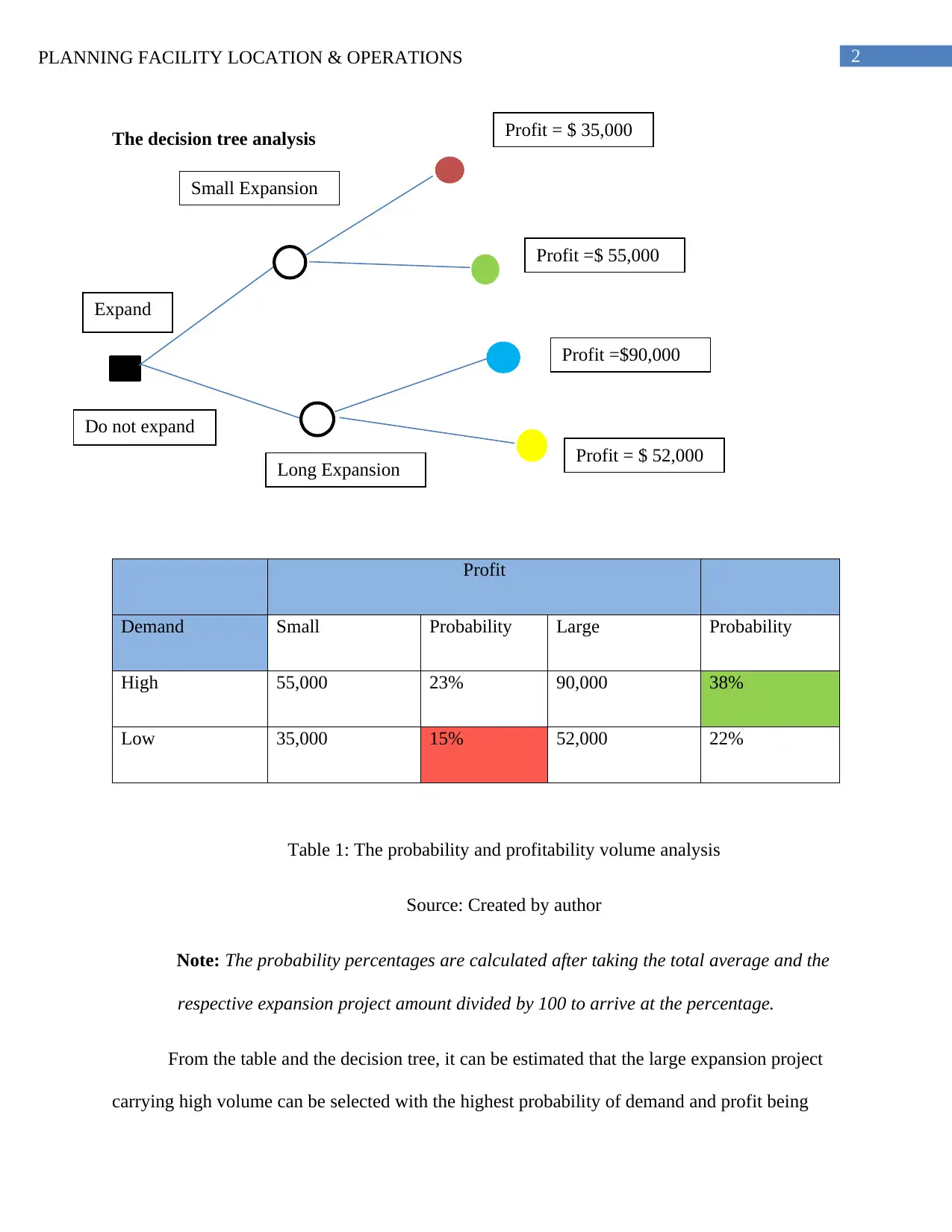
From the table and the decision tree, it can be estimated that the large expansion project
carrying high volume can be selected with the highest probability of demand and profit being
Expand
Do not expand
Small Expansion
Long Expansion
Profit = $ 35,000
Profit =$ 55,000
Profit =$90,000
Profit = $ 52,000
The decision tree analysis
Profit
Demand Small Probability Large Probability
High 55,000 23% 90,000 38%
Low 35,000 15% 52,000 22%
Table 1: The probability and profitability volume analysis
Source: Created by author
Note: The probability percentages are calculated after taking the total average and the
respective expansion project amount divided by 100 to arrive at the percentage.
From the table and the decision tree, it can be estimated that the large expansion project
carrying high volume can be selected with the highest probability of demand and profit being
Expand
Do not expand
Small Expansion
Long Expansion
Profit = $ 35,000
Profit =$ 55,000
Profit =$90,000
Profit = $ 52,000
⊘ This is a preview!⊘
Do you want full access?
Subscribe today to unlock all pages.

Trusted by 1+ million students worldwide

3PLANNING FACILITY LOCATION & OPERATIONS
38%. The large expansion decision is to be taken by moving the lab to the different in the same
building with more cost expenses to fill the space allocation for patients.
38%. The large expansion decision is to be taken by moving the lab to the different in the same
building with more cost expenses to fill the space allocation for patients.
Paraphrase This Document
Need a fresh take? Get an instant paraphrase of this document with our AI Paraphraser

4PLANNING FACILITY LOCATION & OPERATIONS
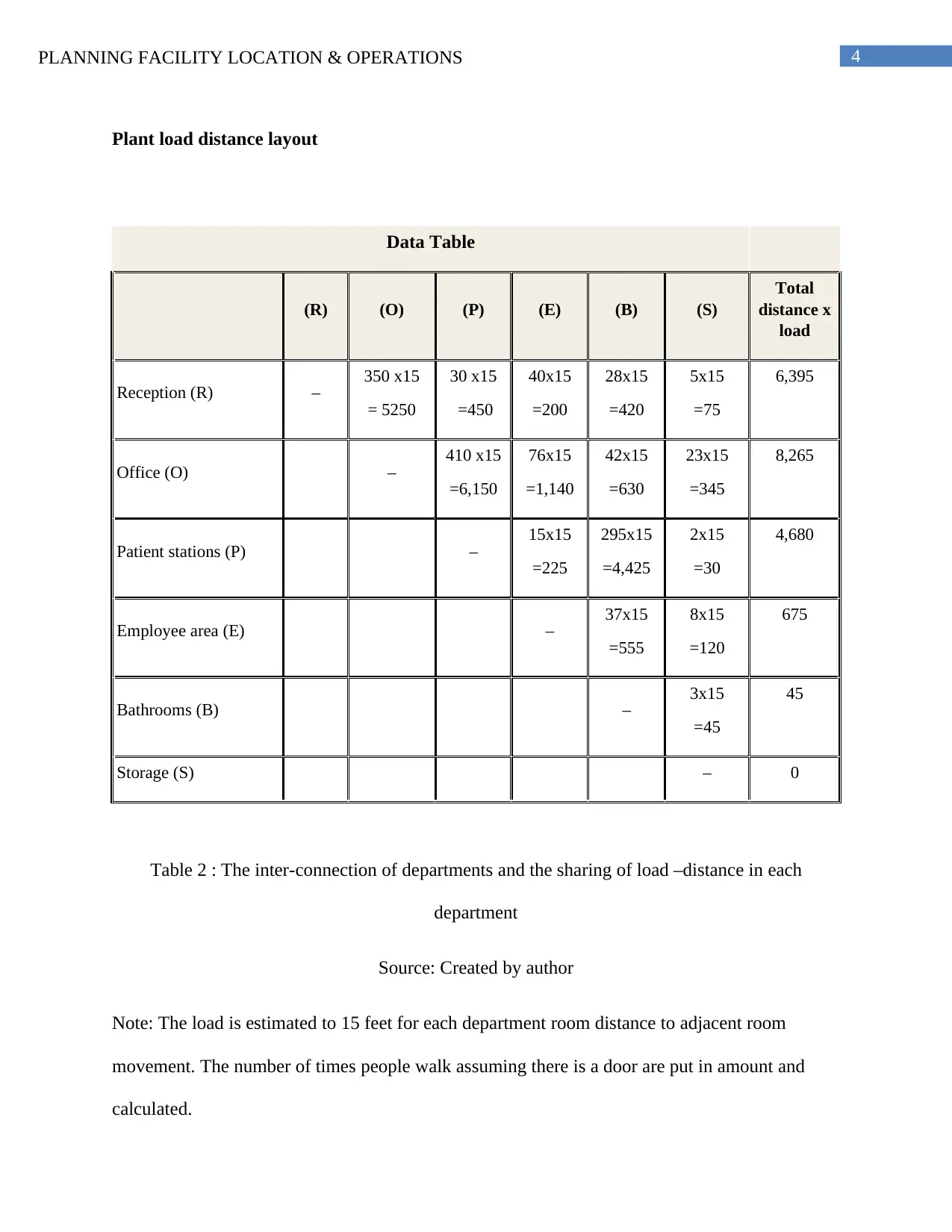
Plant load distance layout
Data Table
(R) (O) (P) (E) (B) (S)
Total
distance x
load
Reception (R) – 350 x15
= 5250
30 x15
=450
40x15
=200
28x15
=420
5x15
=75
6,395
Office (O) – 410 x15
=6,150
76x15
=1,140
42x15
=630
23x15
=345
8,265
Patient stations (P) – 15x15
=225
295x15
=4,425
2x15
=30
4,680
Employee area (E) – 37x15
=555
8x15
=120
675
Bathrooms (B) – 3x15
=45
45
Storage (S) – 0
Table 2 : The inter-connection of departments and the sharing of load –distance in each
department
Source: Created by author
Note: The load is estimated to 15 feet for each department room distance to adjacent room
movement. The number of times people walk assuming there is a door are put in amount and
calculated.
Plant load distance layout
Data Table
(R) (O) (P) (E) (B) (S)
Total
distance x
load
Reception (R) – 350 x15
= 5250
30 x15
=450
40x15
=200
28x15
=420
5x15
=75
6,395
Office (O) – 410 x15
=6,150
76x15
=1,140
42x15
=630
23x15
=345
8,265
Patient stations (P) – 15x15
=225
295x15
=4,425
2x15
=30
4,680
Employee area (E) – 37x15
=555
8x15
=120
675
Bathrooms (B) – 3x15
=45
45
Storage (S) – 0
Table 2 : The inter-connection of departments and the sharing of load –distance in each
department
Source: Created by author
Note: The load is estimated to 15 feet for each department room distance to adjacent room
movement. The number of times people walk assuming there is a door are put in amount and
calculated.

5PLANNING FACILITY LOCATION & OPERATIONS
Bibliography
Kamiński, B., Jakubczyk, M., & Szufel, P. (2018). A framework for sensitivity analysis of
decision trees. Central European journal of operations research, 26(1), 135-159.
Reid, R. D., & Sanders, N. R. (2019). Operations management: an integrated approach. John
Wiley & Sons.
Bibliography
Bell, L. N. (2019). Terrorist assassination and institutional change in repressive regimes.
Terrorism and political violence, 31(4), 853-875.
Bernat, J. L. (2017). Conceptual controversies in death determination.
Finlay, W. M. L. (2018). Language and civilian deaths: Denying responsibility for casualties in
the Gaza conflict 2014. Political psychology, 39(3), 595-609.
Bibliography
Kamiński, B., Jakubczyk, M., & Szufel, P. (2018). A framework for sensitivity analysis of
decision trees. Central European journal of operations research, 26(1), 135-159.
Reid, R. D., & Sanders, N. R. (2019). Operations management: an integrated approach. John
Wiley & Sons.
Bibliography
Bell, L. N. (2019). Terrorist assassination and institutional change in repressive regimes.
Terrorism and political violence, 31(4), 853-875.
Bernat, J. L. (2017). Conceptual controversies in death determination.
Finlay, W. M. L. (2018). Language and civilian deaths: Denying responsibility for casualties in
the Gaza conflict 2014. Political psychology, 39(3), 595-609.
⊘ This is a preview!⊘
Do you want full access?
Subscribe today to unlock all pages.

Trusted by 1+ million students worldwide

6PLANNING FACILITY LOCATION & OPERATIONS
Muller, V. (2018, September). Violent Deaths: Political and Religious Justifications, according
to few Akkadian Texts (2nd Millennium BC).
Serban, A., Yammarino, F. J., Sotak, K. L., Banoeng-Yakubo, J., Mushore, A. B., Hao, C., ... &
Mumford, M. D. (2018). Assassination of political leaders: The role of social conflict.
The Leadership Quarterly, 29(4), 457-475.
Sharpe, J. (2017). Craig Spence. Accidents and Violent Deaths in Early Modern London, 1650–
1750. Studies in Early Modern Cultural, Political and Social History 25. Woodbridge:
Boydell Press, 2016. Pp. 273. $115.00 (cloth). Journal of British Studies, 56(4), 881-882.
Muller, V. (2018, September). Violent Deaths: Political and Religious Justifications, according
to few Akkadian Texts (2nd Millennium BC).
Serban, A., Yammarino, F. J., Sotak, K. L., Banoeng-Yakubo, J., Mushore, A. B., Hao, C., ... &
Mumford, M. D. (2018). Assassination of political leaders: The role of social conflict.
The Leadership Quarterly, 29(4), 457-475.
Sharpe, J. (2017). Craig Spence. Accidents and Violent Deaths in Early Modern London, 1650–
1750. Studies in Early Modern Cultural, Political and Social History 25. Woodbridge:
Boydell Press, 2016. Pp. 273. $115.00 (cloth). Journal of British Studies, 56(4), 881-882.
1 out of 7
Your All-in-One AI-Powered Toolkit for Academic Success.
+13062052269
info@desklib.com
Available 24*7 on WhatsApp / Email
Unlock your academic potential
Copyright © 2020–2026 A2Z Services. All Rights Reserved. Developed and managed by ZUCOL.