Analysis of Police Accountability Framework in the UK Criminology
VerifiedAdded on 2023/05/31
|15
|3803
|94
Report
AI Summary
This report provides a comprehensive overview of police accountability in the United Kingdom, emphasizing its importance in maintaining public trust and preventing abuse of power. It details the various structures and states of police accountability, including the tripartite system involving the Home Office, local police authorities, and the chief constable. The report also examines key legislations such as the Police and Criminal Evidence Act 1984 (PACE) and the roles of Her Majesty's Inspectorate of Constabulary (HMIC) and the Audit Commission in overseeing police functions. Furthermore, it discusses financial and organizational accountability, the complaint system, and challenges related to power balancing, independence, and human rights issues, ultimately highlighting the complexities and necessities of police accountability within the UK's legal and administrative framework.

RUNNING HEAD: Criminology
Introduction to Criminology and Criminal Justice
12/18/2018
Student Name
Introduction to Criminology and Criminal Justice
12/18/2018
Student Name

Paraphrase This Document
Need a fresh take? Get an instant paraphrase of this document with our AI Paraphraser
1
Criminology
Contents
Introduction.................................................................................................................................................2
What is accountability?...............................................................................................................................3
The significance of Police Accountability...................................................................................................4
Structure and States of Police accountability in the UK..............................................................................5
The tripartite system................................................................................................................................6
The Police and Criminal Evidence Act 1984 (PACE).............................................................................7
Her Majestyís Inspectorate of Constabulary (HMIC)..............................................................................8
The Audit Commission (England and Wales)..........................................................................................8
The Police Performance Assessment Framework (PPAF).......................................................................9
Financial Accountability........................................................................................................................10
Organizational Accountability................................................................................................................10
The complaint system............................................................................................................................11
National agencies and their accountability............................................................................................11
The problem in Power Balancing..............................................................................................................12
Issues of Independence..............................................................................................................................12
Human rights issues...................................................................................................................................12
Conclusion.................................................................................................................................................13
References.................................................................................................................................................14
Criminology
Contents
Introduction.................................................................................................................................................2
What is accountability?...............................................................................................................................3
The significance of Police Accountability...................................................................................................4
Structure and States of Police accountability in the UK..............................................................................5
The tripartite system................................................................................................................................6
The Police and Criminal Evidence Act 1984 (PACE).............................................................................7
Her Majestyís Inspectorate of Constabulary (HMIC)..............................................................................8
The Audit Commission (England and Wales)..........................................................................................8
The Police Performance Assessment Framework (PPAF).......................................................................9
Financial Accountability........................................................................................................................10
Organizational Accountability................................................................................................................10
The complaint system............................................................................................................................11
National agencies and their accountability............................................................................................11
The problem in Power Balancing..............................................................................................................12
Issues of Independence..............................................................................................................................12
Human rights issues...................................................................................................................................12
Conclusion.................................................................................................................................................13
References.................................................................................................................................................14
2
Criminology
Introduction
In the current scenario, the police department plays an important role, as it is one of the bodies
that is expected to work in favor of citizens. This is the reason for which the individuals of
society expect best results out of the services of the police. In a democratic society where the
whole law system is regulated by defined authorities and government, it is required to be
responsible and accountable on the part of the police. Now the query is to whom police are
accountable. In order to answer the query, this is to be stated that the same is accountable to
private parties including individuals, government, and other agencies, which are responsible to
oversee the functions of the police department (Newburn, 2012). The police are accountable as
well as answerable to each individual. For a country like the UK where there is a constitutional
monarchy, which means that it is a democratic country but king and queen also exist there.
Judiciary is responsible to check that whether the constitutional provisions and guidelines being
properly followed or not, Further, all of the important decisions made or taken by the
government are required to be check by the majesty as a final approval.
In this paper, the focus will be made on police accountability and different governing bodies and
agencies that oversee the whole workings of the police department in the UK. Further, the
discussion will also include the various fields of accountability, which includes financial,
personal and operation field. The lead objective of this paper is to develop an understanding of
the topic of police accountability. Being, an important part of the society and the law
administrative system, the police is required to be accountable. In the presented report, the
significance of police accountability is also mentioned.
Criminology
Introduction
In the current scenario, the police department plays an important role, as it is one of the bodies
that is expected to work in favor of citizens. This is the reason for which the individuals of
society expect best results out of the services of the police. In a democratic society where the
whole law system is regulated by defined authorities and government, it is required to be
responsible and accountable on the part of the police. Now the query is to whom police are
accountable. In order to answer the query, this is to be stated that the same is accountable to
private parties including individuals, government, and other agencies, which are responsible to
oversee the functions of the police department (Newburn, 2012). The police are accountable as
well as answerable to each individual. For a country like the UK where there is a constitutional
monarchy, which means that it is a democratic country but king and queen also exist there.
Judiciary is responsible to check that whether the constitutional provisions and guidelines being
properly followed or not, Further, all of the important decisions made or taken by the
government are required to be check by the majesty as a final approval.
In this paper, the focus will be made on police accountability and different governing bodies and
agencies that oversee the whole workings of the police department in the UK. Further, the
discussion will also include the various fields of accountability, which includes financial,
personal and operation field. The lead objective of this paper is to develop an understanding of
the topic of police accountability. Being, an important part of the society and the law
administrative system, the police is required to be accountable. In the presented report, the
significance of police accountability is also mentioned.
⊘ This is a preview!⊘
Do you want full access?
Subscribe today to unlock all pages.

Trusted by 1+ million students worldwide
3
Criminology
What is accountability?
Before moving ahead on the discussion about police accountability of police, this is necessary to
understand that what the meaning of accountability is. In a true sense, accountability can be
understood as an obligation of an organization or an individual to account for it is acts, accept the
liability for the same and to disclose and present the results in an open and transparent manner
(Businessdictionary.com, 2018). When it comes to police accountability, this is to mention that it
is a concept, which puts an obligation on the police to be responsible for their doings,
individually as well as organizationally. This is the reason that the police always must keep
themselves for an inquiry about the reasoning of their doings. The reason behind making police
accountable is to control the unnecessary use of powers by them. Imagine a situation where the
police are not liable for their acts, the same is not required to provide justification that why the
same has done a particular task. In such a situation, it is the possibility that police can use it is a
force in an unethical manner and for the personal interest. The significance of Police
accountability is further detailed in the following section:-
The significance of Police Accountability
The main feature of the police accountability is to check that who regulates the police. To whom
they are accountable (Compass.port.ac.uk, 2018). The concept of police accountability is
necessary in order to ensure that police are using their policing services in a fair, equal, and
justified manner. In order to review the complex nature of the subjective accountability in the
jurisdiction of UK, this is necessary to know the terrain of policing in all three different
jurisdictions. Before moving ahead, it should be clear in the mind of readers that what is referred
to as the police of the UK in the paper. The police of the United Kingdom is not a unitary body
Criminology
What is accountability?
Before moving ahead on the discussion about police accountability of police, this is necessary to
understand that what the meaning of accountability is. In a true sense, accountability can be
understood as an obligation of an organization or an individual to account for it is acts, accept the
liability for the same and to disclose and present the results in an open and transparent manner
(Businessdictionary.com, 2018). When it comes to police accountability, this is to mention that it
is a concept, which puts an obligation on the police to be responsible for their doings,
individually as well as organizationally. This is the reason that the police always must keep
themselves for an inquiry about the reasoning of their doings. The reason behind making police
accountable is to control the unnecessary use of powers by them. Imagine a situation where the
police are not liable for their acts, the same is not required to provide justification that why the
same has done a particular task. In such a situation, it is the possibility that police can use it is a
force in an unethical manner and for the personal interest. The significance of Police
accountability is further detailed in the following section:-
The significance of Police Accountability
The main feature of the police accountability is to check that who regulates the police. To whom
they are accountable (Compass.port.ac.uk, 2018). The concept of police accountability is
necessary in order to ensure that police are using their policing services in a fair, equal, and
justified manner. In order to review the complex nature of the subjective accountability in the
jurisdiction of UK, this is necessary to know the terrain of policing in all three different
jurisdictions. Before moving ahead, it should be clear in the mind of readers that what is referred
to as the police of the UK in the paper. The police of the United Kingdom is not a unitary body
Paraphrase This Document
Need a fresh take? Get an instant paraphrase of this document with our AI Paraphraser
4
Criminology
as the national police forces, which presents in many of the nations of across globe. For
instance:- In England and Wales, there are 43 forces which undertake the policing activities
based on geographical area. The Police Service of Northern Ireland (also known as PSNI) is
there in Northern Ireland. Apart from these official forces, some non-home office forces are also
there in the UK. These forces have specialized remit. Following are some the examples of these
forces:-
British Transport Police (BTP)
the United Kingdom Atomic Energy Authority Constabulary (UKAEA)
the Ministry of Defense Police (MOD)
This is the reason that while referring to police, people often think that there is only a single
entity, which is not correct. Police accountability sometimes considers as a hurdle in the free
exercise of the right by a police officer. Therefore, in the year 1980, it becomes a political issue
in England and Wales. However, the commentator has reviewed and noted the existence of the
same necessary for the following reasons:-
1. Financial stewardship: - Police use public resources in their workings and actions and
therefore the same is required to be accountable.
2. Police legitimacy: - Accountability helps police by increasing and supporting legitimacy.
In order to achieve the trust and active co-operation, police often strive for legitimacy,
especially in democratic states (Reiner, 2010).
3. Control over actions:- To regulate the behavior of the police and to prevent the
unwarranted actions of the same, there is a huge requirement of police accountability and
the same is significant for this reason.
Criminology
as the national police forces, which presents in many of the nations of across globe. For
instance:- In England and Wales, there are 43 forces which undertake the policing activities
based on geographical area. The Police Service of Northern Ireland (also known as PSNI) is
there in Northern Ireland. Apart from these official forces, some non-home office forces are also
there in the UK. These forces have specialized remit. Following are some the examples of these
forces:-
British Transport Police (BTP)
the United Kingdom Atomic Energy Authority Constabulary (UKAEA)
the Ministry of Defense Police (MOD)
This is the reason that while referring to police, people often think that there is only a single
entity, which is not correct. Police accountability sometimes considers as a hurdle in the free
exercise of the right by a police officer. Therefore, in the year 1980, it becomes a political issue
in England and Wales. However, the commentator has reviewed and noted the existence of the
same necessary for the following reasons:-
1. Financial stewardship: - Police use public resources in their workings and actions and
therefore the same is required to be accountable.
2. Police legitimacy: - Accountability helps police by increasing and supporting legitimacy.
In order to achieve the trust and active co-operation, police often strive for legitimacy,
especially in democratic states (Reiner, 2010).
3. Control over actions:- To regulate the behavior of the police and to prevent the
unwarranted actions of the same, there is a huge requirement of police accountability and
the same is significant for this reason.
5
Criminology
Structure and States of Police accountability in the UK
From where the powers of police arrive? To answer this question this is to be stated that
legislation is there which defines the powers of the police. However, at many times, these
legislations are used to be interpreted in a different manner by judges while considering and
granting decisions in many of the cases. In addition to this, the executive body can issue the
guidelines on the procedure. When it comes to the policies, most of the powers are available with
ministers who are the major servants of the crown. Police serve it is services not on a state level
but at a central level and hence the system of police accountability is complex in comparison to
other subordinates of the crown.
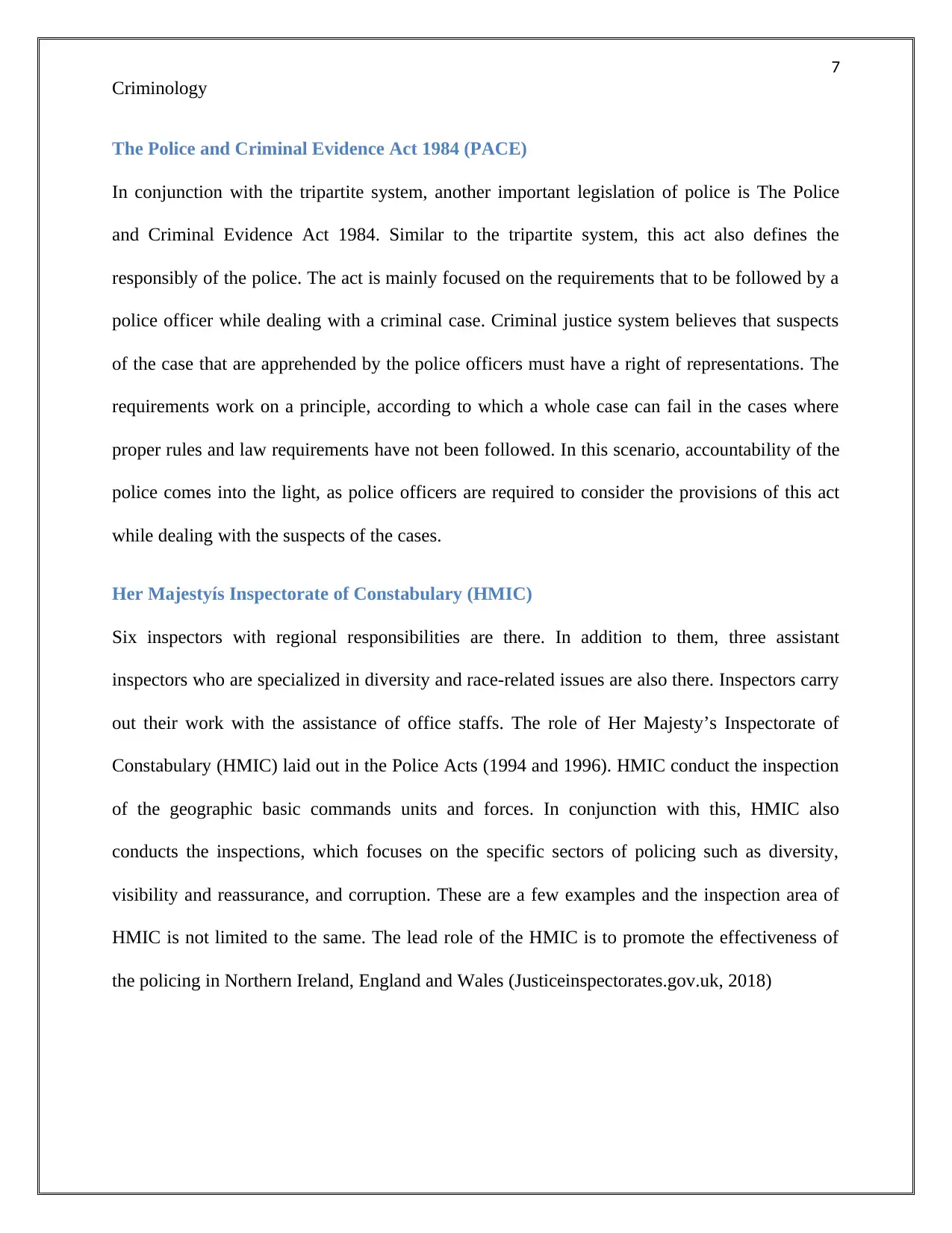
The tripartite system
It is a system of accountability by which the 43 police forces of England and Wales are used to
be held accountable (Publications.parliament.uk, 2018a). The subjective system distributes the
liability among three of the following
The home office
The local police authority
The chief constable of the force
The Home Secretary is the responsible person who helps parliament in proving accountability
under the tripartite system by setting out key priorities. It also helps to provide accountability to
the local population via local police authorities. By the current arrangement, the autonomy of
chief constable is limited as it has been clear that police officers are the public servant and
therefore cannot be a subject matter of political discussion. One can better understand the
tripartite system by looking after below picture
Criminology
Structure and States of Police accountability in the UK
From where the powers of police arrive? To answer this question this is to be stated that
legislation is there which defines the powers of the police. However, at many times, these
legislations are used to be interpreted in a different manner by judges while considering and
granting decisions in many of the cases. In addition to this, the executive body can issue the
guidelines on the procedure. When it comes to the policies, most of the powers are available with
ministers who are the major servants of the crown. Police serve it is services not on a state level
but at a central level and hence the system of police accountability is complex in comparison to
other subordinates of the crown.
The tripartite system
It is a system of accountability by which the 43 police forces of England and Wales are used to
be held accountable (Publications.parliament.uk, 2018a). The subjective system distributes the
liability among three of the following
The home office
The local police authority
The chief constable of the force
The Home Secretary is the responsible person who helps parliament in proving accountability
under the tripartite system by setting out key priorities. It also helps to provide accountability to
the local population via local police authorities. By the current arrangement, the autonomy of
chief constable is limited as it has been clear that police officers are the public servant and
therefore cannot be a subject matter of political discussion. One can better understand the
tripartite system by looking after below picture
⊘ This is a preview!⊘
Do you want full access?
Subscribe today to unlock all pages.
Trusted by 1+ million students worldwide
6
Criminology
(Mawby and Wright, 2005)
Prior to the Police Act 1964, Scotland already had this system not similar to Wales and England.
In this system, the local authority was playing the role of local police authority. Nevertheless, as
the Police (Scotland) Act 1967 is the primary legislation, hence the reforms of England and
Wales have followed the same pattern in Scotland. Joint police boards and police authorities are
the two bodies that set a budget for the police and ensure the best outcomes out of the same for
the public. Moving the focus towards Northern Ireland, policing board plays the role of police
authority and help Police Service of Northern Ireland (PSNI) by meeting with the standards
stated under Human Rights Act 1998.
Criminology
(Mawby and Wright, 2005)
Prior to the Police Act 1964, Scotland already had this system not similar to Wales and England.
In this system, the local authority was playing the role of local police authority. Nevertheless, as
the Police (Scotland) Act 1967 is the primary legislation, hence the reforms of England and
Wales have followed the same pattern in Scotland. Joint police boards and police authorities are
the two bodies that set a budget for the police and ensure the best outcomes out of the same for
the public. Moving the focus towards Northern Ireland, policing board plays the role of police
authority and help Police Service of Northern Ireland (PSNI) by meeting with the standards
stated under Human Rights Act 1998.
Paraphrase This Document
Need a fresh take? Get an instant paraphrase of this document with our AI Paraphraser
7
Criminology
The Police and Criminal Evidence Act 1984 (PACE)
In conjunction with the tripartite system, another important legislation of police is The Police
and Criminal Evidence Act 1984. Similar to the tripartite system, this act also defines the
responsibly of the police. The act is mainly focused on the requirements that to be followed by a
police officer while dealing with a criminal case. Criminal justice system believes that suspects
of the case that are apprehended by the police officers must have a right of representations. The
requirements work on a principle, according to which a whole case can fail in the cases where
proper rules and law requirements have not been followed. In this scenario, accountability of the
police comes into the light, as police officers are required to consider the provisions of this act
while dealing with the suspects of the cases.
Her Majestyís Inspectorate of Constabulary (HMIC)
Six inspectors with regional responsibilities are there. In addition to them, three assistant
inspectors who are specialized in diversity and race-related issues are also there. Inspectors carry
out their work with the assistance of office staffs. The role of Her Majesty’s Inspectorate of
Constabulary (HMIC) laid out in the Police Acts (1994 and 1996). HMIC conduct the inspection
of the geographic basic commands units and forces. In conjunction with this, HMIC also
conducts the inspections, which focuses on the specific sectors of policing such as diversity,
visibility and reassurance, and corruption. These are a few examples and the inspection area of
HMIC is not limited to the same. The lead role of the HMIC is to promote the effectiveness of
the policing in Northern Ireland, England and Wales (Justiceinspectorates.gov.uk, 2018)
Criminology
The Police and Criminal Evidence Act 1984 (PACE)
In conjunction with the tripartite system, another important legislation of police is The Police
and Criminal Evidence Act 1984. Similar to the tripartite system, this act also defines the
responsibly of the police. The act is mainly focused on the requirements that to be followed by a
police officer while dealing with a criminal case. Criminal justice system believes that suspects
of the case that are apprehended by the police officers must have a right of representations. The
requirements work on a principle, according to which a whole case can fail in the cases where
proper rules and law requirements have not been followed. In this scenario, accountability of the
police comes into the light, as police officers are required to consider the provisions of this act
while dealing with the suspects of the cases.
Her Majestyís Inspectorate of Constabulary (HMIC)
Six inspectors with regional responsibilities are there. In addition to them, three assistant
inspectors who are specialized in diversity and race-related issues are also there. Inspectors carry
out their work with the assistance of office staffs. The role of Her Majesty’s Inspectorate of
Constabulary (HMIC) laid out in the Police Acts (1994 and 1996). HMIC conduct the inspection
of the geographic basic commands units and forces. In conjunction with this, HMIC also
conducts the inspections, which focuses on the specific sectors of policing such as diversity,
visibility and reassurance, and corruption. These are a few examples and the inspection area of
HMIC is not limited to the same. The lead role of the HMIC is to promote the effectiveness of
the policing in Northern Ireland, England and Wales (Justiceinspectorates.gov.uk, 2018)
8
Criminology
The Audit Commission (England and Wales)
This is an independent body, which has been established in the year 1982 (Alcock, 2014). Police
of England and Wales firstly been scrutinized in the year 1988 by this commission. As the name
implies the lead task of the commission is to conduct audits. In the year 1988, this commission
has conducted an audit on budgets allocation and financing of police funding. Later on the same
made it focus on different matters such as patrol work, operational matters, and crime
management. According to the noting of one of the retired chief constable, twenty-seven audit
reports have been published in during the period starts from the year 1997 to1999. These reports
have made more than three hundred recommendations. The lead objective behind the
development of this commission is to ensure that police is using funds of the public for a just and
proper purpose and in this manner; their personal interest is not conflicting with the interest of
the nation (Publications.parliament.uk, 2018b).
The Police Performance Assessment Framework (PPAF)
The home office has developed this program in consultation with the Association of Police
Authorities and Association of Police Authorities in the year 2004 (Brain, 2010). The program is
also known as PPAF. The program has provided some performance measure to evaluate the
effectiveness and efficiency of the working of the police. In this manner, these measures do not
only held individual forces accountable but also evaluate their performance in comparison to
other police forces. According to the belief of Home office, PPAF not only measures the
operational effectiveness of police officers but also measures the overall confidence and trust in
police. A baseline assessment has been released by HMIC in the year 2004 which has become a
topic of debate. The reason behind the debate was the comparative performance of different
police forces. In the debate, the lead question to discuss was that whether the chief constable who
Criminology
The Audit Commission (England and Wales)
This is an independent body, which has been established in the year 1982 (Alcock, 2014). Police
of England and Wales firstly been scrutinized in the year 1988 by this commission. As the name
implies the lead task of the commission is to conduct audits. In the year 1988, this commission
has conducted an audit on budgets allocation and financing of police funding. Later on the same
made it focus on different matters such as patrol work, operational matters, and crime
management. According to the noting of one of the retired chief constable, twenty-seven audit
reports have been published in during the period starts from the year 1997 to1999. These reports
have made more than three hundred recommendations. The lead objective behind the
development of this commission is to ensure that police is using funds of the public for a just and
proper purpose and in this manner; their personal interest is not conflicting with the interest of
the nation (Publications.parliament.uk, 2018b).
The Police Performance Assessment Framework (PPAF)
The home office has developed this program in consultation with the Association of Police
Authorities and Association of Police Authorities in the year 2004 (Brain, 2010). The program is
also known as PPAF. The program has provided some performance measure to evaluate the
effectiveness and efficiency of the working of the police. In this manner, these measures do not
only held individual forces accountable but also evaluate their performance in comparison to
other police forces. According to the belief of Home office, PPAF not only measures the
operational effectiveness of police officers but also measures the overall confidence and trust in
police. A baseline assessment has been released by HMIC in the year 2004 which has become a
topic of debate. The reason behind the debate was the comparative performance of different
police forces. In the debate, the lead question to discuss was that whether the chief constable who
⊘ This is a preview!⊘
Do you want full access?
Subscribe today to unlock all pages.
Trusted by 1+ million students worldwide
9
Criminology
has been rated as poor would get dismissed. It has been proven an effective tool of scrutiny of
police by the public. This ensures the accountability of police in the UK in an effective manner.
Financial Accountability
The objective of this program was somewhere similar to the objective of The Audit Commission.
In the year 1980, financial management initiative of the public sector has been implied to police
services by the government. Under this program, the district auditors have the power to check
and make an audit on the financials of public authorities that also includes police. In addition to
this, the national audit officer has produced reports on the subject “value for money”. Apart from
this, the development of Police and Magistrates Courts Act 1994 reduced the budgeting of police
forces to a significant level. Since the enactment of this act, now all the local police authorities
are used to receive cash limited grant instead of the funding from council tax, revenue support
grant and non-domestic rates.
Organizational Accountability
In terms of organizational accountability, a systematic hierarchal structure is required to render a
disciplined and responsible service (Walsh and Conway, 2011). In the UK context, an apparent
military structure has been devised in the system. It is significant to note that the police officers
are required to follow the code of conduct as prescribed. The code of conduct deals with various
matters for the officers. Some of them are the disreputable conduct on part of officers, racially
discriminatory behavior, not following up the orders, and others. The matters like these are
subject to the reprimands, penalties, and fines and are regarded as punishable offenses. These are
subject to the internal investigation and disciplinary hearings, followed by the judgments to be
adhered to. It must be noted that the breach of the code of conduct may also result in criminal or
Criminology
has been rated as poor would get dismissed. It has been proven an effective tool of scrutiny of
police by the public. This ensures the accountability of police in the UK in an effective manner.
Financial Accountability
The objective of this program was somewhere similar to the objective of The Audit Commission.
In the year 1980, financial management initiative of the public sector has been implied to police
services by the government. Under this program, the district auditors have the power to check
and make an audit on the financials of public authorities that also includes police. In addition to
this, the national audit officer has produced reports on the subject “value for money”. Apart from
this, the development of Police and Magistrates Courts Act 1994 reduced the budgeting of police
forces to a significant level. Since the enactment of this act, now all the local police authorities
are used to receive cash limited grant instead of the funding from council tax, revenue support
grant and non-domestic rates.
Organizational Accountability
In terms of organizational accountability, a systematic hierarchal structure is required to render a
disciplined and responsible service (Walsh and Conway, 2011). In the UK context, an apparent
military structure has been devised in the system. It is significant to note that the police officers
are required to follow the code of conduct as prescribed. The code of conduct deals with various
matters for the officers. Some of them are the disreputable conduct on part of officers, racially
discriminatory behavior, not following up the orders, and others. The matters like these are
subject to the reprimands, penalties, and fines and are regarded as punishable offenses. These are
subject to the internal investigation and disciplinary hearings, followed by the judgments to be
adhered to. It must be noted that the breach of the code of conduct may also result in criminal or
Paraphrase This Document
Need a fresh take? Get an instant paraphrase of this document with our AI Paraphraser
10
Criminology
civil offenses. Thus, it can be stated that the structure is such to promote accountability on the
part of the officers.
The complaint system
As stated above, the disciplinary hearings in respect of the officers are initiated with the internal
investigations. These investigations are done by the police forces and the Home Office guides
the same. The patterns of the complaints are examined and monitor the conduct of the officers.
Thus, the aim of the system can be stated to establish trust and confidence among the public. The
Independent Police Complaints Commission (ICCP) as introduced in the year 2004 is a
significant move towards the same. As the governing body is a separate public body, possess an
independent investigation team, and the act setting out its role and responsibilities, are few of the
features on the basis of which the accountability is claimed.
National agencies and their accountability
The Police Act 1997 resulted into the formation of the National Crime Squad (NCS). The
tripartite structure governs the accountability for the operations of the territorial police forces.
The annual service plan sets out the objectives and performance targets of the officers. The
Serious Organised Crime and Police Act prescribe the accountability criteria for the Serious
Organised Crime Agency. The Home Secretary decides the overall policies and priorities. The
agency is required to report to the three ministers namely the Scottish First Minister, Secretary of
State for Northern Ireland, in addition to the Home Secretary. This is because of the role of the
agency in the areas of then Northern Ireland and Scotland. The report is further forwarded to the
Parliament to report on accountability and performance of the agency as a whole.
Criminology
civil offenses. Thus, it can be stated that the structure is such to promote accountability on the
part of the officers.
The complaint system
As stated above, the disciplinary hearings in respect of the officers are initiated with the internal
investigations. These investigations are done by the police forces and the Home Office guides
the same. The patterns of the complaints are examined and monitor the conduct of the officers.
Thus, the aim of the system can be stated to establish trust and confidence among the public. The
Independent Police Complaints Commission (ICCP) as introduced in the year 2004 is a
significant move towards the same. As the governing body is a separate public body, possess an
independent investigation team, and the act setting out its role and responsibilities, are few of the
features on the basis of which the accountability is claimed.
National agencies and their accountability
The Police Act 1997 resulted into the formation of the National Crime Squad (NCS). The
tripartite structure governs the accountability for the operations of the territorial police forces.
The annual service plan sets out the objectives and performance targets of the officers. The
Serious Organised Crime and Police Act prescribe the accountability criteria for the Serious
Organised Crime Agency. The Home Secretary decides the overall policies and priorities. The
agency is required to report to the three ministers namely the Scottish First Minister, Secretary of
State for Northern Ireland, in addition to the Home Secretary. This is because of the role of the
agency in the areas of then Northern Ireland and Scotland. The report is further forwarded to the
Parliament to report on accountability and performance of the agency as a whole.
11
Criminology
Thus, the above segment describes the comprehensive and detailed system of accountability for
the police officers and various agencies in the UK. Various mechanisms have been laid down to
enable the transparent, responsible, and disciplined conduct of the officers and the agencies
controlling them.
However, it must be noted that there exist a number of issues in the system of accountability in
the UK. The following segment describes the same.
The problem in Power Balancing
One of the most debatable problems in the UK Police accountability system is the separation of
the powers and the balance of the same (Shane, 2010). The role of the center in the system has
been viewed as detrimental to the powers of the local democratic agency. This shift has been
further regarded as the lack of the involvement of the local communities in the policing. Thus, to
build the trust and confidence of the public, especially among the ethnic minority communities is
a challenge in terms of the distribution of the power.
Issues of Independence
Another major issue in the system of accountability is the actual existence of independence in the
various operations. The lack of the confidence of the minority communities among the system
has called for even more clear policies as were recently emphasized and set out in IPCC. Thus,
the independence among the agencies is still an issue in terms of accountability.
Human rights issues
Criminology
Thus, the above segment describes the comprehensive and detailed system of accountability for
the police officers and various agencies in the UK. Various mechanisms have been laid down to
enable the transparent, responsible, and disciplined conduct of the officers and the agencies
controlling them.
However, it must be noted that there exist a number of issues in the system of accountability in
the UK. The following segment describes the same.
The problem in Power Balancing
One of the most debatable problems in the UK Police accountability system is the separation of
the powers and the balance of the same (Shane, 2010). The role of the center in the system has
been viewed as detrimental to the powers of the local democratic agency. This shift has been
further regarded as the lack of the involvement of the local communities in the policing. Thus, to
build the trust and confidence of the public, especially among the ethnic minority communities is
a challenge in terms of the distribution of the power.
Issues of Independence
Another major issue in the system of accountability is the actual existence of independence in the
various operations. The lack of the confidence of the minority communities among the system
has called for even more clear policies as were recently emphasized and set out in IPCC. Thus,
the independence among the agencies is still an issue in terms of accountability.
Human rights issues
⊘ This is a preview!⊘
Do you want full access?
Subscribe today to unlock all pages.
Trusted by 1+ million students worldwide

1 out of 15


Related Documents


Your All-in-One AI-Powered Toolkit for Academic Success.
+13062052269
info@desklib.com
Available 24*7 on WhatsApp / Email
![[object Object]](/_next/static/media/star-bottom.7253800d.svg)
Unlock your academic potential
Copyright © 2020–2026 A2Z Services. All Rights Reserved. Developed and managed by ZUCOL.