Political Economy of Development: Colonialism, Modernization & Africa

Verified

Added on  2023/06/11

|5
|1157
|500
Essay
AI Summary
This essay delves into the political economy of development, critically examining the arguments for and against colonialism, particularly its impact on education, healthcare, and cultural norms. It further explores the modernization hypothesis in sub-Saharan Africa, analyzing the relationship between economic development, democracy, and factors like education, urbanization, and income per capita. The essay references key works, including Gilley's defense of colonialism and Bittencourt and Chisadza's analysis of economic development and democracy in Africa, highlighting the complexities and contradictions inherent in these relationships and the challenges faced by post-colonial nations in achieving sustainable development and political stability. The essay also touches upon the systemic crisis of neoliberal capitalism.
Document Page
Running head: POLITICAL ECONOMY OF DEVELOPMENT
Political economy of development
Name of the student
Name of the university
Author note
tabler-icon-diamond-filled.svg

Paraphrase This Document

Need a fresh take? Get an instant paraphrase of this document with our AI Paraphraser
Document Page
1
POLITICAL ECONOMY OF DEVELOPMENT
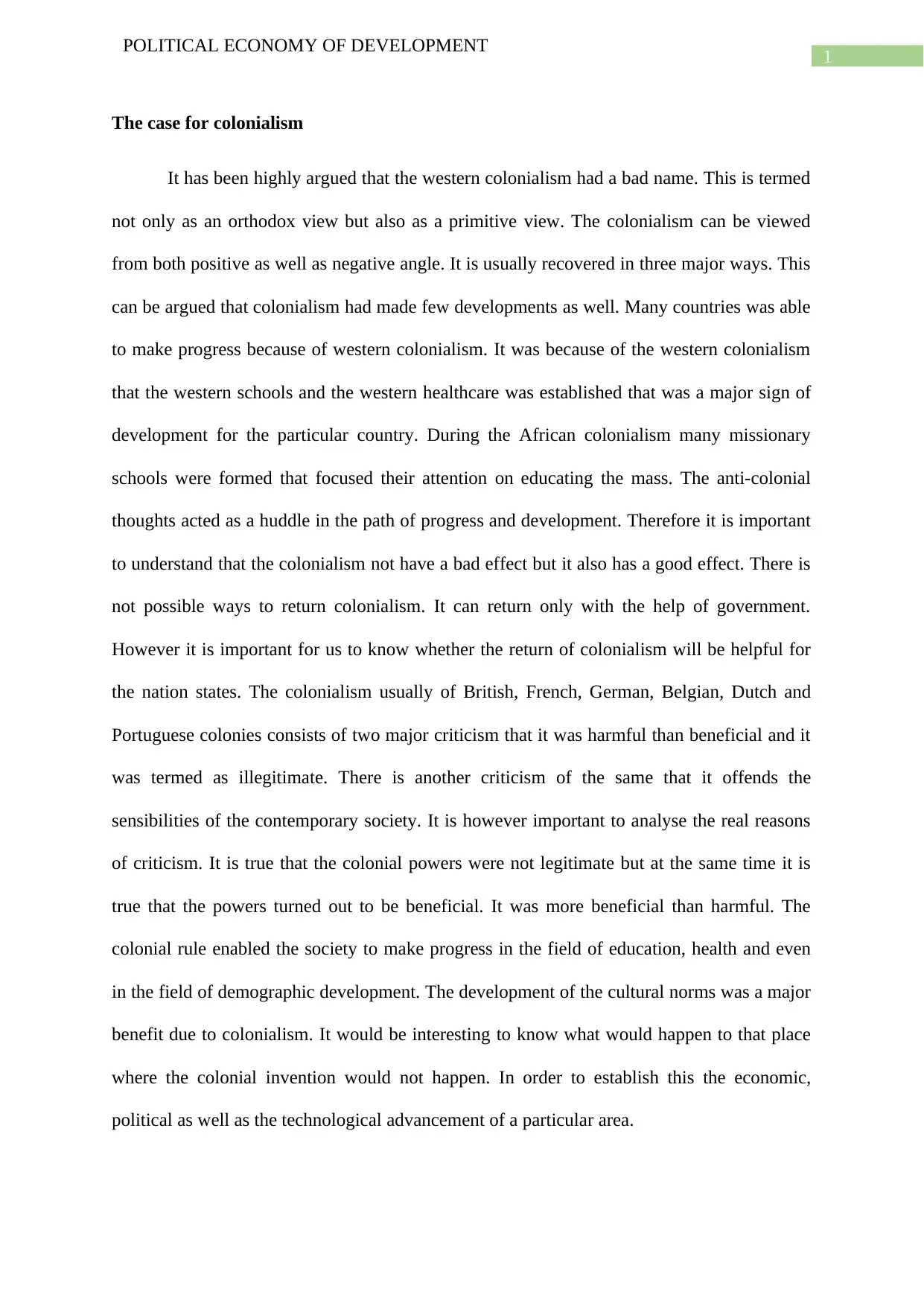
The case for colonialism
It has been highly argued that the western colonialism had a bad name. This is termed
not only as an orthodox view but also as a primitive view. The colonialism can be viewed
from both positive as well as negative angle. It is usually recovered in three major ways. This
can be argued that colonialism had made few developments as well. Many countries was able
to make progress because of western colonialism. It was because of the western colonialism
that the western schools and the western healthcare was established that was a major sign of
development for the particular country. During the African colonialism many missionary
schools were formed that focused their attention on educating the mass. The anti-colonial
thoughts acted as a huddle in the path of progress and development. Therefore it is important
to understand that the colonialism not have a bad effect but it also has a good effect. There is
not possible ways to return colonialism. It can return only with the help of government.
However it is important for us to know whether the return of colonialism will be helpful for
the nation states. The colonialism usually of British, French, German, Belgian, Dutch and
Portuguese colonies consists of two major criticism that it was harmful than beneficial and it
was termed as illegitimate. There is another criticism of the same that it offends the
sensibilities of the contemporary society. It is however important to analyse the real reasons
of criticism. It is true that the colonial powers were not legitimate but at the same time it is
true that the powers turned out to be beneficial. It was more beneficial than harmful. The
colonial rule enabled the society to make progress in the field of education, health and even
in the field of demographic development. The development of the cultural norms was a major
benefit due to colonialism. It would be interesting to know what would happen to that place
where the colonial invention would not happen. In order to establish this the economic,
political as well as the technological advancement of a particular area.
Document Page
2
POLITICAL ECONOMY OF DEVELOPMENT
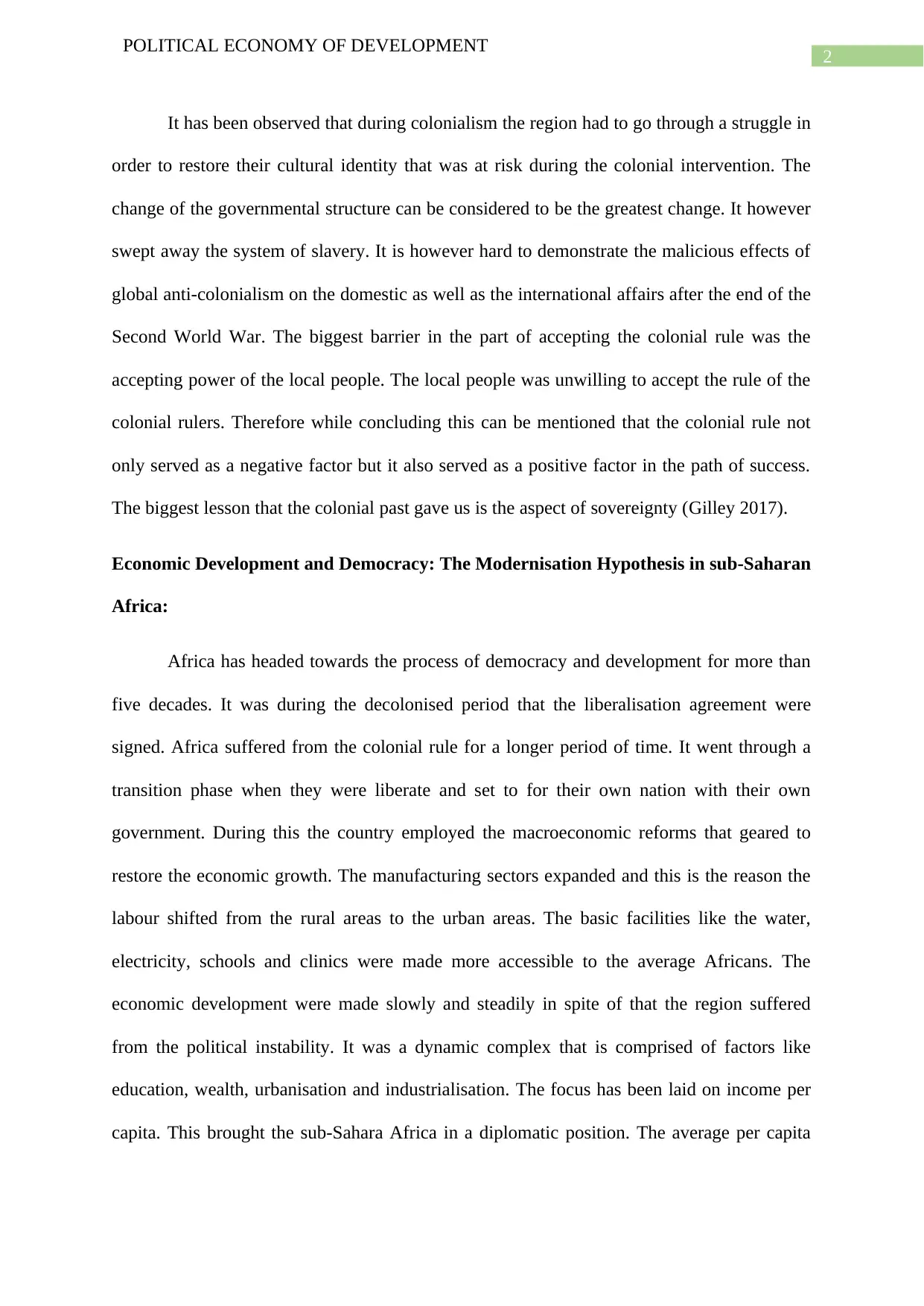
It has been observed that during colonialism the region had to go through a struggle in
order to restore their cultural identity that was at risk during the colonial intervention. The
change of the governmental structure can be considered to be the greatest change. It however
swept away the system of slavery. It is however hard to demonstrate the malicious effects of
global anti-colonialism on the domestic as well as the international affairs after the end of the
Second World War. The biggest barrier in the part of accepting the colonial rule was the
accepting power of the local people. The local people was unwilling to accept the rule of the
colonial rulers. Therefore while concluding this can be mentioned that the colonial rule not
only served as a negative factor but it also served as a positive factor in the path of success.
The biggest lesson that the colonial past gave us is the aspect of sovereignty (Gilley 2017).
Economic Development and Democracy: The Modernisation Hypothesis in sub-Saharan
Africa:
Africa has headed towards the process of democracy and development for more than
five decades. It was during the decolonised period that the liberalisation agreement were
signed. Africa suffered from the colonial rule for a longer period of time. It went through a
transition phase when they were liberate and set to for their own nation with their own
government. During this the country employed the macroeconomic reforms that geared to
restore the economic growth. The manufacturing sectors expanded and this is the reason the
labour shifted from the rural areas to the urban areas. The basic facilities like the water,
electricity, schools and clinics were made more accessible to the average Africans. The
economic development were made slowly and steadily in spite of that the region suffered
from the political instability. It was a dynamic complex that is comprised of factors like
education, wealth, urbanisation and industrialisation. The focus has been laid on income per
capita. This brought the sub-Sahara Africa in a diplomatic position. The average per capita
Document Page
3
POLITICAL ECONOMY OF DEVELOPMENT
income of the region was low but the other economic aspects like education, urbanisation
were high.
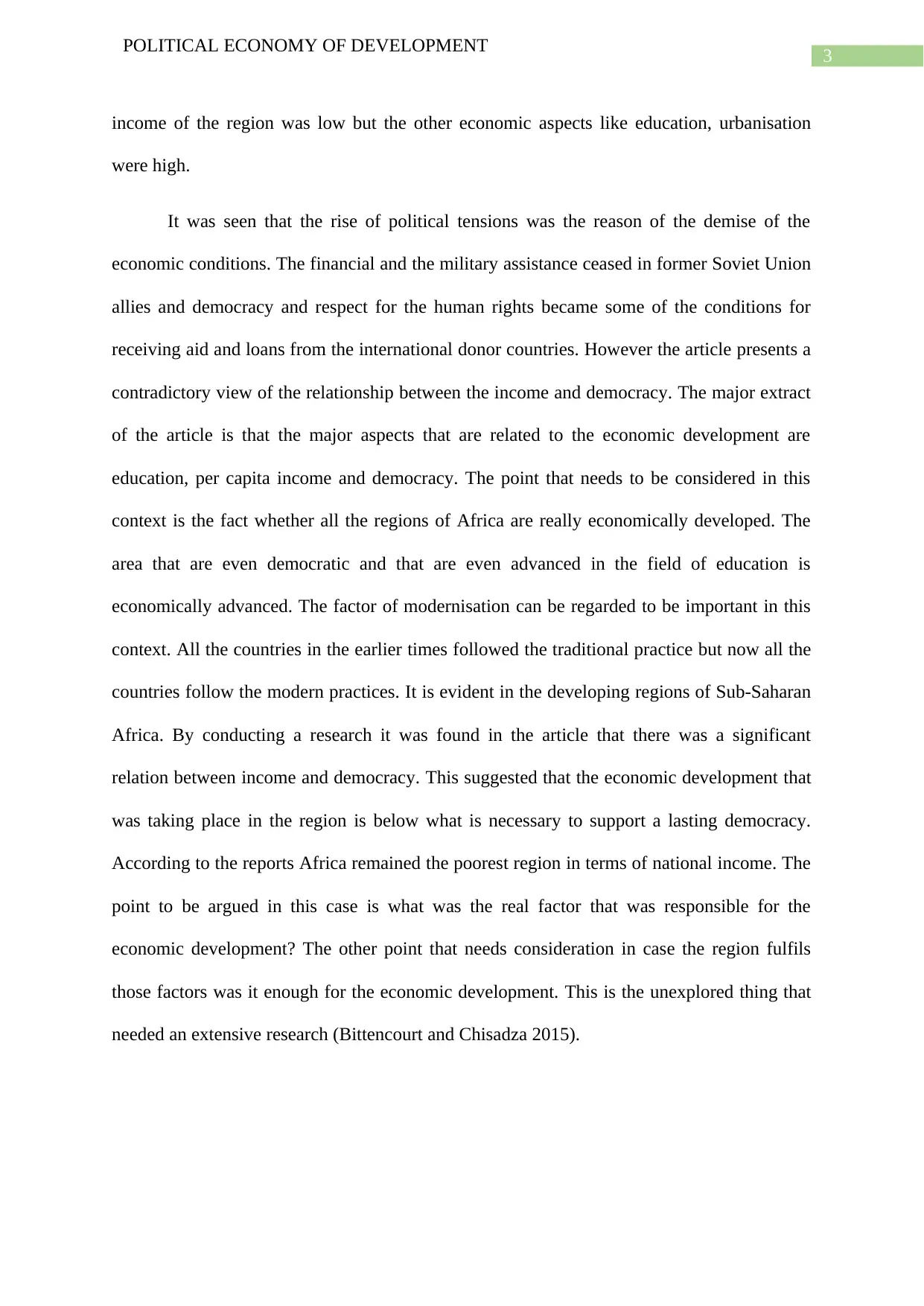
It was seen that the rise of political tensions was the reason of the demise of the
economic conditions. The financial and the military assistance ceased in former Soviet Union
allies and democracy and respect for the human rights became some of the conditions for
receiving aid and loans from the international donor countries. However the article presents a
contradictory view of the relationship between the income and democracy. The major extract
of the article is that the major aspects that are related to the economic development are
education, per capita income and democracy. The point that needs to be considered in this
context is the fact whether all the regions of Africa are really economically developed. The
area that are even democratic and that are even advanced in the field of education is
economically advanced. The factor of modernisation can be regarded to be important in this
context. All the countries in the earlier times followed the traditional practice but now all the
countries follow the modern practices. It is evident in the developing regions of Sub-Saharan
Africa. By conducting a research it was found in the article that there was a significant
relation between income and democracy. This suggested that the economic development that
was taking place in the region is below what is necessary to support a lasting democracy.
According to the reports Africa remained the poorest region in terms of national income. The
point to be argued in this case is what was the real factor that was responsible for the
economic development? The other point that needs consideration in case the region fulfils
those factors was it enough for the economic development. This is the unexplored thing that
needed an extensive research (Bittencourt and Chisadza 2015).
tabler-icon-diamond-filled.svg

Paraphrase This Document

Need a fresh take? Get an instant paraphrase of this document with our AI Paraphraser
Document Page
4
POLITICAL ECONOMY OF DEVELOPMENT
References
Bittencourt, M. and Chisadza, C., 2015. Economic Development and Democracy: The
Modernisation Hypothesis in sub'Saharan Africa.
Gilley, B., 2017. The case for colonialism. Third World Quarterly, pp.1-17.
chevron_up_icon
1 out of 5
circle_padding
hide_on_mobile
zoom_out_icon
[object Object]