Mental Health Care and Provision for the Elderly in the UK Portfolio
VerifiedAdded on 2022/01/18
|16
|5668
|391
Portfolio
AI Summary
This portfolio focuses on mental health care and provision for the elderly in the UK, analyzing key initiatives and resources. It begins by examining the NHS Five Year Forward View and Long-Term Plan commitments, emphasizing the increased funding and goals for improving mental health services for older adults. The portfolio highlights the importance of integrated care, community-based services, and collaborative strategies to address the unique needs of this population. It also references the Gov.UK Living Well in Older Years joint strategic needs assessment toolkit, which provides valuable insights and tools for understanding and addressing mental health concerns in later life. The portfolio emphasizes that mental health problems in older adults are treatable and the importance of promoting well-being, independence, and social engagement. The WHO framework on ageing and health is also considered to understand the importance of interventions throughout the course of a lifetime to preserve functional capacity into older age.
Portfolio on mental health care and
provision for the elderly in the UK.
This profile will assist with tools and services that are available for
older people with mental health problems.
1,NHS Five Year Forward View for Mental
Health and Long-Term Plan commitments.
The NHS Mental Health Implementation
Plan- The Long Term Plan 2019/20-2023-
2024
The NHS Long Term Plan reaffirmed its commitment to pursuing the most
ambitious reform of mental health care in England's history. The current Mental
Health Implementation Plan is to establish a new structure for ensuring that they
carry out this promise locally.
In 2016, the Five Year Forward View for Mental Health was released, marking a
significant step forward by obtaining an additional £1 billion in funding specifically
for mental health services, allowing an additional 1 million individuals to be able to
access the service (NHS, 2019).
The NHS Long Term Plan reaffirmed its commitment to pursuing the
most ambitious reform of mental health care in England's history. The
current Mental Health Implementation Plan is to establish a new structure
for ensuring that they carry out this promise locally.
In 2016, the Five Year Forward View for Mental Health was released,
marking a significant step forward by obtaining an additional £1 billion in
financial support specifically for mental health services, allowing an extra 1
million individuals to be able to access the service (NHS, 2019).
provision for the elderly in the UK.
This profile will assist with tools and services that are available for
older people with mental health problems.
1,NHS Five Year Forward View for Mental
Health and Long-Term Plan commitments.
The NHS Mental Health Implementation
Plan- The Long Term Plan 2019/20-2023-
2024
The NHS Long Term Plan reaffirmed its commitment to pursuing the most
ambitious reform of mental health care in England's history. The current Mental
Health Implementation Plan is to establish a new structure for ensuring that they
carry out this promise locally.
In 2016, the Five Year Forward View for Mental Health was released, marking a
significant step forward by obtaining an additional £1 billion in funding specifically
for mental health services, allowing an additional 1 million individuals to be able to
access the service (NHS, 2019).
The NHS Long Term Plan reaffirmed its commitment to pursuing the
most ambitious reform of mental health care in England's history. The
current Mental Health Implementation Plan is to establish a new structure
for ensuring that they carry out this promise locally.
In 2016, the Five Year Forward View for Mental Health was released,
marking a significant step forward by obtaining an additional £1 billion in
financial support specifically for mental health services, allowing an extra 1
million individuals to be able to access the service (NHS, 2019).

Paraphrase This Document
Need a fresh take? Get an instant paraphrase of this document with our AI Paraphraser
Looking Forward
Improvement Will Aid Communities
Healthcare Systems
The Long-Term Implementation for Older
People
By 2023/24, this Implementation Plan will guarantee that the NHS offers
high-quality, evidence-based mental health services to an extra two
million people through a fully funded national investment fund which is
worth an estimated £2.3 billion per year.
They have been able to set aspirational goals for improving mental
health care services because of this financing and the assistance of their
stakeholders. By 2023/24, 370,000 older adults who suffer from serious
mental health illness will have more control and have better choice when
it comes to their own care, including providing specialised services for
populations with unique requirements, such as those with personality
disorder for example with eating problems (NHS, 2019).
NHS England and NHS Improvement will aid local communities'
healthcare systems in addressing disparities in access, experiences, and
achievements by facilitating, encouraging, and ensuring specific, locally
focused initiatives. This encompasses the creation and transmission of
data, information, and tools to aid in the planning, developing and
delivering of local services (NHS, 2019).
The Long-Term Plan implementation presents a unique opportunity to
ensure older individuals have consistent access to mental health
services and information to address their own mental health issues and
their needs wherever they may present or develop one. Older people's
mental health is woven throughout all the adult mental health aspirations
as extremely important, including Improving access to Psychological
Therapies community-based services for individuals with severe mental
disorder and crisis and liaison with mental health care (NHS, 2019).
Improvement Will Aid Communities
Healthcare Systems
The Long-Term Implementation for Older
People
By 2023/24, this Implementation Plan will guarantee that the NHS offers
high-quality, evidence-based mental health services to an extra two
million people through a fully funded national investment fund which is
worth an estimated £2.3 billion per year.
They have been able to set aspirational goals for improving mental
health care services because of this financing and the assistance of their
stakeholders. By 2023/24, 370,000 older adults who suffer from serious
mental health illness will have more control and have better choice when
it comes to their own care, including providing specialised services for
populations with unique requirements, such as those with personality
disorder for example with eating problems (NHS, 2019).
NHS England and NHS Improvement will aid local communities'
healthcare systems in addressing disparities in access, experiences, and
achievements by facilitating, encouraging, and ensuring specific, locally
focused initiatives. This encompasses the creation and transmission of
data, information, and tools to aid in the planning, developing and
delivering of local services (NHS, 2019).
The Long-Term Plan implementation presents a unique opportunity to
ensure older individuals have consistent access to mental health
services and information to address their own mental health issues and
their needs wherever they may present or develop one. Older people's
mental health is woven throughout all the adult mental health aspirations
as extremely important, including Improving access to Psychological
Therapies community-based services for individuals with severe mental
disorder and crisis and liaison with mental health care (NHS, 2019).
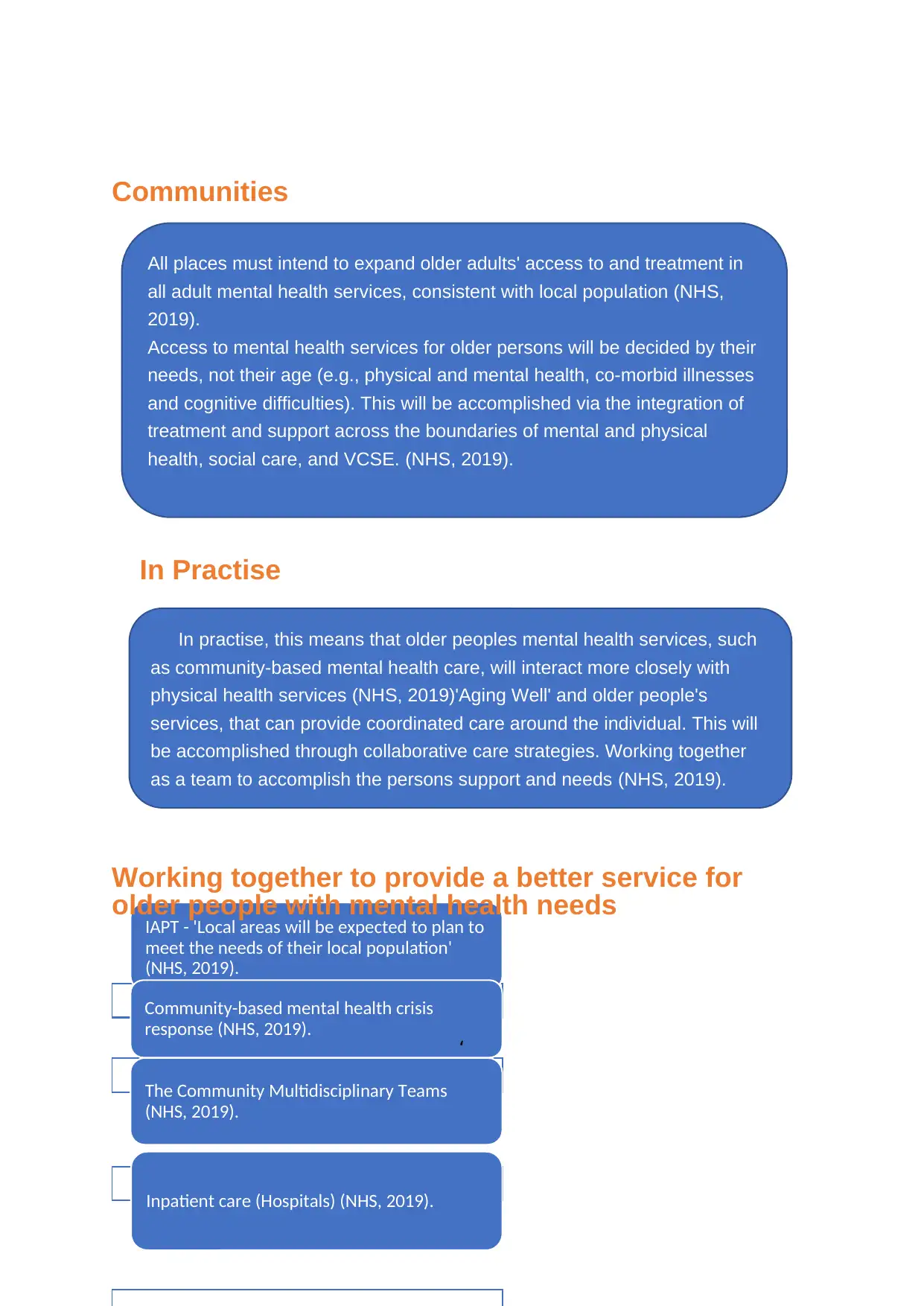
IAPT - 'Local areas will be expected to plan to
meet the needs of their local population'
(NHS, 2019).
Community-based mental health crisis
response (NHS, 2019).
The Community Multidisciplinary Teams
(NHS, 2019).
Inpatient care (Hospitals) (NHS, 2019).
Communities
In Practise
Working together to provide a better service for
older people with mental health needs
‘
All places must intend to expand older adults' access to and treatment in
all adult mental health services, consistent with local population (NHS,
2019).
Access to mental health services for older persons will be decided by their
needs, not their age (e.g., physical and mental health, co-morbid illnesses
and cognitive difficulties). This will be accomplished via the integration of
treatment and support across the boundaries of mental and physical
health, social care, and VCSE. (NHS, 2019).
In practise, this means that older peoples mental health services, such
as community-based mental health care, will interact more closely with
physical health services (NHS, 2019)'Aging Well' and older people's
services, that can provide coordinated care around the individual. This will
be accomplished through collaborative care strategies. Working together
as a team to accomplish the persons support and needs (NHS, 2019).
meet the needs of their local population'
(NHS, 2019).
Community-based mental health crisis
response (NHS, 2019).
The Community Multidisciplinary Teams
(NHS, 2019).
Inpatient care (Hospitals) (NHS, 2019).
Communities
In Practise
Working together to provide a better service for
older people with mental health needs
‘
All places must intend to expand older adults' access to and treatment in
all adult mental health services, consistent with local population (NHS,
2019).
Access to mental health services for older persons will be decided by their
needs, not their age (e.g., physical and mental health, co-morbid illnesses
and cognitive difficulties). This will be accomplished via the integration of
treatment and support across the boundaries of mental and physical
health, social care, and VCSE. (NHS, 2019).
In practise, this means that older peoples mental health services, such
as community-based mental health care, will interact more closely with
physical health services (NHS, 2019)'Aging Well' and older people's
services, that can provide coordinated care around the individual. This will
be accomplished through collaborative care strategies. Working together
as a team to accomplish the persons support and needs (NHS, 2019).
⊘ This is a preview!⊘
Do you want full access?
Subscribe today to unlock all pages.

Trusted by 1+ million students worldwide
2, Gov UK Living well in older years joint strategic
needs assessment (JSNA) Tool Kit for older people
with poor mental health
(National Mental Health Intelligence Network’, 2019)
There are several chapters of the tool kit which help with other ages and
concerns, chapter seven is specifically for older people with poor mental
health, the tool kit is written by National Mental Health Intelligence
Network’, (2019) and published by the government UK (2019).
The toolkit exhibits
.
This toolkit exhibits the National Mental Health Intelligence Network's
(NMHIN) (2019) commitment to supporting the formulation of collaborative
strategic needs assessments for mental health and wellbeing.
It has been created for anyone wishing to comprehend the difficulty of
mental health concerns in their community.
It assists individuals in considering their mental health and well-being
needs as well as identifying some of the critical facts, information, and
expertise that local communities may utilise to develop their knowledge of
needs and to build on this to enable them to get the right help with the right
people (NMHIN, 2019).
needs assessment (JSNA) Tool Kit for older people
with poor mental health
(National Mental Health Intelligence Network’, 2019)
There are several chapters of the tool kit which help with other ages and
concerns, chapter seven is specifically for older people with poor mental
health, the tool kit is written by National Mental Health Intelligence
Network’, (2019) and published by the government UK (2019).
The toolkit exhibits
.
This toolkit exhibits the National Mental Health Intelligence Network's
(NMHIN) (2019) commitment to supporting the formulation of collaborative
strategic needs assessments for mental health and wellbeing.
It has been created for anyone wishing to comprehend the difficulty of
mental health concerns in their community.
It assists individuals in considering their mental health and well-being
needs as well as identifying some of the critical facts, information, and
expertise that local communities may utilise to develop their knowledge of
needs and to build on this to enable them to get the right help with the right
people (NMHIN, 2019).
Paraphrase This Document
Need a fresh take? Get an instant paraphrase of this document with our AI Paraphraser
The purpose
Mental Health in Later Life
Promoting Health and Wellbeing
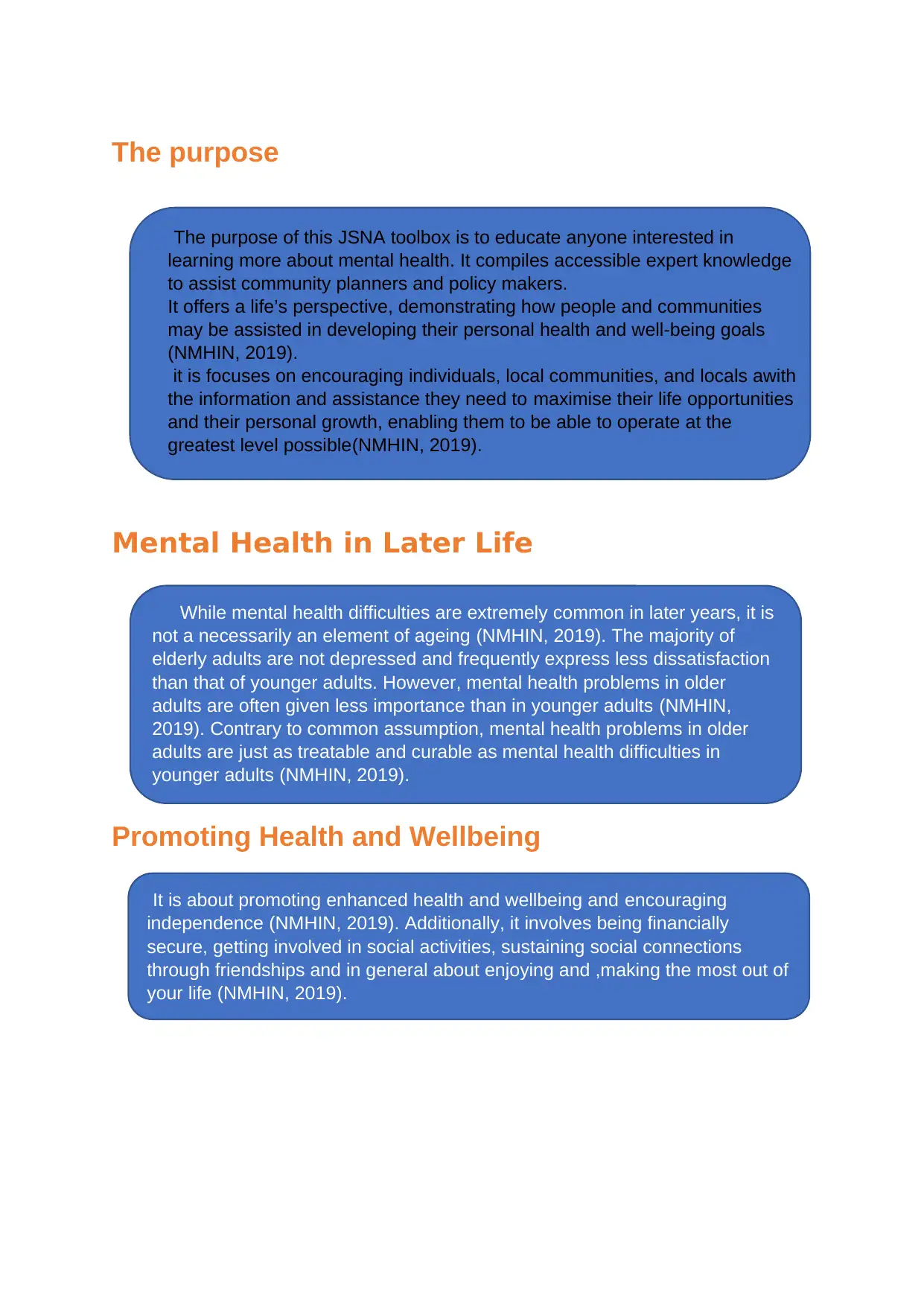
The purpose of this JSNA toolbox is to educate anyone interested in
learning more about mental health. It compiles accessible expert knowledge
to assist community planners and policy makers.
It offers a life’s perspective, demonstrating how people and communities
may be assisted in developing their personal health and well-being goals
(NMHIN, 2019).
it is focuses on encouraging individuals, local communities, and locals awith
the information and assistance they need to maximise their life opportunities
and their personal growth, enabling them to be able to operate at the
greatest level possible(NMHIN, 2019).
While mental health difficulties are extremely common in later years, it is
not a necessarily an element of ageing (NMHIN, 2019). The majority of
elderly adults are not depressed and frequently express less dissatisfaction
than that of younger adults. However, mental health problems in older
adults are often given less importance than in younger adults (NMHIN,
2019). Contrary to common assumption, mental health problems in older
adults are just as treatable and curable as mental health difficulties in
younger adults (NMHIN, 2019).
It is about promoting enhanced health and wellbeing and encouraging
independence (NMHIN, 2019). Additionally, it involves being financially
secure, getting involved in social activities, sustaining social connections
through friendships and in general about enjoying and ,making the most out of
your life (NMHIN, 2019).
Mental Health in Later Life
Promoting Health and Wellbeing
The purpose of this JSNA toolbox is to educate anyone interested in
learning more about mental health. It compiles accessible expert knowledge
to assist community planners and policy makers.
It offers a life’s perspective, demonstrating how people and communities
may be assisted in developing their personal health and well-being goals
(NMHIN, 2019).
it is focuses on encouraging individuals, local communities, and locals awith
the information and assistance they need to maximise their life opportunities
and their personal growth, enabling them to be able to operate at the
greatest level possible(NMHIN, 2019).
While mental health difficulties are extremely common in later years, it is
not a necessarily an element of ageing (NMHIN, 2019). The majority of
elderly adults are not depressed and frequently express less dissatisfaction
than that of younger adults. However, mental health problems in older
adults are often given less importance than in younger adults (NMHIN,
2019). Contrary to common assumption, mental health problems in older
adults are just as treatable and curable as mental health difficulties in
younger adults (NMHIN, 2019).
It is about promoting enhanced health and wellbeing and encouraging
independence (NMHIN, 2019). Additionally, it involves being financially
secure, getting involved in social activities, sustaining social connections
through friendships and in general about enjoying and ,making the most out of
your life (NMHIN, 2019).
The WHO (2017) Framework of Global strategy and
action plan on ageing and health.
'
The toolkit has been put together to give some knowledge and
understanding about mental health and to help older people
realise they are not alone and that there are resources available
to assist them in their community to overcome any mental health
issues they may have or just to enable them to have a better
understanding of mental health issues.
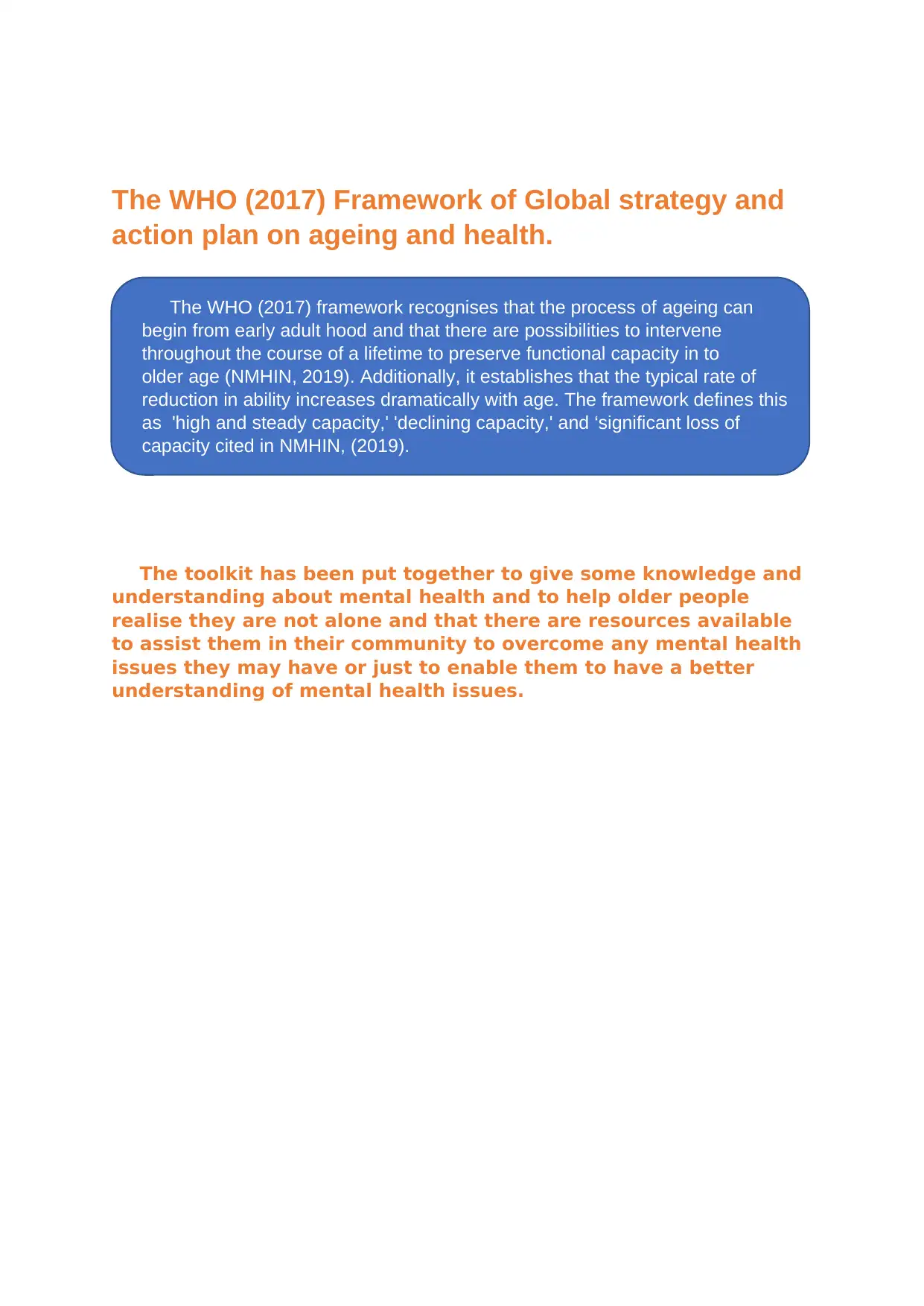
The WHO (2017) framework recognises that the process of ageing can
begin from early adult hood and that there are possibilities to intervene
throughout the course of a lifetime to preserve functional capacity in to
older age (NMHIN, 2019). Additionally, it establishes that the typical rate of
reduction in ability increases dramatically with age. The framework defines this
as 'high and steady capacity,' 'declining capacity,' and ‘significant loss of
capacity cited in NMHIN, (2019).
action plan on ageing and health.
'
The toolkit has been put together to give some knowledge and
understanding about mental health and to help older people
realise they are not alone and that there are resources available
to assist them in their community to overcome any mental health
issues they may have or just to enable them to have a better
understanding of mental health issues.
The WHO (2017) framework recognises that the process of ageing can
begin from early adult hood and that there are possibilities to intervene
throughout the course of a lifetime to preserve functional capacity in to
older age (NMHIN, 2019). Additionally, it establishes that the typical rate of
reduction in ability increases dramatically with age. The framework defines this
as 'high and steady capacity,' 'declining capacity,' and ‘significant loss of
capacity cited in NMHIN, (2019).
⊘ This is a preview!⊘
Do you want full access?
Subscribe today to unlock all pages.
Trusted by 1+ million students worldwide
3,The National Service Framework for Older people
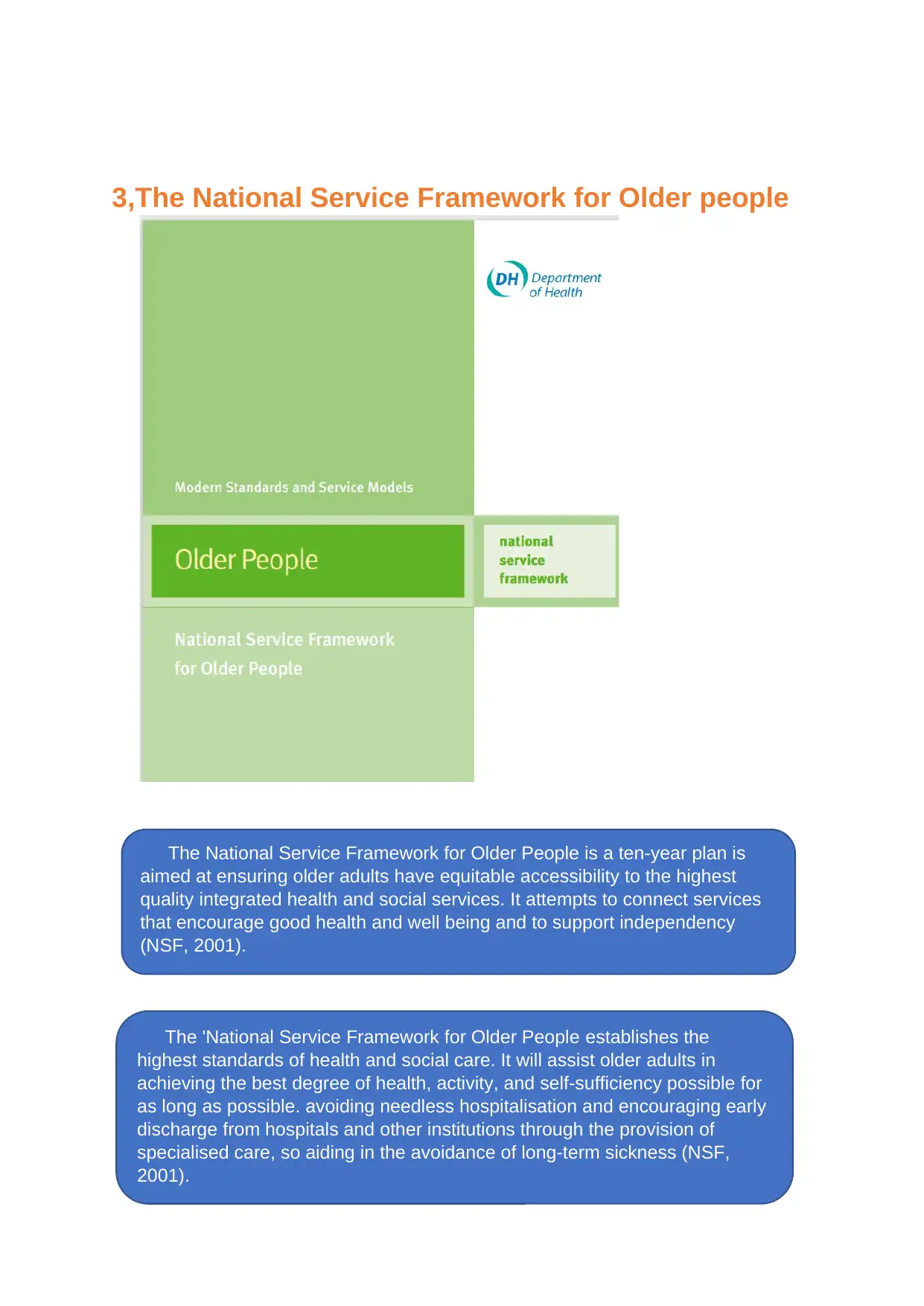
The National Service Framework for Older People is a ten-year plan is
aimed at ensuring older adults have equitable accessibility to the highest
quality integrated health and social services. It attempts to connect services
that encourage good health and well being and to support independency
(NSF, 2001).
The 'National Service Framework for Older People establishes the
highest standards of health and social care. It will assist older adults in
achieving the best degree of health, activity, and self-sufficiency possible for
as long as possible. avoiding needless hospitalisation and encouraging early
discharge from hospitals and other institutions through the provision of
specialised care, so aiding in the avoidance of long-term sickness (NSF,
2001).
The National Service Framework for Older People is a ten-year plan is
aimed at ensuring older adults have equitable accessibility to the highest
quality integrated health and social services. It attempts to connect services
that encourage good health and well being and to support independency
(NSF, 2001).
The 'National Service Framework for Older People establishes the
highest standards of health and social care. It will assist older adults in
achieving the best degree of health, activity, and self-sufficiency possible for
as long as possible. avoiding needless hospitalisation and encouraging early
discharge from hospitals and other institutions through the provision of
specialised care, so aiding in the avoidance of long-term sickness (NSF,
2001).
Paraphrase This Document
Need a fresh take? Get an instant paraphrase of this document with our AI Paraphraser
Highlight the impact of poor mental health on the individual and/or those who care for
them.
This essay will discuss the impact that poor mental health has on older people and
the people who care for them.
Mental health illnesses can occur at any point in a persons life for a variety of
reasons. In addition to the strains that impact everyone, older adults may experience
certain stressors, that are particularly prominent in later life, such as a steady
cognitive decline (World Health Organization, 2017) (WHO), older adults may also
suffer some form of decreased mobility due to chronic pain, fragility due to age, and
other health issues that may involve the need for some form of long-term care.
Furthermore, older adults are more likely to experience life changing events such as
a death of a close family member or friend, loss of friendship and status because of
retirement for example, which can be particularly difficult for them (WHO, 2017).
These stresses can result in feelings of being isolated and lonely and cause a
decline in their mental health which may involve the need for more support from
family, friends and health providers (WHO, 2017). In both cases, the status of their
mental health has an impact on the state of their physical health and vice versa
(WHO, 2017).
Mental health in older adults is often overlooked, however according to Age UK
(2021), nearly half of those aged 55 and over which equates to over 7.7 million
people, have reported having suffered with depression. Similarly, 7.3 million people
have reported having suffered anxiety. This data is reported to Age UK
from YouGov, who conducted the research for them. The findings highlight the
severity of the mental health problem affecting older adults in the United Kingdom in
recent years although mental health problems is not just a UK problem it is
worldwide (Age UK, 2021).
Physical health problems linked with the ageing population, such as heart disease,
relate to a higher rate of depression than in healthy adults (WHO, 2017). Depression
has been demonstrated to have a detrimental effect on the prognosis of older adults
with heart disease when left untreated (WHO, 2017). There is an array of studies
them.
This essay will discuss the impact that poor mental health has on older people and
the people who care for them.
Mental health illnesses can occur at any point in a persons life for a variety of
reasons. In addition to the strains that impact everyone, older adults may experience
certain stressors, that are particularly prominent in later life, such as a steady
cognitive decline (World Health Organization, 2017) (WHO), older adults may also
suffer some form of decreased mobility due to chronic pain, fragility due to age, and
other health issues that may involve the need for some form of long-term care.
Furthermore, older adults are more likely to experience life changing events such as
a death of a close family member or friend, loss of friendship and status because of
retirement for example, which can be particularly difficult for them (WHO, 2017).
These stresses can result in feelings of being isolated and lonely and cause a
decline in their mental health which may involve the need for more support from
family, friends and health providers (WHO, 2017). In both cases, the status of their
mental health has an impact on the state of their physical health and vice versa
(WHO, 2017).
Mental health in older adults is often overlooked, however according to Age UK
(2021), nearly half of those aged 55 and over which equates to over 7.7 million
people, have reported having suffered with depression. Similarly, 7.3 million people
have reported having suffered anxiety. This data is reported to Age UK
from YouGov, who conducted the research for them. The findings highlight the
severity of the mental health problem affecting older adults in the United Kingdom in
recent years although mental health problems is not just a UK problem it is
worldwide (Age UK, 2021).
Physical health problems linked with the ageing population, such as heart disease,
relate to a higher rate of depression than in healthy adults (WHO, 2017). Depression
has been demonstrated to have a detrimental effect on the prognosis of older adults
with heart disease when left untreated (WHO, 2017). There is an array of studies
which link depression and cardiovascular disease for example (Hare et al., 2014;
Kapfhammer, 2011; Vaccarino et al., 2020; Whooley et al., 2008).
Research conducted by Whooley et al., (2008) found that cardiovascular patients
who also have depression have 50 percent more acute exacerbations each year,
although the study did not look at other factors to determine if there were any other
underlying health conditions, or if the people had a sedentary lifestyle which could
further contribute to heart disease. The sample size was of 1000 outpatients with
sedentary heart disease which is a good sample size for the study (Whooley et al.,
2008).
According to Hare et al., (2014) the mortality rates of patients with depression and
heart disease was also higher, furthermore Lange-Asschenfeldt & Lederbogen,
(2011), further found that those patients with chronic heart failure within six months
of being diagnosed there was a five times higher chance of them suffering a cardiac
arrest with the condition. Additionally, another study discovered that depression
raises a person's chance of dying from a heart attack by three point five times as
much as a person without depression (Lesperance et al., 2002). Another study found
that after heart bypass surgery the rise and higher risk of mortality more than
doubled over a five-year period as a result depression (Blumenthal et al 2003).
According to Moussavi et al,.(2007) Individuals with diabetes who additionally suffer
from co-morbid mental health disorders, are more at risk of undesirable health
outcomes and the possibility of premature death. As an example, Katon et al., (2004)
found that individuals who are diabetic and suffer ongoing co-morbid depression,
were 36–38 percent are at a much higher risk of mortality from any cause when
followed up over a further two-year period (Katon et al., 2004). They were also less
likely to take their medication properly and end up in hospital for long periods of time
as a result (Katon et al., 2004).
Mental health problems may also have an adverse effect on Chronic obstructive
pulmonary disease (COPD) symptoms and effects. Individuals with COPD and
mental health problems. Because of their mental health, they have a lower health
condition and experience dyspnoea, regardless of the severity of COPD (Felker et
al., 2010). Furthermore, each year, patients with COPD who also have co-morbid
mental health illnesses have 50 percent more severe exacerbations (Laurin et al.,
2009).
Kapfhammer, 2011; Vaccarino et al., 2020; Whooley et al., 2008).
Research conducted by Whooley et al., (2008) found that cardiovascular patients
who also have depression have 50 percent more acute exacerbations each year,
although the study did not look at other factors to determine if there were any other
underlying health conditions, or if the people had a sedentary lifestyle which could
further contribute to heart disease. The sample size was of 1000 outpatients with
sedentary heart disease which is a good sample size for the study (Whooley et al.,
2008).
According to Hare et al., (2014) the mortality rates of patients with depression and
heart disease was also higher, furthermore Lange-Asschenfeldt & Lederbogen,
(2011), further found that those patients with chronic heart failure within six months
of being diagnosed there was a five times higher chance of them suffering a cardiac
arrest with the condition. Additionally, another study discovered that depression
raises a person's chance of dying from a heart attack by three point five times as
much as a person without depression (Lesperance et al., 2002). Another study found
that after heart bypass surgery the rise and higher risk of mortality more than
doubled over a five-year period as a result depression (Blumenthal et al 2003).
According to Moussavi et al,.(2007) Individuals with diabetes who additionally suffer
from co-morbid mental health disorders, are more at risk of undesirable health
outcomes and the possibility of premature death. As an example, Katon et al., (2004)
found that individuals who are diabetic and suffer ongoing co-morbid depression,
were 36–38 percent are at a much higher risk of mortality from any cause when
followed up over a further two-year period (Katon et al., 2004). They were also less
likely to take their medication properly and end up in hospital for long periods of time
as a result (Katon et al., 2004).
Mental health problems may also have an adverse effect on Chronic obstructive
pulmonary disease (COPD) symptoms and effects. Individuals with COPD and
mental health problems. Because of their mental health, they have a lower health
condition and experience dyspnoea, regardless of the severity of COPD (Felker et
al., 2010). Furthermore, each year, patients with COPD who also have co-morbid
mental health illnesses have 50 percent more severe exacerbations (Laurin et al.,
2009).
⊘ This is a preview!⊘
Do you want full access?
Subscribe today to unlock all pages.
Trusted by 1+ million students worldwide
As a result of co-morbid mental health problems, individuals often engage in
unhealthy living and take up habits such as smoking. A lack of energy and motivation
may have a negative impact on treatment adherence and self-management in
people with mental health issues (DiMatteo et al., 2000), they will often fail to attend
rehabilitation and self-care programmes such as quitting smoking, dietary advice,
and for cardiovascular care (Vamos et al., 2009). People with this condition also
often fail to manage their medication effectively which can have a further impact on
the individuals mental state (Vamos et al., 2009). Could this be as an individual ages
they lose confidence to attend these sessions as their mental health deteriorates and
loss of social status. According to some research, the existence of co-morbid mental
health problems may have a bigger impact on a person being able to function
well and their quality of life than how severe their physical disability (Yohannes et al.,
2010). All of these factors have an impact on the individual’s life and how and where
they live.
As a person ages it is normal for a person’s memory function to decline however
there is mounting evidence that co-morbid mental health disorders may affect a
person’s cognitive ability and cognitive decline with individuals with a chronic
illnesses and a mental health disorder (Molosankwe et al., 2012). To support this a
study conducted by Schmitz et al., (2007) in Canada. The study showed that
individuals with chronic illnesses and depression have a much greater chance of
a cognitive disability than those suffering depression or a long-time chronic
illnesses alone (Schmitz et al., 2007). Planning, organising, starting, sequencing,
shifting, information processing speed, and the working memory are all hampered as
a result of this condition, also our long-term memory does not function correctly and
doesn’t store information like it should when suffering a mental impact (Lesser et al.,
1996). This has a massive impact on a persons functionality and every day tasks
and living with the illness.
A study into caregivers and their mental state was done by Sewitch et al., (2004) the
findings suggest that when depression strikes in later life, it takes a huge toll on both
the sufferer and their family members or care givers. The family members and care
givers of the depressed older individuals suggest that the general caregiver load
ranges from moderate to high levels (Sewitch et al., 2004) Unsurprisingly, one of the
most startling findings of this study has been the high levels of caregiver burden
unhealthy living and take up habits such as smoking. A lack of energy and motivation
may have a negative impact on treatment adherence and self-management in
people with mental health issues (DiMatteo et al., 2000), they will often fail to attend
rehabilitation and self-care programmes such as quitting smoking, dietary advice,
and for cardiovascular care (Vamos et al., 2009). People with this condition also
often fail to manage their medication effectively which can have a further impact on
the individuals mental state (Vamos et al., 2009). Could this be as an individual ages
they lose confidence to attend these sessions as their mental health deteriorates and
loss of social status. According to some research, the existence of co-morbid mental
health problems may have a bigger impact on a person being able to function
well and their quality of life than how severe their physical disability (Yohannes et al.,
2010). All of these factors have an impact on the individual’s life and how and where
they live.
As a person ages it is normal for a person’s memory function to decline however
there is mounting evidence that co-morbid mental health disorders may affect a
person’s cognitive ability and cognitive decline with individuals with a chronic
illnesses and a mental health disorder (Molosankwe et al., 2012). To support this a
study conducted by Schmitz et al., (2007) in Canada. The study showed that
individuals with chronic illnesses and depression have a much greater chance of
a cognitive disability than those suffering depression or a long-time chronic
illnesses alone (Schmitz et al., 2007). Planning, organising, starting, sequencing,
shifting, information processing speed, and the working memory are all hampered as
a result of this condition, also our long-term memory does not function correctly and
doesn’t store information like it should when suffering a mental impact (Lesser et al.,
1996). This has a massive impact on a persons functionality and every day tasks
and living with the illness.
A study into caregivers and their mental state was done by Sewitch et al., (2004) the
findings suggest that when depression strikes in later life, it takes a huge toll on both
the sufferer and their family members or care givers. The family members and care
givers of the depressed older individuals suggest that the general caregiver load
ranges from moderate to high levels (Sewitch et al., 2004) Unsurprisingly, one of the
most startling findings of this study has been the high levels of caregiver burden
Paraphrase This Document
Need a fresh take? Get an instant paraphrase of this document with our AI Paraphraser
identified, which is identical to those discovered in studies with caregivers of older
persons with dementia this is supported also by other studies (Fadden et al., 1987;
Scazufca et al., 2002; Schneider et al., 1999) although some of the sample sizes
are small and the studies are out-dated this still gives a representation that mental
illnesses do have a knock on effect to the caregivers.
To conclude as an older person suffering with mental illness, there are many factors
that contribute to and impact an individual’s life. One illness seems to cause another
and ultimately depression can have a massive impact on an individual being able to
function and get well from other illnesses and can have a detrimental effect on ones
cognitive ability. When suffering with a mental illness it has an adverse effect on all
the other things in one’s life and poor choices are made which does not help their
situation. As an older person they often lose contact with people and suffer with
loneliness and isolation which furthermore has an adverse effect and can contribute
to an individual’s poor mental health. As a caregiver looking after an elderly
individual who suffers with poor mental health, this can have a negative impact on
that person and they can also suffer with poor mental health. There are some self-
help tools available to help and other care resources for example living well in older
years (Gov, 2019).
References
References
Age, U. K. (2021). Depression and anxiety. Age
UK. https://www.ageuk.org.uk/information-advice/health-wellbeing/conditions-
illnesses/depression-anxiety/
Blumenthal, J. A., Lett, H. S., Babyak, M. A., White, W., Smith, P. K., Mark, D. B.,
Jones, R., Mathew, J. P., & Newman, M. F. (2003). Depression as a risk factor
for mortality after coronary artery bypass surgery. The Lancet (British
Edition), 362(9384), 604-609. 10.1016/S0140-6736(03)14190-6
persons with dementia this is supported also by other studies (Fadden et al., 1987;
Scazufca et al., 2002; Schneider et al., 1999) although some of the sample sizes
are small and the studies are out-dated this still gives a representation that mental
illnesses do have a knock on effect to the caregivers.
To conclude as an older person suffering with mental illness, there are many factors
that contribute to and impact an individual’s life. One illness seems to cause another
and ultimately depression can have a massive impact on an individual being able to
function and get well from other illnesses and can have a detrimental effect on ones
cognitive ability. When suffering with a mental illness it has an adverse effect on all
the other things in one’s life and poor choices are made which does not help their
situation. As an older person they often lose contact with people and suffer with
loneliness and isolation which furthermore has an adverse effect and can contribute
to an individual’s poor mental health. As a caregiver looking after an elderly
individual who suffers with poor mental health, this can have a negative impact on
that person and they can also suffer with poor mental health. There are some self-
help tools available to help and other care resources for example living well in older
years (Gov, 2019).
References
References
Age, U. K. (2021). Depression and anxiety. Age
UK. https://www.ageuk.org.uk/information-advice/health-wellbeing/conditions-
illnesses/depression-anxiety/
Blumenthal, J. A., Lett, H. S., Babyak, M. A., White, W., Smith, P. K., Mark, D. B.,
Jones, R., Mathew, J. P., & Newman, M. F. (2003). Depression as a risk factor
for mortality after coronary artery bypass surgery. The Lancet (British
Edition), 362(9384), 604-609. 10.1016/S0140-6736(03)14190-6
DiMatteo, M. R., Lepper, H. S., & Croghan, T. W. (2000). Depression Is a Risk
Factor for Noncompliance With Medical Treatment: Meta-analysis of the Effects
of Anxiety and Depression on Patient Adherence. Archives of Internal Medicine
(1960), 160(14), 2101-2107. 10.1001/archinte.160.14.2101
Fadden, G., Bebbington, P., & Kuipers, L. (1987). Caring and its burdens. A study of
the spouses of depressed patients. British Journal of Psychiatry, 151(5), 660-
667. 10.1192/bjp.151.5.660
Felker, B., Bush, K. R., Harel, O., Shofer, J. B., Shores, M. M., & Au, D. H. (2010).
Added Burden of Mental Disorders on Health Status Among Patients With
Chronic Obstructive Pulmonary Disease. Primary Care Companion to the
Journal of Clinical Psychiatry, 12(4)10.4088/PCC.09m00858gry
Hare, D. L., Toukhsati, S. R., Johansson, P., & Jaarsma, T. (2014). Depression and
cardiovascular disease: a clinical review. European Heart Journal, 35(21), 1365-
1372. 10.1093/eurheartj/eht462
Kapfhammer, H. (2011). The relationship between depression, anxiety and heart
disease - a psychosomatic challenge. Psychiatria Danubina, 23(4), 412-424.
Retrieved from https://www.ncbi.nlm.nih.gov/pubmed/22075746
Lange-Asschenfeldt, C., & Lederbogen, F. (2011). Antidepressant therapy in
coronary artery disease. Nervenarzt, 82(5), 657-6. doi:10.1007/s00115-010-
3181-7 Retrieved from https://www.ncbi.nlm.nih.gov/pubmed/21109992
Laurin, C., Labrecque, M., Dupuis, G., Bacon, S. L., Cartier, A., & Lavoie, K. L.
(2009). Chronic Obstructive Pulmonary Disease Patients With Psychiatric
Factor for Noncompliance With Medical Treatment: Meta-analysis of the Effects
of Anxiety and Depression on Patient Adherence. Archives of Internal Medicine
(1960), 160(14), 2101-2107. 10.1001/archinte.160.14.2101
Fadden, G., Bebbington, P., & Kuipers, L. (1987). Caring and its burdens. A study of
the spouses of depressed patients. British Journal of Psychiatry, 151(5), 660-
667. 10.1192/bjp.151.5.660
Felker, B., Bush, K. R., Harel, O., Shofer, J. B., Shores, M. M., & Au, D. H. (2010).
Added Burden of Mental Disorders on Health Status Among Patients With
Chronic Obstructive Pulmonary Disease. Primary Care Companion to the
Journal of Clinical Psychiatry, 12(4)10.4088/PCC.09m00858gry
Hare, D. L., Toukhsati, S. R., Johansson, P., & Jaarsma, T. (2014). Depression and
cardiovascular disease: a clinical review. European Heart Journal, 35(21), 1365-
1372. 10.1093/eurheartj/eht462
Kapfhammer, H. (2011). The relationship between depression, anxiety and heart
disease - a psychosomatic challenge. Psychiatria Danubina, 23(4), 412-424.
Retrieved from https://www.ncbi.nlm.nih.gov/pubmed/22075746
Lange-Asschenfeldt, C., & Lederbogen, F. (2011). Antidepressant therapy in
coronary artery disease. Nervenarzt, 82(5), 657-6. doi:10.1007/s00115-010-
3181-7 Retrieved from https://www.ncbi.nlm.nih.gov/pubmed/21109992
Laurin, C., Labrecque, M., Dupuis, G., Bacon, S. L., Cartier, A., & Lavoie, K. L.
(2009). Chronic Obstructive Pulmonary Disease Patients With Psychiatric
⊘ This is a preview!⊘
Do you want full access?
Subscribe today to unlock all pages.
Trusted by 1+ million students worldwide

1 out of 16


Related Documents


Your All-in-One AI-Powered Toolkit for Academic Success.
+13062052269
info@desklib.com
Available 24*7 on WhatsApp / Email
![[object Object]](/_next/static/media/star-bottom.7253800d.svg)
Unlock your academic potential
Copyright © 2020–2026 A2Z Services. All Rights Reserved. Developed and managed by ZUCOL.