CSE5DSS Decision Support Systems Assignment Solution, 2018

Verified

Added on  2023/06/14

|25
|2301
|397
Report
AI Summary
This assignment solution covers various aspects of Decision Support Systems, including profit/loss analysis using different strategies, linear programming for advertisement optimization, inventory policy simulation, and predictive modeling for house selling prices. The document explores the application of statistical models such as regression and multilayer perceptron (MLP) to predict selling prices based on factors like area, age, and number of bedrooms. Additionally, it includes a classification task using logistic regression and Naïve Bayes models to predict bank account openings, comparing their performance using ROC curves and lift charts. The analysis provides insights into selecting the best strategies and models for different scenarios, demonstrating a comprehensive understanding of decision support principles and techniques.
Document Page
Running Head: DECISION SUPPORT SYSTEM
Decision Support System
Name of the Student
Name of the University
Author Note
tabler-icon-diamond-filled.svg

Paraphrase This Document

Need a fresh take? Get an instant paraphrase of this document with our AI Paraphraser
Document Page
1DECISION SUPPORT SYSTEM
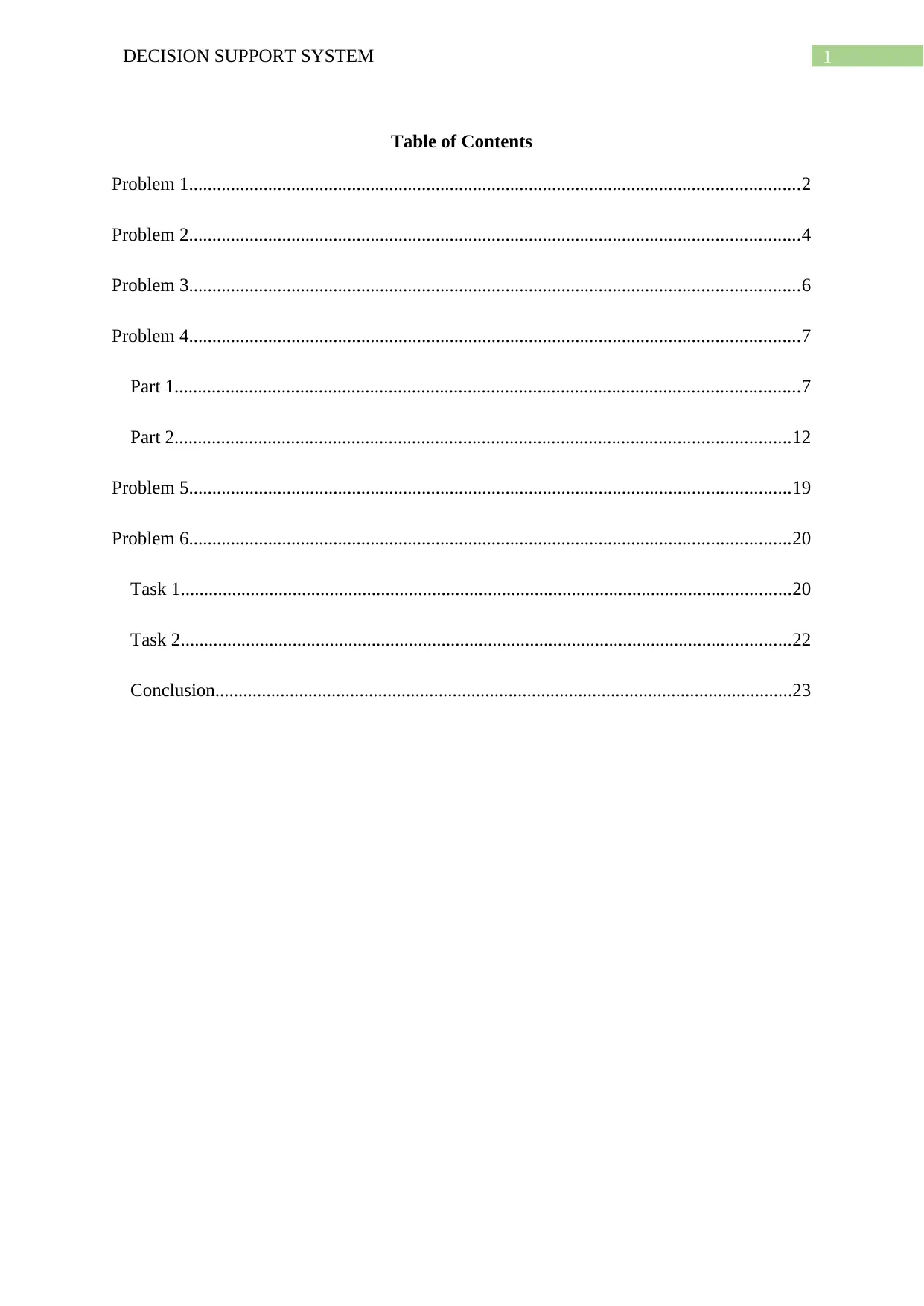
Table of Contents
Problem 1...................................................................................................................................2
Problem 2...................................................................................................................................4
Problem 3...................................................................................................................................6
Problem 4...................................................................................................................................7
Part 1......................................................................................................................................7
Part 2....................................................................................................................................12
Problem 5.................................................................................................................................19
Problem 6.................................................................................................................................20
Task 1...................................................................................................................................20
Task 2...................................................................................................................................22
Conclusion............................................................................................................................23
Document Page
2DECISION SUPPORT SYSTEM
Problem 1
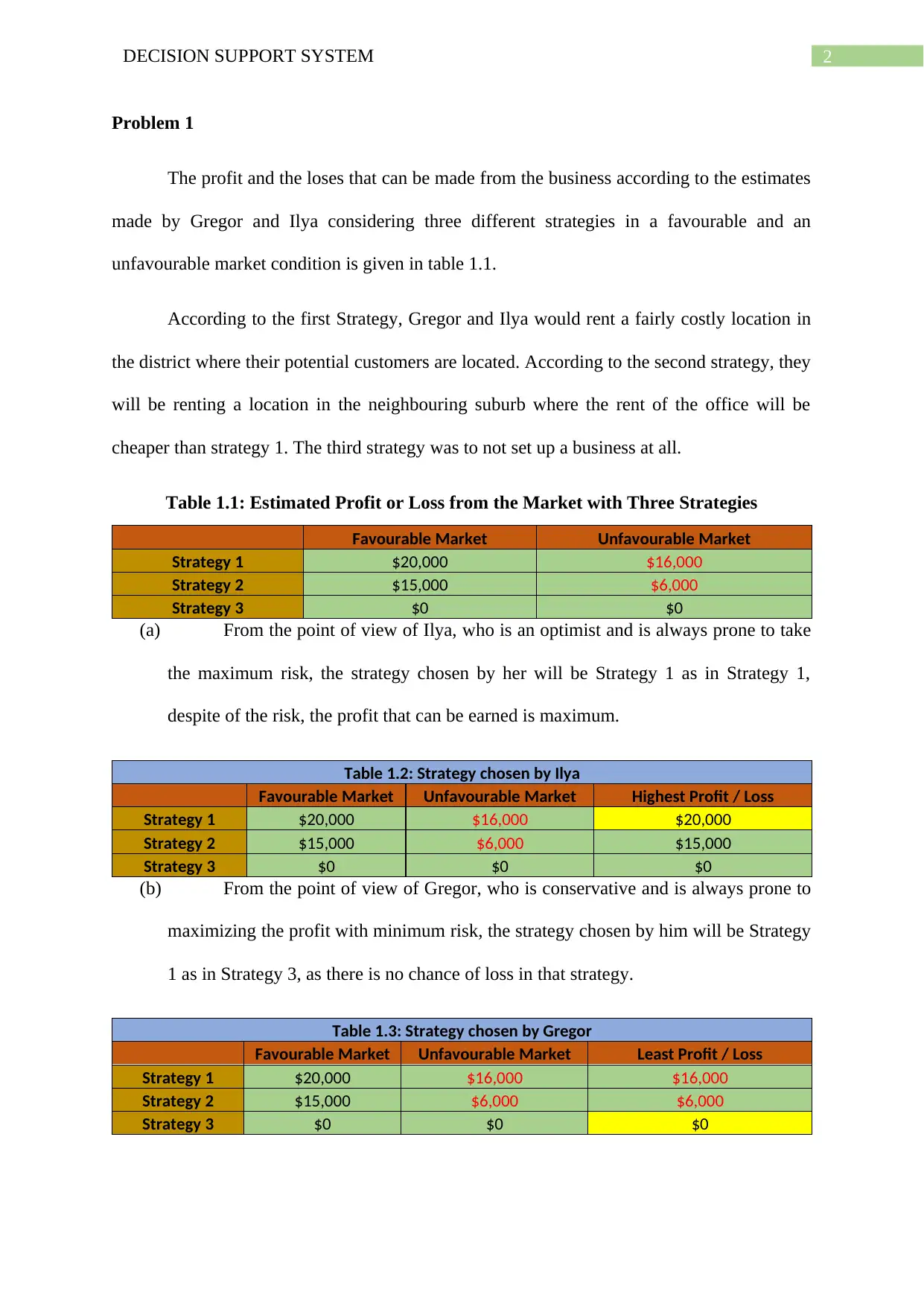
The profit and the loses that can be made from the business according to the estimates
made by Gregor and Ilya considering three different strategies in a favourable and an
unfavourable market condition is given in table 1.1.
According to the first Strategy, Gregor and Ilya would rent a fairly costly location in
the district where their potential customers are located. According to the second strategy, they
will be renting a location in the neighbouring suburb where the rent of the office will be
cheaper than strategy 1. The third strategy was to not set up a business at all.
Table 1.1: Estimated Profit or Loss from the Market with Three Strategies
Favourable Market Unfavourable Market
Strategy 1 $20,000 $16,000
Strategy 2 $15,000 $6,000
Strategy 3 $0 $0
(a) From the point of view of Ilya, who is an optimist and is always prone to take
the maximum risk, the strategy chosen by her will be Strategy 1 as in Strategy 1,
despite of the risk, the profit that can be earned is maximum.
Table 1.2: Strategy chosen by Ilya
Favourable Market Unfavourable Market Highest Profit / Loss
Strategy 1 $20,000 $16,000 $20,000
Strategy 2 $15,000 $6,000 $15,000
Strategy 3 $0 $0 $0
(b) From the point of view of Gregor, who is conservative and is always prone to
maximizing the profit with minimum risk, the strategy chosen by him will be Strategy
1 as in Strategy 3, as there is no chance of loss in that strategy.
Table 1.3: Strategy chosen by Gregor
Favourable Market Unfavourable Market Least Profit / Loss
Strategy 1 $20,000 $16,000 $16,000
Strategy 2 $15,000 $6,000 $6,000
Strategy 3 $0 $0 $0
Document Page
3DECISION SUPPORT SYSTEM
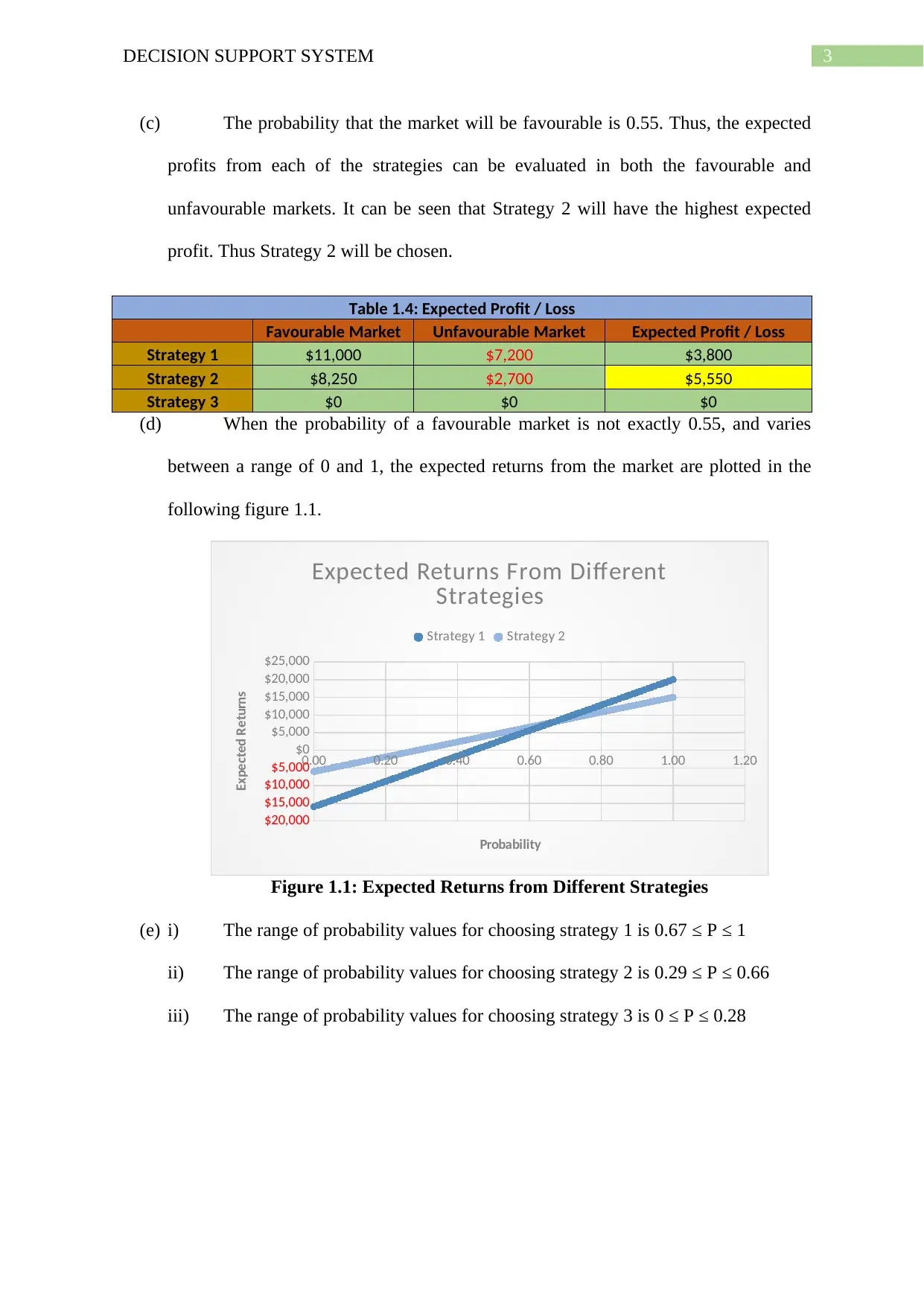
(c) The probability that the market will be favourable is 0.55. Thus, the expected
profits from each of the strategies can be evaluated in both the favourable and
unfavourable markets. It can be seen that Strategy 2 will have the highest expected
profit. Thus Strategy 2 will be chosen.
Table 1.4: Expected Profit / Loss
Favourable Market Unfavourable Market Expected Profit / Loss
Strategy 1 $11,000 $7,200 $3,800
Strategy 2 $8,250 $2,700 $5,550
Strategy 3 $0 $0 $0
(d) When the probability of a favourable market is not exactly 0.55, and varies
between a range of 0 and 1, the expected returns from the market are plotted in the
following figure 1.1.
0.00 0.20 0.40 0.60 0.80 1.00 1.20
$20,000
$15,000
$10,000
$5,000
$0
$5,000
$10,000
$15,000
$20,000
$25,000
Expected Returns From Different
Strategies
Strategy 1 Strategy 2
Probability
Expected Returns
Figure 1.1: Expected Returns from Different Strategies
(e) i) The range of probability values for choosing strategy 1 is 0.67 P ≤ 1
ii) The range of probability values for choosing strategy 2 is 0.29 P ≤ 0.66
iii) The range of probability values for choosing strategy 3 is 0 P ≤ 0.28
tabler-icon-diamond-filled.svg

Paraphrase This Document

Need a fresh take? Get an instant paraphrase of this document with our AI Paraphraser
Document Page
4DECISION SUPPORT SYSTEM
Problem 2
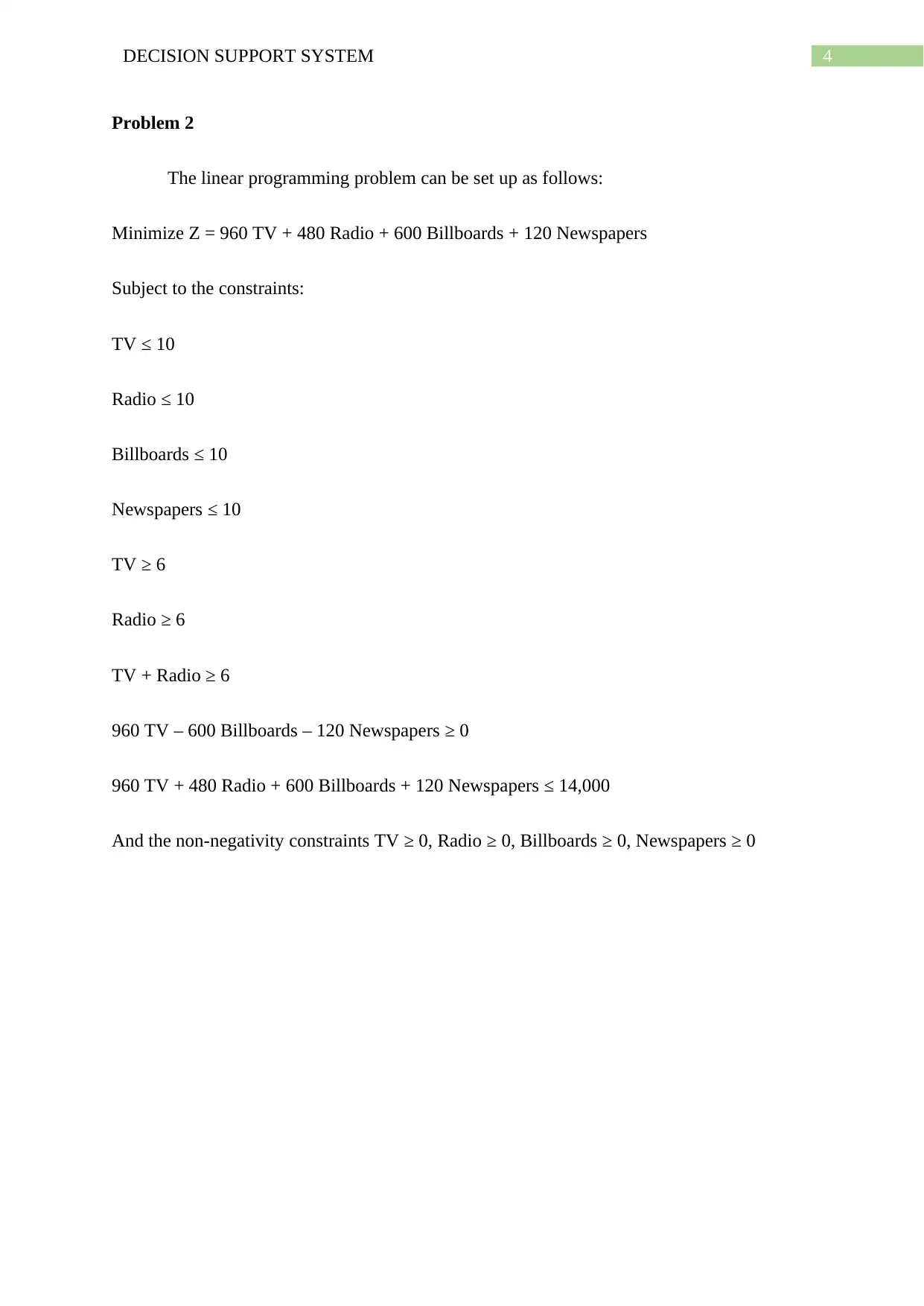
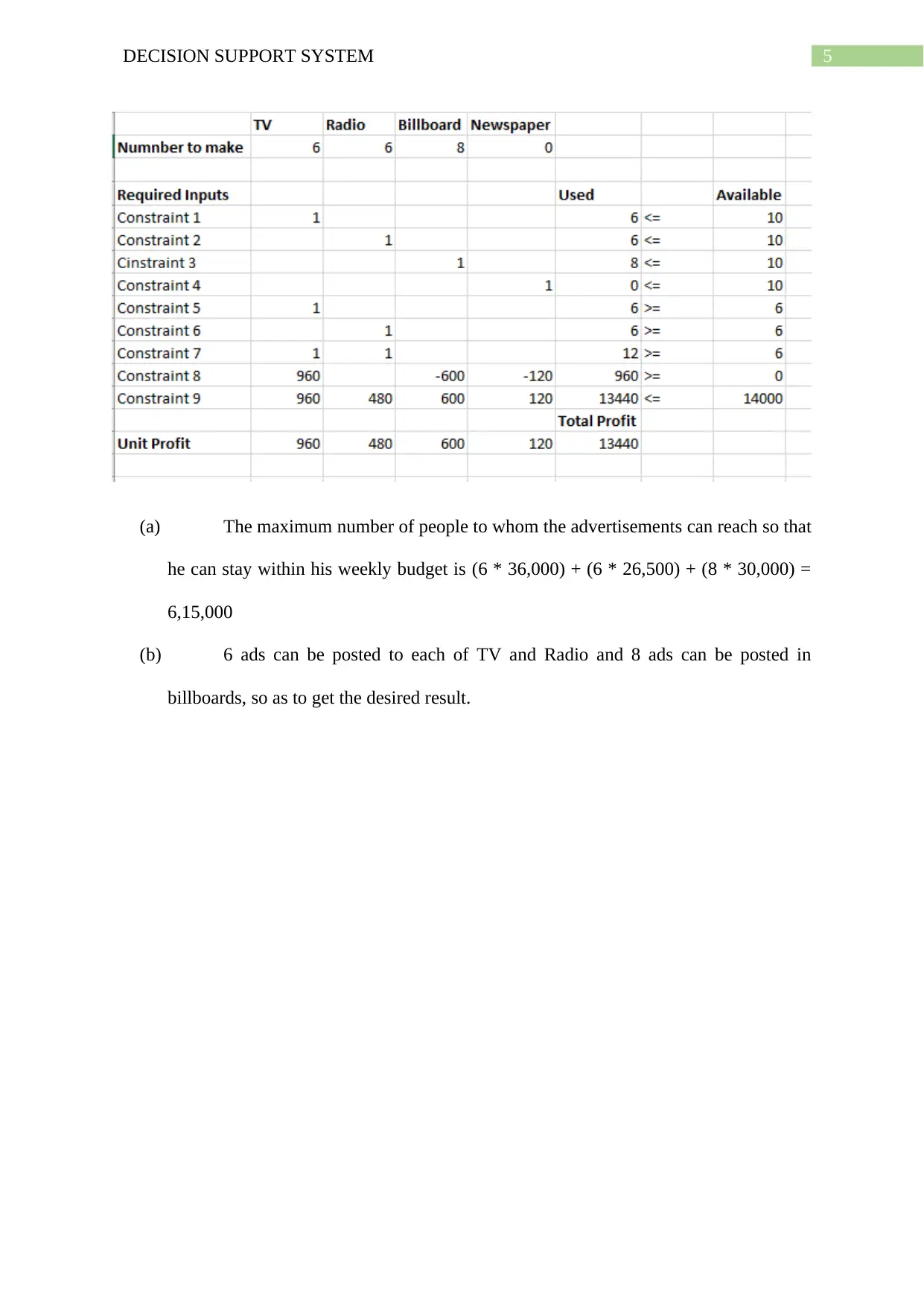
The linear programming problem can be set up as follows:
Minimize Z = 960 TV + 480 Radio + 600 Billboards + 120 Newspapers
Subject to the constraints:
TV ≤ 10
Radio ≤ 10
Billboards ≤ 10
Newspapers ≤ 10
TV ≥ 6
Radio ≥ 6
TV + Radio ≥ 6
960 TV – 600 Billboards – 120 Newspapers ≥ 0
960 TV + 480 Radio + 600 Billboards + 120 Newspapers ≤ 14,000
And the non-negativity constraints TV ≥ 0, Radio ≥ 0, Billboards ≥ 0, Newspapers ≥ 0
Document Page
5DECISION SUPPORT SYSTEM
(a) The maximum number of people to whom the advertisements can reach so that
he can stay within his weekly budget is (6 * 36,000) + (6 * 26,500) + (8 * 30,000) =
6,15,000
(b) 6 ads can be posted to each of TV and Radio and 8 ads can be posted in
billboards, so as to get the desired result.
Document Page
6DECISION SUPPORT SYSTEM
Problem 3
(a) The simulation results show that the best case in this scenario for Max
involving the least cost for inventory policy is $46,360. The worst case in this
scenario for Max involving the highest cost for inventory policy is $64,640. The
average cost of inventory policy that can be incurred by Max considering reorder
point of 5 and reorder quantity of 5 is $56,862.
(b) i) When the reorder re-order point as 3 and the reordering quantity as 3, the
minimum cost incurred is $33,200, the maximum cost incurred is $43,460 and the
average cost that can be incurred is $38,058 on the inventory policy.
ii) When the reorder re-order point is 7 and the reordering quantity is 7, the
minimum cost incurred is $80,860, the maximum cost incurred is $96,460 and the
average cost that can be incurred is $86,876 on the inventory policy.
(c) It is clear that with reordering point and quantity of 3, the maximum cost
incurred is even less than the minimum cost incurred in case of having a reordering
point and quantity of 7. Thus, having a reordering point and quantity of 3 is a better
option for the business.
tabler-icon-diamond-filled.svg

Paraphrase This Document

Need a fresh take? Get an instant paraphrase of this document with our AI Paraphraser
Document Page
7DECISION SUPPORT SYSTEM
Problem 4
Part 1
Model 1:
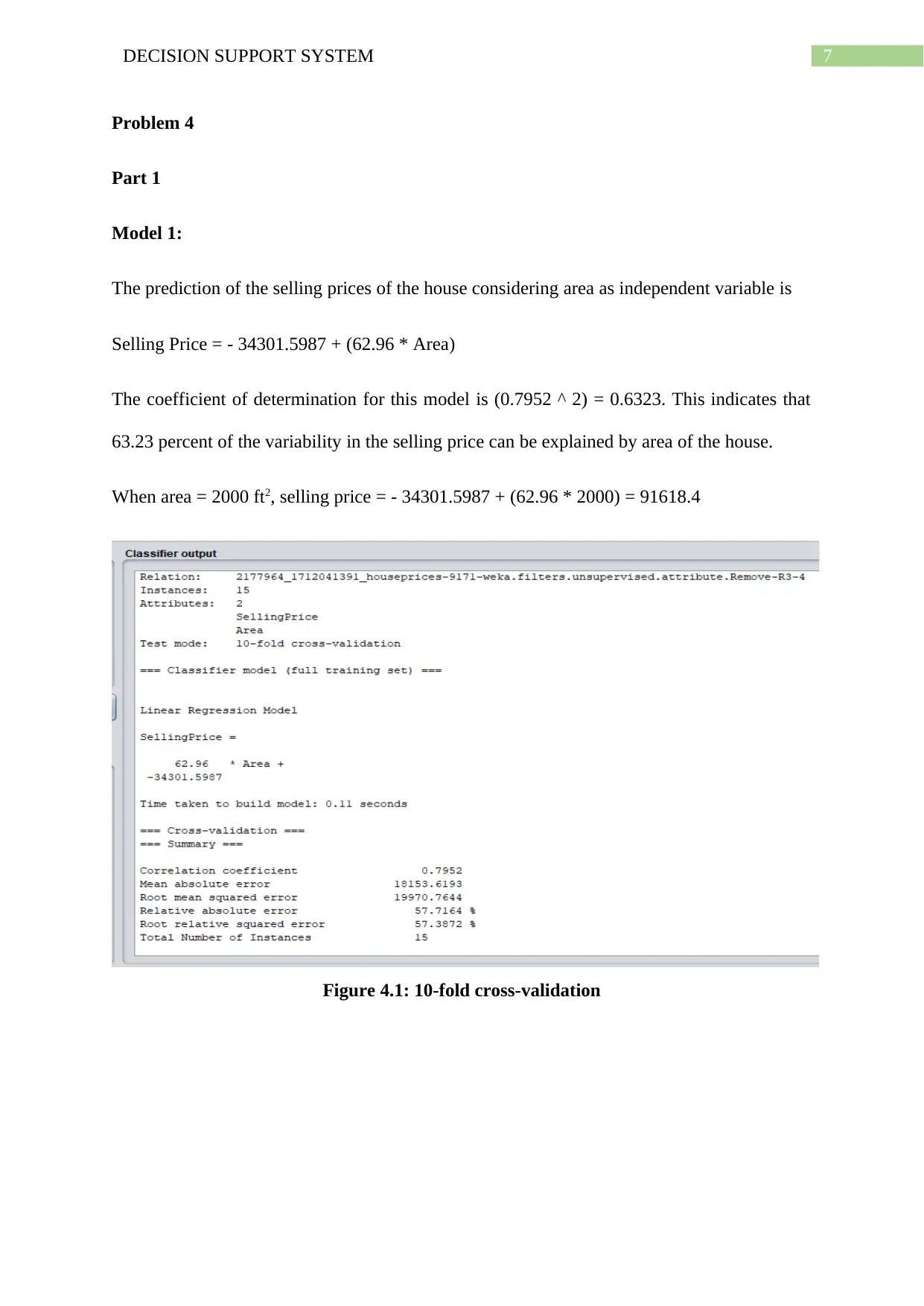
The prediction of the selling prices of the house considering area as independent variable is
Selling Price = - 34301.5987 + (62.96 * Area)
The coefficient of determination for this model is (0.7952 ^ 2) = 0.6323. This indicates that
63.23 percent of the variability in the selling price can be explained by area of the house.
When area = 2000 ft2, selling price = - 34301.5987 + (62.96 * 2000) = 91618.4
Figure 4.1: 10-fold cross-validation
Document Page
8DECISION SUPPORT SYSTEM
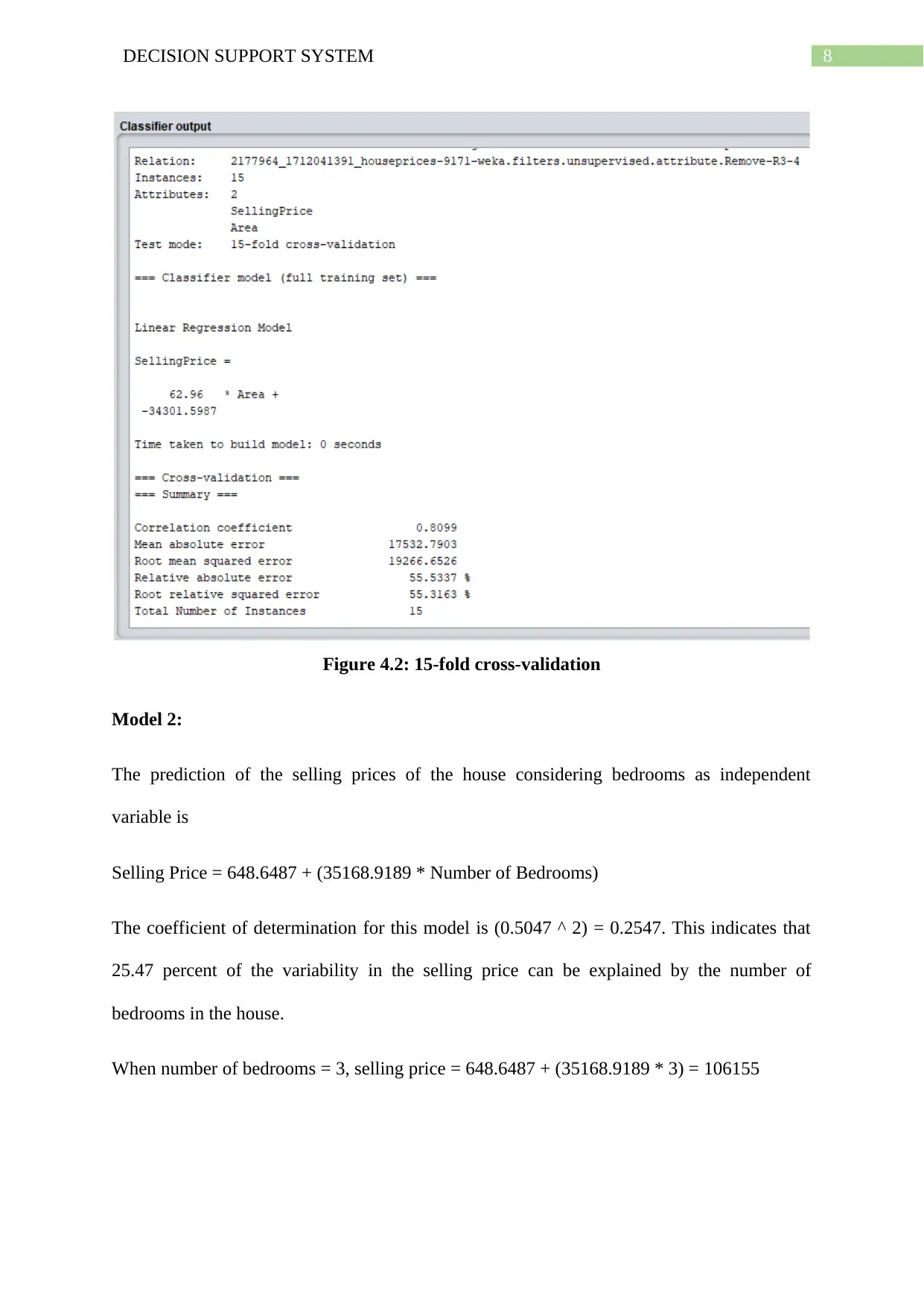
Figure 4.2: 15-fold cross-validation
Model 2:
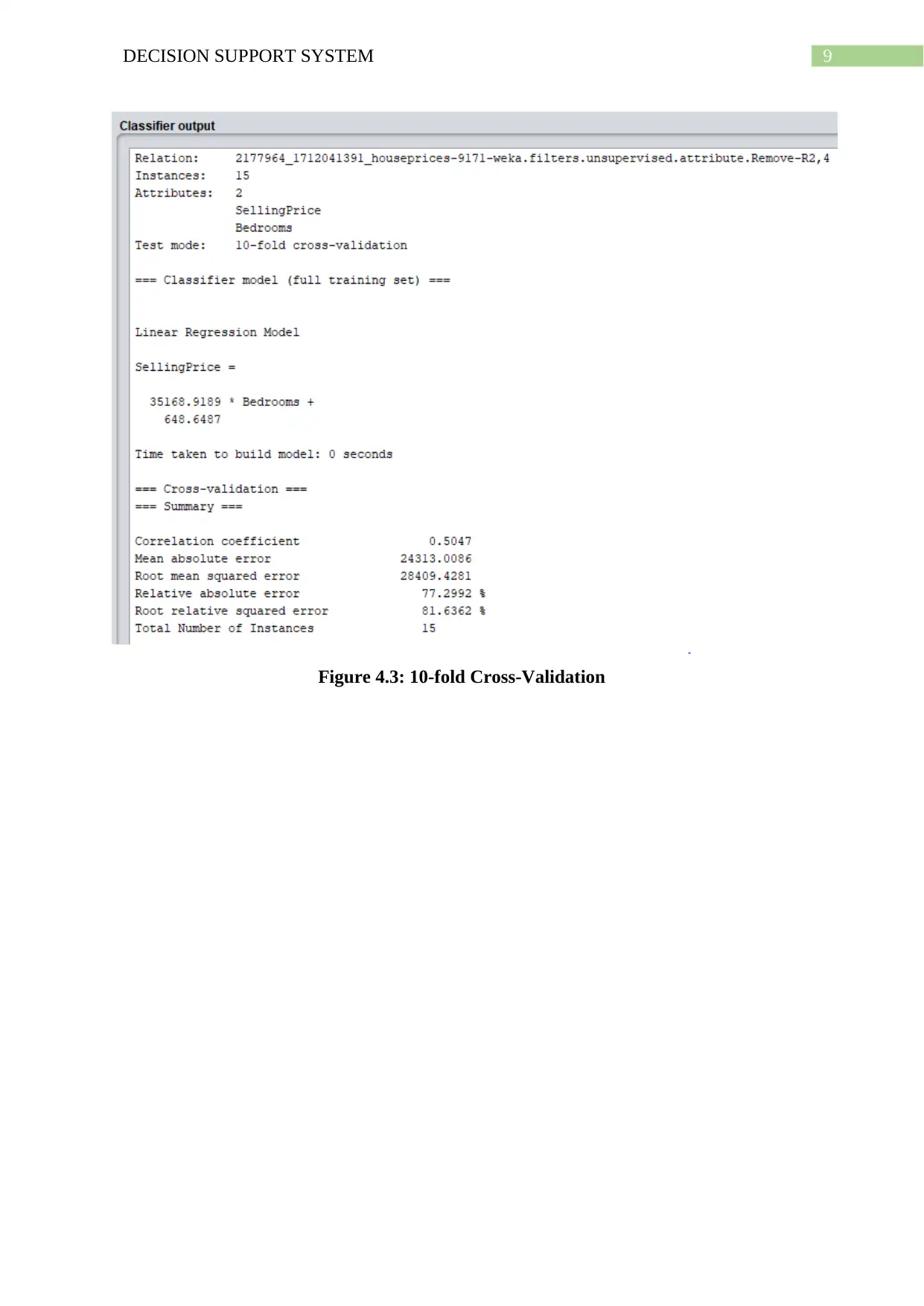
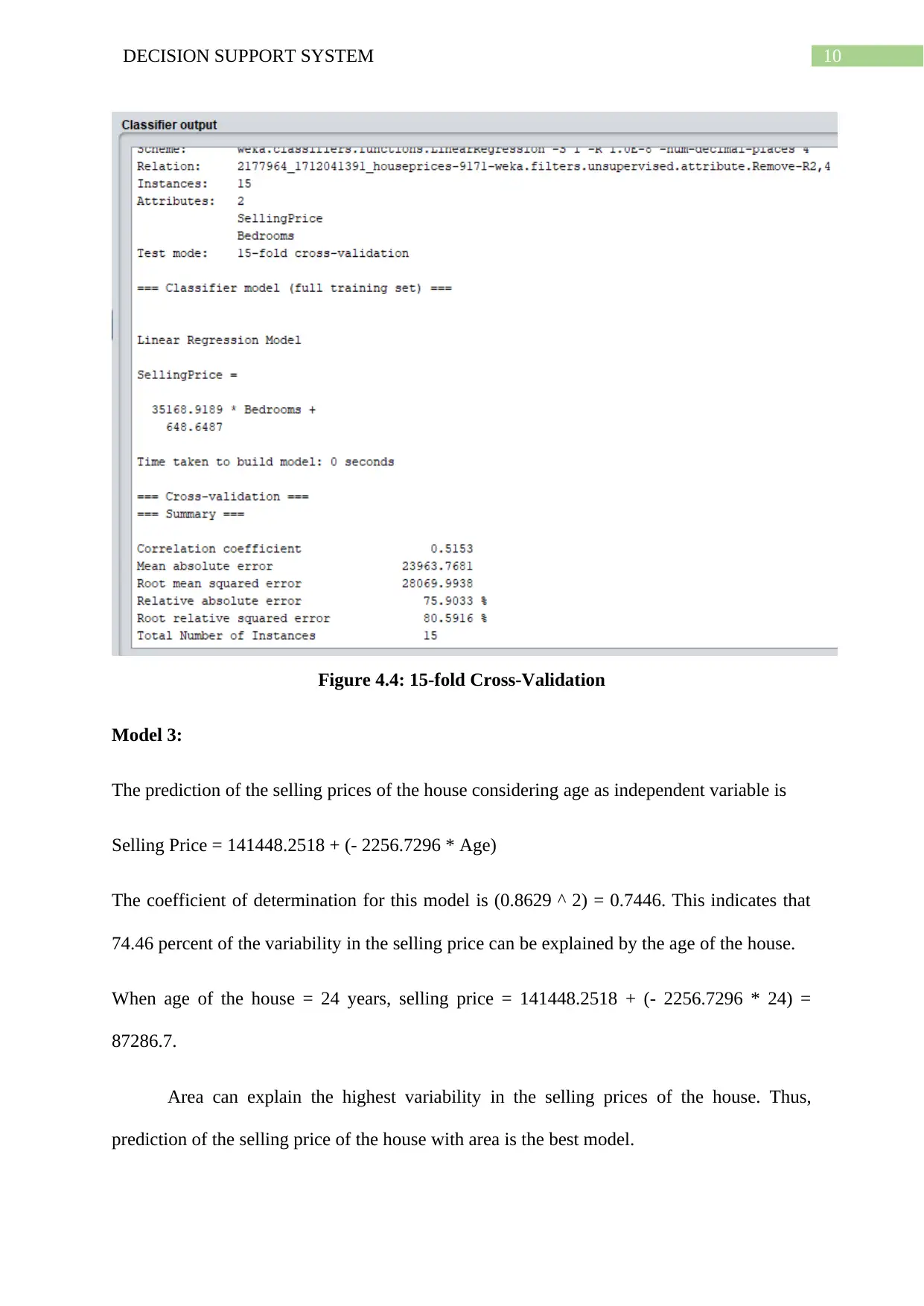
The prediction of the selling prices of the house considering bedrooms as independent
variable is
Selling Price = 648.6487 + (35168.9189 * Number of Bedrooms)
The coefficient of determination for this model is (0.5047 ^ 2) = 0.2547. This indicates that
25.47 percent of the variability in the selling price can be explained by the number of
bedrooms in the house.
When number of bedrooms = 3, selling price = 648.6487 + (35168.9189 * 3) = 106155
Document Page
9DECISION SUPPORT SYSTEM
Figure 4.3: 10-fold Cross-Validation
tabler-icon-diamond-filled.svg

Paraphrase This Document

Need a fresh take? Get an instant paraphrase of this document with our AI Paraphraser
Document Page
10DECISION SUPPORT SYSTEM
Figure 4.4: 15-fold Cross-Validation
Model 3:
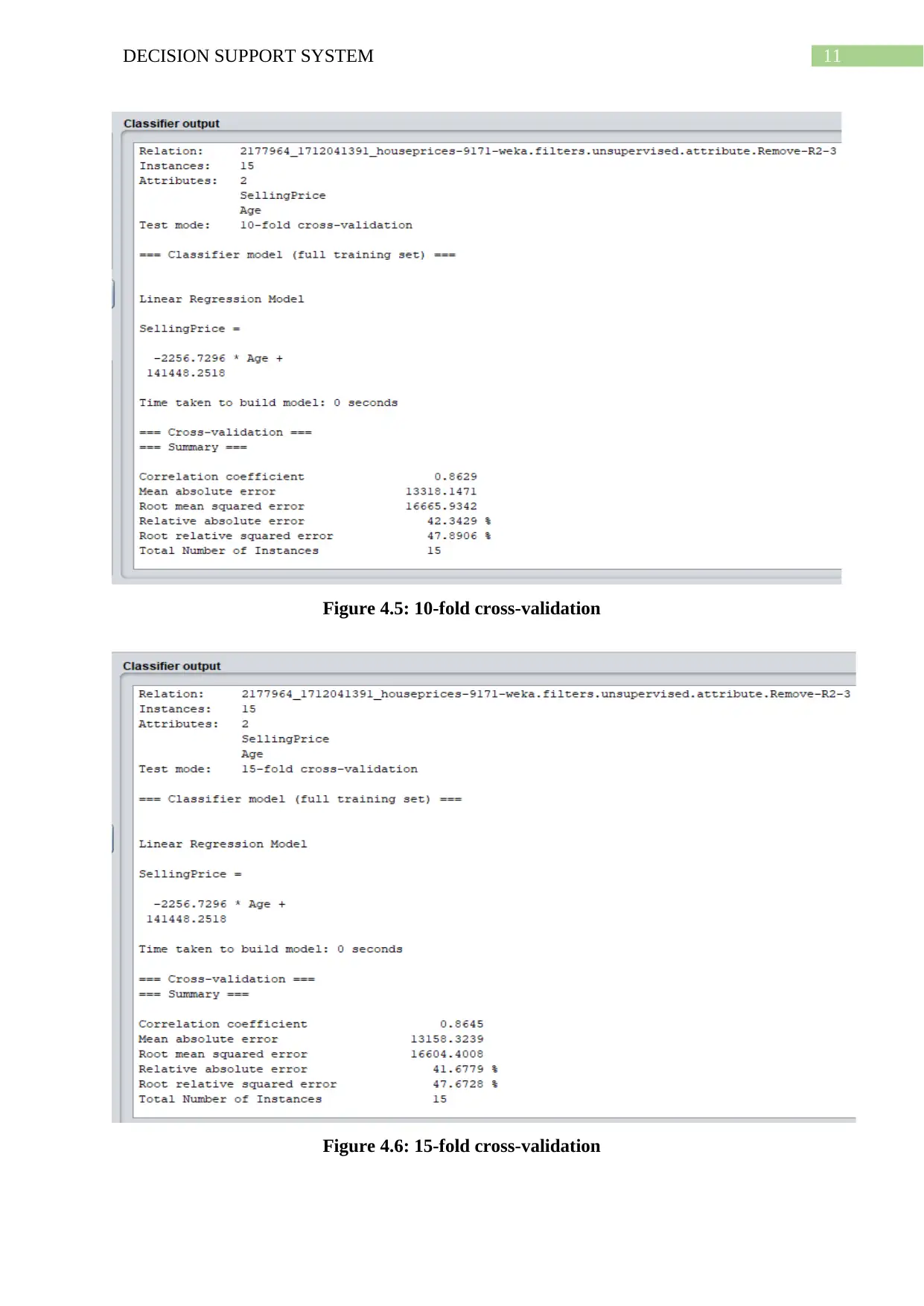
The prediction of the selling prices of the house considering age as independent variable is
Selling Price = 141448.2518 + (- 2256.7296 * Age)
The coefficient of determination for this model is (0.8629 ^ 2) = 0.7446. This indicates that
74.46 percent of the variability in the selling price can be explained by the age of the house.
When age of the house = 24 years, selling price = 141448.2518 + (- 2256.7296 * 24) =
87286.7.
Area can explain the highest variability in the selling prices of the house. Thus,
prediction of the selling price of the house with area is the best model.
Document Page
11DECISION SUPPORT SYSTEM
Figure 4.5: 10-fold cross-validation
Figure 4.6: 15-fold cross-validation
chevron_up_icon
1 out of 25
circle_padding
hide_on_mobile
zoom_out_icon
[object Object]