MNG91211 - Positive Leadership: Employee Motivation & Development

Verified

Added on  2023/06/12

|8
|792
|310
Essay
AI Summary
This essay examines the influence of positive leadership on employee motivation and development, particularly within innovative organizations. It discusses strategies used by positive leaders to motivate employees, focusing on building positive relationships and trust. The analysis centers on engineers as a key employee group, highlighting how positive and transformational leadership can enhance their flexibility and innovation. The essay explores motivational techniques such as improving beliefs, creative values, and mindsets, as well as conflict resolution mechanisms. Skill development exercises, including workshops, simulations, and team experiences, are also discussed as tools used by leaders to improve employee work processes. The essay references various studies to support its arguments, emphasizing the importance of authentic leadership and positive leader-member exchange in fostering moral integrity and commitment among employees.

Document Page
Influence of positive leadership
tabler-icon-diamond-filled.svg

Paraphrase This Document

Need a fresh take? Get an instant paraphrase of this document with our AI Paraphraser
Document Page
introduction
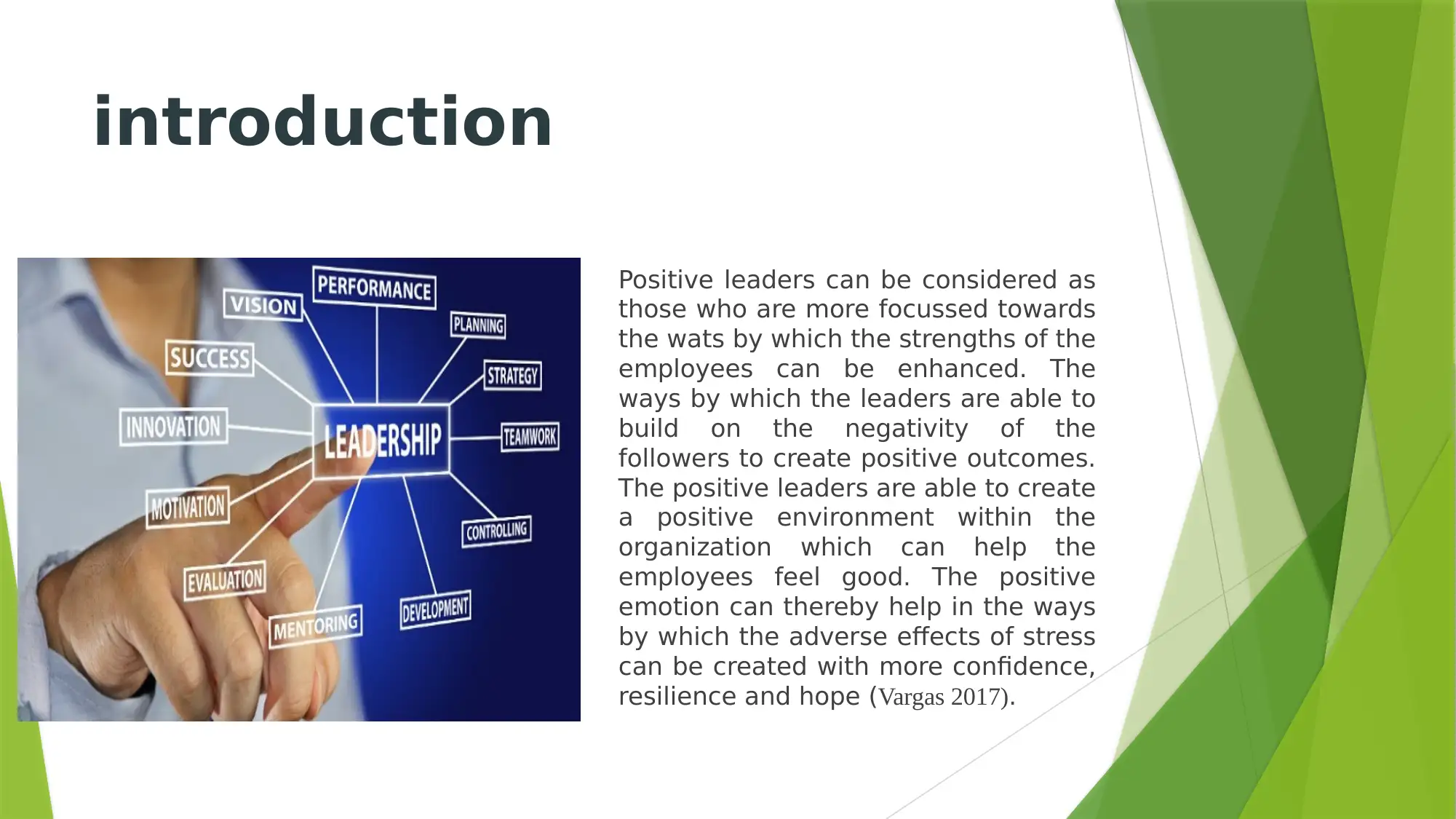
Positive leaders can be considered as
those who are more focussed towards
the wats by which the strengths of the
employees can be enhanced. The
ways by which the leaders are able to
build on the negativity of the
followers to create positive outcomes.
The positive leaders are able to create
a positive environment within the
organization which can help the
employees feel good. The positive
emotion can thereby help in the ways
by which the adverse effects of stress
can be created with more confidence,
resilience and hope (Vargas 2017).
Document Page
Strategy used by the positive
leaders
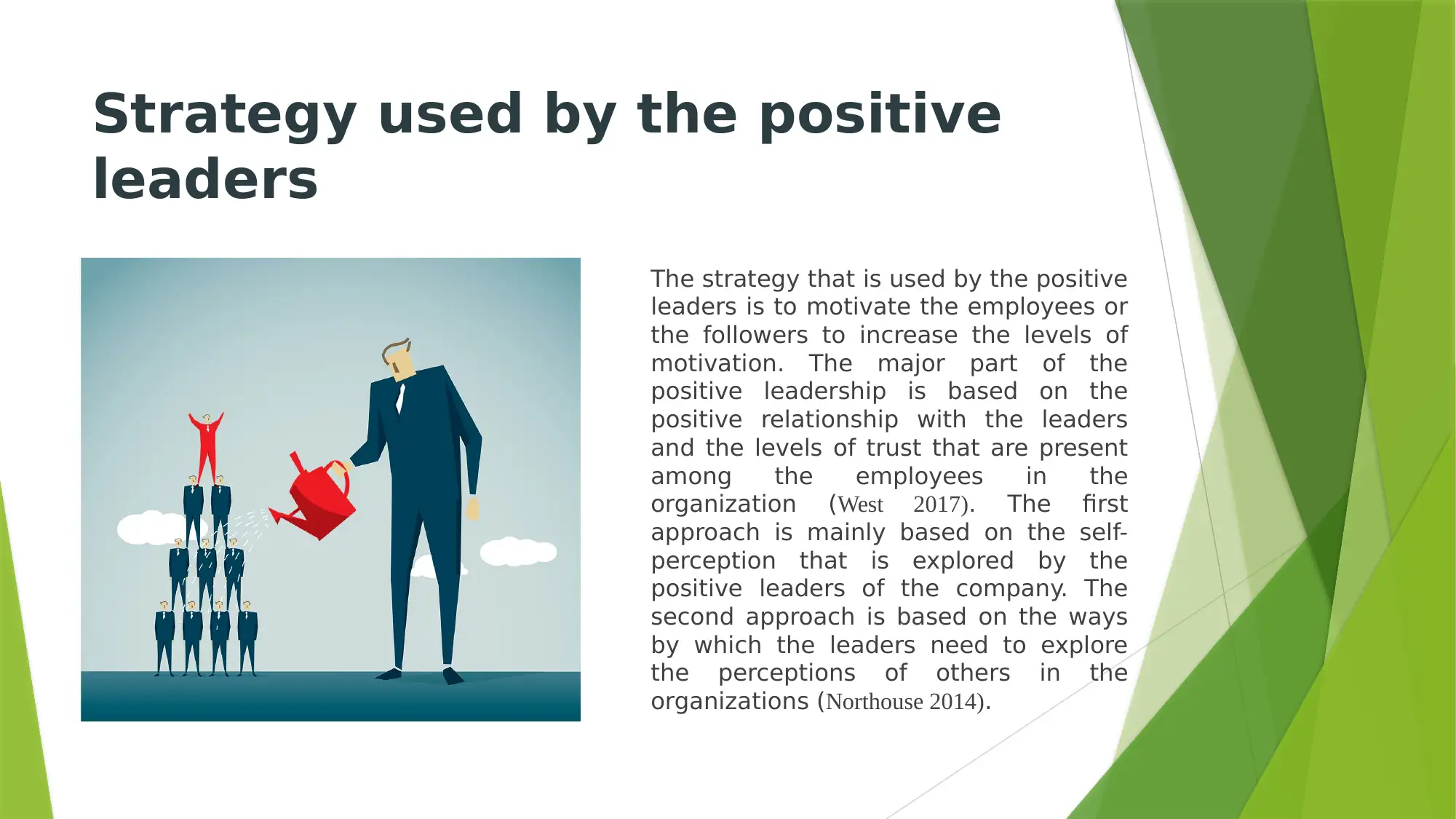
The strategy that is used by the positive
leaders is to motivate the employees or
the followers to increase the levels of
motivation. The major part of the
positive leadership is based on the
positive relationship with the leaders
and the levels of trust that are present
among the employees in the
organization (West 2017). The first
approach is mainly based on the self-
perception that is explored by the
positive leaders of the company. The
second approach is based on the ways
by which the leaders need to explore
the perceptions of others in the
organizations (Northouse 2014).
Document Page
Type of employee chosen for
influencing
The type of employees who are chosen
for the analysis of the positive
leadership are the engineers of
different innovative organizations. The
positive and transformational
leadership can affect the flexibility of
the engineers. The innovations levels of
the organizations and the employees
act as a competitive advantage for the
modern companies. The technology
based companies are more affected by
the transformational style of leadership.
The levels of research and interest has
grown to a large extent with the help of
the positive leadership (Nichols 2016).
tabler-icon-diamond-filled.svg

Paraphrase This Document

Need a fresh take? Get an instant paraphrase of this document with our AI Paraphraser
Document Page
Motivation provided to the
employees
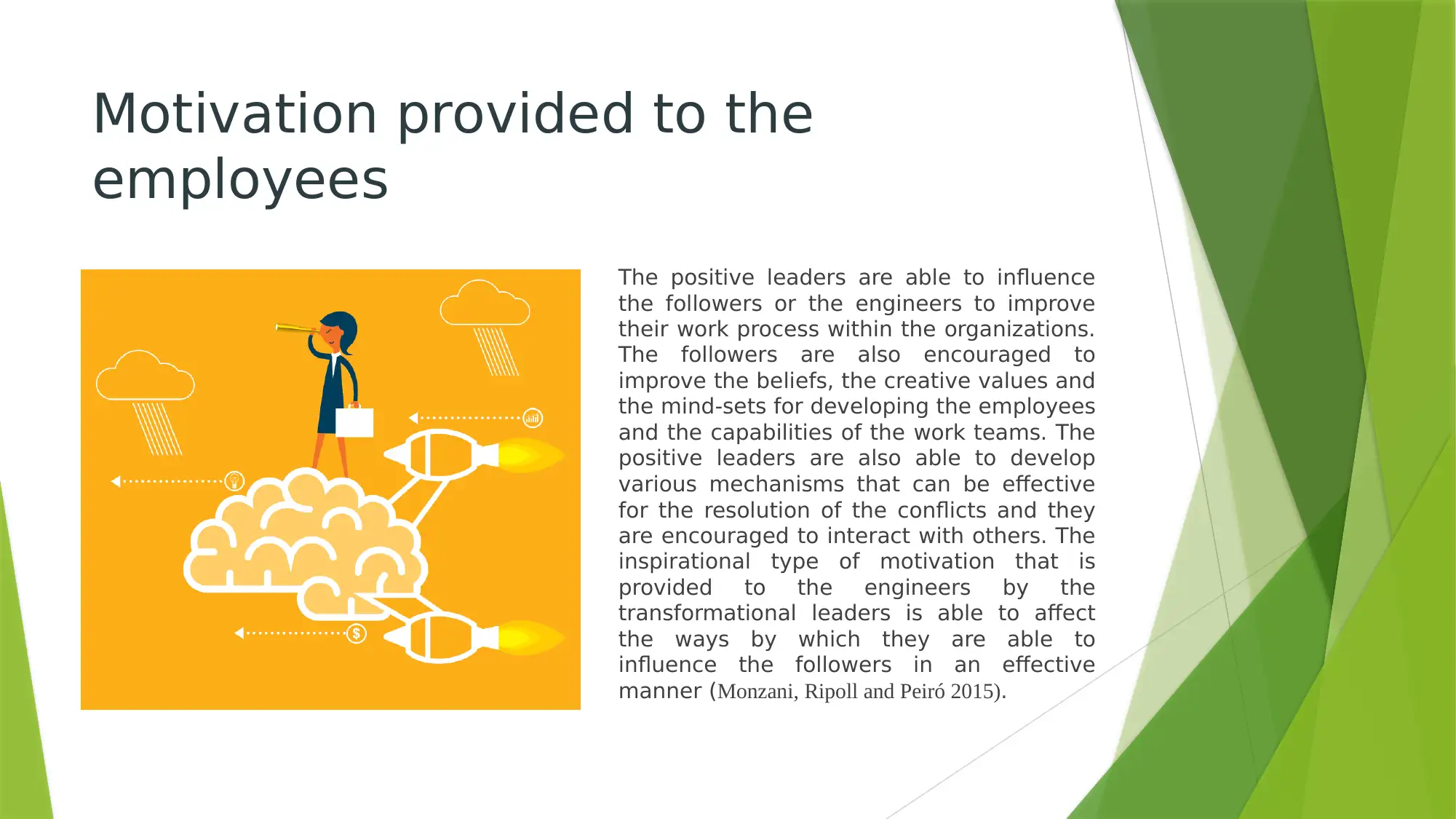
The positive leaders are able to influence
the followers or the engineers to improve
their work process within the organizations.
The followers are also encouraged to
improve the beliefs, the creative values and
the mind-sets for developing the employees
and the capabilities of the work teams. The
positive leaders are also able to develop
various mechanisms that can be effective
for the resolution of the conflicts and they
are encouraged to interact with others. The
inspirational type of motivation that is
provided to the engineers by the
transformational leaders is able to affect
the ways by which they are able to
influence the followers in an effective
manner (Monzani, Ripoll and Peiró 2015).
Document Page
Skills development exercises
used by leaders
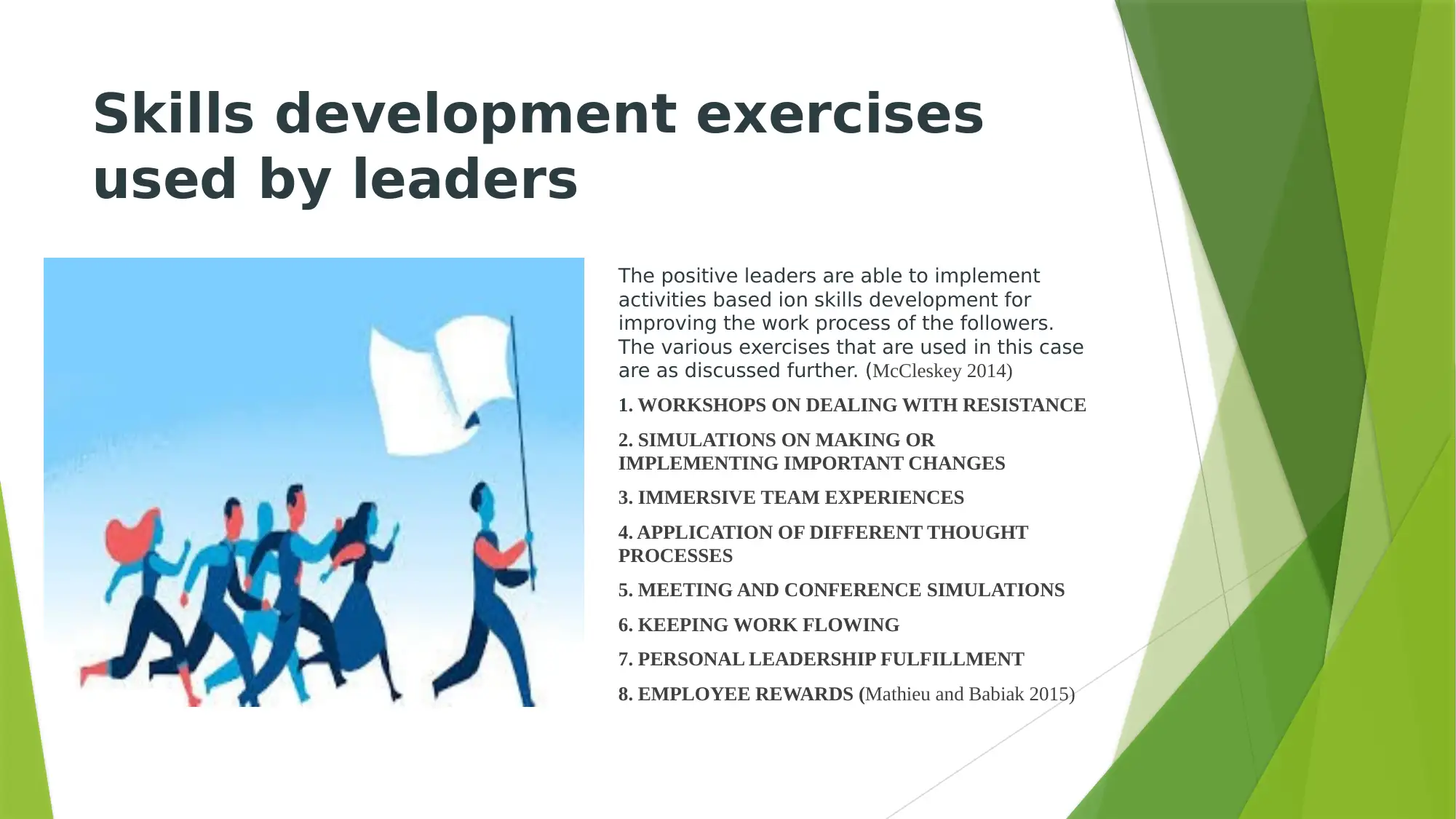
The positive leaders are able to implement
activities based ion skills development for
improving the work process of the followers.
The various exercises that are used in this case
are as discussed further. (McCleskey 2014)
1. WORKSHOPS ON DEALING WITH RESISTANCE
2. SIMULATIONS ON MAKING OR
IMPLEMENTING IMPORTANT CHANGES
3. IMMERSIVE TEAM EXPERIENCES
4. APPLICATION OF DIFFERENT THOUGHT
PROCESSES
5. MEETING AND CONFERENCE SIMULATIONS
6. KEEPING WORK FLOWING
7. PERSONAL LEADERSHIP FULFILLMENT
8. EMPLOYEE REWARDS (Mathieu and Babiak 2015)
Document Page
References
Mathieu, C. and Babiak, P., 2015. Tell me who you are, I'll tell you how you lead: Beyond the Full-Range
Leadership Model, the role of corporate psychopathy on employee attitudes. Personality and Individual
Differences, 87, pp.8-12.
McCleskey, J.A., 2014. Situational, transformational, and transactional leadership and leadership
development. Journal of Business Studies Quarterly, 5(4), p.117.
Monzani, L., Ripoll, P. and Peiró, J.M., 2015. The moderator role of followers’ personality traits in the relations
between leadership styles, two types of task performance and work result satisfaction. European Journal of Work
and Organizational Psychology, 24(3), pp.444-461.
Nichols, A.L., 2016. What do people desire in their leaders? The effect of leadership experience on desired
leadership traits. Leadership & Organization Development Journal, 37(5), pp.658-671.
Northouse, P.G., 2014. Introduction to leadership: Concepts and practice. Sage Publications.
Vargas, M., 2017. Investigating the Influence of Personality Traits and Leadership Styles. Angelo State University
Social Sciences Research Journal, 4(2).
West, M., 2017. Similarities of Transformation and Charismatic Leadership Traits in Gang Leaders and
Community Leaders (Doctoral dissertation, The Chicago School of Professional Psychology).
tabler-icon-diamond-filled.svg

Paraphrase This Document

Need a fresh take? Get an instant paraphrase of this document with our AI Paraphraser
Document Page
chevron_up_icon
1 out of 8
circle_padding
hide_on_mobile
zoom_out_icon
[object Object]