Practical Statistics MATH1P98: Wine Sales Data Analysis, Winter 2017
VerifiedAdded on 2023/06/15
|7
|1172
|429
Homework Assignment
AI Summary
This assignment provides a comprehensive statistical analysis of wine sales data, focusing on proportions of different wine types, sales trends over the years, and hypothesis testing. It includes pie charts illustrating the proportion of sales for red, rosé, and white wines, as well as different types and brands within those categories. The analysis uses a chi-square test to assess the consistency of wine sales proportions, a t-test to compare average sales of red and white wines, and a z-test to evaluate the proportion of Icewine sales. Confidence intervals are calculated for the differences in means and proportions. The assignment concludes with interpretations of the statistical results, providing insights into wine sales patterns and consumer preferences.
Running Head: PRACTICAL STATISTICS
MATH1P98 – Practical Statistics
Name of the Student
Name of the University
Author Note
MATH1P98 – Practical Statistics
Name of the Student
Name of the University
Author Note
Paraphrase This Document
Need a fresh take? Get an instant paraphrase of this document with our AI Paraphraser

1PRACTICAL STATISTICS
Answer 1
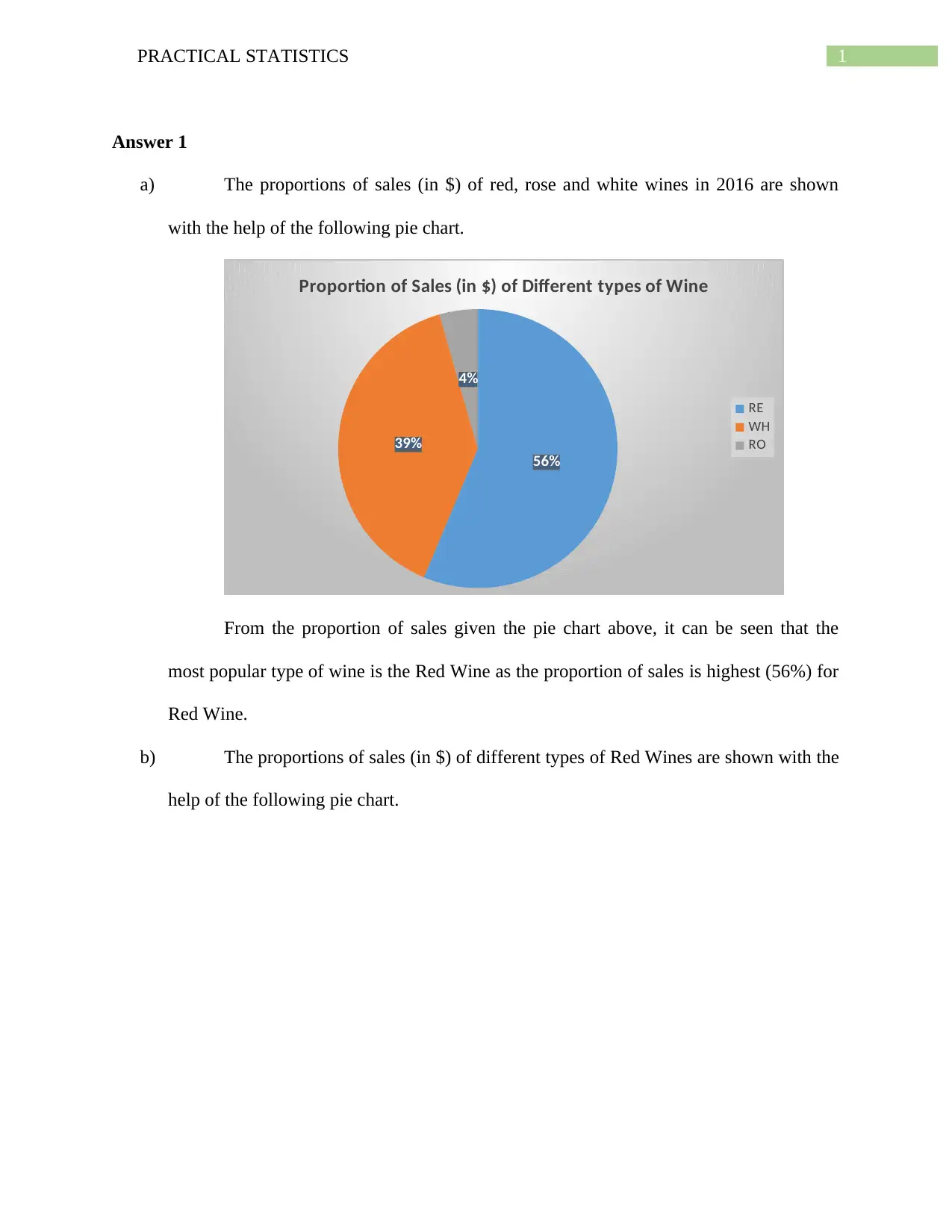
a) The proportions of sales (in $) of red, rose and white wines in 2016 are shown
with the help of the following pie chart.
56%
39%
4%
Proportion of Sales (in $) of Different types of Wine
RE
WH
RO
From the proportion of sales given the pie chart above, it can be seen that the
most popular type of wine is the Red Wine as the proportion of sales is highest (56%) for
Red Wine.
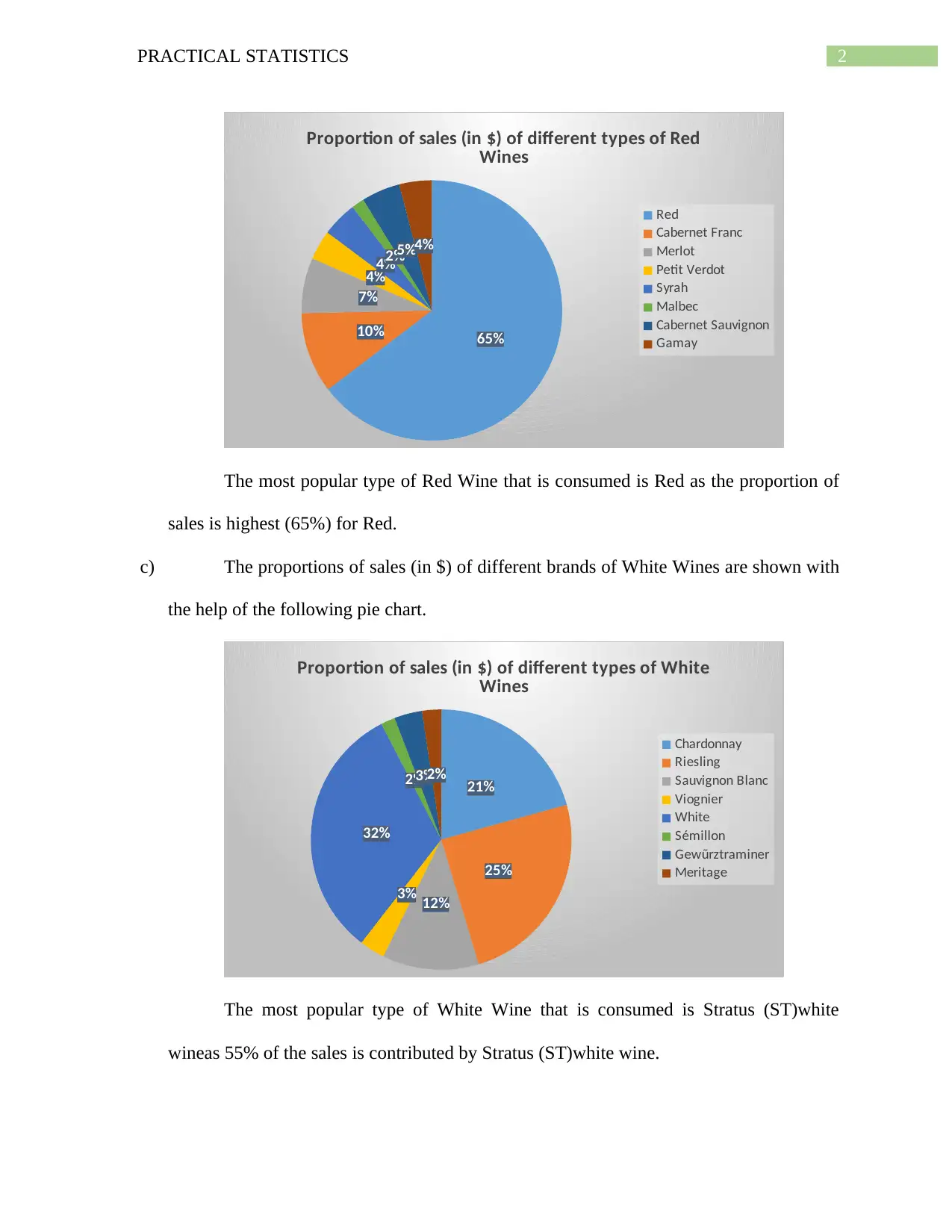
b) The proportions of sales (in $) of different types of Red Wines are shown with the
help of the following pie chart.
Answer 1
a) The proportions of sales (in $) of red, rose and white wines in 2016 are shown
with the help of the following pie chart.
56%
39%
4%
Proportion of Sales (in $) of Different types of Wine
RE
WH
RO
From the proportion of sales given the pie chart above, it can be seen that the
most popular type of wine is the Red Wine as the proportion of sales is highest (56%) for
Red Wine.
b) The proportions of sales (in $) of different types of Red Wines are shown with the
help of the following pie chart.

2PRACTICAL STATISTICS
65%10%
7%
4%
4%2%5%4%
Proportion of sales (in $) of different types of Red
Wines
Red
Cabernet Franc
Merlot
Petit Verdot
Syrah
Malbec
Cabernet Sauvignon
Gamay
The most popular type of Red Wine that is consumed is Red as the proportion of
sales is highest (65%) for Red.
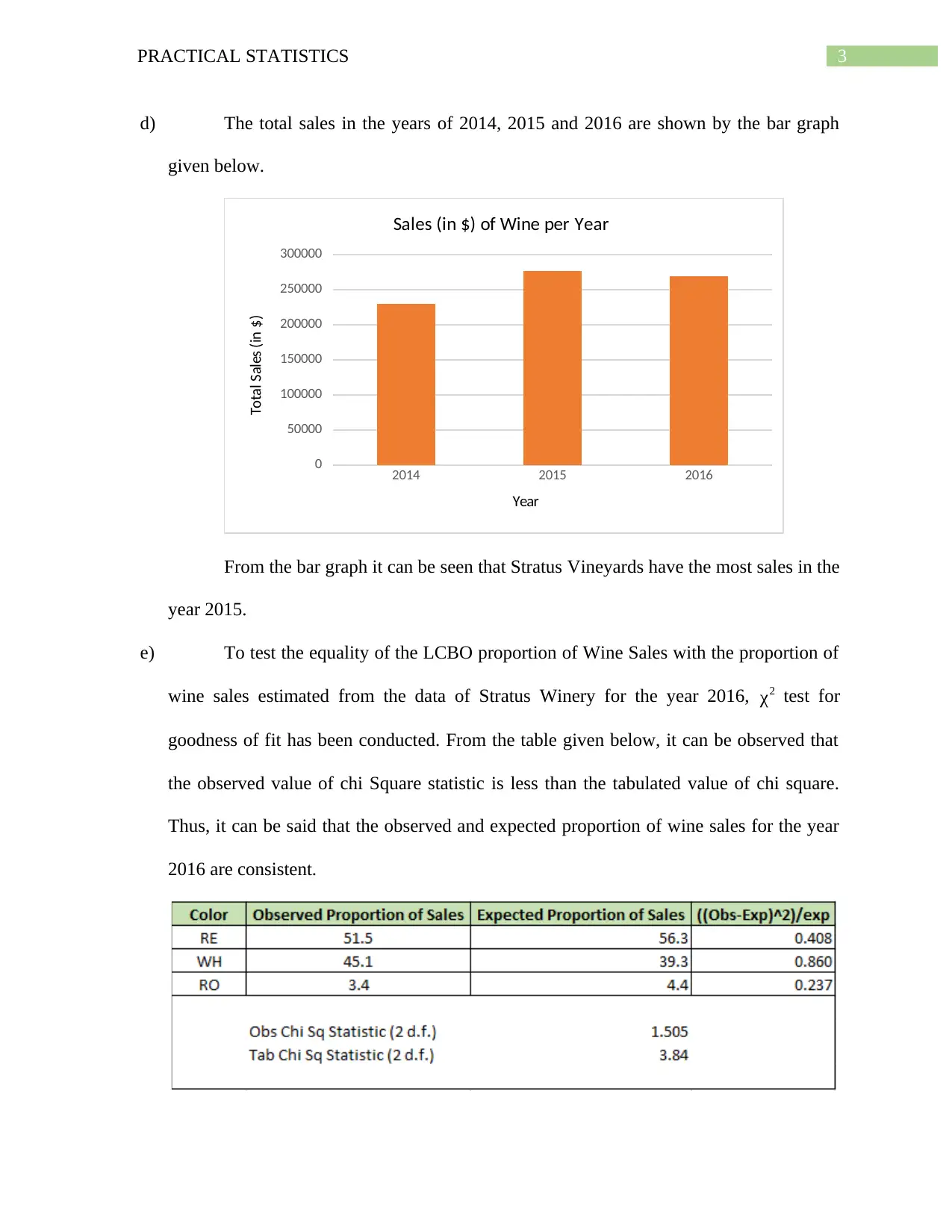
c) The proportions of sales (in $) of different brands of White Wines are shown with
the help of the following pie chart.
21%
25%
12%
3%
32%
2%3%2%
Proportion of sales (in $) of different types of White
Wines
Chardonnay
Riesling
Sauvignon Blanc
Viognier
White
Sémillon
Gewũrztraminer
Meritage
The most popular type of White Wine that is consumed is Stratus (ST)white
wineas 55% of the sales is contributed by Stratus (ST)white wine.
65%10%
7%
4%
4%2%5%4%
Proportion of sales (in $) of different types of Red
Wines
Red
Cabernet Franc
Merlot
Petit Verdot
Syrah
Malbec
Cabernet Sauvignon
Gamay
The most popular type of Red Wine that is consumed is Red as the proportion of
sales is highest (65%) for Red.
c) The proportions of sales (in $) of different brands of White Wines are shown with
the help of the following pie chart.
21%
25%
12%
3%
32%
2%3%2%
Proportion of sales (in $) of different types of White
Wines
Chardonnay
Riesling
Sauvignon Blanc
Viognier
White
Sémillon
Gewũrztraminer
Meritage
The most popular type of White Wine that is consumed is Stratus (ST)white
wineas 55% of the sales is contributed by Stratus (ST)white wine.
⊘ This is a preview!⊘
Do you want full access?
Subscribe today to unlock all pages.

Trusted by 1+ million students worldwide

3PRACTICAL STATISTICS
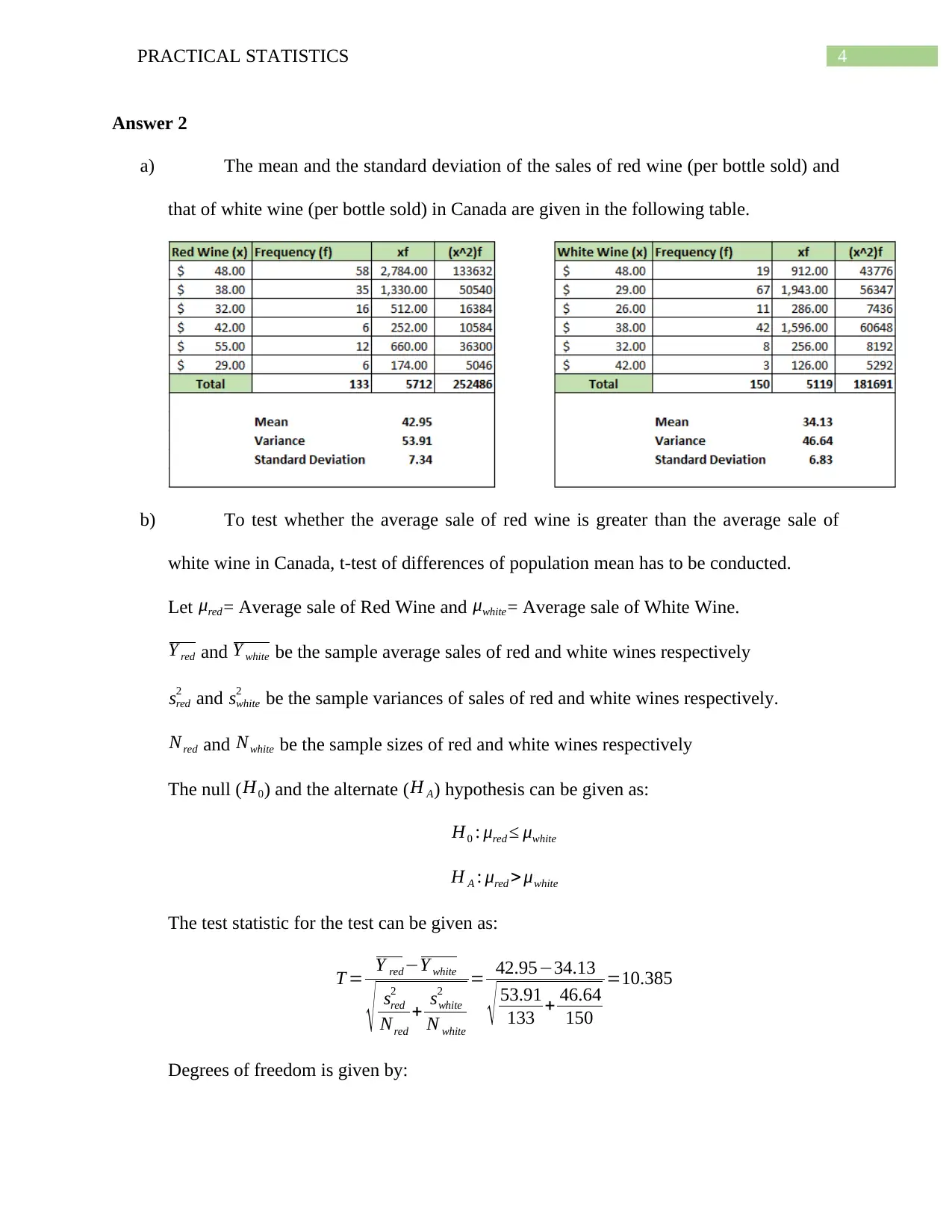
d) The total sales in the years of 2014, 2015 and 2016 are shown by the bar graph
given below.
2014 2015 2016
0
50000
100000
150000
200000
250000
300000
Sales (in $) of Wine per Year
Year
Total Sales (in $)
From the bar graph it can be seen that Stratus Vineyards have the most sales in the
year 2015.
e) To test the equality of the LCBO proportion of Wine Sales with the proportion of
wine sales estimated from the data of Stratus Winery for the year 2016, χ2 test for
goodness of fit has been conducted. From the table given below, it can be observed that
the observed value of chi Square statistic is less than the tabulated value of chi square.
Thus, it can be said that the observed and expected proportion of wine sales for the year
2016 are consistent.
d) The total sales in the years of 2014, 2015 and 2016 are shown by the bar graph
given below.
2014 2015 2016
0
50000
100000
150000
200000
250000
300000
Sales (in $) of Wine per Year
Year
Total Sales (in $)
From the bar graph it can be seen that Stratus Vineyards have the most sales in the
year 2015.
e) To test the equality of the LCBO proportion of Wine Sales with the proportion of
wine sales estimated from the data of Stratus Winery for the year 2016, χ2 test for
goodness of fit has been conducted. From the table given below, it can be observed that
the observed value of chi Square statistic is less than the tabulated value of chi square.
Thus, it can be said that the observed and expected proportion of wine sales for the year
2016 are consistent.
Paraphrase This Document
Need a fresh take? Get an instant paraphrase of this document with our AI Paraphraser

4PRACTICAL STATISTICS
Answer 2
a) The mean and the standard deviation of the sales of red wine (per bottle sold) and
that of white wine (per bottle sold) in Canada are given in the following table.
b) To test whether the average sale of red wine is greater than the average sale of
white wine in Canada, t-test of differences of population mean has to be conducted.
Let μred= Average sale of Red Wine and μwhite= Average sale of White Wine.
Y red and Y white be the sample average sales of red and white wines respectively
sred
2 and swhite
2 be the sample variances of sales of red and white wines respectively.
Nred and Nwhite be the sample sizes of red and white wines respectively
The null (H0) and the alternate ( H A) hypothesis can be given as:
H0 : μred ≤ μwhite
H A : μred > μwhite
The test statistic for the test can be given as:
T = Y red−Y white
√ sred
2
Nred
+ swhite
2
N white
= 42.95−34.13
√ 53.91
133 + 46.64
150
=10.385
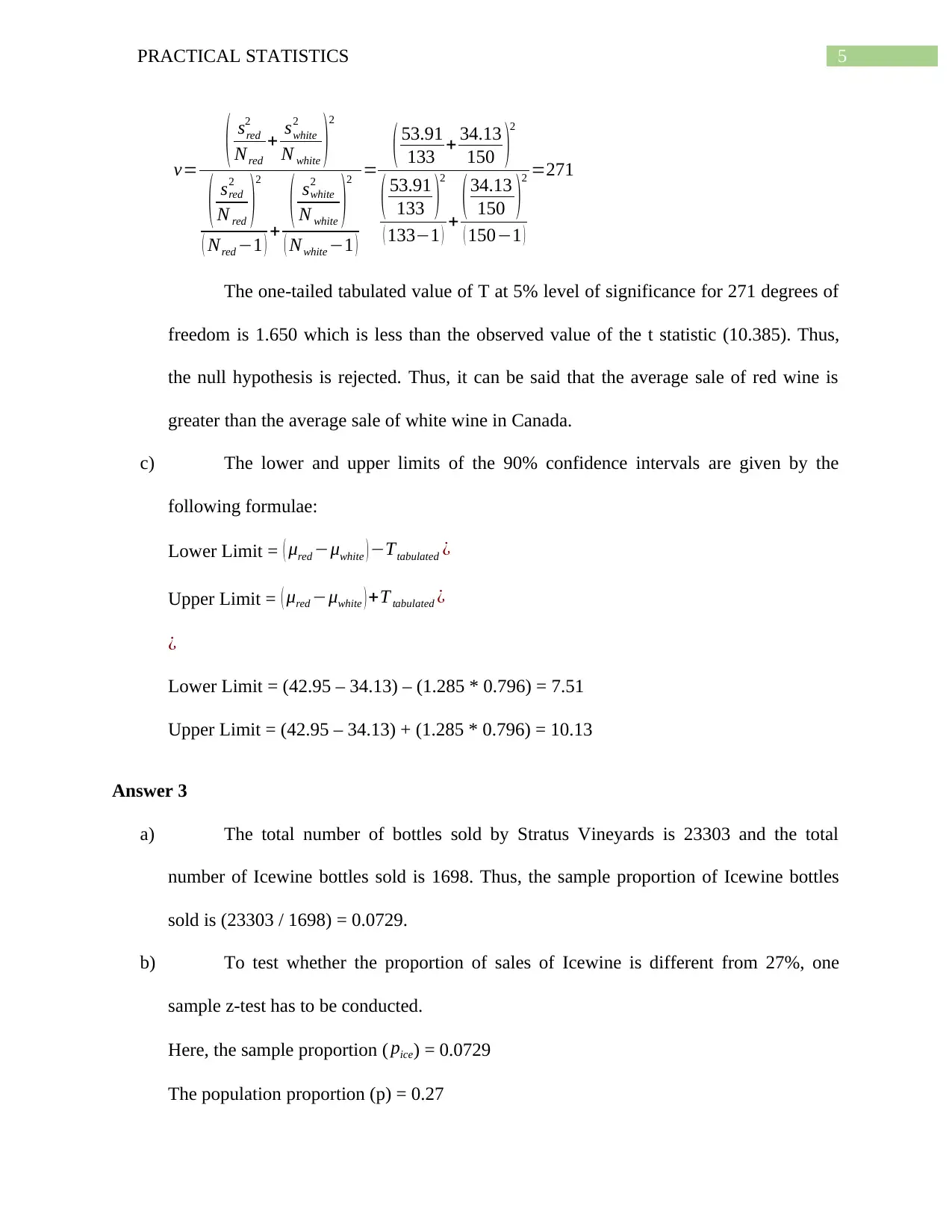
Degrees of freedom is given by:
Answer 2
a) The mean and the standard deviation of the sales of red wine (per bottle sold) and
that of white wine (per bottle sold) in Canada are given in the following table.
b) To test whether the average sale of red wine is greater than the average sale of
white wine in Canada, t-test of differences of population mean has to be conducted.
Let μred= Average sale of Red Wine and μwhite= Average sale of White Wine.
Y red and Y white be the sample average sales of red and white wines respectively
sred
2 and swhite
2 be the sample variances of sales of red and white wines respectively.
Nred and Nwhite be the sample sizes of red and white wines respectively
The null (H0) and the alternate ( H A) hypothesis can be given as:
H0 : μred ≤ μwhite
H A : μred > μwhite
The test statistic for the test can be given as:
T = Y red−Y white
√ sred
2
Nred
+ swhite
2
N white
= 42.95−34.13
√ 53.91
133 + 46.64
150
=10.385
Degrees of freedom is given by:

5PRACTICAL STATISTICS
v=
( sred
2
Nred
+ swhite
2
N white )
2
( sred
2
N red )
2
( Nred −1 ) +
( swhite
2
N white )
2
( Nwhite −1 )
= ( 53.91
133 + 34.13
150 )
2
( 53.91
133 )
2
( 133−1 ) + ( 34.13
150 )
2
( 150−1 )
=271
The one-tailed tabulated value of T at 5% level of significance for 271 degrees of
freedom is 1.650 which is less than the observed value of the t statistic (10.385). Thus,
the null hypothesis is rejected. Thus, it can be said that the average sale of red wine is
greater than the average sale of white wine in Canada.
c) The lower and upper limits of the 90% confidence intervals are given by the
following formulae:
Lower Limit = ( μred −μwhite ) −Ttabulated ¿
Upper Limit = ( μred −μwhite ) +T tabulated ¿
¿
Lower Limit = (42.95 – 34.13) – (1.285 * 0.796) = 7.51
Upper Limit = (42.95 – 34.13) + (1.285 * 0.796) = 10.13
Answer 3
a) The total number of bottles sold by Stratus Vineyards is 23303 and the total
number of Icewine bottles sold is 1698. Thus, the sample proportion of Icewine bottles
sold is (23303 / 1698) = 0.0729.
b) To test whether the proportion of sales of Icewine is different from 27%, one
sample z-test has to be conducted.
Here, the sample proportion ( pice) = 0.0729
The population proportion (p) = 0.27
v=
( sred
2
Nred
+ swhite
2
N white )
2
( sred
2
N red )
2
( Nred −1 ) +
( swhite
2
N white )
2
( Nwhite −1 )
= ( 53.91
133 + 34.13
150 )
2
( 53.91
133 )
2
( 133−1 ) + ( 34.13
150 )
2
( 150−1 )
=271
The one-tailed tabulated value of T at 5% level of significance for 271 degrees of
freedom is 1.650 which is less than the observed value of the t statistic (10.385). Thus,
the null hypothesis is rejected. Thus, it can be said that the average sale of red wine is
greater than the average sale of white wine in Canada.
c) The lower and upper limits of the 90% confidence intervals are given by the
following formulae:
Lower Limit = ( μred −μwhite ) −Ttabulated ¿
Upper Limit = ( μred −μwhite ) +T tabulated ¿
¿
Lower Limit = (42.95 – 34.13) – (1.285 * 0.796) = 7.51
Upper Limit = (42.95 – 34.13) + (1.285 * 0.796) = 10.13
Answer 3
a) The total number of bottles sold by Stratus Vineyards is 23303 and the total
number of Icewine bottles sold is 1698. Thus, the sample proportion of Icewine bottles
sold is (23303 / 1698) = 0.0729.
b) To test whether the proportion of sales of Icewine is different from 27%, one
sample z-test has to be conducted.
Here, the sample proportion ( pice) = 0.0729
The population proportion (p) = 0.27
⊘ This is a preview!⊘
Do you want full access?
Subscribe today to unlock all pages.

Trusted by 1+ million students worldwide

6PRACTICAL STATISTICS
Sample size (n) = 29
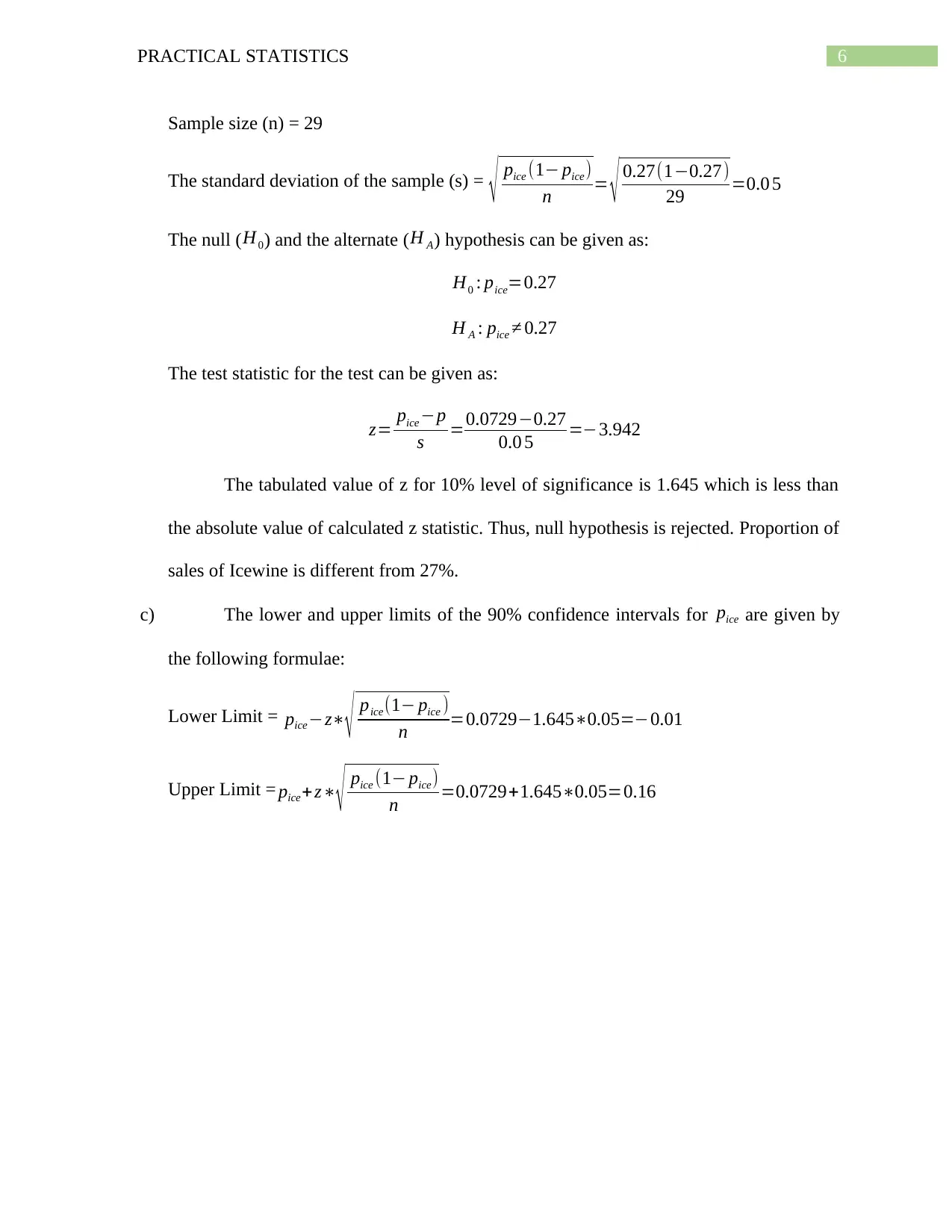
The standard deviation of the sample (s) = √ pice (1− pice)
n = √ 0.27(1−0.27)
29 =0.0 5
The null (H0) and the alternate ( H A) hypothesis can be given as:
H0 : pice=0.27
H A : pice ≠ 0.27
The test statistic for the test can be given as:
z= pice−p
s =0.0729−0.27
0.0 5 =−3.942
The tabulated value of z for 10% level of significance is 1.645 which is less than
the absolute value of calculated z statistic. Thus, null hypothesis is rejected. Proportion of
sales of Icewine is different from 27%.
c) The lower and upper limits of the 90% confidence intervals for pice are given by
the following formulae:
Lower Limit = pice−z∗
√ pice(1− pice )
n =0.0729−1.645∗0.05=−0.01
Upper Limit = pice+z∗
√ pice (1− pice)
n =0.0729+1.645∗0.05=0.16
Sample size (n) = 29
The standard deviation of the sample (s) = √ pice (1− pice)
n = √ 0.27(1−0.27)
29 =0.0 5
The null (H0) and the alternate ( H A) hypothesis can be given as:
H0 : pice=0.27
H A : pice ≠ 0.27
The test statistic for the test can be given as:
z= pice−p
s =0.0729−0.27
0.0 5 =−3.942
The tabulated value of z for 10% level of significance is 1.645 which is less than
the absolute value of calculated z statistic. Thus, null hypothesis is rejected. Proportion of
sales of Icewine is different from 27%.
c) The lower and upper limits of the 90% confidence intervals for pice are given by
the following formulae:
Lower Limit = pice−z∗
√ pice(1− pice )
n =0.0729−1.645∗0.05=−0.01
Upper Limit = pice+z∗
√ pice (1− pice)
n =0.0729+1.645∗0.05=0.16
1 out of 7
Your All-in-One AI-Powered Toolkit for Academic Success.
+13062052269
info@desklib.com
Available 24*7 on WhatsApp / Email
Unlock your academic potential
Copyright © 2020–2026 A2Z Services. All Rights Reserved. Developed and managed by ZUCOL.