English Assignment: Clause Analysis, Intertextuality & Examples

Verified

Added on  2022/08/11

|4
|701
|18
Homework Assignment
AI Summary
This assignment analyzes the basic elements of an English clause, including subject, predicate verb, objects, predicative, and adverbials. It details two testing methods: the subject predicate method and sentence analysis, providing examples for each. The assignment also explores intertextuality, defining it as a standard of textuality where a text's meaning is shaped by another text, and discussing its types (quotation, allusion, etc.) and functions. The solution includes examples and discusses the use of intertextuality to deepen text and context, referencing James Joyce's "Ulysses" as an example of intertextuality. The assignment also addresses the seven standards of textuality, choosing intertextuality to explain and illustrate its presence or absence through examples, supported by cited sources to avoid plagiarism.
Document Page
Running head: ENGLISH ASSIGNMENTS
English Assignments
Name of the Student
Name of the University
Author notes
tabler-icon-diamond-filled.svg

Paraphrase This Document

Need a fresh take? Get an instant paraphrase of this document with our AI Paraphraser
Document Page
1
ENGLISH ASSIGNMENTS
Elements in a Basic Clause
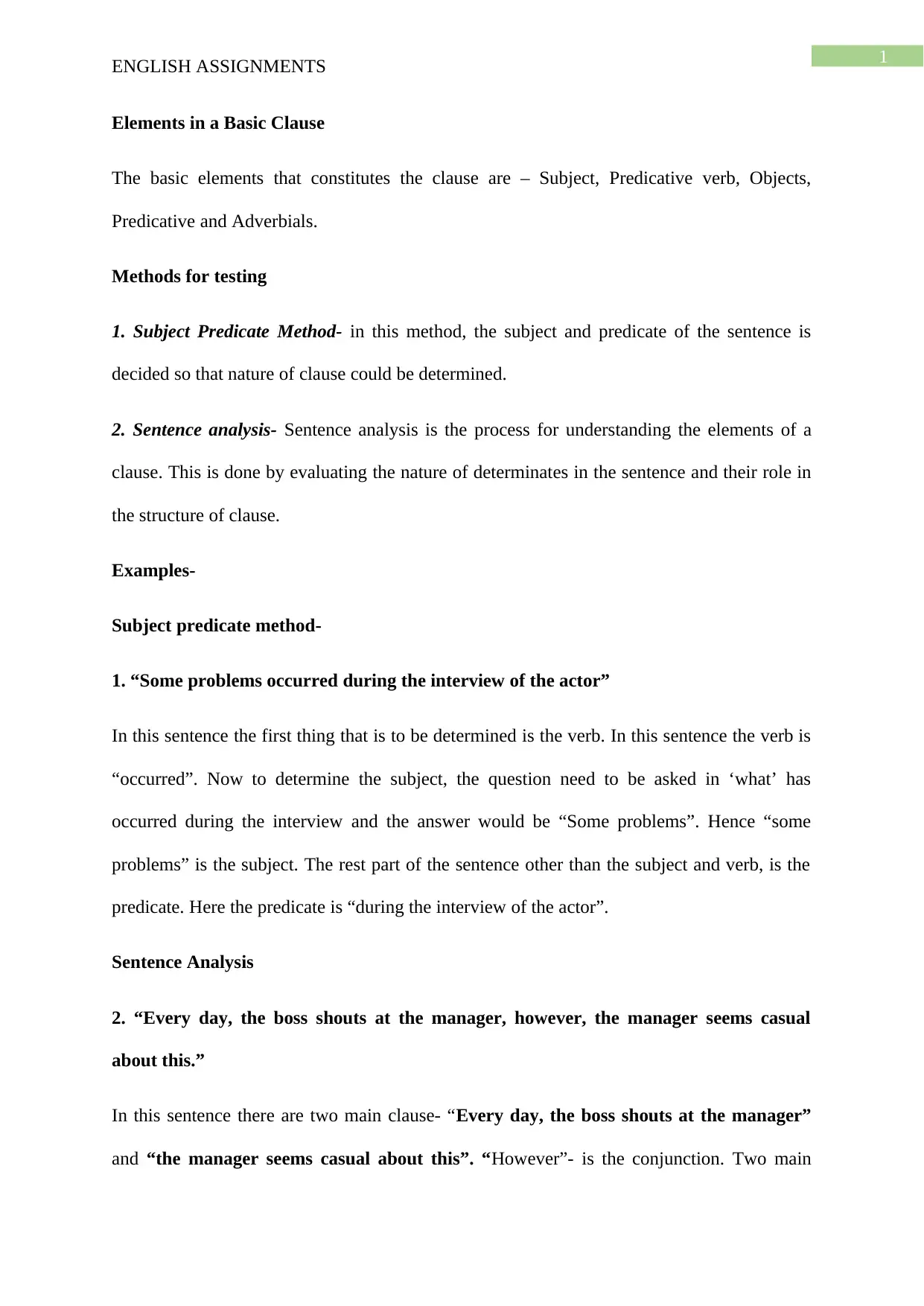
The basic elements that constitutes the clause are – Subject, Predicative verb, Objects,
Predicative and Adverbials.
Methods for testing
1. Subject Predicate Method- in this method, the subject and predicate of the sentence is
decided so that nature of clause could be determined.
2. Sentence analysis- Sentence analysis is the process for understanding the elements of a
clause. This is done by evaluating the nature of determinates in the sentence and their role in
the structure of clause.
Examples-
Subject predicate method-
1. “Some problems occurred during the interview of the actor”
In this sentence the first thing that is to be determined is the verb. In this sentence the verb is
“occurred”. Now to determine the subject, the question need to be asked in ‘what’ has
occurred during the interview and the answer would be “Some problems”. Hence “some
problems” is the subject. The rest part of the sentence other than the subject and verb, is the
predicate. Here the predicate is “during the interview of the actor”.
Sentence Analysis
2. “Every day, the boss shouts at the manager, however, the manager seems casual
about this.”
In this sentence there are two main clause- “Every day, the boss shouts at the manager”
and “the manager seems casual about this”. “However”- is the conjunction. Two main
Document Page
2
ENGLISH ASSIGNMENTS
clause are joined by the conjunction ‘however’ here and the next part becomes the
subordinate clause.
Intertextuality
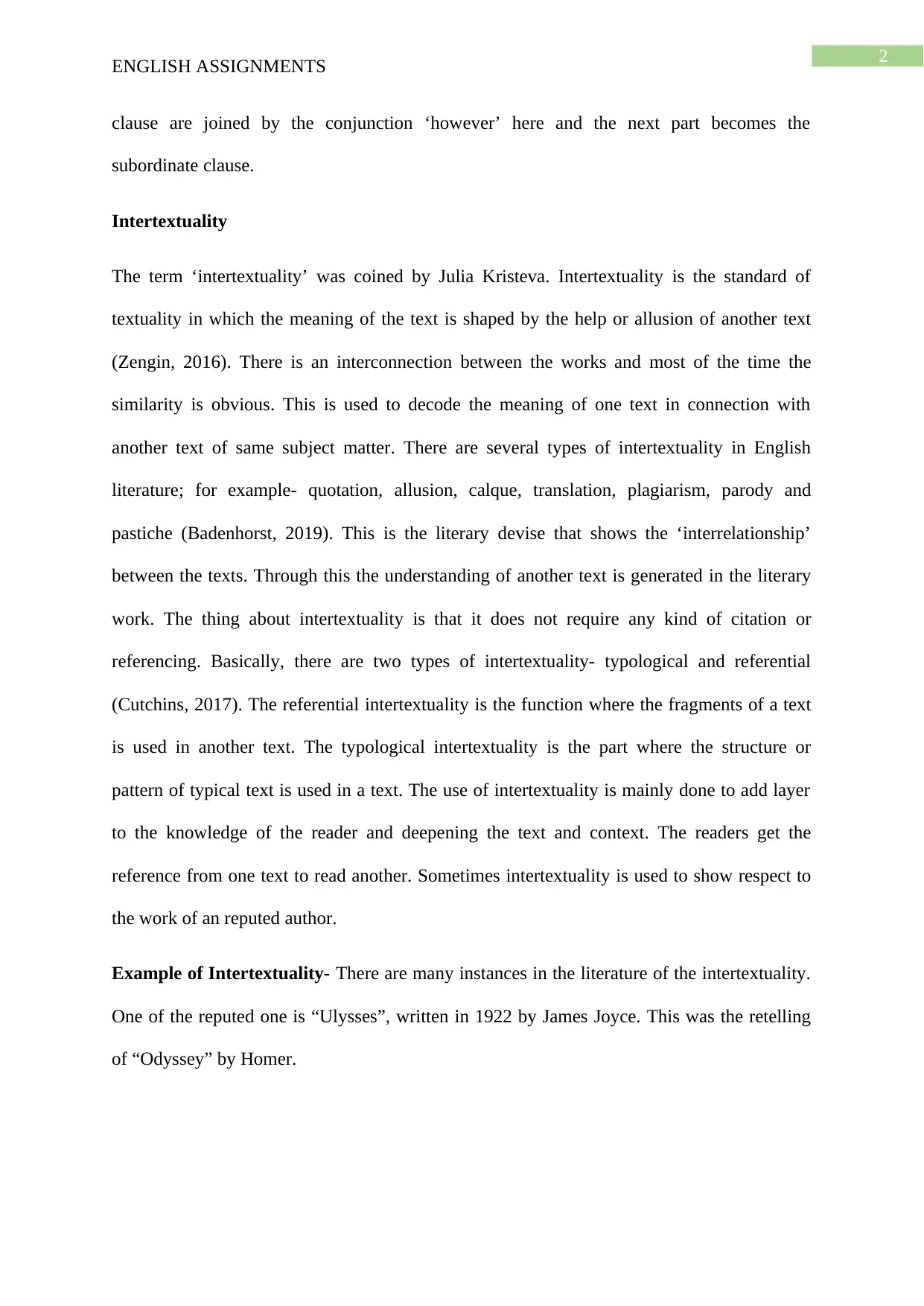
The term ‘intertextuality’ was coined by Julia Kristeva. Intertextuality is the standard of
textuality in which the meaning of the text is shaped by the help or allusion of another text
(Zengin, 2016). There is an interconnection between the works and most of the time the
similarity is obvious. This is used to decode the meaning of one text in connection with
another text of same subject matter. There are several types of intertextuality in English
literature; for example- quotation, allusion, calque, translation, plagiarism, parody and
pastiche (Badenhorst, 2019). This is the literary devise that shows the ‘interrelationship’
between the texts. Through this the understanding of another text is generated in the literary
work. The thing about intertextuality is that it does not require any kind of citation or
referencing. Basically, there are two types of intertextuality- typological and referential
(Cutchins, 2017). The referential intertextuality is the function where the fragments of a text
is used in another text. The typological intertextuality is the part where the structure or
pattern of typical text is used in a text. The use of intertextuality is mainly done to add layer
to the knowledge of the reader and deepening the text and context. The readers get the
reference from one text to read another. Sometimes intertextuality is used to show respect to
the work of an reputed author.
Example of Intertextuality- There are many instances in the literature of the intertextuality.
One of the reputed one is “Ulysses”, written in 1922 by James Joyce. This was the retelling
of “Odyssey” by Homer.
Document Page
3
ENGLISH ASSIGNMENTS
References
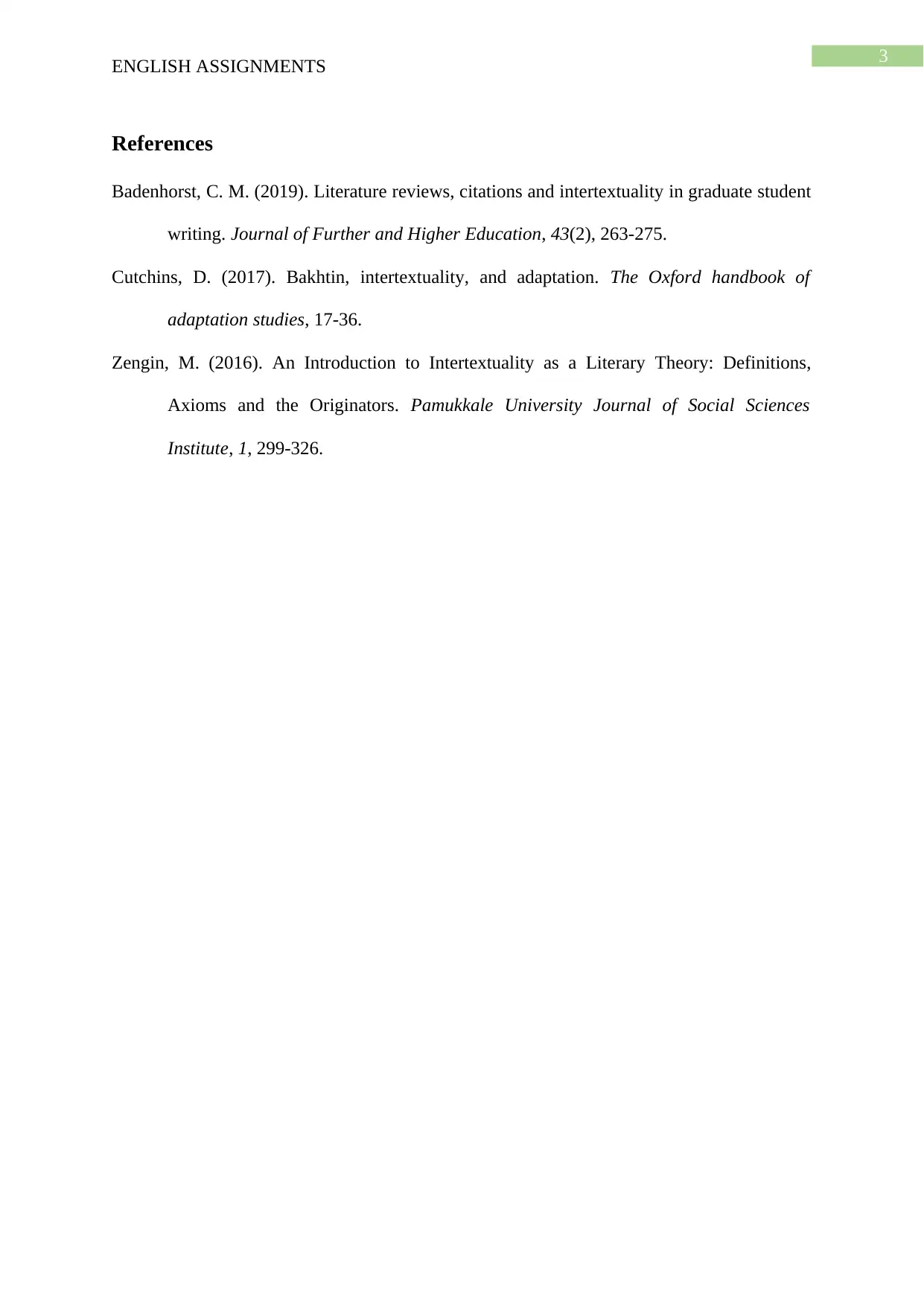
Badenhorst, C. M. (2019). Literature reviews, citations and intertextuality in graduate student
writing. Journal of Further and Higher Education, 43(2), 263-275.
Cutchins, D. (2017). Bakhtin, intertextuality, and adaptation. The Oxford handbook of
adaptation studies, 17-36.
Zengin, M. (2016). An Introduction to Intertextuality as a Literary Theory: Definitions,
Axioms and the Originators. Pamukkale University Journal of Social Sciences
Institute, 1, 299-326.
chevron_up_icon
1 out of 4
circle_padding
hide_on_mobile
zoom_out_icon
[object Object]