Leadership Development Program: A Change Management Implementation
VerifiedAdded on 2023/03/30
|8
|1580
|318
Presentation
AI Summary
This presentation paper addresses the challenge of developing and implementing an internal leadership development program within a high-tech organization. It emphasizes the importance of senior leaders understanding the change effort and involving lower-level managers in the decision-making process to mitigate resistance. Specific steps to make the change stick include engaging stakeholders, developing a change leadership team, and implementing a servant leadership model. The paper also recommends using Kotter's change model and Lewin's model to ensure successful implementation and long-term sustainability of the leadership development program, highlighting the need for clear communication, strategic vision, and consistent execution.
Running Head: PRESENTATION PAPER
Presentation paper
Student’s Name
University Name
Author’s Note
Presentation paper
Student’s Name
University Name
Author’s Note
Paraphrase This Document
Need a fresh take? Get an instant paraphrase of this document with our AI Paraphraser

2
PRESENTATION PAPER
Explain what the senior most leaders needs to understand and do to successfully implement
the change
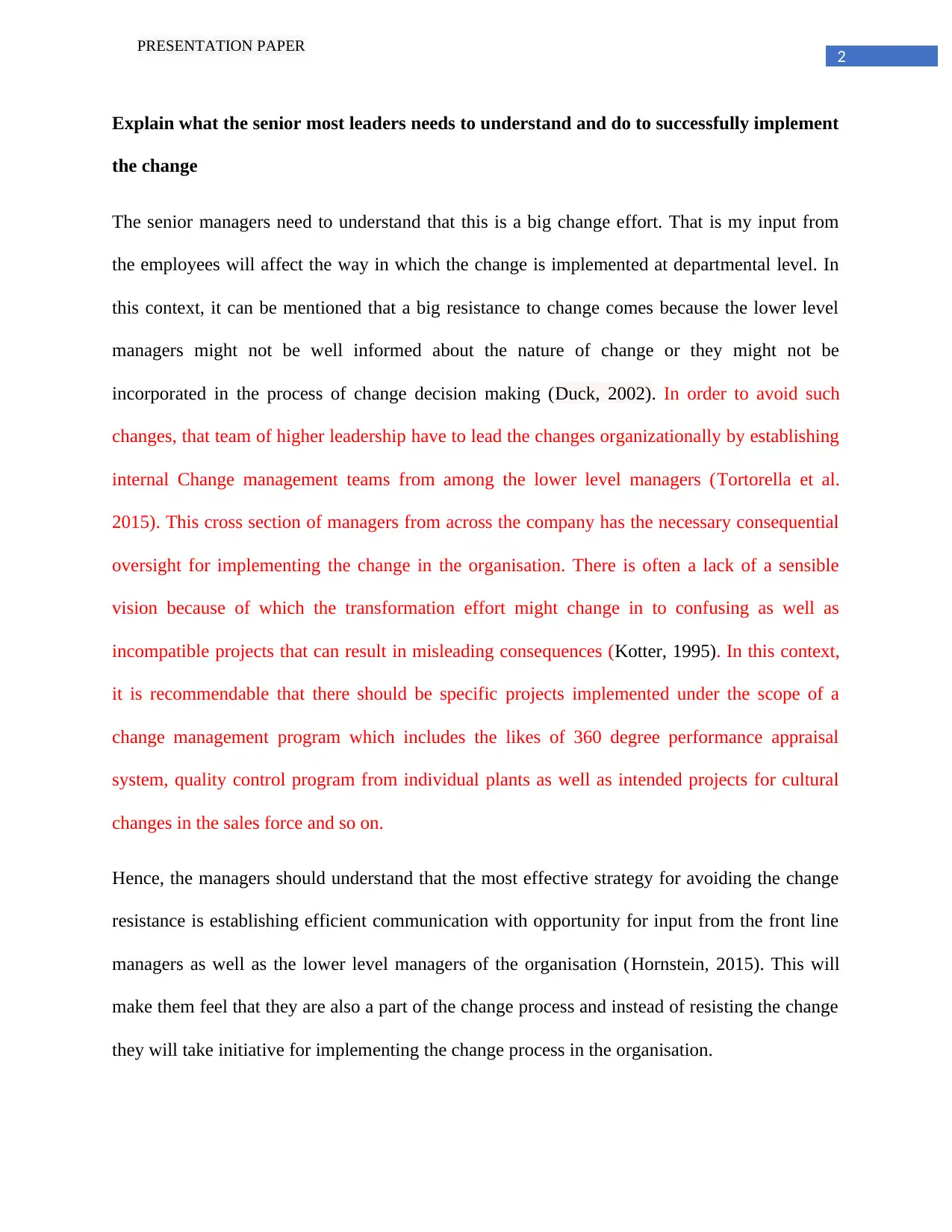
The senior managers need to understand that this is a big change effort. That is my input from
the employees will affect the way in which the change is implemented at departmental level. In
this context, it can be mentioned that a big resistance to change comes because the lower level
managers might not be well informed about the nature of change or they might not be
incorporated in the process of change decision making (Duck, 2002). In order to avoid such
changes, that team of higher leadership have to lead the changes organizationally by establishing
internal Change management teams from among the lower level managers (Tortorella et al.
2015). This cross section of managers from across the company has the necessary consequential
oversight for implementing the change in the organisation. There is often a lack of a sensible
vision because of which the transformation effort might change in to confusing as well as
incompatible projects that can result in misleading consequences (Kotter, 1995). In this context,
it is recommendable that there should be specific projects implemented under the scope of a
change management program which includes the likes of 360 degree performance appraisal
system, quality control program from individual plants as well as intended projects for cultural
changes in the sales force and so on.
Hence, the managers should understand that the most effective strategy for avoiding the change
resistance is establishing efficient communication with opportunity for input from the front line
managers as well as the lower level managers of the organisation (Hornstein, 2015). This will
make them feel that they are also a part of the change process and instead of resisting the change
they will take initiative for implementing the change process in the organisation.
PRESENTATION PAPER
Explain what the senior most leaders needs to understand and do to successfully implement
the change
The senior managers need to understand that this is a big change effort. That is my input from
the employees will affect the way in which the change is implemented at departmental level. In
this context, it can be mentioned that a big resistance to change comes because the lower level
managers might not be well informed about the nature of change or they might not be
incorporated in the process of change decision making (Duck, 2002). In order to avoid such
changes, that team of higher leadership have to lead the changes organizationally by establishing
internal Change management teams from among the lower level managers (Tortorella et al.
2015). This cross section of managers from across the company has the necessary consequential
oversight for implementing the change in the organisation. There is often a lack of a sensible
vision because of which the transformation effort might change in to confusing as well as
incompatible projects that can result in misleading consequences (Kotter, 1995). In this context,
it is recommendable that there should be specific projects implemented under the scope of a
change management program which includes the likes of 360 degree performance appraisal
system, quality control program from individual plants as well as intended projects for cultural
changes in the sales force and so on.
Hence, the managers should understand that the most effective strategy for avoiding the change
resistance is establishing efficient communication with opportunity for input from the front line
managers as well as the lower level managers of the organisation (Hornstein, 2015). This will
make them feel that they are also a part of the change process and instead of resisting the change
they will take initiative for implementing the change process in the organisation.

3
PRESENTATION PAPER
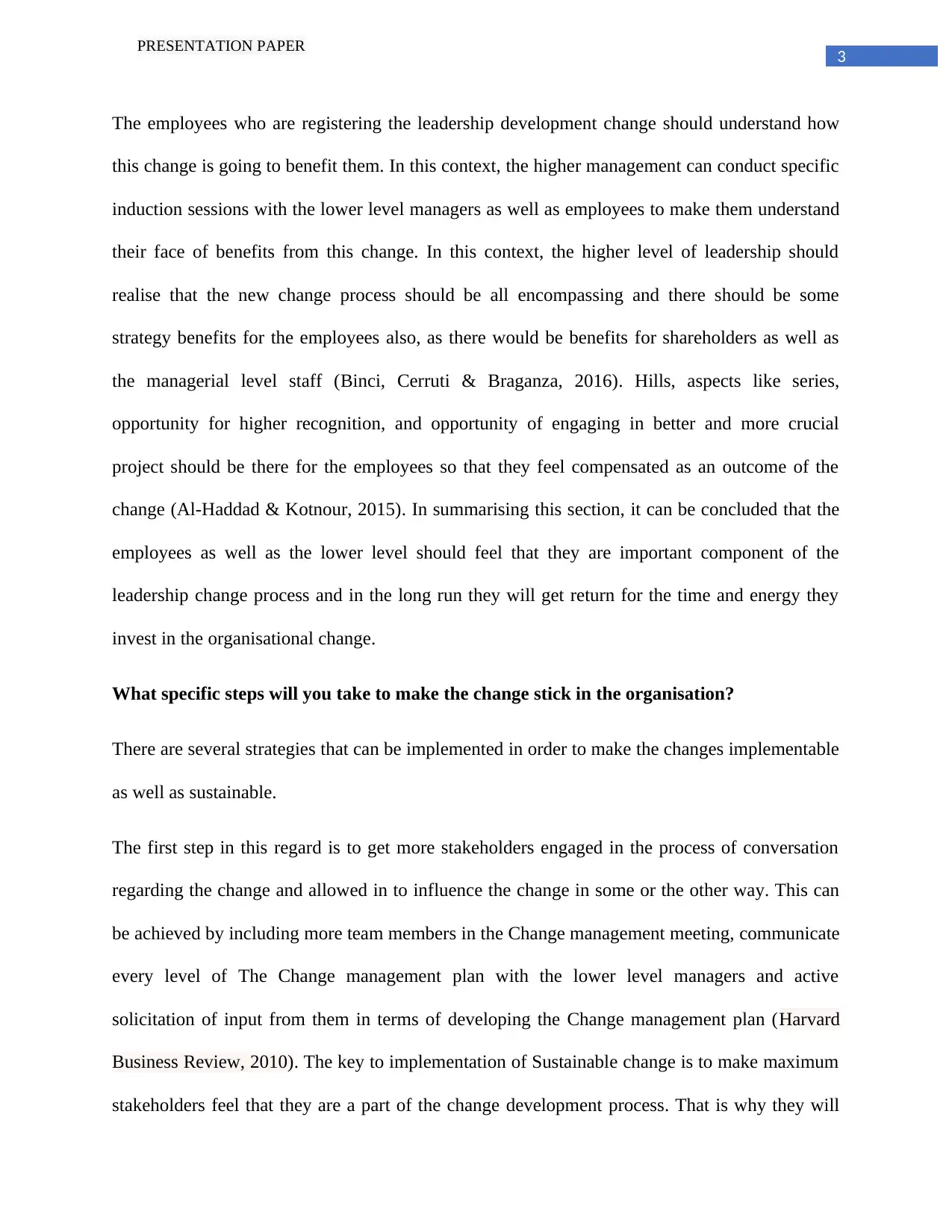
The employees who are registering the leadership development change should understand how
this change is going to benefit them. In this context, the higher management can conduct specific
induction sessions with the lower level managers as well as employees to make them understand
their face of benefits from this change. In this context, the higher level of leadership should
realise that the new change process should be all encompassing and there should be some
strategy benefits for the employees also, as there would be benefits for shareholders as well as
the managerial level staff (Binci, Cerruti & Braganza, 2016). Hills, aspects like series,
opportunity for higher recognition, and opportunity of engaging in better and more crucial
project should be there for the employees so that they feel compensated as an outcome of the
change (Al-Haddad & Kotnour, 2015). In summarising this section, it can be concluded that the
employees as well as the lower level should feel that they are important component of the
leadership change process and in the long run they will get return for the time and energy they
invest in the organisational change.
What specific steps will you take to make the change stick in the organisation?
There are several strategies that can be implemented in order to make the changes implementable
as well as sustainable.
The first step in this regard is to get more stakeholders engaged in the process of conversation
regarding the change and allowed in to influence the change in some or the other way. This can
be achieved by including more team members in the Change management meeting, communicate
every level of The Change management plan with the lower level managers and active
solicitation of input from them in terms of developing the Change management plan (Harvard
Business Review, 2010). The key to implementation of Sustainable change is to make maximum
stakeholders feel that they are a part of the change development process. That is why they will
PRESENTATION PAPER
The employees who are registering the leadership development change should understand how
this change is going to benefit them. In this context, the higher management can conduct specific
induction sessions with the lower level managers as well as employees to make them understand
their face of benefits from this change. In this context, the higher level of leadership should
realise that the new change process should be all encompassing and there should be some
strategy benefits for the employees also, as there would be benefits for shareholders as well as
the managerial level staff (Binci, Cerruti & Braganza, 2016). Hills, aspects like series,
opportunity for higher recognition, and opportunity of engaging in better and more crucial
project should be there for the employees so that they feel compensated as an outcome of the
change (Al-Haddad & Kotnour, 2015). In summarising this section, it can be concluded that the
employees as well as the lower level should feel that they are important component of the
leadership change process and in the long run they will get return for the time and energy they
invest in the organisational change.
What specific steps will you take to make the change stick in the organisation?
There are several strategies that can be implemented in order to make the changes implementable
as well as sustainable.
The first step in this regard is to get more stakeholders engaged in the process of conversation
regarding the change and allowed in to influence the change in some or the other way. This can
be achieved by including more team members in the Change management meeting, communicate
every level of The Change management plan with the lower level managers and active
solicitation of input from them in terms of developing the Change management plan (Harvard
Business Review, 2010). The key to implementation of Sustainable change is to make maximum
stakeholders feel that they are a part of the change development process. That is why they will
⊘ This is a preview!⊘
Do you want full access?
Subscribe today to unlock all pages.

Trusted by 1+ million students worldwide

4
PRESENTATION PAPER
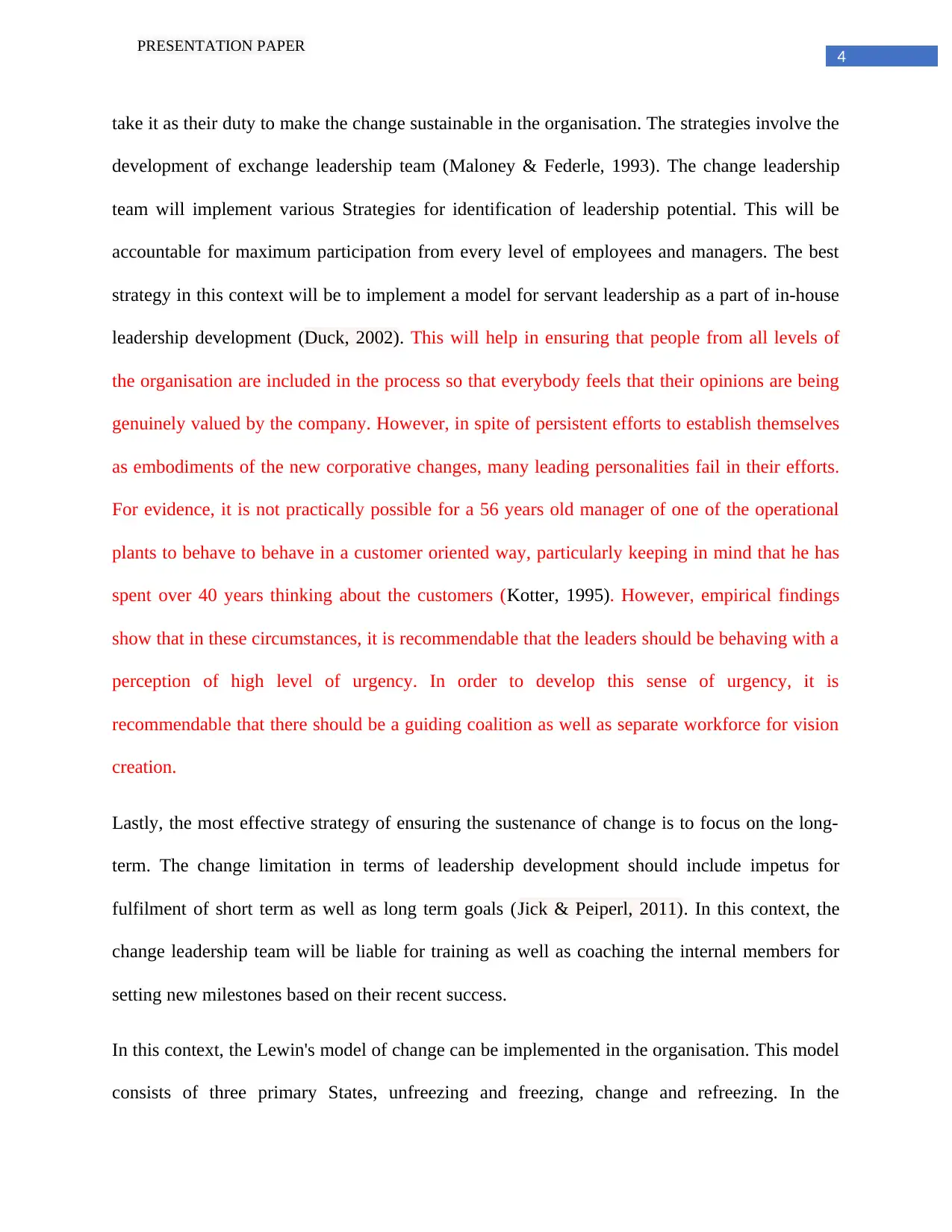
take it as their duty to make the change sustainable in the organisation. The strategies involve the
development of exchange leadership team (Maloney & Federle, 1993). The change leadership
team will implement various Strategies for identification of leadership potential. This will be
accountable for maximum participation from every level of employees and managers. The best
strategy in this context will be to implement a model for servant leadership as a part of in-house
leadership development (Duck, 2002). This will help in ensuring that people from all levels of
the organisation are included in the process so that everybody feels that their opinions are being
genuinely valued by the company. However, in spite of persistent efforts to establish themselves
as embodiments of the new corporative changes, many leading personalities fail in their efforts.
For evidence, it is not practically possible for a 56 years old manager of one of the operational
plants to behave to behave in a customer oriented way, particularly keeping in mind that he has
spent over 40 years thinking about the customers (Kotter, 1995). However, empirical findings
show that in these circumstances, it is recommendable that the leaders should be behaving with a
perception of high level of urgency. In order to develop this sense of urgency, it is
recommendable that there should be a guiding coalition as well as separate workforce for vision
creation.
Lastly, the most effective strategy of ensuring the sustenance of change is to focus on the long-
term. The change limitation in terms of leadership development should include impetus for
fulfilment of short term as well as long term goals (Jick & Peiperl, 2011). In this context, the
change leadership team will be liable for training as well as coaching the internal members for
setting new milestones based on their recent success.
In this context, the Lewin's model of change can be implemented in the organisation. This model
consists of three primary States, unfreezing and freezing, change and refreezing. In the
PRESENTATION PAPER
take it as their duty to make the change sustainable in the organisation. The strategies involve the
development of exchange leadership team (Maloney & Federle, 1993). The change leadership
team will implement various Strategies for identification of leadership potential. This will be
accountable for maximum participation from every level of employees and managers. The best
strategy in this context will be to implement a model for servant leadership as a part of in-house
leadership development (Duck, 2002). This will help in ensuring that people from all levels of
the organisation are included in the process so that everybody feels that their opinions are being
genuinely valued by the company. However, in spite of persistent efforts to establish themselves
as embodiments of the new corporative changes, many leading personalities fail in their efforts.
For evidence, it is not practically possible for a 56 years old manager of one of the operational
plants to behave to behave in a customer oriented way, particularly keeping in mind that he has
spent over 40 years thinking about the customers (Kotter, 1995). However, empirical findings
show that in these circumstances, it is recommendable that the leaders should be behaving with a
perception of high level of urgency. In order to develop this sense of urgency, it is
recommendable that there should be a guiding coalition as well as separate workforce for vision
creation.
Lastly, the most effective strategy of ensuring the sustenance of change is to focus on the long-
term. The change limitation in terms of leadership development should include impetus for
fulfilment of short term as well as long term goals (Jick & Peiperl, 2011). In this context, the
change leadership team will be liable for training as well as coaching the internal members for
setting new milestones based on their recent success.
In this context, the Lewin's model of change can be implemented in the organisation. This model
consists of three primary States, unfreezing and freezing, change and refreezing. In the
Paraphrase This Document
Need a fresh take? Get an instant paraphrase of this document with our AI Paraphraser

5
PRESENTATION PAPER
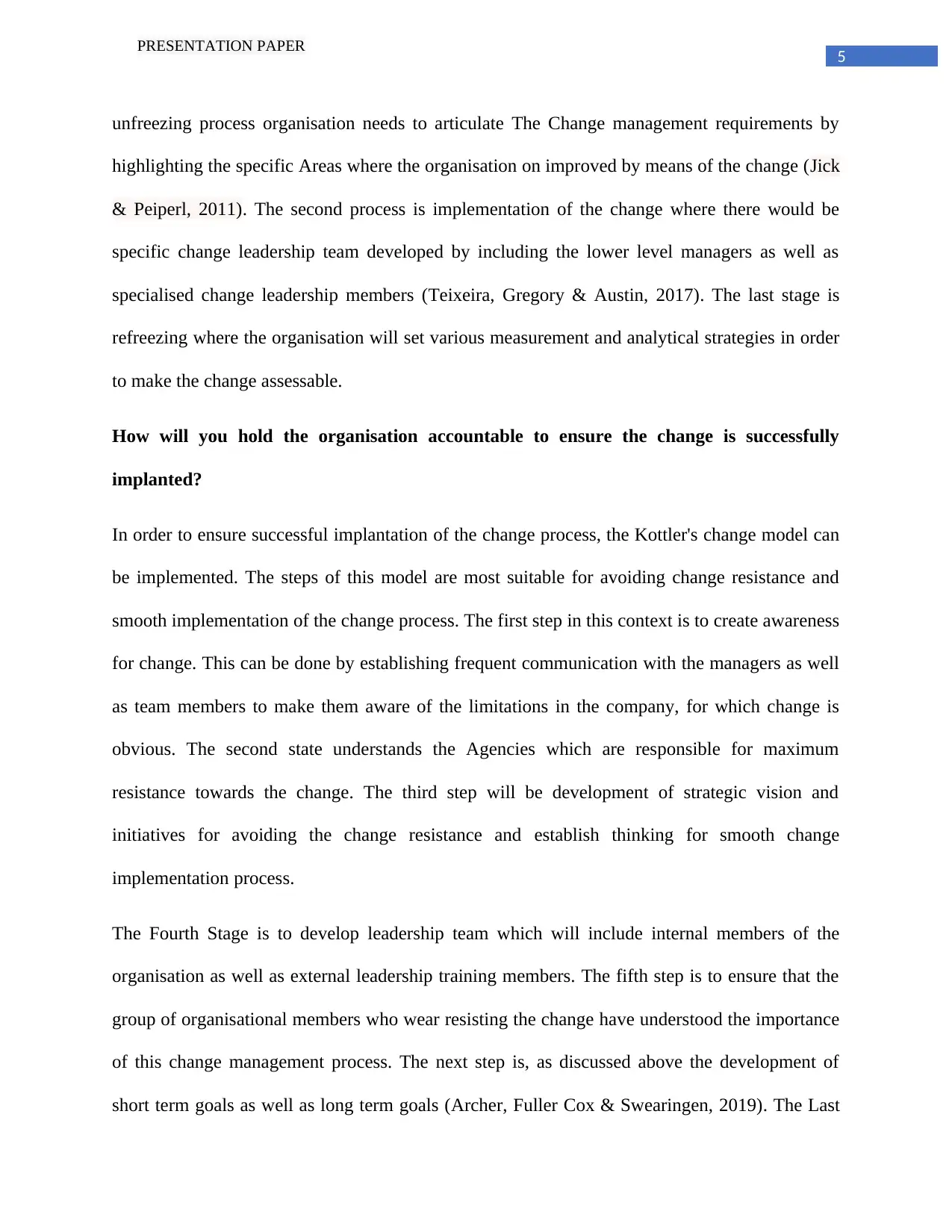
unfreezing process organisation needs to articulate The Change management requirements by
highlighting the specific Areas where the organisation on improved by means of the change (Jick
& Peiperl, 2011). The second process is implementation of the change where there would be
specific change leadership team developed by including the lower level managers as well as
specialised change leadership members (Teixeira, Gregory & Austin, 2017). The last stage is
refreezing where the organisation will set various measurement and analytical strategies in order
to make the change assessable.
How will you hold the organisation accountable to ensure the change is successfully
implanted?
In order to ensure successful implantation of the change process, the Kottler's change model can
be implemented. The steps of this model are most suitable for avoiding change resistance and
smooth implementation of the change process. The first step in this context is to create awareness
for change. This can be done by establishing frequent communication with the managers as well
as team members to make them aware of the limitations in the company, for which change is
obvious. The second state understands the Agencies which are responsible for maximum
resistance towards the change. The third step will be development of strategic vision and
initiatives for avoiding the change resistance and establish thinking for smooth change
implementation process.
The Fourth Stage is to develop leadership team which will include internal members of the
organisation as well as external leadership training members. The fifth step is to ensure that the
group of organisational members who wear resisting the change have understood the importance
of this change management process. The next step is, as discussed above the development of
short term goals as well as long term goals (Archer, Fuller Cox & Swearingen, 2019). The Last
PRESENTATION PAPER
unfreezing process organisation needs to articulate The Change management requirements by
highlighting the specific Areas where the organisation on improved by means of the change (Jick
& Peiperl, 2011). The second process is implementation of the change where there would be
specific change leadership team developed by including the lower level managers as well as
specialised change leadership members (Teixeira, Gregory & Austin, 2017). The last stage is
refreezing where the organisation will set various measurement and analytical strategies in order
to make the change assessable.
How will you hold the organisation accountable to ensure the change is successfully
implanted?
In order to ensure successful implantation of the change process, the Kottler's change model can
be implemented. The steps of this model are most suitable for avoiding change resistance and
smooth implementation of the change process. The first step in this context is to create awareness
for change. This can be done by establishing frequent communication with the managers as well
as team members to make them aware of the limitations in the company, for which change is
obvious. The second state understands the Agencies which are responsible for maximum
resistance towards the change. The third step will be development of strategic vision and
initiatives for avoiding the change resistance and establish thinking for smooth change
implementation process.
The Fourth Stage is to develop leadership team which will include internal members of the
organisation as well as external leadership training members. The fifth step is to ensure that the
group of organisational members who wear resisting the change have understood the importance
of this change management process. The next step is, as discussed above the development of
short term goals as well as long term goals (Archer, Fuller Cox & Swearingen, 2019). The Last

6
PRESENTATION PAPER
Two Steps will be ensuring a proper execution plan so that the change implementation process is
accelerated as well as properly institutionalized.
PRESENTATION PAPER
Two Steps will be ensuring a proper execution plan so that the change implementation process is
accelerated as well as properly institutionalized.
⊘ This is a preview!⊘
Do you want full access?
Subscribe today to unlock all pages.

Trusted by 1+ million students worldwide

7
PRESENTATION PAPER
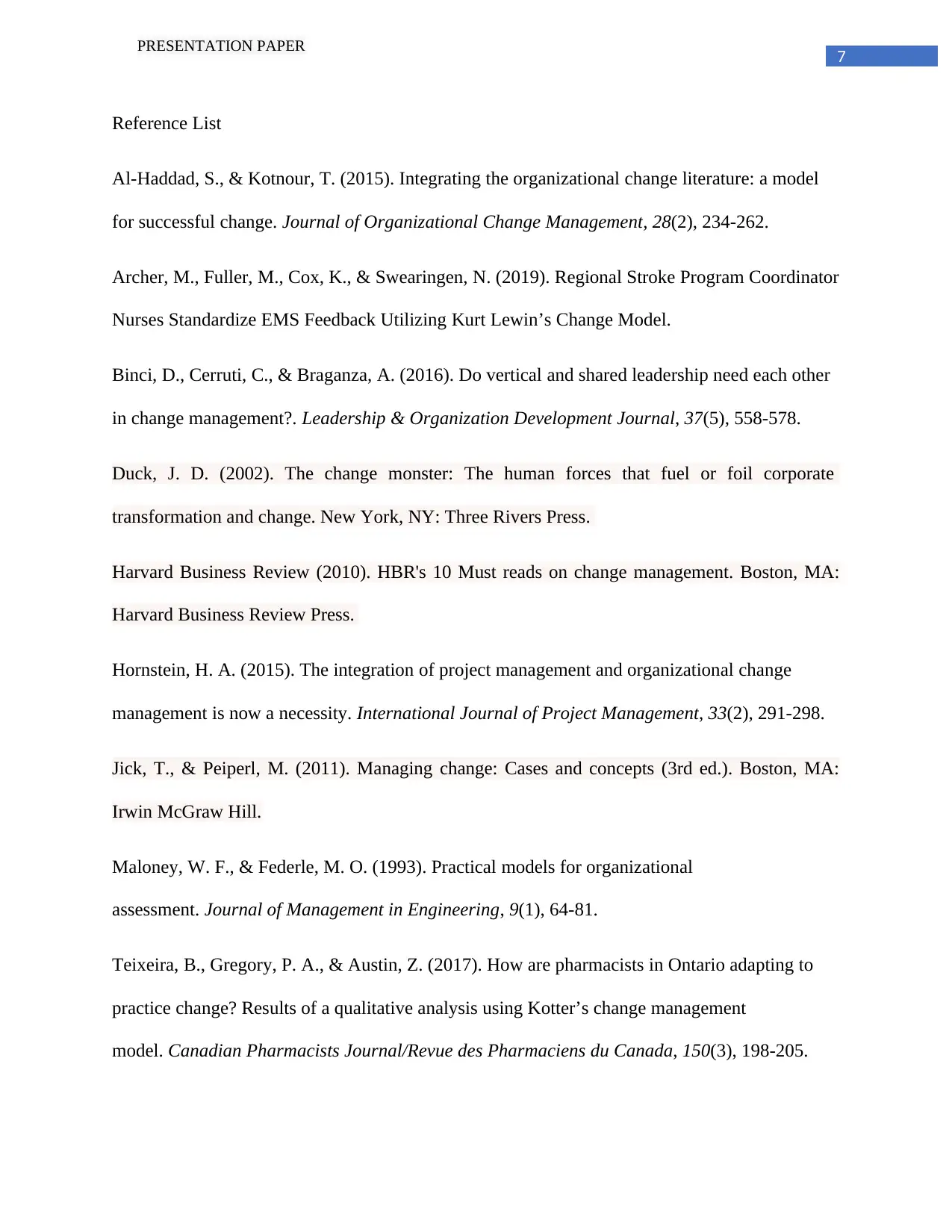
Reference List
Al-Haddad, S., & Kotnour, T. (2015). Integrating the organizational change literature: a model
for successful change. Journal of Organizational Change Management, 28(2), 234-262.
Archer, M., Fuller, M., Cox, K., & Swearingen, N. (2019). Regional Stroke Program Coordinator
Nurses Standardize EMS Feedback Utilizing Kurt Lewin’s Change Model.
Binci, D., Cerruti, C., & Braganza, A. (2016). Do vertical and shared leadership need each other
in change management?. Leadership & Organization Development Journal, 37(5), 558-578.
Duck, J. D. (2002). The change monster: The human forces that fuel or foil corporate
transformation and change. New York, NY: Three Rivers Press.
Harvard Business Review (2010). HBR's 10 Must reads on change management. Boston, MA:
Harvard Business Review Press.
Hornstein, H. A. (2015). The integration of project management and organizational change
management is now a necessity. International Journal of Project Management, 33(2), 291-298.
Jick, T., & Peiperl, M. (2011). Managing change: Cases and concepts (3rd ed.). Boston, MA:
Irwin McGraw Hill.
Maloney, W. F., & Federle, M. O. (1993). Practical models for organizational
assessment. Journal of Management in Engineering, 9(1), 64-81.
Teixeira, B., Gregory, P. A., & Austin, Z. (2017). How are pharmacists in Ontario adapting to
practice change? Results of a qualitative analysis using Kotter’s change management
model. Canadian Pharmacists Journal/Revue des Pharmaciens du Canada, 150(3), 198-205.
PRESENTATION PAPER
Reference List
Al-Haddad, S., & Kotnour, T. (2015). Integrating the organizational change literature: a model
for successful change. Journal of Organizational Change Management, 28(2), 234-262.
Archer, M., Fuller, M., Cox, K., & Swearingen, N. (2019). Regional Stroke Program Coordinator
Nurses Standardize EMS Feedback Utilizing Kurt Lewin’s Change Model.
Binci, D., Cerruti, C., & Braganza, A. (2016). Do vertical and shared leadership need each other
in change management?. Leadership & Organization Development Journal, 37(5), 558-578.
Duck, J. D. (2002). The change monster: The human forces that fuel or foil corporate
transformation and change. New York, NY: Three Rivers Press.
Harvard Business Review (2010). HBR's 10 Must reads on change management. Boston, MA:
Harvard Business Review Press.
Hornstein, H. A. (2015). The integration of project management and organizational change
management is now a necessity. International Journal of Project Management, 33(2), 291-298.
Jick, T., & Peiperl, M. (2011). Managing change: Cases and concepts (3rd ed.). Boston, MA:
Irwin McGraw Hill.
Maloney, W. F., & Federle, M. O. (1993). Practical models for organizational
assessment. Journal of Management in Engineering, 9(1), 64-81.
Teixeira, B., Gregory, P. A., & Austin, Z. (2017). How are pharmacists in Ontario adapting to
practice change? Results of a qualitative analysis using Kotter’s change management
model. Canadian Pharmacists Journal/Revue des Pharmaciens du Canada, 150(3), 198-205.
Paraphrase This Document
Need a fresh take? Get an instant paraphrase of this document with our AI Paraphraser

8
PRESENTATION PAPER
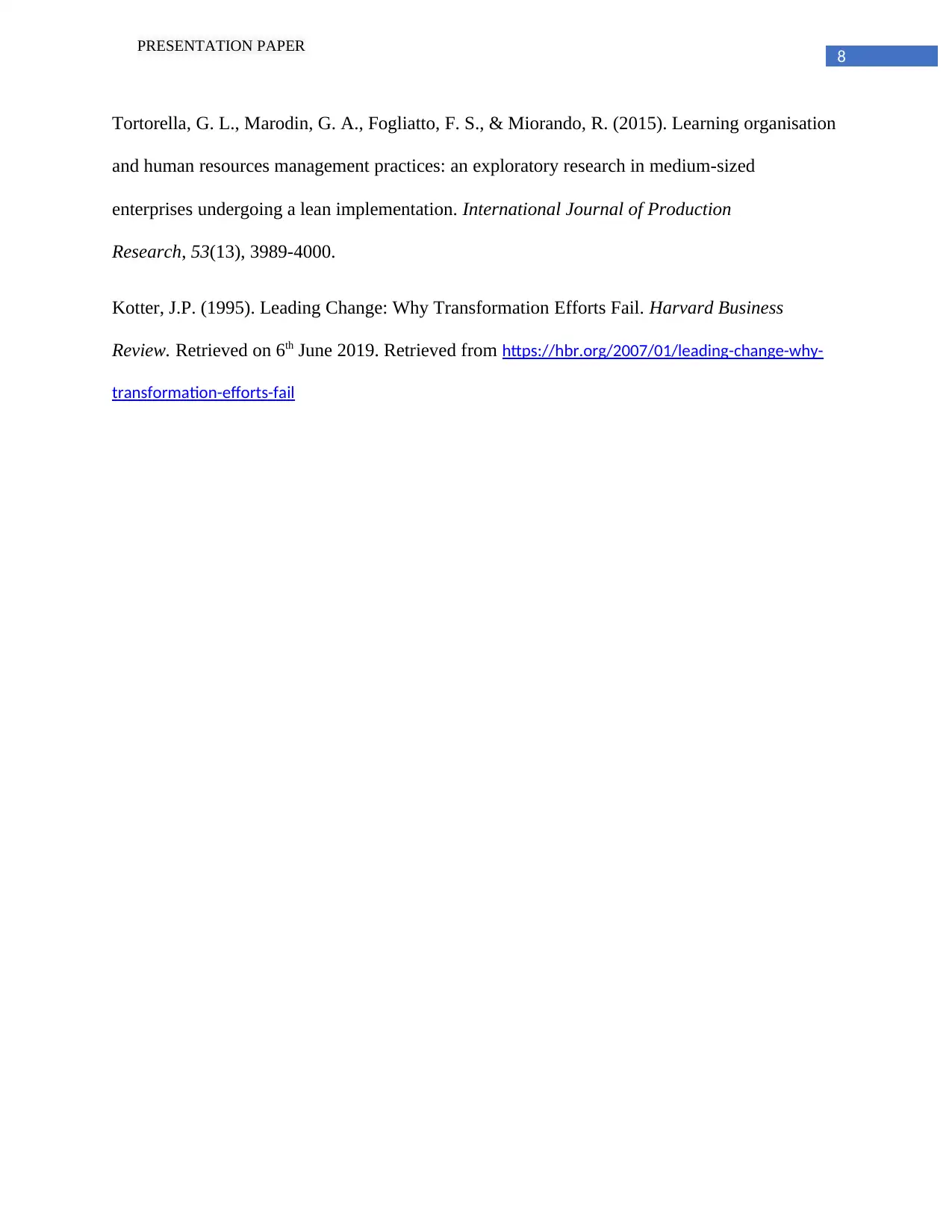
Tortorella, G. L., Marodin, G. A., Fogliatto, F. S., & Miorando, R. (2015). Learning organisation
and human resources management practices: an exploratory research in medium-sized
enterprises undergoing a lean implementation. International Journal of Production
Research, 53(13), 3989-4000.
Kotter, J.P. (1995). Leading Change: Why Transformation Efforts Fail. Harvard Business
Review. Retrieved on 6th June 2019. Retrieved from https://hbr.org/2007/01/leading-change-why-
transformation-efforts-fail
PRESENTATION PAPER
Tortorella, G. L., Marodin, G. A., Fogliatto, F. S., & Miorando, R. (2015). Learning organisation
and human resources management practices: an exploratory research in medium-sized
enterprises undergoing a lean implementation. International Journal of Production
Research, 53(13), 3989-4000.
Kotter, J.P. (1995). Leading Change: Why Transformation Efforts Fail. Harvard Business
Review. Retrieved on 6th June 2019. Retrieved from https://hbr.org/2007/01/leading-change-why-
transformation-efforts-fail
1 out of 8
Related Documents
Your All-in-One AI-Powered Toolkit for Academic Success.
+13062052269
info@desklib.com
Available 24*7 on WhatsApp / Email
Unlock your academic potential
Copyright © 2020–2026 A2Z Services. All Rights Reserved. Developed and managed by ZUCOL.