Analyzing Health Research Methods: Examples and Recommendations
VerifiedAdded on 2020/02/24
|13
|2888
|308
Homework Assignment
AI Summary
This assignment analyzes two examples of health research methods, focusing on study design, research questions, hypotheses, sampling techniques, data collection, and ethical considerations. The first example examines the impact of energy-dense drinks on malnutrition in children using a cross-sectional study. The second example investigates the effects of a supplementary-meal drink on the wellbeing of obese Indian females through a double-blind randomized controlled trial. The analysis evaluates the strengths and weaknesses of each study, including the clarity of the research questions, appropriateness of the methodology, and ethical concerns. The assignment also provides recommendations for improving the research designs, particularly in areas such as aligning the study duration with the research hypotheses, clarifying selection criteria, and addressing gaps in knowledge. The goal is to provide a comprehensive understanding of the principles and practices of effective health research.
Running head: HEALTH RESEARCH METHOD
HEALTH RESEARCH METHOD
[Author Name(s), First M. Last, Omit Titles and Degrees]
[Institutional Affiliation(s)]
HEALTH RESEARCH METHOD
[Author Name(s), First M. Last, Omit Titles and Degrees]
[Institutional Affiliation(s)]

Paraphrase This Document
Need a fresh take? Get an instant paraphrase of this document with our AI Paraphraser
2
HEALTH RESEARCH METHOD
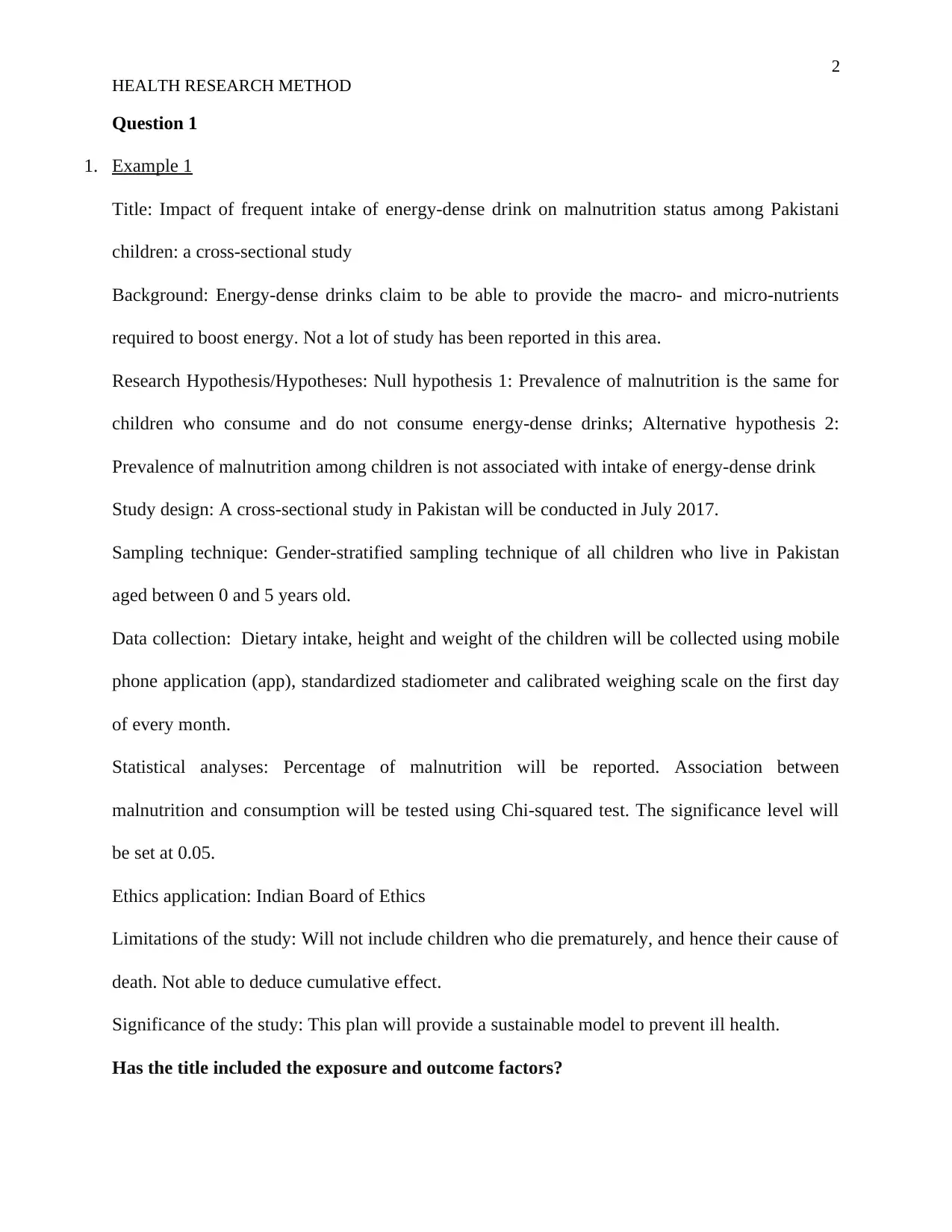
Question 1
1. Example 1
Title: Impact of frequent intake of energy-dense drink on malnutrition status among Pakistani
children: a cross-sectional study
Background: Energy-dense drinks claim to be able to provide the macro- and micro-nutrients
required to boost energy. Not a lot of study has been reported in this area.
Research Hypothesis/Hypotheses: Null hypothesis 1: Prevalence of malnutrition is the same for
children who consume and do not consume energy-dense drinks; Alternative hypothesis 2:
Prevalence of malnutrition among children is not associated with intake of energy-dense drink
Study design: A cross-sectional study in Pakistan will be conducted in July 2017.
Sampling technique: Gender-stratified sampling technique of all children who live in Pakistan
aged between 0 and 5 years old.
Data collection: Dietary intake, height and weight of the children will be collected using mobile
phone application (app), standardized stadiometer and calibrated weighing scale on the first day
of every month.
Statistical analyses: Percentage of malnutrition will be reported. Association between
malnutrition and consumption will be tested using Chi-squared test. The significance level will
be set at 0.05.
Ethics application: Indian Board of Ethics
Limitations of the study: Will not include children who die prematurely, and hence their cause of
death. Not able to deduce cumulative effect.
Significance of the study: This plan will provide a sustainable model to prevent ill health.
Has the title included the exposure and outcome factors?
HEALTH RESEARCH METHOD
Question 1
1. Example 1
Title: Impact of frequent intake of energy-dense drink on malnutrition status among Pakistani
children: a cross-sectional study
Background: Energy-dense drinks claim to be able to provide the macro- and micro-nutrients
required to boost energy. Not a lot of study has been reported in this area.
Research Hypothesis/Hypotheses: Null hypothesis 1: Prevalence of malnutrition is the same for
children who consume and do not consume energy-dense drinks; Alternative hypothesis 2:
Prevalence of malnutrition among children is not associated with intake of energy-dense drink
Study design: A cross-sectional study in Pakistan will be conducted in July 2017.
Sampling technique: Gender-stratified sampling technique of all children who live in Pakistan
aged between 0 and 5 years old.
Data collection: Dietary intake, height and weight of the children will be collected using mobile
phone application (app), standardized stadiometer and calibrated weighing scale on the first day
of every month.
Statistical analyses: Percentage of malnutrition will be reported. Association between
malnutrition and consumption will be tested using Chi-squared test. The significance level will
be set at 0.05.
Ethics application: Indian Board of Ethics
Limitations of the study: Will not include children who die prematurely, and hence their cause of
death. Not able to deduce cumulative effect.
Significance of the study: This plan will provide a sustainable model to prevent ill health.
Has the title included the exposure and outcome factors?
3
HEALTH RESEARCH METHOD
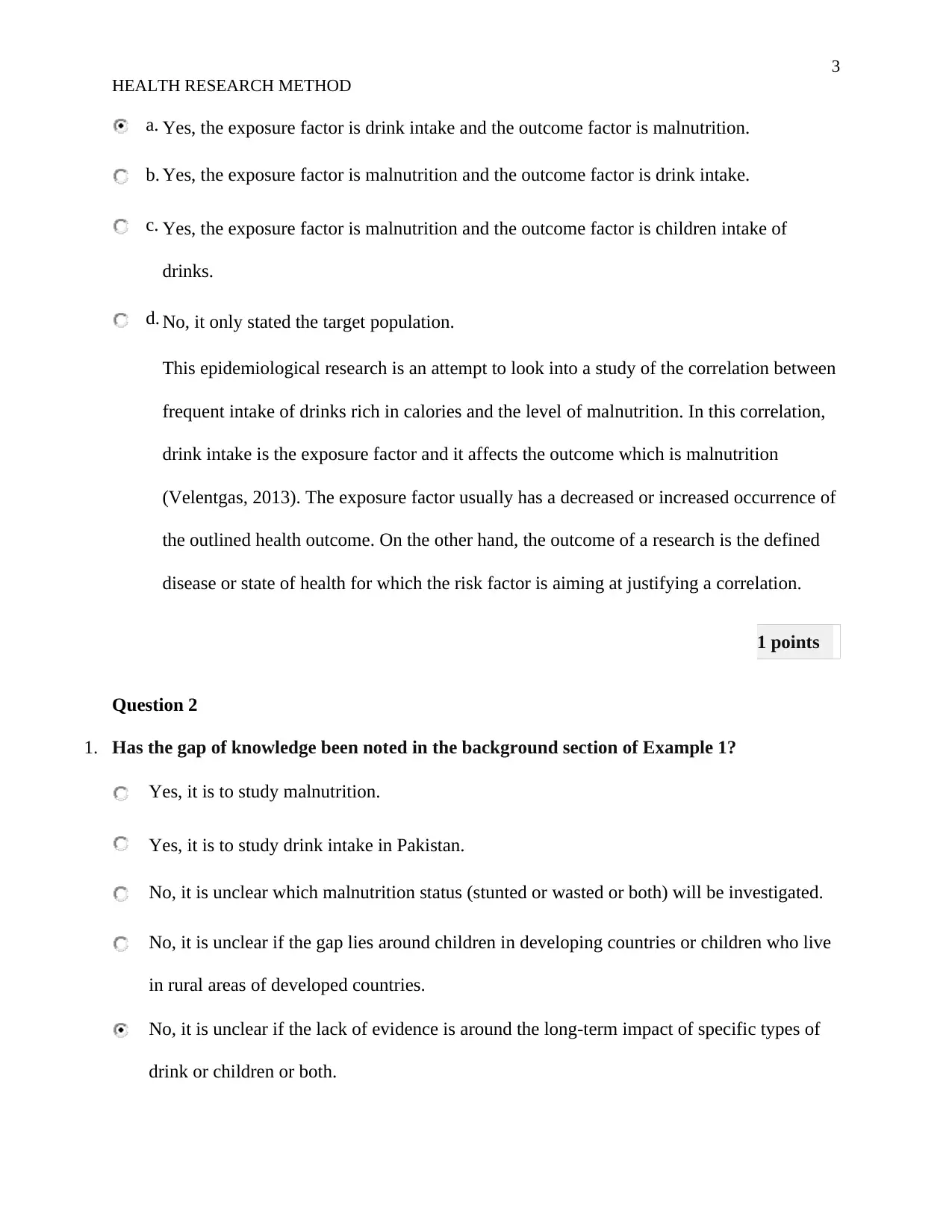
a. Yes, the exposure factor is drink intake and the outcome factor is malnutrition.
b. Yes, the exposure factor is malnutrition and the outcome factor is drink intake.
c. Yes, the exposure factor is malnutrition and the outcome factor is children intake of
drinks.
d. No, it only stated the target population.
This epidemiological research is an attempt to look into a study of the correlation between
frequent intake of drinks rich in calories and the level of malnutrition. In this correlation,
drink intake is the exposure factor and it affects the outcome which is malnutrition
(Velentgas, 2013). The exposure factor usually has a decreased or increased occurrence of
the outlined health outcome. On the other hand, the outcome of a research is the defined
disease or state of health for which the risk factor is aiming at justifying a correlation.
1 points
Question 2
1. Has the gap of knowledge been noted in the background section of Example 1?
Yes, it is to study malnutrition.
Yes, it is to study drink intake in Pakistan.
No, it is unclear which malnutrition status (stunted or wasted or both) will be investigated.
No, it is unclear if the gap lies around children in developing countries or children who live
in rural areas of developed countries.
No, it is unclear if the lack of evidence is around the long-term impact of specific types of
drink or children or both.
HEALTH RESEARCH METHOD
a. Yes, the exposure factor is drink intake and the outcome factor is malnutrition.
b. Yes, the exposure factor is malnutrition and the outcome factor is drink intake.
c. Yes, the exposure factor is malnutrition and the outcome factor is children intake of
drinks.
d. No, it only stated the target population.
This epidemiological research is an attempt to look into a study of the correlation between
frequent intake of drinks rich in calories and the level of malnutrition. In this correlation,
drink intake is the exposure factor and it affects the outcome which is malnutrition
(Velentgas, 2013). The exposure factor usually has a decreased or increased occurrence of
the outlined health outcome. On the other hand, the outcome of a research is the defined
disease or state of health for which the risk factor is aiming at justifying a correlation.
1 points
Question 2
1. Has the gap of knowledge been noted in the background section of Example 1?
Yes, it is to study malnutrition.
Yes, it is to study drink intake in Pakistan.
No, it is unclear which malnutrition status (stunted or wasted or both) will be investigated.
No, it is unclear if the gap lies around children in developing countries or children who live
in rural areas of developed countries.
No, it is unclear if the lack of evidence is around the long-term impact of specific types of
drink or children or both.
⊘ This is a preview!⊘
Do you want full access?
Subscribe today to unlock all pages.

Trusted by 1+ million students worldwide
4
HEALTH RESEARCH METHOD
The background information provided in this study is seemingly to broad and thus not
specific on the aim of the research. There is need to narrow down the background to a
categorical problem. There are numerous types of energy drinks some of which are not even
usable by children. A background should have a detailed explanation of the study to outline
the context of the problem. It should as well give a slight history of the problem including
any preceding attempts to address it (Macnee, 2015).
1 points
Question 3
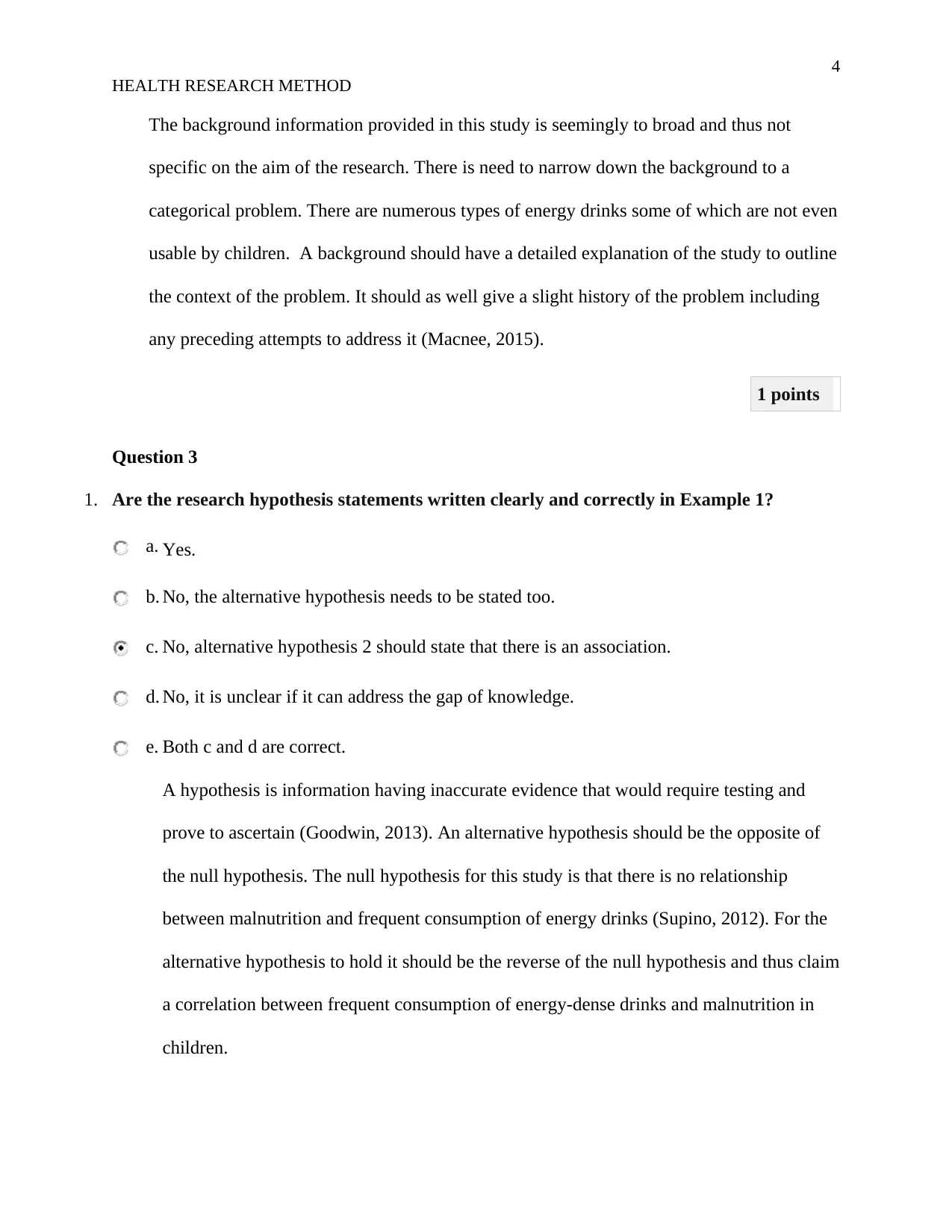
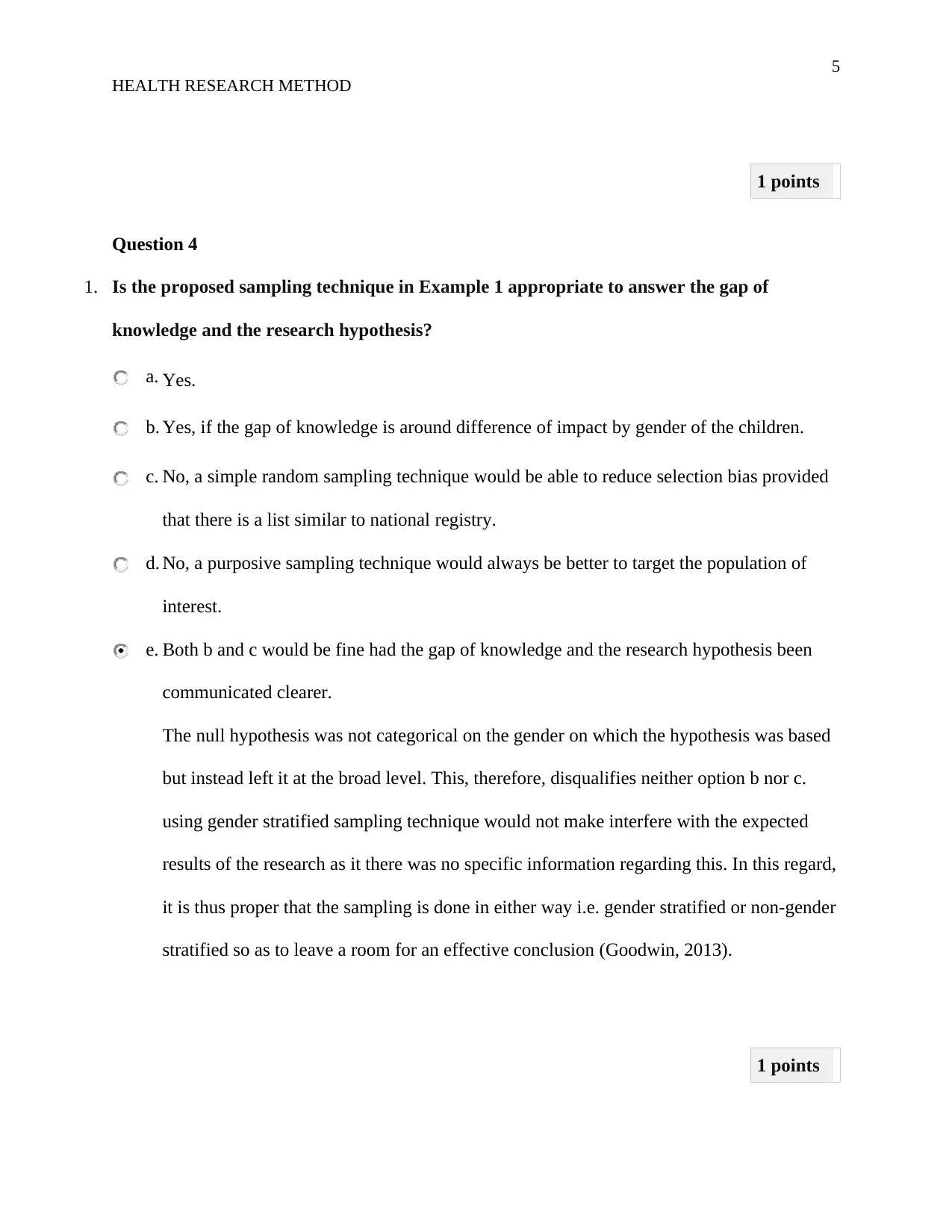
1. Are the research hypothesis statements written clearly and correctly in Example 1?
a. Yes.
b. No, the alternative hypothesis needs to be stated too.
c. No, alternative hypothesis 2 should state that there is an association.
d. No, it is unclear if it can address the gap of knowledge.
e. Both c and d are correct.
A hypothesis is information having inaccurate evidence that would require testing and
prove to ascertain (Goodwin, 2013). An alternative hypothesis should be the opposite of
the null hypothesis. The null hypothesis for this study is that there is no relationship
between malnutrition and frequent consumption of energy drinks (Supino, 2012). For the
alternative hypothesis to hold it should be the reverse of the null hypothesis and thus claim
a correlation between frequent consumption of energy-dense drinks and malnutrition in
children.
HEALTH RESEARCH METHOD
The background information provided in this study is seemingly to broad and thus not
specific on the aim of the research. There is need to narrow down the background to a
categorical problem. There are numerous types of energy drinks some of which are not even
usable by children. A background should have a detailed explanation of the study to outline
the context of the problem. It should as well give a slight history of the problem including
any preceding attempts to address it (Macnee, 2015).
1 points
Question 3
1. Are the research hypothesis statements written clearly and correctly in Example 1?
a. Yes.
b. No, the alternative hypothesis needs to be stated too.
c. No, alternative hypothesis 2 should state that there is an association.
d. No, it is unclear if it can address the gap of knowledge.
e. Both c and d are correct.
A hypothesis is information having inaccurate evidence that would require testing and
prove to ascertain (Goodwin, 2013). An alternative hypothesis should be the opposite of
the null hypothesis. The null hypothesis for this study is that there is no relationship
between malnutrition and frequent consumption of energy drinks (Supino, 2012). For the
alternative hypothesis to hold it should be the reverse of the null hypothesis and thus claim
a correlation between frequent consumption of energy-dense drinks and malnutrition in
children.
Paraphrase This Document
Need a fresh take? Get an instant paraphrase of this document with our AI Paraphraser
5
HEALTH RESEARCH METHOD
1 points
Question 4
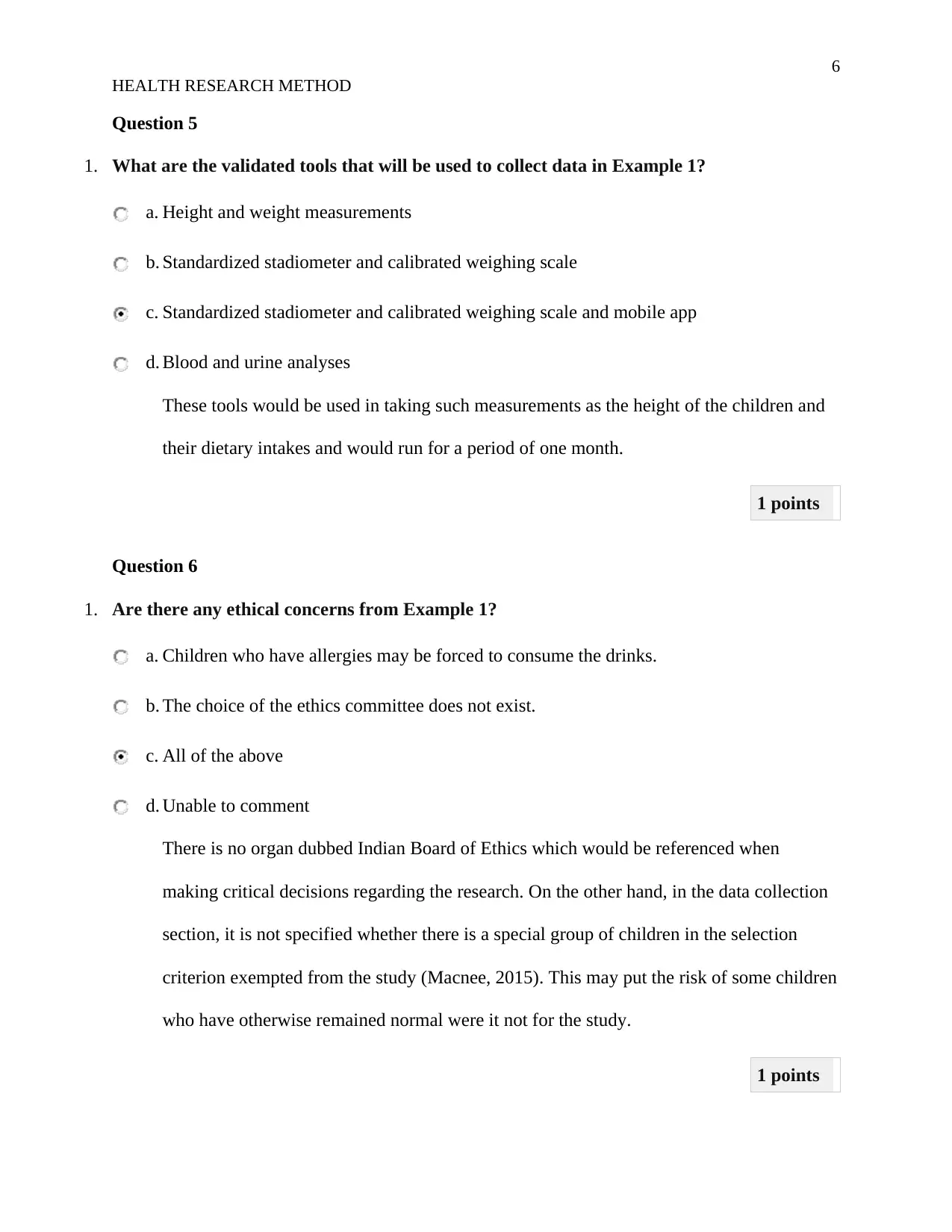
1. Is the proposed sampling technique in Example 1 appropriate to answer the gap of
knowledge and the research hypothesis?
a. Yes.
b. Yes, if the gap of knowledge is around difference of impact by gender of the children.
c. No, a simple random sampling technique would be able to reduce selection bias provided
that there is a list similar to national registry.
d. No, a purposive sampling technique would always be better to target the population of
interest.
e. Both b and c would be fine had the gap of knowledge and the research hypothesis been
communicated clearer.
The null hypothesis was not categorical on the gender on which the hypothesis was based
but instead left it at the broad level. This, therefore, disqualifies neither option b nor c.
using gender stratified sampling technique would not make interfere with the expected
results of the research as it there was no specific information regarding this. In this regard,
it is thus proper that the sampling is done in either way i.e. gender stratified or non-gender
stratified so as to leave a room for an effective conclusion (Goodwin, 2013).
1 points
HEALTH RESEARCH METHOD
1 points
Question 4
1. Is the proposed sampling technique in Example 1 appropriate to answer the gap of
knowledge and the research hypothesis?
a. Yes.
b. Yes, if the gap of knowledge is around difference of impact by gender of the children.
c. No, a simple random sampling technique would be able to reduce selection bias provided
that there is a list similar to national registry.
d. No, a purposive sampling technique would always be better to target the population of
interest.
e. Both b and c would be fine had the gap of knowledge and the research hypothesis been
communicated clearer.
The null hypothesis was not categorical on the gender on which the hypothesis was based
but instead left it at the broad level. This, therefore, disqualifies neither option b nor c.
using gender stratified sampling technique would not make interfere with the expected
results of the research as it there was no specific information regarding this. In this regard,
it is thus proper that the sampling is done in either way i.e. gender stratified or non-gender
stratified so as to leave a room for an effective conclusion (Goodwin, 2013).
1 points
6
HEALTH RESEARCH METHOD
Question 5
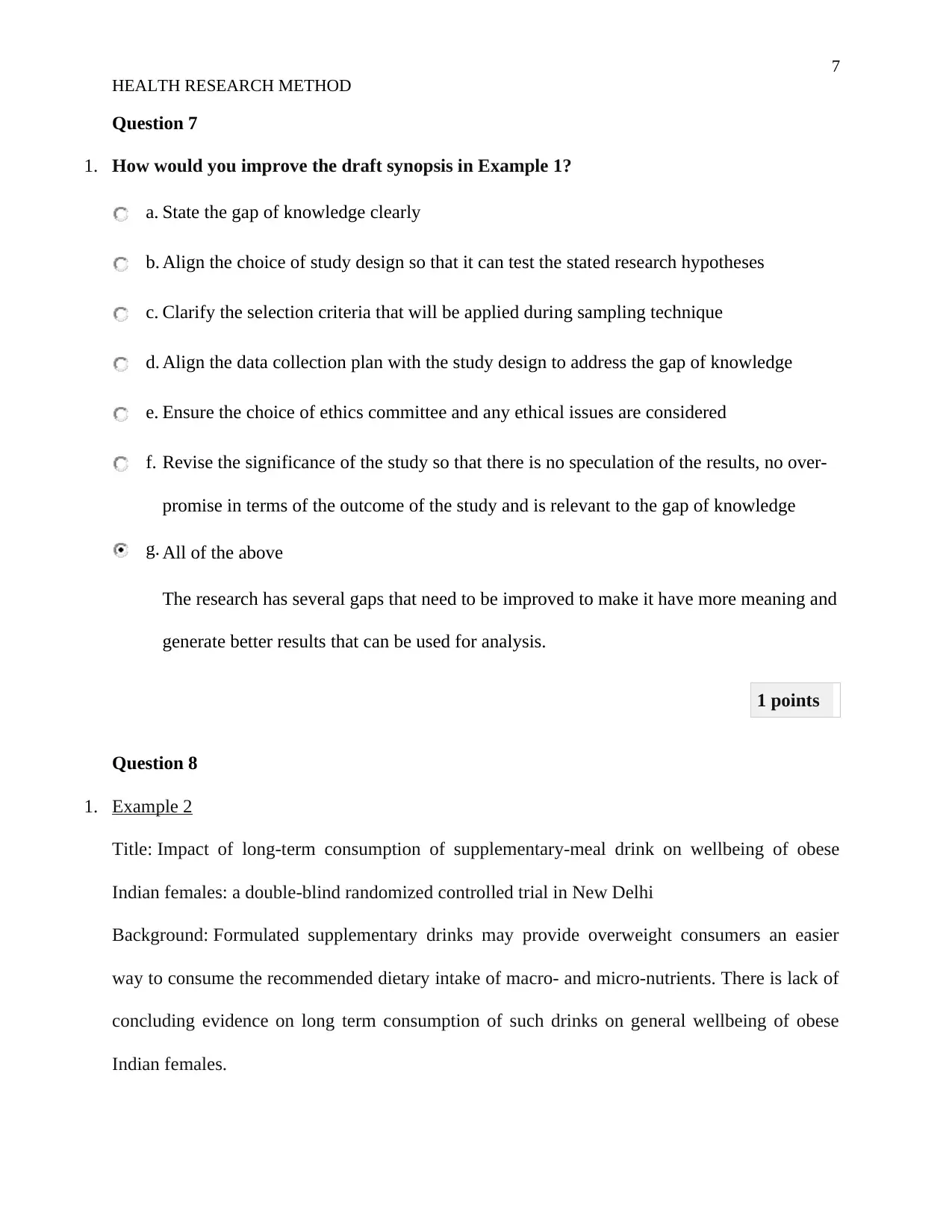
1. What are the validated tools that will be used to collect data in Example 1?
a. Height and weight measurements
b. Standardized stadiometer and calibrated weighing scale
c. Standardized stadiometer and calibrated weighing scale and mobile app
d. Blood and urine analyses
These tools would be used in taking such measurements as the height of the children and
their dietary intakes and would run for a period of one month.
1 points
Question 6
1. Are there any ethical concerns from Example 1?
a. Children who have allergies may be forced to consume the drinks.
b. The choice of the ethics committee does not exist.
c. All of the above
d. Unable to comment
There is no organ dubbed Indian Board of Ethics which would be referenced when
making critical decisions regarding the research. On the other hand, in the data collection
section, it is not specified whether there is a special group of children in the selection
criterion exempted from the study (Macnee, 2015). This may put the risk of some children
who have otherwise remained normal were it not for the study.
1 points
HEALTH RESEARCH METHOD
Question 5
1. What are the validated tools that will be used to collect data in Example 1?
a. Height and weight measurements
b. Standardized stadiometer and calibrated weighing scale
c. Standardized stadiometer and calibrated weighing scale and mobile app
d. Blood and urine analyses
These tools would be used in taking such measurements as the height of the children and
their dietary intakes and would run for a period of one month.
1 points
Question 6
1. Are there any ethical concerns from Example 1?
a. Children who have allergies may be forced to consume the drinks.
b. The choice of the ethics committee does not exist.
c. All of the above
d. Unable to comment
There is no organ dubbed Indian Board of Ethics which would be referenced when
making critical decisions regarding the research. On the other hand, in the data collection
section, it is not specified whether there is a special group of children in the selection
criterion exempted from the study (Macnee, 2015). This may put the risk of some children
who have otherwise remained normal were it not for the study.
1 points
⊘ This is a preview!⊘
Do you want full access?
Subscribe today to unlock all pages.
Trusted by 1+ million students worldwide
7
HEALTH RESEARCH METHOD
Question 7
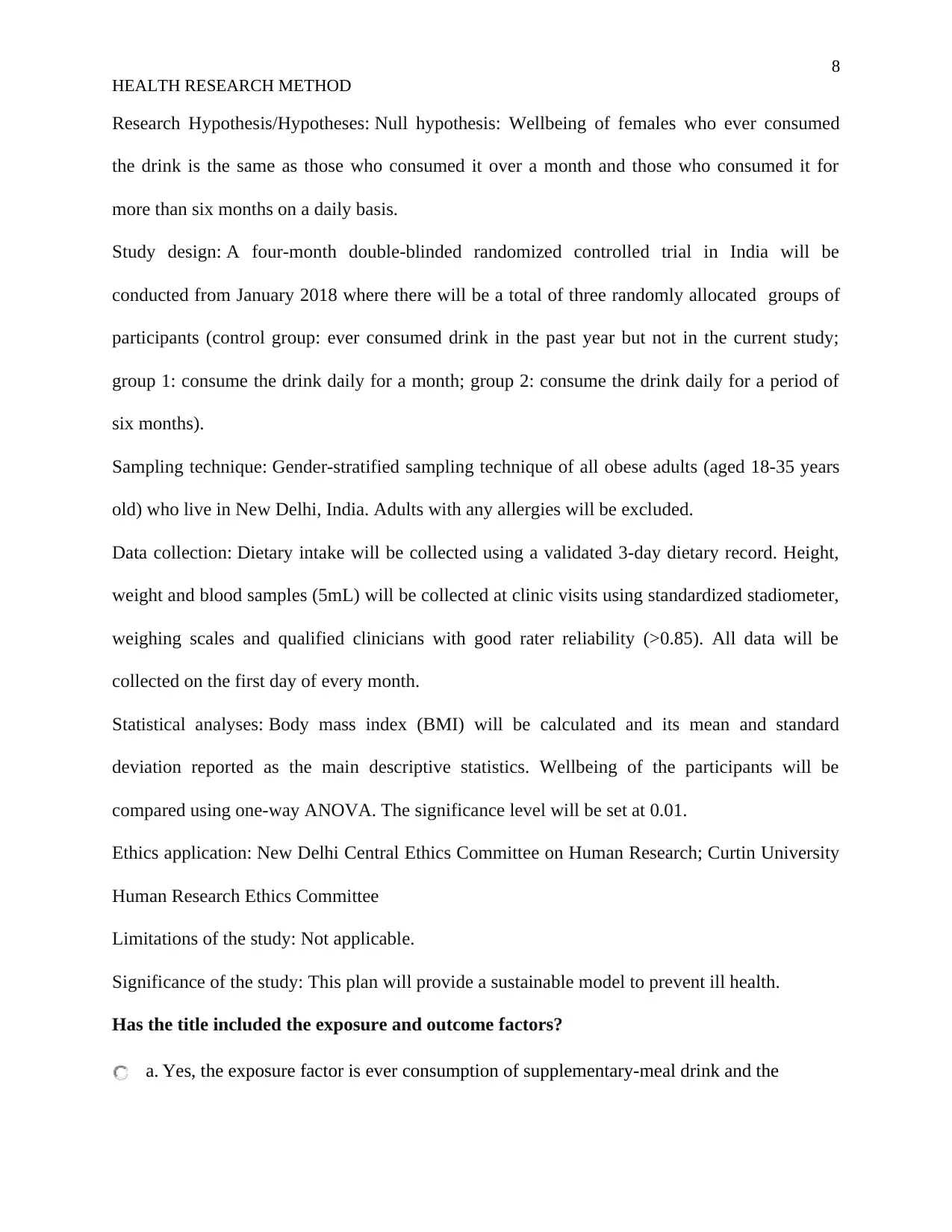
1. How would you improve the draft synopsis in Example 1?
a. State the gap of knowledge clearly
b. Align the choice of study design so that it can test the stated research hypotheses
c. Clarify the selection criteria that will be applied during sampling technique
d. Align the data collection plan with the study design to address the gap of knowledge
e. Ensure the choice of ethics committee and any ethical issues are considered
f. Revise the significance of the study so that there is no speculation of the results, no over-
promise in terms of the outcome of the study and is relevant to the gap of knowledge
g. All of the above
The research has several gaps that need to be improved to make it have more meaning and
generate better results that can be used for analysis.
1 points
Question 8
1. Example 2
Title: Impact of long-term consumption of supplementary-meal drink on wellbeing of obese
Indian females: a double-blind randomized controlled trial in New Delhi
Background: Formulated supplementary drinks may provide overweight consumers an easier
way to consume the recommended dietary intake of macro- and micro-nutrients. There is lack of
concluding evidence on long term consumption of such drinks on general wellbeing of obese
Indian females.
HEALTH RESEARCH METHOD
Question 7
1. How would you improve the draft synopsis in Example 1?
a. State the gap of knowledge clearly
b. Align the choice of study design so that it can test the stated research hypotheses
c. Clarify the selection criteria that will be applied during sampling technique
d. Align the data collection plan with the study design to address the gap of knowledge
e. Ensure the choice of ethics committee and any ethical issues are considered
f. Revise the significance of the study so that there is no speculation of the results, no over-
promise in terms of the outcome of the study and is relevant to the gap of knowledge
g. All of the above
The research has several gaps that need to be improved to make it have more meaning and
generate better results that can be used for analysis.
1 points
Question 8
1. Example 2
Title: Impact of long-term consumption of supplementary-meal drink on wellbeing of obese
Indian females: a double-blind randomized controlled trial in New Delhi
Background: Formulated supplementary drinks may provide overweight consumers an easier
way to consume the recommended dietary intake of macro- and micro-nutrients. There is lack of
concluding evidence on long term consumption of such drinks on general wellbeing of obese
Indian females.
Paraphrase This Document
Need a fresh take? Get an instant paraphrase of this document with our AI Paraphraser
8
HEALTH RESEARCH METHOD
Research Hypothesis/Hypotheses: Null hypothesis: Wellbeing of females who ever consumed
the drink is the same as those who consumed it over a month and those who consumed it for
more than six months on a daily basis.
Study design: A four-month double-blinded randomized controlled trial in India will be
conducted from January 2018 where there will be a total of three randomly allocated groups of
participants (control group: ever consumed drink in the past year but not in the current study;
group 1: consume the drink daily for a month; group 2: consume the drink daily for a period of
six months).
Sampling technique: Gender-stratified sampling technique of all obese adults (aged 18-35 years
old) who live in New Delhi, India. Adults with any allergies will be excluded.
Data collection: Dietary intake will be collected using a validated 3-day dietary record. Height,
weight and blood samples (5mL) will be collected at clinic visits using standardized stadiometer,
weighing scales and qualified clinicians with good rater reliability (>0.85). All data will be
collected on the first day of every month.
Statistical analyses: Body mass index (BMI) will be calculated and its mean and standard
deviation reported as the main descriptive statistics. Wellbeing of the participants will be
compared using one-way ANOVA. The significance level will be set at 0.01.
Ethics application: New Delhi Central Ethics Committee on Human Research; Curtin University
Human Research Ethics Committee
Limitations of the study: Not applicable.
Significance of the study: This plan will provide a sustainable model to prevent ill health.
Has the title included the exposure and outcome factors?
a. Yes, the exposure factor is ever consumption of supplementary-meal drink and the
HEALTH RESEARCH METHOD
Research Hypothesis/Hypotheses: Null hypothesis: Wellbeing of females who ever consumed
the drink is the same as those who consumed it over a month and those who consumed it for
more than six months on a daily basis.
Study design: A four-month double-blinded randomized controlled trial in India will be
conducted from January 2018 where there will be a total of three randomly allocated groups of
participants (control group: ever consumed drink in the past year but not in the current study;
group 1: consume the drink daily for a month; group 2: consume the drink daily for a period of
six months).
Sampling technique: Gender-stratified sampling technique of all obese adults (aged 18-35 years
old) who live in New Delhi, India. Adults with any allergies will be excluded.
Data collection: Dietary intake will be collected using a validated 3-day dietary record. Height,
weight and blood samples (5mL) will be collected at clinic visits using standardized stadiometer,
weighing scales and qualified clinicians with good rater reliability (>0.85). All data will be
collected on the first day of every month.
Statistical analyses: Body mass index (BMI) will be calculated and its mean and standard
deviation reported as the main descriptive statistics. Wellbeing of the participants will be
compared using one-way ANOVA. The significance level will be set at 0.01.
Ethics application: New Delhi Central Ethics Committee on Human Research; Curtin University
Human Research Ethics Committee
Limitations of the study: Not applicable.
Significance of the study: This plan will provide a sustainable model to prevent ill health.
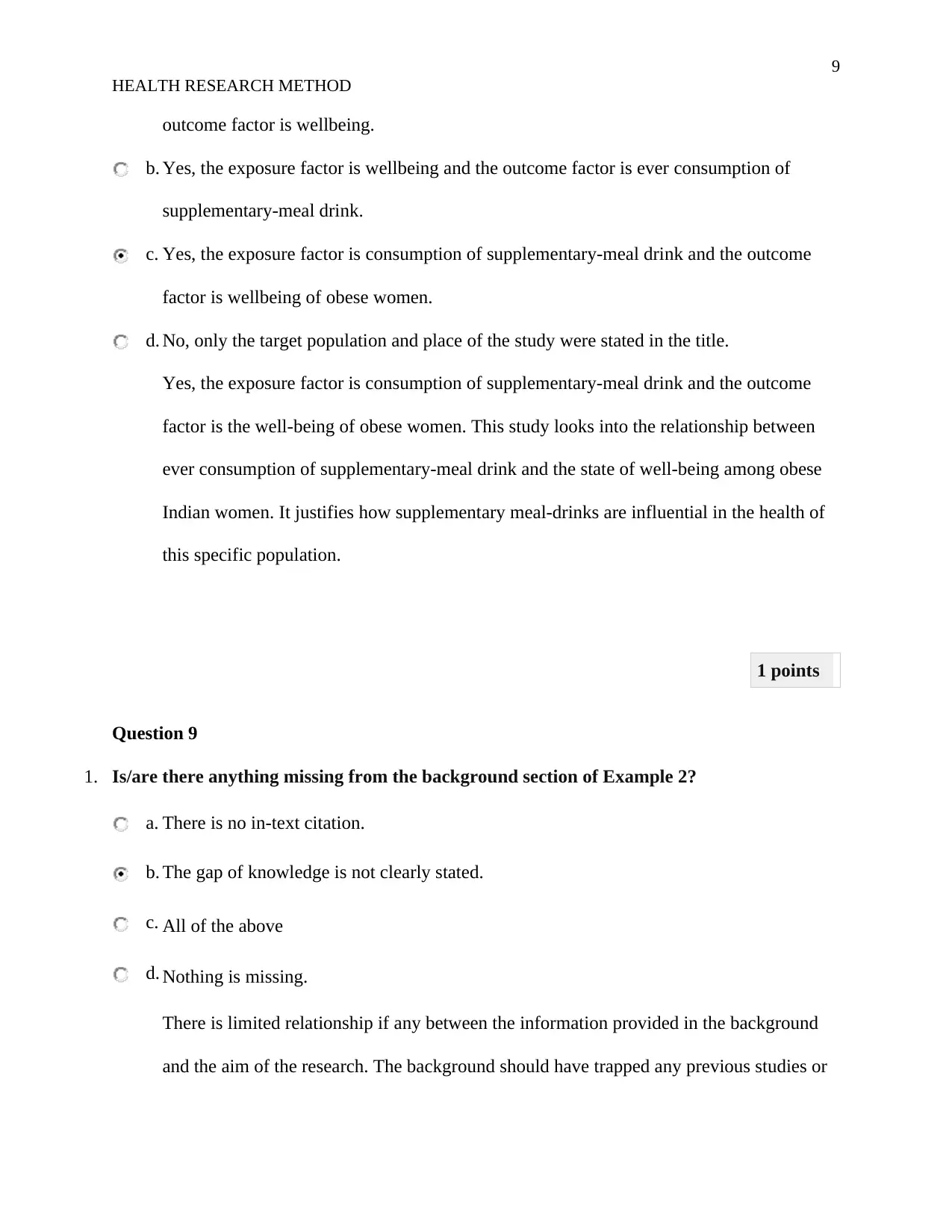
Has the title included the exposure and outcome factors?
a. Yes, the exposure factor is ever consumption of supplementary-meal drink and the
9
HEALTH RESEARCH METHOD
outcome factor is wellbeing.
b. Yes, the exposure factor is wellbeing and the outcome factor is ever consumption of
supplementary-meal drink.
c. Yes, the exposure factor is consumption of supplementary-meal drink and the outcome
factor is wellbeing of obese women.
d. No, only the target population and place of the study were stated in the title.
Yes, the exposure factor is consumption of supplementary-meal drink and the outcome
factor is the well-being of obese women. This study looks into the relationship between
ever consumption of supplementary-meal drink and the state of well-being among obese
Indian women. It justifies how supplementary meal-drinks are influential in the health of
this specific population.
1 points
Question 9
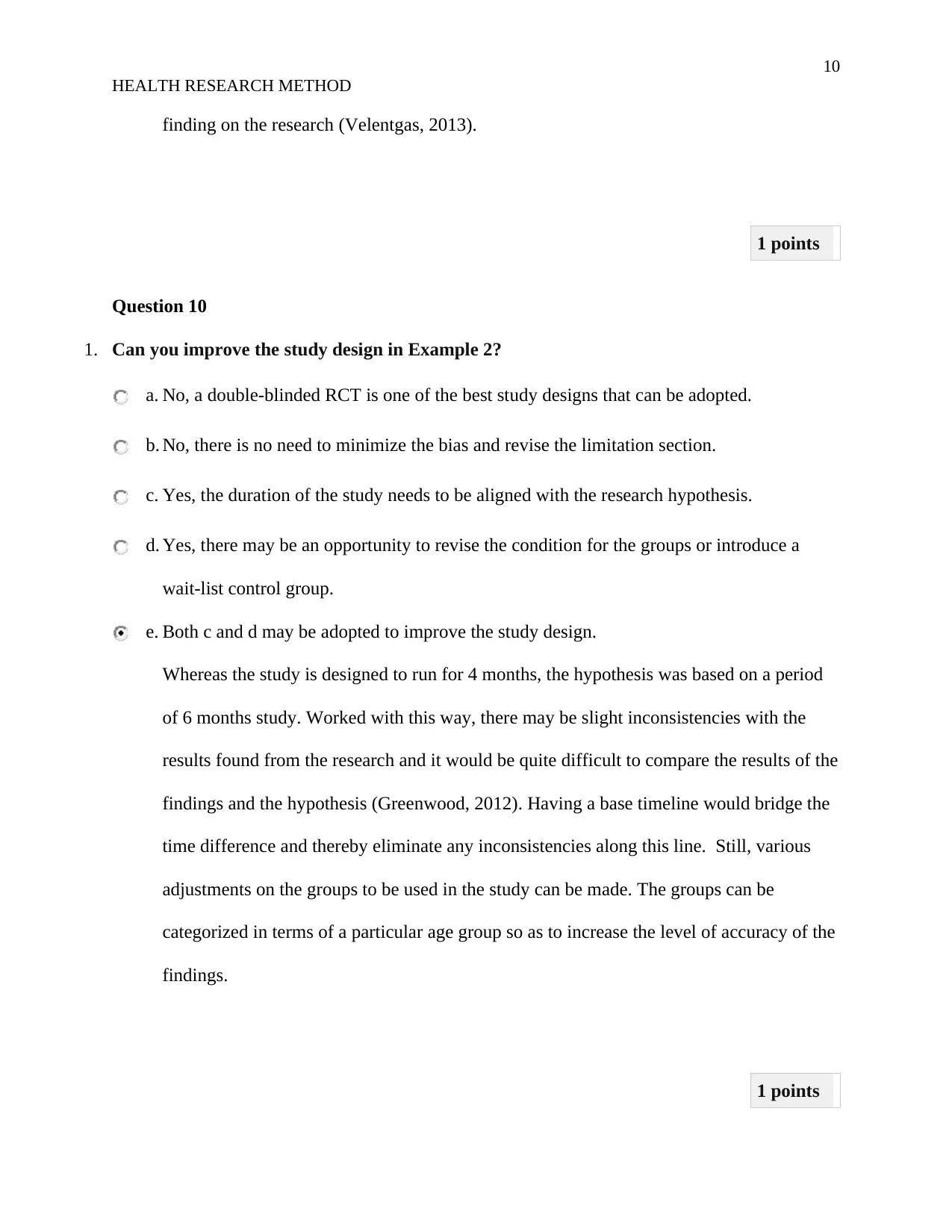
1. Is/are there anything missing from the background section of Example 2?
a. There is no in-text citation.
b. The gap of knowledge is not clearly stated.
c. All of the above
d. Nothing is missing.
There is limited relationship if any between the information provided in the background
and the aim of the research. The background should have trapped any previous studies or
HEALTH RESEARCH METHOD
outcome factor is wellbeing.
b. Yes, the exposure factor is wellbeing and the outcome factor is ever consumption of
supplementary-meal drink.
c. Yes, the exposure factor is consumption of supplementary-meal drink and the outcome
factor is wellbeing of obese women.
d. No, only the target population and place of the study were stated in the title.
Yes, the exposure factor is consumption of supplementary-meal drink and the outcome
factor is the well-being of obese women. This study looks into the relationship between
ever consumption of supplementary-meal drink and the state of well-being among obese
Indian women. It justifies how supplementary meal-drinks are influential in the health of
this specific population.
1 points
Question 9
1. Is/are there anything missing from the background section of Example 2?
a. There is no in-text citation.
b. The gap of knowledge is not clearly stated.
c. All of the above
d. Nothing is missing.
There is limited relationship if any between the information provided in the background
and the aim of the research. The background should have trapped any previous studies or
⊘ This is a preview!⊘
Do you want full access?
Subscribe today to unlock all pages.
Trusted by 1+ million students worldwide
10
HEALTH RESEARCH METHOD
finding on the research (Velentgas, 2013).
1 points
Question 10
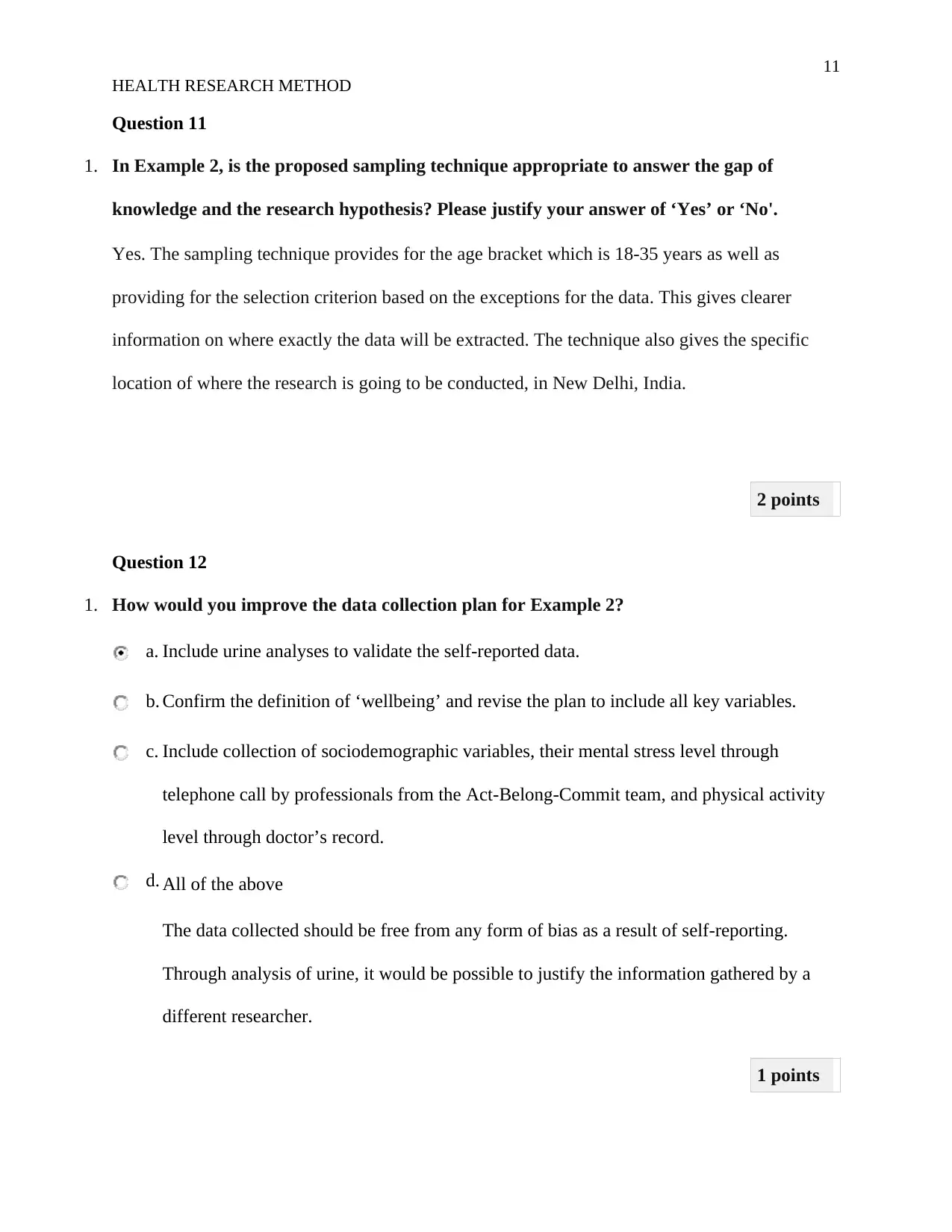
1. Can you improve the study design in Example 2?
a. No, a double-blinded RCT is one of the best study designs that can be adopted.
b. No, there is no need to minimize the bias and revise the limitation section.
c. Yes, the duration of the study needs to be aligned with the research hypothesis.
d. Yes, there may be an opportunity to revise the condition for the groups or introduce a
wait-list control group.
e. Both c and d may be adopted to improve the study design.
Whereas the study is designed to run for 4 months, the hypothesis was based on a period
of 6 months study. Worked with this way, there may be slight inconsistencies with the
results found from the research and it would be quite difficult to compare the results of the
findings and the hypothesis (Greenwood, 2012). Having a base timeline would bridge the
time difference and thereby eliminate any inconsistencies along this line. Still, various
adjustments on the groups to be used in the study can be made. The groups can be
categorized in terms of a particular age group so as to increase the level of accuracy of the
findings.
1 points
HEALTH RESEARCH METHOD
finding on the research (Velentgas, 2013).
1 points
Question 10
1. Can you improve the study design in Example 2?
a. No, a double-blinded RCT is one of the best study designs that can be adopted.
b. No, there is no need to minimize the bias and revise the limitation section.
c. Yes, the duration of the study needs to be aligned with the research hypothesis.
d. Yes, there may be an opportunity to revise the condition for the groups or introduce a
wait-list control group.
e. Both c and d may be adopted to improve the study design.
Whereas the study is designed to run for 4 months, the hypothesis was based on a period
of 6 months study. Worked with this way, there may be slight inconsistencies with the
results found from the research and it would be quite difficult to compare the results of the
findings and the hypothesis (Greenwood, 2012). Having a base timeline would bridge the
time difference and thereby eliminate any inconsistencies along this line. Still, various
adjustments on the groups to be used in the study can be made. The groups can be
categorized in terms of a particular age group so as to increase the level of accuracy of the
findings.
1 points
Paraphrase This Document
Need a fresh take? Get an instant paraphrase of this document with our AI Paraphraser
11
HEALTH RESEARCH METHOD
Question 11
1. In Example 2, is the proposed sampling technique appropriate to answer the gap of
knowledge and the research hypothesis? Please justify your answer of ‘Yes’ or ‘No'.
Yes. The sampling technique provides for the age bracket which is 18-35 years as well as
providing for the selection criterion based on the exceptions for the data. This gives clearer
information on where exactly the data will be extracted. The technique also gives the specific
location of where the research is going to be conducted, in New Delhi, India.
2 points
Question 12
1. How would you improve the data collection plan for Example 2?
a. Include urine analyses to validate the self-reported data.
b. Confirm the definition of ‘wellbeing’ and revise the plan to include all key variables.
c. Include collection of sociodemographic variables, their mental stress level through
telephone call by professionals from the Act-Belong-Commit team, and physical activity
level through doctor’s record.
d. All of the above
The data collected should be free from any form of bias as a result of self-reporting.
Through analysis of urine, it would be possible to justify the information gathered by a
different researcher.
1 points
HEALTH RESEARCH METHOD
Question 11
1. In Example 2, is the proposed sampling technique appropriate to answer the gap of
knowledge and the research hypothesis? Please justify your answer of ‘Yes’ or ‘No'.
Yes. The sampling technique provides for the age bracket which is 18-35 years as well as
providing for the selection criterion based on the exceptions for the data. This gives clearer
information on where exactly the data will be extracted. The technique also gives the specific
location of where the research is going to be conducted, in New Delhi, India.
2 points
Question 12
1. How would you improve the data collection plan for Example 2?
a. Include urine analyses to validate the self-reported data.
b. Confirm the definition of ‘wellbeing’ and revise the plan to include all key variables.
c. Include collection of sociodemographic variables, their mental stress level through
telephone call by professionals from the Act-Belong-Commit team, and physical activity
level through doctor’s record.
d. All of the above
The data collected should be free from any form of bias as a result of self-reporting.
Through analysis of urine, it would be possible to justify the information gathered by a
different researcher.
1 points
12
HEALTH RESEARCH METHOD
Question 13
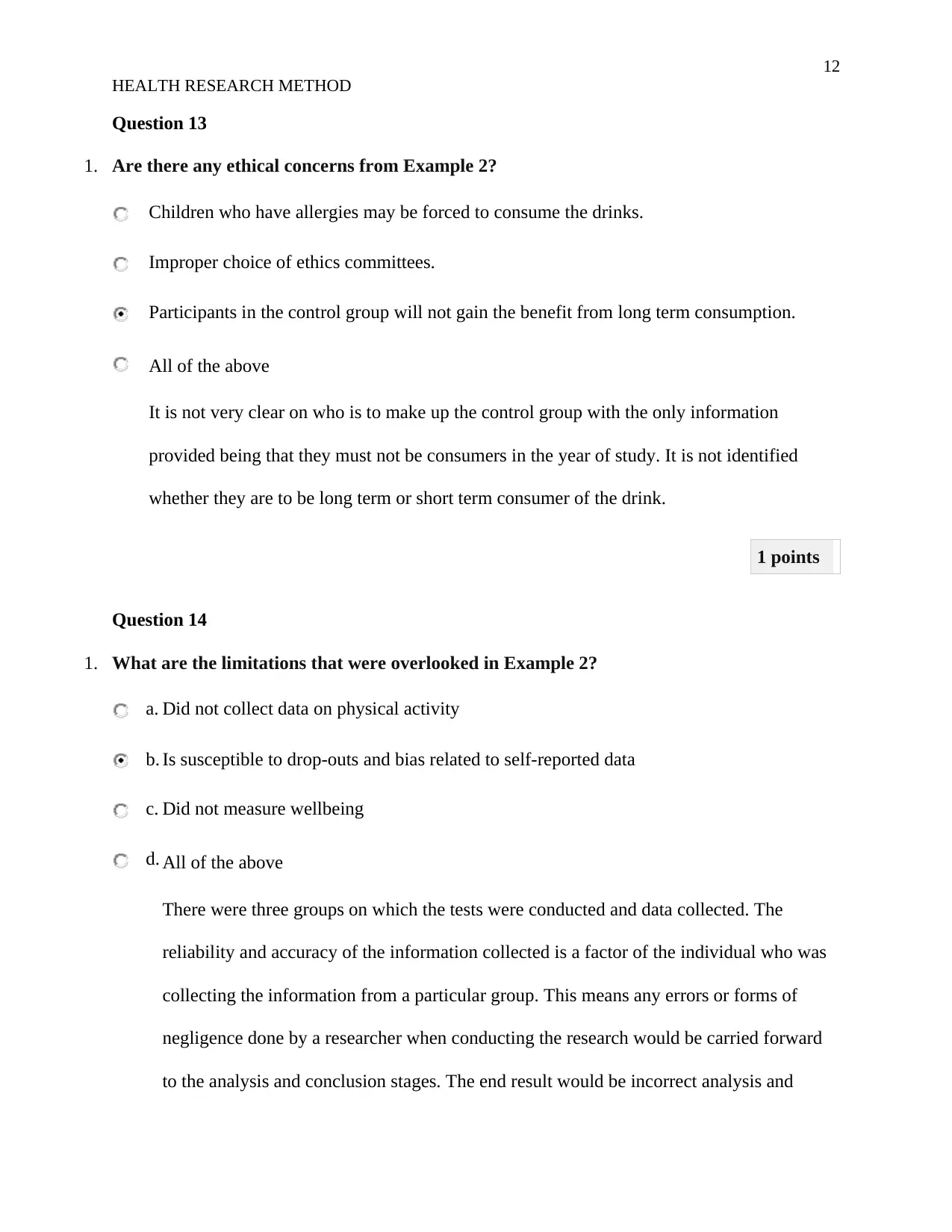
1. Are there any ethical concerns from Example 2?
Children who have allergies may be forced to consume the drinks.
Improper choice of ethics committees.
Participants in the control group will not gain the benefit from long term consumption.
All of the above
It is not very clear on who is to make up the control group with the only information
provided being that they must not be consumers in the year of study. It is not identified
whether they are to be long term or short term consumer of the drink.
1 points
Question 14
1. What are the limitations that were overlooked in Example 2?
a. Did not collect data on physical activity
b. Is susceptible to drop-outs and bias related to self-reported data
c. Did not measure wellbeing
d. All of the above
There were three groups on which the tests were conducted and data collected. The
reliability and accuracy of the information collected is a factor of the individual who was
collecting the information from a particular group. This means any errors or forms of
negligence done by a researcher when conducting the research would be carried forward
to the analysis and conclusion stages. The end result would be incorrect analysis and
HEALTH RESEARCH METHOD
Question 13
1. Are there any ethical concerns from Example 2?
Children who have allergies may be forced to consume the drinks.
Improper choice of ethics committees.
Participants in the control group will not gain the benefit from long term consumption.
All of the above
It is not very clear on who is to make up the control group with the only information
provided being that they must not be consumers in the year of study. It is not identified
whether they are to be long term or short term consumer of the drink.
1 points
Question 14
1. What are the limitations that were overlooked in Example 2?
a. Did not collect data on physical activity
b. Is susceptible to drop-outs and bias related to self-reported data
c. Did not measure wellbeing
d. All of the above
There were three groups on which the tests were conducted and data collected. The
reliability and accuracy of the information collected is a factor of the individual who was
collecting the information from a particular group. This means any errors or forms of
negligence done by a researcher when conducting the research would be carried forward
to the analysis and conclusion stages. The end result would be incorrect analysis and
⊘ This is a preview!⊘
Do you want full access?
Subscribe today to unlock all pages.
Trusted by 1+ million students worldwide

1 out of 13


Related Documents


Your All-in-One AI-Powered Toolkit for Academic Success.
+13062052269
info@desklib.com
Available 24*7 on WhatsApp / Email
![[object Object]](/_next/static/media/star-bottom.7253800d.svg)
Unlock your academic potential
Copyright © 2020–2025 A2Z Services. All Rights Reserved. Developed and managed by ZUCOL.