Price Theory Assignment: Equilibrium, Profit and Market Power

Verified

Added on  2019/10/31

|4
|532
|233
Homework Assignment
AI Summary
This assignment solution delves into price theory, examining the behavior of two firms in a competitive market. It begins by analyzing the demand functions of each firm, determining their relationship as substitutes. The solution then calculates the marginal revenue and marginal cost for each firm, establishing response functions to determine equilibrium prices. Through simultaneous equations, the equilibrium prices for both firms are found, followed by the calculation of equilibrium quantities. Finally, the assignment computes the profits of each firm and assesses their market power using the Lerner Index. The analysis highlights the impact of demand elasticity on market power, providing a comprehensive understanding of firm competition and market dynamics.

Document Page
PRICE THEORY
STUDENT ID:
[Pick the date]
tabler-icon-diamond-filled.svg

Paraphrase This Document

Need a fresh take? Get an instant paraphrase of this document with our AI Paraphraser
Document Page
PRICE THEORY
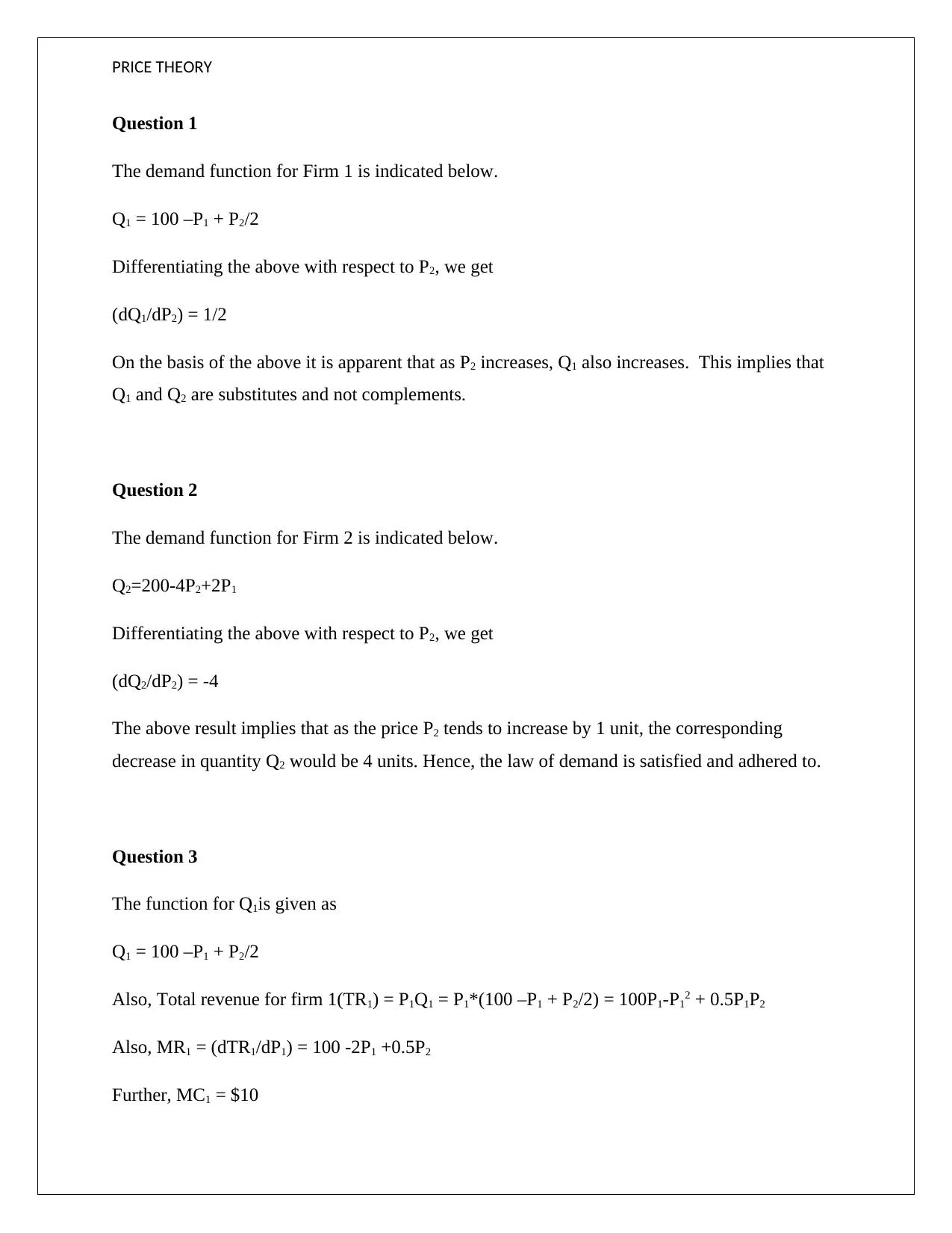
Question 1
The demand function for Firm 1 is indicated below.
Q1 = 100 –P1 + P2/2
Differentiating the above with respect to P2, we get
(dQ1/dP2) = 1/2
On the basis of the above it is apparent that as P2 increases, Q1 also increases. This implies that
Q1 and Q2 are substitutes and not complements.
Question 2
The demand function for Firm 2 is indicated below.
Q2=200-4P2+2P1
Differentiating the above with respect to P2, we get
(dQ2/dP2) = -4
The above result implies that as the price P2 tends to increase by 1 unit, the corresponding
decrease in quantity Q2 would be 4 units. Hence, the law of demand is satisfied and adhered to.
Question 3
The function for Q1is given as
Q1 = 100 –P1 + P2/2
Also, Total revenue for firm 1(TR1) = P1Q1 = P1*(100 –P1 + P2/2) = 100P1-P12 + 0.5P1P2
Also, MR1 = (dTR1/dP1) = 100 -2P1 +0.5P2
Further, MC1 = $10
Document Page
PRICE THEORY
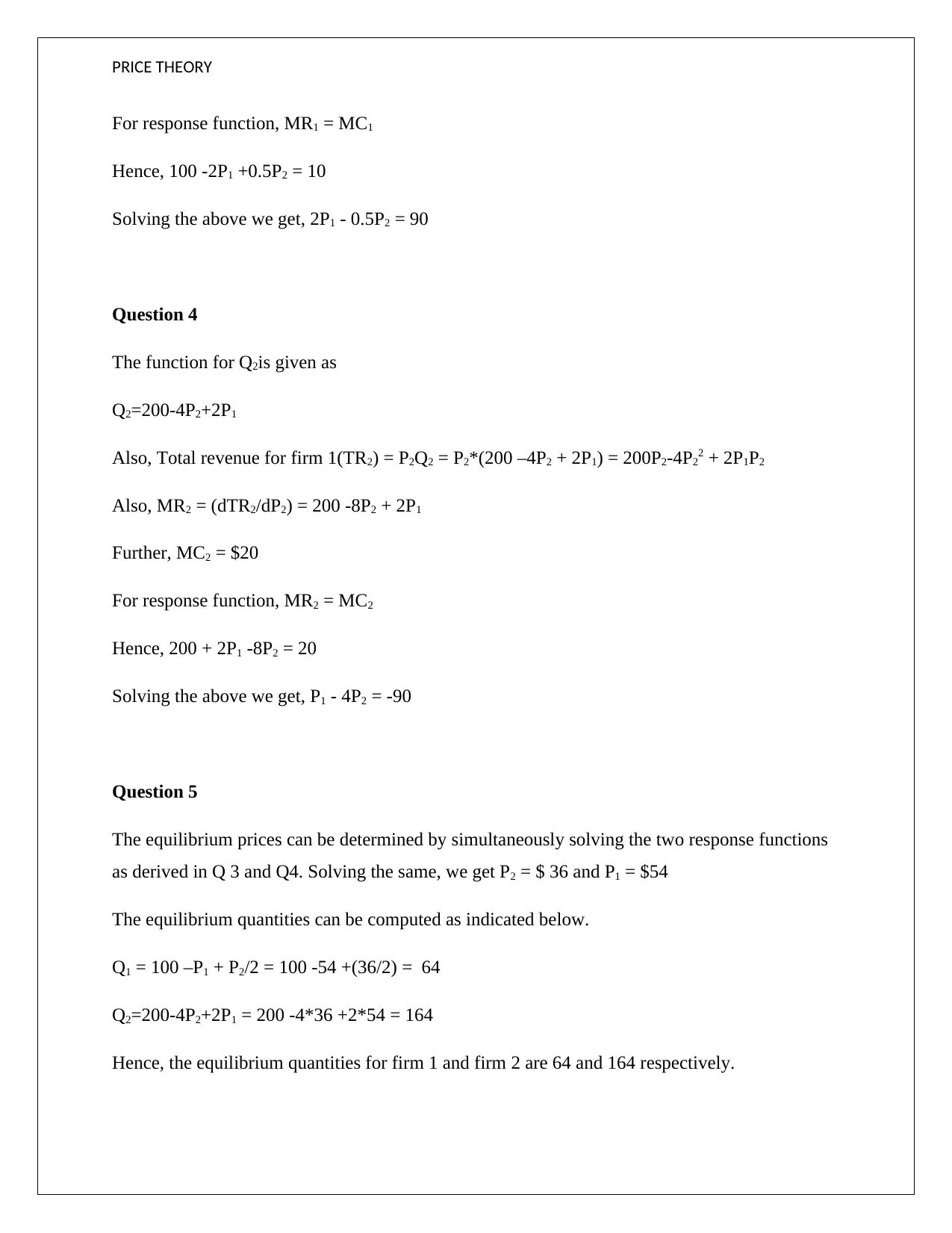
For response function, MR1 = MC1
Hence, 100 -2P1 +0.5P2 = 10
Solving the above we get, 2P1 - 0.5P2 = 90
Question 4
The function for Q2is given as
Q2=200-4P2+2P1
Also, Total revenue for firm 1(TR2) = P2Q2 = P2*(200 –4P2 + 2P1) = 200P2-4P22 + 2P1P2
Also, MR2 = (dTR2/dP2) = 200 -8P2 + 2P1
Further, MC2 = $20
For response function, MR2 = MC2
Hence, 200 + 2P1 -8P2 = 20
Solving the above we get, P1 - 4P2 = -90
Question 5
The equilibrium prices can be determined by simultaneously solving the two response functions
as derived in Q 3 and Q4. Solving the same, we get P2 = $ 36 and P1 = $54
The equilibrium quantities can be computed as indicated below.
Q1 = 100 –P1 + P2/2 = 100 -54 +(36/2) = 64
Q2=200-4P2+2P1 = 200 -4*36 +2*54 = 164
Hence, the equilibrium quantities for firm 1 and firm 2 are 64 and 164 respectively.
Document Page
PRICE THEORY
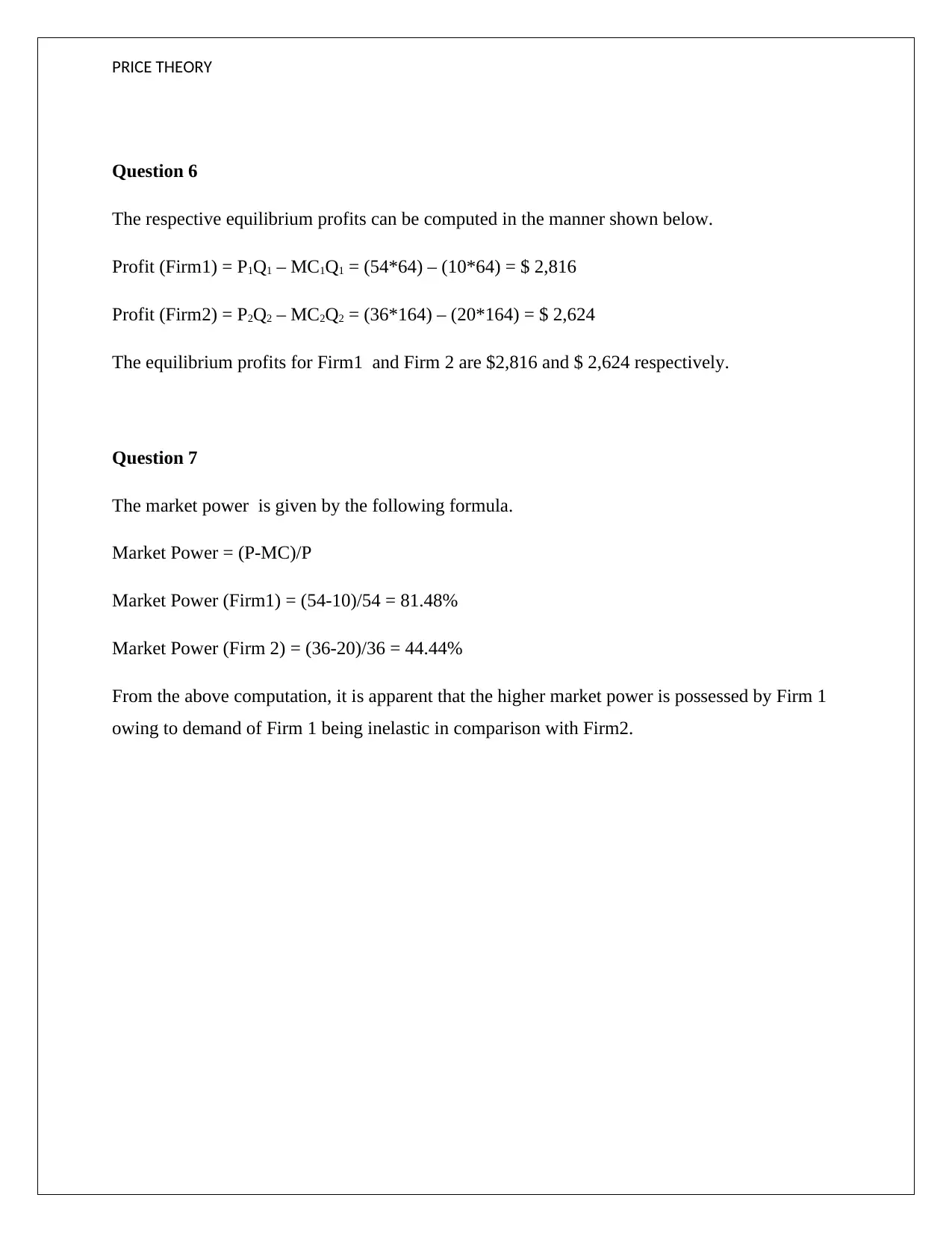
Question 6
The respective equilibrium profits can be computed in the manner shown below.
Profit (Firm1) = P1Q1 – MC1Q1 = (54*64) – (10*64) = $ 2,816
Profit (Firm2) = P2Q2 – MC2Q2 = (36*164) – (20*164) = $ 2,624
The equilibrium profits for Firm1 and Firm 2 are $2,816 and $ 2,624 respectively.
Question 7
The market power is given by the following formula.
Market Power = (P-MC)/P
Market Power (Firm1) = (54-10)/54 = 81.48%
Market Power (Firm 2) = (36-20)/36 = 44.44%
From the above computation, it is apparent that the higher market power is possessed by Firm 1
owing to demand of Firm 1 being inelastic in comparison with Firm2.
chevron_up_icon
1 out of 4
circle_padding
hide_on_mobile
zoom_out_icon
[object Object]