University ITC Project Management Report: Methodology Comparison

Verified

Added on  2023/06/09

|7
|1159
|313
Report
AI Summary
This report delves into the realm of ITC Project Management, focusing on the application and comparison of project management methodologies. It begins by defining project management methodologies and their importance in structuring, planning, and executing projects. The report highlights the necessity of selecting the appropriate project management tool and team. A comparative analysis is then conducted between the PRINCE2 and PMBOK methodologies, examining their definitions, types, themes, knowledge areas, processes, principles, techniques, skills, focus, and organizational aspects. The report further illustrates the project life cycle within the context of PRINCE2 and PMBOK, detailing the processes involved in each methodology, from project initiation to project closure. Visual aids, such as figures, are included to represent the process flow of both methodologies. The report concludes by referencing relevant literature to support its findings and recommendations. This report will be useful for students studying project management.
Document Page
Running head: ITC PROJECT MANAGEMENT
ITC Project Management
Name of Student-
Name of University-
Author’s Note
tabler-icon-diamond-filled.svg

Paraphrase This Document

Need a fresh take? Get an instant paraphrase of this document with our AI Paraphraser
Document Page
1ITC PROJECT MANAGEMENT
Answer to Question 1:
Methodology is basically a model that project managers employ for making design, plan
as well as implement the objective of the project and achieve the objectives of the project. Many
project management methodologies are used so that the project can get benefitted from the
project management. The main motivation towards making the process of project management is
to manage a project that seems to be very large and are inexplicable (Bongiovanni et al., 2015).
There are many methodologies that are used for developing a project and organizing complex
plans as well. To govern a project there must be some specific rules and those rules are followed
by project management methodologies.
The methodologies associated with any project can be stated as a way that describes a
system that does something. Before beginning a project management, right tool for project
management must be selected, along with a good team and the project manager must know about
how they are will manage the project with project management methodologies (Hornstein, 2015).
The project manager takes the preference about selecting the methodology of project manager
while conducting a project.
The project manager has the duty to select a project management methodology for
carrying out a project successfully. The type of methodology that is picked by the project
manager will help to profound the team work as well as impact on an individual works on that
project (Nicholas & Steyn, 2017). All the project management methodologies that are available
have different advantages as well as disadvantages and the project methodologies are different
for different types of project. Some methodologies are needed for speeding up the work of
project and some are needed for comprehensiveness.
Document Page
2ITC PROJECT MANAGEMENT
Answer to Question 2:
The project management methodologies that id chosen to make a comparison is Prince2
methodology and PMBOK methodology. The comparison is stated below.
Features PRINCE2 PMBOK
Definition of the
methodologies
Prince2 is a structured
methodology.
PMBOK is a standard and a
guide methodology.
Type of methodologies This methodology is basically
a practical methodology that
mainly focuses on the critical
laws.
This is a comprehensive type
of methodology.
Themes and the knowledge
areas
PRINCE2 contains 7 themes
involved.
There are about 10
knowledge areas in PMBOK
methodology.
Processes and related
activities
Contains about 7 processes
and total of 35 activities.
There are 5 group of
processes and total of 47
processes involved in
PMBOK.
Principles There are seven principles
involved in PRINCE2
methodology.
There is no principle in
PMBOK methodology.
Document Page
3ITC PROJECT MANAGEMENT
Techniques There are specific techniques
involved in PRINCE2
methodology.
There are techniques for each
particular process involved in
PMBOK (Kisslinger, 2015).
Skills No particular skills offered. There are interpersonal skills
in PMBOK methodology.
Focus This methodology mainly
focuses on business case and
products (Joslin & Müller,
2015).
This methodology gives focus
on customer requirements.
Role of project This methodology calls a
project board for providing
oversight.
This methodology only
suggests role of the sponsor
that he should play.
Organizational assets and
the environmental factors
Partly covers environmental
factors and organizational
assets.
Assets as well as
environmental factors are
strongly integrated with all
the processes (Kerzner &
Kerzner, 2017).
Management Principle These principles are managed
by exception.
There is no management
principle.
tabler-icon-diamond-filled.svg

Paraphrase This Document

Need a fresh take? Get an instant paraphrase of this document with our AI Paraphraser
Document Page
4ITC PROJECT MANAGEMENT
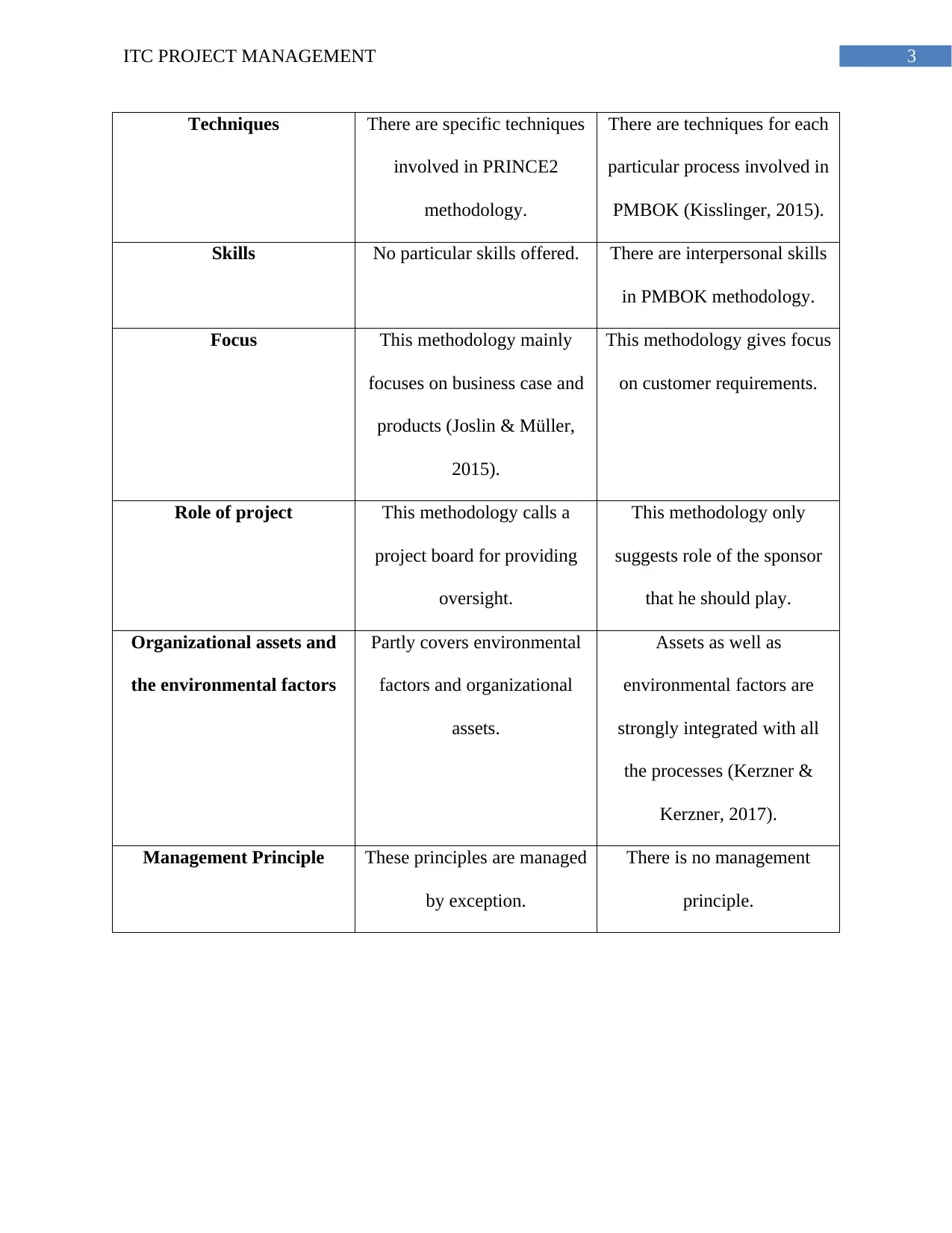
Figure 1: Process of PRIN CE 2 Methodology
(Source: Joslin & Müller, 2015)
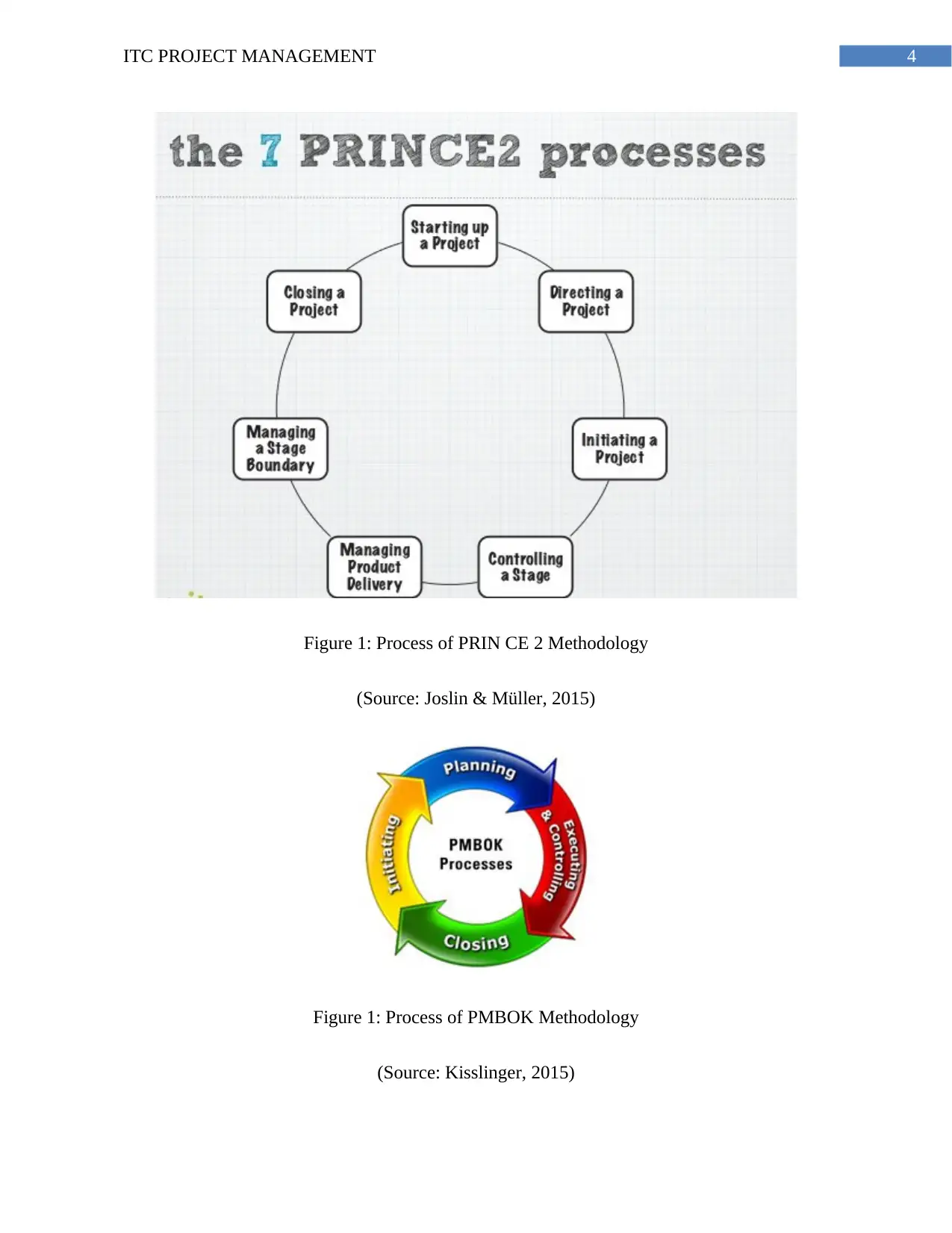
Figure 1: Process of PMBOK Methodology
(Source: Kisslinger, 2015)
Document Page
5ITC PROJECT MANAGEMENT
Answer to Question 3:
PRINCE2 is related with a project life cycle which consists of processes for completing a
project. A process is structured activity set that are accomplished for completing a particular
objective in a project. Prince2 methodology in project management contains all the activities for
starting a project, running a project as well as completing project successfully. All the activities
are grouped into processes in a project life cycle. This is a process based approach that consists
of seven processes in the project management. This PRINCE2 methodology helps to complete
the project in the project life cycle.
The PMBOK methodology in a project life cycle helps to divide the project in to five
phases. The phases are initiating the project, planning the project, executing the project,
controlling the project, as well as closing the project (Martinelli & Milosevic, 2016).
Initiating the project- This process mainly recognize when the project phase is to begin
and then gathers all the commitment that are required to get the project started.
Planning the project- This involves all projects to be planned and to maintain all the
project phases in a particular project.
Project executing and project controlling- This two phases executes the decided project
phases and executes them accordingly. And the project controlling helps to control all the phases
in a project life cycle.
Closing the project- This involves closing the project satisfying all the objectives.
Document Page
6ITC PROJECT MANAGEMENT
References
Bongiovanni, A., Colotti, G., Liguori, G. L., Di Carlo, M., Digilio, F. A., Lacerra, G., ... &
Kisslinger, A. (2015). Applying Quality and Project Management methodologies in
biomedical research laboratories: a public research network’s case study. Accreditation
and Quality Assurance, 20(3), 203-213.
Hornstein, H. A. (2015). The integration of project management and organizational change
management is now a necessity. International Journal of Project Management, 33(2),
291-298.
Joslin, R., & Müller, R. (2015). Relationships between a project management methodology and
project success in different project governance contexts. International Journal of Project
Management, 33(6), 1377-1392.
Kerzner, H., & Kerzner, H. R. (2017). Project management: a systems approach to planning,
scheduling, and controlling. John Wiley & Sons.
Martinelli, R. J., & Milosevic, D. Z. (2016). Project management toolbox: tools and techniques
for the practicing project manager. John Wiley & Sons.
Nicholas, J. M., & Steyn, H. (2017). Project management for engineering, business and
technology. Routledge.
chevron_up_icon
1 out of 7
circle_padding
hide_on_mobile
zoom_out_icon
[object Object]