Economic Analysis of Bills of Sale: Principles of Law and Economics
VerifiedAdded on 2023/06/09
|15
|4636
|81
Report
AI Summary
This report summarizes Law Commission Report No. 369 regarding Bills of Sale, highlighting their archaic nature and the proposal for a Goods Mortgages Act. It explores the economic rationale behind Bills of Sale, emphasizing their role in facilitating the use of owned goods as security for loans while retaining possession. The report discusses the efficiency in resource allocation, increased productivity, and the economic reasons for changes in the existing English laws. It addresses the limitations of the older bill, including inadequate protections for borrowers, unnecessary formality burdens, and rigid boundaries, which led to market failures, lack of efficiency, and high transaction costs. The analysis underscores the need for amending the Bills of Sale Act to better balance the interests of lenders and borrowers and promote overall economic welfare, with Desklib providing students access to similar solved assignments.

1
PRINCIPLES OF LAW AND ECONOMICS
Principles of law and economics
Student Name
University Name
PRINCIPLES OF LAW AND ECONOMICS
Principles of law and economics
Student Name
University Name

Paraphrase This Document
Need a fresh take? Get an instant paraphrase of this document with our AI Paraphraser
2
PRINCIPLES OF LAW AND ECONOMICS
Introduction
The aim is to summarize the Law Commission Report No 369 regarding Bills of Sale.
The Bills of Sale are very archaic in nature and these are Victorian Statutes. These statutes can
be repealed in their entire self. The proposal of the Law Commission was to come up with the
Goods Mortgages Act which has been a recommendation to change the archaic statute and bring
in new recommendations. The new recommendation shall incorporate the following, such as:
1. The Bill seeks to give protection to the borrowers and the aim is to preserve the rights of the
borrowers.
2. The aim is also to help the small businesses so that they do not face too many restrictions on
secured lending.
The Bills of Sale are the ways of ensuring that the individuals have access to the goods
they already own as security for their loans and the owners can also retain the possession of these
goods. Therefore, there shall be extended protection to lenders and also borrowers. The reason
behind the inception of these new bills is to do away with the primitive restrictions that was laid
down by the laws in the Victorian times.1 Therefore, the money lenders’ faced restrictions which
finally led to the new statutes, the Bills of Sale Act 1878 and the Bills of Sale Amendment Act
1882. Though the Bill of Sale Acts was criticized heavily for being primitive and restrictive in
their nature, the bill was still in force and they are still implemented in gauging the rights of the
lenders2.
Q1. Economic Rationale for the Bills of Sales
1 Bridge, Michael G. The international sale of goods. Oxford University Press, 2017.
2 Yap, Ji Lian. "Considering commercial and company law reform." Statute Law Review 36.2 (2015): 152-159.
PRINCIPLES OF LAW AND ECONOMICS
Introduction
The aim is to summarize the Law Commission Report No 369 regarding Bills of Sale.
The Bills of Sale are very archaic in nature and these are Victorian Statutes. These statutes can
be repealed in their entire self. The proposal of the Law Commission was to come up with the
Goods Mortgages Act which has been a recommendation to change the archaic statute and bring
in new recommendations. The new recommendation shall incorporate the following, such as:
1. The Bill seeks to give protection to the borrowers and the aim is to preserve the rights of the
borrowers.
2. The aim is also to help the small businesses so that they do not face too many restrictions on
secured lending.
The Bills of Sale are the ways of ensuring that the individuals have access to the goods
they already own as security for their loans and the owners can also retain the possession of these
goods. Therefore, there shall be extended protection to lenders and also borrowers. The reason
behind the inception of these new bills is to do away with the primitive restrictions that was laid
down by the laws in the Victorian times.1 Therefore, the money lenders’ faced restrictions which
finally led to the new statutes, the Bills of Sale Act 1878 and the Bills of Sale Amendment Act
1882. Though the Bill of Sale Acts was criticized heavily for being primitive and restrictive in
their nature, the bill was still in force and they are still implemented in gauging the rights of the
lenders2.
Q1. Economic Rationale for the Bills of Sales
1 Bridge, Michael G. The international sale of goods. Oxford University Press, 2017.
2 Yap, Ji Lian. "Considering commercial and company law reform." Statute Law Review 36.2 (2015): 152-159.
3
PRINCIPLES OF LAW AND ECONOMICS
From the above discussion, it can be seen that the bills of sales facilitate the individuals
to use the goods or property which they own, as security for loans or other types of obligations,
while simultaneously retaining possession of theses goods. This in turn enable the individuals to
efficiently use their goods as and when required3. There lies significant economic rationale and
notions behind the implementation of the Bills of Sale Act, which can be described with the help
of the theoretical and conceptual frameworks of economics, discussed as follows:
Efficiency in Resource Allocations
In the conceptual framework of economics, one of the primary problems which any
economy deals with is that of efficient allocation of resources. One of the primary assumptions in
economics is that of the scarcity of resources- that is, all the productive resources are limited and
therefore, often trade-offs arise regarding the allocation of resources in such a way that the
economic growth as well as the overall welfare is maximized4.
In this context, the bills of sale, by enabling the individuals to use their owned products
as security for the purpose of procuring loans, while still retaining possession of the same, helps
to a considerable extent in efficient allocation and utilization of productive resources (as the
goods which are usually used as security for obtaining loans generally fall under the
segmentation of capital goods, thereby being one of the four crucial factors of production in
economics), thereby helping in increasing the overall welfare of the economy as well as that of
the individuals in particular5.
Increase in productivity in the economy
3 Piscicelli, Laura, Tim Cooper, and Tom Fisher. "The role of values in collaborative consumption: insights from a
product-service system for lending and borrowing in the UK." Journal of Cleaner Production 97 (2015): 21-29.
4 Iossa, Elisabetta, and David Martimort. "The simple microeconomics of public‐private partnerships." Journal of
Public Economic Theory 17.1 (2015): 4-48.
5 Meade, James E. A Neo-Classical Theory of Economic Growth (Routledge Revivals). Routledge, 2013.
PRINCIPLES OF LAW AND ECONOMICS
From the above discussion, it can be seen that the bills of sales facilitate the individuals
to use the goods or property which they own, as security for loans or other types of obligations,
while simultaneously retaining possession of theses goods. This in turn enable the individuals to
efficiently use their goods as and when required3. There lies significant economic rationale and
notions behind the implementation of the Bills of Sale Act, which can be described with the help
of the theoretical and conceptual frameworks of economics, discussed as follows:
Efficiency in Resource Allocations
In the conceptual framework of economics, one of the primary problems which any
economy deals with is that of efficient allocation of resources. One of the primary assumptions in
economics is that of the scarcity of resources- that is, all the productive resources are limited and
therefore, often trade-offs arise regarding the allocation of resources in such a way that the
economic growth as well as the overall welfare is maximized4.
In this context, the bills of sale, by enabling the individuals to use their owned products
as security for the purpose of procuring loans, while still retaining possession of the same, helps
to a considerable extent in efficient allocation and utilization of productive resources (as the
goods which are usually used as security for obtaining loans generally fall under the
segmentation of capital goods, thereby being one of the four crucial factors of production in
economics), thereby helping in increasing the overall welfare of the economy as well as that of
the individuals in particular5.
Increase in productivity in the economy
3 Piscicelli, Laura, Tim Cooper, and Tom Fisher. "The role of values in collaborative consumption: insights from a
product-service system for lending and borrowing in the UK." Journal of Cleaner Production 97 (2015): 21-29.
4 Iossa, Elisabetta, and David Martimort. "The simple microeconomics of public‐private partnerships." Journal of
Public Economic Theory 17.1 (2015): 4-48.
5 Meade, James E. A Neo-Classical Theory of Economic Growth (Routledge Revivals). Routledge, 2013.
⊘ This is a preview!⊘
Do you want full access?
Subscribe today to unlock all pages.

Trusted by 1+ million students worldwide
4
PRINCIPLES OF LAW AND ECONOMICS
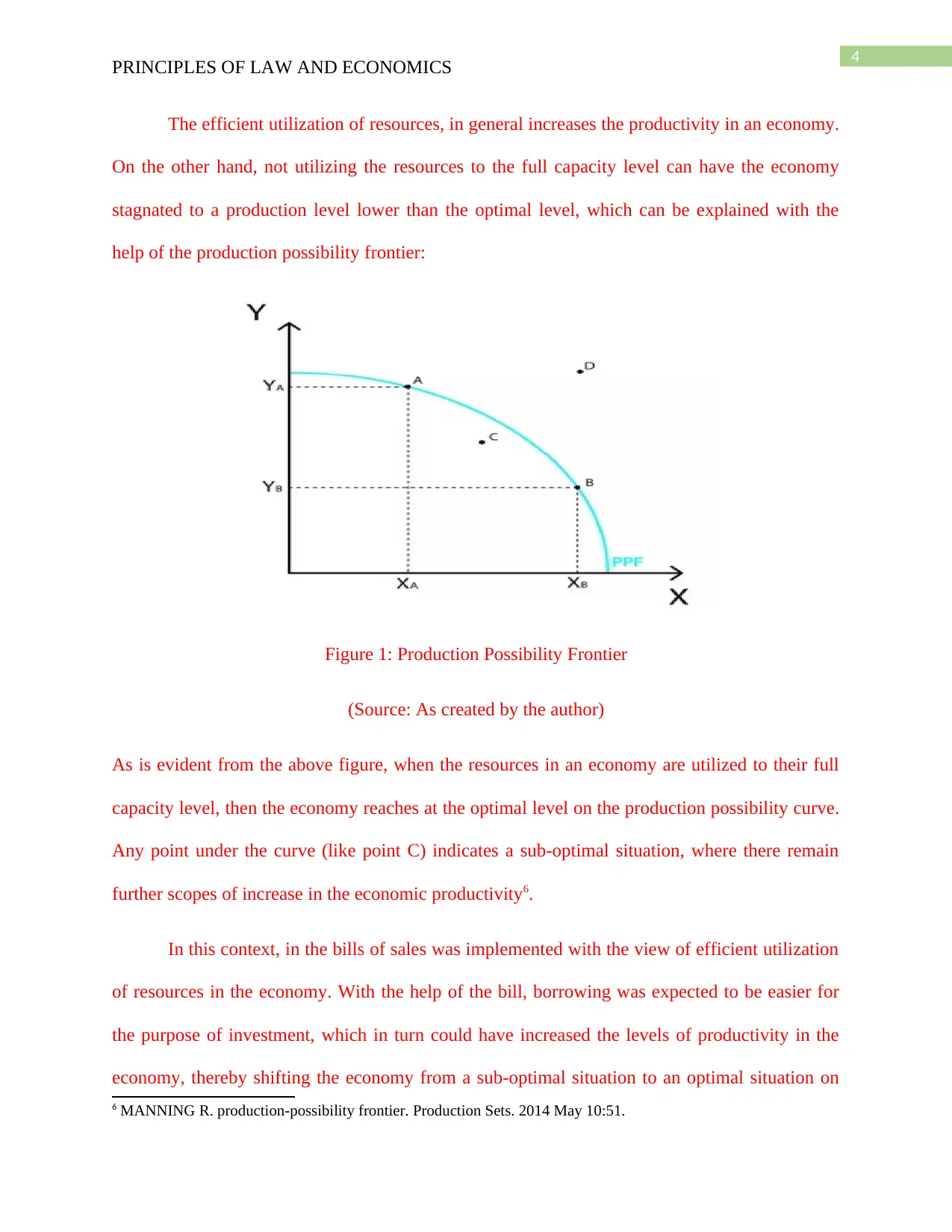
The efficient utilization of resources, in general increases the productivity in an economy.
On the other hand, not utilizing the resources to the full capacity level can have the economy
stagnated to a production level lower than the optimal level, which can be explained with the
help of the production possibility frontier:
Figure 1: Production Possibility Frontier
(Source: As created by the author)
As is evident from the above figure, when the resources in an economy are utilized to their full
capacity level, then the economy reaches at the optimal level on the production possibility curve.
Any point under the curve (like point C) indicates a sub-optimal situation, where there remain
further scopes of increase in the economic productivity6.
In this context, in the bills of sales was implemented with the view of efficient utilization
of resources in the economy. With the help of the bill, borrowing was expected to be easier for
the purpose of investment, which in turn could have increased the levels of productivity in the
economy, thereby shifting the economy from a sub-optimal situation to an optimal situation on
6 MANNING R. production-possibility frontier. Production Sets. 2014 May 10:51.
PRINCIPLES OF LAW AND ECONOMICS
The efficient utilization of resources, in general increases the productivity in an economy.
On the other hand, not utilizing the resources to the full capacity level can have the economy
stagnated to a production level lower than the optimal level, which can be explained with the
help of the production possibility frontier:
Figure 1: Production Possibility Frontier
(Source: As created by the author)
As is evident from the above figure, when the resources in an economy are utilized to their full
capacity level, then the economy reaches at the optimal level on the production possibility curve.
Any point under the curve (like point C) indicates a sub-optimal situation, where there remain
further scopes of increase in the economic productivity6.
In this context, in the bills of sales was implemented with the view of efficient utilization
of resources in the economy. With the help of the bill, borrowing was expected to be easier for
the purpose of investment, which in turn could have increased the levels of productivity in the
economy, thereby shifting the economy from a sub-optimal situation to an optimal situation on
6 MANNING R. production-possibility frontier. Production Sets. 2014 May 10:51.
Paraphrase This Document
Need a fresh take? Get an instant paraphrase of this document with our AI Paraphraser
5
PRINCIPLES OF LAW AND ECONOMICS
the PPF curve. Without the presence of this facility, the borrowers would not have been able to
easily use their property for lending thereby increasing the investment and productivity aspects7.
All these factors cumulatively advocate in favor of the Bills of Sales as according to these
theories the implementation of bills of sales, by emphasizing on the increasing efficiency and
productivity of the economy, can have positive implications on the lenders, borrowers as well as
on the economy as a whole.
Q2: Economic Reasons behind the need for changes
In the older English Law, there was no appropriate law that governed the interests of the lenders
and therefore the Law Commission drafted the new bill that ensured that individuals will access
the bill to be protected and that the individuals shall have the privilege to use the goods they
already have as a security for the loan. The lenders shall have the right to possess the goods. The
Bill of Sales has become redundant and has also become very outdated which needs strict
overhauling.8 The new proposed bill shall have the ability to use the personal properties in their
possession as collateral. Therefore, the new bill shall give the necessary protection to a consumer
in cases when he cannot protect himself against. The economics of the older bill was to promote
the rights of the lenders but not much emphasis was given to the borrowers. The bill applied
immense pressure and higher caps of payment to the lenders and no protection of law and
economics was given to the borrowers. The stakeholders have been at the receiving end of higher
payment and costs and therefore there rights in the Bills of Sale Acts was curtailed. The
stakeholders were not given the right to review and retain the goods they used as their own and
there was also a restriction on the collateral of their personal property.
7 Balassa, Bela. The theory of economic integration (routledge revivals). Routledge, 2013.
8 Hanrahan, Pamela. "Professional conduct: New restrictions for lawyers involved in managed investment
schemes." LSJ: Law Society of NSW Journal 45 (2018): 72.
PRINCIPLES OF LAW AND ECONOMICS
the PPF curve. Without the presence of this facility, the borrowers would not have been able to
easily use their property for lending thereby increasing the investment and productivity aspects7.
All these factors cumulatively advocate in favor of the Bills of Sales as according to these
theories the implementation of bills of sales, by emphasizing on the increasing efficiency and
productivity of the economy, can have positive implications on the lenders, borrowers as well as
on the economy as a whole.
Q2: Economic Reasons behind the need for changes
In the older English Law, there was no appropriate law that governed the interests of the lenders
and therefore the Law Commission drafted the new bill that ensured that individuals will access
the bill to be protected and that the individuals shall have the privilege to use the goods they
already have as a security for the loan. The lenders shall have the right to possess the goods. The
Bill of Sales has become redundant and has also become very outdated which needs strict
overhauling.8 The new proposed bill shall have the ability to use the personal properties in their
possession as collateral. Therefore, the new bill shall give the necessary protection to a consumer
in cases when he cannot protect himself against. The economics of the older bill was to promote
the rights of the lenders but not much emphasis was given to the borrowers. The bill applied
immense pressure and higher caps of payment to the lenders and no protection of law and
economics was given to the borrowers. The stakeholders have been at the receiving end of higher
payment and costs and therefore there rights in the Bills of Sale Acts was curtailed. The
stakeholders were not given the right to review and retain the goods they used as their own and
there was also a restriction on the collateral of their personal property.
7 Balassa, Bela. The theory of economic integration (routledge revivals). Routledge, 2013.
8 Hanrahan, Pamela. "Professional conduct: New restrictions for lawyers involved in managed investment
schemes." LSJ: Law Society of NSW Journal 45 (2018): 72.
6
PRINCIPLES OF LAW AND ECONOMICS
As discussed above, in the recent period, the need has been felt in the financial and
economic domain, for changing the current English laws which exist in the aspects of the bills of
sales as the same have been facing the following limitations:
Absence of adequate protections for the borrowers and also for the third parties acquiring
interests
Huge and unnecessary formality burdens in terms of registration of the securities thereby
leading to the increase in costs on parts of the lenders 9
Presence of strict and rigidly defined boundaries, thereby creating problems for the
unincorporated businesses to lend or borrow money by using the goods present with the
people
All these factors and limitations of the Bills of Sale highlight the presence of economic
reasons behind the need for changing and amending the Bills of Sale Act and the English laws
which currently exist in this domain. The primary economic reasons behind the same can be
explained as follows:
Presence of market failure- In terms of the conceptual framework of economics, a market
failure occurs when the welfare of all the parties or agents are not optimized or maximized or
when a situation arises in the market where the benefits are biased, thereby making one side of
the market better off at the cost of loss of welfare of the other side10.
This can be seen to be happening in the concerned scenario with the current English laws
for bills of sales in action. This is because, the Bills of Sale Act, since its implementation, has
9 Fejős, Andrea. "Achieving safety and affordability in the UK payday loans market." Journal of Consumer
Policy 38.2 (2015): 181-202.
10 Rios, Manuel C., Campbell R. McConnell, and Stanley L. Brue. Economics: Principles, problems, and policies.
McGraw-Hill, 2013.
PRINCIPLES OF LAW AND ECONOMICS
As discussed above, in the recent period, the need has been felt in the financial and
economic domain, for changing the current English laws which exist in the aspects of the bills of
sales as the same have been facing the following limitations:
Absence of adequate protections for the borrowers and also for the third parties acquiring
interests
Huge and unnecessary formality burdens in terms of registration of the securities thereby
leading to the increase in costs on parts of the lenders 9
Presence of strict and rigidly defined boundaries, thereby creating problems for the
unincorporated businesses to lend or borrow money by using the goods present with the
people
All these factors and limitations of the Bills of Sale highlight the presence of economic
reasons behind the need for changing and amending the Bills of Sale Act and the English laws
which currently exist in this domain. The primary economic reasons behind the same can be
explained as follows:
Presence of market failure- In terms of the conceptual framework of economics, a market
failure occurs when the welfare of all the parties or agents are not optimized or maximized or
when a situation arises in the market where the benefits are biased, thereby making one side of
the market better off at the cost of loss of welfare of the other side10.
This can be seen to be happening in the concerned scenario with the current English laws
for bills of sales in action. This is because, the Bills of Sale Act, since its implementation, has
9 Fejős, Andrea. "Achieving safety and affordability in the UK payday loans market." Journal of Consumer
Policy 38.2 (2015): 181-202.
10 Rios, Manuel C., Campbell R. McConnell, and Stanley L. Brue. Economics: Principles, problems, and policies.
McGraw-Hill, 2013.
⊘ This is a preview!⊘
Do you want full access?
Subscribe today to unlock all pages.
Trusted by 1+ million students worldwide
7
PRINCIPLES OF LAW AND ECONOMICS
focused more on securing and increasing the welfare of the lenders in the economy, thereby to
some extent ignoring the aspects of the protection of the borrowers and the third parties.
This in turn, has led the borrowers and the third parties to a comparatively worse off
position, hampering their economic welfare, which shows the occurrence of what is known to be
market failure in the conceptual framework of economics, as in the presence of the current laws
in this domain, the welfare of all the participants in the concerned market has not been seen to be
maximized11.
Lack of efficiency- As discussed above, one of the criticisms which the Bills of Sale Act faced in
the contemporary period is that of the presence of highly defined and rigid boundaries in the
aspects of the lending and borrowing activities and particularly in terms of registration of the
securities for the purpose of acquiring loans or for meeting obligations12.
The presence of burdensome formalities in the aspects of creation and registration of the
securities indicates towards the lack of efficiencies in the market as the processes are time-taking
as well as costly. The rigidly defined boundaries also hamper flexibilities in the operations and
not all the businesses (specially the small and unincorporated ones) could reap the fruits of the
Bills of Sale Act, which in turn is another economic reason behind the need for changing and
amending the concerned act as due to the lack of efficiencies the same is not fit for the
contemporary business environment.
Presence of high transaction costs- In terms of the generalized theoretical framework of
economics, the term “transaction cost” refers to the costs which are associated with the exchange
of commodities and services, which mainly occur due to the presence of any kind of market
11 Stiglitz, Joseph E., and Jay K. Rosengard. Economics of the public sector: Fourth international student edition.
WW Norton & Company, 2015.
12 Scitovsky, Tibor. Welfare & Competition. Routledge, 2013.
PRINCIPLES OF LAW AND ECONOMICS
focused more on securing and increasing the welfare of the lenders in the economy, thereby to
some extent ignoring the aspects of the protection of the borrowers and the third parties.
This in turn, has led the borrowers and the third parties to a comparatively worse off
position, hampering their economic welfare, which shows the occurrence of what is known to be
market failure in the conceptual framework of economics, as in the presence of the current laws
in this domain, the welfare of all the participants in the concerned market has not been seen to be
maximized11.
Lack of efficiency- As discussed above, one of the criticisms which the Bills of Sale Act faced in
the contemporary period is that of the presence of highly defined and rigid boundaries in the
aspects of the lending and borrowing activities and particularly in terms of registration of the
securities for the purpose of acquiring loans or for meeting obligations12.
The presence of burdensome formalities in the aspects of creation and registration of the
securities indicates towards the lack of efficiencies in the market as the processes are time-taking
as well as costly. The rigidly defined boundaries also hamper flexibilities in the operations and
not all the businesses (specially the small and unincorporated ones) could reap the fruits of the
Bills of Sale Act, which in turn is another economic reason behind the need for changing and
amending the concerned act as due to the lack of efficiencies the same is not fit for the
contemporary business environment.
Presence of high transaction costs- In terms of the generalized theoretical framework of
economics, the term “transaction cost” refers to the costs which are associated with the exchange
of commodities and services, which mainly occur due to the presence of any kind of market
11 Stiglitz, Joseph E., and Jay K. Rosengard. Economics of the public sector: Fourth international student edition.
WW Norton & Company, 2015.
12 Scitovsky, Tibor. Welfare & Competition. Routledge, 2013.
Paraphrase This Document
Need a fresh take? Get an instant paraphrase of this document with our AI Paraphraser
8
PRINCIPLES OF LAW AND ECONOMICS
imperfections13. Thus, the transaction costs include communication charges, legal fees, cost of
information of price and others. The presence of high transaction costs in a market indicates
towards the presence of high level of market imperfections, thereby hampering the activities of
the concerned markets.
In this context, in the concerned scenario, the burdens of high formalities in the aspects of
creating as well as registration of the securities can be seen to have imposed considerable costs
for the lenders, which can be categorized under the domain of transaction costs arising out of the
market imperfections and lack of efficiencies in the market.
Thus, from the above discussion, it can be asserted that there are significant economic
reasons behind the need for changes in the Bills of Sale Act and the current laws existing in the
domain of the same.
Q 3: The Goods Mortgage's Bill was announced as a speech in the year 2017. The hope was that
it will be introduced as a special procedure in the parliament. This was seen as a new start with
the uncontroversial announced in the parliament. In the year 2014 with the recommendation of
the treasury it was seen that the Law Commission was given the responsibility of regulating the
earlier bills as the whole concept of the law governing logbook lending was considered
untenable. The reform gathered support from the logbook lenders as well as the protectors of
consumers in the agency. The stakeholders also ensure protection with the new recommendation.
The treasury gave the responsibility to the commission legislation show the parliament could
review the draft clause in this session14. This shall also form a part of other legislations that looks
at the interests of the borrowers and also will be read along with the provisions of the Consumer
13 Tadelis, Steven, and Oliver E. Williamson. "Transaction cost economics." The handbook of organizational
economics(2012): 159-193.
14 Friedline, Terri. "Policy Recommendations for Expanding Access to Banking and Financial Services." (2018).
PRINCIPLES OF LAW AND ECONOMICS
imperfections13. Thus, the transaction costs include communication charges, legal fees, cost of
information of price and others. The presence of high transaction costs in a market indicates
towards the presence of high level of market imperfections, thereby hampering the activities of
the concerned markets.
In this context, in the concerned scenario, the burdens of high formalities in the aspects of
creating as well as registration of the securities can be seen to have imposed considerable costs
for the lenders, which can be categorized under the domain of transaction costs arising out of the
market imperfections and lack of efficiencies in the market.
Thus, from the above discussion, it can be asserted that there are significant economic
reasons behind the need for changes in the Bills of Sale Act and the current laws existing in the
domain of the same.
Q 3: The Goods Mortgage's Bill was announced as a speech in the year 2017. The hope was that
it will be introduced as a special procedure in the parliament. This was seen as a new start with
the uncontroversial announced in the parliament. In the year 2014 with the recommendation of
the treasury it was seen that the Law Commission was given the responsibility of regulating the
earlier bills as the whole concept of the law governing logbook lending was considered
untenable. The reform gathered support from the logbook lenders as well as the protectors of
consumers in the agency. The stakeholders also ensure protection with the new recommendation.
The treasury gave the responsibility to the commission legislation show the parliament could
review the draft clause in this session14. This shall also form a part of other legislations that looks
at the interests of the borrowers and also will be read along with the provisions of the Consumer
13 Tadelis, Steven, and Oliver E. Williamson. "Transaction cost economics." The handbook of organizational
economics(2012): 159-193.
14 Friedline, Terri. "Policy Recommendations for Expanding Access to Banking and Financial Services." (2018).
9
PRINCIPLES OF LAW AND ECONOMICS
Credit Act 1974 as well as the Financial Conduct Authority. The aim of the measures taken by
the new bill is to make sure that the lenders conduct for projects which are affordable in nature
and also that the borrowers are made aware of all the information that related to the credit. In the
year 2015 with the help of a bill there was a cap which was put on the price which related to
payday lending. The intention was to regulate the function of the financial conduct authority so
that they apply a cap on default charges of the loans that arose out of the log book.
The recommendations also aim to prove that the laws of the England and Wales also need
overhauling with regards to implementation of the bill. The laws do not apply to the jurisdiction
of Northern Ireland. In the year 2015 the need for reform was highly felt and it was believed that
the rights of the lenders as well as the borrowers was getting hampered. The AutoMoney
reflected the condition of their rights and held that the Bills of Sale Act was outdated and that it
severely needed overhauling and reform. The new idea was to make sure that the personal
property which was in the possession of the people could made be used as a collateral. It was
also agreed by the charity organization StepChange which also held that the old law had to be
changed with time and that the law was not moving with the needs of the time. In his language,
the law had become very antiquated and was also becoming very incomprehensible by other
users and the consumers were not coming ahead with their borrowing. The rights of the innocent
purchasers were not getting addressed and the old law was not giving adequate protection to the
consumers. The law did not give enough attention to the needs of the consumers and was also
held that under the provisions of the old law, there was no place for consumer protection. In
cases when the borrowers fell into any difficulty with regards to payment, the law did not give
much credit to them and their rights were neglected. Therefore, the new law came in place so
that the situation could be ameliorated with the regards of the hardships that the borrowers face
PRINCIPLES OF LAW AND ECONOMICS
Credit Act 1974 as well as the Financial Conduct Authority. The aim of the measures taken by
the new bill is to make sure that the lenders conduct for projects which are affordable in nature
and also that the borrowers are made aware of all the information that related to the credit. In the
year 2015 with the help of a bill there was a cap which was put on the price which related to
payday lending. The intention was to regulate the function of the financial conduct authority so
that they apply a cap on default charges of the loans that arose out of the log book.
The recommendations also aim to prove that the laws of the England and Wales also need
overhauling with regards to implementation of the bill. The laws do not apply to the jurisdiction
of Northern Ireland. In the year 2015 the need for reform was highly felt and it was believed that
the rights of the lenders as well as the borrowers was getting hampered. The AutoMoney
reflected the condition of their rights and held that the Bills of Sale Act was outdated and that it
severely needed overhauling and reform. The new idea was to make sure that the personal
property which was in the possession of the people could made be used as a collateral. It was
also agreed by the charity organization StepChange which also held that the old law had to be
changed with time and that the law was not moving with the needs of the time. In his language,
the law had become very antiquated and was also becoming very incomprehensible by other
users and the consumers were not coming ahead with their borrowing. The rights of the innocent
purchasers were not getting addressed and the old law was not giving adequate protection to the
consumers. The law did not give enough attention to the needs of the consumers and was also
held that under the provisions of the old law, there was no place for consumer protection. In
cases when the borrowers fell into any difficulty with regards to payment, the law did not give
much credit to them and their rights were neglected. Therefore, the new law came in place so
that the situation could be ameliorated with the regards of the hardships that the borrowers face
⊘ This is a preview!⊘
Do you want full access?
Subscribe today to unlock all pages.
Trusted by 1+ million students worldwide
10
PRINCIPLES OF LAW AND ECONOMICS
along with the private purchases15. The lenders are not allowed to take part in any financial
undertakings and there are strict restrictions on them.
In the new bill, after complete consultation, it was felt that the bill will majorly try to
address issues related to credit loans and also logbooks which are used by the consumers. The
bill explores the rights of the small traders who believe that they mostly depend on their vehicles
and also they start borrowing for their own support and protection. The new bill believes that
there is much higher need for protection of the borrowers and if there are provisions of
repossession, it will turn out to be a very bad situation for the borrowers.
The new bill also tried to address the issues that arise out of unintelligible documents.
The problem that has been faced by many borrowers is that they cannot comprehend the purport
and the implications of the documents and end up making wrong decisions. They do not put
much emphasis on the implications of the logbook loans and therefore are faced with situations
that arise out of their domain. The bill of sales failed to enlighten the borrowers regarding their
rights and obligations. It is a primary requirement of modern documents that it has to be in
written format and that the text should contain proper details which are comprehensive and can
be understood with proper deliberation16. If the ordinary people cannot understand the meaning
of the documents by plain reading, the intention of the document is questionable and also the
question of applicability of the bill becomes doubtful. The new bill as formulated by the Law
Commission tries to change this problem and makes sure that the documents are well crafted and
15 Collins, Daniel M. "Security bills of sale and logbook loans: a tolerated eccentricity." Journal of International
Banking Law and Regulation 31 (2016).
16 Thomas, Sean. "Mortgages, Fixtures, Fittings and Security over Personal Property." N. Ir. Legal Q. 66 (2015):
343.
PRINCIPLES OF LAW AND ECONOMICS
along with the private purchases15. The lenders are not allowed to take part in any financial
undertakings and there are strict restrictions on them.
In the new bill, after complete consultation, it was felt that the bill will majorly try to
address issues related to credit loans and also logbooks which are used by the consumers. The
bill explores the rights of the small traders who believe that they mostly depend on their vehicles
and also they start borrowing for their own support and protection. The new bill believes that
there is much higher need for protection of the borrowers and if there are provisions of
repossession, it will turn out to be a very bad situation for the borrowers.
The new bill also tried to address the issues that arise out of unintelligible documents.
The problem that has been faced by many borrowers is that they cannot comprehend the purport
and the implications of the documents and end up making wrong decisions. They do not put
much emphasis on the implications of the logbook loans and therefore are faced with situations
that arise out of their domain. The bill of sales failed to enlighten the borrowers regarding their
rights and obligations. It is a primary requirement of modern documents that it has to be in
written format and that the text should contain proper details which are comprehensive and can
be understood with proper deliberation16. If the ordinary people cannot understand the meaning
of the documents by plain reading, the intention of the document is questionable and also the
question of applicability of the bill becomes doubtful. The new bill as formulated by the Law
Commission tries to change this problem and makes sure that the documents are well crafted and
15 Collins, Daniel M. "Security bills of sale and logbook loans: a tolerated eccentricity." Journal of International
Banking Law and Regulation 31 (2016).
16 Thomas, Sean. "Mortgages, Fixtures, Fittings and Security over Personal Property." N. Ir. Legal Q. 66 (2015):
343.
Paraphrase This Document
Need a fresh take? Get an instant paraphrase of this document with our AI Paraphraser
11
PRINCIPLES OF LAW AND ECONOMICS
uses proper language so that there are no issues regarding the common people not understanding
the meaning17.
Voluntary termination
The court gives relief to a borrower with regards to his failure to make payments on time.
This does not help the borrowers who do not have the power to repay the loans. The court is
lenient on borrowers who can pay the loan but not with the borrowers who do not have any
future prospect of making that payment. In such cases, the clause of voluntary termination comes
into play. The CCTA give the provision of voluntary termination which is for the consumers to
apply for it. It is also important because it provides the consumers with the right to apply for the
repayment and also they are given some control over what they want as a statutory protection.
Problems faced by the private purchasers
The Victorian laws were very restricted in their approach regarding the protection of
private purchasers and they were not given all the rights. The private purchasers were made to
act in their best capacity and even though they acted in good faith and care, it was seen that they
were not recognized and the problem was faced mostly by people who bought second hand cars.
In such cases, if a situation arises when the party who has bought a second hand car does not
know that it is whose he faces problems regarding paying off the loan. The purchaser does not
know where that loans is getting paid and he might end up losing that car. Therefore, the nee
recommendation states that the rights of the private investors should be primary18.
17 Tharney, Laura C., and Samuel M. Silver. "Legislation and Law Revision Commissions: One Option for the
Management and Maintenance of Ever-Increasing Bodies of Statutory Law." Seton Hall Legis. J. 41 (2016): 329.
18 Peters, Pauline E. "Analysing Land Law Reform." Development and Change 46.1 (2015): 167-193.
PRINCIPLES OF LAW AND ECONOMICS
uses proper language so that there are no issues regarding the common people not understanding
the meaning17.
Voluntary termination
The court gives relief to a borrower with regards to his failure to make payments on time.
This does not help the borrowers who do not have the power to repay the loans. The court is
lenient on borrowers who can pay the loan but not with the borrowers who do not have any
future prospect of making that payment. In such cases, the clause of voluntary termination comes
into play. The CCTA give the provision of voluntary termination which is for the consumers to
apply for it. It is also important because it provides the consumers with the right to apply for the
repayment and also they are given some control over what they want as a statutory protection.
Problems faced by the private purchasers
The Victorian laws were very restricted in their approach regarding the protection of
private purchasers and they were not given all the rights. The private purchasers were made to
act in their best capacity and even though they acted in good faith and care, it was seen that they
were not recognized and the problem was faced mostly by people who bought second hand cars.
In such cases, if a situation arises when the party who has bought a second hand car does not
know that it is whose he faces problems regarding paying off the loan. The purchaser does not
know where that loans is getting paid and he might end up losing that car. Therefore, the nee
recommendation states that the rights of the private investors should be primary18.
17 Tharney, Laura C., and Samuel M. Silver. "Legislation and Law Revision Commissions: One Option for the
Management and Maintenance of Ever-Increasing Bodies of Statutory Law." Seton Hall Legis. J. 41 (2016): 329.
18 Peters, Pauline E. "Analysing Land Law Reform." Development and Change 46.1 (2015): 167-193.
12
PRINCIPLES OF LAW AND ECONOMICS
The burden faced by lenders
The Bills of Sales Act mandates that all the bills of sale shall be recognized by the high
judiciary and that the High Court shall acknowledge all the bills. The entire [process of
registration is very expensive and also very tedious. The Law Commission therefore states that
the entire process should be done online and that will help in keeping an online database. The
process becomes easy because the online registration is not expensive and also easily accessible
by everyone19.
Conclusion
The entire process of registration under this bill shall reform the whole process. The rights of the
traders along with the partners will be protected. In cases when the Law Commission becomes
aware that a particular bill is being targeted for being illegal and not recognized, it will also lead
to bankruptcy. Sometimes the registration might take a very long time and therefore it is highly
advisable that the laws are in sync with the current needs of the legislation. The new bill shall
reform all the rights of the borrowers among with the lenders. It shall be a new age law that will
take into account every right and obligation of the borrowers. The law is to keep the interest and
the rights of the borrowers. The Victorian laws were very strict and they needed completed
reform along with the passage of time. It is soon believed that it is needed for the laws to adapt to
the changing scenario. The reason behind the recommendation is to keep into account the
continuous process of overhauling. The older laws did not consider that the consumers needed
laws for their protection and they were very oblivious to the needs but with time, it has been
believed that the rights of the borrowers are equally important and they need equal protection
19 Collins, Brian D., and Shai Akabas. "Bipartisan Recommendations-for Policy Makers and Practitioners-to
Improve Retirement Security and Personal Savings." Benefits Quarterly 33.3 (2017): 8.
PRINCIPLES OF LAW AND ECONOMICS
The burden faced by lenders
The Bills of Sales Act mandates that all the bills of sale shall be recognized by the high
judiciary and that the High Court shall acknowledge all the bills. The entire [process of
registration is very expensive and also very tedious. The Law Commission therefore states that
the entire process should be done online and that will help in keeping an online database. The
process becomes easy because the online registration is not expensive and also easily accessible
by everyone19.
Conclusion
The entire process of registration under this bill shall reform the whole process. The rights of the
traders along with the partners will be protected. In cases when the Law Commission becomes
aware that a particular bill is being targeted for being illegal and not recognized, it will also lead
to bankruptcy. Sometimes the registration might take a very long time and therefore it is highly
advisable that the laws are in sync with the current needs of the legislation. The new bill shall
reform all the rights of the borrowers among with the lenders. It shall be a new age law that will
take into account every right and obligation of the borrowers. The law is to keep the interest and
the rights of the borrowers. The Victorian laws were very strict and they needed completed
reform along with the passage of time. It is soon believed that it is needed for the laws to adapt to
the changing scenario. The reason behind the recommendation is to keep into account the
continuous process of overhauling. The older laws did not consider that the consumers needed
laws for their protection and they were very oblivious to the needs but with time, it has been
believed that the rights of the borrowers are equally important and they need equal protection
19 Collins, Brian D., and Shai Akabas. "Bipartisan Recommendations-for Policy Makers and Practitioners-to
Improve Retirement Security and Personal Savings." Benefits Quarterly 33.3 (2017): 8.
⊘ This is a preview!⊘
Do you want full access?
Subscribe today to unlock all pages.
Trusted by 1+ million students worldwide

1 out of 15


Your All-in-One AI-Powered Toolkit for Academic Success.
+13062052269
info@desklib.com
Available 24*7 on WhatsApp / Email
![[object Object]](/_next/static/media/star-bottom.7253800d.svg)
Unlock your academic potential
Copyright © 2020–2026 A2Z Services. All Rights Reserved. Developed and managed by ZUCOL.