Case Management: Principles, Analysis, and Ethical Considerations
VerifiedAdded on 2022/08/21
|13
|3046
|29
Report
AI Summary
This report delves into the principles of case management through the analysis of a case study involving a family facing domestic violence, substance abuse, and child protection concerns. The report outlines the case management process, including data collection, needs assessment, solution planning, intervention strategies, and ongoing monitoring and evaluation. It addresses ethical and professional considerations, emphasizing client autonomy, beneficence, non-maleficence, and justice. Resources for capacity building of case managers are evaluated, highlighting the importance of training and support from various agencies. The report also reflects on a group presentation, discussing the collaborative process, challenges, and lessons learned. The conclusion summarizes the key aspects of effective case management, emphasizing its holistic approach to client care and the collaborative effort required for positive outcomes. The case study involves a family where the father is unemployed and abuses substances, leading to domestic violence and child neglect. The report provides an in-depth discussion of the challenges and provides solutions to ensure the safety and well-being of the child and the mother.
Running head: PRINCIPLES OF CASE MANAGEMENT
Principles of Case Management
Name of the Student:
Name of the University:
Author Note:
Principles of Case Management
Name of the Student:
Name of the University:
Author Note:

Paraphrase This Document
Need a fresh take? Get an instant paraphrase of this document with our AI Paraphraser
1PRINCIPLES OF CASE MANAGEMENT
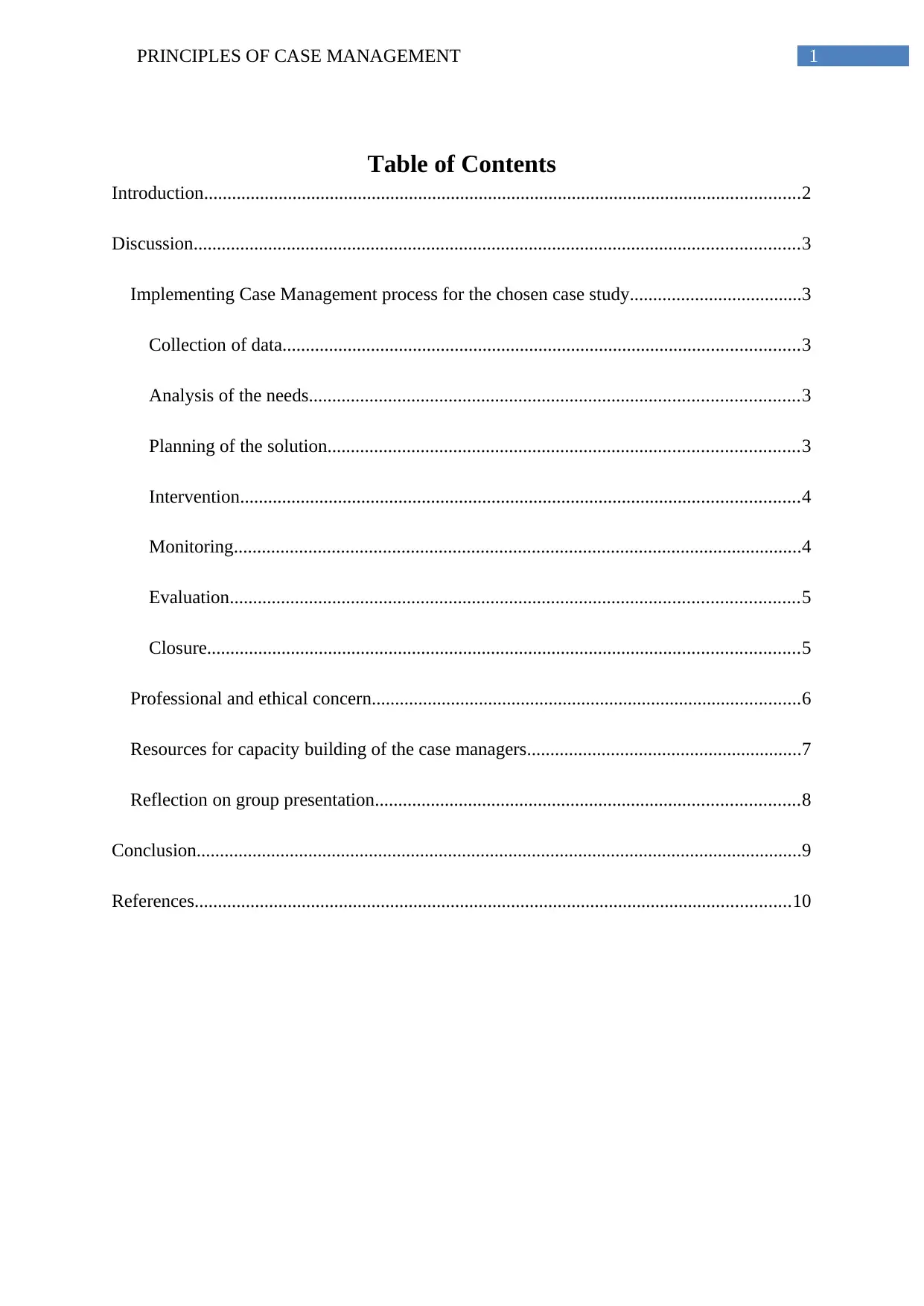
Table of Contents
Introduction................................................................................................................................2
Discussion..................................................................................................................................3
Implementing Case Management process for the chosen case study.....................................3
Collection of data...............................................................................................................3
Analysis of the needs.........................................................................................................3
Planning of the solution.....................................................................................................3
Intervention........................................................................................................................4
Monitoring..........................................................................................................................4
Evaluation..........................................................................................................................5
Closure...............................................................................................................................5
Professional and ethical concern............................................................................................6
Resources for capacity building of the case managers...........................................................7
Reflection on group presentation...........................................................................................8
Conclusion..................................................................................................................................9
References................................................................................................................................10
Table of Contents
Introduction................................................................................................................................2
Discussion..................................................................................................................................3
Implementing Case Management process for the chosen case study.....................................3
Collection of data...............................................................................................................3
Analysis of the needs.........................................................................................................3
Planning of the solution.....................................................................................................3
Intervention........................................................................................................................4
Monitoring..........................................................................................................................4
Evaluation..........................................................................................................................5
Closure...............................................................................................................................5
Professional and ethical concern............................................................................................6
Resources for capacity building of the case managers...........................................................7
Reflection on group presentation...........................................................................................8
Conclusion..................................................................................................................................9
References................................................................................................................................10
2PRINCIPLES OF CASE MANAGEMENT
Introduction
Case Management is a holistic approach to caring for individuals (Stokes et al., 2016).
Four components that ensure effective Case Management are intake, assessment of needs of
the clients, planning the service that they need and monitoring and evaluation of the proffered
service. It is not in itself a profession rather it is a specialty practice based on cross-discipline
and interdependency (Heath, Hull & Oppenheim, 2016). The principle of Case Management
is based on a best practice or outcome approach, which provides the clients with complete
wellness outcome through advocacy, education, communication, service resource
identification and service facilitation. Autonomy, beneficence, non-maleficence and justice
guide the principles of Case Management. Their work is client centered and their main motto
is to achieve safe, effective, timely, equitable and efficient service to the clients.
Case Management is a collaborative approach requires the participation of medical
and paramedical healthcare professionals (Vanderplasschen et al., 2019). Other independent
welfare organizations are also involved in the Case Management process. In this report, a
case study is analyzed through the lens of effective Case Management to determine the best
possible solution in the given scenario. Additionally, the professional and ethical concerns for
the presented scenario are identified. Moreover, the resources needed for the capacity
building for the people involved in the scenario has been evaluated. Finally, the group
presentation that involved the case study has been analyzed to reflect upon the group work
and effort.
Introduction
Case Management is a holistic approach to caring for individuals (Stokes et al., 2016).
Four components that ensure effective Case Management are intake, assessment of needs of
the clients, planning the service that they need and monitoring and evaluation of the proffered
service. It is not in itself a profession rather it is a specialty practice based on cross-discipline
and interdependency (Heath, Hull & Oppenheim, 2016). The principle of Case Management
is based on a best practice or outcome approach, which provides the clients with complete
wellness outcome through advocacy, education, communication, service resource
identification and service facilitation. Autonomy, beneficence, non-maleficence and justice
guide the principles of Case Management. Their work is client centered and their main motto
is to achieve safe, effective, timely, equitable and efficient service to the clients.
Case Management is a collaborative approach requires the participation of medical
and paramedical healthcare professionals (Vanderplasschen et al., 2019). Other independent
welfare organizations are also involved in the Case Management process. In this report, a
case study is analyzed through the lens of effective Case Management to determine the best
possible solution in the given scenario. Additionally, the professional and ethical concerns for
the presented scenario are identified. Moreover, the resources needed for the capacity
building for the people involved in the scenario has been evaluated. Finally, the group
presentation that involved the case study has been analyzed to reflect upon the group work
and effort.
⊘ This is a preview!⊘
Do you want full access?
Subscribe today to unlock all pages.

Trusted by 1+ million students worldwide
3PRINCIPLES OF CASE MANAGEMENT
Discussion
Implementing Case Management process for the chosen case study
Case Management is the single contact point for clients with total health and social
service systems. A Case Management process involves the following stages, collection of
relevant data regarding the current scenario and background information of the people
involved, assessment of the data and situation to gather a complete understanding of the
scenario and planning a process for complete care to ensure that the clients are receive the
best possible solution (Morandi et al., 2017). This is followed by intervention, monitoring the
effectiveness of the plan, evaluation of the outcome and closing the case after resolution.
Collection of data
In the presented case study, the most crucial points to note are the abusive nature of
Aden, which puts Anna and Alex in a vulnerable state. Aden does not have a job and is a
substance abuser. He is violent at times and Anna cannot support the expenses of the family
and Aden’s alcoholism through her income.
Analysis of the needs
The situation thus presented leads to the assessment that Alex needs child protection
from abusive Aden, Anna needs support for family care and new start of life, Anna and Alex
needs protection from domestic violence and drug and alcohol counselling and rehabilitation
for Alex. These solutions provides the best possible outcome for both Anna and Alex and
thus, is the planning for the case.
Planning of the solution
The presented solutions have the following rationale behind it:
The planning helps Anna to participate in groups and become more self-dependent.
Discussion
Implementing Case Management process for the chosen case study
Case Management is the single contact point for clients with total health and social
service systems. A Case Management process involves the following stages, collection of
relevant data regarding the current scenario and background information of the people
involved, assessment of the data and situation to gather a complete understanding of the
scenario and planning a process for complete care to ensure that the clients are receive the
best possible solution (Morandi et al., 2017). This is followed by intervention, monitoring the
effectiveness of the plan, evaluation of the outcome and closing the case after resolution.
Collection of data
In the presented case study, the most crucial points to note are the abusive nature of
Aden, which puts Anna and Alex in a vulnerable state. Aden does not have a job and is a
substance abuser. He is violent at times and Anna cannot support the expenses of the family
and Aden’s alcoholism through her income.
Analysis of the needs
The situation thus presented leads to the assessment that Alex needs child protection
from abusive Aden, Anna needs support for family care and new start of life, Anna and Alex
needs protection from domestic violence and drug and alcohol counselling and rehabilitation
for Alex. These solutions provides the best possible outcome for both Anna and Alex and
thus, is the planning for the case.
Planning of the solution
The presented solutions have the following rationale behind it:
The planning helps Anna to participate in groups and become more self-dependent.
Paraphrase This Document
Need a fresh take? Get an instant paraphrase of this document with our AI Paraphraser
4PRINCIPLES OF CASE MANAGEMENT
It supports her as she makes life-changing decisions.
She is able to develop relationships in support groups.
Alex is protected from emotional and physical trauma.
Aden gets a chance for sober life.
Intervention
The Intervention process would include the following intervention orders,
Child Safety for Alex
Police safety like alarms and cameras for Anna and Alex
Application to payment for parenting
Counselling for Alex
New Start allowance for Anna
Partner allowance for Anna
Monitoring
The Next step of managing the case includes monitoring the intervention plan.
Monitoring a Case Management is necessary to ensure that the services that the clients are
receiving are fulfilling their needs as a whole and they are being benefitted by the
intervention (Hudon et al., 2017). The monitoring process includes the assessment of whether
the immediate or urgent needs of the clients are fulfilled and their long-term needs are being
addressed. In the presented case scenario, the urgent needs of the client are protection of the
child and the mother from abuse and rehabilitation for Aden. The long-term needs are family
and spousal support for both Anna and Alex, counselling for all the three members,
reconciliation of Alex and Anna and procedure for separation between Anna and Aden if they
decide so. The Case Management worker needs to monitor on weekly basis, the improvement
and effectiveness of the intervention (Marin, Hauder & Matthes, 2016). The monitoring
It supports her as she makes life-changing decisions.
She is able to develop relationships in support groups.
Alex is protected from emotional and physical trauma.
Aden gets a chance for sober life.
Intervention
The Intervention process would include the following intervention orders,
Child Safety for Alex
Police safety like alarms and cameras for Anna and Alex
Application to payment for parenting
Counselling for Alex
New Start allowance for Anna
Partner allowance for Anna
Monitoring
The Next step of managing the case includes monitoring the intervention plan.
Monitoring a Case Management is necessary to ensure that the services that the clients are
receiving are fulfilling their needs as a whole and they are being benefitted by the
intervention (Hudon et al., 2017). The monitoring process includes the assessment of whether
the immediate or urgent needs of the clients are fulfilled and their long-term needs are being
addressed. In the presented case scenario, the urgent needs of the client are protection of the
child and the mother from abuse and rehabilitation for Aden. The long-term needs are family
and spousal support for both Anna and Alex, counselling for all the three members,
reconciliation of Alex and Anna and procedure for separation between Anna and Aden if they
decide so. The Case Management worker needs to monitor on weekly basis, the improvement
and effectiveness of the intervention (Marin, Hauder & Matthes, 2016). The monitoring
5PRINCIPLES OF CASE MANAGEMENT
process might involve taking weekly reports from the child protection service, counsellors,
support group moderators, and rehabilitation centers. Apart from that investigating from the
neighbors and relatives are also effective in this scenario. Maintaining surveillance of the
family members, following up with service providers and the clients, checking their
improvement records, reviewing the data and reporting to the concerned people will ensure
that the monitoring has been effective (Reeves et al., 2018).
Evaluation
The evaluation process in this case needs to take into account the success of the Child
Protection Services in protecting Alex from mental and physical trauma, success of the
family support programs by evaluating Anna’s approach to taking care of Alex, improvement
of Aden in rehabilitation and the success of reconciliation of the family. If all efforts fail, the
case managers need to provide Anna with Domestic violence protection and prepare for a
separation process for Anna or Alex depending on the situation. The effectiveness of the
intervention will allow Anna to become more dependent and learn how to care for Alex.
Through Childcare Support Alex should be able to return to school and concentrate on his
studies. Monitoring would also allow the caseworkers to keep track of the reconciliation
success (Nsibande et al., 2018).
Closure
For closure, Aden should be removed from the house so that Anna and Alex are
protected from any harm. The removal may be either permanent or temporary depending on
Aden’s effort in recovering from substance abuse. Alex’s counselling should continue, as he
would need constant support for settling into a new life. Even if he is put into Anna’s care, it
needs to be monitored.
process might involve taking weekly reports from the child protection service, counsellors,
support group moderators, and rehabilitation centers. Apart from that investigating from the
neighbors and relatives are also effective in this scenario. Maintaining surveillance of the
family members, following up with service providers and the clients, checking their
improvement records, reviewing the data and reporting to the concerned people will ensure
that the monitoring has been effective (Reeves et al., 2018).
Evaluation
The evaluation process in this case needs to take into account the success of the Child
Protection Services in protecting Alex from mental and physical trauma, success of the
family support programs by evaluating Anna’s approach to taking care of Alex, improvement
of Aden in rehabilitation and the success of reconciliation of the family. If all efforts fail, the
case managers need to provide Anna with Domestic violence protection and prepare for a
separation process for Anna or Alex depending on the situation. The effectiveness of the
intervention will allow Anna to become more dependent and learn how to care for Alex.
Through Childcare Support Alex should be able to return to school and concentrate on his
studies. Monitoring would also allow the caseworkers to keep track of the reconciliation
success (Nsibande et al., 2018).
Closure
For closure, Aden should be removed from the house so that Anna and Alex are
protected from any harm. The removal may be either permanent or temporary depending on
Aden’s effort in recovering from substance abuse. Alex’s counselling should continue, as he
would need constant support for settling into a new life. Even if he is put into Anna’s care, it
needs to be monitored.
⊘ This is a preview!⊘
Do you want full access?
Subscribe today to unlock all pages.
Trusted by 1+ million students worldwide
6PRINCIPLES OF CASE MANAGEMENT
Professional and ethical concern
Case managers need to consider several professional and ethical aspects while
delivering their services. A successful case manager ensures that the analysis of the client
needs are done comprehensively so that proper identification is done, the client is provided
with options for necessary services and the clients have access to the resources that they need
for meeting their needs (Breda, 2018). The professional concern for Case Management
includes:
They must put the interest of the public above their personal interest, which means
giving the clients the most importance.
They must ensure that they give their clients the respect and dignity that is deserved
by all human beings.
They must remain objective in their approach to clients and their situations, which
indicates that they must not get too emotionally involved with the clients and their
problems (Cardona-Cardona, Montaño-Moreno & Campos-Vidal, 2017).
They must act with integrity when working with other professionals so that the client
they are serving gets the best outcome.
They also must ensure that the service and benefits that they are offering to the client
are to the client’s best interest and matches the situation of individual clients.
They also must ensure that they are obeying the state and country laws and
regulations.
The ethical liability of Case Management is based on Advocacy, Autonomy, Beneficence,
Justice, Non-maleficence and veracity (Hamilton, Roe & Gootherts, 2016). Advocacy allows
them to act on behalf of people who cannot speak for their own self. For example, in the case
study, Alex is a minor and thus cannot take his decisions, the father is substance abuser and
Professional and ethical concern
Case managers need to consider several professional and ethical aspects while
delivering their services. A successful case manager ensures that the analysis of the client
needs are done comprehensively so that proper identification is done, the client is provided
with options for necessary services and the clients have access to the resources that they need
for meeting their needs (Breda, 2018). The professional concern for Case Management
includes:
They must put the interest of the public above their personal interest, which means
giving the clients the most importance.
They must ensure that they give their clients the respect and dignity that is deserved
by all human beings.
They must remain objective in their approach to clients and their situations, which
indicates that they must not get too emotionally involved with the clients and their
problems (Cardona-Cardona, Montaño-Moreno & Campos-Vidal, 2017).
They must act with integrity when working with other professionals so that the client
they are serving gets the best outcome.
They also must ensure that the service and benefits that they are offering to the client
are to the client’s best interest and matches the situation of individual clients.
They also must ensure that they are obeying the state and country laws and
regulations.
The ethical liability of Case Management is based on Advocacy, Autonomy, Beneficence,
Justice, Non-maleficence and veracity (Hamilton, Roe & Gootherts, 2016). Advocacy allows
them to act on behalf of people who cannot speak for their own self. For example, in the case
study, Alex is a minor and thus cannot take his decisions, the father is substance abuser and
Paraphrase This Document
Need a fresh take? Get an instant paraphrase of this document with our AI Paraphraser
7PRINCIPLES OF CASE MANAGEMENT
thus is deemed unsuitable to take decisions and the mother is too distressed to take decisions.
Thus, the caseworker must take decisions for his benefit until the situation changes.
Autonomy allows the patients to select their own course of action, to choose their healthcare.
Beneficence directs them to promote good and actively prevent or remove harm, Justice
directs them to decide right and fair and take decisions based on that and non-maleficence
directs them to keep from doing any harm to any person (Gibson, Samuels & Pryce, 2018).
Veracity is their liability to tell the truth in ethical situations.
Resources for capacity building of the case managers
Capacity building in Case Management is the process through individuals are able to
develop and retain their skills and other resources needed for their jobs (Powell & Tahan,
2018). In Case Management, two key resources are related to capacity building. They are the
Child Protection Case Management training for caseworkers, supervisors and managers and
the Child Protection Case Management Supervision and Coaching Training. Capacity
building for managing these kinds of cases requires empathy, resource planning and a drive
to provide best outcome. In order to provide best outcome planning for intervention is
required which in turn needs a knowledge of organizations and programs that are able to
provide support for different clients and the legal and ethical issues that they need to consider
while managing a case (Hingley-Jones & Ruch, 2016).
For capacity building, case managers also need support from healthcare, mental health
and childcare agencies who are able to provide best possible solution for individual people.
They also need support from the law enforcement and legal personnel so that they can
provide all the necessary support. The capacity building requires the case managers to
develop skills related to background research, analyze scenario, assessment of the scenario,
understanding the need of the clients and providing the best possible solution to them
thus is deemed unsuitable to take decisions and the mother is too distressed to take decisions.
Thus, the caseworker must take decisions for his benefit until the situation changes.
Autonomy allows the patients to select their own course of action, to choose their healthcare.
Beneficence directs them to promote good and actively prevent or remove harm, Justice
directs them to decide right and fair and take decisions based on that and non-maleficence
directs them to keep from doing any harm to any person (Gibson, Samuels & Pryce, 2018).
Veracity is their liability to tell the truth in ethical situations.
Resources for capacity building of the case managers
Capacity building in Case Management is the process through individuals are able to
develop and retain their skills and other resources needed for their jobs (Powell & Tahan,
2018). In Case Management, two key resources are related to capacity building. They are the
Child Protection Case Management training for caseworkers, supervisors and managers and
the Child Protection Case Management Supervision and Coaching Training. Capacity
building for managing these kinds of cases requires empathy, resource planning and a drive
to provide best outcome. In order to provide best outcome planning for intervention is
required which in turn needs a knowledge of organizations and programs that are able to
provide support for different clients and the legal and ethical issues that they need to consider
while managing a case (Hingley-Jones & Ruch, 2016).
For capacity building, case managers also need support from healthcare, mental health
and childcare agencies who are able to provide best possible solution for individual people.
They also need support from the law enforcement and legal personnel so that they can
provide all the necessary support. The capacity building requires the case managers to
develop skills related to background research, analyze scenario, assessment of the scenario,
understanding the need of the clients and providing the best possible solution to them
8PRINCIPLES OF CASE MANAGEMENT
(Damiani-Taraba et al., 2017). They are also required to develop monitoring and evaluation
skills for the intervention. The resources that they need also include funding, proper training
for Case Management, ethical guidance and real life experience or fieldwork, that helps them
in future workplace practice.
Reflection on group presentation
In our class, we provided a group presentation where we analyzed the case study and
presented solution, intervention and monitoring plan for the chosen case study. We were
three people in the group and the group presentation provided us with an opportunity to
understand the way collaborative process works. When we first started to work, we faced
many challenges and issues in creating a balance. We were unable to understand the strengths
of each other and in our initial meetings, we talked a lot but no significant progress was
made. Then we decided to have an informal meeting, which actually helped us. We learnt
about each other and in the next group session, we divided the task within us. There were no
one leader of the group; each took leadership roles in their own genre.
The group presentation also enhanced our public speaking and oral presentation skills.
It enabled us to look into the depths of alcohol and substance abuse and how these cases are
handled, how ethical and professional dilemma often arise while working as a case manager.
Moreover, through the group presentation we were able to develop our team building
capacity. As we had lost much of our valuable time at the beginning, we started doing smart
work and in the end could save time when we could prepare our presentation delivery and
timing. The group presentation also helped in understanding the principles and processes of
Case Management.
(Damiani-Taraba et al., 2017). They are also required to develop monitoring and evaluation
skills for the intervention. The resources that they need also include funding, proper training
for Case Management, ethical guidance and real life experience or fieldwork, that helps them
in future workplace practice.
Reflection on group presentation
In our class, we provided a group presentation where we analyzed the case study and
presented solution, intervention and monitoring plan for the chosen case study. We were
three people in the group and the group presentation provided us with an opportunity to
understand the way collaborative process works. When we first started to work, we faced
many challenges and issues in creating a balance. We were unable to understand the strengths
of each other and in our initial meetings, we talked a lot but no significant progress was
made. Then we decided to have an informal meeting, which actually helped us. We learnt
about each other and in the next group session, we divided the task within us. There were no
one leader of the group; each took leadership roles in their own genre.
The group presentation also enhanced our public speaking and oral presentation skills.
It enabled us to look into the depths of alcohol and substance abuse and how these cases are
handled, how ethical and professional dilemma often arise while working as a case manager.
Moreover, through the group presentation we were able to develop our team building
capacity. As we had lost much of our valuable time at the beginning, we started doing smart
work and in the end could save time when we could prepare our presentation delivery and
timing. The group presentation also helped in understanding the principles and processes of
Case Management.
⊘ This is a preview!⊘
Do you want full access?
Subscribe today to unlock all pages.
Trusted by 1+ million students worldwide
9PRINCIPLES OF CASE MANAGEMENT
Conclusion
From the above discussion, it can be concluded that Case Management is a practice
that collaborates all the essential aspects of caring for a person in need. It enables a one-point
contact for all their needs. Thus, the case managers must be able to understand and
differentiate between the needs of individuals. This requires a humanistic and singular
approach which means that every individual and their problems will be treated as unique and
the care that is provided to them will be designed in such a way that it fulfills all their needs
and addresses all the necessary aspects of solving the problem from roots. While providing
this service case managers require ethical and professional guidelines so that they can deliver
effective service. They need resources to build their capacity as case managers. The presented
case study provides insight into the approaches to case management and the group
presentation enabled us to engage with them in more depth.
Conclusion
From the above discussion, it can be concluded that Case Management is a practice
that collaborates all the essential aspects of caring for a person in need. It enables a one-point
contact for all their needs. Thus, the case managers must be able to understand and
differentiate between the needs of individuals. This requires a humanistic and singular
approach which means that every individual and their problems will be treated as unique and
the care that is provided to them will be designed in such a way that it fulfills all their needs
and addresses all the necessary aspects of solving the problem from roots. While providing
this service case managers require ethical and professional guidelines so that they can deliver
effective service. They need resources to build their capacity as case managers. The presented
case study provides insight into the approaches to case management and the group
presentation enabled us to engage with them in more depth.
Paraphrase This Document
Need a fresh take? Get an instant paraphrase of this document with our AI Paraphraser
10PRINCIPLES OF CASE MANAGEMENT
References
Cardona-Cardona, J., Montaño-Moreno, J. J., & Campos-Vidal, J. F. (2017). Definition of
Intervention Contexts in Social Casework Practice: Predictor Variables. The British
Journal of Social Work, 47(2), 343-357.
Damiani-Taraba, G., Dumbrill, G., Gladstone, J., Koster, A., Leslie, B., & Charles, M.
(2017). The evolving relationship between casework skills, engagement, and positive
case outcomes in child protection: A structural equation model. Children and Youth
Services Review, 79, 456-462.
Gibson, K., Samuels, G., & Pryce, J. (2018). Authors of accountability: Paperwork and social
work in contemporary child welfare practice. Children and Youth Services
Review, 85, 43-52.
Hamilton, P. M., Roe, M. M., & Gootherts, E. (2016). Ethics for Case Managers.
Heath III, F. F., Hull, R., & Oppenheim, D. (2016). Applying Case Management Principles to
Support Analytics Process Management. In International Conference on Business
Process Management (pp. 376-388). Springer, Cham.
Hingley-Jones, H., & Ruch, G. (2016). ‘Stumbling through’? Relationship-based social work
practice in austere times. Journal of Social Work Practice, 30(3), 235-248.
Hudon, C., Chouinard, M. C., Lambert, M., Diadiou, F., Bouliane, D., & Beaudin, J. (2017).
Key factors of case management interventions for frequent users of healthcare
services: a thematic analysis review. BMJ open, 7(10), e017762.
References
Cardona-Cardona, J., Montaño-Moreno, J. J., & Campos-Vidal, J. F. (2017). Definition of
Intervention Contexts in Social Casework Practice: Predictor Variables. The British
Journal of Social Work, 47(2), 343-357.
Damiani-Taraba, G., Dumbrill, G., Gladstone, J., Koster, A., Leslie, B., & Charles, M.
(2017). The evolving relationship between casework skills, engagement, and positive
case outcomes in child protection: A structural equation model. Children and Youth
Services Review, 79, 456-462.
Gibson, K., Samuels, G., & Pryce, J. (2018). Authors of accountability: Paperwork and social
work in contemporary child welfare practice. Children and Youth Services
Review, 85, 43-52.
Hamilton, P. M., Roe, M. M., & Gootherts, E. (2016). Ethics for Case Managers.
Heath III, F. F., Hull, R., & Oppenheim, D. (2016). Applying Case Management Principles to
Support Analytics Process Management. In International Conference on Business
Process Management (pp. 376-388). Springer, Cham.
Hingley-Jones, H., & Ruch, G. (2016). ‘Stumbling through’? Relationship-based social work
practice in austere times. Journal of Social Work Practice, 30(3), 235-248.
Hudon, C., Chouinard, M. C., Lambert, M., Diadiou, F., Bouliane, D., & Beaudin, J. (2017).
Key factors of case management interventions for frequent users of healthcare
services: a thematic analysis review. BMJ open, 7(10), e017762.
11PRINCIPLES OF CASE MANAGEMENT
Marin, M. A., Hauder, M., & Matthes, F. (2016). Case management: an evaluation of existing
approaches for knowledge-intensive processes. In International Conference on
Business Process Management (pp. 5-16). Springer, Cham.
Morandi, S., Silva, B., Golay, P., & Bonsack, C. (2017). Intensive Case Management for
Addiction to promote engagement with care of people with severe mental and
substance use disorders: an observational study. Substance abuse treatment,
prevention, and policy, 12(1), 26.
Nsibande, D., Loveday, M., Daniels, K., Sanders, D., Doherty, T., & Zembe, W. (2018).
Approaches and strategies used in the training and supervision of Health Extension
Workers (HEWs) delivering integrated community case management (iCCM) of
childhood illness in Ethiopia: a qualitative rapid appraisal. African health
sciences, 18(1), 188-197.
Powell, S. K., & Tahan, H. M. (2018). Case management: A practical guide for education
and practice. Lippincott Williams & Wilkins.
Reeves, S., Straus, S. E., Pinfold, P., Goldman, J., & Zwarenstein, M. (2018). Case
management: effects on professional practice and health care outcomes. The
Cochrane database of systematic reviews, 2018(2).
Stokes, J., Kristensen, S. R., Checkland, K., & Bower, P. (2016). Effectiveness of
multidisciplinary team case management: difference-in-differences analysis. BMJ
open, 6(4), e010468.
van Breda, A. (2018). Developmental social case work: A process model. International
Social Work, 61(1), 66-78.
Marin, M. A., Hauder, M., & Matthes, F. (2016). Case management: an evaluation of existing
approaches for knowledge-intensive processes. In International Conference on
Business Process Management (pp. 5-16). Springer, Cham.
Morandi, S., Silva, B., Golay, P., & Bonsack, C. (2017). Intensive Case Management for
Addiction to promote engagement with care of people with severe mental and
substance use disorders: an observational study. Substance abuse treatment,
prevention, and policy, 12(1), 26.
Nsibande, D., Loveday, M., Daniels, K., Sanders, D., Doherty, T., & Zembe, W. (2018).
Approaches and strategies used in the training and supervision of Health Extension
Workers (HEWs) delivering integrated community case management (iCCM) of
childhood illness in Ethiopia: a qualitative rapid appraisal. African health
sciences, 18(1), 188-197.
Powell, S. K., & Tahan, H. M. (2018). Case management: A practical guide for education
and practice. Lippincott Williams & Wilkins.
Reeves, S., Straus, S. E., Pinfold, P., Goldman, J., & Zwarenstein, M. (2018). Case
management: effects on professional practice and health care outcomes. The
Cochrane database of systematic reviews, 2018(2).
Stokes, J., Kristensen, S. R., Checkland, K., & Bower, P. (2016). Effectiveness of
multidisciplinary team case management: difference-in-differences analysis. BMJ
open, 6(4), e010468.
van Breda, A. (2018). Developmental social case work: A process model. International
Social Work, 61(1), 66-78.
⊘ This is a preview!⊘
Do you want full access?
Subscribe today to unlock all pages.
Trusted by 1+ million students worldwide

1 out of 13


Related Documents


Your All-in-One AI-Powered Toolkit for Academic Success.
+13062052269
info@desklib.com
Available 24*7 on WhatsApp / Email
![[object Object]](/_next/static/media/star-bottom.7253800d.svg)
Unlock your academic potential
Copyright © 2020–2026 A2Z Services. All Rights Reserved. Developed and managed by ZUCOL.