Flu Case Study: Survey Analysis, Data Collection Methods, and Analysis

Verified

Added on  2021/04/17

|4
|690
|45
Report
AI Summary
This report presents a flu case study analyzing survey data and data collection methods. The study explores the use of e-tablets for efficient data gathering, comparing it to traditional paper-based methods, and highlights the advantages of e-tablets, such as increased efficiency, direct communication, cost-effectiveness, and reduced security risks. The report also discusses the importance of survey questions for gathering relevant information from participants, including those who are vaccinated and those who are not. Furthermore, the report suggests that the mean would be the most suitable measure of central tendency for analyzing the data, as it uses every value collected and provides a stable measure across repeated surveys. The analysis is supported by references to relevant literature on research methods and statistical analysis.

Document Page
Running Head: FLU CASE STUDY 1
Flu case study
Student
Course
Tutor
Date
tabler-icon-diamond-filled.svg

Paraphrase This Document

Need a fresh take? Get an instant paraphrase of this document with our AI Paraphraser
Document Page
FLU CASE STUDY 2
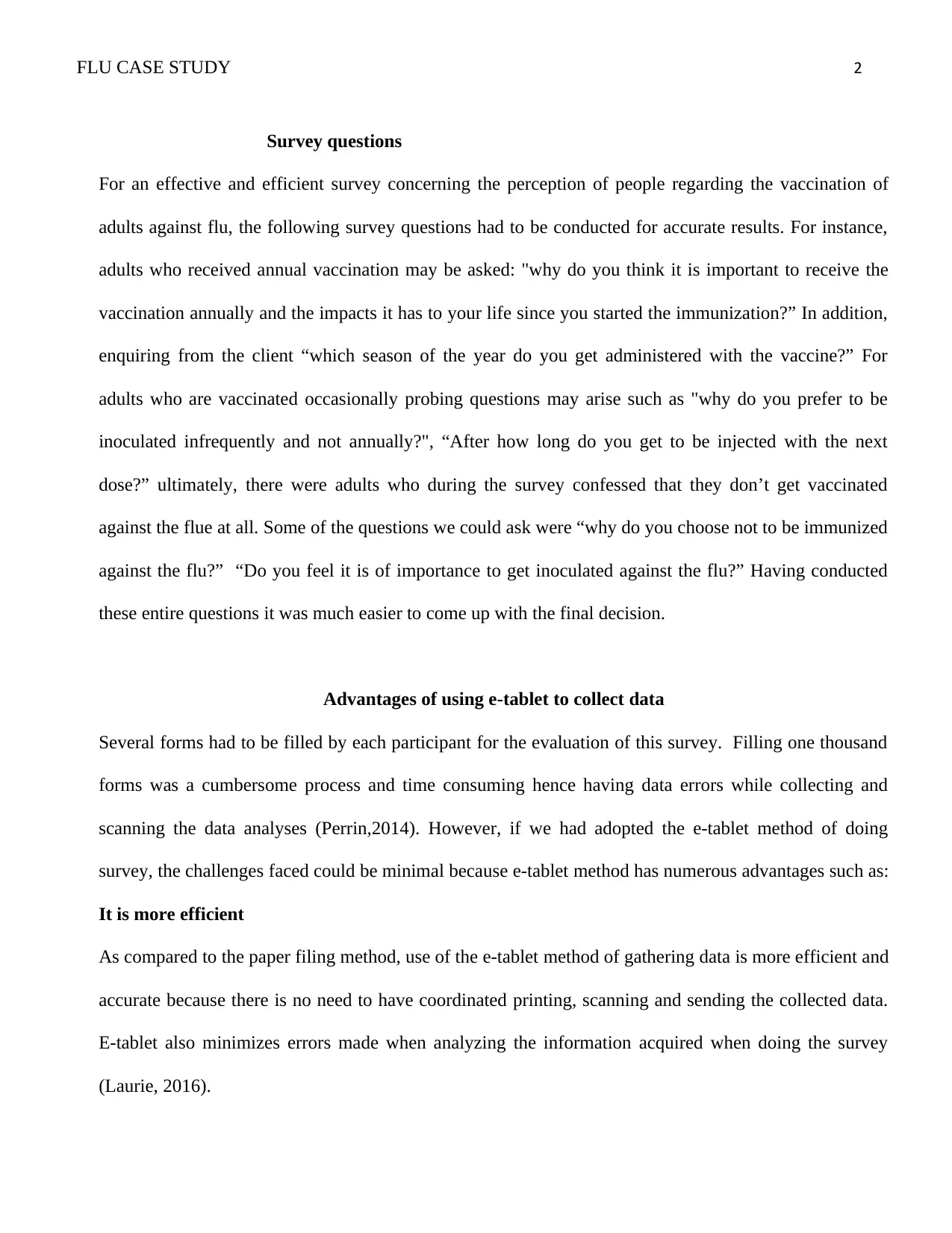
Survey questions
For an effective and efficient survey concerning the perception of people regarding the vaccination of
adults against flu, the following survey questions had to be conducted for accurate results. For instance,
adults who received annual vaccination may be asked: "why do you think it is important to receive the
vaccination annually and the impacts it has to your life since you started the immunization?” In addition,
enquiring from the client “which season of the year do you get administered with the vaccine?” For
adults who are vaccinated occasionally probing questions may arise such as "why do you prefer to be
inoculated infrequently and not annually?", “After how long do you get to be injected with the next
dose?” ultimately, there were adults who during the survey confessed that they don’t get vaccinated
against the flue at all. Some of the questions we could ask were “why do you choose not to be immunized
against the flu?” “Do you feel it is of importance to get inoculated against the flu?” Having conducted
these entire questions it was much easier to come up with the final decision.
Advantages of using e-tablet to collect data
Several forms had to be filled by each participant for the evaluation of this survey. Filling one thousand
forms was a cumbersome process and time consuming hence having data errors while collecting and
scanning the data analyses (Perrin,2014). However, if we had adopted the e-tablet method of doing
survey, the challenges faced could be minimal because e-tablet method has numerous advantages such as:
It is more efficient
As compared to the paper filing method, use of the e-tablet method of gathering data is more efficient and
accurate because there is no need to have coordinated printing, scanning and sending the collected data.
E-tablet also minimizes errors made when analyzing the information acquired when doing the survey
(Laurie, 2016).
Document Page
FLU CASE STUDY 3
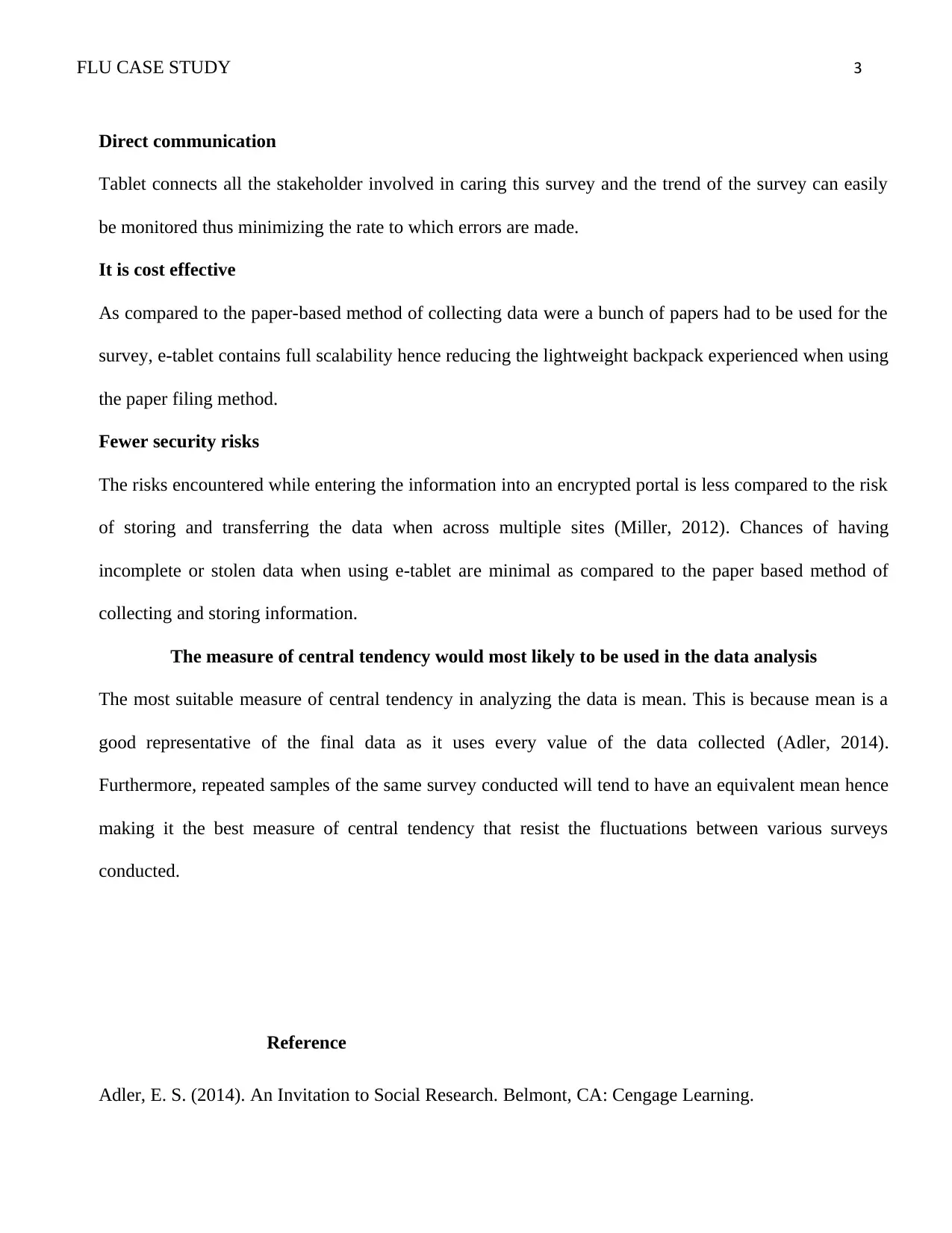
Direct communication
Tablet connects all the stakeholder involved in caring this survey and the trend of the survey can easily
be monitored thus minimizing the rate to which errors are made.
It is cost effective
As compared to the paper-based method of collecting data were a bunch of papers had to be used for the
survey, e-tablet contains full scalability hence reducing the lightweight backpack experienced when using
the paper filing method.
Fewer security risks
The risks encountered while entering the information into an encrypted portal is less compared to the risk
of storing and transferring the data when across multiple sites (Miller, 2012). Chances of having
incomplete or stolen data when using e-tablet are minimal as compared to the paper based method of
collecting and storing information.
The measure of central tendency would most likely to be used in the data analysis
The most suitable measure of central tendency in analyzing the data is mean. This is because mean is a
good representative of the final data as it uses every value of the data collected (Adler, 2014).
Furthermore, repeated samples of the same survey conducted will tend to have an equivalent mean hence
making it the best measure of central tendency that resist the fluctuations between various surveys
conducted.
Reference
Adler, E. S. (2014). An Invitation to Social Research. Belmont, CA: Cengage Learning.
Document Page
FLU CASE STUDY 4
Laurie, C. (2016). Doing real research: a practical guide to social research. Los Angeles: SAGE.
Miller, R. K. (2012). Rethinking reference and instruction with tablets. Chicago: ALATechSource.
Perrin, K. (. (2014). Principles of Evaluation and Research for Health Care Programs. Sudbury: Jones & Bartlett
Learning.
chevron_up_icon
1 out of 4
circle_padding
hide_on_mobile
zoom_out_icon
[object Object]