Principles of Financial Literacy: A Comprehensive Analysis
VerifiedAdded on 2019/09/19
|16
|3682
|361
Report
AI Summary
This report provides a comprehensive overview of the principles of financial literacy. It begins by defining financial literacy and its importance, then delves into key concepts such as budgeting and financial planning, emphasizing the significance of understanding income management and investment strategies. The report explores risk management, including the role of insurance, and highlights the importance of considering superannuation and legal aspects like power of attorney and valid wills. It discusses the differences between various investment strategies, such as direct investing versus mutual funds, and government versus corporate bonds. The report also examines the role of financial literacy initiatives and their impact. Finally, it concludes by summarizing the main points and emphasizing the need for continuous financial education to make informed financial decisions and achieve long-term financial well-being.
Principles of Financial Literacy

Paraphrase This Document
Need a fresh take? Get an instant paraphrase of this document with our AI Paraphraser
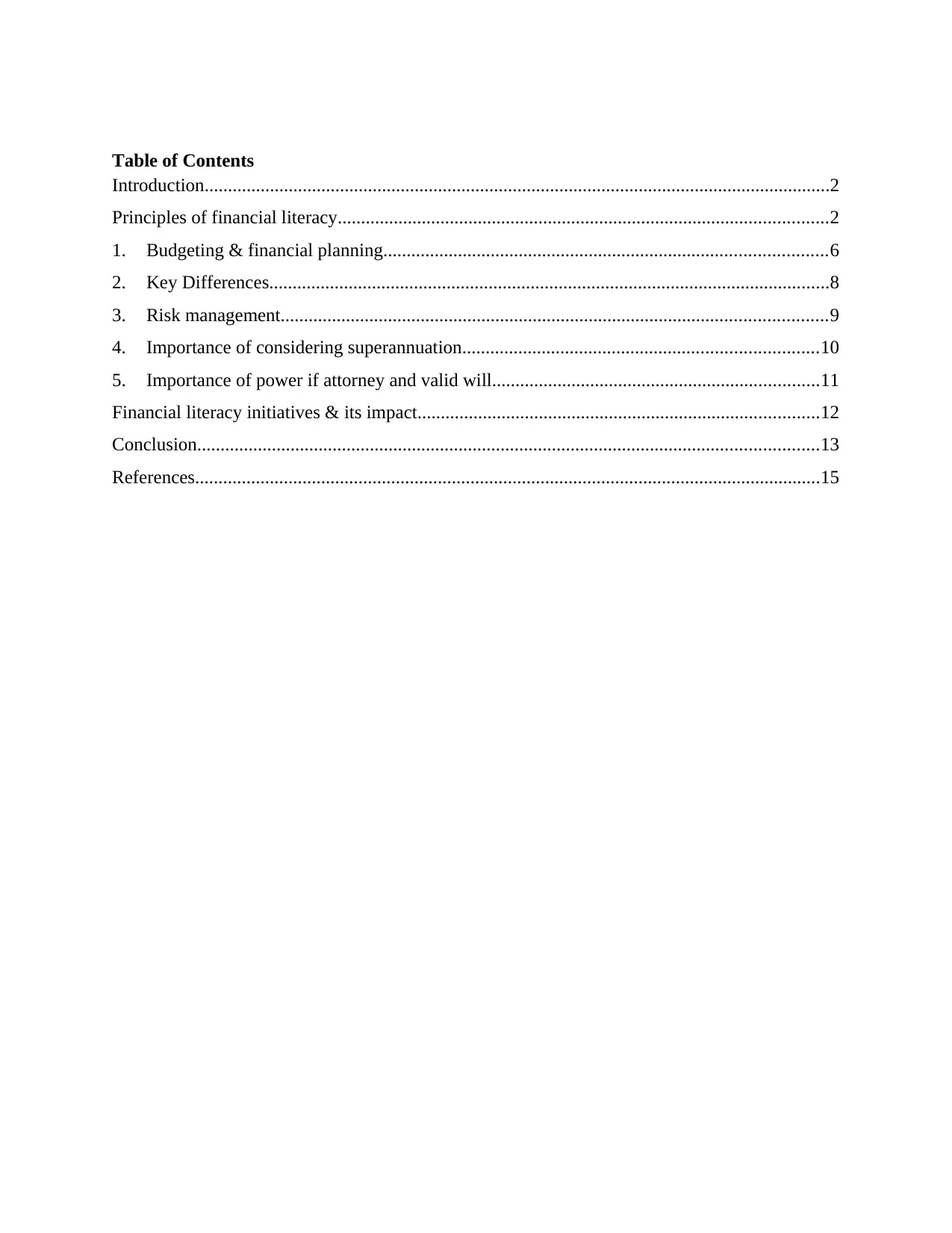
Table of Contents
Introduction......................................................................................................................................2
Principles of financial literacy.........................................................................................................2
1. Budgeting & financial planning...............................................................................................6
2. Key Differences........................................................................................................................8
3. Risk management.....................................................................................................................9
4. Importance of considering superannuation............................................................................10
5. Importance of power if attorney and valid will......................................................................11
Financial literacy initiatives & its impact......................................................................................12
Conclusion.....................................................................................................................................13
References......................................................................................................................................15
Introduction......................................................................................................................................2
Principles of financial literacy.........................................................................................................2
1. Budgeting & financial planning...............................................................................................6
2. Key Differences........................................................................................................................8
3. Risk management.....................................................................................................................9
4. Importance of considering superannuation............................................................................10
5. Importance of power if attorney and valid will......................................................................11
Financial literacy initiatives & its impact......................................................................................12
Conclusion.....................................................................................................................................13
References......................................................................................................................................15
Introduction
In this present paper, we will discuss the principles of financial literacy. The financial literacy is
defined as the ability to understand the working of money in the world. It includes the managing
of income of an individual in order to generate higher returns within the particular period of
time. It also comprised the skills and knowledge of an individual who helps to take an effective
decision regarding the utilization of financial resources. The short-term programs are focusing on
raising interest in personal finance in various countries such as Japan, United States, Australia
and the United Kingdom.
In the United Kingdom, it is recognized as the financial capability and the government has
started national strategy on financial capability in the year 2003 (Fernandes et al., 2014). The
government of the United States had also taken the initiative by established financial literacy and
education commission in the year 2003. According to the analysis of financial literacy by the
international OECD study, it is found that there were only 67% of respondents have an
understanding of compounded interest, but out of them, only 28 people are having a good
understanding of compound interest (Jappelli et al., 2013). In the Canadian survey, it is
considered by the respondents that the right investment prediction is more difficult than selecting
the dentist. In the survey of United States, it is found that the four out of ten people are not
saving for their retirement.
Principles of financial literacy
In the recent years, the concerned regarding the financial literacy have been improved across the
worldwide in order to enhance the financial knowledge of people. It has stemmed in the specific
In this present paper, we will discuss the principles of financial literacy. The financial literacy is
defined as the ability to understand the working of money in the world. It includes the managing
of income of an individual in order to generate higher returns within the particular period of
time. It also comprised the skills and knowledge of an individual who helps to take an effective
decision regarding the utilization of financial resources. The short-term programs are focusing on
raising interest in personal finance in various countries such as Japan, United States, Australia
and the United Kingdom.
In the United Kingdom, it is recognized as the financial capability and the government has
started national strategy on financial capability in the year 2003 (Fernandes et al., 2014). The
government of the United States had also taken the initiative by established financial literacy and
education commission in the year 2003. According to the analysis of financial literacy by the
international OECD study, it is found that there were only 67% of respondents have an
understanding of compounded interest, but out of them, only 28 people are having a good
understanding of compound interest (Jappelli et al., 2013). In the Canadian survey, it is
considered by the respondents that the right investment prediction is more difficult than selecting
the dentist. In the survey of United States, it is found that the four out of ten people are not
saving for their retirement.
Principles of financial literacy
In the recent years, the concerned regarding the financial literacy have been improved across the
worldwide in order to enhance the financial knowledge of people. It has stemmed in the specific
⊘ This is a preview!⊘
Do you want full access?
Subscribe today to unlock all pages.

Trusted by 1+ million students worldwide
from public to private support system through shifting the demographic files which comprise of
aging of population and development in the wide range in the financial market. The concern was
highlighted mainly due to the financial and economic challenges which recognize the lack of
financial literacy and it contributes towards the ill financial decision making of people (Lusardi
et al., 2014).
Following are the seven principles of financial literacy which are developed by the organization
for economic cooperation and development in order to improve the financial literacy across the
worldwide:
1. Financial education
The aim of the financial education principle is to improve the knowledge related to the
financial products, risk, concept, information and objective advice in order to improve the
decision making of an individual which enables to enhance the financial wellbeing of
people. The financial education is beyond the provision of financial advice and
information which should be regulated in order to improve the decision making of an
individual and protect the financials of clients.
2. Financial capacity building
Another principle of financial literacy is to build the financial capacity through the
financial information and instruction which should be promoted in order to achieve the
objective of principles. The financial education should be providing in an unbiased
manner and fair in order to improve the knowledge of people. The various programs
should be coordinated in order to develop the efficiency among the people.
3. Financial education program
aging of population and development in the wide range in the financial market. The concern was
highlighted mainly due to the financial and economic challenges which recognize the lack of
financial literacy and it contributes towards the ill financial decision making of people (Lusardi
et al., 2014).
Following are the seven principles of financial literacy which are developed by the organization
for economic cooperation and development in order to improve the financial literacy across the
worldwide:
1. Financial education
The aim of the financial education principle is to improve the knowledge related to the
financial products, risk, concept, information and objective advice in order to improve the
decision making of an individual which enables to enhance the financial wellbeing of
people. The financial education is beyond the provision of financial advice and
information which should be regulated in order to improve the decision making of an
individual and protect the financials of clients.
2. Financial capacity building
Another principle of financial literacy is to build the financial capacity through the
financial information and instruction which should be promoted in order to achieve the
objective of principles. The financial education should be providing in an unbiased
manner and fair in order to improve the knowledge of people. The various programs
should be coordinated in order to develop the efficiency among the people.
3. Financial education program
Paraphrase This Document
Need a fresh take? Get an instant paraphrase of this document with our AI Paraphraser
The focus of financial education program is to improve the high priority issues which
depend on the national circumstances it includes the importance of financial life
planning, for example, private debt management, savings, insurance, financial awareness
for example elementary financial mathematics and economics. The awareness among the
future retirees must be developed regarding the assessment of retirement saving scheme
in order to provide financial stability for the life of an individual (Taft et al., 2013).
4. Regulatory and administrative framework
The account of regulatory and administrative should include the financial education
which acts as a promoter tool to improve the economic growth of the nation. The
togetherness of financial regulation helps to improve the consumer protection. The
financial education should be promoted in order to develop the awareness among the
consumers
5. Measures
The corrective measures must be taken when the deficiencies are predicted in the
financial capacity. There are various policies tools which should be used to protect the
consumers and the regulations of financial institutions. The default mechanism should b e
into account the financial education without limiting the freedom of contract.
6. Role of financial institutions
The role of financial institutions should be promoted in order to improve the financial
education of people and to become the part of good governance for the financial clients.
The accountability and responsibility of financial institutions should be encouraged in
order to provide the information as well as the advice related to the financial issues and
the financial awareness among the clients must be promoted in order to improve the
depend on the national circumstances it includes the importance of financial life
planning, for example, private debt management, savings, insurance, financial awareness
for example elementary financial mathematics and economics. The awareness among the
future retirees must be developed regarding the assessment of retirement saving scheme
in order to provide financial stability for the life of an individual (Taft et al., 2013).
4. Regulatory and administrative framework
The account of regulatory and administrative should include the financial education
which acts as a promoter tool to improve the economic growth of the nation. The
togetherness of financial regulation helps to improve the consumer protection. The
financial education should be promoted in order to develop the awareness among the
consumers
5. Measures
The corrective measures must be taken when the deficiencies are predicted in the
financial capacity. There are various policies tools which should be used to protect the
consumers and the regulations of financial institutions. The default mechanism should b e
into account the financial education without limiting the freedom of contract.
6. Role of financial institutions
The role of financial institutions should be promoted in order to improve the financial
education of people and to become the part of good governance for the financial clients.
The accountability and responsibility of financial institutions should be encouraged in
order to provide the information as well as the advice related to the financial issues and
the financial awareness among the clients must be promoted in order to improve the
effective decision making related to the long-term commitment of funds which represents
the future income of an individual (Xiao et al., 2014).
7. Designing of financial education program
The financial education program should be designed to develop the financial awareness
among the people and improve the financial literacy of target audience. The financial
education should be regarded as continues process in order to enhance the financial
knowledge related to the complex market.
The United States Securities and Exchange Commission has developed the
principles for personal financing in order to improve the financial literacy among
the natives:
1. Make a plan
It is the key to financial security in order to achieve the financial goals of an
individual. The financial plan acts as a roadmap to get comfortable retirement and the
financially secure life.
2. Save and invest for the long period
The savings must be done by an individual in order to secure the future. The period of
investment should be long in order to maximize the return, but it also includes
financial risk which can be reducing through financial literacy.
3. Scrutinize before the investment
The investigation must be properly done regarding the investment plan in order to
minimize the risk related to the investment.
4. Avoid the cost of delay
the future income of an individual (Xiao et al., 2014).
7. Designing of financial education program
The financial education program should be designed to develop the financial awareness
among the people and improve the financial literacy of target audience. The financial
education should be regarded as continues process in order to enhance the financial
knowledge related to the complex market.
The United States Securities and Exchange Commission has developed the
principles for personal financing in order to improve the financial literacy among
the natives:
1. Make a plan
It is the key to financial security in order to achieve the financial goals of an
individual. The financial plan acts as a roadmap to get comfortable retirement and the
financially secure life.
2. Save and invest for the long period
The savings must be done by an individual in order to secure the future. The period of
investment should be long in order to maximize the return, but it also includes
financial risk which can be reducing through financial literacy.
3. Scrutinize before the investment
The investigation must be properly done regarding the investment plan in order to
minimize the risk related to the investment.
4. Avoid the cost of delay
⊘ This is a preview!⊘
Do you want full access?
Subscribe today to unlock all pages.
Trusted by 1+ million students worldwide
Time is considered as one of the most important factors which need to be considering
at the time of making the investment. For example, if the investment saves $5 at
eight percent in the age of 18 years than at the age of 65 then total amount will be
$134,000. So the investment should not be delays in order to maximize the returns
(Markham et al., 2015).
1. Budgeting & financial planning
Following are the factors which show that the financial planning and budgeting
helps to achieve the goals and objectives:
1. Know the total home pay
The home pay includes the total expenses which must be deducted in order to
determine the available money for the investment purpose.
2. Pay yourself first
There should be some amount which must be saved for long-term financial
obligations and unexpected emergencies before paying monthly expenses so that
the future must be saved.
3. Start saving young
The investment should be started at the early age in order to secure the future and
retirement would be secure. So the total savings must be determined then some
proportionate amount must be saved at the certain period of time.
4. Compare interest rates
at the time of making the investment. For example, if the investment saves $5 at
eight percent in the age of 18 years than at the age of 65 then total amount will be
$134,000. So the investment should not be delays in order to maximize the returns
(Markham et al., 2015).
1. Budgeting & financial planning
Following are the factors which show that the financial planning and budgeting
helps to achieve the goals and objectives:
1. Know the total home pay
The home pay includes the total expenses which must be deducted in order to
determine the available money for the investment purpose.
2. Pay yourself first
There should be some amount which must be saved for long-term financial
obligations and unexpected emergencies before paying monthly expenses so that
the future must be saved.
3. Start saving young
The investment should be started at the early age in order to secure the future and
retirement would be secure. So the total savings must be determined then some
proportionate amount must be saved at the certain period of time.
4. Compare interest rates
Paraphrase This Document
Need a fresh take? Get an instant paraphrase of this document with our AI Paraphraser
The information related to the interest must be obtained from multiple financial
services in order to get the best value for money within the particular period of
time.
5. Don’t borrow what can’t be repaid
The responsible borrower must borrow the amount which can be paid in the future
and the worth of getting credit must be shown in order to get money. The
comparison must be made between the income and present financial obligations in
order to check the availability of paying the debts (Hill et al., 2016).
6. Budget the money
The annual budget must be developing in order to determine the expected income
and expenses within the particular year which enables to expense within the
limitations of income budget.
7. “The rule of 72” can be used to double the money
The duration of doubling the money can be determined by dividing the rate of
interest by 72 which enables to check the duration in achieving the particular
amount.
8. High rates are equal to high risks
It is the principle of investment which states that the higher rates come with, the
higher risk which shows that the investor must consider the risk factor at the time
of making an investment in the particular plan for the specific period of time.
9. Do not expect something for nothing
The investor must not rely on the fake advertisement and financial offers which
promise the pay free offers and guaranteed investment returns.
services in order to get the best value for money within the particular period of
time.
5. Don’t borrow what can’t be repaid
The responsible borrower must borrow the amount which can be paid in the future
and the worth of getting credit must be shown in order to get money. The
comparison must be made between the income and present financial obligations in
order to check the availability of paying the debts (Hill et al., 2016).
6. Budget the money
The annual budget must be developing in order to determine the expected income
and expenses within the particular year which enables to expense within the
limitations of income budget.
7. “The rule of 72” can be used to double the money
The duration of doubling the money can be determined by dividing the rate of
interest by 72 which enables to check the duration in achieving the particular
amount.
8. High rates are equal to high risks
It is the principle of investment which states that the higher rates come with, the
higher risk which shows that the investor must consider the risk factor at the time
of making an investment in the particular plan for the specific period of time.
9. Do not expect something for nothing
The investor must not rely on the fake advertisement and financial offers which
promise the pay free offers and guaranteed investment returns.

10. Financial Future should be map
The investor must plan for the financial future by creating a roadmap in order to
achieve the financial goals within the particular time framework. The roadmap
must be realistic to achieve the objective of financial planning.
11. The credit past will be credit future
The credit report is maintained by the credit bureau in which the history of
repaying loans of the borrower is included. The negative information in the credit
report impacts on the ability of borrowing of an individual in the future (Pang et
al., 2016).
12. Insurance must be purchased
The insurance must be purchased by the investor in order to secure the future through
avoiding the financial losses such as accident, illness, and others. The insurance plan is
the part of the financial plan.
Couple 1:
The budgeting and financial planning help to forecast and save money for the future in
order to achieve the goals and objective within the specific time framework.
Couple 2:
The pre-retirement plans require financial planning and budgeting in order to secure
the future. The planning helps to forecast and allocating the resources in order to
achieve the goals and objectives.
Couple 3:
In the retirement stage, the financial planning helps to predict the total budget of
expenditure in order to secure the future financially.
The investor must plan for the financial future by creating a roadmap in order to
achieve the financial goals within the particular time framework. The roadmap
must be realistic to achieve the objective of financial planning.
11. The credit past will be credit future
The credit report is maintained by the credit bureau in which the history of
repaying loans of the borrower is included. The negative information in the credit
report impacts on the ability of borrowing of an individual in the future (Pang et
al., 2016).
12. Insurance must be purchased
The insurance must be purchased by the investor in order to secure the future through
avoiding the financial losses such as accident, illness, and others. The insurance plan is
the part of the financial plan.
Couple 1:
The budgeting and financial planning help to forecast and save money for the future in
order to achieve the goals and objective within the specific time framework.
Couple 2:
The pre-retirement plans require financial planning and budgeting in order to secure
the future. The planning helps to forecast and allocating the resources in order to
achieve the goals and objectives.
Couple 3:
In the retirement stage, the financial planning helps to predict the total budget of
expenditure in order to secure the future financially.
⊘ This is a preview!⊘
Do you want full access?
Subscribe today to unlock all pages.
Trusted by 1+ million students worldwide
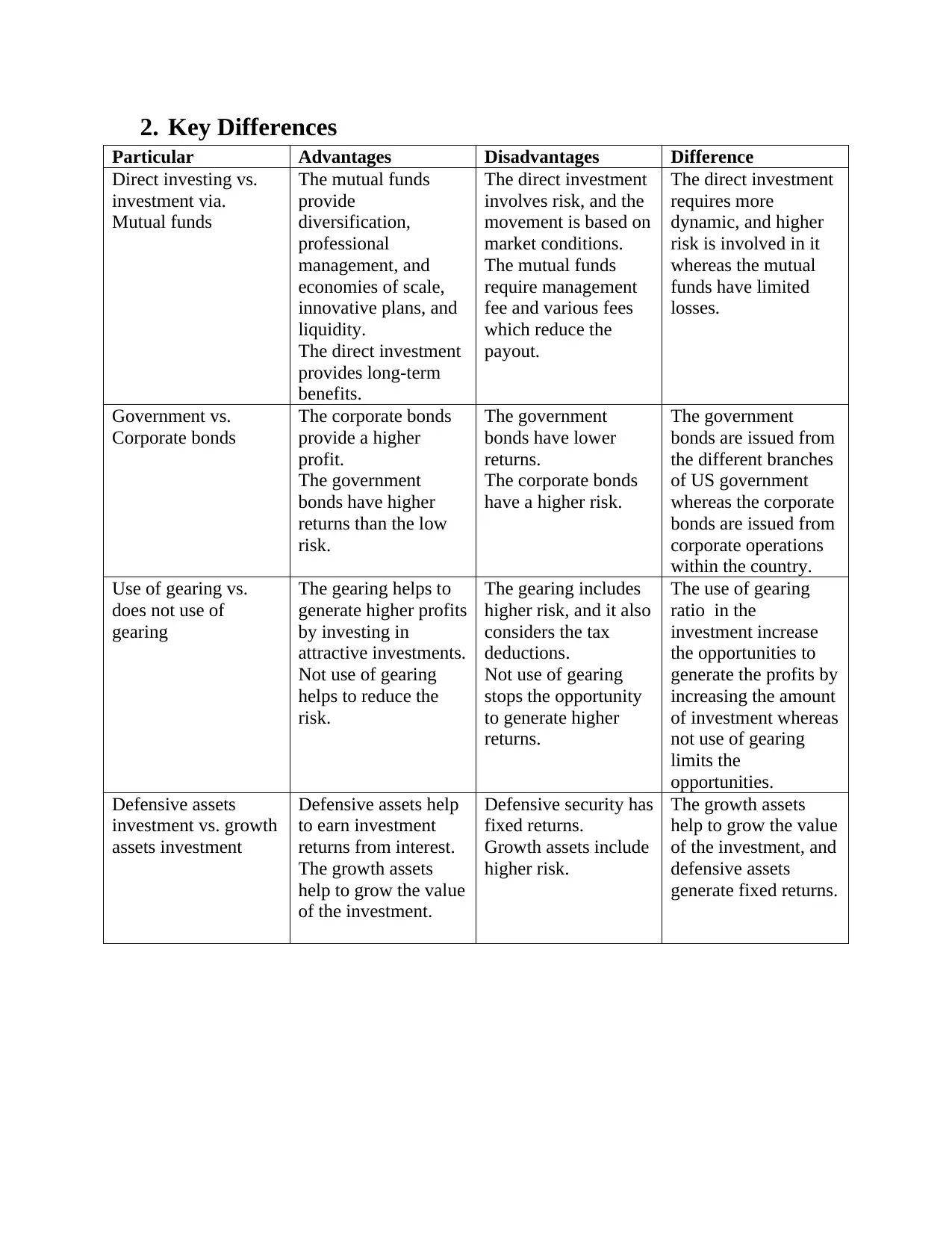
2. Key Differences
Particular Advantages Disadvantages Difference
Direct investing vs.
investment via.
Mutual funds
The mutual funds
provide
diversification,
professional
management, and
economies of scale,
innovative plans, and
liquidity.
The direct investment
provides long-term
benefits.
The direct investment
involves risk, and the
movement is based on
market conditions.
The mutual funds
require management
fee and various fees
which reduce the
payout.
The direct investment
requires more
dynamic, and higher
risk is involved in it
whereas the mutual
funds have limited
losses.
Government vs.
Corporate bonds
The corporate bonds
provide a higher
profit.
The government
bonds have higher
returns than the low
risk.
The government
bonds have lower
returns.
The corporate bonds
have a higher risk.
The government
bonds are issued from
the different branches
of US government
whereas the corporate
bonds are issued from
corporate operations
within the country.
Use of gearing vs.
does not use of
gearing
The gearing helps to
generate higher profits
by investing in
attractive investments.
Not use of gearing
helps to reduce the
risk.
The gearing includes
higher risk, and it also
considers the tax
deductions.
Not use of gearing
stops the opportunity
to generate higher
returns.
The use of gearing
ratio in the
investment increase
the opportunities to
generate the profits by
increasing the amount
of investment whereas
not use of gearing
limits the
opportunities.
Defensive assets
investment vs. growth
assets investment
Defensive assets help
to earn investment
returns from interest.
The growth assets
help to grow the value
of the investment.
Defensive security has
fixed returns.
Growth assets include
higher risk.
The growth assets
help to grow the value
of the investment, and
defensive assets
generate fixed returns.
Particular Advantages Disadvantages Difference
Direct investing vs.
investment via.
Mutual funds
The mutual funds
provide
diversification,
professional
management, and
economies of scale,
innovative plans, and
liquidity.
The direct investment
provides long-term
benefits.
The direct investment
involves risk, and the
movement is based on
market conditions.
The mutual funds
require management
fee and various fees
which reduce the
payout.
The direct investment
requires more
dynamic, and higher
risk is involved in it
whereas the mutual
funds have limited
losses.
Government vs.
Corporate bonds
The corporate bonds
provide a higher
profit.
The government
bonds have higher
returns than the low
risk.
The government
bonds have lower
returns.
The corporate bonds
have a higher risk.
The government
bonds are issued from
the different branches
of US government
whereas the corporate
bonds are issued from
corporate operations
within the country.
Use of gearing vs.
does not use of
gearing
The gearing helps to
generate higher profits
by investing in
attractive investments.
Not use of gearing
helps to reduce the
risk.
The gearing includes
higher risk, and it also
considers the tax
deductions.
Not use of gearing
stops the opportunity
to generate higher
returns.
The use of gearing
ratio in the
investment increase
the opportunities to
generate the profits by
increasing the amount
of investment whereas
not use of gearing
limits the
opportunities.
Defensive assets
investment vs. growth
assets investment
Defensive assets help
to earn investment
returns from interest.
The growth assets
help to grow the value
of the investment.
Defensive security has
fixed returns.
Growth assets include
higher risk.
The growth assets
help to grow the value
of the investment, and
defensive assets
generate fixed returns.
Paraphrase This Document
Need a fresh take? Get an instant paraphrase of this document with our AI Paraphraser
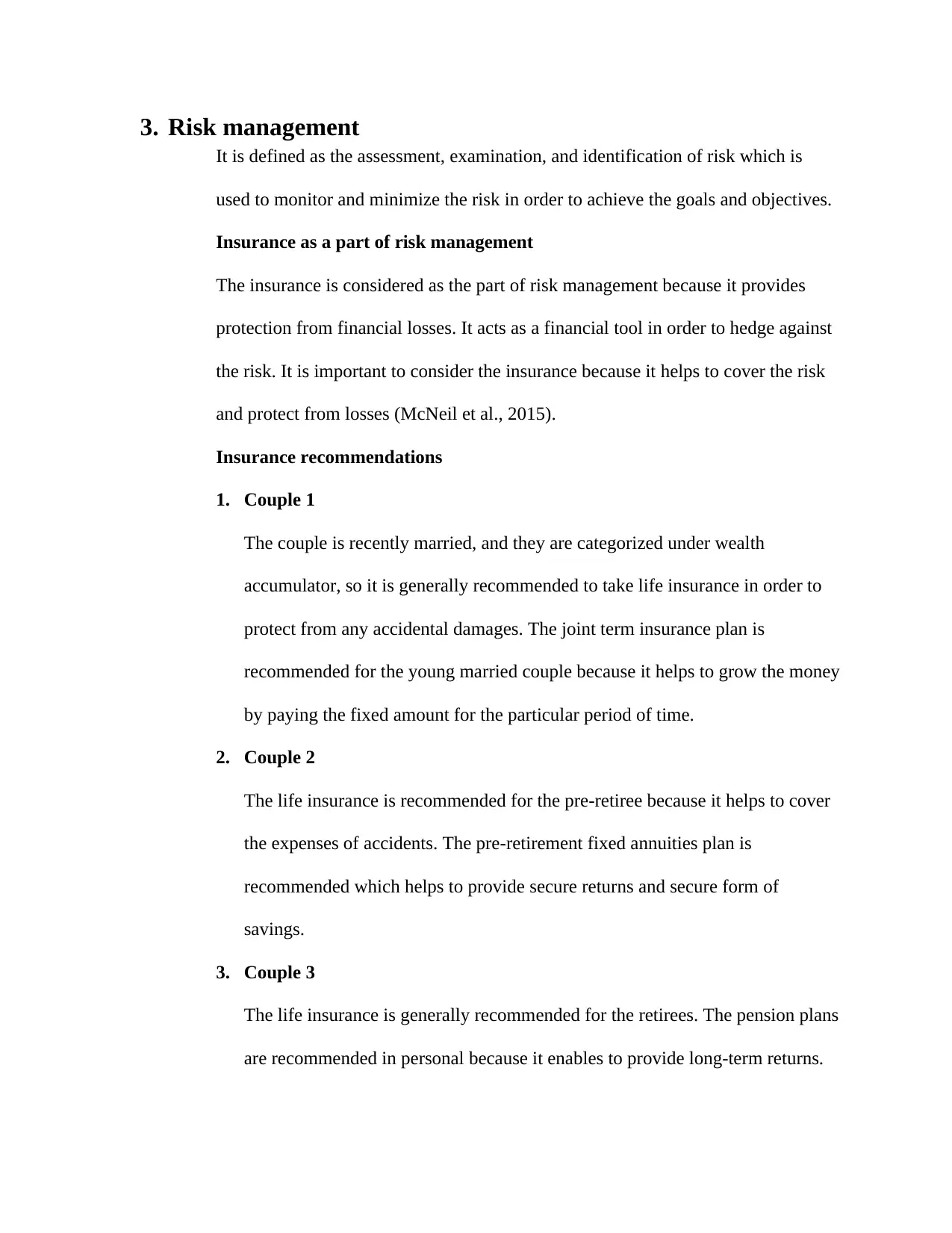
3. Risk management
It is defined as the assessment, examination, and identification of risk which is
used to monitor and minimize the risk in order to achieve the goals and objectives.
Insurance as a part of risk management
The insurance is considered as the part of risk management because it provides
protection from financial losses. It acts as a financial tool in order to hedge against
the risk. It is important to consider the insurance because it helps to cover the risk
and protect from losses (McNeil et al., 2015).
Insurance recommendations
1. Couple 1
The couple is recently married, and they are categorized under wealth
accumulator, so it is generally recommended to take life insurance in order to
protect from any accidental damages. The joint term insurance plan is
recommended for the young married couple because it helps to grow the money
by paying the fixed amount for the particular period of time.
2. Couple 2
The life insurance is recommended for the pre-retiree because it helps to cover
the expenses of accidents. The pre-retirement fixed annuities plan is
recommended which helps to provide secure returns and secure form of
savings.
3. Couple 3
The life insurance is generally recommended for the retirees. The pension plans
are recommended in personal because it enables to provide long-term returns.
It is defined as the assessment, examination, and identification of risk which is
used to monitor and minimize the risk in order to achieve the goals and objectives.
Insurance as a part of risk management
The insurance is considered as the part of risk management because it provides
protection from financial losses. It acts as a financial tool in order to hedge against
the risk. It is important to consider the insurance because it helps to cover the risk
and protect from losses (McNeil et al., 2015).
Insurance recommendations
1. Couple 1
The couple is recently married, and they are categorized under wealth
accumulator, so it is generally recommended to take life insurance in order to
protect from any accidental damages. The joint term insurance plan is
recommended for the young married couple because it helps to grow the money
by paying the fixed amount for the particular period of time.
2. Couple 2
The life insurance is recommended for the pre-retiree because it helps to cover
the expenses of accidents. The pre-retirement fixed annuities plan is
recommended which helps to provide secure returns and secure form of
savings.
3. Couple 3
The life insurance is generally recommended for the retirees. The pension plans
are recommended in personal because it enables to provide long-term returns.
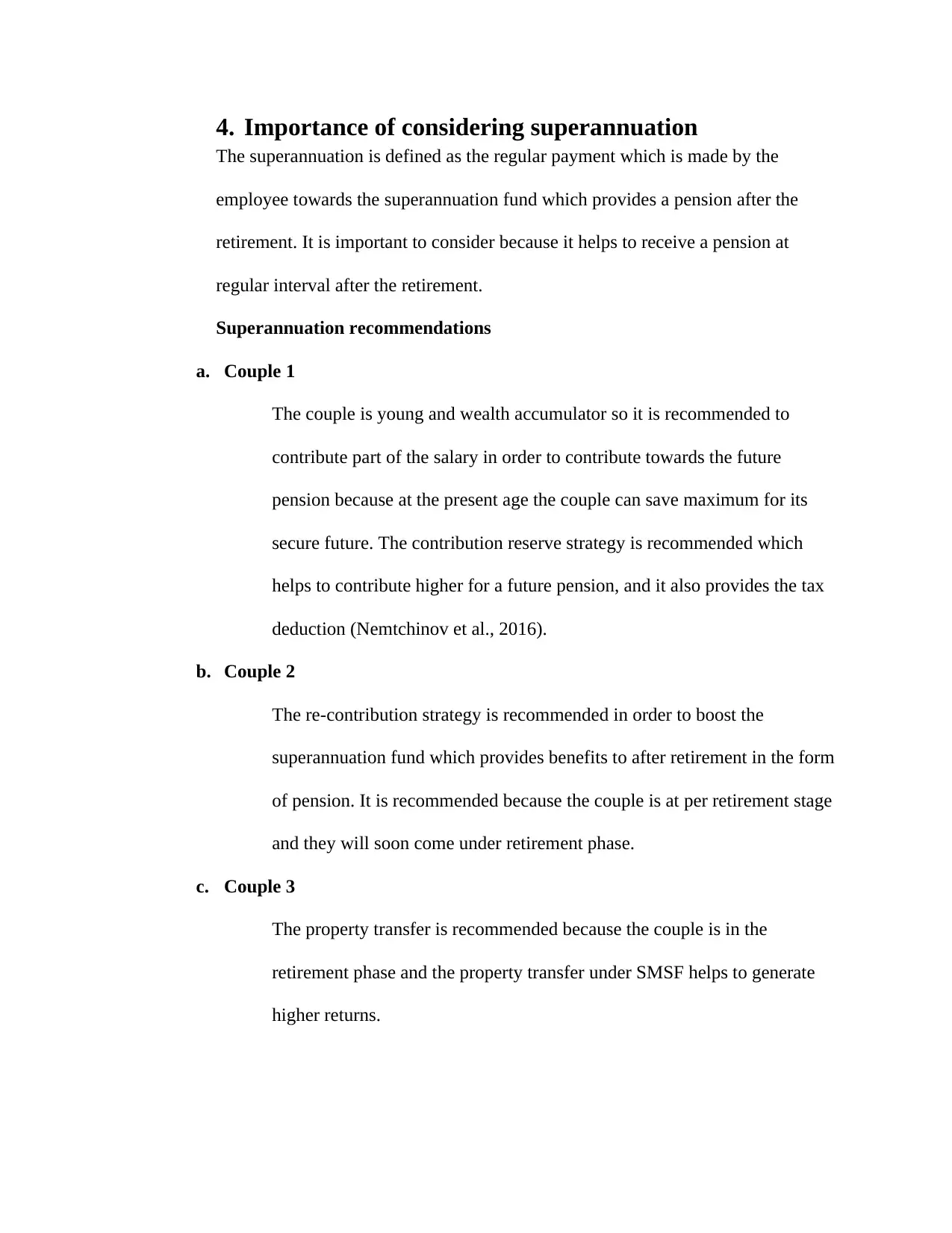
4. Importance of considering superannuation
The superannuation is defined as the regular payment which is made by the
employee towards the superannuation fund which provides a pension after the
retirement. It is important to consider because it helps to receive a pension at
regular interval after the retirement.
Superannuation recommendations
a. Couple 1
The couple is young and wealth accumulator so it is recommended to
contribute part of the salary in order to contribute towards the future
pension because at the present age the couple can save maximum for its
secure future. The contribution reserve strategy is recommended which
helps to contribute higher for a future pension, and it also provides the tax
deduction (Nemtchinov et al., 2016).
b. Couple 2
The re-contribution strategy is recommended in order to boost the
superannuation fund which provides benefits to after retirement in the form
of pension. It is recommended because the couple is at per retirement stage
and they will soon come under retirement phase.
c. Couple 3
The property transfer is recommended because the couple is in the
retirement phase and the property transfer under SMSF helps to generate
higher returns.
The superannuation is defined as the regular payment which is made by the
employee towards the superannuation fund which provides a pension after the
retirement. It is important to consider because it helps to receive a pension at
regular interval after the retirement.
Superannuation recommendations
a. Couple 1
The couple is young and wealth accumulator so it is recommended to
contribute part of the salary in order to contribute towards the future
pension because at the present age the couple can save maximum for its
secure future. The contribution reserve strategy is recommended which
helps to contribute higher for a future pension, and it also provides the tax
deduction (Nemtchinov et al., 2016).
b. Couple 2
The re-contribution strategy is recommended in order to boost the
superannuation fund which provides benefits to after retirement in the form
of pension. It is recommended because the couple is at per retirement stage
and they will soon come under retirement phase.
c. Couple 3
The property transfer is recommended because the couple is in the
retirement phase and the property transfer under SMSF helps to generate
higher returns.
⊘ This is a preview!⊘
Do you want full access?
Subscribe today to unlock all pages.
Trusted by 1+ million students worldwide

1 out of 16


Related Documents


Your All-in-One AI-Powered Toolkit for Academic Success.
+13062052269
info@desklib.com
Available 24*7 on WhatsApp / Email
![[object Object]](/_next/static/media/star-bottom.7253800d.svg)
Unlock your academic potential
Copyright © 2020–2025 A2Z Services. All Rights Reserved. Developed and managed by ZUCOL.