Report on Principles of Health and Social Care Practice - Unit 2
VerifiedAdded on  2020/11/23
|8
|1681
|59
Report
AI Summary
This report delves into the core principles of health and social care practice, encompassing a range of critical topics. It begins by outlining the fundamental guidelines for supporting individual healthcare, emphasizing client protection procedures, and analyzing the benefits derived from social and health care services. The report further explores the ethical dilemmas and conflicts that arise in healthcare settings, along with the implementation of policies, legislation, and regulations. It also examines local policies, evaluates policy effectiveness, and discusses relevant theories underpinning health and social practice. The impact of social processes on service users, the effectiveness of interprofessional working, and the roles, responsibilities, accountabilities, and duties within social health care services are also analyzed. The report concludes with recommendations for enhancing personal contributions to meet practice requirements, supported by a comprehensive list of references.
Principles of Health and
Social Care Practice. Unit
2.
Social Care Practice. Unit
2.
Paraphrase This Document
Need a fresh take? Get an instant paraphrase of this document with our AI Paraphraser

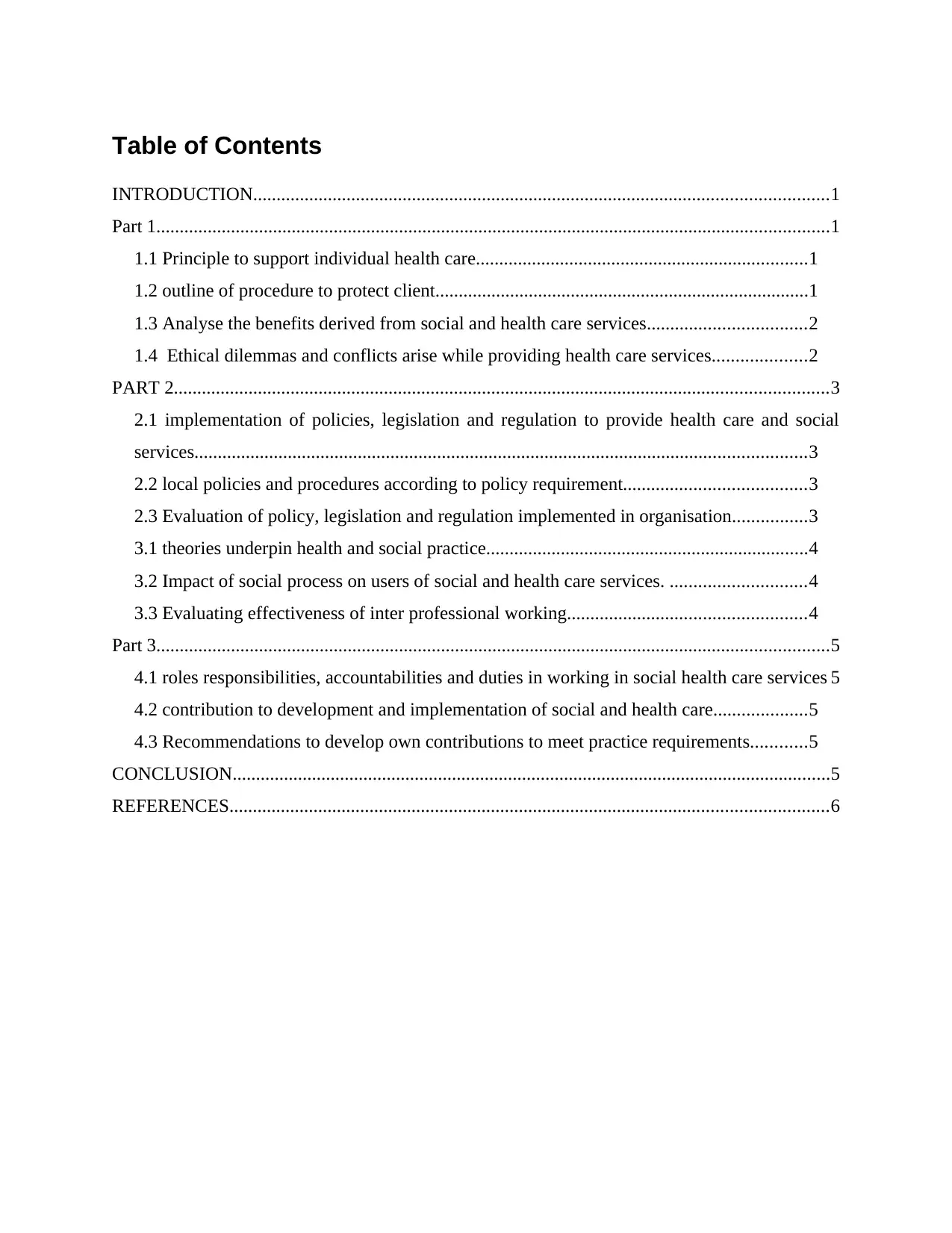
Table of Contents
INTRODUCTION...........................................................................................................................1
Part 1................................................................................................................................................1
1.1 Principle to support individual health care.......................................................................1
1.2 outline of procedure to protect client................................................................................1
1.3 Analyse the benefits derived from social and health care services..................................2
1.4 Ethical dilemmas and conflicts arise while providing health care services....................2
PART 2............................................................................................................................................3
2.1 implementation of policies, legislation and regulation to provide health care and social
services...................................................................................................................................3
2.2 local policies and procedures according to policy requirement.......................................3
2.3 Evaluation of policy, legislation and regulation implemented in organisation................3
3.1 theories underpin health and social practice.....................................................................4
3.2 Impact of social process on users of social and health care services. .............................4
3.3 Evaluating effectiveness of inter professional working...................................................4
Part 3................................................................................................................................................5
4.1 roles responsibilities, accountabilities and duties in working in social health care services 5
4.2 contribution to development and implementation of social and health care....................5
4.3 Recommendations to develop own contributions to meet practice requirements............5
CONCLUSION................................................................................................................................5
REFERENCES................................................................................................................................6
INTRODUCTION...........................................................................................................................1
Part 1................................................................................................................................................1
1.1 Principle to support individual health care.......................................................................1
1.2 outline of procedure to protect client................................................................................1
1.3 Analyse the benefits derived from social and health care services..................................2
1.4 Ethical dilemmas and conflicts arise while providing health care services....................2
PART 2............................................................................................................................................3
2.1 implementation of policies, legislation and regulation to provide health care and social
services...................................................................................................................................3
2.2 local policies and procedures according to policy requirement.......................................3
2.3 Evaluation of policy, legislation and regulation implemented in organisation................3
3.1 theories underpin health and social practice.....................................................................4
3.2 Impact of social process on users of social and health care services. .............................4
3.3 Evaluating effectiveness of inter professional working...................................................4
Part 3................................................................................................................................................5
4.1 roles responsibilities, accountabilities and duties in working in social health care services 5
4.2 contribution to development and implementation of social and health care....................5
4.3 Recommendations to develop own contributions to meet practice requirements............5
CONCLUSION................................................................................................................................5
REFERENCES................................................................................................................................6

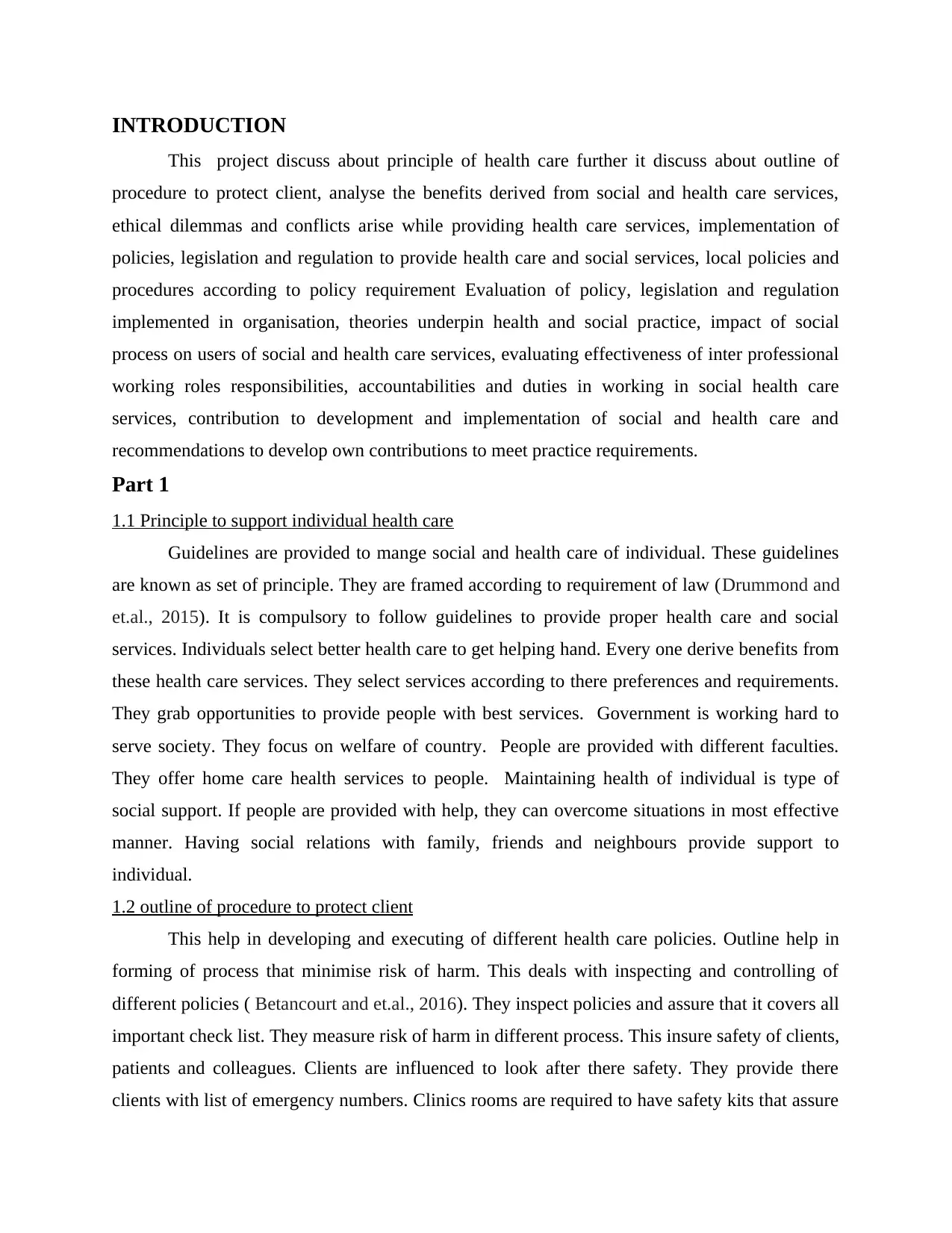
INTRODUCTION
This project discuss about principle of health care further it discuss about outline of
procedure to protect client, analyse the benefits derived from social and health care services,
ethical dilemmas and conflicts arise while providing health care services, implementation of
policies, legislation and regulation to provide health care and social services, local policies and
procedures according to policy requirement Evaluation of policy, legislation and regulation
implemented in organisation, theories underpin health and social practice, impact of social
process on users of social and health care services, evaluating effectiveness of inter professional
working roles responsibilities, accountabilities and duties in working in social health care
services, contribution to development and implementation of social and health care and
recommendations to develop own contributions to meet practice requirements.
Part 1
1.1 Principle to support individual health care
Guidelines are provided to mange social and health care of individual. These guidelines
are known as set of principle. They are framed according to requirement of law (Drummond and
et.al., 2015). It is compulsory to follow guidelines to provide proper health care and social
services. Individuals select better health care to get helping hand. Every one derive benefits from
these health care services. They select services according to there preferences and requirements.
They grab opportunities to provide people with best services. Government is working hard to
serve society. They focus on welfare of country. People are provided with different faculties.
They offer home care health services to people. Maintaining health of individual is type of
social support. If people are provided with help, they can overcome situations in most effective
manner. Having social relations with family, friends and neighbours provide support to
individual.
1.2 outline of procedure to protect client
This help in developing and executing of different health care policies. Outline help in
forming of process that minimise risk of harm. This deals with inspecting and controlling of
different policies ( Betancourt and et.al., 2016). They inspect policies and assure that it covers all
important check list. They measure risk of harm in different process. This insure safety of clients,
patients and colleagues. Clients are influenced to look after there safety. They provide there
clients with list of emergency numbers. Clinics rooms are required to have safety kits that assure
This project discuss about principle of health care further it discuss about outline of
procedure to protect client, analyse the benefits derived from social and health care services,
ethical dilemmas and conflicts arise while providing health care services, implementation of
policies, legislation and regulation to provide health care and social services, local policies and
procedures according to policy requirement Evaluation of policy, legislation and regulation
implemented in organisation, theories underpin health and social practice, impact of social
process on users of social and health care services, evaluating effectiveness of inter professional
working roles responsibilities, accountabilities and duties in working in social health care
services, contribution to development and implementation of social and health care and
recommendations to develop own contributions to meet practice requirements.
Part 1
1.1 Principle to support individual health care
Guidelines are provided to mange social and health care of individual. These guidelines
are known as set of principle. They are framed according to requirement of law (Drummond and
et.al., 2015). It is compulsory to follow guidelines to provide proper health care and social
services. Individuals select better health care to get helping hand. Every one derive benefits from
these health care services. They select services according to there preferences and requirements.
They grab opportunities to provide people with best services. Government is working hard to
serve society. They focus on welfare of country. People are provided with different faculties.
They offer home care health services to people. Maintaining health of individual is type of
social support. If people are provided with help, they can overcome situations in most effective
manner. Having social relations with family, friends and neighbours provide support to
individual.
1.2 outline of procedure to protect client
This help in developing and executing of different health care policies. Outline help in
forming of process that minimise risk of harm. This deals with inspecting and controlling of
different policies ( Betancourt and et.al., 2016). They inspect policies and assure that it covers all
important check list. They measure risk of harm in different process. This insure safety of clients,
patients and colleagues. Clients are influenced to look after there safety. They provide there
clients with list of emergency numbers. Clinics rooms are required to have safety kits that assure
⊘ This is a preview!⊘
Do you want full access?
Subscribe today to unlock all pages.

Trusted by 1+ million students worldwide

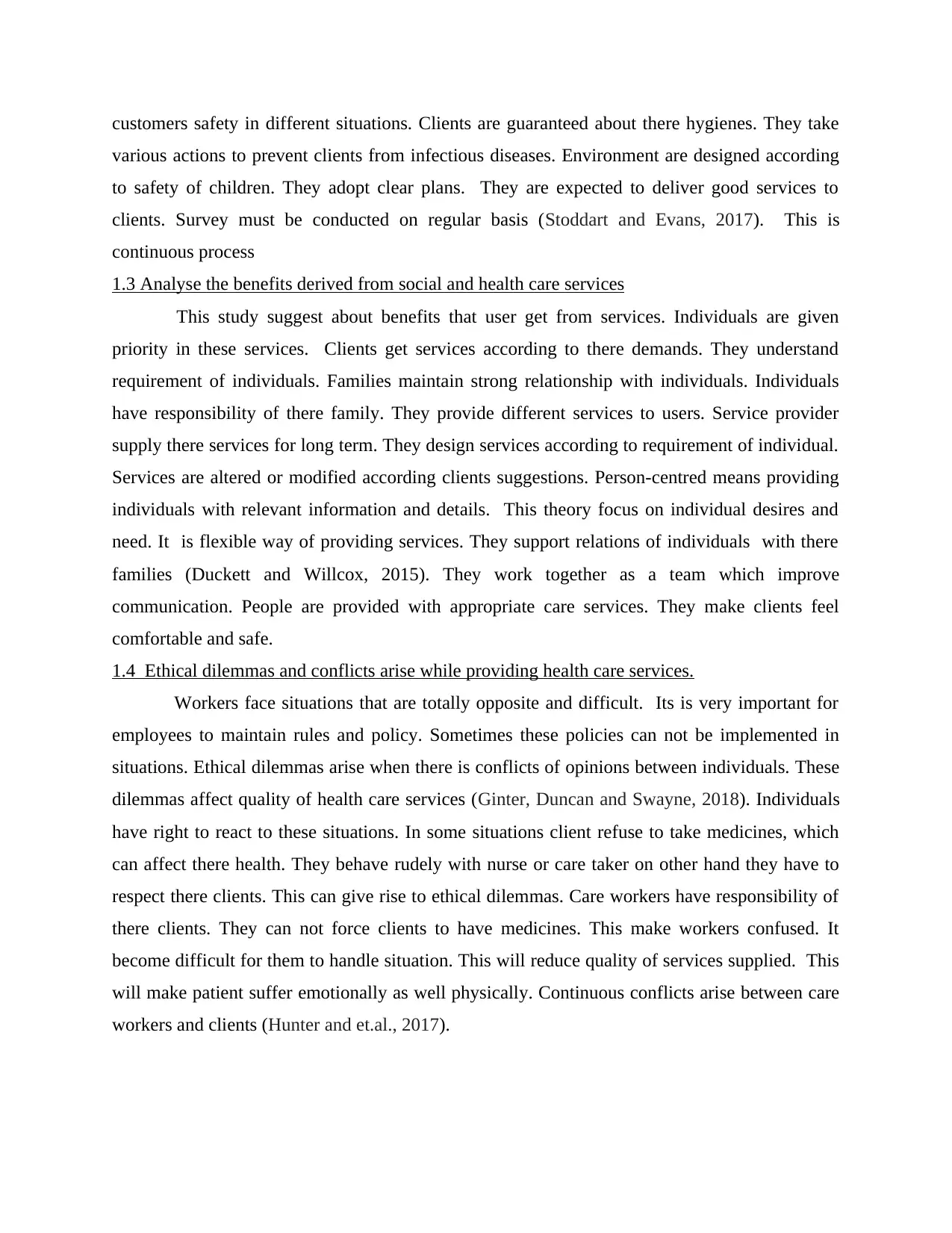
customers safety in different situations. Clients are guaranteed about there hygienes. They take
various actions to prevent clients from infectious diseases. Environment are designed according
to safety of children. They adopt clear plans. They are expected to deliver good services to
clients. Survey must be conducted on regular basis (Stoddart and Evans, 2017). This is
continuous process
1.3 Analyse the benefits derived from social and health care services
This study suggest about benefits that user get from services. Individuals are given
priority in these services. Clients get services according to there demands. They understand
requirement of individuals. Families maintain strong relationship with individuals. Individuals
have responsibility of there family. They provide different services to users. Service provider
supply there services for long term. They design services according to requirement of individual.
Services are altered or modified according clients suggestions. Person-centred means providing
individuals with relevant information and details. This theory focus on individual desires and
need. It is flexible way of providing services. They support relations of individuals with there
families (Duckett and Willcox, 2015). They work together as a team which improve
communication. People are provided with appropriate care services. They make clients feel
comfortable and safe.
1.4 Ethical dilemmas and conflicts arise while providing health care services.
Workers face situations that are totally opposite and difficult. Its is very important for
employees to maintain rules and policy. Sometimes these policies can not be implemented in
situations. Ethical dilemmas arise when there is conflicts of opinions between individuals. These
dilemmas affect quality of health care services (Ginter, Duncan and Swayne, 2018). Individuals
have right to react to these situations. In some situations client refuse to take medicines, which
can affect there health. They behave rudely with nurse or care taker on other hand they have to
respect there clients. This can give rise to ethical dilemmas. Care workers have responsibility of
there clients. They can not force clients to have medicines. This make workers confused. It
become difficult for them to handle situation. This will reduce quality of services supplied. This
will make patient suffer emotionally as well physically. Continuous conflicts arise between care
workers and clients (Hunter and et.al., 2017).
various actions to prevent clients from infectious diseases. Environment are designed according
to safety of children. They adopt clear plans. They are expected to deliver good services to
clients. Survey must be conducted on regular basis (Stoddart and Evans, 2017). This is
continuous process
1.3 Analyse the benefits derived from social and health care services
This study suggest about benefits that user get from services. Individuals are given
priority in these services. Clients get services according to there demands. They understand
requirement of individuals. Families maintain strong relationship with individuals. Individuals
have responsibility of there family. They provide different services to users. Service provider
supply there services for long term. They design services according to requirement of individual.
Services are altered or modified according clients suggestions. Person-centred means providing
individuals with relevant information and details. This theory focus on individual desires and
need. It is flexible way of providing services. They support relations of individuals with there
families (Duckett and Willcox, 2015). They work together as a team which improve
communication. People are provided with appropriate care services. They make clients feel
comfortable and safe.
1.4 Ethical dilemmas and conflicts arise while providing health care services.
Workers face situations that are totally opposite and difficult. Its is very important for
employees to maintain rules and policy. Sometimes these policies can not be implemented in
situations. Ethical dilemmas arise when there is conflicts of opinions between individuals. These
dilemmas affect quality of health care services (Ginter, Duncan and Swayne, 2018). Individuals
have right to react to these situations. In some situations client refuse to take medicines, which
can affect there health. They behave rudely with nurse or care taker on other hand they have to
respect there clients. This can give rise to ethical dilemmas. Care workers have responsibility of
there clients. They can not force clients to have medicines. This make workers confused. It
become difficult for them to handle situation. This will reduce quality of services supplied. This
will make patient suffer emotionally as well physically. Continuous conflicts arise between care
workers and clients (Hunter and et.al., 2017).
Paraphrase This Document
Need a fresh take? Get an instant paraphrase of this document with our AI Paraphraser

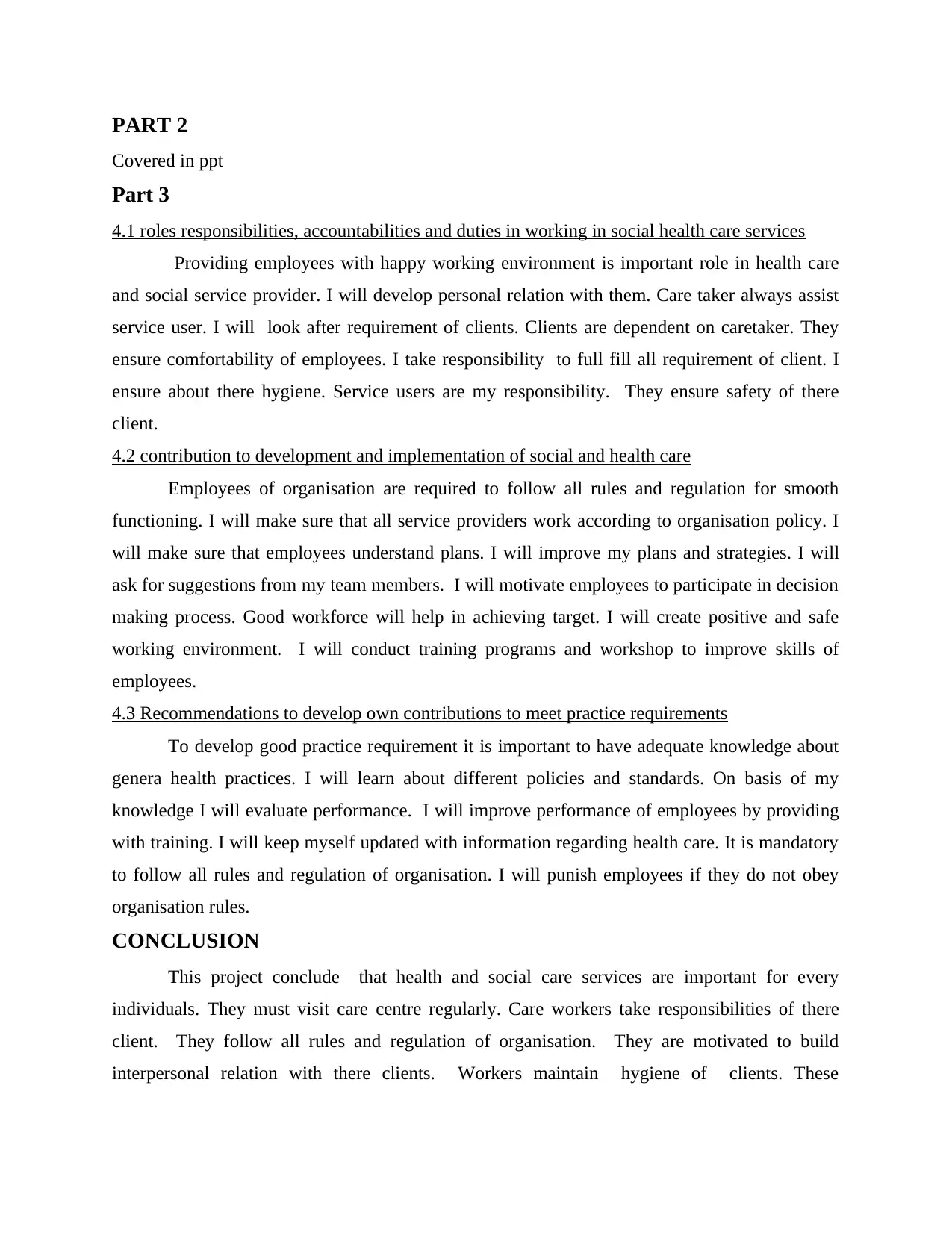
PART 2
Covered in ppt
Part 3
4.1 roles responsibilities, accountabilities and duties in working in social health care services
Providing employees with happy working environment is important role in health care
and social service provider. I will develop personal relation with them. Care taker always assist
service user. I will look after requirement of clients. Clients are dependent on caretaker. They
ensure comfortability of employees. I take responsibility to full fill all requirement of client. I
ensure about there hygiene. Service users are my responsibility. They ensure safety of there
client.
4.2 contribution to development and implementation of social and health care
Employees of organisation are required to follow all rules and regulation for smooth
functioning. I will make sure that all service providers work according to organisation policy. I
will make sure that employees understand plans. I will improve my plans and strategies. I will
ask for suggestions from my team members. I will motivate employees to participate in decision
making process. Good workforce will help in achieving target. I will create positive and safe
working environment. I will conduct training programs and workshop to improve skills of
employees.
4.3 Recommendations to develop own contributions to meet practice requirements
To develop good practice requirement it is important to have adequate knowledge about
genera health practices. I will learn about different policies and standards. On basis of my
knowledge I will evaluate performance. I will improve performance of employees by providing
with training. I will keep myself updated with information regarding health care. It is mandatory
to follow all rules and regulation of organisation. I will punish employees if they do not obey
organisation rules.
CONCLUSION
This project conclude that health and social care services are important for every
individuals. They must visit care centre regularly. Care workers take responsibilities of there
client. They follow all rules and regulation of organisation. They are motivated to build
interpersonal relation with there clients. Workers maintain hygiene of clients. These
Covered in ppt
Part 3
4.1 roles responsibilities, accountabilities and duties in working in social health care services
Providing employees with happy working environment is important role in health care
and social service provider. I will develop personal relation with them. Care taker always assist
service user. I will look after requirement of clients. Clients are dependent on caretaker. They
ensure comfortability of employees. I take responsibility to full fill all requirement of client. I
ensure about there hygiene. Service users are my responsibility. They ensure safety of there
client.
4.2 contribution to development and implementation of social and health care
Employees of organisation are required to follow all rules and regulation for smooth
functioning. I will make sure that all service providers work according to organisation policy. I
will make sure that employees understand plans. I will improve my plans and strategies. I will
ask for suggestions from my team members. I will motivate employees to participate in decision
making process. Good workforce will help in achieving target. I will create positive and safe
working environment. I will conduct training programs and workshop to improve skills of
employees.
4.3 Recommendations to develop own contributions to meet practice requirements
To develop good practice requirement it is important to have adequate knowledge about
genera health practices. I will learn about different policies and standards. On basis of my
knowledge I will evaluate performance. I will improve performance of employees by providing
with training. I will keep myself updated with information regarding health care. It is mandatory
to follow all rules and regulation of organisation. I will punish employees if they do not obey
organisation rules.
CONCLUSION
This project conclude that health and social care services are important for every
individuals. They must visit care centre regularly. Care workers take responsibilities of there
client. They follow all rules and regulation of organisation. They are motivated to build
interpersonal relation with there clients. Workers maintain hygiene of clients. These

organisation combine with government to treat hazardous disease. They both work together to
satisfy client requirement. They provide different services that help to overcome illness of client.
REFERENCES
Books and Journals
Betancourt, J.R. And et.al., 2016. Defining cultural competence: a practical framework for
addressing racial/ethnic disparities in health and health care. Public health reports.
Chartier, Y. ed., 2014. Safe management of wastes from health-care activities. World Health
Organization.
Drummond, M.F. And et.al., 2015. Methods for the economic evaluation of health care
programmes. Oxford university press.
Duckett, S. and Willcox, S., 2015. The Australian health care system (No. Ed. 5). Oxford
University Press
Ginter, P.M., Duncan, W.J. and Swayne, L.E., 2018. The strategic management of health care
organizations. John Wiley & Sons.
Hunter, C.L. And et.al., 2017. Integrated behavioral health in primary care: Step-by-step
guidance for assessment and intervention. American Psychological Association.
McFarland, M.R. and Wehbe-Alamah, H.B., 2014. Leininger's culture care diversity and
universality. Jones & Bartlett Publishers.
Pett, M.A., 2015. Nonparametric statistics for health care research: Statistics for small samples
and unusual distributions. Sage Publications.
Stoddart, G.L. and Evans, R.G., 2017. Producing health, consuming health care. In Why are
some people healthy and others not? (pp. 27-64). Routledge.
White, K.M., Dudley-Brown, S. and Terhaar, M.F. eds., 2016. Translation of evidence into
nursing and health care. Springer Publishing Company.
satisfy client requirement. They provide different services that help to overcome illness of client.
REFERENCES
Books and Journals
Betancourt, J.R. And et.al., 2016. Defining cultural competence: a practical framework for
addressing racial/ethnic disparities in health and health care. Public health reports.
Chartier, Y. ed., 2014. Safe management of wastes from health-care activities. World Health
Organization.
Drummond, M.F. And et.al., 2015. Methods for the economic evaluation of health care
programmes. Oxford university press.
Duckett, S. and Willcox, S., 2015. The Australian health care system (No. Ed. 5). Oxford
University Press
Ginter, P.M., Duncan, W.J. and Swayne, L.E., 2018. The strategic management of health care
organizations. John Wiley & Sons.
Hunter, C.L. And et.al., 2017. Integrated behavioral health in primary care: Step-by-step
guidance for assessment and intervention. American Psychological Association.
McFarland, M.R. and Wehbe-Alamah, H.B., 2014. Leininger's culture care diversity and
universality. Jones & Bartlett Publishers.
Pett, M.A., 2015. Nonparametric statistics for health care research: Statistics for small samples
and unusual distributions. Sage Publications.
Stoddart, G.L. and Evans, R.G., 2017. Producing health, consuming health care. In Why are
some people healthy and others not? (pp. 27-64). Routledge.
White, K.M., Dudley-Brown, S. and Terhaar, M.F. eds., 2016. Translation of evidence into
nursing and health care. Springer Publishing Company.
⊘ This is a preview!⊘
Do you want full access?
Subscribe today to unlock all pages.

Trusted by 1+ million students worldwide

Paraphrase This Document
Need a fresh take? Get an instant paraphrase of this document with our AI Paraphraser

1 out of 8
Related Documents
Your All-in-One AI-Powered Toolkit for Academic Success.
 +13062052269
info@desklib.com
Available 24*7 on WhatsApp / Email
Unlock your academic potential
Copyright © 2020–2025 A2Z Services. All Rights Reserved. Developed and managed by ZUCOL.