Leadership Styles and Organizational Commitment: A Review
VerifiedAdded on 2020/04/29
|12
|3415
|238
Essay
AI Summary
The essay focuses on examining how different leadership styles affect organizational commitment by analyzing Dr. Manmohan Singh's tenure as the Prime Minister of India from 2004 to 2014. It explores transformational and situational leadership styles that characterized his approach, drawing insights from existing literature on leadership and employee engagement. The analysis investigates how these styles influenced various stakeholders within governmental and non-governmental sectors in terms of motivation, productivity, and loyalty. Key studies referenced include those by McCleskey (2014) on leadership development, Laschinger et al. (2016) on empowerment and commitment, and Paustian-Underdahl et al. (2014) on gender dynamics in leadership perceptions. The essay aims to provide a comprehensive understanding of how effective leadership can foster organizational commitment, using empirical evidence from Dr. Singh's leadership experiences.
Running head: PRINCIPLES OF LEADERSHIP
Principles of Leadership
Name of the Student
Name of the University
Author note
Principles of Leadership
Name of the Student
Name of the University
Author note

Paraphrase This Document
Need a fresh take? Get an instant paraphrase of this document with our AI Paraphraser
1PRINCIPLES OF LEADERSHIP
Abstract
The essay helps in understanding the concept of leadership management that has been
followed by Dr. Manmohan Singh while he was the Prime Minister of India. The leadership
style has to be analyzed properly that has been followed by him that helped him in coping up
with different demands along with the expectations of the normal individuals.
The main aim of the report is to analyze the style of leadership that has been followed by Dr.
Manmohan Singh while he was the leader along with Prime Minister of India. The main
purpose of the essay is to review the biography of Dr. Manmohan Singh along with
identification of the different crucial events that has shaped the approach of leadership of Dr.
Manmohan Singh.
The conclusion will be based on the style of leadership that has been followed by Dr.
Manmohan Singh during his tenure of being the Prime Minister of India. Proper analysis is
required to be done on the crucial events in order to shape the style of leadership.
Abstract
The essay helps in understanding the concept of leadership management that has been
followed by Dr. Manmohan Singh while he was the Prime Minister of India. The leadership
style has to be analyzed properly that has been followed by him that helped him in coping up
with different demands along with the expectations of the normal individuals.
The main aim of the report is to analyze the style of leadership that has been followed by Dr.
Manmohan Singh while he was the leader along with Prime Minister of India. The main
purpose of the essay is to review the biography of Dr. Manmohan Singh along with
identification of the different crucial events that has shaped the approach of leadership of Dr.
Manmohan Singh.
The conclusion will be based on the style of leadership that has been followed by Dr.
Manmohan Singh during his tenure of being the Prime Minister of India. Proper analysis is
required to be done on the crucial events in order to shape the style of leadership.
2PRINCIPLES OF LEADERSHIP
Dr. Manmohan Singh was born in the year 1932 in the month of September 26th at
Gah, West Punjab, India that is now shifted to Pakistan. He was the Indian economist as well
as politician and he became the Prime Minister of India in the year 2004 and continued his
career in the post of Prime Minister till 2014. He was the first Sikh along with the first non
Indian to occupy the office of Prime Minister. Dr. Manmohan Singh attended the University
of Punjab along with University of Cambridge situated in Great Britain. Later, he has earned
degree of doctorate from University of Oxford (Strom, Sears & Kelly, 2014).
In the year 1970, he has been named in a series of the advisory posts in the economics
and later he became the frequent consultant to different Prime Ministers. Furthermore, he
worked with Reserve Bank of India as the director along with governor as well. Later, when
he was made the finance minister in the year 1991, there was a verge of economic collapse in
the country. Dr. Manmohan Singh has devalued rupee, lowered the taxes as well as privatized
the industries that were run by the state. He helped in transforming the economy of the entire
country and he helped in sparking a boom in the entire economy as well (Sethuraman &
Suresh, 2014).
He was the member of the Lok Sabha as well as Rajya Sabha in the year 1996 but he
was defeated. Dr. Manmohan Singh presided over the economy that was expanding in nature
but the precipitated rise in the cost of the fuel has marked a huge rise in the inflationary rate
that had threatened the ability of the government in order to provide different subsidies to the
poor people in the country. In respect of meeting the demands of the country, Dr. Manmohan
Singh entered into different kinds of negotiations with the president of United States George
W. Bush for corporation pact that was nuclear in nature. This particular deal helped India in
receiving fuel technology for the different nuclear plants along with provided proper ability
to purchase the nuclear plant in the entire market of world.
Dr. Manmohan Singh was born in the year 1932 in the month of September 26th at
Gah, West Punjab, India that is now shifted to Pakistan. He was the Indian economist as well
as politician and he became the Prime Minister of India in the year 2004 and continued his
career in the post of Prime Minister till 2014. He was the first Sikh along with the first non
Indian to occupy the office of Prime Minister. Dr. Manmohan Singh attended the University
of Punjab along with University of Cambridge situated in Great Britain. Later, he has earned
degree of doctorate from University of Oxford (Strom, Sears & Kelly, 2014).
In the year 1970, he has been named in a series of the advisory posts in the economics
and later he became the frequent consultant to different Prime Ministers. Furthermore, he
worked with Reserve Bank of India as the director along with governor as well. Later, when
he was made the finance minister in the year 1991, there was a verge of economic collapse in
the country. Dr. Manmohan Singh has devalued rupee, lowered the taxes as well as privatized
the industries that were run by the state. He helped in transforming the economy of the entire
country and he helped in sparking a boom in the entire economy as well (Sethuraman &
Suresh, 2014).
He was the member of the Lok Sabha as well as Rajya Sabha in the year 1996 but he
was defeated. Dr. Manmohan Singh presided over the economy that was expanding in nature
but the precipitated rise in the cost of the fuel has marked a huge rise in the inflationary rate
that had threatened the ability of the government in order to provide different subsidies to the
poor people in the country. In respect of meeting the demands of the country, Dr. Manmohan
Singh entered into different kinds of negotiations with the president of United States George
W. Bush for corporation pact that was nuclear in nature. This particular deal helped India in
receiving fuel technology for the different nuclear plants along with provided proper ability
to purchase the nuclear plant in the entire market of world.
⊘ This is a preview!⊘
Do you want full access?
Subscribe today to unlock all pages.

Trusted by 1+ million students worldwide
3PRINCIPLES OF LEADERSHIP
In the proper elections of the parliament in the month of May in the year 2009,
Congress has increased the number of seats in legislature; Dr. Manmohan Singh took office
as the prime minister for second time. The slow movement in the growth of the economy in
India along with further legislations of corruption against the Congress party individuals was
hampered during the second term of Dr. Manmohan Singh. This has led to the deterioration
in the popularity of the entire party with the entire population of voting. In the year 2014, Dr.
Manmohan Singh announced that he would not seek the third term as the Prime Minister in
the Lok Sabha. He left his seat in the month of May 26th and on that particular date, Narendra
Modi was declared as the Prime Minister of India.
In the era of the drastic change, the main focus is on the management function that is
related to social as well as political entity of the entity of the business. There are different
kinds of leadership styles that have been followed by Dr. Manmohan Singh during his tenure
as the Prime Minister of India (Paustian-Underdahl, Walker & Woehr, 2014). The different
kinds of leadership styles that have been followed are as follows:
Authoritarian
Participative
Delegative
The leadership named as Authoritarian style generally occurs wherein the different
decisions are taken by the manager and the approach of the leadership that is followed by the
manager in the organization or in the politics is the top down approach. The role of the
different employees in the organization is nonexistent in nature and there is no execution of
the commands that are received from the management (Triana, Richard & Yücel 2017). This
kind of style is followed by different managers in the organization when the simultaneous
conditions are met by the different leaders of the organization. The leader is the head of the
In the proper elections of the parliament in the month of May in the year 2009,
Congress has increased the number of seats in legislature; Dr. Manmohan Singh took office
as the prime minister for second time. The slow movement in the growth of the economy in
India along with further legislations of corruption against the Congress party individuals was
hampered during the second term of Dr. Manmohan Singh. This has led to the deterioration
in the popularity of the entire party with the entire population of voting. In the year 2014, Dr.
Manmohan Singh announced that he would not seek the third term as the Prime Minister in
the Lok Sabha. He left his seat in the month of May 26th and on that particular date, Narendra
Modi was declared as the Prime Minister of India.
In the era of the drastic change, the main focus is on the management function that is
related to social as well as political entity of the entity of the business. There are different
kinds of leadership styles that have been followed by Dr. Manmohan Singh during his tenure
as the Prime Minister of India (Paustian-Underdahl, Walker & Woehr, 2014). The different
kinds of leadership styles that have been followed are as follows:
Authoritarian
Participative
Delegative
The leadership named as Authoritarian style generally occurs wherein the different
decisions are taken by the manager and the approach of the leadership that is followed by the
manager in the organization or in the politics is the top down approach. The role of the
different employees in the organization is nonexistent in nature and there is no execution of
the commands that are received from the management (Triana, Richard & Yücel 2017). This
kind of style is followed by different managers in the organization when the simultaneous
conditions are met by the different leaders of the organization. The leader is the head of the
Paraphrase This Document
Need a fresh take? Get an instant paraphrase of this document with our AI Paraphraser
4PRINCIPLES OF LEADERSHIP
different decisions that are taken by them and this is not applicable on the employees of the
organization along with there is no such delegation of tasks as well (Öztekin, İşçi & Karadağ
2015).
The second kind of leadership that is followed is participative style wherein the
different kinds of decisions of how as well as what to do are based on the different kinds of
communication as well as the information that are collected from the different staff members
of the entire organization (Yahaya & Ebrahim, 2016). The final decision is of the manager of
the organization as well but the employees of the different organizations have the right to
speak and put their opinions properly as well. This is the kind of leadership style that is
interpreted as the sign of the weakness but it is not the fact of the move, but this is the kind of
style of leadership that has provided proper importance to the views of the employees (Renko
et al., 2015).
This kind of leadership has helped in providing proper value to the employees in the
organization with providing proper financial incentive that helps in stimulating the
employees’ job performance in order to increase the sales and this has helped in increasing
the job satisfaction of the employees as well. Apart from the satisfaction of the employees,
the entire benefit also relies on the ability of the employees to make better, informed and
accurate decisions as well. It can be inferred that the participative style of leadership is the
sign of the strength and it is easy to implement such leadership style as this will help in
possessing the different kinds of information along with understanding the importance of
employees as well (Girma, 2016).
The third style of leadership is the Delegative or free reign style of leadership wherein
the management has the minimal role in taking up different important decisions in the
management and the entire responsibility has been provided on the staff members of the
different decisions that are taken by them and this is not applicable on the employees of the
organization along with there is no such delegation of tasks as well (Öztekin, İşçi & Karadağ
2015).
The second kind of leadership that is followed is participative style wherein the
different kinds of decisions of how as well as what to do are based on the different kinds of
communication as well as the information that are collected from the different staff members
of the entire organization (Yahaya & Ebrahim, 2016). The final decision is of the manager of
the organization as well but the employees of the different organizations have the right to
speak and put their opinions properly as well. This is the kind of leadership style that is
interpreted as the sign of the weakness but it is not the fact of the move, but this is the kind of
style of leadership that has provided proper importance to the views of the employees (Renko
et al., 2015).
This kind of leadership has helped in providing proper value to the employees in the
organization with providing proper financial incentive that helps in stimulating the
employees’ job performance in order to increase the sales and this has helped in increasing
the job satisfaction of the employees as well. Apart from the satisfaction of the employees,
the entire benefit also relies on the ability of the employees to make better, informed and
accurate decisions as well. It can be inferred that the participative style of leadership is the
sign of the strength and it is easy to implement such leadership style as this will help in
possessing the different kinds of information along with understanding the importance of
employees as well (Girma, 2016).
The third style of leadership is the Delegative or free reign style of leadership wherein
the management has the minimal role in taking up different important decisions in the
management and the entire responsibility has been provided on the staff members of the
5PRINCIPLES OF LEADERSHIP
organization (Laschinger, Read & Zhu, 2016). The proper delegation of tasks is performed by
the employees of the entire organization and this has helped the employees in the
organization to take part in the different kind of activities that are performed by the entire
organization. This is the best kind of leadership that can be implemented by different
organizations as this will help in providing proper importance to the employees in the
organization as well. Whenever the manager of the organization is handling different kinds of
task, it is suggested to the manager of the organization to delegate the different kinds of task
as this will help in finishing the different kinds of task on time. The tasks can be properly
delegated to the employees wherein he can delegate the different chores; there are different
kinds of risk that are involved in this kind of the style of the leadership style.
The style of leadership that has been adopted by Dr. Manmohan Singh while his
tenure of the Prime Minister in India, he followed the participative style of leadership as this
helped him in delegating the different tasks to the subordinates and he respected the opinions
of the opinions of the leaders (Clinebell et al., 2013). Dr. Manmohan Singh is the 14th Prime
Minister of India and he is the only individual who has been respected politically as well as
the different communities that are related to academics as the thinker along with scholar as
well. Dr. Manmohan Singh is the notable member of international community along with the
recipient of the numerous awards as well.
The leadership style that has been followed by Dr. Manmohan Singh is participative
style of leadership wherein he provided different opportunities to the members of the
legislations in keeping their viewpoints properly as this helped him along with the members
to understand the opinions properly and this has helped him in solving different matters in the
tenure of his being the Prime Minister of India. While Dr. Manmohan Singh was appointed as
the Prime Minister of India, the leadership style that was followed by the previous leader was
autocratic leadership that was in the year 1990 and when Dr. Manmohan Singh became the
organization (Laschinger, Read & Zhu, 2016). The proper delegation of tasks is performed by
the employees of the entire organization and this has helped the employees in the
organization to take part in the different kind of activities that are performed by the entire
organization. This is the best kind of leadership that can be implemented by different
organizations as this will help in providing proper importance to the employees in the
organization as well. Whenever the manager of the organization is handling different kinds of
task, it is suggested to the manager of the organization to delegate the different kinds of task
as this will help in finishing the different kinds of task on time. The tasks can be properly
delegated to the employees wherein he can delegate the different chores; there are different
kinds of risk that are involved in this kind of the style of the leadership style.
The style of leadership that has been adopted by Dr. Manmohan Singh while his
tenure of the Prime Minister in India, he followed the participative style of leadership as this
helped him in delegating the different tasks to the subordinates and he respected the opinions
of the opinions of the leaders (Clinebell et al., 2013). Dr. Manmohan Singh is the 14th Prime
Minister of India and he is the only individual who has been respected politically as well as
the different communities that are related to academics as the thinker along with scholar as
well. Dr. Manmohan Singh is the notable member of international community along with the
recipient of the numerous awards as well.
The leadership style that has been followed by Dr. Manmohan Singh is participative
style of leadership wherein he provided different opportunities to the members of the
legislations in keeping their viewpoints properly as this helped him along with the members
to understand the opinions properly and this has helped him in solving different matters in the
tenure of his being the Prime Minister of India. While Dr. Manmohan Singh was appointed as
the Prime Minister of India, the leadership style that was followed by the previous leader was
autocratic leadership that was in the year 1990 and when Dr. Manmohan Singh became the
⊘ This is a preview!⊘
Do you want full access?
Subscribe today to unlock all pages.
Trusted by 1+ million students worldwide
6PRINCIPLES OF LEADERSHIP
prime minister of India (Samad et al., 2015). With the autocratic leadership style, the health
of the country was not up to the mark and the country was in great trouble as well (Arnold et
al., 2015). The country was in great verge of bankruptcy and this was creating lot of trouble
for the different individuals as well. During this crucial time, the new Prime Minister Dr.
Manmohan Singh understood the requirements of the individuals of the country and the entire
necessity of the reforms that were introducing in nature and this helped in understanding the
entire requirement of the kind of leadership that was required to be implemented in the
country to improve the different situations that was affecting the lives of the normal
individuals in the society along with improvement in the different kinds of reforms in the
entire country as well (Keskes, 2014).
Dr. Manmohan Singh convinced the subalterns with the help of autocratic decisions
as this is the style of leadership that was required at that point of time and this helped him in
introducing liberalization in the economy as well. The main accomplishments of Dr.
Manmohan Singh were the entire economy liberalization, proper change in the corporate
affairs as well as the different improvements that were required in the country as well. The
Prime Minister Dr. Manmohan Singh helped in improving the different standards of living in
meeting the different expectations of the individuals (Frankel & PGCMS, 2017).
Few days ago, when Dr. Manmohan Singh militated the participative style of
leadership in the country when he made proper urge in the international community that
included Africa in the entire process of decision making as well as to intensify the endeavors
in order to properly support the regional development in the country as well. The
participative style of leadership has helped him in maintaining proper peace in the entire
community among the individuals in the country as this was the kind of leadership wherein
the different requirements of the country was properly understood by Dr. Manmohan Singh
and this helped him in introducing the participative style of leadership wherein the decisions
prime minister of India (Samad et al., 2015). With the autocratic leadership style, the health
of the country was not up to the mark and the country was in great trouble as well (Arnold et
al., 2015). The country was in great verge of bankruptcy and this was creating lot of trouble
for the different individuals as well. During this crucial time, the new Prime Minister Dr.
Manmohan Singh understood the requirements of the individuals of the country and the entire
necessity of the reforms that were introducing in nature and this helped in understanding the
entire requirement of the kind of leadership that was required to be implemented in the
country to improve the different situations that was affecting the lives of the normal
individuals in the society along with improvement in the different kinds of reforms in the
entire country as well (Keskes, 2014).
Dr. Manmohan Singh convinced the subalterns with the help of autocratic decisions
as this is the style of leadership that was required at that point of time and this helped him in
introducing liberalization in the economy as well. The main accomplishments of Dr.
Manmohan Singh were the entire economy liberalization, proper change in the corporate
affairs as well as the different improvements that were required in the country as well. The
Prime Minister Dr. Manmohan Singh helped in improving the different standards of living in
meeting the different expectations of the individuals (Frankel & PGCMS, 2017).
Few days ago, when Dr. Manmohan Singh militated the participative style of
leadership in the country when he made proper urge in the international community that
included Africa in the entire process of decision making as well as to intensify the endeavors
in order to properly support the regional development in the country as well. The
participative style of leadership has helped him in maintaining proper peace in the entire
community among the individuals in the country as this was the kind of leadership wherein
the different requirements of the country was properly understood by Dr. Manmohan Singh
and this helped him in introducing the participative style of leadership wherein the decisions
Paraphrase This Document
Need a fresh take? Get an instant paraphrase of this document with our AI Paraphraser
7PRINCIPLES OF LEADERSHIP
and the other ideas of the normal individuals along with the subordinates were taken into
action as well in order to maintain the different expectations as well as the demands of the
individuals as well.
Dr. Manmohan Singh also followed the Delegative style of leadership along with the
participative style of leadership wherein he mentioned the friendly behavior that was required
in order to reduce the corruption from the entire country. Furthermore, it is not believable that
the achievement that has been made by him was only due to him, but the team members or
the subordinates helped him in achieving the different goals for the different activities
(Clarke, 2013).
The crucial event that has shaped the leadership style of Dr. Manmohan Singh while
his tenure as the leader for the entire country, it was seen that he has handled different kinds
of situations in the entire country with the proper style of Delegative as well as participative
leadership style. With the mixture of three kinds of leadership, Dr. Manmohan Singh has
achieved the crucial development in the regional endeavors as this helped him in intensifying
the different kinds of decision making for the progress of the entire country as well (Reardon
et al., 2013).
Dr. Manmohan Singh has implemented all the three kinds of style of leadership as this
helped him in being successful in different fields of politics as the Prime Minister of India as
well as the finance minister as well. He has the proper ability to cope up with different
difficulties that were faced by the different normal individuals in the entire country with
proper cooperation and with the proper combination of the style of leadership as well. The
leadership style of the Prime Minister has helped in achieving the different difficult goals of
the country as the condition of the country was not up to the mark and this has huge influence
on the living of the normal individuals as well (Aydin, Sarier & Uysal, 2013).
and the other ideas of the normal individuals along with the subordinates were taken into
action as well in order to maintain the different expectations as well as the demands of the
individuals as well.
Dr. Manmohan Singh also followed the Delegative style of leadership along with the
participative style of leadership wherein he mentioned the friendly behavior that was required
in order to reduce the corruption from the entire country. Furthermore, it is not believable that
the achievement that has been made by him was only due to him, but the team members or
the subordinates helped him in achieving the different goals for the different activities
(Clarke, 2013).
The crucial event that has shaped the leadership style of Dr. Manmohan Singh while
his tenure as the leader for the entire country, it was seen that he has handled different kinds
of situations in the entire country with the proper style of Delegative as well as participative
leadership style. With the mixture of three kinds of leadership, Dr. Manmohan Singh has
achieved the crucial development in the regional endeavors as this helped him in intensifying
the different kinds of decision making for the progress of the entire country as well (Reardon
et al., 2013).
Dr. Manmohan Singh has implemented all the three kinds of style of leadership as this
helped him in being successful in different fields of politics as the Prime Minister of India as
well as the finance minister as well. He has the proper ability to cope up with different
difficulties that were faced by the different normal individuals in the entire country with
proper cooperation and with the proper combination of the style of leadership as well. The
leadership style of the Prime Minister has helped in achieving the different difficult goals of
the country as the condition of the country was not up to the mark and this has huge influence
on the living of the normal individuals as well (Aydin, Sarier & Uysal, 2013).
8PRINCIPLES OF LEADERSHIP
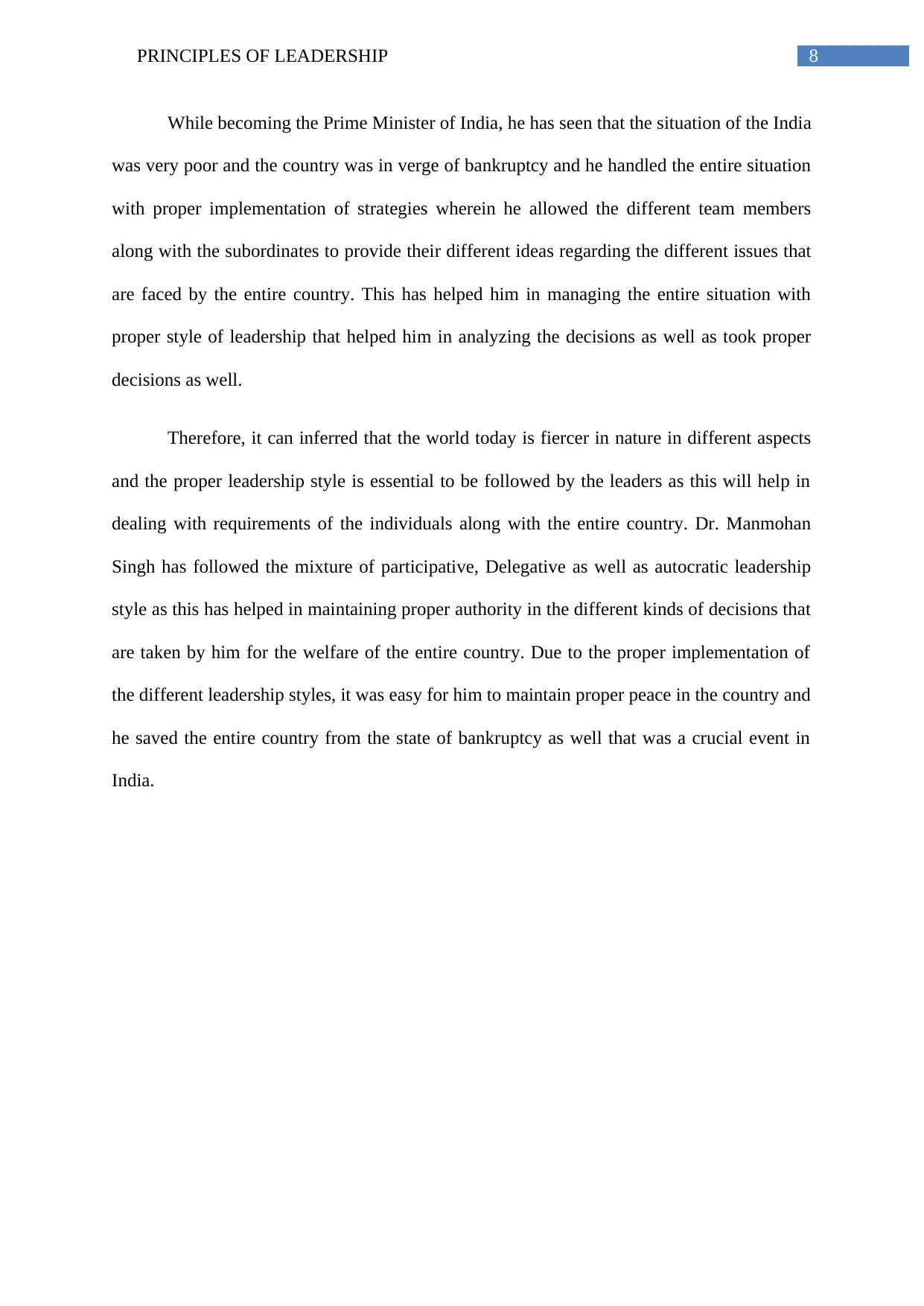
While becoming the Prime Minister of India, he has seen that the situation of the India
was very poor and the country was in verge of bankruptcy and he handled the entire situation
with proper implementation of strategies wherein he allowed the different team members
along with the subordinates to provide their different ideas regarding the different issues that
are faced by the entire country. This has helped him in managing the entire situation with
proper style of leadership that helped him in analyzing the decisions as well as took proper
decisions as well.
Therefore, it can inferred that the world today is fiercer in nature in different aspects
and the proper leadership style is essential to be followed by the leaders as this will help in
dealing with requirements of the individuals along with the entire country. Dr. Manmohan
Singh has followed the mixture of participative, Delegative as well as autocratic leadership
style as this has helped in maintaining proper authority in the different kinds of decisions that
are taken by him for the welfare of the entire country. Due to the proper implementation of
the different leadership styles, it was easy for him to maintain proper peace in the country and
he saved the entire country from the state of bankruptcy as well that was a crucial event in
India.
While becoming the Prime Minister of India, he has seen that the situation of the India
was very poor and the country was in verge of bankruptcy and he handled the entire situation
with proper implementation of strategies wherein he allowed the different team members
along with the subordinates to provide their different ideas regarding the different issues that
are faced by the entire country. This has helped him in managing the entire situation with
proper style of leadership that helped him in analyzing the decisions as well as took proper
decisions as well.
Therefore, it can inferred that the world today is fiercer in nature in different aspects
and the proper leadership style is essential to be followed by the leaders as this will help in
dealing with requirements of the individuals along with the entire country. Dr. Manmohan
Singh has followed the mixture of participative, Delegative as well as autocratic leadership
style as this has helped in maintaining proper authority in the different kinds of decisions that
are taken by him for the welfare of the entire country. Due to the proper implementation of
the different leadership styles, it was easy for him to maintain proper peace in the country and
he saved the entire country from the state of bankruptcy as well that was a crucial event in
India.
⊘ This is a preview!⊘
Do you want full access?
Subscribe today to unlock all pages.
Trusted by 1+ million students worldwide
9PRINCIPLES OF LEADERSHIP
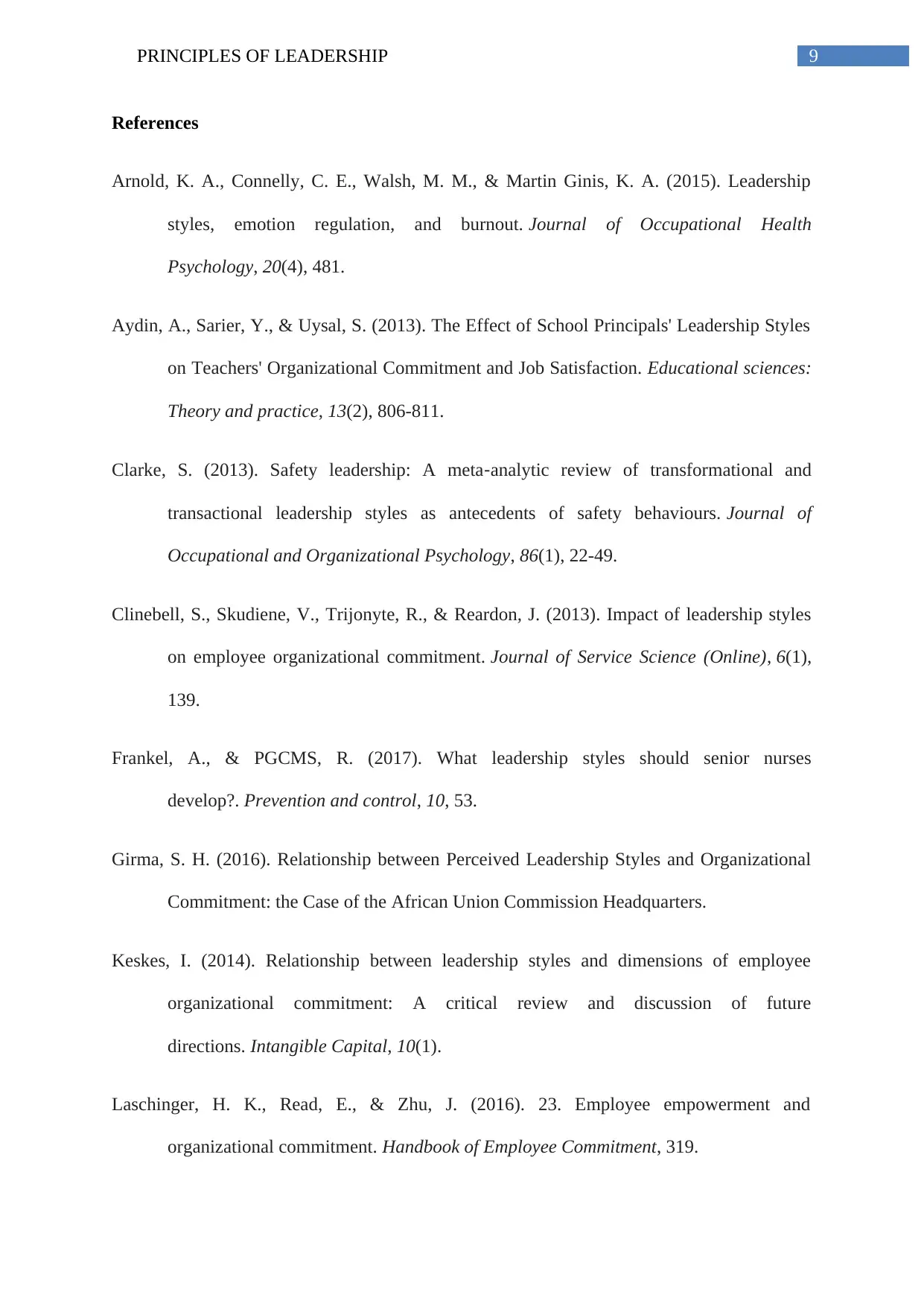
References
Arnold, K. A., Connelly, C. E., Walsh, M. M., & Martin Ginis, K. A. (2015). Leadership
styles, emotion regulation, and burnout. Journal of Occupational Health
Psychology, 20(4), 481.
Aydin, A., Sarier, Y., & Uysal, S. (2013). The Effect of School Principals' Leadership Styles
on Teachers' Organizational Commitment and Job Satisfaction. Educational sciences:
Theory and practice, 13(2), 806-811.
Clarke, S. (2013). Safety leadership: A meta‐analytic review of transformational and
transactional leadership styles as antecedents of safety behaviours. Journal of
Occupational and Organizational Psychology, 86(1), 22-49.
Clinebell, S., Skudiene, V., Trijonyte, R., & Reardon, J. (2013). Impact of leadership styles
on employee organizational commitment. Journal of Service Science (Online), 6(1),
139.
Frankel, A., & PGCMS, R. (2017). What leadership styles should senior nurses
develop?. Prevention and control, 10, 53.
Girma, S. H. (2016). Relationship between Perceived Leadership Styles and Organizational
Commitment: the Case of the African Union Commission Headquarters.
Keskes, I. (2014). Relationship between leadership styles and dimensions of employee
organizational commitment: A critical review and discussion of future
directions. Intangible Capital, 10(1).
Laschinger, H. K., Read, E., & Zhu, J. (2016). 23. Employee empowerment and
organizational commitment. Handbook of Employee Commitment, 319.
References
Arnold, K. A., Connelly, C. E., Walsh, M. M., & Martin Ginis, K. A. (2015). Leadership
styles, emotion regulation, and burnout. Journal of Occupational Health
Psychology, 20(4), 481.
Aydin, A., Sarier, Y., & Uysal, S. (2013). The Effect of School Principals' Leadership Styles
on Teachers' Organizational Commitment and Job Satisfaction. Educational sciences:
Theory and practice, 13(2), 806-811.
Clarke, S. (2013). Safety leadership: A meta‐analytic review of transformational and
transactional leadership styles as antecedents of safety behaviours. Journal of
Occupational and Organizational Psychology, 86(1), 22-49.
Clinebell, S., Skudiene, V., Trijonyte, R., & Reardon, J. (2013). Impact of leadership styles
on employee organizational commitment. Journal of Service Science (Online), 6(1),
139.
Frankel, A., & PGCMS, R. (2017). What leadership styles should senior nurses
develop?. Prevention and control, 10, 53.
Girma, S. H. (2016). Relationship between Perceived Leadership Styles and Organizational
Commitment: the Case of the African Union Commission Headquarters.
Keskes, I. (2014). Relationship between leadership styles and dimensions of employee
organizational commitment: A critical review and discussion of future
directions. Intangible Capital, 10(1).
Laschinger, H. K., Read, E., & Zhu, J. (2016). 23. Employee empowerment and
organizational commitment. Handbook of Employee Commitment, 319.
Paraphrase This Document
Need a fresh take? Get an instant paraphrase of this document with our AI Paraphraser
10PRINCIPLES OF LEADERSHIP
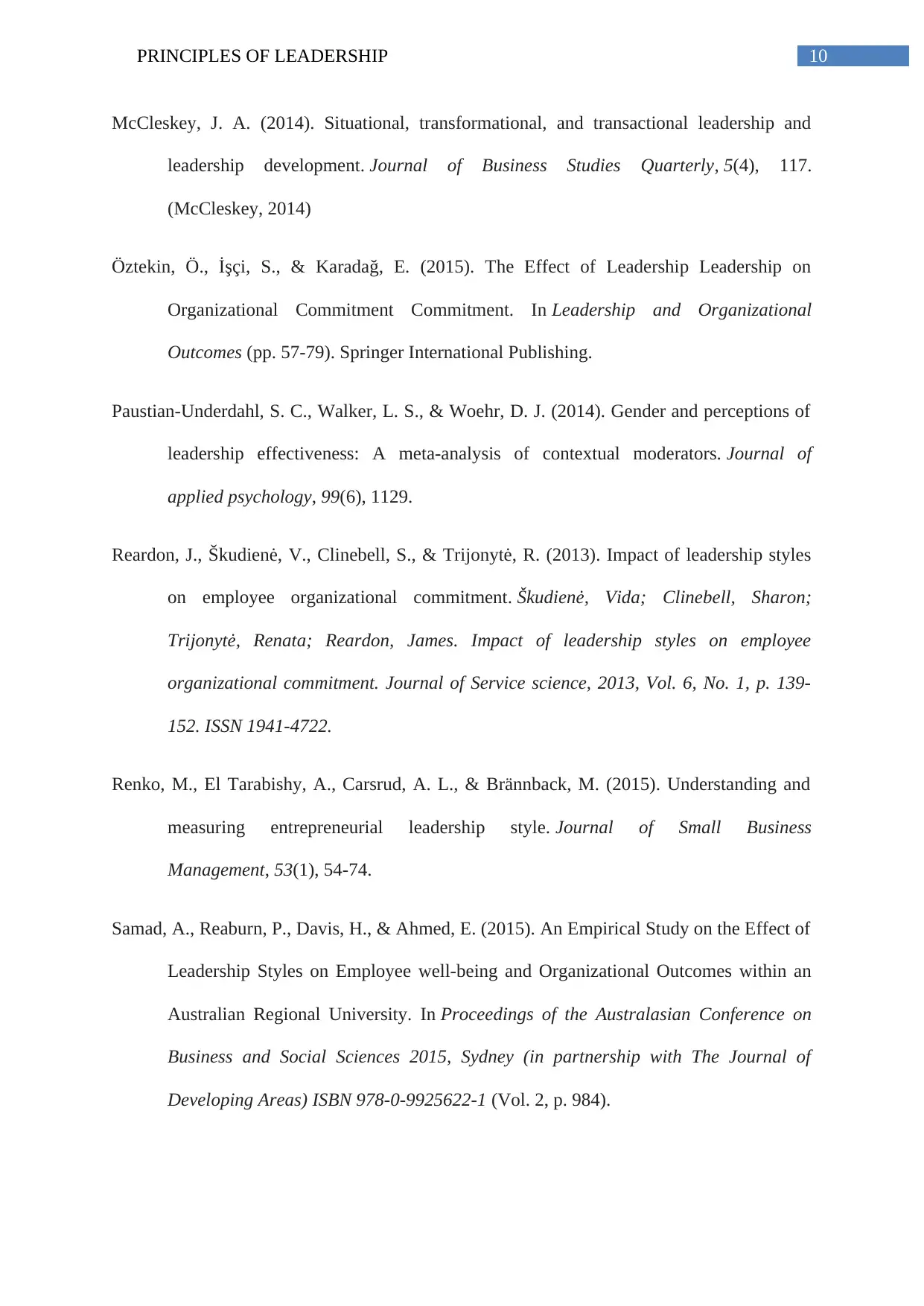
McCleskey, J. A. (2014). Situational, transformational, and transactional leadership and
leadership development. Journal of Business Studies Quarterly, 5(4), 117.
(McCleskey, 2014)
Öztekin, Ö., İşçi, S., & Karadağ, E. (2015). The Effect of Leadership Leadership on
Organizational Commitment Commitment. In Leadership and Organizational
Outcomes (pp. 57-79). Springer International Publishing.
Paustian-Underdahl, S. C., Walker, L. S., & Woehr, D. J. (2014). Gender and perceptions of
leadership effectiveness: A meta-analysis of contextual moderators. Journal of
applied psychology, 99(6), 1129.
Reardon, J., Škudienė, V., Clinebell, S., & Trijonytė, R. (2013). Impact of leadership styles
on employee organizational commitment. Škudienė, Vida; Clinebell, Sharon;
Trijonytė, Renata; Reardon, James. Impact of leadership styles on employee
organizational commitment. Journal of Service science, 2013, Vol. 6, No. 1, p. 139-
152. ISSN 1941-4722.
Renko, M., El Tarabishy, A., Carsrud, A. L., & Brännback, M. (2015). Understanding and
measuring entrepreneurial leadership style. Journal of Small Business
Management, 53(1), 54-74.
Samad, A., Reaburn, P., Davis, H., & Ahmed, E. (2015). An Empirical Study on the Effect of
Leadership Styles on Employee well-being and Organizational Outcomes within an
Australian Regional University. In Proceedings of the Australasian Conference on
Business and Social Sciences 2015, Sydney (in partnership with The Journal of
Developing Areas) ISBN 978-0-9925622-1 (Vol. 2, p. 984).
McCleskey, J. A. (2014). Situational, transformational, and transactional leadership and
leadership development. Journal of Business Studies Quarterly, 5(4), 117.
(McCleskey, 2014)
Öztekin, Ö., İşçi, S., & Karadağ, E. (2015). The Effect of Leadership Leadership on
Organizational Commitment Commitment. In Leadership and Organizational
Outcomes (pp. 57-79). Springer International Publishing.
Paustian-Underdahl, S. C., Walker, L. S., & Woehr, D. J. (2014). Gender and perceptions of
leadership effectiveness: A meta-analysis of contextual moderators. Journal of
applied psychology, 99(6), 1129.
Reardon, J., Škudienė, V., Clinebell, S., & Trijonytė, R. (2013). Impact of leadership styles
on employee organizational commitment. Škudienė, Vida; Clinebell, Sharon;
Trijonytė, Renata; Reardon, James. Impact of leadership styles on employee
organizational commitment. Journal of Service science, 2013, Vol. 6, No. 1, p. 139-
152. ISSN 1941-4722.
Renko, M., El Tarabishy, A., Carsrud, A. L., & Brännback, M. (2015). Understanding and
measuring entrepreneurial leadership style. Journal of Small Business
Management, 53(1), 54-74.
Samad, A., Reaburn, P., Davis, H., & Ahmed, E. (2015). An Empirical Study on the Effect of
Leadership Styles on Employee well-being and Organizational Outcomes within an
Australian Regional University. In Proceedings of the Australasian Conference on
Business and Social Sciences 2015, Sydney (in partnership with The Journal of
Developing Areas) ISBN 978-0-9925622-1 (Vol. 2, p. 984).
11PRINCIPLES OF LEADERSHIP
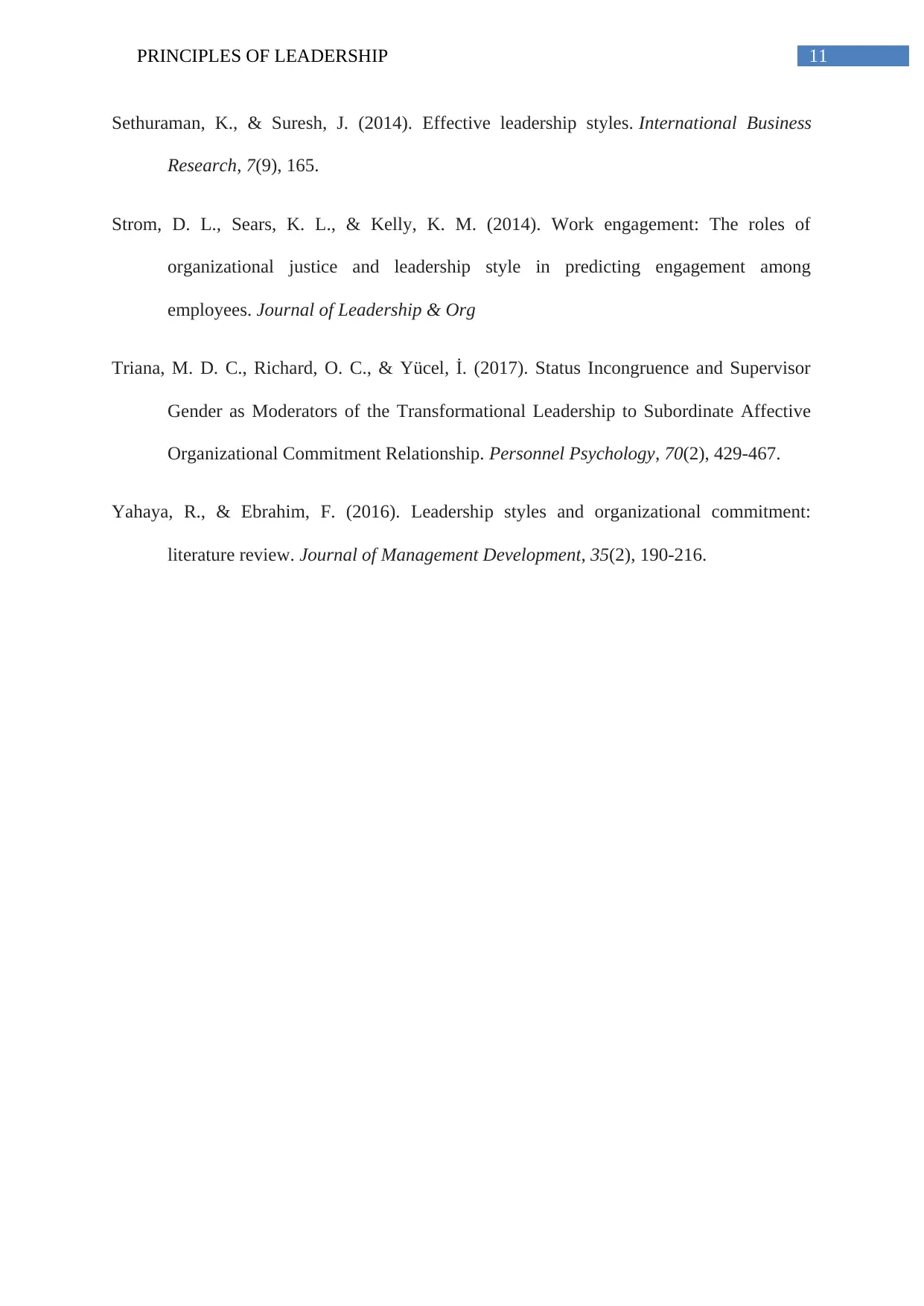
Sethuraman, K., & Suresh, J. (2014). Effective leadership styles. International Business
Research, 7(9), 165.
Strom, D. L., Sears, K. L., & Kelly, K. M. (2014). Work engagement: The roles of
organizational justice and leadership style in predicting engagement among
employees. Journal of Leadership & Org
Triana, M. D. C., Richard, O. C., & Yücel, İ. (2017). Status Incongruence and Supervisor
Gender as Moderators of the Transformational Leadership to Subordinate Affective
Organizational Commitment Relationship. Personnel Psychology, 70(2), 429-467.
Yahaya, R., & Ebrahim, F. (2016). Leadership styles and organizational commitment:
literature review. Journal of Management Development, 35(2), 190-216.
Sethuraman, K., & Suresh, J. (2014). Effective leadership styles. International Business
Research, 7(9), 165.
Strom, D. L., Sears, K. L., & Kelly, K. M. (2014). Work engagement: The roles of
organizational justice and leadership style in predicting engagement among
employees. Journal of Leadership & Org
Triana, M. D. C., Richard, O. C., & Yücel, İ. (2017). Status Incongruence and Supervisor
Gender as Moderators of the Transformational Leadership to Subordinate Affective
Organizational Commitment Relationship. Personnel Psychology, 70(2), 429-467.
Yahaya, R., & Ebrahim, F. (2016). Leadership styles and organizational commitment:
literature review. Journal of Management Development, 35(2), 190-216.
⊘ This is a preview!⊘
Do you want full access?
Subscribe today to unlock all pages.
Trusted by 1+ million students worldwide

1 out of 12


Related Documents


Your All-in-One AI-Powered Toolkit for Academic Success.
+13062052269
info@desklib.com
Available 24*7 on WhatsApp / Email
![[object Object]](/_next/static/media/star-bottom.7253800d.svg)
Unlock your academic potential
Copyright © 2020–2026 A2Z Services. All Rights Reserved. Developed and managed by ZUCOL.