Principles of Purchasing: Online Ethics and Customer Behavior Report

Verified

Added on  2022/09/23

|3
|849
|23
Report
AI Summary
This report delves into the principles of purchasing, focusing on the impact of online ethics and customer behavior. It analyzes two key articles: Limbu, Wolf, & Lunsford's work on consumers' perceptions of online ethics and its effects on satisfaction and loyalty, and Carrigan & Attalla's examination of ethical consumer behavior. The report highlights critical principles such as security, privacy, fulfillment, non-deception, and loyalty, emphasizing their importance in online retailing. It explores how customer perceptions of ethical practices influence purchasing decisions and the significance of social responsibility in consumer choices. The analysis also addresses the role of customer sophistication and the trade-offs consumers make between ethical considerations, price, quality, and value. Ultimately, the report underscores the need for marketers to understand and adhere to ethical principles to foster customer trust and loyalty, driving business success.

Document Page
Principles of purchasing
P
tabler-icon-diamond-filled.svg

Paraphrase This Document

Need a fresh take? Get an instant paraphrase of this document with our AI Paraphraser
Document Page
Principles of purchasing 1
Limbu, Y. B., Wolf, M., & Lunsford, D. L. (2011). Consumers' perceptions of online
ethics and its effects on satisfaction and loyalty. Journal of Research in Interactive
Marketing, 5(1), 71-89.
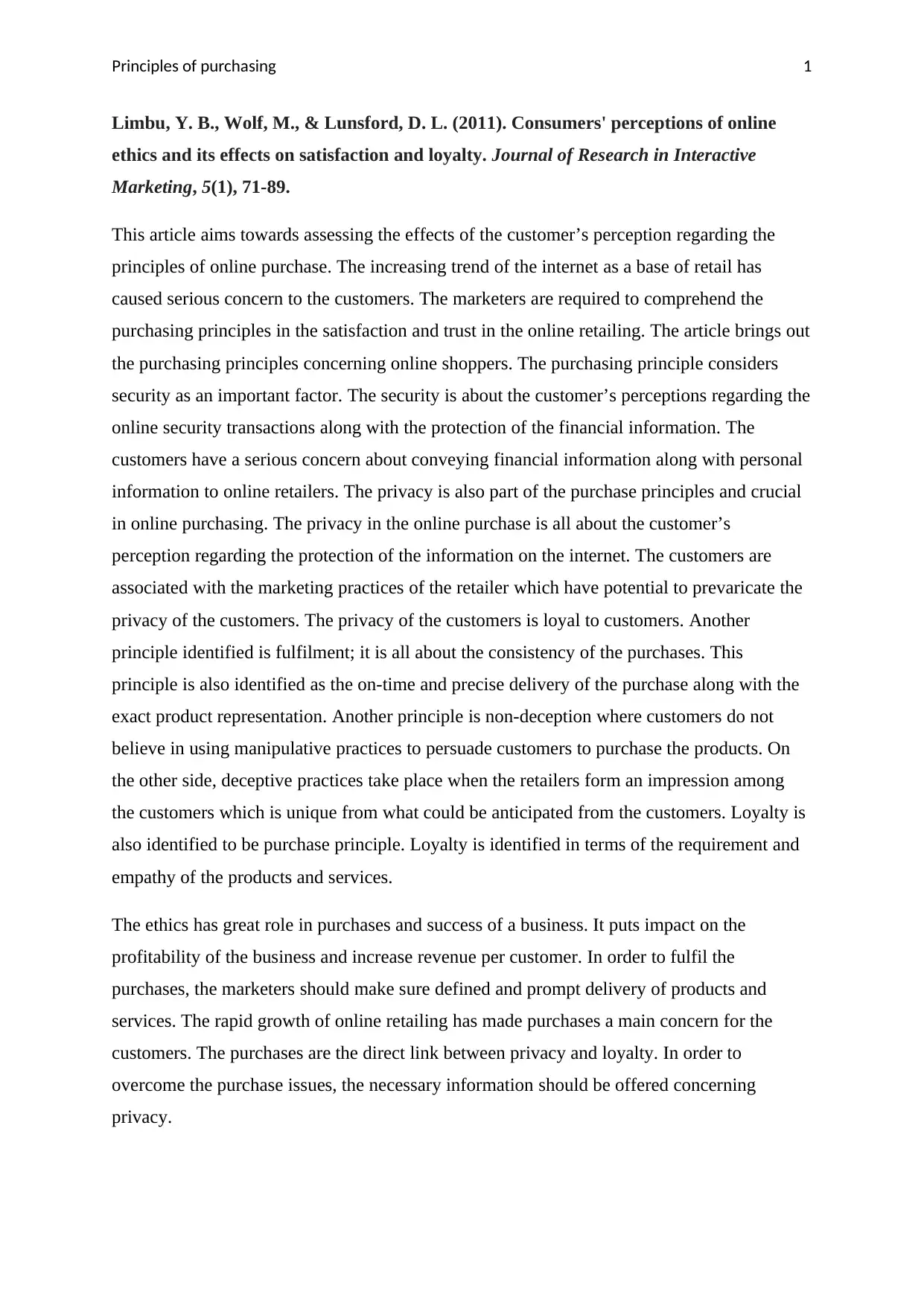
This article aims towards assessing the effects of the customer’s perception regarding the
principles of online purchase. The increasing trend of the internet as a base of retail has
caused serious concern to the customers. The marketers are required to comprehend the
purchasing principles in the satisfaction and trust in the online retailing. The article brings out
the purchasing principles concerning online shoppers. The purchasing principle considers
security as an important factor. The security is about the customer’s perceptions regarding the
online security transactions along with the protection of the financial information. The
customers have a serious concern about conveying financial information along with personal
information to online retailers. The privacy is also part of the purchase principles and crucial
in online purchasing. The privacy in the online purchase is all about the customer’s
perception regarding the protection of the information on the internet. The customers are
associated with the marketing practices of the retailer which have potential to prevaricate the
privacy of the customers. The privacy of the customers is loyal to customers. Another
principle identified is fulfilment; it is all about the consistency of the purchases. This
principle is also identified as the on-time and precise delivery of the purchase along with the
exact product representation. Another principle is non-deception where customers do not
believe in using manipulative practices to persuade customers to purchase the products. On
the other side, deceptive practices take place when the retailers form an impression among
the customers which is unique from what could be anticipated from the customers. Loyalty is
also identified to be purchase principle. Loyalty is identified in terms of the requirement and
empathy of the products and services.
The ethics has great role in purchases and success of a business. It puts impact on the
profitability of the business and increase revenue per customer. In order to fulfil the
purchases, the marketers should make sure defined and prompt delivery of products and
services. The rapid growth of online retailing has made purchases a main concern for the
customers. The purchases are the direct link between privacy and loyalty. In order to
overcome the purchase issues, the necessary information should be offered concerning
privacy.
Document Page
Principles of purchasing 2
Carrigan, M., & Attalla, A. (2001). The myth of the ethical consumer–do ethics matter
in purchase behaviour?. Journal of consumer marketing, 18(7), 560-578.
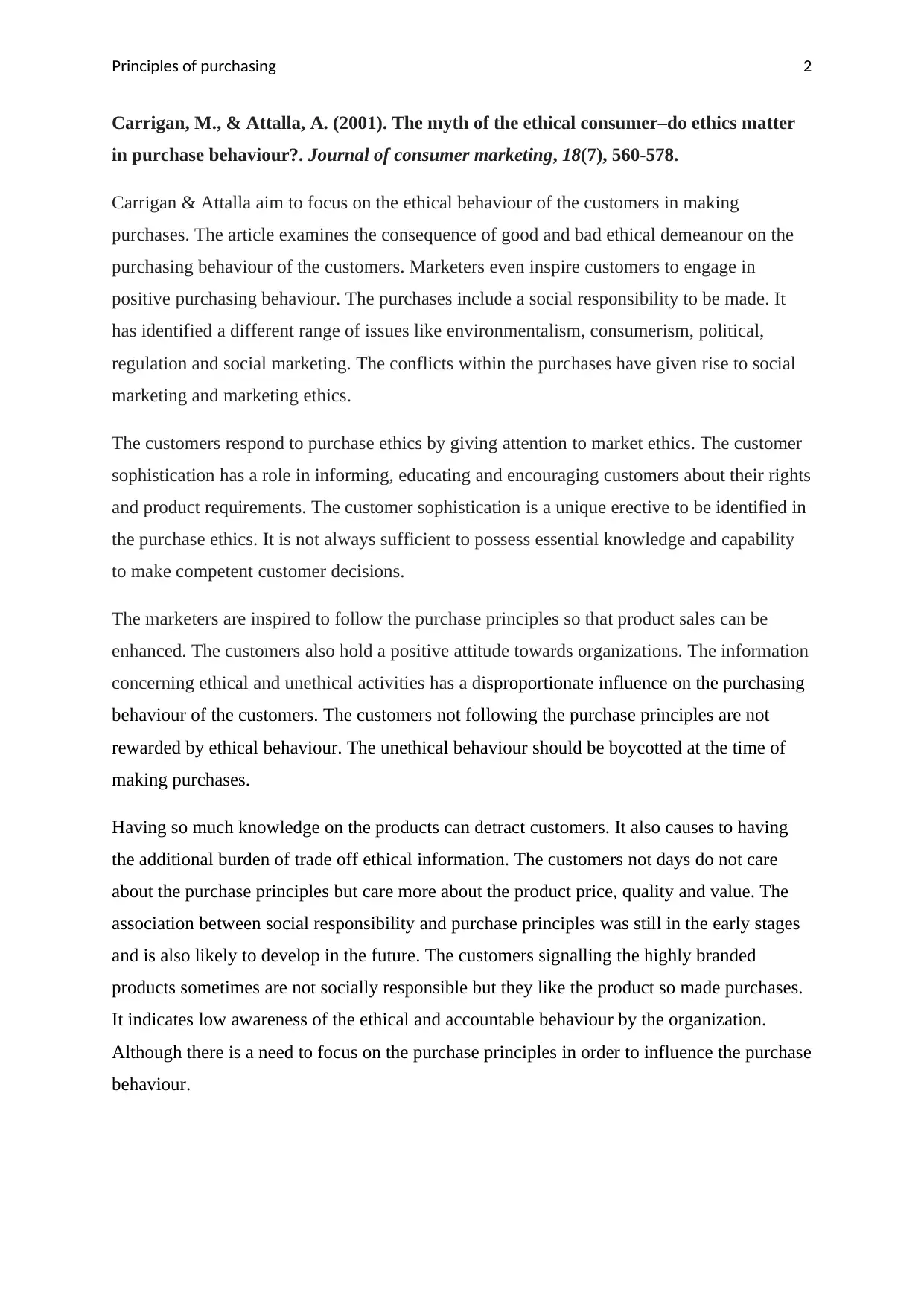
Carrigan & Attalla aim to focus on the ethical behaviour of the customers in making
purchases. The article examines the consequence of good and bad ethical demeanour on the
purchasing behaviour of the customers. Marketers even inspire customers to engage in
positive purchasing behaviour. The purchases include a social responsibility to be made. It
has identified a different range of issues like environmentalism, consumerism, political,
regulation and social marketing. The conflicts within the purchases have given rise to social
marketing and marketing ethics.
The customers respond to purchase ethics by giving attention to market ethics. The customer
sophistication has a role in informing, educating and encouraging customers about their rights
and product requirements. The customer sophistication is a unique erective to be identified in
the purchase ethics. It is not always sufficient to possess essential knowledge and capability
to make competent customer decisions.
The marketers are inspired to follow the purchase principles so that product sales can be
enhanced. The customers also hold a positive attitude towards organizations. The information
concerning ethical and unethical activities has a disproportionate influence on the purchasing
behaviour of the customers. The customers not following the purchase principles are not
rewarded by ethical behaviour. The unethical behaviour should be boycotted at the time of
making purchases.
Having so much knowledge on the products can detract customers. It also causes to having
the additional burden of trade off ethical information. The customers not days do not care
about the purchase principles but care more about the product price, quality and value. The
association between social responsibility and purchase principles was still in the early stages
and is also likely to develop in the future. The customers signalling the highly branded
products sometimes are not socially responsible but they like the product so made purchases.
It indicates low awareness of the ethical and accountable behaviour by the organization.
Although there is a need to focus on the purchase principles in order to influence the purchase
behaviour.
chevron_up_icon
1 out of 3
circle_padding
hide_on_mobile
zoom_out_icon
[object Object]