Production Planning: Aggregate Planning, MRP & Airbus A380 Analysis
VerifiedAdded on 2023/06/11
|7
|1328
|54
Report
AI Summary
This report delves into production planning and management principles, utilizing the Airbus A380 development as a case study to illustrate the complexities and challenges involved. It explores aggregate planning options, including capacity and demand considerations, to minimize production costs and meet demand effectively. The report also examines Material Requirements Planning (MRP), covering gross and net requirements, and analyzes the factors that contributed to delays and difficulties during the A380's development, such as lack of integration, environmental challenges, and competition. Furthermore, it discusses the impact of an organization's capacity on demand, highlighting how appropriate capacity can differentiate products and increase demand. The analysis includes cause-and-effect diagrams to illustrate the various factors affecting production processes and ultimately impacting strategic success or failure. Desklib offers a wealth of resources, including past papers and solved assignments, to support students in mastering these concepts.
Running head: PRODUCTION PLANNING AND MANAGEMENT
Production Planning and Management
Name
Institutional Affiliations
Production Planning and Management
Name
Institutional Affiliations
Paraphrase This Document
Need a fresh take? Get an instant paraphrase of this document with our AI Paraphraser

PRODUCTION PLANNING AND MANAGEMENT 2
QUESTIONS ON PRODUCTION PLANNING AND MANAGEMENT
The reason for having an aggregate planning is to reduce the cost over the period of
planning and meet the demand. In aggregate production planning, there are three options for
planning which include capacity options, demand options, and aggregate planning. Each option
gives a different cost of production, which helps the producer to determine, which production
plan minimizes the cost of production and meets the demand. The following are answers to
questions based on the aggregate production planning. An example on the development of the
Airbus A380 is given. It also looks into the capacity of an organization and how it affects
demand (Mc Lean, 2018).
Question 3: The Airbus A380 has for a long time been successful and have provided
services to very many people traveling from one place to another. During the development of the
Airbus A380, one could think that the project would never be successful. The development of the
Airbus A380 has faced many difficulties all through its development history (Upadhyay, &
Zafar, 2018). This makes it a perfect example to demonstrate the importance of developing a
product or a service to strategic success or failure. The development of the Airbus A380 was a
journey filled with very many incidents and a very long one. It faced many problems in its
development, which included market delays, problems in discovering cracks and doors problems.
Airbus took a step of consulting the required materials to build a super-large aircraft with the
international airlines. The Airbus finally forms the large aircraft and due to its large size, they
had to come up with new designs of engines specifically designed for the large aircraft. They
started with manufacturing the crafts key components including wings and engines. The work
continues until the aircraft makes its first flight successfully (Upadhyay, & Zafar, 2018).
QUESTIONS ON PRODUCTION PLANNING AND MANAGEMENT
The reason for having an aggregate planning is to reduce the cost over the period of
planning and meet the demand. In aggregate production planning, there are three options for
planning which include capacity options, demand options, and aggregate planning. Each option
gives a different cost of production, which helps the producer to determine, which production
plan minimizes the cost of production and meets the demand. The following are answers to
questions based on the aggregate production planning. An example on the development of the
Airbus A380 is given. It also looks into the capacity of an organization and how it affects
demand (Mc Lean, 2018).
Question 3: The Airbus A380 has for a long time been successful and have provided
services to very many people traveling from one place to another. During the development of the
Airbus A380, one could think that the project would never be successful. The development of the
Airbus A380 has faced many difficulties all through its development history (Upadhyay, &
Zafar, 2018). This makes it a perfect example to demonstrate the importance of developing a
product or a service to strategic success or failure. The development of the Airbus A380 was a
journey filled with very many incidents and a very long one. It faced many problems in its
development, which included market delays, problems in discovering cracks and doors problems.
Airbus took a step of consulting the required materials to build a super-large aircraft with the
international airlines. The Airbus finally forms the large aircraft and due to its large size, they
had to come up with new designs of engines specifically designed for the large aircraft. They
started with manufacturing the crafts key components including wings and engines. The work
continues until the aircraft makes its first flight successfully (Upadhyay, & Zafar, 2018).

PRODUCTION PLANNING AND MANAGEMENT 3
The aircraft started as a small aircraft than to jumbo jet, which was later, improvise to
make the A380 aircraft (Akkermans, & Van Wassenhove, 2018). A380 had unique feature
because of its extra –large size that could hold up to 850 passengers. The problem of the delay
was encountered during the development of this aircraft in 2006, which was around six to seven
months. The trouble caused confusion in both the Airbus and EADS boardrooms. The delays
were caused by the fact that the aircraft was very large and posted a problem during the boarding
of passengers. The main reason for the delay during the development of the aircraft is due to lack
of integration between the manufacturers and the people responsible for the design.
Manufacturing processes were prolonged, for example, the wiring system was designed twice
due to the incompatibility of the first design by French and Germany factories (van Garrel et al,
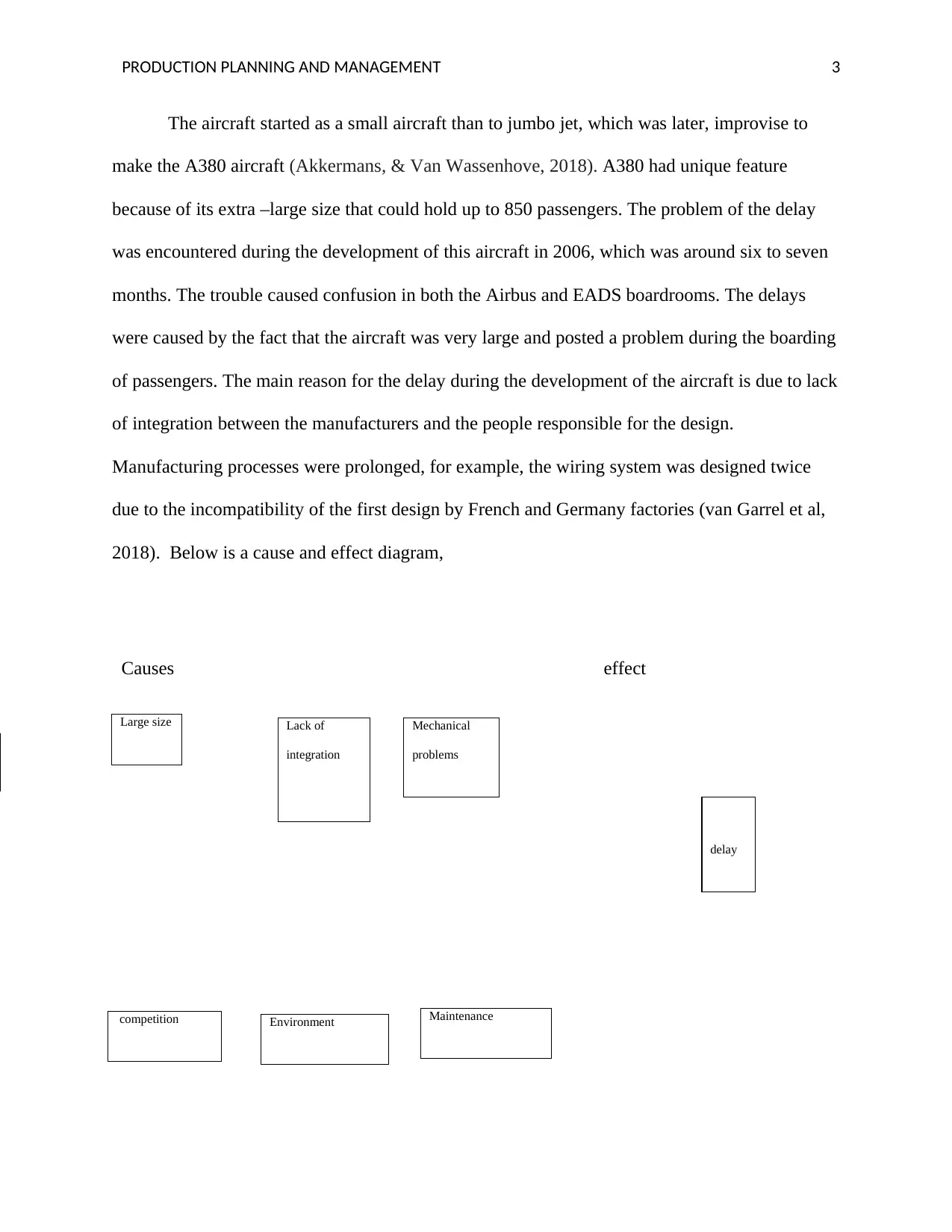
2018). Below is a cause and effect diagram,
Causes effect
delay
Large size Lack of
integration
Mechanical
problems
MaintenanceEnvironmentcompetition
The aircraft started as a small aircraft than to jumbo jet, which was later, improvise to
make the A380 aircraft (Akkermans, & Van Wassenhove, 2018). A380 had unique feature
because of its extra –large size that could hold up to 850 passengers. The problem of the delay
was encountered during the development of this aircraft in 2006, which was around six to seven
months. The trouble caused confusion in both the Airbus and EADS boardrooms. The delays
were caused by the fact that the aircraft was very large and posted a problem during the boarding
of passengers. The main reason for the delay during the development of the aircraft is due to lack
of integration between the manufacturers and the people responsible for the design.
Manufacturing processes were prolonged, for example, the wiring system was designed twice
due to the incompatibility of the first design by French and Germany factories (van Garrel et al,
2018). Below is a cause and effect diagram,
Causes effect
delay
Large size Lack of
integration
Mechanical
problems
MaintenanceEnvironmentcompetition
⊘ This is a preview!⊘
Do you want full access?
Subscribe today to unlock all pages.

Trusted by 1+ million students worldwide

PRODUCTION PLANNING AND MANAGEMENT 4
Other than the capacity of the aircraft, the environment caused the delay. Some challenging
weather conditi0ons cause a lot of delay in the development of the Airbus. Engine strikes and
other mechanical damages also posted a great challenge to the development of the craft. It would
take a lot of time to take the aircraft to different countries such as France for the checkups of the
aircraft.
The A380 aircraft also faced challenges due to increased competition from the other aircraft.
The size of the aircraft was too big and this made it difficult for it to compete effectively (Van
Garrel et al, 2018). The modern aircraft have posted a great trouble in the history of the aircraft.
In addition, the craft also had problems such as engineers’ strikes, supply chain problems and
other mistakes by engineers involved in designs. These problems also caused many delays in the
operations of the aircraft. The development process behind the success of the aircraft involved
design engineers who came up with unique features to be used in creating the aircraft. The
aircraft passed a lot of test including a test of 850 passengers being able to get out of the aircraft
in around 80 seconds when almost half of the exits were closed (Upadhyay, & Zafar, 2018).
Question 4: the human recourses in the organization, material and physical resources,
intellectual recourses, financial recourses and other factors affecting the organization's
production processes define capacity the products of an organization (Li, & Jiao, 2018). It is
where a producer of things adds the capacity of for instance computer software and does not
charge the added capacity. This enables the consumer to have a room for expanding the capacity
anytime they make a progress. In the event the consumer needs to upgrade the operations, they
would contact the producer to activate the added capacity. This gives the producer a chance to
charge the added capacity, which was not charged during the selling of the computer (Zhao,
Zheng, & Litvinov, 2018).
Other than the capacity of the aircraft, the environment caused the delay. Some challenging
weather conditi0ons cause a lot of delay in the development of the Airbus. Engine strikes and
other mechanical damages also posted a great challenge to the development of the craft. It would
take a lot of time to take the aircraft to different countries such as France for the checkups of the
aircraft.
The A380 aircraft also faced challenges due to increased competition from the other aircraft.
The size of the aircraft was too big and this made it difficult for it to compete effectively (Van
Garrel et al, 2018). The modern aircraft have posted a great trouble in the history of the aircraft.
In addition, the craft also had problems such as engineers’ strikes, supply chain problems and
other mistakes by engineers involved in designs. These problems also caused many delays in the
operations of the aircraft. The development process behind the success of the aircraft involved
design engineers who came up with unique features to be used in creating the aircraft. The
aircraft passed a lot of test including a test of 850 passengers being able to get out of the aircraft
in around 80 seconds when almost half of the exits were closed (Upadhyay, & Zafar, 2018).
Question 4: the human recourses in the organization, material and physical resources,
intellectual recourses, financial recourses and other factors affecting the organization's
production processes define capacity the products of an organization (Li, & Jiao, 2018). It is
where a producer of things adds the capacity of for instance computer software and does not
charge the added capacity. This enables the consumer to have a room for expanding the capacity
anytime they make a progress. In the event the consumer needs to upgrade the operations, they
would contact the producer to activate the added capacity. This gives the producer a chance to
charge the added capacity, which was not charged during the selling of the computer (Zhao,
Zheng, & Litvinov, 2018).
Paraphrase This Document
Need a fresh take? Get an instant paraphrase of this document with our AI Paraphraser

PRODUCTION PLANNING AND MANAGEMENT 5
Capacity can lead to an increase in the demand for a product or lag the demand for that product.
In the case of an increase in the capacity then the actual demand must go up which may result to
loss of potential customers who move to somewhere else when the demand becomes more than
the rate of the capacity increase. On the other hand, having appropriate capacity will enable you
to produce goods and services which are unique and thus increasing the demand for the products.
Appropriate capacity enables the organization to be able to differentiate their products and is able
to produce the commodities as demanded (Minguez et al, 2018).
Capacity can lead to an increase in the demand for a product or lag the demand for that product.
In the case of an increase in the capacity then the actual demand must go up which may result to
loss of potential customers who move to somewhere else when the demand becomes more than
the rate of the capacity increase. On the other hand, having appropriate capacity will enable you
to produce goods and services which are unique and thus increasing the demand for the products.
Appropriate capacity enables the organization to be able to differentiate their products and is able
to produce the commodities as demanded (Minguez et al, 2018).

PRODUCTION PLANNING AND MANAGEMENT 6
REFERENCES
Akkermans, H. A., & Van Wassenhove, L. N. (2018). A dynamic model of managerial response
to grey swan events in supply networks. International Journal of Production Research, 56(1-2),
10-21.
Li, X. Y., & Jiao, Y. (2018). U.S. Patent No. 9,900,402. Washington, DC: U.S. Patent and
Trademark Office.
McLean, M. (2018). Understanding your economy: Using analysis to guide local strategic
planning. Routledge.
Mínguez, R., García-Bertrand, R., Arroyo, J. M., & Alguacil, N. (2018). On the Solution of
Large-Scale Robust Transmission Network Expansion Planning under Uncertain Demand and
Generation Capacity. IEEE Transactions on Power Systems, 33(2), 1242-1251.
Upadhyay, D. K., & Zafar, A. (2018). President Macron’s Visit to China: Shaping New
Partnership.
van Garrel, A., ten Pas, S., Venner, K., & van Muijden, J. (2018). Wind Turbine Aerodynamics
from an Aerospace Perspective. In 2018 Wind Energy Symposium (p. 0991).
Zhao, F., Zheng, T., & Litvinov, E. (2018). Constructing Demand Curves in forwarding Capacity
Market. IEEE Transactions on Power Systems, 33(1), 525-535.
REFERENCES
Akkermans, H. A., & Van Wassenhove, L. N. (2018). A dynamic model of managerial response
to grey swan events in supply networks. International Journal of Production Research, 56(1-2),
10-21.
Li, X. Y., & Jiao, Y. (2018). U.S. Patent No. 9,900,402. Washington, DC: U.S. Patent and
Trademark Office.
McLean, M. (2018). Understanding your economy: Using analysis to guide local strategic
planning. Routledge.
Mínguez, R., García-Bertrand, R., Arroyo, J. M., & Alguacil, N. (2018). On the Solution of
Large-Scale Robust Transmission Network Expansion Planning under Uncertain Demand and
Generation Capacity. IEEE Transactions on Power Systems, 33(2), 1242-1251.
Upadhyay, D. K., & Zafar, A. (2018). President Macron’s Visit to China: Shaping New
Partnership.
van Garrel, A., ten Pas, S., Venner, K., & van Muijden, J. (2018). Wind Turbine Aerodynamics
from an Aerospace Perspective. In 2018 Wind Energy Symposium (p. 0991).
Zhao, F., Zheng, T., & Litvinov, E. (2018). Constructing Demand Curves in forwarding Capacity
Market. IEEE Transactions on Power Systems, 33(1), 525-535.
⊘ This is a preview!⊘
Do you want full access?
Subscribe today to unlock all pages.

Trusted by 1+ million students worldwide

PRODUCTION PLANNING AND MANAGEMENT 7
1 out of 7
Related Documents
Your All-in-One AI-Powered Toolkit for Academic Success.
+13062052269
info@desklib.com
Available 24*7 on WhatsApp / Email
Unlock your academic potential
Copyright © 2020–2026 A2Z Services. All Rights Reserved. Developed and managed by ZUCOL.