RN Professionalism: Ethical, Legal Duties & Team Collaboration

Verified

Added on  2023/06/11

|5
|946
|283
Report
AI Summary
This report provides an overview of the professional accountability of a registered nurse, addressing ethical, legal, and professional requirements. It highlights the four ethical principles: autonomy, beneficence, non-maleficence, and justice, with personal examples illustrating their application in clinical practice. The report further discusses the importance of teamwork, continuous improvement in quality and safety, and an understanding of NSW Health’s CORE values (Collaboration, Openness, Respect, Empowerment). Specific examples from clinical placements are used to demonstrate the application of these principles and values in real-world scenarios. The author reflects on their experiences working with doctors and pharmacists, attending seminars for professional development, and ensuring patient safety and well-being. The report concludes by emphasizing the importance of respecting patient rights, collaborating with colleagues, and empowering patients with relevant information.
Document Page
1
PROFESSIONAL ACCOUNTABILITY
Name:
Institution:
Tutor:
Date:
tabler-icon-diamond-filled.svg

Paraphrase This Document

Need a fresh take? Get an instant paraphrase of this document with our AI Paraphraser
Document Page
2
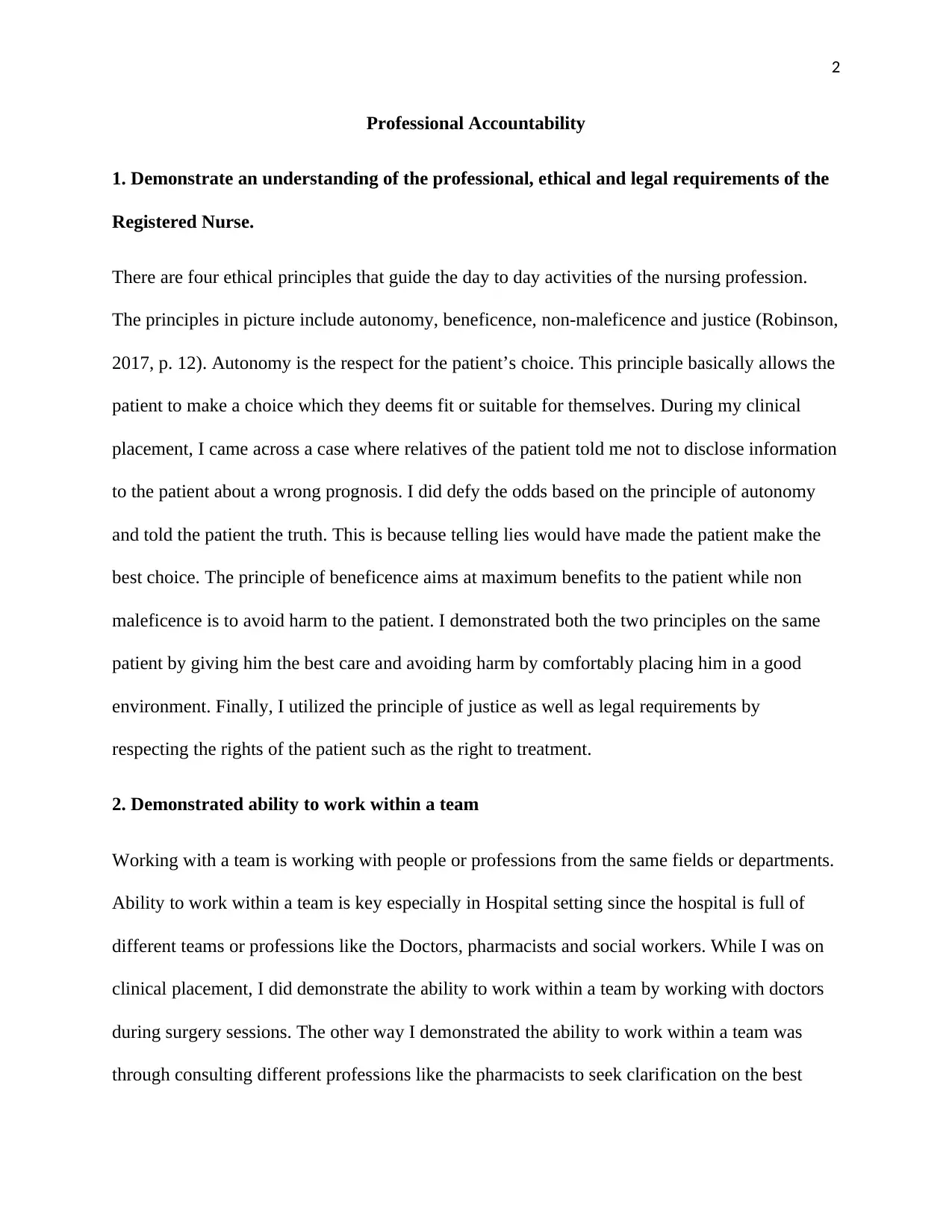
Professional Accountability
1. Demonstrate an understanding of the professional, ethical and legal requirements of the
Registered Nurse.
There are four ethical principles that guide the day to day activities of the nursing profession.
The principles in picture include autonomy, beneficence, non-maleficence and justice (Robinson,
2017, p. 12). Autonomy is the respect for the patient’s choice. This principle basically allows the
patient to make a choice which they deems fit or suitable for themselves. During my clinical
placement, I came across a case where relatives of the patient told me not to disclose information
to the patient about a wrong prognosis. I did defy the odds based on the principle of autonomy
and told the patient the truth. This is because telling lies would have made the patient make the
best choice. The principle of beneficence aims at maximum benefits to the patient while non
maleficence is to avoid harm to the patient. I demonstrated both the two principles on the same
patient by giving him the best care and avoiding harm by comfortably placing him in a good
environment. Finally, I utilized the principle of justice as well as legal requirements by
respecting the rights of the patient such as the right to treatment.
2. Demonstrated ability to work within a team
Working with a team is working with people or professions from the same fields or departments.
Ability to work within a team is key especially in Hospital setting since the hospital is full of
different teams or professions like the Doctors, pharmacists and social workers. While I was on
clinical placement, I did demonstrate the ability to work within a team by working with doctors
during surgery sessions. The other way I demonstrated the ability to work within a team was
through consulting different professions like the pharmacists to seek clarification on the best
Document Page
3
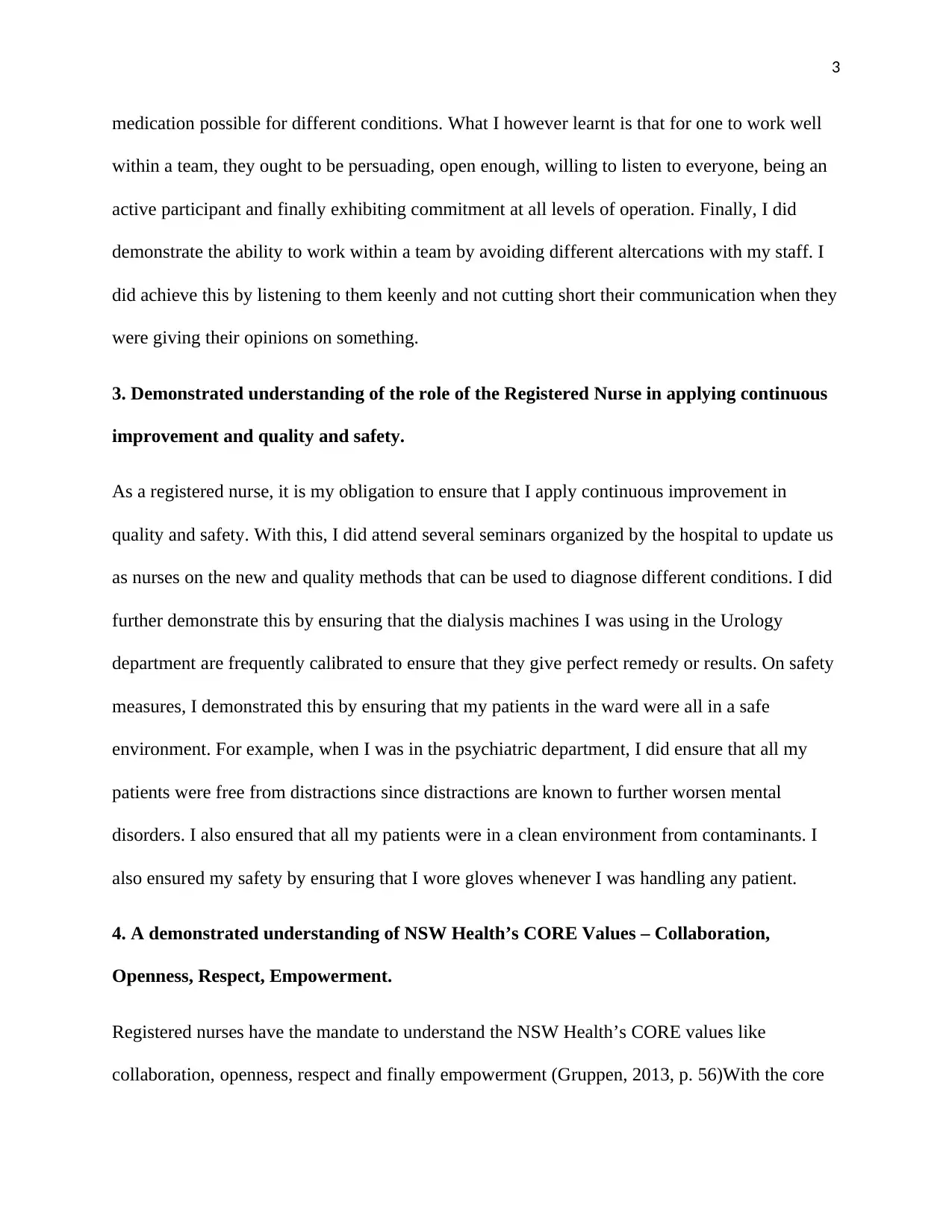
medication possible for different conditions. What I however learnt is that for one to work well
within a team, they ought to be persuading, open enough, willing to listen to everyone, being an
active participant and finally exhibiting commitment at all levels of operation. Finally, I did
demonstrate the ability to work within a team by avoiding different altercations with my staff. I
did achieve this by listening to them keenly and not cutting short their communication when they
were giving their opinions on something.
3. Demonstrated understanding of the role of the Registered Nurse in applying continuous
improvement and quality and safety.
As a registered nurse, it is my obligation to ensure that I apply continuous improvement in
quality and safety. With this, I did attend several seminars organized by the hospital to update us
as nurses on the new and quality methods that can be used to diagnose different conditions. I did
further demonstrate this by ensuring that the dialysis machines I was using in the Urology
department are frequently calibrated to ensure that they give perfect remedy or results. On safety
measures, I demonstrated this by ensuring that my patients in the ward were all in a safe
environment. For example, when I was in the psychiatric department, I did ensure that all my
patients were free from distractions since distractions are known to further worsen mental
disorders. I also ensured that all my patients were in a clean environment from contaminants. I
also ensured my safety by ensuring that I wore gloves whenever I was handling any patient.
4. A demonstrated understanding of NSW Health’s CORE Values – Collaboration,
Openness, Respect, Empowerment.
Registered nurses have the mandate to understand the NSW Health’s CORE values like
collaboration, openness, respect and finally empowerment (Gruppen, 2013, p. 56)With the core
Document Page
4
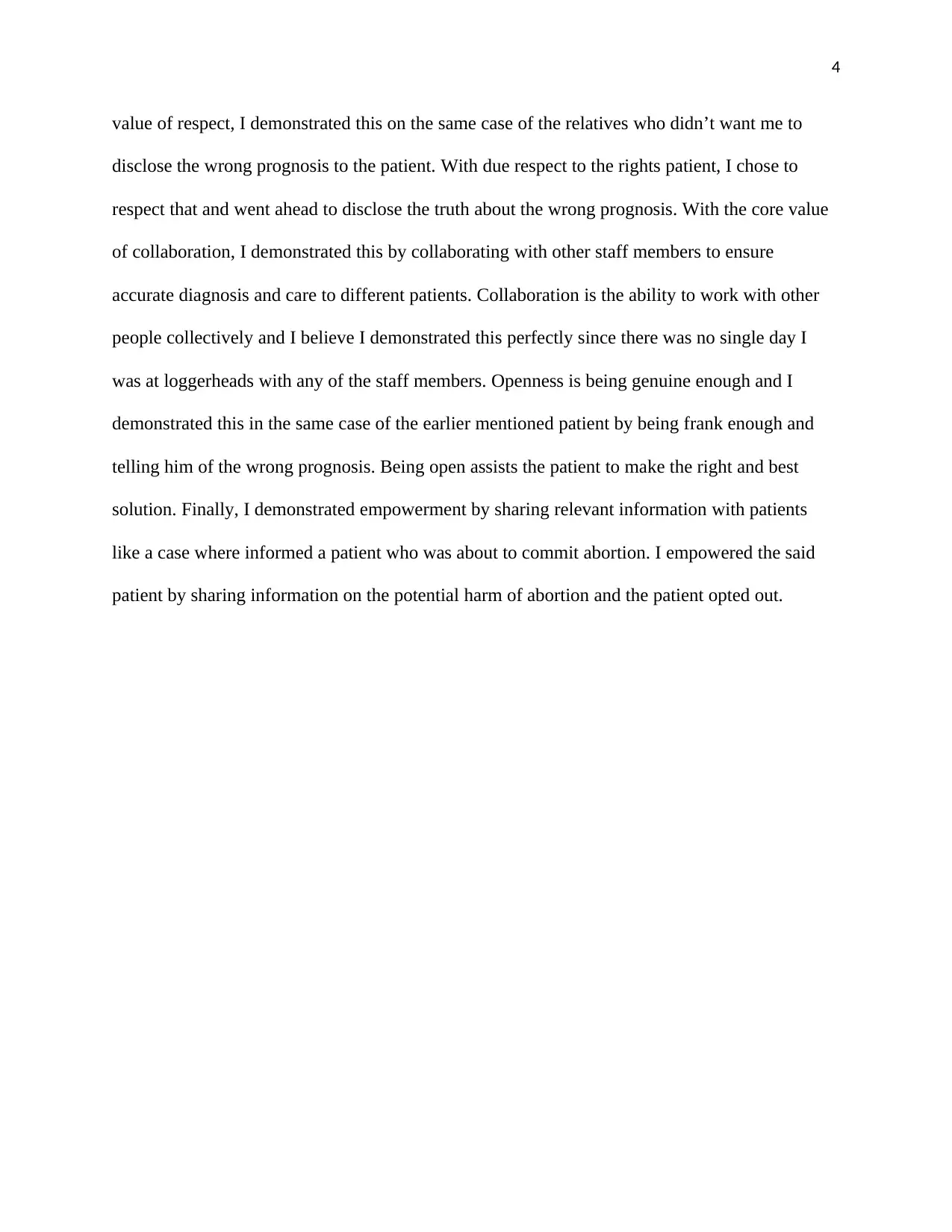
value of respect, I demonstrated this on the same case of the relatives who didn’t want me to
disclose the wrong prognosis to the patient. With due respect to the rights patient, I chose to
respect that and went ahead to disclose the truth about the wrong prognosis. With the core value
of collaboration, I demonstrated this by collaborating with other staff members to ensure
accurate diagnosis and care to different patients. Collaboration is the ability to work with other
people collectively and I believe I demonstrated this perfectly since there was no single day I
was at loggerheads with any of the staff members. Openness is being genuine enough and I
demonstrated this in the same case of the earlier mentioned patient by being frank enough and
telling him of the wrong prognosis. Being open assists the patient to make the right and best
solution. Finally, I demonstrated empowerment by sharing relevant information with patients
like a case where informed a patient who was about to commit abortion. I empowered the said
patient by sharing information on the potential harm of abortion and the patient opted out.
tabler-icon-diamond-filled.svg

Paraphrase This Document

Need a fresh take? Get an instant paraphrase of this document with our AI Paraphraser
Document Page
5
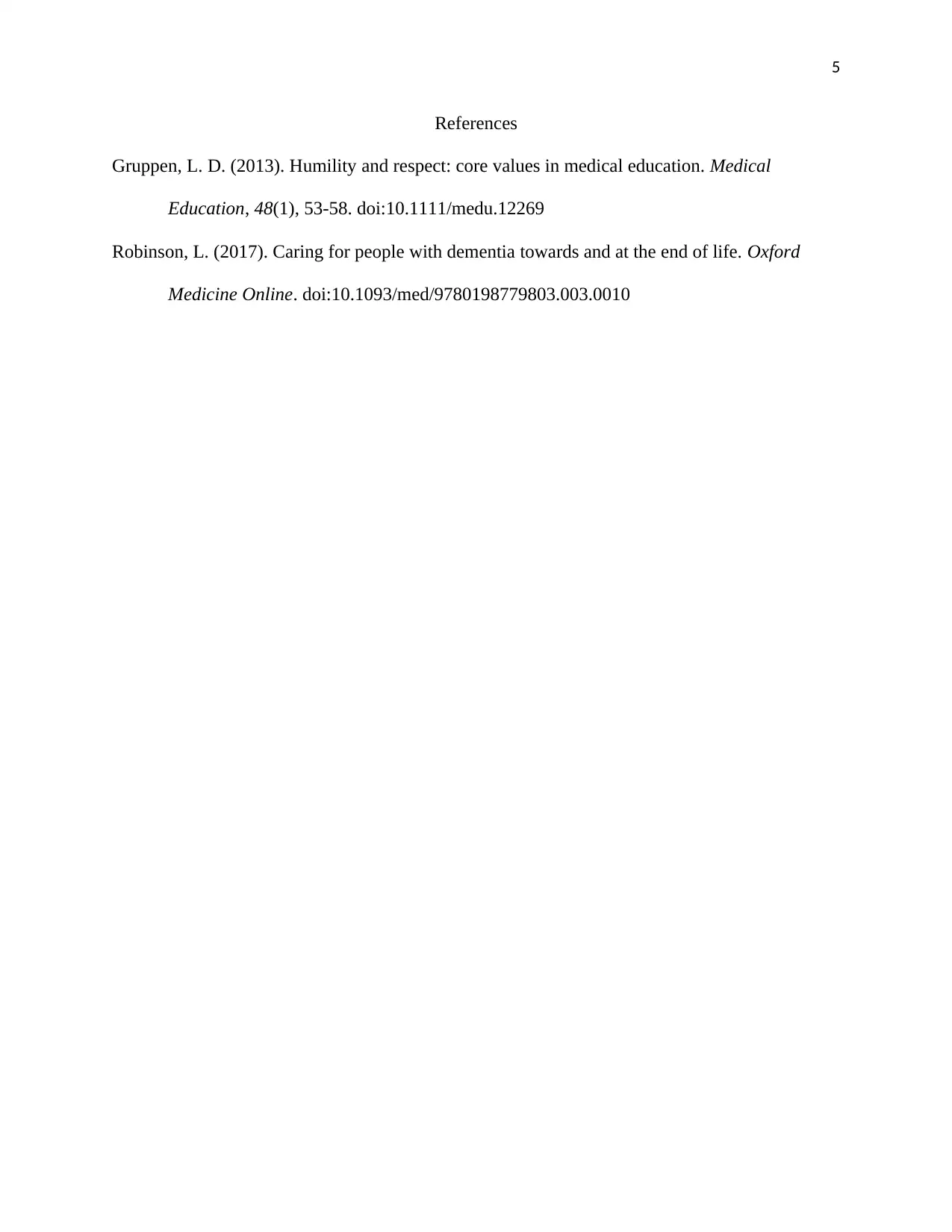
References
Gruppen, L. D. (2013). Humility and respect: core values in medical education. Medical
Education, 48(1), 53-58. doi:10.1111/medu.12269
Robinson, L. (2017). Caring for people with dementia towards and at the end of life. Oxford
Medicine Online. doi:10.1093/med/9780198779803.003.0010
chevron_up_icon
1 out of 5
circle_padding
hide_on_mobile
zoom_out_icon
[object Object]