Communication Skills and Professional Development: An Essay

Verified

Added on  2020/02/05

|5
|1707
|114
Essay
AI Summary
This essay examines the crucial role of communication skills in professional settings. It emphasizes the importance of effective communication for building trust, fostering a healthy work environment, and enhancing individual and organizational performance. The essay discusses various interpersonal skills, including active listening, providing constructive feedback, and asking clarifying questions, and how they contribute to successful interactions and decision-making. It also highlights the significance of communication in conflict resolution, employee motivation, and the effective implementation of changes within an organization. Furthermore, the essay explores the application of communication theories, such as Development Communication theory, to ensure clear information delivery and promote professional growth. The essay concludes by underscoring the impact of strong communication skills on customer satisfaction, employee engagement, and overall organizational success.

Document Page
Essay
tabler-icon-diamond-filled.svg

Paraphrase This Document

Need a fresh take? Get an instant paraphrase of this document with our AI Paraphraser
Document Page
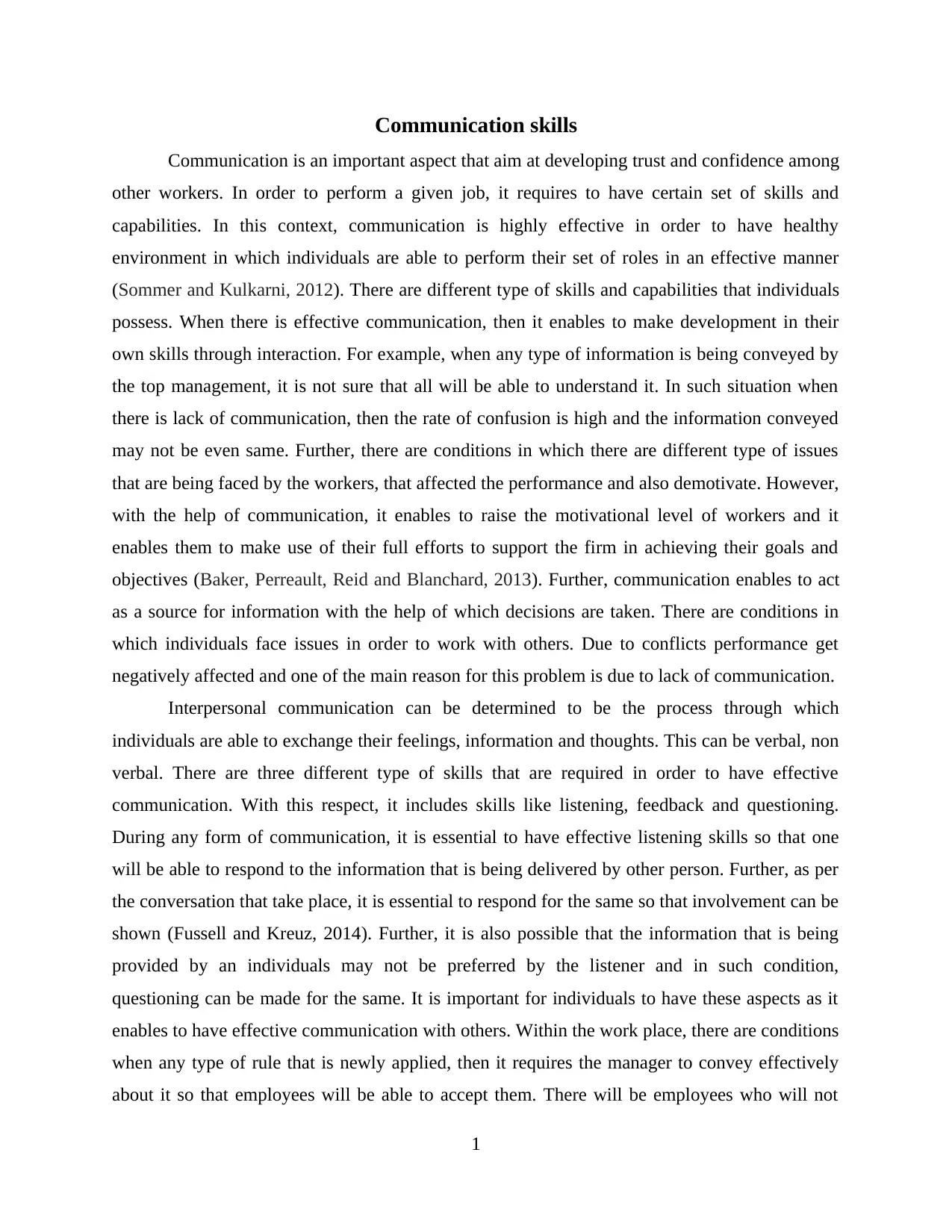
Communication skills
Communication is an important aspect that aim at developing trust and confidence among
other workers. In order to perform a given job, it requires to have certain set of skills and
capabilities. In this context, communication is highly effective in order to have healthy
environment in which individuals are able to perform their set of roles in an effective manner
(Sommer and Kulkarni, 2012). There are different type of skills and capabilities that individuals
possess. When there is effective communication, then it enables to make development in their
own skills through interaction. For example, when any type of information is being conveyed by
the top management, it is not sure that all will be able to understand it. In such situation when
there is lack of communication, then the rate of confusion is high and the information conveyed
may not be even same. Further, there are conditions in which there are different type of issues
that are being faced by the workers, that affected the performance and also demotivate. However,
with the help of communication, it enables to raise the motivational level of workers and it
enables them to make use of their full efforts to support the firm in achieving their goals and
objectives (Baker, Perreault, Reid and Blanchard, 2013). Further, communication enables to act
as a source for information with the help of which decisions are taken. There are conditions in
which individuals face issues in order to work with others. Due to conflicts performance get
negatively affected and one of the main reason for this problem is due to lack of communication.
Interpersonal communication can be determined to be the process through which
individuals are able to exchange their feelings, information and thoughts. This can be verbal, non
verbal. There are three different type of skills that are required in order to have effective
communication. With this respect, it includes skills like listening, feedback and questioning.
During any form of communication, it is essential to have effective listening skills so that one
will be able to respond to the information that is being delivered by other person. Further, as per
the conversation that take place, it is essential to respond for the same so that involvement can be
shown (Fussell and Kreuz, 2014). Further, it is also possible that the information that is being
provided by an individuals may not be preferred by the listener and in such condition,
questioning can be made for the same. It is important for individuals to have these aspects as it
enables to have effective communication with others. Within the work place, there are conditions
when any type of rule that is newly applied, then it requires the manager to convey effectively
about it so that employees will be able to accept them. There will be employees who will not
1
Document Page
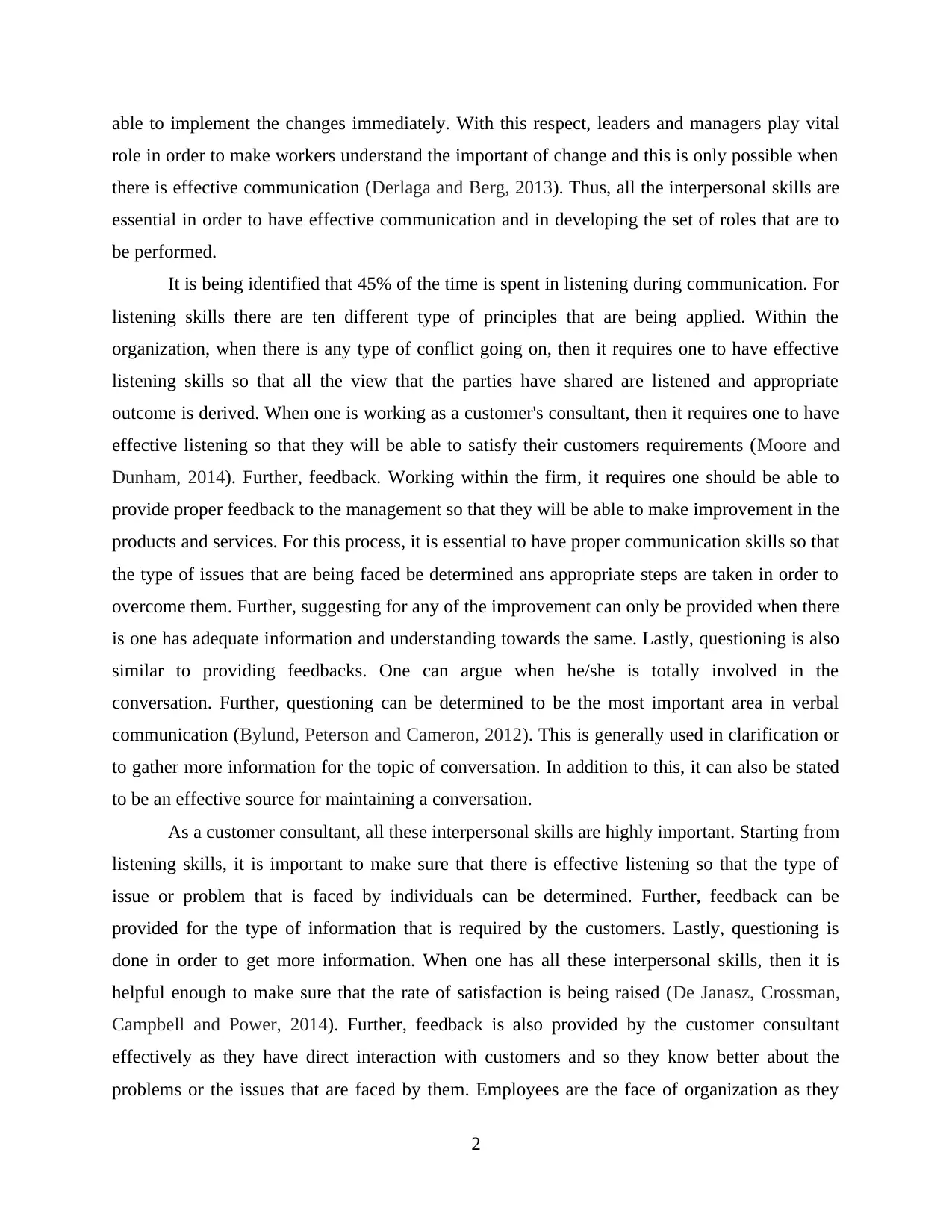
able to implement the changes immediately. With this respect, leaders and managers play vital
role in order to make workers understand the important of change and this is only possible when
there is effective communication (Derlaga and Berg, 2013). Thus, all the interpersonal skills are
essential in order to have effective communication and in developing the set of roles that are to
be performed.
It is being identified that 45% of the time is spent in listening during communication. For
listening skills there are ten different type of principles that are being applied. Within the
organization, when there is any type of conflict going on, then it requires one to have effective
listening skills so that all the view that the parties have shared are listened and appropriate
outcome is derived. When one is working as a customer's consultant, then it requires one to have
effective listening so that they will be able to satisfy their customers requirements (Moore and
Dunham, 2014). Further, feedback. Working within the firm, it requires one should be able to
provide proper feedback to the management so that they will be able to make improvement in the
products and services. For this process, it is essential to have proper communication skills so that
the type of issues that are being faced be determined ans appropriate steps are taken in order to
overcome them. Further, suggesting for any of the improvement can only be provided when there
is one has adequate information and understanding towards the same. Lastly, questioning is also
similar to providing feedbacks. One can argue when he/she is totally involved in the
conversation. Further, questioning can be determined to be the most important area in verbal
communication (Bylund, Peterson and Cameron, 2012). This is generally used in clarification or
to gather more information for the topic of conversation. In addition to this, it can also be stated
to be an effective source for maintaining a conversation.
As a customer consultant, all these interpersonal skills are highly important. Starting from
listening skills, it is important to make sure that there is effective listening so that the type of
issue or problem that is faced by individuals can be determined. Further, feedback can be
provided for the type of information that is required by the customers. Lastly, questioning is
done in order to get more information. When one has all these interpersonal skills, then it is
helpful enough to make sure that the rate of satisfaction is being raised (De Janasz, Crossman,
Campbell and Power, 2014). Further, feedback is also provided by the customer consultant
effectively as they have direct interaction with customers and so they know better about the
problems or the issues that are faced by them. Employees are the face of organization as they
2
Document Page
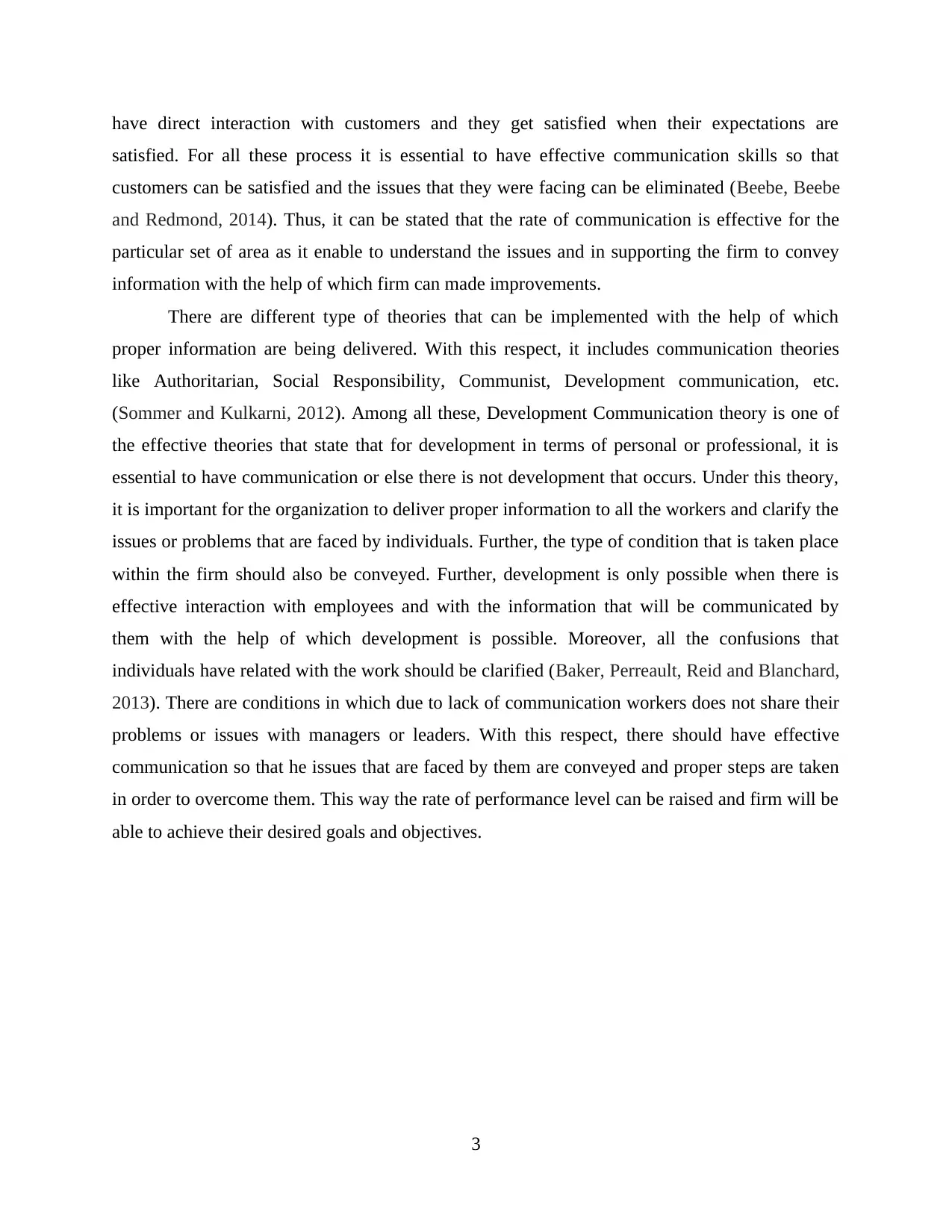
have direct interaction with customers and they get satisfied when their expectations are
satisfied. For all these process it is essential to have effective communication skills so that
customers can be satisfied and the issues that they were facing can be eliminated (Beebe, Beebe
and Redmond, 2014). Thus, it can be stated that the rate of communication is effective for the
particular set of area as it enable to understand the issues and in supporting the firm to convey
information with the help of which firm can made improvements.
There are different type of theories that can be implemented with the help of which
proper information are being delivered. With this respect, it includes communication theories
like Authoritarian, Social Responsibility, Communist, Development communication, etc.
(Sommer and Kulkarni, 2012). Among all these, Development Communication theory is one of
the effective theories that state that for development in terms of personal or professional, it is
essential to have communication or else there is not development that occurs. Under this theory,
it is important for the organization to deliver proper information to all the workers and clarify the
issues or problems that are faced by individuals. Further, the type of condition that is taken place
within the firm should also be conveyed. Further, development is only possible when there is
effective interaction with employees and with the information that will be communicated by
them with the help of which development is possible. Moreover, all the confusions that
individuals have related with the work should be clarified (Baker, Perreault, Reid and Blanchard,
2013). There are conditions in which due to lack of communication workers does not share their
problems or issues with managers or leaders. With this respect, there should have effective
communication so that he issues that are faced by them are conveyed and proper steps are taken
in order to overcome them. This way the rate of performance level can be raised and firm will be
able to achieve their desired goals and objectives.
3
tabler-icon-diamond-filled.svg

Paraphrase This Document

Need a fresh take? Get an instant paraphrase of this document with our AI Paraphraser
Document Page
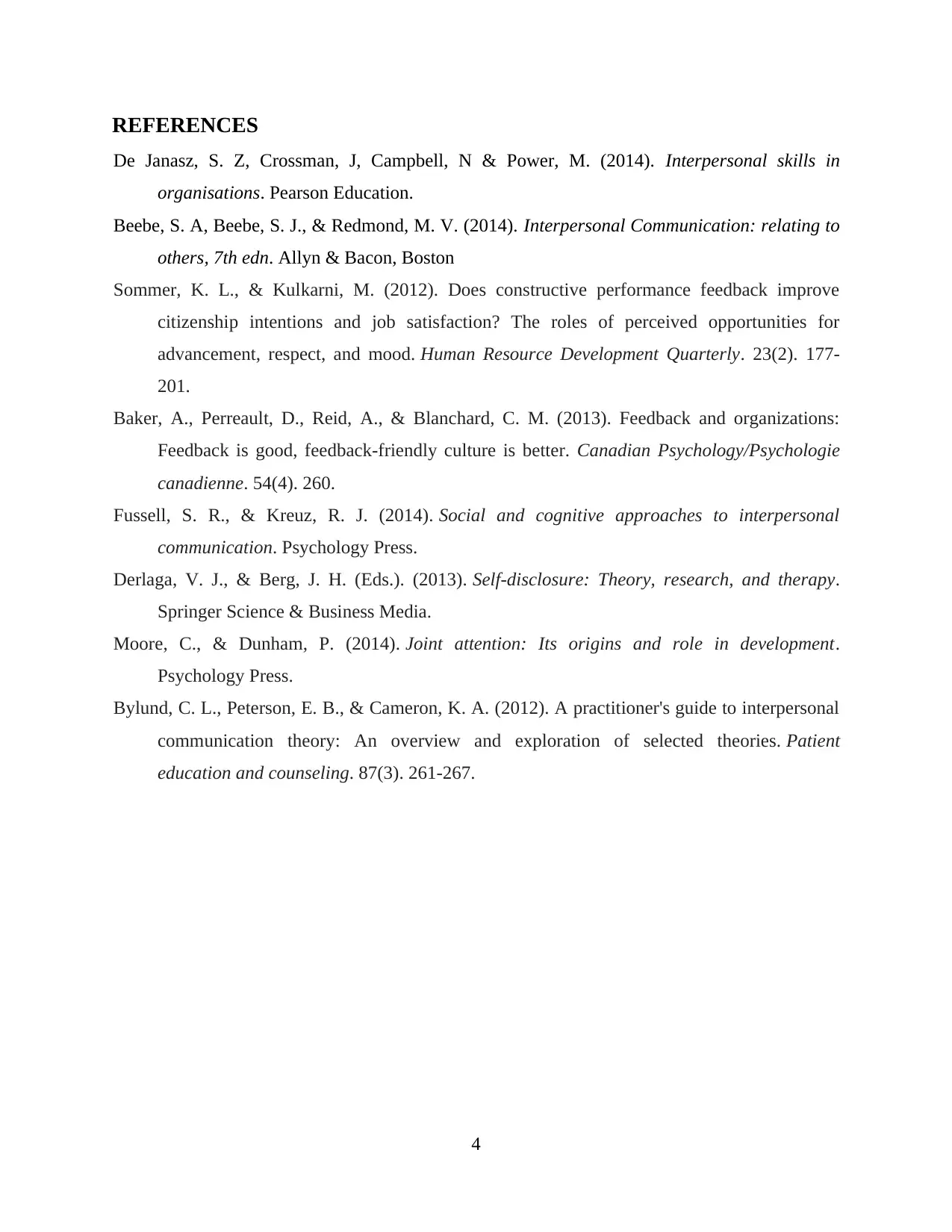
REFERENCES
De Janasz, S. Z, Crossman, J, Campbell, N & Power, M. (2014). Interpersonal skills in
organisations. Pearson Education.
Beebe, S. A, Beebe, S. J., & Redmond, M. V. (2014). Interpersonal Communication: relating to
others, 7th edn. Allyn & Bacon, Boston
Sommer, K. L., & Kulkarni, M. (2012). Does constructive performance feedback improve
citizenship intentions and job satisfaction? The roles of perceived opportunities for
advancement, respect, and mood. Human Resource Development Quarterly. 23(2). 177-
201.
Baker, A., Perreault, D., Reid, A., & Blanchard, C. M. (2013). Feedback and organizations:
Feedback is good, feedback-friendly culture is better. Canadian Psychology/Psychologie
canadienne. 54(4). 260.
Fussell, S. R., & Kreuz, R. J. (2014). Social and cognitive approaches to interpersonal
communication. Psychology Press.
Derlaga, V. J., & Berg, J. H. (Eds.). (2013). Self-disclosure: Theory, research, and therapy.
Springer Science & Business Media.
Moore, C., & Dunham, P. (2014). Joint attention: Its origins and role in development.
Psychology Press.
Bylund, C. L., Peterson, E. B., & Cameron, K. A. (2012). A practitioner's guide to interpersonal
communication theory: An overview and exploration of selected theories. Patient
education and counseling. 87(3). 261-267.
4
chevron_up_icon
1 out of 5
circle_padding
hide_on_mobile
zoom_out_icon
[object Object]