University Healthcare: Professional Conduct and Communication Analysis

Verified

Added on  2021/04/21

|4
|676
|38
Homework Assignment
AI Summary
This assignment delves into the critical aspects of professional conduct and communication within the healthcare environment, specifically focusing on the nurse-patient relationship. The analysis examines the role of humor, therapeutic communication techniques, and the significance of active listening and silence in fostering effective interactions. The assignment references studies by Tanay et al. (2014), Engard (2017), and Raphael-Grimm (2015) to support its arguments. It highlights that while humor can be a useful tool, it is not the only factor in building a strong relationship. It also explores the value of silence in allowing patients and nurses to process information and raise concerns. Furthermore, it emphasizes the importance of clinicians' non-verbal communication, such as eye contact and body language, in creating a respectful and supportive environment for patients. The assignment provides a comprehensive overview of these key elements to improve healthcare communication and professional conduct.
Document Page
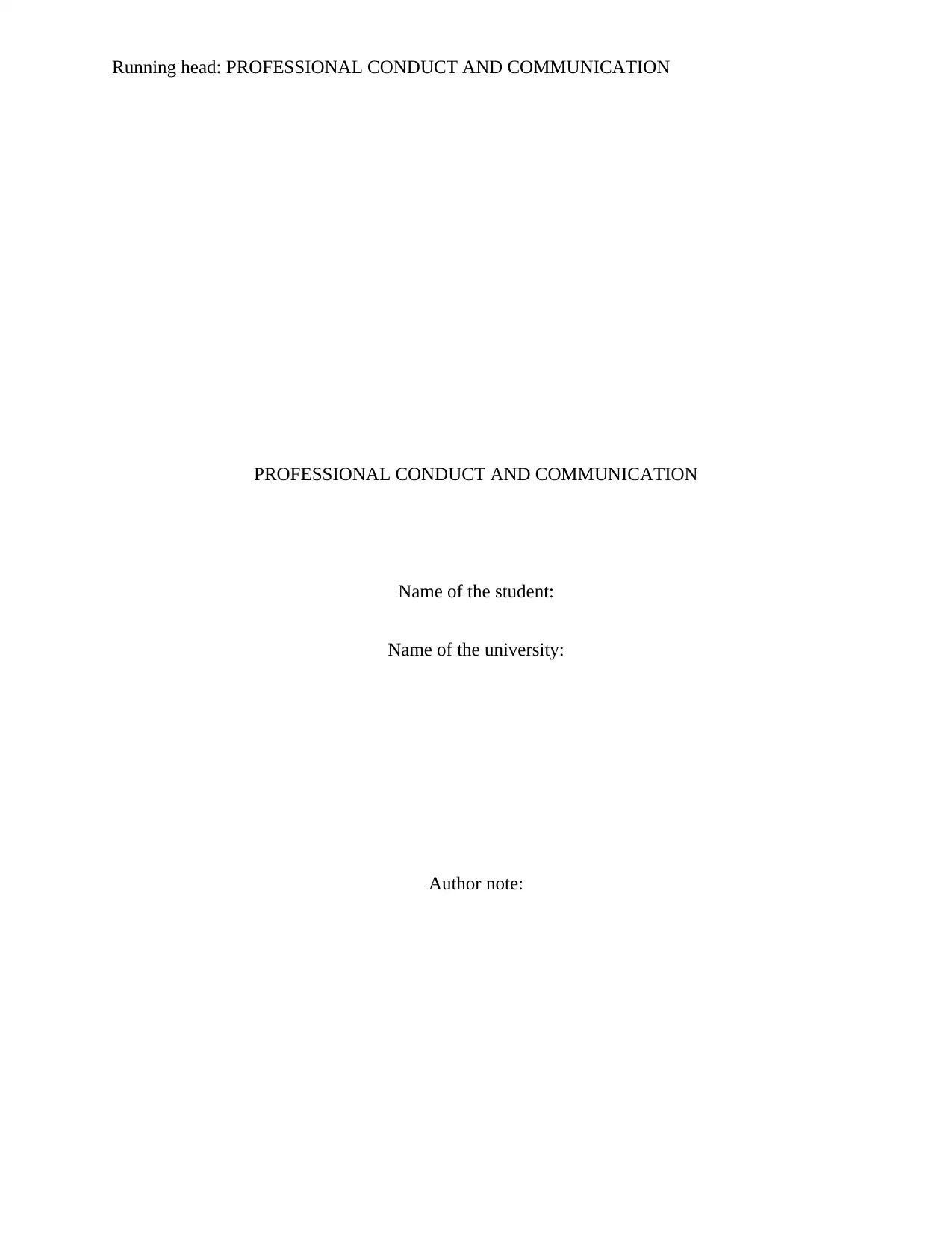
Running head: PROFESSIONAL CONDUCT AND COMMUNICATION
PROFESSIONAL CONDUCT AND COMMUNICATION
Name of the student:
Name of the university:
Author note:
tabler-icon-diamond-filled.svg

Paraphrase This Document

Need a fresh take? Get an instant paraphrase of this document with our AI Paraphraser
Document Page
1
PROFESSIONAL CONDUCT AND COMMUNICATION
Part 1:
Question 1:
Tanay, M. A., Wiseman, T., Roberts, J., & Ream, E. (2014). A time to weep and a time to laugh:
humour in the nurse–patient relationship in an adult cancer setting. Supportive Care in
Cancer, 22(5), 1295-1301.doi: https://doi.org/10.1007/s00520-013-2084-0
The study that had been conducted by Tanay et al. (2014) revealed that both service users
as well as the healthcare professionals in the cancer department of the healthcare sectors support
the use of humor in order to develop the relationship between them. However, participants had
accepted it that humor is not the only factor that helps in developing a strong nurse patient
relationship. Therefore, one can reach to a conclusion that although humor can be used as one of
the component tools which influences effective communication but there may also be many other
communication tools that the professionals can also use to develop therapeutic nurse patient
relationship.
Question 2:
Engard, B. (2017). 17 Therapeutic Communication Techniques | Rivier Online. Rivier University
| Online. Retrieved 20 March 2018, from https://online.rivier.edu/therapeutic-communication-
techniques/
Researchers are of the opinion that it is sometimes needful for both the patients and the
service providers not to talk at all. They are of the opinion that deliberate silence is helpful in
giving the patients and the nurses the scope where they can think about and then process or act
accordingly in the conversation. Such silence is also helpful as it provides the opportunity to the
Document Page
2
PROFESSIONAL CONDUCT AND COMMUNICATION
patients to utilize the time and space for raising a new concern for discussion. It is advisable to
the nurses to allow the patient to break their silence first (Engard, 2017).
Question 3:
Raphael-Grimm, T. (2015). The art of communication in nursing and health care: an
interdisciplinary approach. Springer Publishing Company. https://books.google.co.in/books?
hl=en&lr=&id=TGe6BAAAQBAJ&oi=fnd&pg=PP1&dq=Raphael-Grimm,+T.+(2015).
+The+art+of+communication+in+nursing+and+health+care:+an+interdisciplinary+approach.
+Springer+Publishing+Company.&ots=G5z25rHm4p&sig=UUbfAFgz2v7KWUzM8lMssbUdvb
A&redir_esc=y#v=onepage&q&f=false
Raphael-Grimm (2015) has stated that listening should be considered as one of the most
important part of effective communication between patients and nurses. Clinicians should sit
down in a way by which they are at the eye level with the patients. They should initiate and
maintain proper eye contact with the patient during communicating with them. However, they
should be careful, as many cultures consider eye contact as a means of disrespect. Besides, their
body language should be such that it does not assume to the patient that the clinicians are trying
to wrap up the work in a hurried manner.
Part 2: End text referencing:
Engard, B. (2017). 17 Therapeutic Communication Techniques | Rivier Online. Rivier University
| Online. Retrieved 20 March 2018, from https://online.rivier.edu/therapeutic-
communication-techniques/
Document Page
3
PROFESSIONAL CONDUCT AND COMMUNICATION
Raphael-Grimm, T. (2015). The art of communication in nursing and health care: an
interdisciplinary approach. Springer Publishing Company. Retrieved from
https://books.google.co.in/books?
hl=en&lr=&id=TGe6BAAAQBAJ&oi=fnd&pg=PP1&dq=Raphael-Grimm,+T.+(2015).
+The+art+of+communication+in+nursing+and+health+care:
+an+interdisciplinary+approach.
+Springer+Publishing+Company.&ots=G5z25rHm4p&sig=UUbfAFgz2v7KWUzM8lMs
sbUdvbA&redir_esc=y#v=onepage&q&f=false
Tanay, M. A., Wiseman, T., Roberts, J., & Ream, E. (2014). A time to weep and a time to laugh:
humour in the nurse–patient relationship in an adult cancer setting. Supportive Care in
Cancer, 22(5), 1295-1301. https://doi.org/10.1007/s00520-013-2084-0
chevron_up_icon
1 out of 4
circle_padding
hide_on_mobile
zoom_out_icon
[object Object]