PROJ-6012: Capital Metro Light Rail Information System Report
VerifiedAdded on 2022/11/13
|15
|3808
|171
Report
AI Summary
This report provides a comprehensive analysis of the information system implementation for the Capital Metro light rail project in Canberra, Australia. The project aims to alleviate traffic congestion and provide a convenient ticketing system for passengers. The report details the project's overview, organizational aspects, budget, and the problem statement, emphasizing the need for an efficient ticketing system. It explores the current state of information technology, the project's impact on society and the organization, and the project selection method employed. The report justifies the use of the waterfall methodology, outlines software applications used in the system development life cycle, and defines the strategic goals of the organization and the project. Furthermore, it presents the project's scope, schedule, and budget, including a detailed work breakdown structure. The report concludes with a discussion of the project's significance and potential benefits, supported by references to relevant literature.
Running Head: PROJ-6012
Information System Implementation: Capital Metro Light Rail
Name of the Student
Name of the University
Information System Implementation: Capital Metro Light Rail
Name of the Student
Name of the University

Paraphrase This Document
Need a fresh take? Get an instant paraphrase of this document with our AI Paraphraser
1PROJ-6012
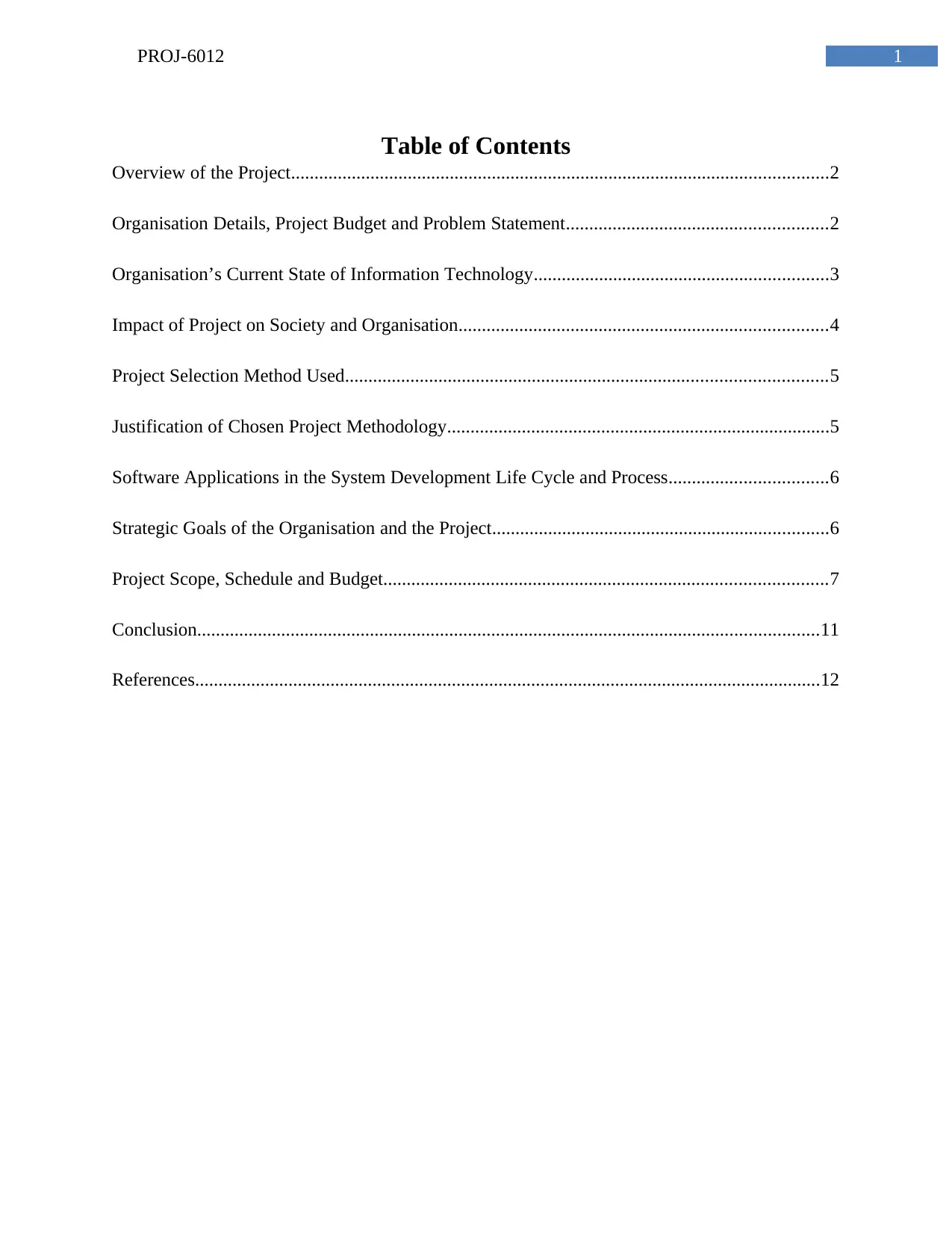
Table of Contents
Overview of the Project...................................................................................................................2
Organisation Details, Project Budget and Problem Statement........................................................2
Organisation’s Current State of Information Technology...............................................................3
Impact of Project on Society and Organisation...............................................................................4
Project Selection Method Used.......................................................................................................5
Justification of Chosen Project Methodology..................................................................................5
Software Applications in the System Development Life Cycle and Process..................................6
Strategic Goals of the Organisation and the Project........................................................................6
Project Scope, Schedule and Budget...............................................................................................7
Conclusion.....................................................................................................................................11
References......................................................................................................................................12
Table of Contents
Overview of the Project...................................................................................................................2
Organisation Details, Project Budget and Problem Statement........................................................2
Organisation’s Current State of Information Technology...............................................................3
Impact of Project on Society and Organisation...............................................................................4
Project Selection Method Used.......................................................................................................5
Justification of Chosen Project Methodology..................................................................................5
Software Applications in the System Development Life Cycle and Process..................................6
Strategic Goals of the Organisation and the Project........................................................................6
Project Scope, Schedule and Budget...............................................................................................7
Conclusion.....................................................................................................................................11
References......................................................................................................................................12
2PROJ-6012
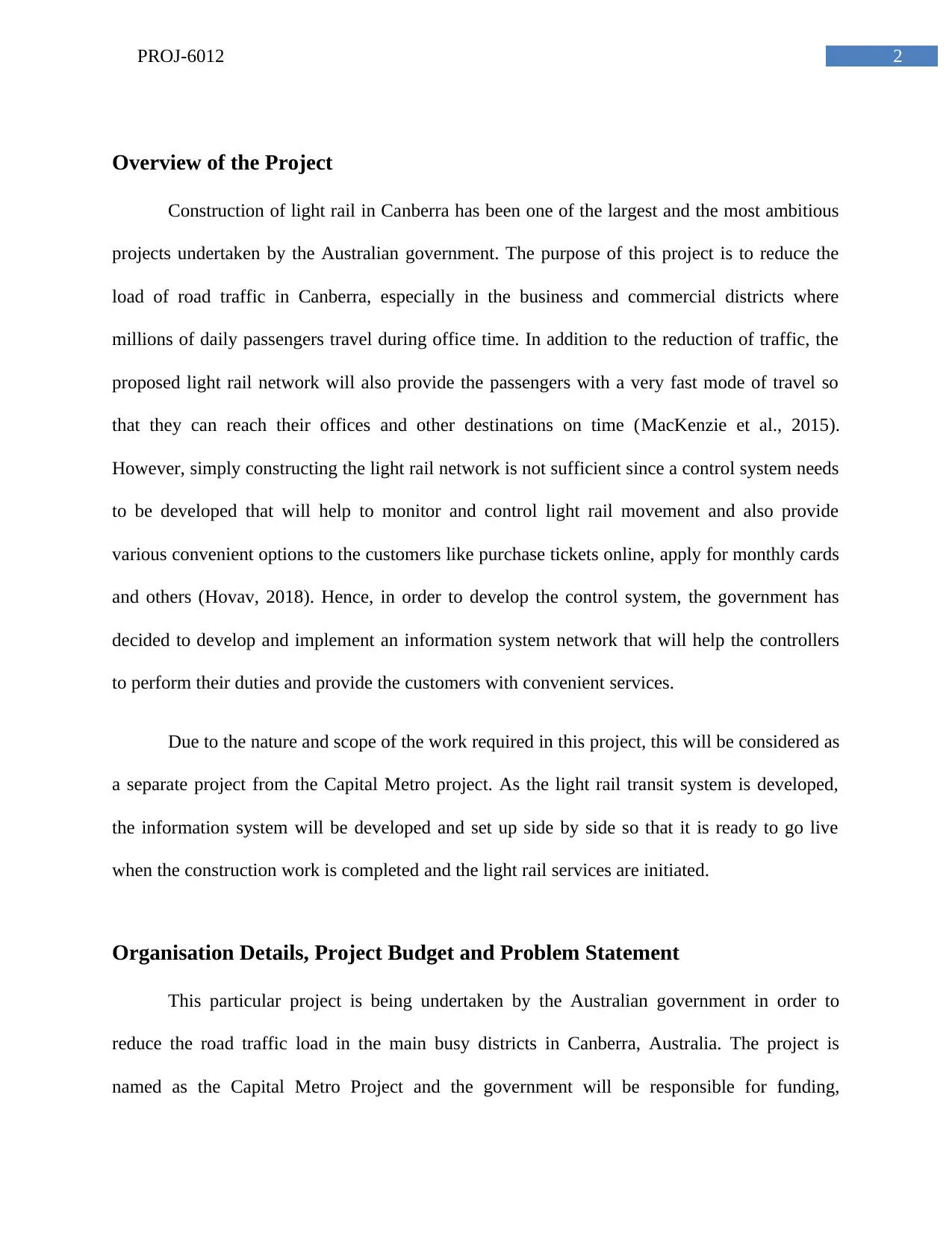
Overview of the Project
Construction of light rail in Canberra has been one of the largest and the most ambitious
projects undertaken by the Australian government. The purpose of this project is to reduce the
load of road traffic in Canberra, especially in the business and commercial districts where
millions of daily passengers travel during office time. In addition to the reduction of traffic, the
proposed light rail network will also provide the passengers with a very fast mode of travel so
that they can reach their offices and other destinations on time (MacKenzie et al., 2015).
However, simply constructing the light rail network is not sufficient since a control system needs
to be developed that will help to monitor and control light rail movement and also provide
various convenient options to the customers like purchase tickets online, apply for monthly cards
and others (Hovav, 2018). Hence, in order to develop the control system, the government has
decided to develop and implement an information system network that will help the controllers
to perform their duties and provide the customers with convenient services.
Due to the nature and scope of the work required in this project, this will be considered as
a separate project from the Capital Metro project. As the light rail transit system is developed,
the information system will be developed and set up side by side so that it is ready to go live
when the construction work is completed and the light rail services are initiated.
Organisation Details, Project Budget and Problem Statement
This particular project is being undertaken by the Australian government in order to
reduce the road traffic load in the main busy districts in Canberra, Australia. The project is
named as the Capital Metro Project and the government will be responsible for funding,
Overview of the Project
Construction of light rail in Canberra has been one of the largest and the most ambitious
projects undertaken by the Australian government. The purpose of this project is to reduce the
load of road traffic in Canberra, especially in the business and commercial districts where
millions of daily passengers travel during office time. In addition to the reduction of traffic, the
proposed light rail network will also provide the passengers with a very fast mode of travel so
that they can reach their offices and other destinations on time (MacKenzie et al., 2015).
However, simply constructing the light rail network is not sufficient since a control system needs
to be developed that will help to monitor and control light rail movement and also provide
various convenient options to the customers like purchase tickets online, apply for monthly cards
and others (Hovav, 2018). Hence, in order to develop the control system, the government has
decided to develop and implement an information system network that will help the controllers
to perform their duties and provide the customers with convenient services.
Due to the nature and scope of the work required in this project, this will be considered as
a separate project from the Capital Metro project. As the light rail transit system is developed,
the information system will be developed and set up side by side so that it is ready to go live
when the construction work is completed and the light rail services are initiated.
Organisation Details, Project Budget and Problem Statement
This particular project is being undertaken by the Australian government in order to
reduce the road traffic load in the main busy districts in Canberra, Australia. The project is
named as the Capital Metro Project and the government will be responsible for funding,
⊘ This is a preview!⊘
Do you want full access?
Subscribe today to unlock all pages.

Trusted by 1+ million students worldwide
3PROJ-6012
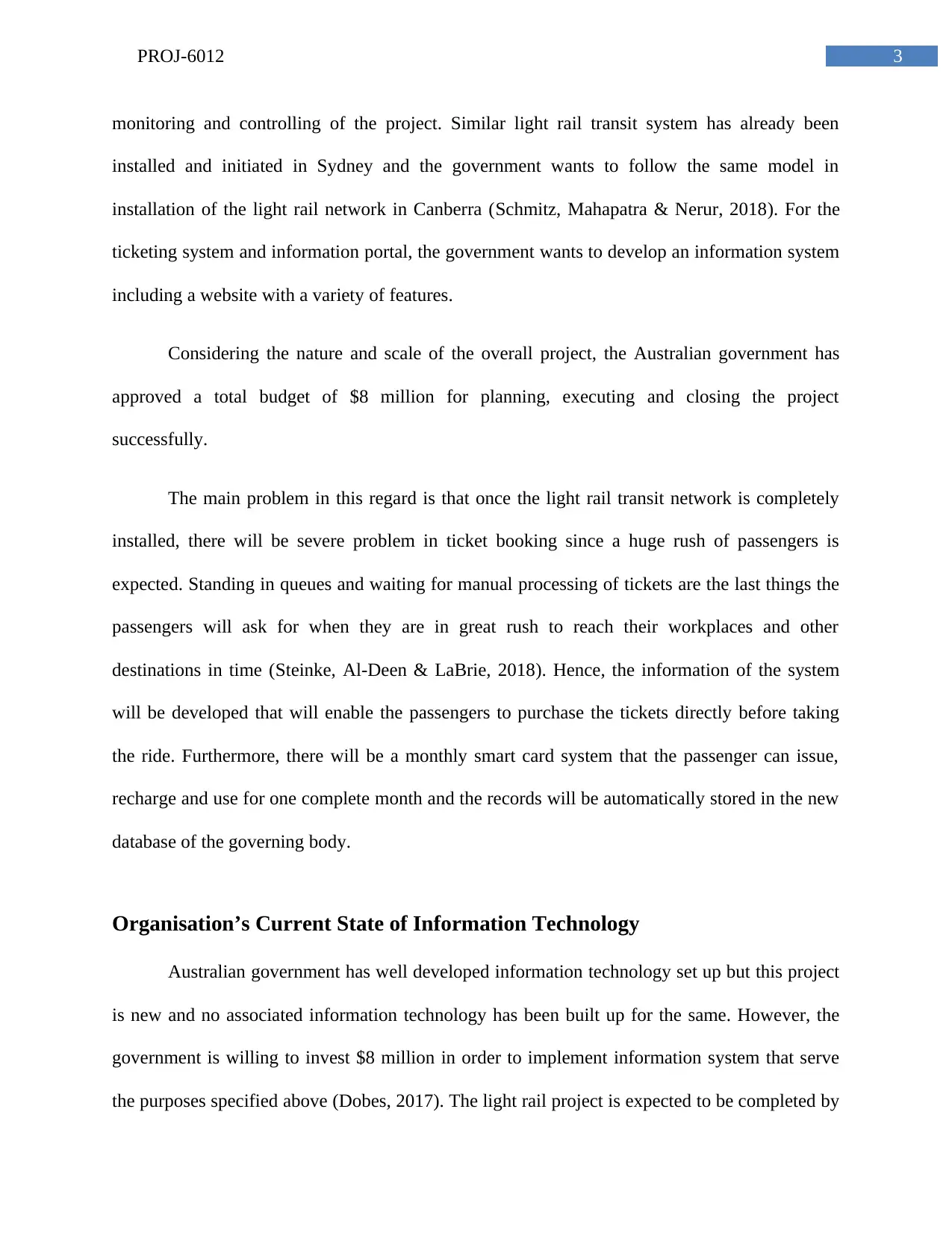
monitoring and controlling of the project. Similar light rail transit system has already been
installed and initiated in Sydney and the government wants to follow the same model in
installation of the light rail network in Canberra (Schmitz, Mahapatra & Nerur, 2018). For the
ticketing system and information portal, the government wants to develop an information system
including a website with a variety of features.
Considering the nature and scale of the overall project, the Australian government has
approved a total budget of $8 million for planning, executing and closing the project
successfully.
The main problem in this regard is that once the light rail transit network is completely
installed, there will be severe problem in ticket booking since a huge rush of passengers is
expected. Standing in queues and waiting for manual processing of tickets are the last things the
passengers will ask for when they are in great rush to reach their workplaces and other
destinations in time (Steinke, Al-Deen & LaBrie, 2018). Hence, the information of the system
will be developed that will enable the passengers to purchase the tickets directly before taking
the ride. Furthermore, there will be a monthly smart card system that the passenger can issue,
recharge and use for one complete month and the records will be automatically stored in the new
database of the governing body.
Organisation’s Current State of Information Technology
Australian government has well developed information technology set up but this project
is new and no associated information technology has been built up for the same. However, the
government is willing to invest $8 million in order to implement information system that serve
the purposes specified above (Dobes, 2017). The light rail project is expected to be completed by
monitoring and controlling of the project. Similar light rail transit system has already been
installed and initiated in Sydney and the government wants to follow the same model in
installation of the light rail network in Canberra (Schmitz, Mahapatra & Nerur, 2018). For the
ticketing system and information portal, the government wants to develop an information system
including a website with a variety of features.
Considering the nature and scale of the overall project, the Australian government has
approved a total budget of $8 million for planning, executing and closing the project
successfully.
The main problem in this regard is that once the light rail transit network is completely
installed, there will be severe problem in ticket booking since a huge rush of passengers is
expected. Standing in queues and waiting for manual processing of tickets are the last things the
passengers will ask for when they are in great rush to reach their workplaces and other
destinations in time (Steinke, Al-Deen & LaBrie, 2018). Hence, the information of the system
will be developed that will enable the passengers to purchase the tickets directly before taking
the ride. Furthermore, there will be a monthly smart card system that the passenger can issue,
recharge and use for one complete month and the records will be automatically stored in the new
database of the governing body.
Organisation’s Current State of Information Technology
Australian government has well developed information technology set up but this project
is new and no associated information technology has been built up for the same. However, the
government is willing to invest $8 million in order to implement information system that serve
the purposes specified above (Dobes, 2017). The light rail project is expected to be completed by
Paraphrase This Document
Need a fresh take? Get an instant paraphrase of this document with our AI Paraphraser
4PROJ-6012
2026 and before that, the information system will be designed and implemented. Once the light
rail service has been initiated, various staff will be assigned to monitor, control and manage the
information system and all relevant services through it.
Impact of Project on Society and Organisation
The proposed project will have significant impact on the society and the organisational
success as a whole. It has also been discussed that the main purpose of building the light rail
network is to reduce the load of traffic from the busiest streets of Canberra and to provide faster
means of travel for the office going people. Hence, once the light rail network is available for
service, the passengers will look for faster means of travel during rush hours without having to
worry about standing in long queues for purchasing tickets (Peltier, 2016). Thus the new
information system will solve this problem and it will be very convenient for the passengers to
purchase the tickets online and ride the light rail on way to their destinations. Additional offers
like discounts for students, smart monthly cards for daily passengers and other associated
facilities will further benefit the passengers and thus the information system can have profound
impact on the passengers of the light rail service.
The goal of Australian government regarding this project is to provide fast and
convenient mode of travel for the passengers and reduce the traffic load on the streets (Tarhini,
Yunis & El-Kassar, 2018). Thus, the project will help the government to achieve the strategic
goal and encourage more daily passengers to ride the light rail trains in order to reach their
offices and other destinations.
2026 and before that, the information system will be designed and implemented. Once the light
rail service has been initiated, various staff will be assigned to monitor, control and manage the
information system and all relevant services through it.
Impact of Project on Society and Organisation
The proposed project will have significant impact on the society and the organisational
success as a whole. It has also been discussed that the main purpose of building the light rail
network is to reduce the load of traffic from the busiest streets of Canberra and to provide faster
means of travel for the office going people. Hence, once the light rail network is available for
service, the passengers will look for faster means of travel during rush hours without having to
worry about standing in long queues for purchasing tickets (Peltier, 2016). Thus the new
information system will solve this problem and it will be very convenient for the passengers to
purchase the tickets online and ride the light rail on way to their destinations. Additional offers
like discounts for students, smart monthly cards for daily passengers and other associated
facilities will further benefit the passengers and thus the information system can have profound
impact on the passengers of the light rail service.
The goal of Australian government regarding this project is to provide fast and
convenient mode of travel for the passengers and reduce the traffic load on the streets (Tarhini,
Yunis & El-Kassar, 2018). Thus, the project will help the government to achieve the strategic
goal and encourage more daily passengers to ride the light rail trains in order to reach their
offices and other destinations.
5PROJ-6012
Project Selection Method Used
Project selection methods are used when there are options of a number of projects and the
organisation needs to decide which project will be most suitable and feasible considering the
current state of affairs. In this case, the government had the choices of projects that will benefit
the common people who will take the light rail services to travel to their destinations. In this
case, the project was selected completely based on the requirements and convenience of the
customers (Davis & Yen, 2018). This project does not have financial implications on the
governing body since the government will be funding the entire project and the only business
value from the project is the ticket sales for travelling in the light rail network. Hence, the only
selection method used for this case is analysis of the customer benefits and requirements.
Justification of Chosen Project Methodology
As per the requirements of the project, an information system will be developed for
ticketing and information portal of the light rail transit service. This project can be managed
using traditional waterfall methodology that requires step by step implementation of each phase
of the project. In this methodology, the project is generally divided into a number of different
phases that are conducted one after another in a sequential manner (Bērziša et al., 2015).
However, it is to be ensured that one phase is complete and milestone is reached before
proceeding to the next phase.
The main reason behind selection of this methodology in this project is that it provides a
straightforward and clear step by step framework that can be effectively applied for the project.
The process of information system development includes survey of requirements, project
planning, project implementation, design and testing and others. These activities can be
Project Selection Method Used
Project selection methods are used when there are options of a number of projects and the
organisation needs to decide which project will be most suitable and feasible considering the
current state of affairs. In this case, the government had the choices of projects that will benefit
the common people who will take the light rail services to travel to their destinations. In this
case, the project was selected completely based on the requirements and convenience of the
customers (Davis & Yen, 2018). This project does not have financial implications on the
governing body since the government will be funding the entire project and the only business
value from the project is the ticket sales for travelling in the light rail network. Hence, the only
selection method used for this case is analysis of the customer benefits and requirements.
Justification of Chosen Project Methodology
As per the requirements of the project, an information system will be developed for
ticketing and information portal of the light rail transit service. This project can be managed
using traditional waterfall methodology that requires step by step implementation of each phase
of the project. In this methodology, the project is generally divided into a number of different
phases that are conducted one after another in a sequential manner (Bērziša et al., 2015).
However, it is to be ensured that one phase is complete and milestone is reached before
proceeding to the next phase.
The main reason behind selection of this methodology in this project is that it provides a
straightforward and clear step by step framework that can be effectively applied for the project.
The process of information system development includes survey of requirements, project
planning, project implementation, design and testing and others. These activities can be
⊘ This is a preview!⊘
Do you want full access?
Subscribe today to unlock all pages.
Trusted by 1+ million students worldwide
6PROJ-6012
conducted in sequentially arranged phases, which are displayed in detail in the project schedule
table that is provided in later part of the report.
Software Applications in the System Development Life Cycle and Process
For the purpose of this project i.e. the implementation of information system for Capital
Metro, several software applications for system development can be used. In addition to the
development software applications, specific data and system protection software can be used that
can prevent attack by malwares or any other external third party attackers like hackers
(Mahadevan, Kettinger & Meservy, 2015). Before launching the information system, it is to be
ensured that all the software applications have been installed and they are running successfully as
per system specifications and requirements.
Strategic Goals of the Organisation and the Project
The main strategic goals of the organisation in context of this project are discussed as
follows.
Traffic Control – Currently, the traffic in the streets of Canberra Central Business District
has crossed all thresholds and thus, there are frequent traffic blockages, delayed arrival of people
at their workplaces and other destinations and others. The purpose of the proposed light rail is to
reduce the load on the roadway and provide the customers will fast means of travel, especially in
and around the central business district of the city.
Convenient Ticket Booking System – In addition to light rail services, the government also
wants to introduce convenient ticketing option for the passengers. This will reduce the overall
waiting time for the passengers for purchasing tickets and will also attract customers to available
conducted in sequentially arranged phases, which are displayed in detail in the project schedule
table that is provided in later part of the report.
Software Applications in the System Development Life Cycle and Process
For the purpose of this project i.e. the implementation of information system for Capital
Metro, several software applications for system development can be used. In addition to the
development software applications, specific data and system protection software can be used that
can prevent attack by malwares or any other external third party attackers like hackers
(Mahadevan, Kettinger & Meservy, 2015). Before launching the information system, it is to be
ensured that all the software applications have been installed and they are running successfully as
per system specifications and requirements.
Strategic Goals of the Organisation and the Project
The main strategic goals of the organisation in context of this project are discussed as
follows.
Traffic Control – Currently, the traffic in the streets of Canberra Central Business District
has crossed all thresholds and thus, there are frequent traffic blockages, delayed arrival of people
at their workplaces and other destinations and others. The purpose of the proposed light rail is to
reduce the load on the roadway and provide the customers will fast means of travel, especially in
and around the central business district of the city.
Convenient Ticket Booking System – In addition to light rail services, the government also
wants to introduce convenient ticketing option for the passengers. This will reduce the overall
waiting time for the passengers for purchasing tickets and will also attract customers to available
Paraphrase This Document
Need a fresh take? Get an instant paraphrase of this document with our AI Paraphraser
7PROJ-6012
the services of the light rail (Park & Park, 2017). This strategy is as per the organisational policy
of the Australian government that wants to launch the light rail service with lots of customer
benefits and convenience.
Project Scope, Schedule and Budget
The scope of this project includes the development of the information system for the
Capital Metro light rail transit system through which the passengers can purchase tickets online
or use monthly smart card instead of purchasing ticket daily. The scope also includes the
development of a website for Capital Metro, which will consist of all the relevant information
and details of the services, light rail time table, route information, ticket booking option and
others (Zeng et al., 2016). After the construction of the light rail network is complete, the
information system will be directly integrated with the light rail services for smooth and
convenient services to the customers.
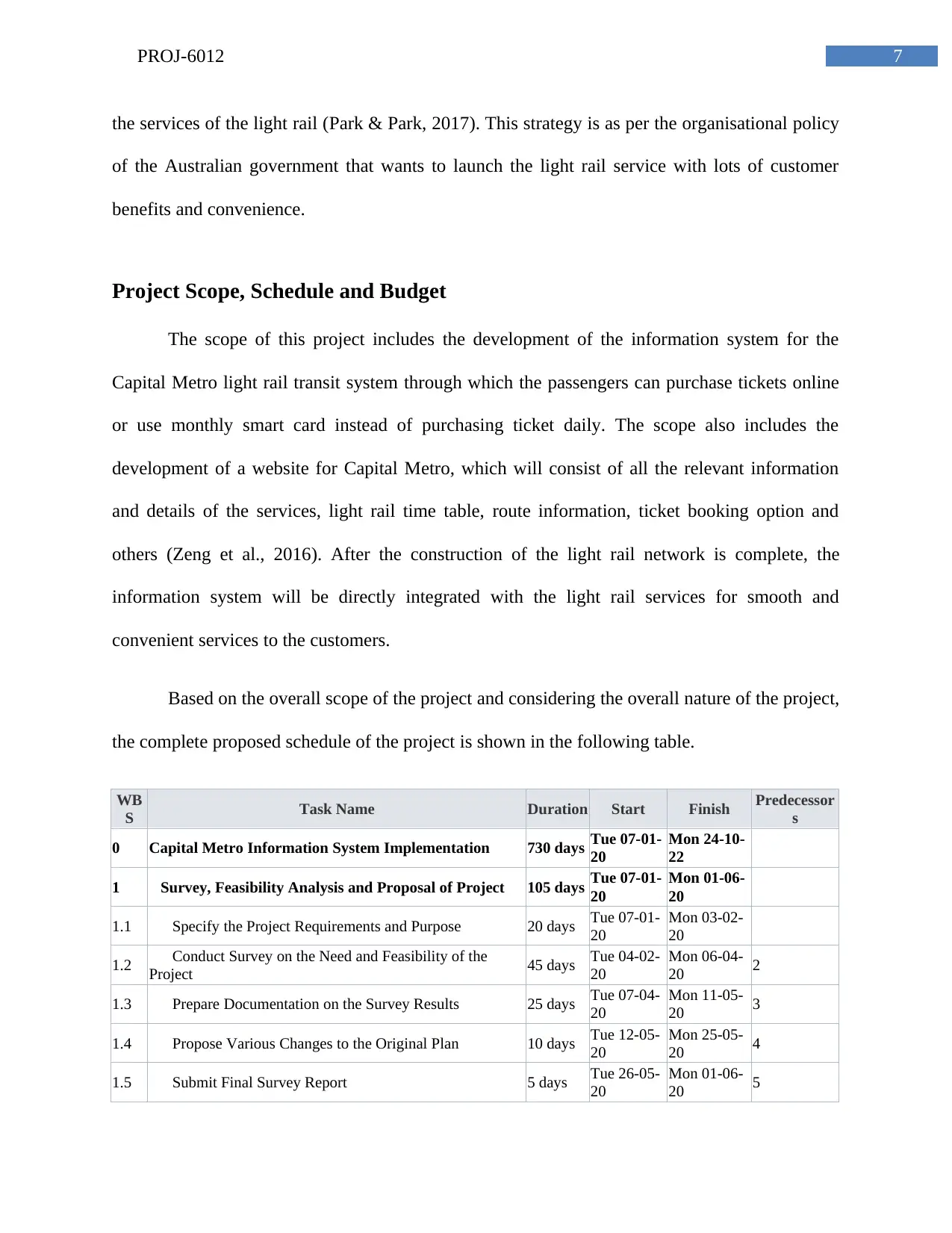
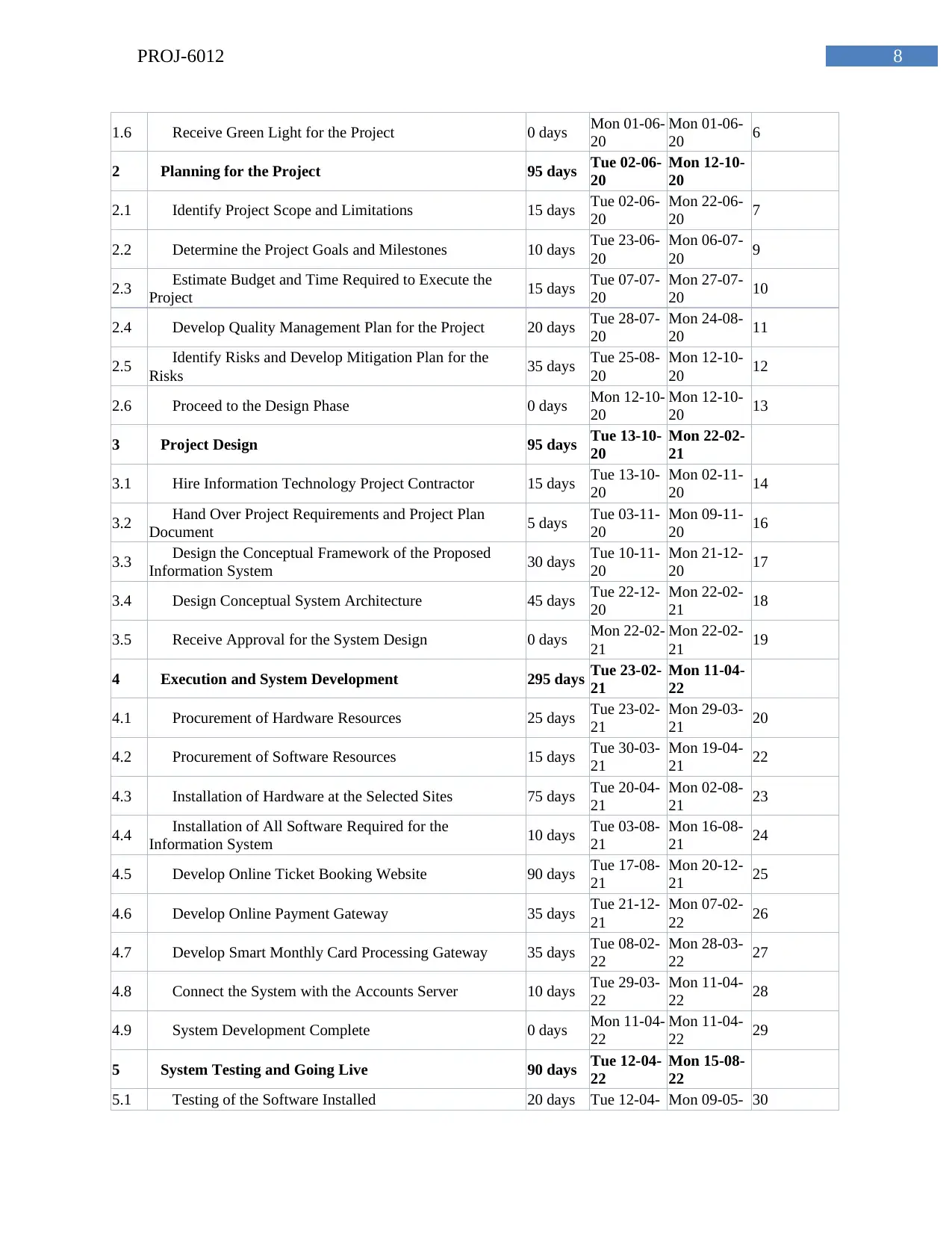
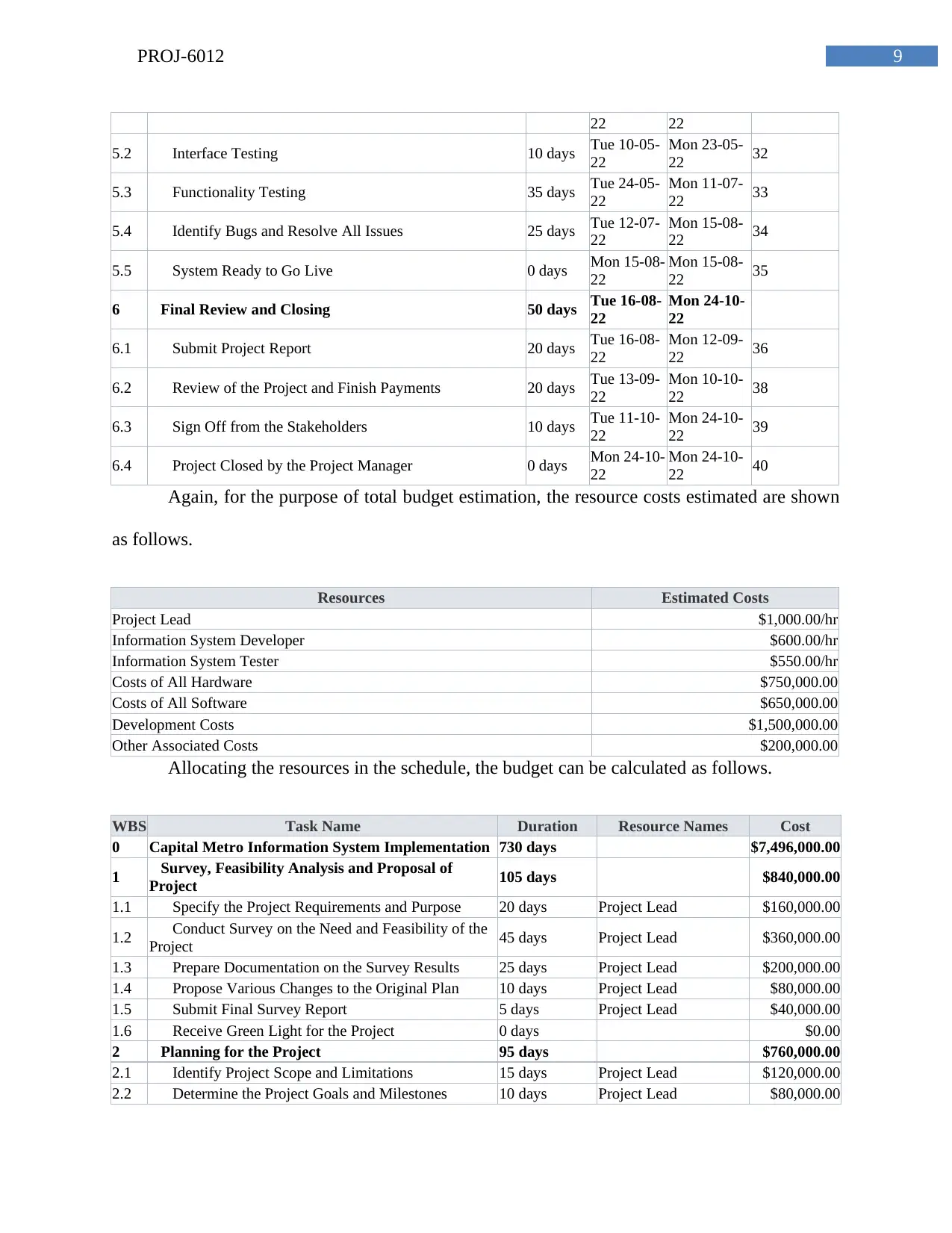
Based on the overall scope of the project and considering the overall nature of the project,
the complete proposed schedule of the project is shown in the following table.
WB
S Task Name Duration Start Finish Predecessor
s
0 Capital Metro Information System Implementation 730 days Tue 07-01-
20
Mon 24-10-
22
1 Survey, Feasibility Analysis and Proposal of Project 105 days Tue 07-01-
20
Mon 01-06-
20
1.1 Specify the Project Requirements and Purpose 20 days Tue 07-01-
20
Mon 03-02-
20
1.2 Conduct Survey on the Need and Feasibility of the
Project 45 days Tue 04-02-
20
Mon 06-04-
20 2
1.3 Prepare Documentation on the Survey Results 25 days Tue 07-04-
20
Mon 11-05-
20 3
1.4 Propose Various Changes to the Original Plan 10 days Tue 12-05-
20
Mon 25-05-
20 4
1.5 Submit Final Survey Report 5 days Tue 26-05-
20
Mon 01-06-
20 5
the services of the light rail (Park & Park, 2017). This strategy is as per the organisational policy
of the Australian government that wants to launch the light rail service with lots of customer
benefits and convenience.
Project Scope, Schedule and Budget
The scope of this project includes the development of the information system for the
Capital Metro light rail transit system through which the passengers can purchase tickets online
or use monthly smart card instead of purchasing ticket daily. The scope also includes the
development of a website for Capital Metro, which will consist of all the relevant information
and details of the services, light rail time table, route information, ticket booking option and
others (Zeng et al., 2016). After the construction of the light rail network is complete, the
information system will be directly integrated with the light rail services for smooth and
convenient services to the customers.
Based on the overall scope of the project and considering the overall nature of the project,
the complete proposed schedule of the project is shown in the following table.
WB
S Task Name Duration Start Finish Predecessor
s
0 Capital Metro Information System Implementation 730 days Tue 07-01-
20
Mon 24-10-
22
1 Survey, Feasibility Analysis and Proposal of Project 105 days Tue 07-01-
20
Mon 01-06-
20
1.1 Specify the Project Requirements and Purpose 20 days Tue 07-01-
20
Mon 03-02-
20
1.2 Conduct Survey on the Need and Feasibility of the
Project 45 days Tue 04-02-
20
Mon 06-04-
20 2
1.3 Prepare Documentation on the Survey Results 25 days Tue 07-04-
20
Mon 11-05-
20 3
1.4 Propose Various Changes to the Original Plan 10 days Tue 12-05-
20
Mon 25-05-
20 4
1.5 Submit Final Survey Report 5 days Tue 26-05-
20
Mon 01-06-
20 5
8PROJ-6012
1.6 Receive Green Light for the Project 0 days Mon 01-06-
20
Mon 01-06-
20 6
2 Planning for the Project 95 days Tue 02-06-
20
Mon 12-10-
20
2.1 Identify Project Scope and Limitations 15 days Tue 02-06-
20
Mon 22-06-
20 7
2.2 Determine the Project Goals and Milestones 10 days Tue 23-06-
20
Mon 06-07-
20 9
2.3 Estimate Budget and Time Required to Execute the
Project 15 days Tue 07-07-
20
Mon 27-07-
20 10
2.4 Develop Quality Management Plan for the Project 20 days Tue 28-07-
20
Mon 24-08-
20 11
2.5 Identify Risks and Develop Mitigation Plan for the
Risks 35 days Tue 25-08-
20
Mon 12-10-
20 12
2.6 Proceed to the Design Phase 0 days Mon 12-10-
20
Mon 12-10-
20 13
3 Project Design 95 days Tue 13-10-
20
Mon 22-02-
21
3.1 Hire Information Technology Project Contractor 15 days Tue 13-10-
20
Mon 02-11-
20 14
3.2 Hand Over Project Requirements and Project Plan
Document 5 days Tue 03-11-
20
Mon 09-11-
20 16
3.3 Design the Conceptual Framework of the Proposed
Information System 30 days Tue 10-11-
20
Mon 21-12-
20 17
3.4 Design Conceptual System Architecture 45 days Tue 22-12-
20
Mon 22-02-
21 18
3.5 Receive Approval for the System Design 0 days Mon 22-02-
21
Mon 22-02-
21 19
4 Execution and System Development 295 days Tue 23-02-
21
Mon 11-04-
22
4.1 Procurement of Hardware Resources 25 days Tue 23-02-
21
Mon 29-03-
21 20
4.2 Procurement of Software Resources 15 days Tue 30-03-
21
Mon 19-04-
21 22
4.3 Installation of Hardware at the Selected Sites 75 days Tue 20-04-
21
Mon 02-08-
21 23
4.4 Installation of All Software Required for the
Information System 10 days Tue 03-08-
21
Mon 16-08-
21 24
4.5 Develop Online Ticket Booking Website 90 days Tue 17-08-
21
Mon 20-12-
21 25
4.6 Develop Online Payment Gateway 35 days Tue 21-12-
21
Mon 07-02-
22 26
4.7 Develop Smart Monthly Card Processing Gateway 35 days Tue 08-02-
22
Mon 28-03-
22 27
4.8 Connect the System with the Accounts Server 10 days Tue 29-03-
22
Mon 11-04-
22 28
4.9 System Development Complete 0 days Mon 11-04-
22
Mon 11-04-
22 29
5 System Testing and Going Live 90 days Tue 12-04-
22
Mon 15-08-
22
5.1 Testing of the Software Installed 20 days Tue 12-04- Mon 09-05- 30
1.6 Receive Green Light for the Project 0 days Mon 01-06-
20
Mon 01-06-
20 6
2 Planning for the Project 95 days Tue 02-06-
20
Mon 12-10-
20
2.1 Identify Project Scope and Limitations 15 days Tue 02-06-
20
Mon 22-06-
20 7
2.2 Determine the Project Goals and Milestones 10 days Tue 23-06-
20
Mon 06-07-
20 9
2.3 Estimate Budget and Time Required to Execute the
Project 15 days Tue 07-07-
20
Mon 27-07-
20 10
2.4 Develop Quality Management Plan for the Project 20 days Tue 28-07-
20
Mon 24-08-
20 11
2.5 Identify Risks and Develop Mitigation Plan for the
Risks 35 days Tue 25-08-
20
Mon 12-10-
20 12
2.6 Proceed to the Design Phase 0 days Mon 12-10-
20
Mon 12-10-
20 13
3 Project Design 95 days Tue 13-10-
20
Mon 22-02-
21
3.1 Hire Information Technology Project Contractor 15 days Tue 13-10-
20
Mon 02-11-
20 14
3.2 Hand Over Project Requirements and Project Plan
Document 5 days Tue 03-11-
20
Mon 09-11-
20 16
3.3 Design the Conceptual Framework of the Proposed
Information System 30 days Tue 10-11-
20
Mon 21-12-
20 17
3.4 Design Conceptual System Architecture 45 days Tue 22-12-
20
Mon 22-02-
21 18
3.5 Receive Approval for the System Design 0 days Mon 22-02-
21
Mon 22-02-
21 19
4 Execution and System Development 295 days Tue 23-02-
21
Mon 11-04-
22
4.1 Procurement of Hardware Resources 25 days Tue 23-02-
21
Mon 29-03-
21 20
4.2 Procurement of Software Resources 15 days Tue 30-03-
21
Mon 19-04-
21 22
4.3 Installation of Hardware at the Selected Sites 75 days Tue 20-04-
21
Mon 02-08-
21 23
4.4 Installation of All Software Required for the
Information System 10 days Tue 03-08-
21
Mon 16-08-
21 24
4.5 Develop Online Ticket Booking Website 90 days Tue 17-08-
21
Mon 20-12-
21 25
4.6 Develop Online Payment Gateway 35 days Tue 21-12-
21
Mon 07-02-
22 26
4.7 Develop Smart Monthly Card Processing Gateway 35 days Tue 08-02-
22
Mon 28-03-
22 27
4.8 Connect the System with the Accounts Server 10 days Tue 29-03-
22
Mon 11-04-
22 28
4.9 System Development Complete 0 days Mon 11-04-
22
Mon 11-04-
22 29
5 System Testing and Going Live 90 days Tue 12-04-
22
Mon 15-08-
22
5.1 Testing of the Software Installed 20 days Tue 12-04- Mon 09-05- 30
⊘ This is a preview!⊘
Do you want full access?
Subscribe today to unlock all pages.
Trusted by 1+ million students worldwide
9PROJ-6012
22 22
5.2 Interface Testing 10 days Tue 10-05-
22
Mon 23-05-
22 32
5.3 Functionality Testing 35 days Tue 24-05-
22
Mon 11-07-
22 33
5.4 Identify Bugs and Resolve All Issues 25 days Tue 12-07-
22
Mon 15-08-
22 34
5.5 System Ready to Go Live 0 days Mon 15-08-
22
Mon 15-08-
22 35
6 Final Review and Closing 50 days Tue 16-08-
22
Mon 24-10-
22
6.1 Submit Project Report 20 days Tue 16-08-
22
Mon 12-09-
22 36
6.2 Review of the Project and Finish Payments 20 days Tue 13-09-
22
Mon 10-10-
22 38
6.3 Sign Off from the Stakeholders 10 days Tue 11-10-
22
Mon 24-10-
22 39
6.4 Project Closed by the Project Manager 0 days Mon 24-10-
22
Mon 24-10-
22 40
Again, for the purpose of total budget estimation, the resource costs estimated are shown
as follows.
Resources Estimated Costs
Project Lead $1,000.00/hr
Information System Developer $600.00/hr
Information System Tester $550.00/hr
Costs of All Hardware $750,000.00
Costs of All Software $650,000.00
Development Costs $1,500,000.00
Other Associated Costs $200,000.00
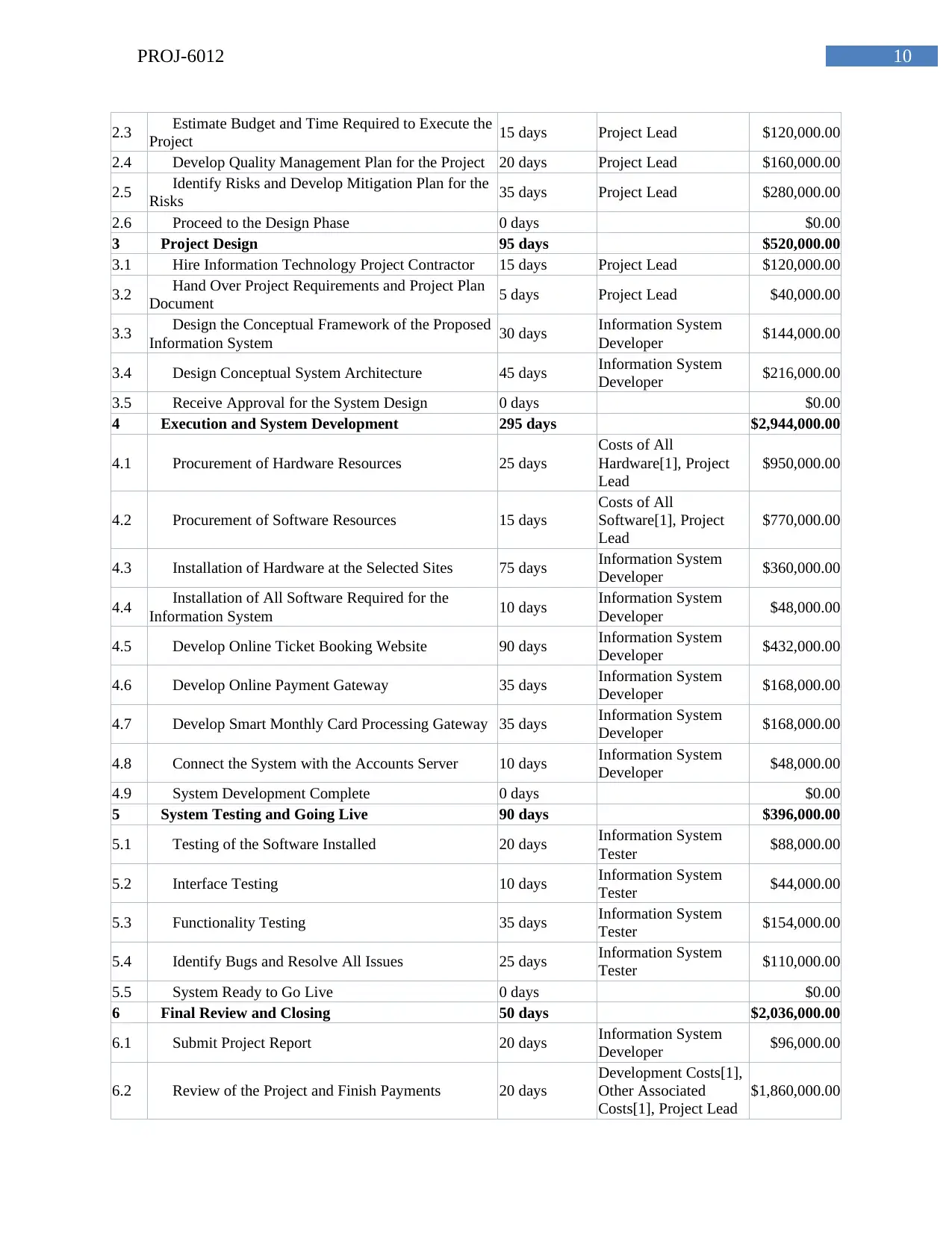
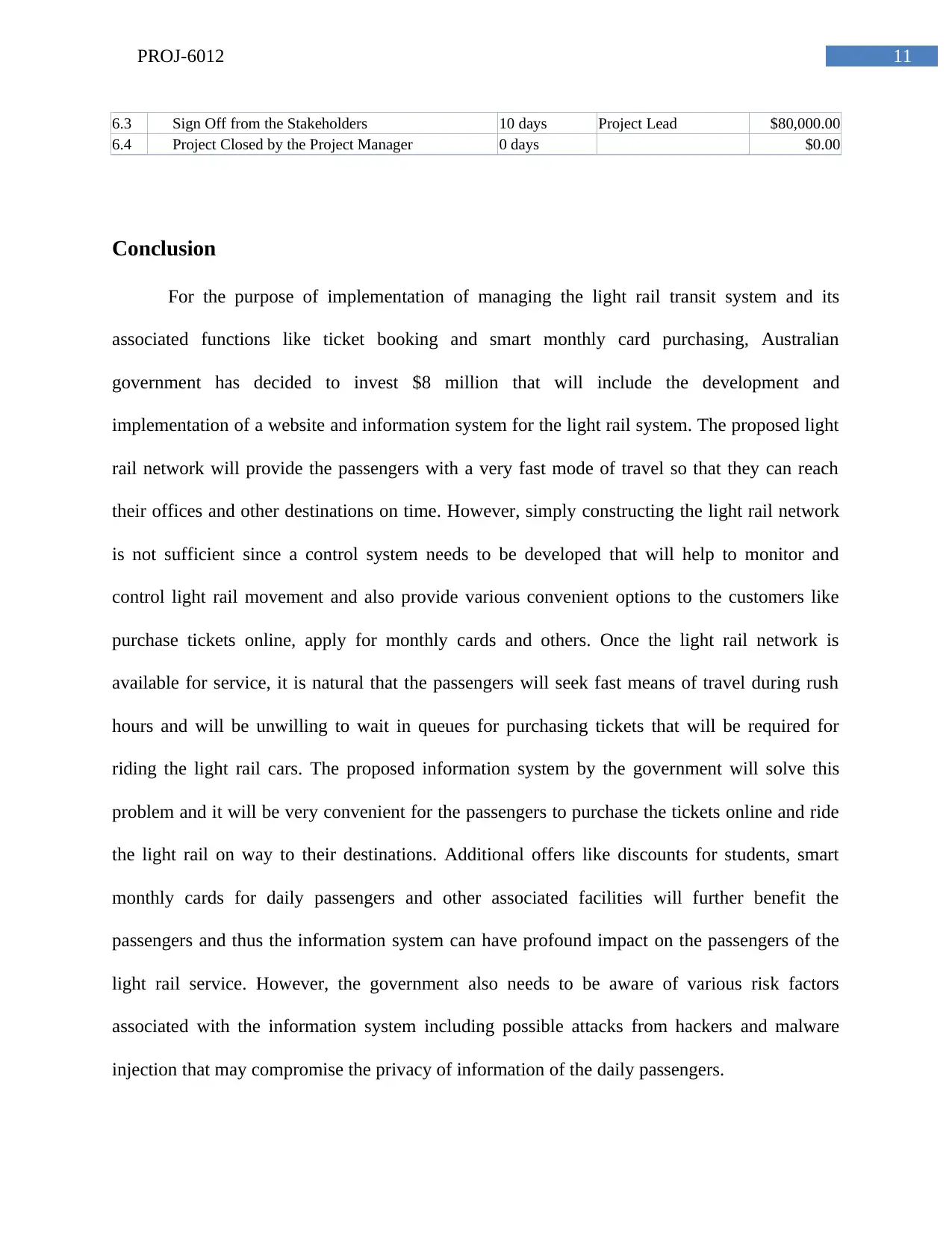
Allocating the resources in the schedule, the budget can be calculated as follows.
WBS Task Name Duration Resource Names Cost
0 Capital Metro Information System Implementation 730 days $7,496,000.00
1 Survey, Feasibility Analysis and Proposal of
Project 105 days $840,000.00
1.1 Specify the Project Requirements and Purpose 20 days Project Lead $160,000.00
1.2 Conduct Survey on the Need and Feasibility of the
Project 45 days Project Lead $360,000.00
1.3 Prepare Documentation on the Survey Results 25 days Project Lead $200,000.00
1.4 Propose Various Changes to the Original Plan 10 days Project Lead $80,000.00
1.5 Submit Final Survey Report 5 days Project Lead $40,000.00
1.6 Receive Green Light for the Project 0 days $0.00
2 Planning for the Project 95 days $760,000.00
2.1 Identify Project Scope and Limitations 15 days Project Lead $120,000.00
2.2 Determine the Project Goals and Milestones 10 days Project Lead $80,000.00
22 22
5.2 Interface Testing 10 days Tue 10-05-
22
Mon 23-05-
22 32
5.3 Functionality Testing 35 days Tue 24-05-
22
Mon 11-07-
22 33
5.4 Identify Bugs and Resolve All Issues 25 days Tue 12-07-
22
Mon 15-08-
22 34
5.5 System Ready to Go Live 0 days Mon 15-08-
22
Mon 15-08-
22 35
6 Final Review and Closing 50 days Tue 16-08-
22
Mon 24-10-
22
6.1 Submit Project Report 20 days Tue 16-08-
22
Mon 12-09-
22 36
6.2 Review of the Project and Finish Payments 20 days Tue 13-09-
22
Mon 10-10-
22 38
6.3 Sign Off from the Stakeholders 10 days Tue 11-10-
22
Mon 24-10-
22 39
6.4 Project Closed by the Project Manager 0 days Mon 24-10-
22
Mon 24-10-
22 40
Again, for the purpose of total budget estimation, the resource costs estimated are shown
as follows.
Resources Estimated Costs
Project Lead $1,000.00/hr
Information System Developer $600.00/hr
Information System Tester $550.00/hr
Costs of All Hardware $750,000.00
Costs of All Software $650,000.00
Development Costs $1,500,000.00
Other Associated Costs $200,000.00
Allocating the resources in the schedule, the budget can be calculated as follows.
WBS Task Name Duration Resource Names Cost
0 Capital Metro Information System Implementation 730 days $7,496,000.00
1 Survey, Feasibility Analysis and Proposal of
Project 105 days $840,000.00
1.1 Specify the Project Requirements and Purpose 20 days Project Lead $160,000.00
1.2 Conduct Survey on the Need and Feasibility of the
Project 45 days Project Lead $360,000.00
1.3 Prepare Documentation on the Survey Results 25 days Project Lead $200,000.00
1.4 Propose Various Changes to the Original Plan 10 days Project Lead $80,000.00
1.5 Submit Final Survey Report 5 days Project Lead $40,000.00
1.6 Receive Green Light for the Project 0 days $0.00
2 Planning for the Project 95 days $760,000.00
2.1 Identify Project Scope and Limitations 15 days Project Lead $120,000.00
2.2 Determine the Project Goals and Milestones 10 days Project Lead $80,000.00
Paraphrase This Document
Need a fresh take? Get an instant paraphrase of this document with our AI Paraphraser
10PROJ-6012
2.3 Estimate Budget and Time Required to Execute the
Project 15 days Project Lead $120,000.00
2.4 Develop Quality Management Plan for the Project 20 days Project Lead $160,000.00
2.5 Identify Risks and Develop Mitigation Plan for the
Risks 35 days Project Lead $280,000.00
2.6 Proceed to the Design Phase 0 days $0.00
3 Project Design 95 days $520,000.00
3.1 Hire Information Technology Project Contractor 15 days Project Lead $120,000.00
3.2 Hand Over Project Requirements and Project Plan
Document 5 days Project Lead $40,000.00
3.3 Design the Conceptual Framework of the Proposed
Information System 30 days Information System
Developer $144,000.00
3.4 Design Conceptual System Architecture 45 days Information System
Developer $216,000.00
3.5 Receive Approval for the System Design 0 days $0.00
4 Execution and System Development 295 days $2,944,000.00
4.1 Procurement of Hardware Resources 25 days
Costs of All
Hardware[1], Project
Lead
$950,000.00
4.2 Procurement of Software Resources 15 days
Costs of All
Software[1], Project
Lead
$770,000.00
4.3 Installation of Hardware at the Selected Sites 75 days Information System
Developer $360,000.00
4.4 Installation of All Software Required for the
Information System 10 days Information System
Developer $48,000.00
4.5 Develop Online Ticket Booking Website 90 days Information System
Developer $432,000.00
4.6 Develop Online Payment Gateway 35 days Information System
Developer $168,000.00
4.7 Develop Smart Monthly Card Processing Gateway 35 days Information System
Developer $168,000.00
4.8 Connect the System with the Accounts Server 10 days Information System
Developer $48,000.00
4.9 System Development Complete 0 days $0.00
5 System Testing and Going Live 90 days $396,000.00
5.1 Testing of the Software Installed 20 days Information System
Tester $88,000.00
5.2 Interface Testing 10 days Information System
Tester $44,000.00
5.3 Functionality Testing 35 days Information System
Tester $154,000.00
5.4 Identify Bugs and Resolve All Issues 25 days Information System
Tester $110,000.00
5.5 System Ready to Go Live 0 days $0.00
6 Final Review and Closing 50 days $2,036,000.00
6.1 Submit Project Report 20 days Information System
Developer $96,000.00
6.2 Review of the Project and Finish Payments 20 days
Development Costs[1],
Other Associated
Costs[1], Project Lead
$1,860,000.00
2.3 Estimate Budget and Time Required to Execute the
Project 15 days Project Lead $120,000.00
2.4 Develop Quality Management Plan for the Project 20 days Project Lead $160,000.00
2.5 Identify Risks and Develop Mitigation Plan for the
Risks 35 days Project Lead $280,000.00
2.6 Proceed to the Design Phase 0 days $0.00
3 Project Design 95 days $520,000.00
3.1 Hire Information Technology Project Contractor 15 days Project Lead $120,000.00
3.2 Hand Over Project Requirements and Project Plan
Document 5 days Project Lead $40,000.00
3.3 Design the Conceptual Framework of the Proposed
Information System 30 days Information System
Developer $144,000.00
3.4 Design Conceptual System Architecture 45 days Information System
Developer $216,000.00
3.5 Receive Approval for the System Design 0 days $0.00
4 Execution and System Development 295 days $2,944,000.00
4.1 Procurement of Hardware Resources 25 days
Costs of All
Hardware[1], Project
Lead
$950,000.00
4.2 Procurement of Software Resources 15 days
Costs of All
Software[1], Project
Lead
$770,000.00
4.3 Installation of Hardware at the Selected Sites 75 days Information System
Developer $360,000.00
4.4 Installation of All Software Required for the
Information System 10 days Information System
Developer $48,000.00
4.5 Develop Online Ticket Booking Website 90 days Information System
Developer $432,000.00
4.6 Develop Online Payment Gateway 35 days Information System
Developer $168,000.00
4.7 Develop Smart Monthly Card Processing Gateway 35 days Information System
Developer $168,000.00
4.8 Connect the System with the Accounts Server 10 days Information System
Developer $48,000.00
4.9 System Development Complete 0 days $0.00
5 System Testing and Going Live 90 days $396,000.00
5.1 Testing of the Software Installed 20 days Information System
Tester $88,000.00
5.2 Interface Testing 10 days Information System
Tester $44,000.00
5.3 Functionality Testing 35 days Information System
Tester $154,000.00
5.4 Identify Bugs and Resolve All Issues 25 days Information System
Tester $110,000.00
5.5 System Ready to Go Live 0 days $0.00
6 Final Review and Closing 50 days $2,036,000.00
6.1 Submit Project Report 20 days Information System
Developer $96,000.00
6.2 Review of the Project and Finish Payments 20 days
Development Costs[1],
Other Associated
Costs[1], Project Lead
$1,860,000.00
11PROJ-6012
6.3 Sign Off from the Stakeholders 10 days Project Lead $80,000.00
6.4 Project Closed by the Project Manager 0 days $0.00
Conclusion
For the purpose of implementation of managing the light rail transit system and its
associated functions like ticket booking and smart monthly card purchasing, Australian
government has decided to invest $8 million that will include the development and
implementation of a website and information system for the light rail system. The proposed light
rail network will provide the passengers with a very fast mode of travel so that they can reach
their offices and other destinations on time. However, simply constructing the light rail network
is not sufficient since a control system needs to be developed that will help to monitor and
control light rail movement and also provide various convenient options to the customers like
purchase tickets online, apply for monthly cards and others. Once the light rail network is
available for service, it is natural that the passengers will seek fast means of travel during rush
hours and will be unwilling to wait in queues for purchasing tickets that will be required for
riding the light rail cars. The proposed information system by the government will solve this
problem and it will be very convenient for the passengers to purchase the tickets online and ride
the light rail on way to their destinations. Additional offers like discounts for students, smart
monthly cards for daily passengers and other associated facilities will further benefit the
passengers and thus the information system can have profound impact on the passengers of the
light rail service. However, the government also needs to be aware of various risk factors
associated with the information system including possible attacks from hackers and malware
injection that may compromise the privacy of information of the daily passengers.
6.3 Sign Off from the Stakeholders 10 days Project Lead $80,000.00
6.4 Project Closed by the Project Manager 0 days $0.00
Conclusion
For the purpose of implementation of managing the light rail transit system and its
associated functions like ticket booking and smart monthly card purchasing, Australian
government has decided to invest $8 million that will include the development and
implementation of a website and information system for the light rail system. The proposed light
rail network will provide the passengers with a very fast mode of travel so that they can reach
their offices and other destinations on time. However, simply constructing the light rail network
is not sufficient since a control system needs to be developed that will help to monitor and
control light rail movement and also provide various convenient options to the customers like
purchase tickets online, apply for monthly cards and others. Once the light rail network is
available for service, it is natural that the passengers will seek fast means of travel during rush
hours and will be unwilling to wait in queues for purchasing tickets that will be required for
riding the light rail cars. The proposed information system by the government will solve this
problem and it will be very convenient for the passengers to purchase the tickets online and ride
the light rail on way to their destinations. Additional offers like discounts for students, smart
monthly cards for daily passengers and other associated facilities will further benefit the
passengers and thus the information system can have profound impact on the passengers of the
light rail service. However, the government also needs to be aware of various risk factors
associated with the information system including possible attacks from hackers and malware
injection that may compromise the privacy of information of the daily passengers.
⊘ This is a preview!⊘
Do you want full access?
Subscribe today to unlock all pages.
Trusted by 1+ million students worldwide

1 out of 15


Related Documents


Your All-in-One AI-Powered Toolkit for Academic Success.
+13062052269
info@desklib.com
Available 24*7 on WhatsApp / Email
![[object Object]](/_next/static/media/star-bottom.7253800d.svg)
Unlock your academic potential
Copyright © 2020–2026 A2Z Services. All Rights Reserved. Developed and managed by ZUCOL.